83 Jean St, Grange QLD 4051
Mon-Fri 07:30 AM - 04:00 PM - Sat - 8:00 - 12 - Sunday Closed
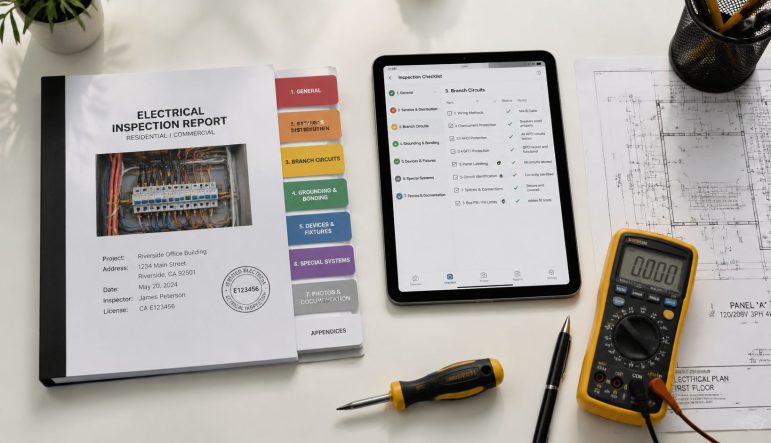
Most property owners assume an electrical inspection report proves the property is compliant. It doesn't. A report is evidence of what a licensed electrician inspected and tested at a particular time, not a substitute for the physical safety of the installation, the corrective work identified, or any separate obligations that apply to a rental property.
That distinction matters in Brisbane, particularly when landlords receive a tidy PDF and file it away without checking its scope. Queensland's electrical safety system includes inspections, testing, notices, licensing activity and follow-up action. In the Electrical Safety Office's Q1 2024-25 performance report, regulators recorded 641 audits, 315 response assessments, 376 improvement notices, 60 infringement notices and 36 electrical safety protection notices in the published performance report. Documentation supports compliance, but it doesn't create compliance by itself.
An electrical inspection report can be accurate and still leave a property owner non-compliant. The document records what a licensed electrician inspected and tested at a particular time. It does not confirm that every defect has been repaired, that excluded areas are safe, or that separate rental-property duties, such as smoke alarm requirements, were met.
Read the report as a decision record, not a final approval. It should identify the property and inspection boundaries, describe the equipment and circuits assessed, separate visual observations from test results, and state any access limitations. A short note saying “checked” or “no issues noted” gives you little protection during a tenancy dispute, sale, insurance question or regulatory enquiry if it omits those details.

A properly scoped report records the electrician's observations and testing. It can show that a qualified person attended the property, support maintenance records and provide a work list. It cannot show that listed defects were corrected after the visit, that inaccessible parts of the installation were safe, or that another legal obligation was included.
Before filing the report as a compliance outcome, confirm:
Rental owners should also check whether smoke alarm obligations were handled separately. An electrical inspection may identify wiring or equipment defects, but it does not automatically certify alarm placement, operation, maintenance or other duties that apply to the tenancy. Combining both tasks in one appointment can be practical, provided the electrician clearly documents each scope and supplies the records required for each obligation.
Practical rule: The report tells you what was found. Compliance requires action on unsafe findings, confirmation of completed work and records that cover every applicable obligation.
Property managers need a reliable record of report versions, repairs, access attempts and follow-up evidence. A real estate workflow can connect those records with tenancy and maintenance tasks, which is why guidance on brokerage compliance with CRM tools can be relevant to electrical defect tracking. The software organises evidence. It does not replace licensed electrical work, smoke alarm checks or required regulatory processes.
A periodic verification under AS/NZS 3019 goes beyond confirming that fittings operate. It evaluates whether an existing low-voltage electrical installation remains safe for continued use. Standards Australia and Standards New Zealand apply the standard to installations connected to a low-voltage a.c. supply system exceeding 50 V a.c. and not exceeding 1000 V a.c. in the standard overview. The assessment uses inspection and, where appropriate, testing.
The report should connect technical findings with the legal duties that apply to the property. The electrician considers whether the installation aligns with relevant requirements at the time of construction, whether deterioration has affected safety, and whether defects create a risk of electric shock or fire. Receiving this report does not, by itself, make a rental property compliant. Repairs, verification and records may still be required.

A report based on periodic verification should answer five practical questions:
Queensland's electrical safety regime operates alongside the technical standard. Regulatory activity includes audits, contractor audits, response assessments and enforcement notices. The regulator's Q1 2024-25 performance report recorded 121 electrical contractor audits, 19 new test reports received, four serious electrical incidents and 21 licensing referrals in the regulator's published figures.
A licensed electrician should prepare the report because the work requires professional judgement, safe testing practices and interpretation of electrical conditions. A generic property checklist completed without the required electrical qualifications does not provide the same assessment as periodic verification under the relevant standard.
Smoke alarm duties remain a separate compliance question for rental properties. An electrical report may identify wiring or equipment defects, but it does not automatically confirm alarm placement, operation or maintenance. If one appointment covers both tasks, the report and supporting records should identify each scope separately.
A complete report should allow another qualified person, property manager or regulator to understand what happened at the site without guessing. Queensland WorkSafe guidance on test reports emphasises objective evidence, the inspection method, client and site details, equipment descriptions and related document or test records in its reporting requirements.
The strongest reports are specific enough to guide repairs. They don't hide behind broad statements such as “electrical system satisfactory” when the electrician has only inspected accessible areas or performed limited testing.

| Report component | What to look for | Why it matters |
|---|---|---|
| Client and site details | Owner or client, property address, inspection date and relevant contact details | Identifies the installation and creates traceability |
| Scope of inspection | Areas, circuits, fittings and equipment included or excluded | Prevents a limited inspection being mistaken for a whole-property assessment |
| Methodology | Visual inspection, test procedures, equipment used and access limitations | Shows how conclusions were reached |
| Findings and test records | Separate observations, measured results, photos and supporting documents | Distinguishes visible defects from test-based evidence |
| Corrective action | Defect description, required work, priority and completion status | Turns the report into a maintenance and compliance tool |
The equipment list deserves close attention. The Queensland Electrical Safety Act review recommended including in-scope electrical equipment and devices, partly to help demonstrate compliance and manage recalls. For a Brisbane rental property, that means the report should identify inspected circuits and relevant equipment rather than treating the house as an anonymous collection of outlets.
Look for explicit comments on RCD presence and condition, switchboard enclosure and labelling, protective devices, insulation condition, accessible outlets, fixed appliances and any signs of overheating or damage. A photo should support a finding where practical, but a photo doesn't replace the written description or test result.
The conclusion should also state limitations. If furniture blocked outlets, tenants couldn't provide access, a subfloor wasn't entered or equipment couldn't be safely isolated, those facts belong in the report. A transparent limitation is useful. A vague conclusion that conceals the limitation isn't.
A signed electrical inspection report does not, by itself, prove that a rental property meets every safety obligation. Electrical safety checks and smoke alarm compliance checks address different systems, requirements and evidence. Queensland's Electrical Safety Office provides rental electrical safety information separately through its electrical safety guidance, which reflects that distinction.
An electrical inspection assesses the installation within the agreed scope, such as wiring, switchboards, fittings, protective devices and relevant equipment. Smoke alarm compliance concerns alarm type, placement, operation, interconnection where applicable and alarm condition. One technician can perform both services during the same visit, but combining the appointments does not combine the legal tests.

For a Queensland rental property, an electrical safety check covering all electrical installations and fittings is required every 2 years, in accordance with Section 4 of AS/NZS 3019 on periodic assessment, through its electrical safety guidance. It creates a recurring compliance record, not merely a document for a purchase or handover.
Smoke alarm obligations require separate verification. “Smoke alarms tested” is too vague if the report does not identify the required alarm type, location, interconnection or replacement arrangements. The reverse also applies. A smoke alarm service report cannot establish that switchboard protection, circuit condition or electrical fittings were safe.
Before accepting a combined booking, ask the provider to confirm the scope in writing. The final records should make clear:
A landlord may receive one invoice and still need two distinct compliance records. For Queensland-specific rental duties and practical alarm guidance, review smoke alarm compliance in Queensland. The operational rule is simple: one visit can contain two services, but one generic certificate cannot satisfy two separate obligations.
A defect isn't automatically urgent because it appears in a formal report, and it isn't harmless because the property still has power. Severity depends on the condition, the likelihood of exposure, the protective measures available and whether continued use could create electric shock, fire or equipment damage.
Queensland's enforcement data provides useful context. Proactive construction inspections identified non-compliances in 59% of 224 assessments, according to the Q1 construction report published by Queensland WorkSafe. That figure doesn't tell you the risk level of a particular defect, but it does show why owners should treat findings as signals requiring competent assessment rather than dismissing them as paperwork.
| Defect category | Examples | Risk level | Recommended response |
|---|---|---|---|
| Documentation or identification | Missing circuit labels, incomplete equipment list, unclear scope | Lower immediate risk, but poor traceability | Ask for clarification and update records |
| Accessory condition | Damaged outlet, loose fitting, cracked switch plate or heat marking | Moderate to high, depending on location and use | Isolate where necessary and arrange licensed repair |
| Protective devices | Missing or defective RCD, unsafe breaker arrangement, unsuitable protection | High | Obtain prompt electrician assessment and avoid relying on the affected circuit |
| Conductors and insulation | Deteriorated insulation, exposed wiring, damaged cable | High | Stop use if unsafe, isolate the circuit where appropriate and arrange urgent remediation |
| Switchboard or moisture risk | Corrosion, water entry, damaged enclosure or unsafe protective equipment | High to immediate | Keep clear, arrange urgent assessment and address the source of moisture |
The report should explain why the finding matters. “Switchboard issue” isn't enough. A useful entry identifies the component, observed condition, safety consequence and recommended correction. It should also say whether the electrician recommends immediate isolation, prompt repair or planned maintenance.
A lower-priority item may still become urgent if water enters the switchboard, a tenant reports tingling, a breaker repeatedly trips or the defect worsens. Don't reset a tripping protective device repeatedly, remove covers or attempt a DIY repair to make a report look cleaner.
For buyers and renovators, an independent pre-purchase electrical inspection can help separate visible concerns from issues requiring deeper testing. For landlords, the best response is to record the decision, assign the repair and retain evidence of completion rather than marking the report “received”.
Remediation should follow the risk, not the order in which findings appear on the page. A cracked switch plate and unsafe switchboard protection shouldn't receive the same response just because both occupy a row in the report.
Start by asking the electrician to classify each item. Reports may use terms such as immediate danger, urgent, recommended or maintenance, but those labels only help when the electrician defines them. If the report doesn't state whether a circuit should be isolated or whether the property can remain occupied, request clarification in writing.
Common work may include replacing damaged accessories, repairing wiring, fitting or replacing RCD protection, correcting switchboard arrangements, upgrading an unsafe switchboard or replacing smoke alarms. The right solution depends on the installation and the defect. A cheap component replacement may be unsuitable if the underlying issue is deteriorated insulation, water entry or inadequate protection.
Repair standard: The job isn't finished when the new part is installed. It's finished when the electrician has tested the result and supplied records that show what changed.
Ask about disruption before work begins. Switchboard work can affect the whole property, while a local accessory repair may be limited to one circuit. Occupied rentals need proper tenant communication, safe access and a plan for restoring essential services. Don't promise a tenant that work will be completed within a particular period until the electrician has assessed the site and confirmed availability.
Receiving a PDF does not prove that required electrical work has been lodged or accepted by a regulator. An inspection report, completion certificate and portal submission are separate records, and each serves a different purpose. Rental owners should check the compliance status rather than file every document under “completed”.
NSW demonstrates the change toward digital lodgement. Building Commission NSW states that all Certificates of Compliance for Electrical Work must be submitted through the eCert portal from 1 July 2026. Handwritten and PDF forms will no longer be accepted, including certificates for solar and battery installations under the eCert requirements. This requirement does not automatically apply to Queensland work, but it gives owners a practical question to ask: was the document issued, lodged, accepted, or only emailed?
The answer depends on the state, the type of work and the applicable process. Before closing the job file, confirm:
Digital records reduce misplaced paperwork, but an uploaded file is not automatically accepted compliance. If the electrician has not completed a required submission, ask for the status and the corrective action. Do not alter a certificate yourself or rely on an unidentified screenshot.
For Queensland work, keep the inspection report with the relevant electrical certificate of compliance. The report records the inspection findings. The certificate records completed electrical work where certification is required. Keeping both helps a property manager show what was found, what was repaired and whether the required lodgement was completed.
For rental properties in Queensland, ongoing compliance depends on a disciplined schedule and clear records. An electrical safety check belongs in the same property file as smoke alarm records, repair documents, access notes and tenancy information. These obligations are related, but they are not interchangeable. A completed electrical report does not prove that smoke alarm requirements have been met.
For Queensland rentals, arrange assessment of all electrical installations and fittings every 2 years under the AS/NZS 3019 periodic assessment requirement, as noted earlier. Record the date the inspection was completed, rather than relying on the invoice date.
A practical register should contain:
Review the report when a tenant moves in, after renovation work, following repeated electrical complaints and before a property changes hands. New equipment can alter the risk profile. A report prepared before renovation may not describe the finished installation, so arrange another assessment where the work changes the electrical system.
Give tenants clear notice and practical instructions. State when access is required, which areas must be clear and what to do about burning smells, shocks, damaged fittings or repeated tripping. Record failed access attempts, rescheduled visits and any restrictions. A compliance date should never disappear into an email chain.
Keep smoke alarm tasks on their own schedule, with their own evidence and follow-up. If a defect remains open, assign a responsible person and a due action. “Landlord notified” records communication, not completion. A register that tracks both the electrical finding and the completed repair shows whether the property has returned to compliance.
A report describes the installation on the inspection date. Later damage, alterations, water entry, tenant complaints or new equipment can change the risk. For a Queensland rental property, treat the report as evidence for the relevant compliance process, not as permanent clearance. Urgent defects require action when found.
The answer depends on the tenancy arrangement, the property manager's records and the report's purpose. Tenants should make requests in writing, especially where they have reported a shock, burning smell, damaged fitting or repeated tripping. Whatever document is provided, the owner or manager remains responsible for responding to safety findings and retaining suitable records.
Give another licensed electrician the report, photographs, invoices and test records. The new electrician should inspect the present condition and verify completed work rather than signing off repairs they did not perform. Request a fresh report or completion record stating the scope, tests, findings and any remaining defects.
Ask for the dated report, inspection scope, test results, defect list and evidence of completed repairs. A seller's statement that the property was recently checked does not establish what was tested or whether defects were corrected. If the records are incomplete, arrange an independent inspection before purchase or renovation planning.
Usually, no. An inspection report records an assessment. A certificate may relate to completed electrical work and a prescribed certification process. Smoke alarm records address a separate obligation, so identify what each document proves before treating the property as compliant.
For Queensland rental work, confirm whether the required electrical safety paperwork has been completed and lodged through the applicable process, rather than assuming an inspection report is the lodgement record. Keep the inspection report, repair evidence and any prescribed form together so the compliance trail can be checked later.
DLG Electrical provides Brisbane electrical safety inspections, testing, defect identification and compliance documentation for homeowners, landlords, property managers and renovators. If findings or outstanding repairs are unclear, visit DLG Electrical to discuss the inspection scope and practical next steps.

Master Electrician with over 30 years of experience. Founded DLG Electrical in 2005 after international project work including electrical installations at Stamford Bridge Stadium, London(Home of Chelsea FC).

Local Electricians that can fix all Electric Hot water Systems.
Motion sensor lights are a versatile addition to any home, offering nu
