83 Jean St, Grange QLD 4051
Mon-Fri 07:30 AM - 04:00 PM - Sat - 8:00 - 12 - Sunday Closed
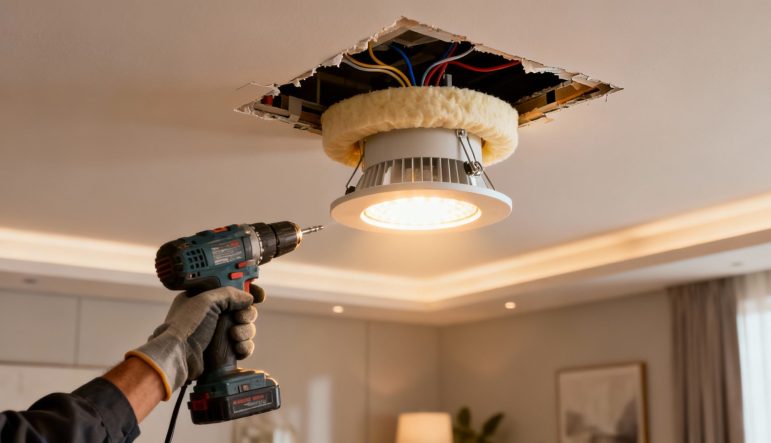
When you glance up at your ceiling, you probably just see a light. But what if that simple fixture was also a fire gate, designed to automatically seal off a room the moment disaster strikes? That’s exactly what a fire rated downlight does—it’s engineered to stop fire from tearing through ceiling cavities and spreading to other parts of your home.
Picture a standard downlight. To install it, you have to cut a hole in your ceiling, which instantly compromises its ability to act as a fire barrier. It’s like leaving a window wide open for fire to climb through. A fire rated downlight, on the other hand, acts like an automatic, fireproof shutter for that window, restoring your ceiling’s original fire integrity.
This isn’t some optional extra; it’s a non-negotiable safety feature. If a fire breaks out, these specialised lights are designed to swell up when exposed to heat, blocking flames and smoke from rushing into the roof space or the room above. Those precious extra minutes of containment could be the difference between a minor incident and a total loss, giving your family critical time to get out safely.
The critical importance of these lights is written into Australia’s building codes. Following major updates in 2019, the National Construction Code (NCC) now mandates fire-rated fixtures in most new builds and major renovations, particularly for residential and commercial buildings with multiple levels.
These downlights are built to maintain the ceiling’s fire integrity for 60 to 120 minutes—a vital timeframe in the multi-story homes and apartment blocks common across Brisbane. If you’d like to dig deeper into the specifics, you can explore more about these fire safety regulations and market trends for a global perspective on downlight forecasts.
In short, choosing fire rated downlights gives you three key advantages:
At the end of the day, installing fire rated downlights is about so much more than just lighting a room. It’s a fundamental investment in the safety of your property and the people you care about—a cornerstone of modern electrical safety that should never be overlooked.
It might seem far-fetched that a small light fixture could actually hold back a raging fire, but the science behind fire rated downlights is brilliantly simple and incredibly effective. The secret weapon is a specialised material called intumescent.
Think of it as a highly advanced safety airbag built right into the downlight’s casing. Under normal, everyday conditions, this material is completely inactive. But when it’s exposed to the intense heat of a fire—usually kicking in around 150°C—it triggers a rapid chemical reaction and expands like crazy, often swelling up to 50 times its original size.
This powerful expansion creates a dense, fire-resistant charcoal plug that completely seals the hole cut into your ceiling for the light. By blocking this gap, it instantly restores the ceiling’s original fire barrier, effectively trapping the fire and smoke in the room where it started. This stops it from racing into your roof space or spreading to the floor above.
This whole process is what the building codes are talking about when they mention maintaining a ceiling’s ‘fire integrity’. A standard, non-rated downlight leaves a permanent hole in your ceiling. In a fire, this hole acts like a chimney, actively sucking flames and hot gases upwards and accelerating the fire’s spread.
A fire rated downlight does the exact opposite—it actively plugs the gap.
The diagram below really brings home how these lights are more than just a single component; they’re a complete safety system designed for protection, compliance, and your family’s wellbeing.
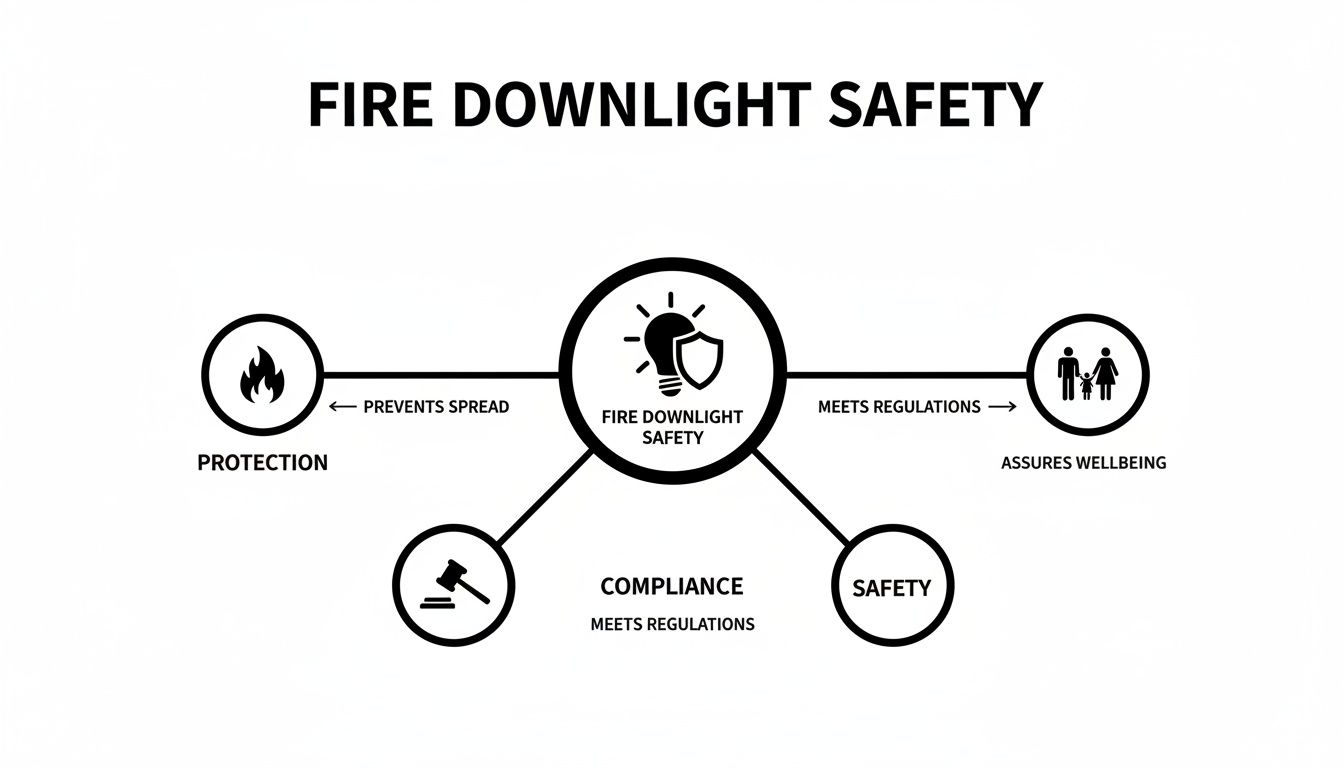
As you can see, it’s not just about stopping flames. It’s about a comprehensive approach to home safety that addresses multiple critical areas at once.
You’ll often see fire rated downlights advertised with specific times, like ’60-minute’ or ’90-minute’ ratings. These aren’t just marketing terms; they’re official certifications earned through gruelling tests under Australian Standard AS 1530.4.
A 90-minute fire rating means the downlight has been tested and proven to maintain the ceiling’s fire barrier for at least 90 minutes under intense, real-world fire conditions. This provides precious, life-saving time for everyone to evacuate safely and for emergency services to arrive and take control.
This rating system makes it straightforward to match your downlights to the fire resistance level required for your home. For instance, a two-storey house in Brisbane will have stricter requirements than a single-storey home, because the ceiling of the ground floor is also the floor for the level above.
Choosing the right rating ensures your entire home’s structure works together as a unified safety system, giving you and your family the best possible protection when every single second counts.
Navigating Australian building codes can sometimes feel like you’re wading through mud. But when it comes to fire safety, the rules are actually refreshingly clear—and they’re all designed to protect people and property. In Queensland, the National Construction Code (NCC) is the authority that dictates when and where fire rated downlights are a non-negotiable part of a build or renovation.
The basic principle is this: if you cut a hole in a ceiling that’s designed to be a fire barrier, you have to restore that barrier’s integrity. A standard downlight is just an open door for fire and smoke, but a fire rated one is designed to automatically seal that gap, containing a blaze and buying everyone precious, life-saving time.
The rules are most strict for buildings where a fire could easily jump from one self-contained area to another. This is especially relevant in Brisbane’s booming multi-residential and multi-storey home market.
You are legally required to install fire rated downlights in these situations:
Essentially, if a ceiling separates two distinct living zones or floors, it needs to be protected. The recent construction and renovation wave across Queensland has massively increased the need for compliant electrical work. In Brisbane alone, residential projects saw a 25% increase in electrical upgrades between 2020 and 2025, where fire rated downlights are crucial for meeting Australian Standard AS 5637.1. You can read more about how Australia’s emergency lighting market is evolving.
Meeting these rules isn’t just about the lights themselves; it’s about creating a complete fire safety system. These lights work hand-in-hand with other mandatory safety measures, which you can learn more about in our guide on the current smoke alarm legislation in Queensland.
Think of it this way: smoke alarms are your early warning system, shouting that there’s a problem. Fire rated downlights are your passive defence system, silently and automatically working to slow the fire down, whether you’re home or not.
By understanding your obligations under Queensland law, you’re doing more than just ticking a box for a building inspector. You’re making a genuine, life-saving investment that strengthens your home’s structural integrity and adds a critical layer of defence against the unthinkable.
Picking the right fire-rated downlights for your home goes way beyond just finding a style you like. It’s really about matching the light’s safety features to your specific ceiling and insulation. With so many different ratings and types out there, making an informed choice is the only way to ensure your home is both safe and compliant.
A good place to start is the fire rating itself, which you’ll see listed in minutes, like 60 or 90 minutes. This number tells you exactly how long the downlight can hold back a fire and maintain the integrity of your ceiling. For most two-storey homes here in Brisbane, a 90-minute rating is the standard, giving you solid protection by stopping fire from ripping through to the floor above.
Next, you absolutely have to consider if the downlight is compatible with your ceiling insulation. This is where the Insulation Contact (IC) rating comes into play, and it’s a big deal.
An IC rating is a safety mark that tells you a downlight can be completely covered with insulation without overheating and becoming a fire hazard. In Australia, the rating you want to see is IC-4 or its more recent equivalent, IC-F.
An IC-4 or IC-F rated downlight is specifically designed to be buried in building insulation. In modern, energy-efficient homes where insulation is packed in tight, this is non-negotiable. Installing a non-IC rated light and letting insulation cover it is a serious fire risk waiting to happen.
Always look for this rating before you buy, especially if your roof space is insulated. It’s your guarantee that the fitting is built to handle heat properly, even when it’s completely smothered.
The switch to LED technology has been a complete game-changer for fire-rated downlights. The rise of integrated LEDs has transformed lighting in Australia, with over 65% of new installations now using this tech. Old halogen globes were notorious power hogs, but modern LEDs are incredibly efficient and last for ages.
Think about it: a traditional halogen can chew through 5–10 times more power and will only give you about 2,000 hours of life. A quality LED equivalent, on the other hand, can run for 25,000 to 50,000 hours. For Brisbane households, where lighting can make up 10% of the power bill, that switch adds up to real savings.
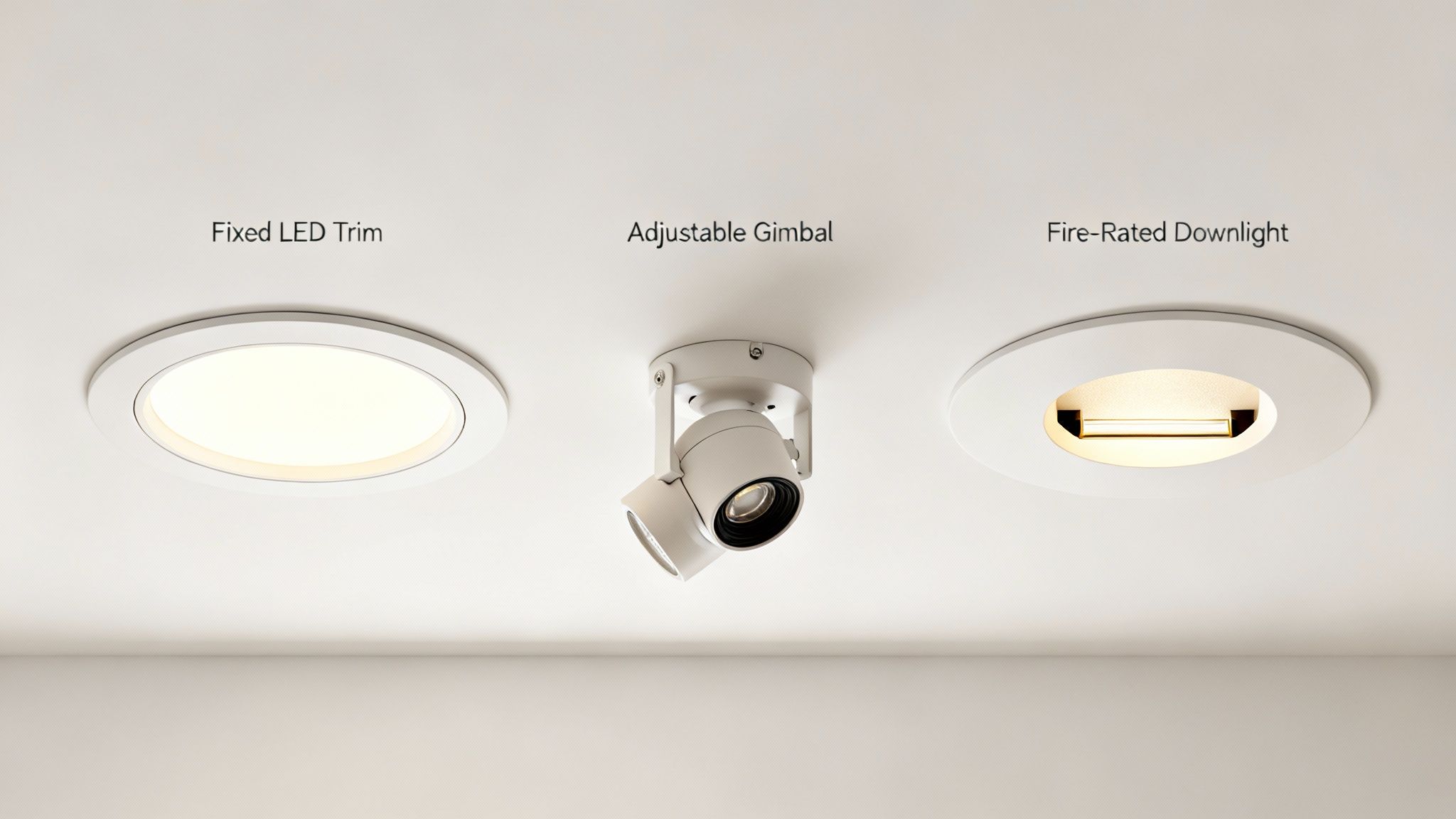
Finally, think about what you actually need the lights to do. Your choice will usually boil down to two main types of fire-rated downlights:
For most homes, a smart mix of both types delivers the best result. Use fixed lights for overall ambient light and bring in gimble lights to highlight the things you love. If you’re after more ideas, check out our guide to LED downlights. By thinking through these key factors, you can choose fire-rated downlights that strike the perfect balance between safety, efficiency, and style for your home.
When you start planning an electrical upgrade, it’s easy to get fixated on the price tag of the lights themselves. While the cost per downlight is definitely part of the picture, the real investment includes professional installation—and for very good reason. This isn’t just about sticking some new lights in the ceiling; it’s a critical safety upgrade that absolutely needs a licensed expert.
The total cost is always a mix of the hardware and the labour from a qualified Brisbane electrician. Trying to DIY this kind of job to save a few quid is a classic false economy. It’s not just that dodgy wiring creates immediate fire and shock hazards; it can also completely void your home insurance, leaving you high and dry if something goes wrong.
Retrofitting your home means pulling out old, power-hungry, and non-compliant lights and replacing them with modern, safe alternatives. Yes, there’s an upfront expense to doing this properly, but it’s much smarter to see it as a long-term investment in your property’s safety and your family’s wellbeing.
Think about the ongoing financial perks that start chipping away at that initial cost from day one:
When you weigh the initial spend against the massive benefits of improved safety, legal compliance, and ongoing energy savings, the true value really shines through. It’s an investment that genuinely pays for itself over time.
At the end of the day, upgrading to professionally installed fire rated downlights is one of the smartest moves you can make as a homeowner. It protects your house from fire, brings it up to current Australian Standards, and actively puts money back in your pocket by lowering your running costs.
Some weekend projects are perfect for a bit of DIY, but installing fire-rated downlights is absolutely not one of them. While you can find plenty of guides online on how to install recessed lighting, the specific requirements for fire-rated models mean this is a job strictly for a licensed professional. Every single time.
Attempting this yourself isn’t just risky—it’s dangerous. Incorrect wiring is an immediate fire hazard and creates a very real danger of electric shock. Even worse, an improper installation completely undermines the whole point of the downlight. It fails to restore the ceiling’s fire barrier, leaving your home and family vulnerable.
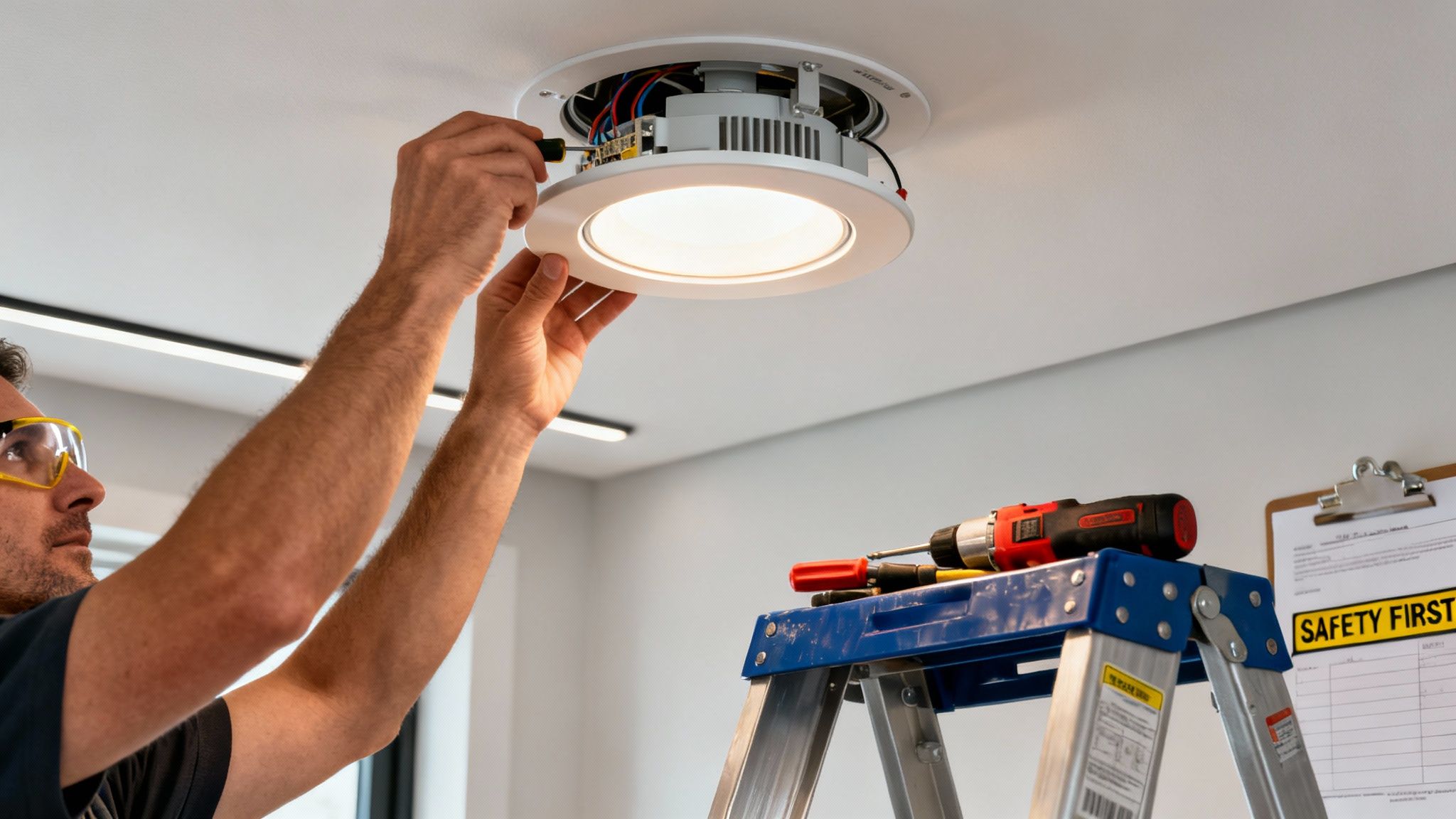
Hiring a licensed electrician isn’t just about getting the job done; it’s about securing guaranteed safety and compliance. A professional has the expertise to navigate complex wiring, local building codes, and the critical fire safety standards that keep you protected.
A licensed electrician doesn’t just install a light; they certify that the work is safe, compliant with Queensland regulations, and won’t compromise your home’s structural integrity or your insurance policy. This is the only way to ensure total protection.
When you hire a professional, you get essential guarantees that are simply impossible to achieve with a DIY job. These include:
Ultimately, professional installation is the only way to ensure your fire-rated downlights perform as designed when you need them most. If you’re looking for a trusted expert, finding a reliable Brisbane electrician is the most critical step in protecting your home and family.
Of course. Here is the rewritten section, crafted to sound like an experienced human expert and match the provided blog post examples.
Even after getting your head around the basics, it’s completely normal to have a few more questions rattling around. Getting clear, practical answers is the key to feeling confident about the lighting choices you make for your home’s safety. Let’s run through some of the most common queries we hear from Brisbane homeowners.
This is a great question and one that comes up a lot. In the past, the only way to make a standard downlight fire-safe was to install a big, clumsy “fire hood” or “can” over it in the ceiling space. These were basically a retrofitted solution to a problem.
Thankfully, technology has moved on. Modern fire rated downlights are designed as a complete, all-in-one unit. They have the fire protection—that clever intumescent seal—built right in.
So, for any properly certified fire rated downlight, you absolutely do not need an external fire hood. It’s designed to do the job on its own, which makes for a much cleaner, faster, and more reliable installation. Fire hoods are now mostly a thing of the past, only used for older, non-rated fittings.
Yes, it can, and honestly, this is the combination you should be looking for in any modern home. A downlight that is both fire rated and IC rated (look for markings like IC-4 or IC-F) is the gold standard for safety and performance.
It’s a two-for-one deal on peace of mind:
Having this dual certification means you’re getting the best fire protection without sacrificing your home’s energy efficiency by creating gaps in your insulation. It’s the perfect setup for any insulated ceiling, especially in multi-storey homes.
A lot of people get this confused, but fire rating and insulation contact (IC) rating are not the same thing. They address two completely different risks. One is about containing a fire that has already started, while the other is about preventing the light itself from starting one.
Fire ratings are given in minutes—you’ll typically see 60 or 90 minutes—and this number tells you how long the downlight held up under intense, simulated fire conditions in a testing lab.
A 90-minute rating means the fixture successfully maintained the integrity of the fire barrier for at least that long. It doesn’t mean the light will keep working, but it will keep the hole sealed, preventing flames and smoke from ripping through to the floor above. This provides a critical window of time for everyone to evacuate safely and for emergency services to arrive.
The rating you need is dictated by your home’s construction and local building codes. For most residential homes in Queensland with a standard timber joist ceiling, a 90-minute rating is the recommended standard.
Choosing the right downlights is one of the most important safety decisions you’ll make for your home. For expert advice and professional installation of fire rated downlights in Brisbane, trust the licensed team at DLG Electrical. We’ll make sure your home is safe, compliant, and beautifully lit.
Visit dlgelectrical.com.au to get your free quote today.

Master Electrician with over 30 years of experience. Founded DLG Electrical in 2005 after international project work including electrical installations at Stamford Bridge Stadium, London(Home of Chelsea FC).

Local Electricians that can fix all Electric Hot water Systems.
Motion sensor lights are a versatile addition to any home, offering nu

The NCC requires both an FRL.& RISF60 fire rating
An FRL alone is non compliant in Auatralia
The ceiling cavity is important to protect
Fire rated ceilings require BOTH an FRL and an RISF rating
Fire rated downlights do NOT achieve this sadly at present and DO NOT comply with the NCC fpr use in fire rated ceilings