83 Jean St, Grange QLD 4051
Mon-Fri 07:30 AM - 04:00 PM - Sat - 8:00 - 12 - Sunday Closed
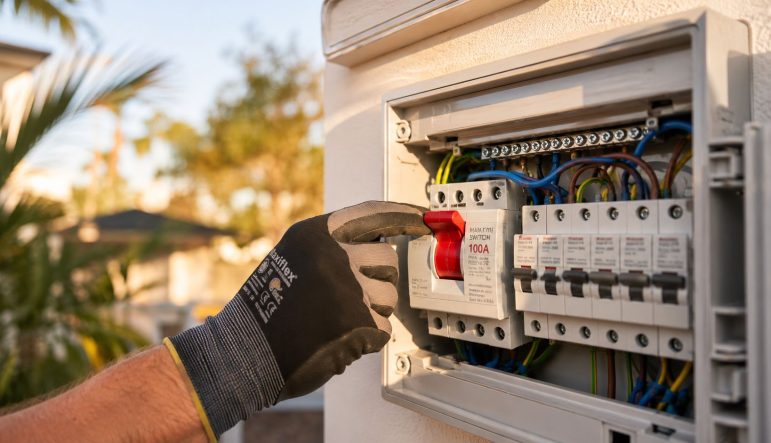
A Brisbane summer afternoon is a good time to discover that you don't really know your switchboard. The air-conditioner stops, the fridge goes quiet, and a quick look outside reveals a metal box filled with switches that all seem to have a different job. Before you reset anything, you need to know which device controls one circuit, which protects against electrical faults, and which one can isolate the whole home.
That device is the main switch. It sits at the centre of the main switch electrical arrangement, connecting the incoming supply to the circuits that power your lights, sockets, hot water, oven and air-conditioning. It isn't just another switch on the panel. It's the house's emergency stop.
The first instinct is usually to walk straight to the meter box. In many Brisbane homes, you'll find it outside, often near the meter on an external wall, including a south or east-facing wall, or beside the garage. Open the outer metal door and you may see the meter, a row of labelled or poorly labelled switches, safety switches with test buttons, older ceramic fuses, or a mixture of old and newer equipment.
Don't start by flicking every switch. Stand back and look for a device labelled main switch. Queensland Electrical Safety Office guidance states that a home switchboard must have a switch labelled “main switch” that can turn off all power and lighting circuits in the dwelling. That makes it the single point of isolation for the installation, not merely the first device in the row. Queensland Government electrical safety guidance explains the household role of this control.
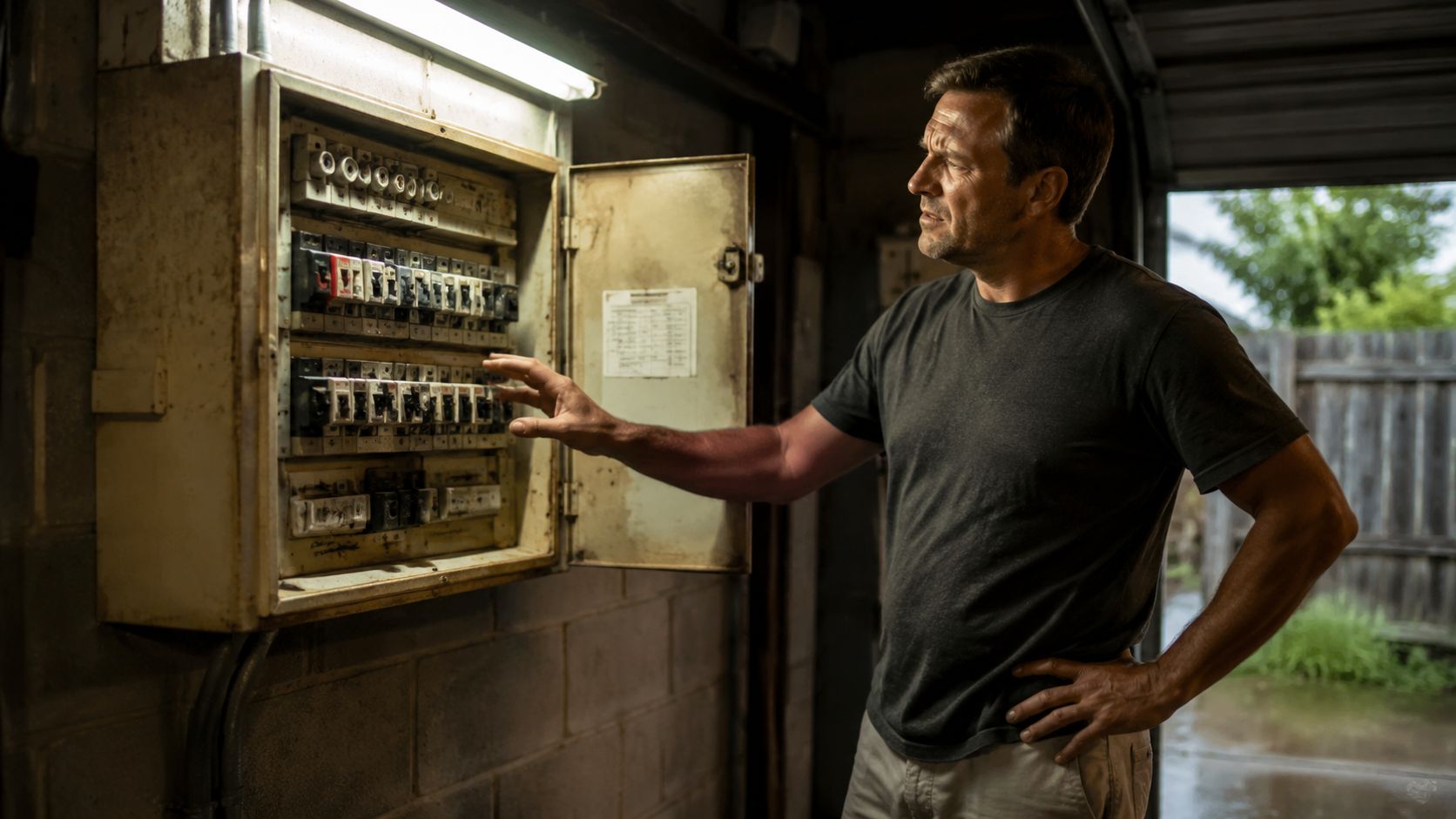
A main switch normally controls the entire installation. A circuit breaker generally controls a particular circuit, such as power points or lights. A safety switch, also called an RCD, is designed to respond to leakage that could place a person at risk. The devices can sit close together, and their handles may look similar, which is why homeowners often choose the wrong one during a fault.
If the switchboard is clearly labelled and there's no smell, heat, visible damage or water entry, you may be able to identify a tripped protective device and follow the electrician's or manufacturer's reset instructions. If the main switch won't stay on, a breaker keeps tripping, or anything looks damaged, stop there and call a licensed electrician.
Emergency habit: Know where the main switch is before you need it. During a fault or urgent maintenance, finding the correct isolator matters more than knowing the names of every component.
The rest of the panel can wait. Your immediate decision is simple: identify, reset only when it's plainly safe, or isolate and get help.
Think of electricity entering your home like water flowing through a managed supply system. The street supply is the river. The meter records what enters the property. The main switch is the large dam gate that can stop the flow to the whole installation. After that gate, smaller irrigation gates distribute supply to individual circuits.
The practical path looks like this:
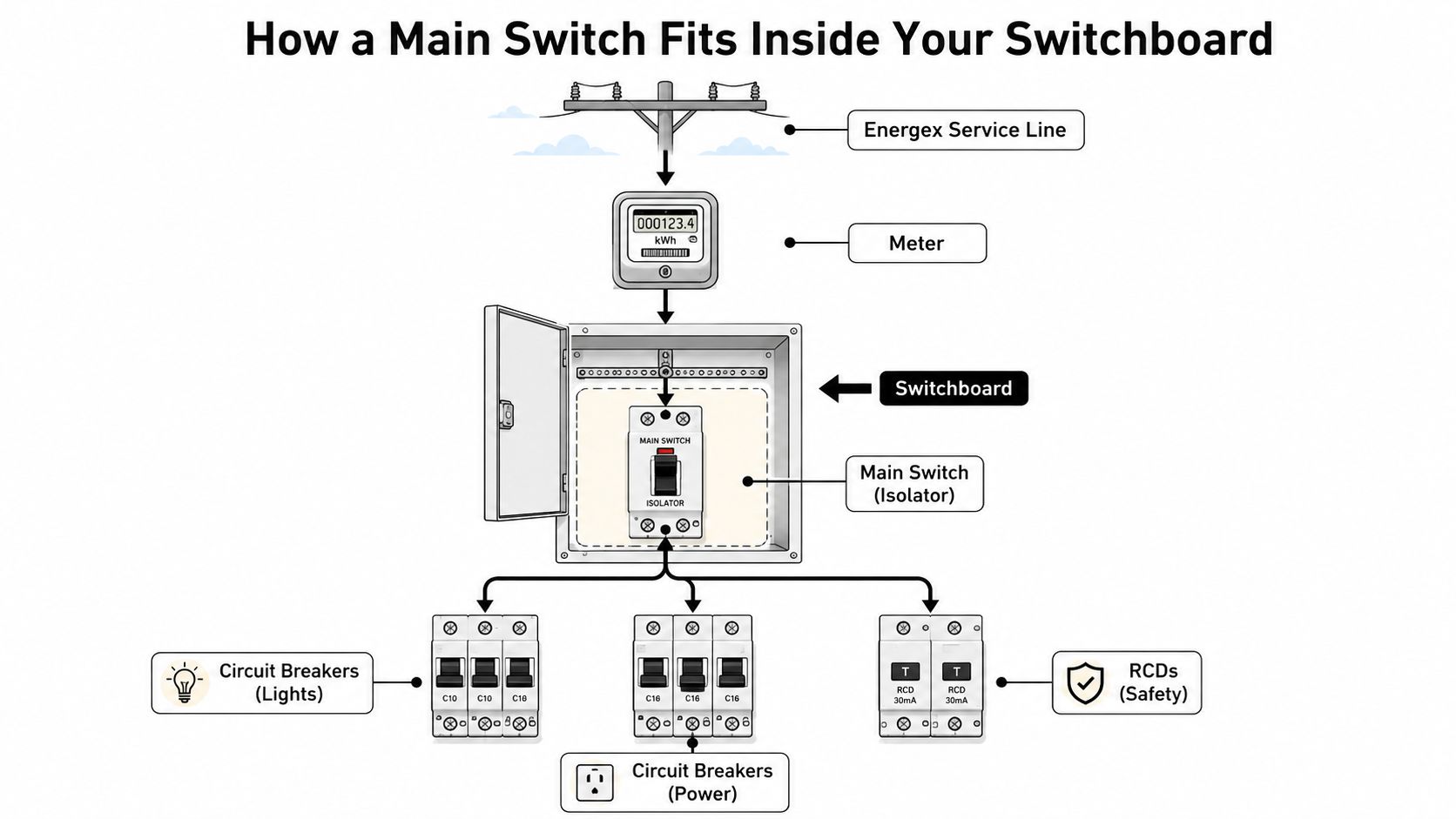
The main switch sits ahead of the sub-circuits because it must provide a practical way to disconnect the installation as a whole. Queensland guidance says the switchboard must have a switch labelled “main switch” that turns off all power and lighting circuits. Queensland Government's home electricity information also places that requirement within the wider connection and electrical-safety framework.
A circuit breaker downstream may disconnect the oven circuit while leaving the bedrooms, garage and outdoor power live. Switching off the main switch should remove supply from the whole dwelling, although solar, batteries, generators or multiple supplies can create additional isolation requirements. That's why an electrician must assess the complete installation rather than assume one handle makes every conductor safe.
Older Brisbane homes may have main switches marked with ratings such as 63 A, 80 A or 100 A, but the number printed on the device doesn't tell you whether the board can safely support a new load. The switch's interrupting capacity, the board assembly, prospective fault current, conductor size and thermal conditions all matter. A replacement isn't automatically suitable because its amp rating looks familiar.
The modern compliance question can also involve the switchboard assembly standard. Industry guidance explains that Australian switchboard assemblies moved from the older AS/NZS 3439 series to AS/NZS 61439, while boards rated at 125 A or below and with short-circuit fault ratings of 10 kA or less may fall within an exemption pathway, provided they still comply with AS/NZS 3000. This switchboard standards guide outlines why selection involves more than the printed current rating.
The three devices answer three different questions:
A main switch is primarily an isolation control. It doesn't replace overcurrent protection and it doesn't make a house shock-safe. A circuit breaker protects wiring and connected equipment from excessive current, while an RCD monitors the balance between active and neutral current and disconnects when it detects leakage. Queensland's official frequently asked questions make this distinction clear, explaining that circuit breakers protect wiring and appliances, safety switches protect people, and the main switch turns the whole installation on or off. Queensland electrical safety FAQs are useful when a switchboard's labels don't make the difference obvious.
| Feature | Main Switch | Circuit Breaker | Safety Switch (RCD) |
|---|---|---|---|
| Primary purpose | Isolates the whole installation | Protects an individual circuit from overcurrent | Reduces shock risk from electrical leakage |
| What it protects | Provides whole-installation isolation | Wiring and connected equipment | People exposed to leakage current |
| What causes operation | Manual movement, unless part of a combined device | Excess current or a short circuit | Current imbalance or leakage |
| Test button | Usually no test button | Usually no test button | Used to test the RCD's operating function |
| What it doesn't do | Doesn't replace circuit protection or RCD protection | Doesn't provide personal shock protection by itself | Doesn't necessarily protect against every overload condition |
A main switch may be the first handle you notice, but it isn't always the largest-looking device. Some switchboards contain multiple main switches for different supplies or sections. A solar system, battery system or other alternative supply can require separate isolation steps, so never rely on a single assumption in a modified installation.
An RCD with a test button can look like a main switch because both devices have a lever. The test button is the giveaway, but it doesn't mean that device isolates the entire home. Similarly, a circuit breaker that trips may turn off a room or appliance circuit while the rest of the property remains energised.
Older boards can contain a main switch followed by ordinary breakers without RCD coverage across the circuits. In Queensland, safety-switch obligations also connect with property sales and domestic safety disclosures, and buyers may need to arrange installation if required protection is absent. The exact compliance position depends on the property and transaction, so a licensed electrician should inspect the board rather than treat a working main switch as proof of full protection.
A main switch can make the house dark while leaving you without the personal protection an RCD is designed to provide. Those are separate safety functions.
Queensland's main-switch requirements sit inside a layered system rather than one isolated rule. The relevant framework includes the Electricity Act 1994, Electricity Regulation 2006, Electrical Safety Act 2002 and Electrical Safety Regulation 2013, alongside the Australian Wiring Rules. The Queensland Government states that the switchboard must have a switch labelled “main switch” that turns off all power and lighting circuits, and that the supply to the installation must be examined before first connection to confirm it has no serious defects and is electrically safe. The Australian electrical safety rules provide useful background on how national installation standards fit into electrical work.
For a homeowner, the legal language becomes easier to manage when converted into practical checks.
Look for a main switch that is:
Queensland guidance also highlights the importance of switching off power at the main switchboard before workers enter domestic roof spaces. That requirement shows why the main switch is a safety control, not just a convenience for restarting appliances.
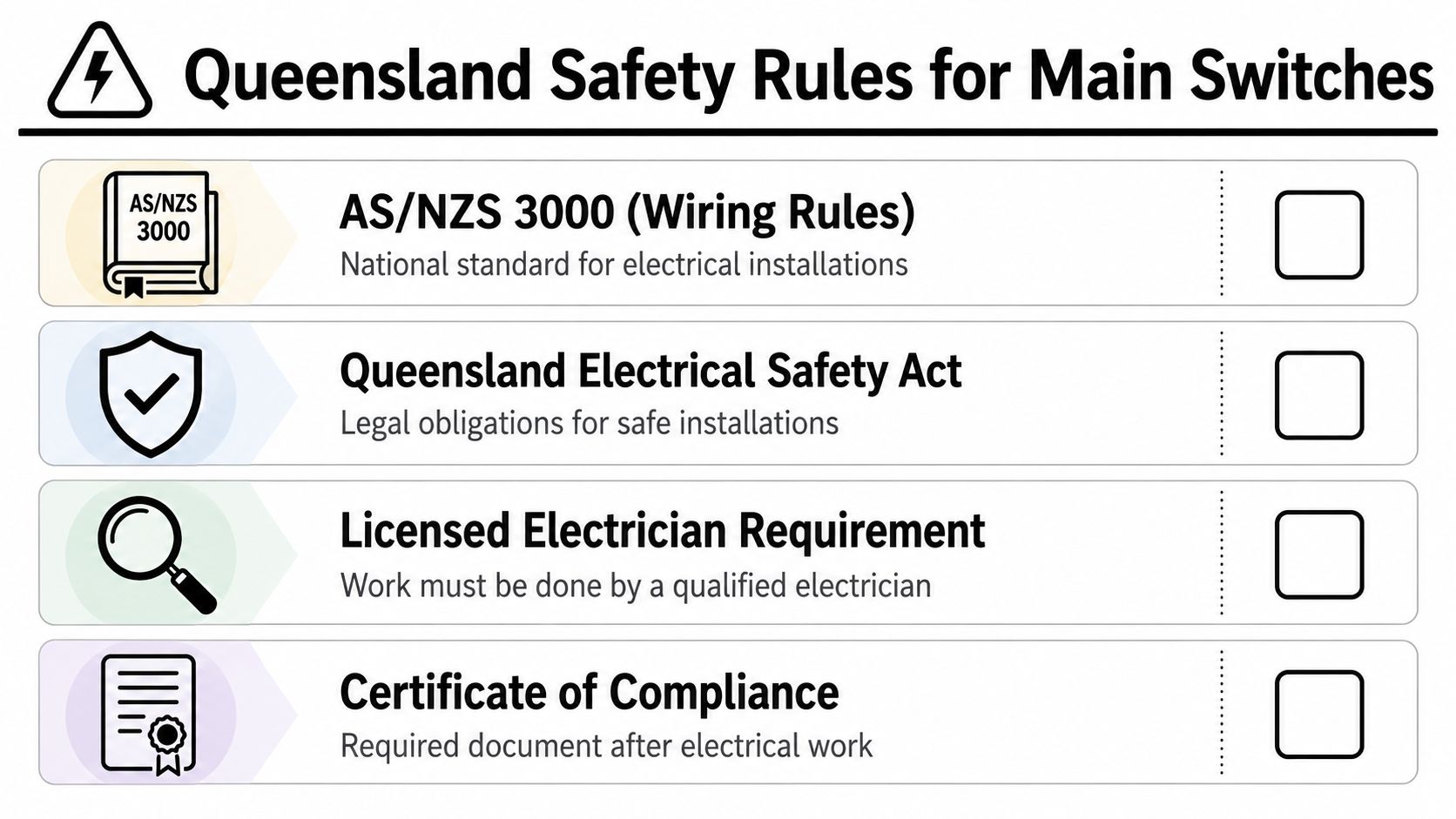
A homeowner can look, read labels and report symptoms. Work inside the switchboard, including replacing a main switch, changing wiring, modifying protection or altering the enclosure, belongs with a licensed electrical worker. Don't remove covers, probe terminals or assume that turning off one breaker has made the board safe.
After electrical work, ask for the relevant compliance documentation and keep it with your property records. The form and certificate requirements depend on the work and circumstances, so the electrician should explain what has been issued. For Brisbane renovation planning, the switchboard upgrade regulations guide can help you prepare questions before arranging an inspection.
A main switch used to be easy for homeowners to regard as a fixed, permanent part of the property. Modern homes challenge that assumption. Rooftop solar, battery inverters, EV chargers, ducted air-conditioning, induction cooking and high-demand hot-water systems can all change how the switchboard handles supply, generation and isolation.
The issue isn't just adding together appliance labels. An electrician needs to consider maximum demand, diversity, existing circuit arrangements, conductor capacity, fault levels, equipment compatibility and the way energy can flow in both directions. Solar and battery equipment can keep parts of an installation energised under conditions where a homeowner believes the mains have been switched off.
Don't ask only, “What amp main switch should I buy?” Ask, “What will this switchboard need to do after the new equipment is connected?” Western Power's guidance says a main-switch circuit breaker is required for new premises or altered connections involving systems such as solar, EV chargers, large electrical appliances or air-conditioners. Although network requirements vary by distributor and location, the principle is valuable for Brisbane homeowners: a new load or generation system can turn a simple replacement into a connection and compliance review. The guidance on main-switch circuit breakers for altered connections explains that broader context.
The comparison below is deliberately qualitative. Exact current demand can't be safely assigned from an appliance name alone.
| Appliance or System | Typical Load | Cumulative with Existing Loads |
|---|---|---|
| EV charger | A substantial dedicated demand | Can compete with cooking, hot water and air-conditioning |
| Ducted air-conditioning | A large whole-home demand | May become significant during hot weather |
| Induction cooktop | A high-demand cooking load | Adds pressure during evening use |
| Solar or battery inverter | A generation and isolation consideration | Changes protection and supply arrangements |
| Hot-water system | A dedicated controlled load in many homes | Must be assessed with the board's existing capacity |
A practical household detail can matter too. If you're planning an office fit-out or a kitchen upgrade, even a kitchen water tap for offices can introduce another electrical appliance or hot-water demand that belongs in the load discussion.
For an EV project, review the home EV charger installation information before choosing equipment. The electrician should assess the whole board, not just the spare space beside the existing breakers.
A switchboard can show trouble before a component fails completely. Some signs indicate immediate risk, while others justify a planned inspection. The safe response depends on what you can observe without touching internal parts.
Burning smells, scorching, melted plastic, visible smoke, sparks, water entry, crackling or a hot switchboard surface are urgent. Move away from the board, keep people clear, and call a licensed electrician. If there's an active fire, smoke or immediate danger, contact emergency services. Don't pour water onto electrical equipment.
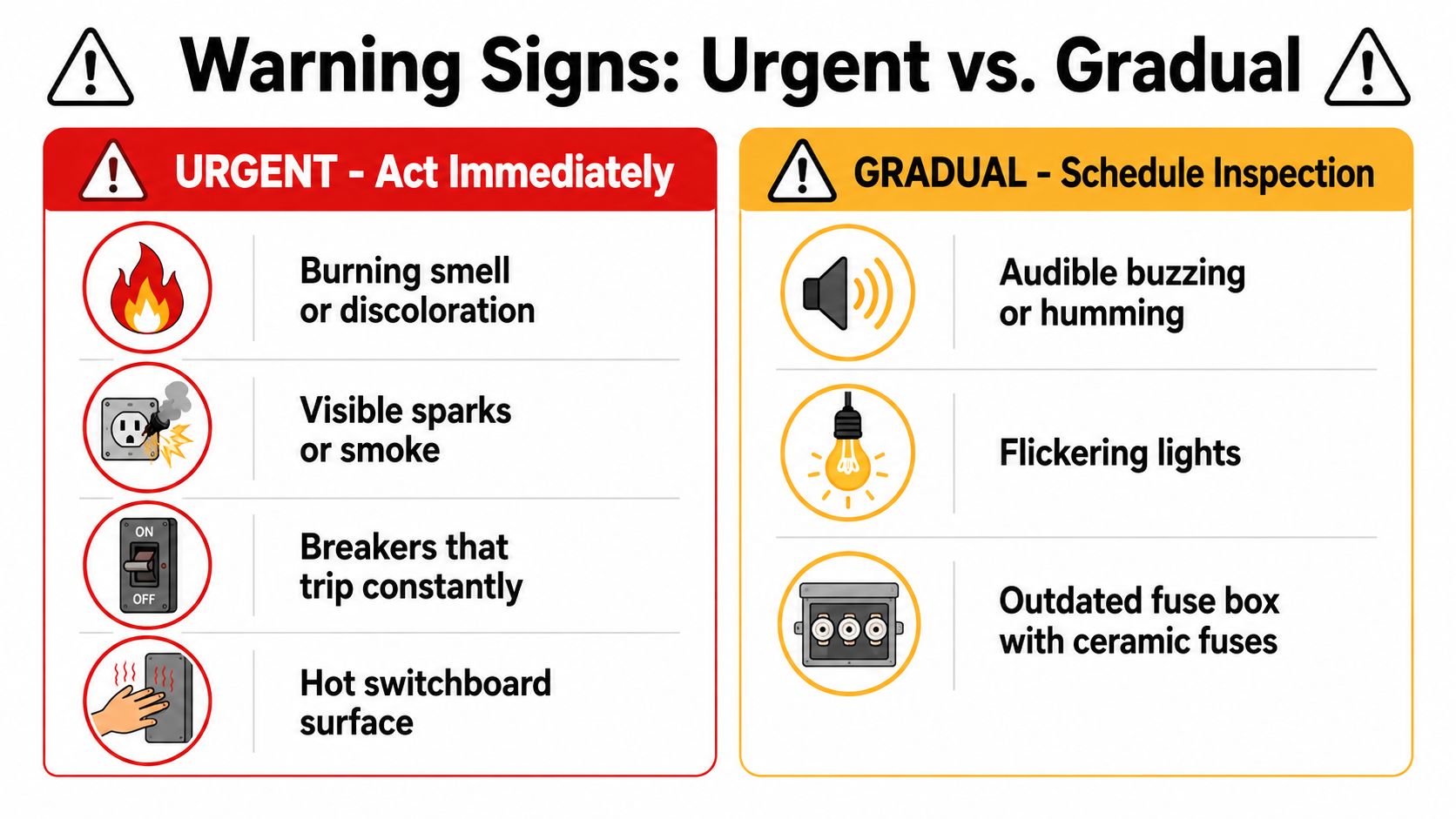
A switch that won't reset isn't being difficult. It's telling you that the protective device has detected a condition that hasn't been resolved.
Flickering lights when large equipment starts, unexplained interruptions, missing labels, a dated ceramic-fuse board or an old backing panel should be documented and discussed with an electrician. Older materials may require careful handling, particularly where an electrician suspects asbestos-containing components. Don't open the board to confirm what the panel is made from.
Take a clear photograph from outside the enclosure, write down which appliance was operating, and record which device moved. Don't remove covers or touch exposed equipment. The visual guide is a useful prompt, and this short video can reinforce the difference between common switchboard components.
The main switch is connected to the part of the installation where mistakes can expose a worker to serious fault energy. Even when the handle is off, an electrician must verify isolation because incoming conductors, busbars, alternative supplies and parts of the switchboard can remain dangerous. A homeowner can't confirm that condition by looking at the lever.
A qualified electrician approaches the job as a controlled isolation and testing process. They identify every supply, isolate at the correct point, test for dead, inspect connections and verify that the replacement device suits the board's assembly, conductors and protective arrangements. Solar and battery installations make that sequence especially important because generated energy can alter the expected shutdown path.
If one protective device has tripped and the board is dry, cool and undamaged, a single straightforward reset may restore power. If it trips again, don't keep cycling it. Repeated resets can leave a fault undiscovered and may increase the chance of heat damage.
A main-switch diagnosis or replacement also involves more than fitting a part. The electrician may need to check the MEN arrangement, neutral connections, fault protection, enclosure condition, labelling, supply capacity and the relationship between the main switch and downstream devices. The job should finish with the testing and compliance documentation applicable to the work.
For property owners comparing contractors, electrical contractor registration information is a useful starting point. Check that the business is properly licensed, insured and experienced with Brisbane switchboards and distributor requirements. Ask who will perform the work, what will be tested, whether alternative supplies are present, and what documents you'll receive.
Never trade speed for isolation. A dark house isn't proof that every part of the installation is safe to touch.
If the board is burning, wet, sparking or visibly damaged, keep clear and arrange urgent professional assistance. A licensed electrician can decide whether the installation should remain isolated until repairs are complete.
Take this checklist with you when you inspect the switchboard. You're recording information for a professional, not attempting electrical work.
Write down:
Don't touch exposed conductors, remove the escutcheon or test a switch by repeatedly turning it on and off. If the main switch won't stay on, or you find an urgent warning sign, leave the installation alone and contact a licensed electrician promptly.
A routine list can wait for a planned inspection, but danger signs shouldn't. Give the electrician your notes and photographs so they can arrive prepared to assess isolation, protection, capacity and compliance.
DLG Electrical can inspect Brisbane switchboards, identify the true whole-home isolator, and include main-switch replacement within a suitable switchboard upgrade where required. Visit DLG Electrical to discuss your symptoms, recent electrical additions and the right next step for your home.

Master Electrician with over 30 years of experience. Founded DLG Electrical in 2005 after international project work including electrical installations at Stamford Bridge Stadium, London(Home of Chelsea FC).

Local Electricians that can fix all Electric Hot water Systems.
Motion sensor lights are a versatile addition to any home, offering nu
