83 Jean St, Grange QLD 4051
Mon-Fri 07:30 AM - 04:00 PM - Sat - 8:00 - 12 - Sunday Closed
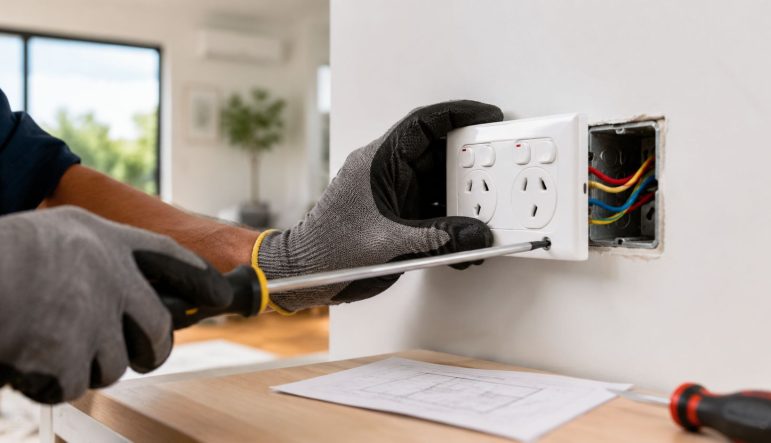
You notice it when the room is already finished.
The TV goes on the wall and there's no socket where the bracket lands. The bedside table is in the right place, but the charger lead has to snake across the floor. The kitchen island looks clean until someone wants to plug in a mixer or laptop. That's usually the point where homeowners start looking into power outlet installation.
In Brisbane, that's not a handyman job and it's not a weekend DIY task. It's licensed electrical work, and for good reason. A power point might look simple from the front, but the actual work sits behind the plasterboard, inside the circuit, and within the Wiring Rules that govern where it can go, what it can supply, and how it must be protected.
Good installation solves more than convenience. It reduces overloaded power boards, keeps cables out of walkways, and makes the house safer and easier to live in. Bad installation does the opposite. It creates hidden faults, water-clearance breaches, nuisance tripping, and serious shock and fire risk.
It's common not to think about outlets until there aren't enough of them.
A common one is the new wall-mounted TV. Another is the home office desk that ends up on an internal wall with no nearby supply. In older Brisbane homes, I also see rooms where the original outlet layout made sense decades ago but doesn't match how people live now, with phone chargers, monitors, robot vacuums, coffee stations and bedside devices all competing for the same point.
That's when extension leads and power boards start multiplying. One board becomes two. Then a double adaptor gets added behind furniture where nobody can see it.
Practical rule: if you're solving a permanent power problem with temporary accessories, you probably need a proper outlet installed.
In Australia, power outlet installation is regulated work. The physical job may involve cutting into plasterboard, running cable, making terminations, checking the circuit capacity and confirming the location complies with wet-area and general wiring rules. It has to be done by a licensed electrician.
Queensland homes deal with a mix of older wiring, renovated spaces and modern appliance loads. That combination makes assumptions dangerous. A spot that looks easy from the room side may have structural framing, insulation, existing services or circuit limitations behind it.
Homeowners don't need to know how to terminate conductors or size a circuit. They do need to know what good practice looks like:
The right electrician should also explain trade-offs clearly. Sometimes the neatest-looking position isn't the best cable route. Sometimes a slightly different wall location avoids patching, lowers labour and still works just as well day to day. That practical judgement is what separates clean professional work from expensive rework.
Choosing the outlet first saves headaches later. A point that suits a bedside lamp is not the same point I'd specify for an outdoor wall, a kitchen island, or a dedicated appliance with a higher current draw.
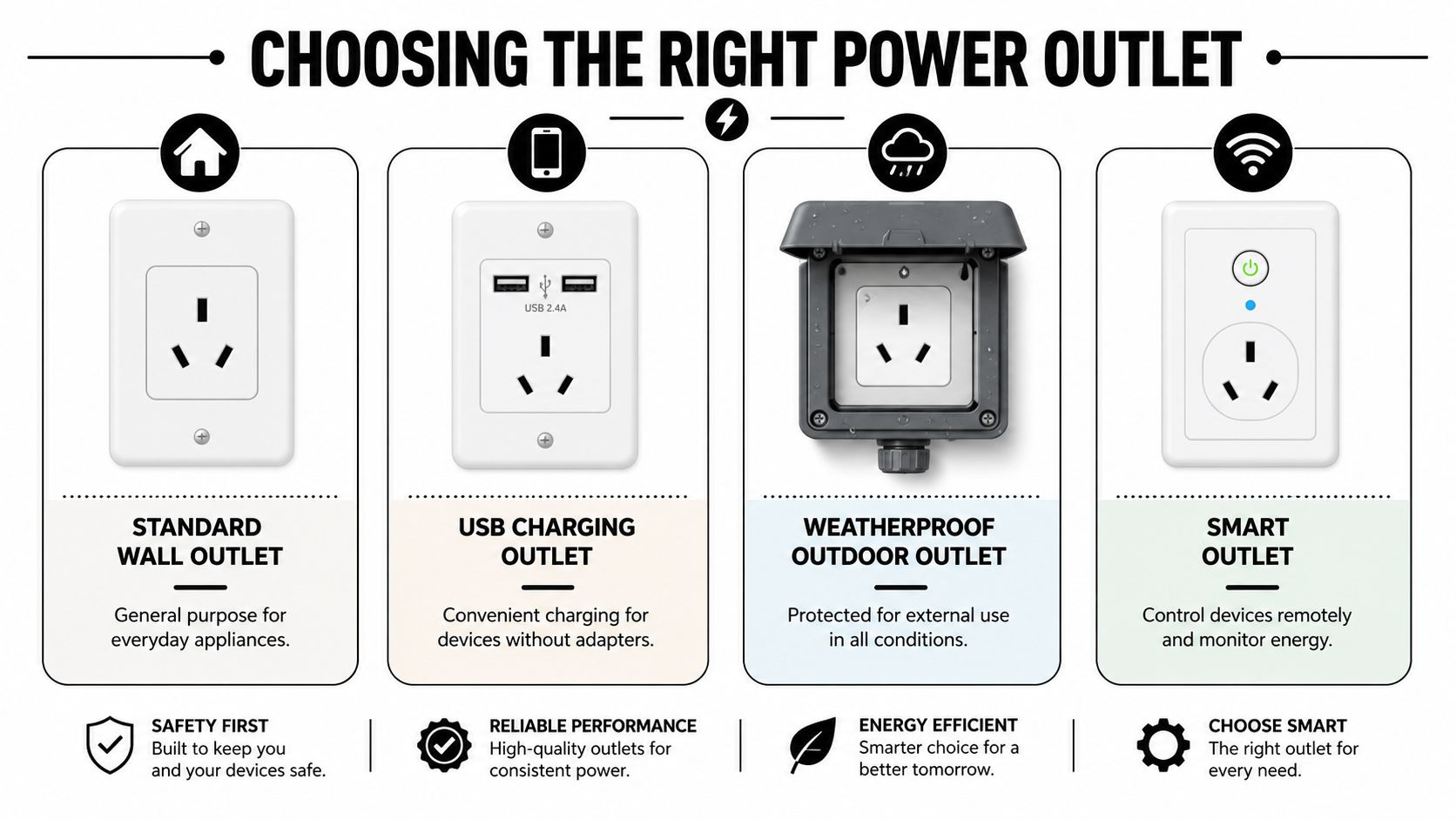
In Brisbane homes, the standard choice for general use is a 10A general purpose outlet, or GPO. It suits living rooms, bedrooms, hallways, studies, and plenty of everyday appliances.
That does not mean every room should get the same fitting.
Older Queensland homes often need a closer look before I recommend adding more points of the same type. The outlet on the wall might look ordinary, but the circuit behind it may already be carrying more than it should, especially in houses that have had piecemeal renovations over the years. The right choice is based on the appliance, the room, and what the existing wiring can safely support.
Some outlet types are worth specifying from the start because they solve a real problem in daily use:
Kitchen outlets need careful placement. A pop-up fitting might suit the design, but if it ends up too close to a sink or in a spot that gets regular splashing, it is the wrong product in the wrong location. In Brisbane renovations, I often find the better outcome is a less flashy outlet placed where it stays usable, compliant, and easy to maintain.
A good-looking outlet in the wrong spot is still the wrong outlet.
| Outlet Type | Best For | Amperage | Key Feature |
|---|---|---|---|
| Standard wall outlet | General household use | 10A | Everyday power for common appliances |
| USB charging outlet | Bedside, study, kitchen charging | Qualitative only | Built-in device charging without adaptors |
| Weatherproof outdoor outlet | Patios, gardens, external areas | Qualitative only | Protected for outdoor conditions |
| 15A outlet | Dedicated higher-load applications | 15A | Suits appliances that require a higher-rated outlet |
| Pop-up kitchen outlet | Benchtops and island use | Qualitative only | Concealed look when not in use |
The best outlet choice matches the room, the appliance, and the way the space is used. In practice, that can mean adding USB outlets in a study, keeping standard 10A points for general areas, and reserving 15A outlets for equipment that requires them.
What causes trouble is treating outlet selection as a style decision only. Faceplate colour and profile matter, but Brisbane electricians also have to consider moisture exposure, cable route, likely load, and whether the location will remain practical once furniture, appliances, and benchtop use are taken into account. That is where experience saves money. A small adjustment in outlet type or position can avoid nuisance trips, damaged fittings, and costly rework later.
In Brisbane, the price of a new power point is driven by access, circuit conditions, and compliance work far more than the outlet itself.
Replacing an existing outlet is usually the lower-cost job because the cable location and wall opening already exist. Adding a brand-new point costs more because the electrician may need to run new cable, check circuit capacity, cut in a new mounting position, and test the completed work to Queensland requirements.
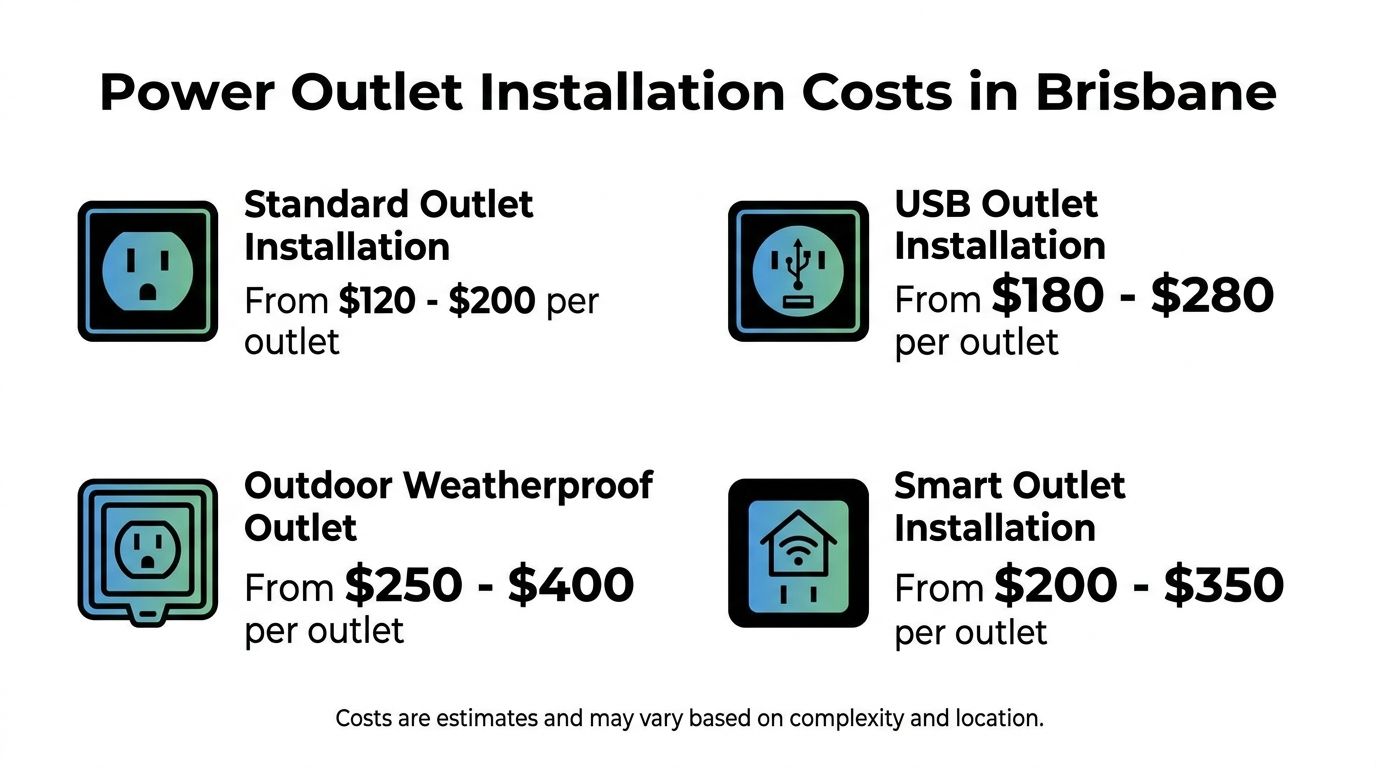
Two outlets can look the same once the cover plate is on. The work behind the wall can be completely different.
A standard add-on in an internal plasterboard wall is often quicker than installing into masonry, tiled areas, or locations with limited roof or underfloor access. Older Brisbane homes can also add time if the existing wiring needs checking, the switchboard arrangement is dated, or the proposed point is a long way from a suitable supply.
The final cost usually comes down to a few practical factors:
A power point install is not just a faceplate and fifteen minutes on the tools.
You are paying for licensed electrical work under the Queensland safety framework. That includes safe isolation, checking the existing circuit, running and securing cable, correct terminations, polarity and protection testing, and making sure the finished installation complies with AS/NZS 3000. If conditions on site show the circuit is unsuitable, the job may also require extra rectification before a new outlet can be legally connected.
In most standard residential outlet installations, electricians commonly use 2.5mm² TPS cable for socket-outlet circuits where appropriate. The exact cable type and protection still depend on the circuit design and the installation environment.
I tell Brisbane homeowners to read quotes closely. A fair quote should say whether patching is included, whether access assumptions have been made, and what could change the price once the wall or roof space is opened up.
A cheap figure on the phone often becomes an expensive job on site.
From the homeowner's side, adding a power point can look like a small job. From the electrician's side, it starts with assessment.
The first question isn't where you want the outlet. It's whether the proposed location makes sense for the existing circuit, the cable route and the room itself. That includes checking how the new point can be supplied and whether the route can be done neatly.
In a finished Brisbane home, the cleanest job is usually the one with the least disruption. That doesn't mean shortcuts. It means choosing a route that works with the building rather than fighting it.
In plasterboard homes, one practical retrofit option is the back-to-back installation technique, where the new outlet is positioned in a way that reduces wall damage and avoids unnecessary demolition. That approach has been discussed as a cost-effective and compliant option when carried out by a registered contractor in this AusRenovation discussion about adding outlets.
The broad process is straightforward, even if the detail requires trade skill.
Isolate and assess the circuit
The electrician confirms the circuit arrangement, checks the proposed load and makes sure the location is suitable.
Cut the opening and run cable
In standard outlet work, this may involve cutting a plasterboard opening between studs and feeding the cable through the chosen path.
Terminate the conductors correctly
The basic conductor identification for typical outlet work is Brown for Active, Blue for Neutral, and Green/Yellow for Earth, as described in the Australian installation reference cited earlier.
Mount, test and verify
The point is secured properly, tested, and checked for correct operation.
New builds are predictable. Retrofits are not.
Existing homes hide surprises. There may be noggins exactly where you don't want them, insulation packed tightly in the cavity, old patchwork from previous works, or a wall that isn't as empty as it sounded when tapped. The skill is in getting a compliant result with minimal damage.
What works is careful planning and realistic positioning. What doesn't work is insisting on an exact spot that turns a simple retrofit into a much larger repair job. A small shift in location often produces a cleaner result and a lower bill.
A new power point in a Brisbane home can look simple on the surface. The risk sits behind the plaster. I have seen neat-looking DIY outlet work with no effective earth, loose terminations, and points installed too close to sinks. The faceplate looked fine. The installation was not safe.
For power outlet installation, the legal benchmark is the Wiring Rules, especially AS/NZS 3000, along with Queensland licensing requirements. Those rules set the minimum standard for outlet location, circuit protection, cable selection, testing, and final verification. They are not design advice. They are the difference between an outlet that is safe to use every day and one that creates fire or shock risk.
If you want the broader framework in plain English, this guide to electrical wiring standards in Australia is a useful starting point.
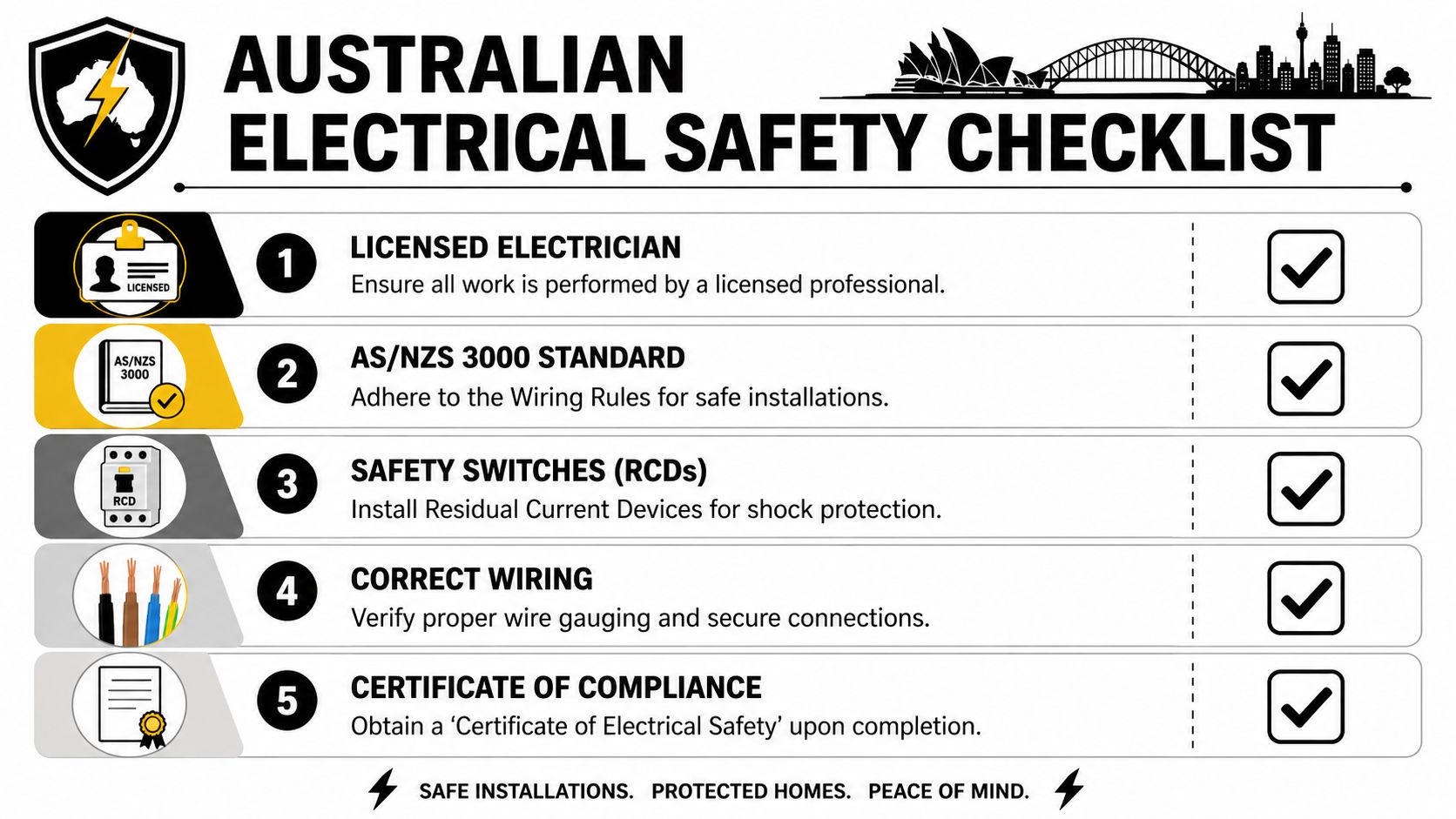
Compliance starts with load and circuit suitability.
A standard general-purpose outlet has a rating, but that does not mean every wall is ready for another high-draw appliance. In older Brisbane homes, especially post-war timber houses and renovated properties with mixed-age wiring, the key question is whether the existing circuit has capacity, the correct protection, and sound terminations all the way back to the board. Adding a point without checking that first is poor practice.
Wet areas need even more care. Bathrooms, laundries, kitchens, and outdoor locations are where location rules matter most because water, cleaning products, and condensation change the level of risk quickly. Clearance distances, mounting positions, and the type of protection used all need to suit the room. A power point that is acceptable on a bedroom wall may be unlawful or unsafe near a laundry tub or kitchen sink.
In Queensland, electrical installation work is licensed work. That includes installing or relocating a power point. Homeowners can choose where they want better access to power, but the actual wiring, termination, testing, and certification must be done by a licensed electrician.
There is a good reason for that.
Safe outlet installation is not just matching wire colours and screwing on a plate. The electrician needs to confirm polarity, earth continuity, insulation integrity, fault loop performance where relevant, and that the protective device will operate as intended under fault conditions. If RCD protection is required, it must be verified properly. If the circuit shows signs of age or previous poor workmanship, that has to be addressed before the new outlet is energised.
The problems I see in retrofits are usually practical, not theoretical:
Those issues are common in finished homes because previous renovations do not always follow current standards, and hidden conditions only show up once testing starts.
Here's a practical video overview that helps show why compliance matters in real homes.
A compliant installation is correctly located for the room, connected to a suitable circuit, protected by the right device, and fully tested before use. It is also documented properly when required. That matters for safety, insurance, and any future electrical work on the property.
For homeowners in Brisbane, the safest approach is straightforward. Decide how you want to use the space, show the electrician what will be plugged in there, and ask for the location to be checked against current rules before any cutting starts. That avoids expensive rework and keeps the job legal from day one.
When a power point stops working, the safest first move is to check what failed before you assume the outlet itself is faulty.
A dead outlet can be caused by a tripped safety device, a circuit issue, a damaged appliance, a loose connection, or overloading. You can do a few safe checks without opening anything.
Try another appliance
Plug in something you know works. That rules out the original device quickly.
Check nearby outlets
If more than one point is affected, the issue may be circuit-wide rather than a single socket.
Look at the switchboard
If a breaker or safety switch has tripped, reset it once if it's safe to do so and observe what happens next.
Remove the power board from the equation
Overloaded boards are a frequent trouble source.
A common reason for tripping is too much connected load. Standard residential 10 amp outlets are designed to handle up to 2400 watts, and exceeding that, especially by running multiple high-draw appliances through one power board, is a common cause of circuit trips according to this Australian electrical troubleshooting video reference.
If the outlet is warm, discoloured, loose in the wall, sparking, crackling, or causes repeated tripping, stop using it.
The same applies if resetting the switchboard doesn't hold, or if one appliance trips the circuit repeatedly from different points. At that point, the problem has moved beyond basic homeowner checks and needs proper diagnosis. If you're dealing with that right now, this guide on a power outlet not working gives a practical next step.
Power outlet installation sits in the category of jobs that look deceptively small. The faceplate is small. The consequences of bad work are not.
A licensed electrician isn't there just to connect wires. They're there to make sure the outlet location is lawful, the circuit can support the addition, the cable route is safe, the terminations are correct, and the final installation suits the environment it's in. That matters in every home, but especially in Brisbane where many properties combine older construction with newer appliance demands and staged renovations.
A good hiring checklist is simple:
If you want a plain-English overview of how contractor licensing works more broadly, the SaberTask 2026 contractor guide is a useful background read.
A Brisbane electrician who regularly works in existing homes tends to make better calls on practical layout, wall access, likely cable paths and how to minimise damage during retrofits. That experience shows up in the small decisions. Where to position the point so furniture covers the lead. When to use an easier back-to-back route. When to push back on a non-compliant kitchen or laundry location before the plaster is cut.
That's the difference between an outlet that merely exists and one that works well in the room.
For homeowners, the right decision is rarely the fastest cheap fix. It's the installation that stays safe, passes scrutiny, and doesn't create another hidden issue inside the wall or at the switchboard.
If you're adding a point behind a TV, upgrading a bedroom layout, fitting out a renovation, or fixing an outlet problem that keeps coming back, get a licensed Brisbane electrician to assess it properly from the start.
Need help with power outlet installation, outlet replacement, or a new point in a tricky spot? DLG Electrical is a family-owned Brisbane electrical contractor with 19+ years of local experience, a 5-star Google rating, fully licensed and insured electricians, and a strong focus on doing the job safely and properly the first time. If you'd like a free, no-obligation quote, call the team on (07) 3062 8255 or visit the website to book.

Master Electrician with over 30 years of experience. Founded DLG Electrical in 2005 after international project work including electrical installations at Stamford Bridge Stadium, London(Home of Chelsea FC).

Local Electricians that can fix all Electric Hot water Systems.
Motion sensor lights are a versatile addition to any home, offering nu
