83 Jean St, Grange QLD 4051
Mon-Fri 07:30 AM - 04:00 PM - Sat - 8:00 - 12 - Sunday Closed
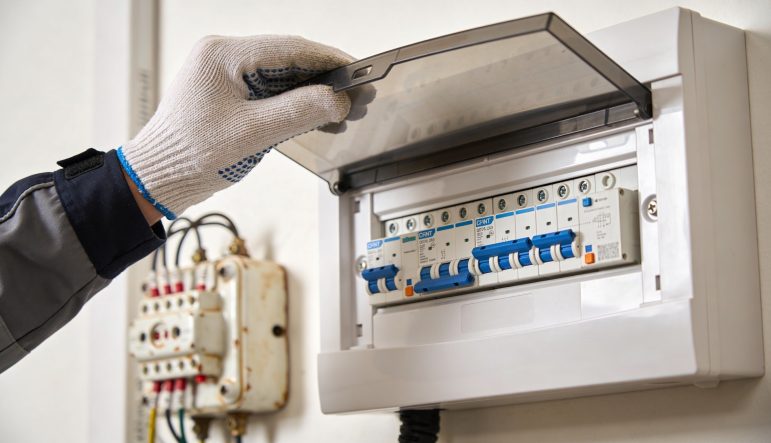
If you’re searching for switchboard upgrades near me, there’s a good chance something in your home already feels off. Maybe the lights dip when the air con starts. Maybe a circuit trips when the kettle and microwave run together. Or maybe you’ve opened an old meter box in a Brisbane home and found ceramic fuses, aged wiring, or a board that plainly doesn’t belong in a modern house.
That’s usually the point where homeowners realise a switchboard isn’t just a box on the wall. It’s the control centre for safety, power distribution, and compliance. In Brisbane, that matters even more in older homes around Grange, Windsor, and other Northside suburbs where pre-1990s electrical infrastructure is still common.
Generic guides often miss the local issues that affect your decision. Queensland rules, asbestos-backed boards, storm exposure, rental obligations, and solar battery upgrades all change what a proper switchboard upgrade should include. A Brisbane electrician looks at those details first, because that’s what decides whether the work solves the problem or just delays it.
An old fuse box works like a manual gatekeeper. It reacts late, gives limited protection, and often leaves the homeowner trying to work out which fuse controls what. A modern switchboard is closer to an automated security system. It monitors circuits continuously, isolates faults faster, and gives each part of the home more targeted protection.
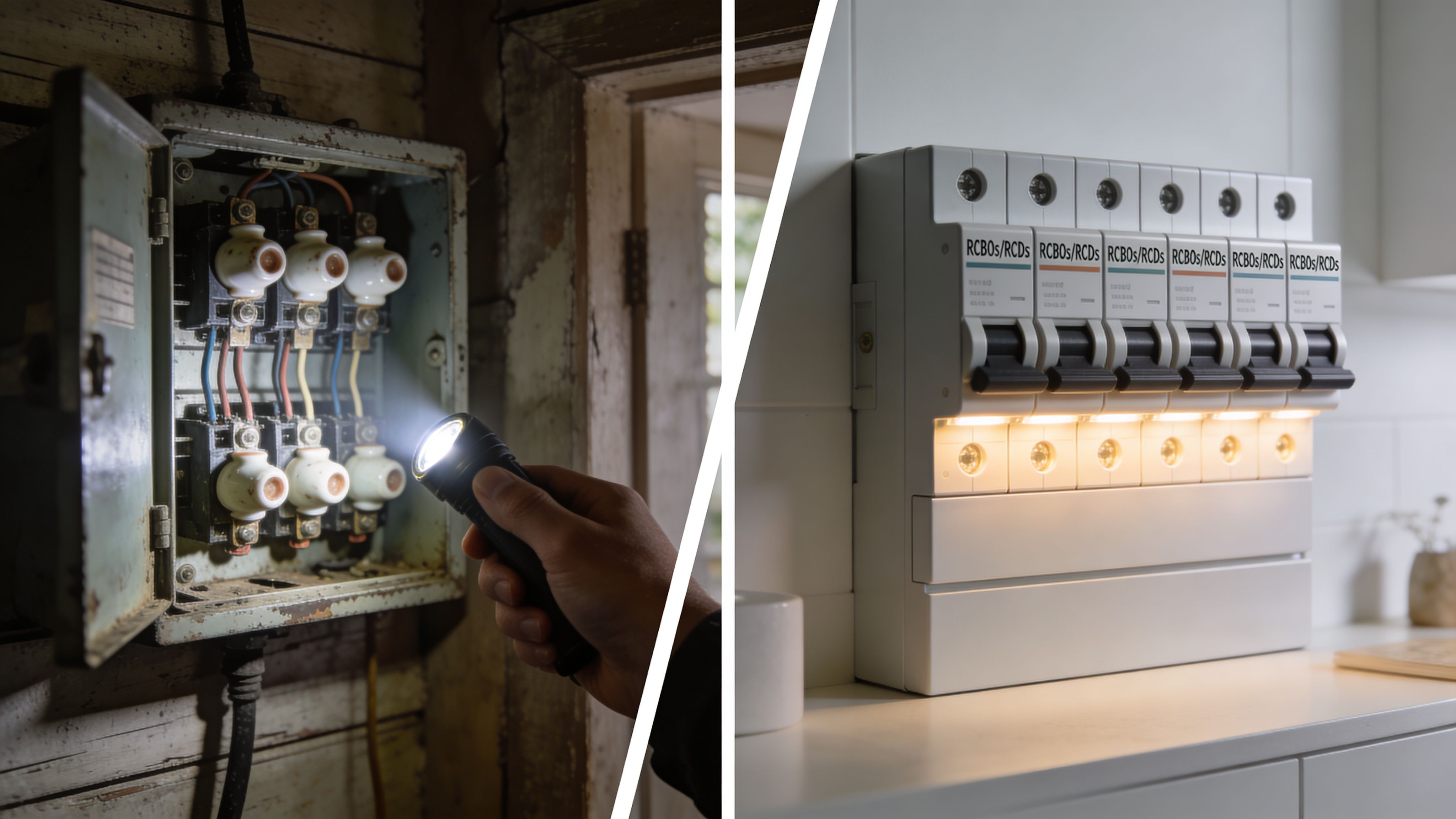
The biggest change is the move from old fuses to circuit breakers and RCD safety switches. A fuse is basic. It blows when current gets too high, then it needs replacing. A breaker trips and can be reset once the fault is fixed.
An RCD does a different job. It watches for electricity leaking to earth, which is the kind of fault that can injure someone using a faulty appliance or touching damaged wiring. In Brisbane switchboard upgrades, RCD safety switches detect earth leakage currents as low as 30mA and interrupt power in 20 to 40ms, helping prevent electrocution. Since the 1991 mandates, they’ve been linked to an 85% reduction in shock fatalities according to ESQ data, as noted by GQ Electrical’s switchboard upgrade guide.
The safety benefit is obvious, but the practical benefit matters too. A modern board gives cleaner circuit separation, clearer labelling, and better fault isolation. That means one problem circuit is less likely to affect the whole house.
A common point of confusion is the difference between a fuse and a breaker. If you want the plain-English version, this breakdown of fuse versus circuit breaker protection explains what each one does in a home.
Practical rule: If your board still relies on ceramic fuses, you’re not dealing with an inconvenience. You’re dealing with outdated protection.
A proper residential switchboard upgrade usually centres on a few core elements:
That’s the key leap. You’re not just replacing an old box. You’re bringing the home’s electrical protection up to a standard that suits how Brisbane households use power now.
You plug in the air con on a humid Brisbane afternoon, the lights dip, and a circuit trips when the oven is already running. That is a common point where an old switchboard stops being a minor annoyance and starts showing its limits.
Some warning signs are obvious. Others only show up once the house is carrying more load than the original installation was built for. In older Brisbane homes, especially post-war cottages and houses built before the 1990s, I see the same pattern again and again.
These are the faults and warning signs that most often lead homeowners to search for switchboard upgrades near me:
A board can still switch power on and off and still be wrong for the house.
A switchboard upgrade is often triggered by a change in how the home uses power, not by a dramatic fault. Renovations, larger air conditioners, induction cooktops, pool equipment, workshop circuits, and EV chargers all increase demand. Older boards were rarely laid out with that mix in mind.
That matters in Brisbane because many homes are now being prepared for solar optimisation, battery storage, or electrification upgrades. If the switchboard has no spare ways, poor circuit separation, or outdated protection, those projects can stall until the board is brought up to a workable standard under AS/NZS 3000.
For landlords, this is not just a maintenance issue. It is a compliance issue.
Queensland rental properties must meet prescribed minimum housing standards, and electrical safety obligations do not disappear because an older board still appears to work. If a rental has outdated protection, damaged components, or no practical way to isolate and protect circuits properly, that should be assessed before it becomes a tenancy dispute, emergency fault, or insurance problem. After upgrade work, the right paperwork also matters, including a Queensland electrical certificate of compliance.
It is time to get the switchboard assessed if two or more of these apply:
In practice, the best time to upgrade is before the board fails, before new work starts, and before asbestos meter board issues or supply coordination turn a simple job into a longer one.
A lot of Brisbane homeowners only look closely at the switchboard after a circuit trips, a renovation starts, or a solar installer says the existing board cannot stay as it is. That is usually the point where safety rules stop being theory and start affecting what can legally be done at the property.
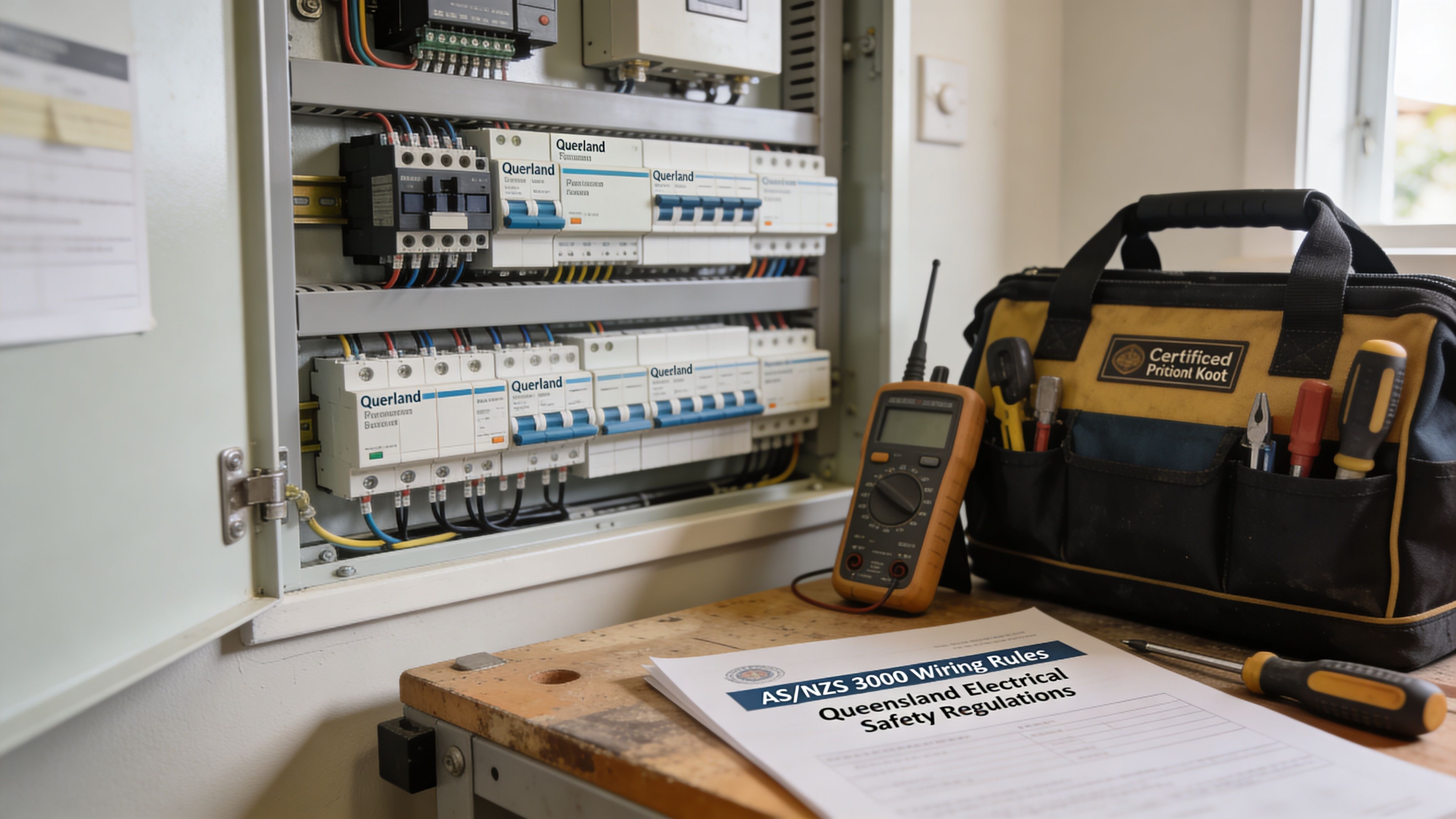
In Queensland, switchboard work has to line up with AS/NZS 3000:2018, along with the local electrical safety requirements that govern licensed work, testing, and certification. For homeowners, the practical takeaway is simple. Once the board is being altered in a meaningful way, old fuse setups and outdated protection often cannot remain untouched.
A compliant upgrade usually means replacing rewireable fuses or older mixed equipment with properly rated circuit breakers, safety switches where required, clear circuit identification, and a board layout that can be tested and isolated safely. Good compliance is not only about fitting newer parts. It is about whether the whole installation can be left in a safe, serviceable condition.
Upgrading also improves fault protection and makes nuisance problems easier to trace. A modern board will not prevent every outage, but it does give the home a safer and more dependable electrical foundation than an aging fuse panel.
After the work is finished, the electrician should issue the correct paperwork. If you want a plain-English explanation of what that should include, this guide to a Queensland electrical certificate of compliance sets out what homeowners should expect.
Brisbane homes have a few recurring switchboard issues that generic articles usually miss. One of the biggest is the age of the housing stock. It is still common to find boards fixed to old timber panels, cramped meter positions, or asbestos backing boards that need special handling before any upgrade can start.
That changes the job.
If asbestos is present, the work cannot be treated like a standard board swap. The removal process, site controls, and coordination all need to be handled correctly. If the backing is poor, or the cabling entering the board is brittle or heat-affected, fitting new breakers onto an old base is not a proper solution.
This is also where future planning matters in Queensland. More Brisbane homeowners are adding air conditioning, induction cooking, EV chargers, rooftop solar, and battery systems tied to state incentive schemes. A board that only just meets today’s load may create extra cost later if there is no room for new protection devices, metering changes, or battery isolation requirements.
In the field, switchboard non-compliance usually shows up as a pattern, not a single defect. An old fuse board might also have poor labelling, no practical main isolation, deteriorated neutral links, undersized enclosures, or mixed generations of equipment added over time.
That matters because compliance is assessed as a whole installation in the area being worked on. If one part is unsafe or unsuitable, the rest of the upgrade may need to change with it.
A proper quote should identify:
Old switchboards can keep running for years right up until they do not. Heat damage, loose terminations, and poor fault protection often sit out of sight until there is repeated tripping, a burnt connection, or a dangerous fault.
The legal and insurance side matters as well. If there is an electrical incident, the condition of the board and the records for any upgrade work can come under close review. The same applies during sale, lease renewal, major renovation approval, or solar and battery installation.
A compliant switchboard does two jobs. It protects the home more effectively today, and it gives you a board that can support what Brisbane households are adding next.
Most homeowners are less worried about the idea of an upgrade than the disruption around it. They want to know what happens, how long the power will be off, and whether the electrician will leave them with a neat, tested, clearly labelled result. That’s exactly how the process should be approached.
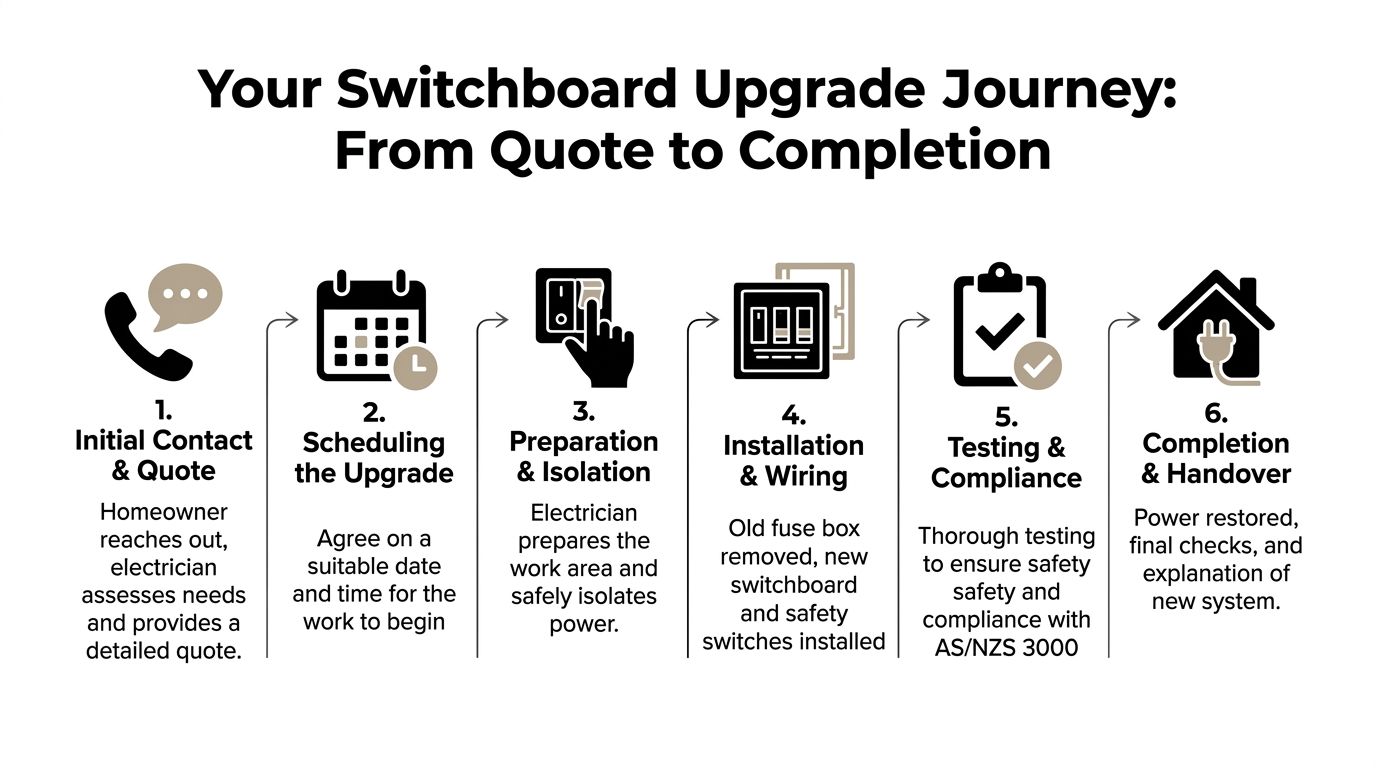
The first stage is inspection and quoting. A licensed electrician checks the existing board, looks at the cabling condition, notes any compliance issues, and asks what the home needs now and in the near future. That last part matters. A board that suits today but leaves no room for planned upgrades can become a short-term fix.
Then the job is scheduled and the shutdown is explained clearly. For many Brisbane homes, the upgrade involves a planned power isolation while the old board is removed and the new one is installed.
A helpful visual summary sits below.
On the day itself, the work usually follows a clean sequence:
For homeowners, the biggest practical impact is downtime. According to the Brisbane-specific guidance already noted earlier, the process commonly involves around 4 to 8 hours of outage while the work is completed and final checks are done.
The visible hardware is only half the job. The part that separates a proper upgrade from a rushed one is the final testing and documentation.
That handover should include:
Good switchboard work looks organised before the cover goes on. Neat routing, clear identification, and complete testing usually tell you a lot about the standard of the whole job.
For North Brisbane homeowners, the best experience is straightforward. The electrician arrives prepared, isolates the supply safely, completes the upgrade cleanly, restores power, and leaves the board easier to understand than the old one ever was.
You notice the lights dip when the air con starts, then you get a quote for solar batteries or an EV charger and the installer says the switchboard needs attention first. That is how this usually comes up in Brisbane. The price depends less on the box itself and more on what is hiding behind it. In Australia, a standard single-phase residential switchboard upgrade commonly falls in the $900 to $1,800 range, while a 3-phase upgrade is often $1,500 to $3,500, according to Connex Electrical’s guide to switchboard upgrade pricing.
Older Brisbane homes often need extra work before a new board can be signed off. Fuse gear, damaged cabling, limited circuit space, and unsuitable mounting surfaces all push the cost up. In Queensland, the job also has to meet current safety requirements under AS/NZS 3000, so a cheap front-only replacement can turn into a more involved upgrade once the existing installation is opened up.
| Factor | Why it affects cost |
|---|---|
| Single-phase or 3-phase supply | 3-phase boards need different protection, more hardware, and more time to configure |
| Condition of the existing wiring | Older or heat-affected cabling may need repairs before the new board can be connected safely |
| Number of circuits | More circuits means more breakers, more testing, and more space needed in the enclosure |
| Asbestos or unsuitable backing material | Older meter panels and backing boards can create compliance and safety issues that need separate handling |
| Future capacity | Allowing room for solar batteries, EV charging, or new appliances can make sense now rather than paying for another board change later |
| After-hours call-out | Emergency work is usually priced higher than planned daytime work |
Asbestos is one of the bigger cost variables in older suburbs. If the board is mounted on asbestos backing, electricians cannot just drill through it and keep going. The material has to be handled correctly, and that can involve a separate removal step before the switchboard work starts.
Timeframes are usually straightforward if the site is prepared and no hidden defects show up. A standard residential upgrade is often completed in one day, but older homes can stretch that if the cabling needs repairs, the meter panel needs attention, or asbestos is involved. If you want a clearer sense of what affects timing in local homes, this guide on switchboard upgrade work in Brisbane homes gives useful context.
A proper upgrade usually includes more than new breakers. It commonly covers removal of outdated components, installation of a compliant enclosure, RCD protection, circuit identification, testing, and the required certification. That matters because the switchboard has to do more than turn power on and off. It has to protect people, isolate faults properly, and leave enough room for what your home may need next.
That future capacity matters more in Queensland than many generic guides admit. Homeowners adding solar, battery storage, or EV charging often find the switchboard becomes the limiting point first. Spending a little more on circuit space and a board layout that allows expansion can save a second round of electrical work later.
Price still matters. So does scope. The best quote is usually the one that explains what is included, what is excluded, and what could change if hidden issues are found after isolation and inspection. For homeowners comparing contractors online, a business that presents clear local reviews and job details usually inspires more confidence than one with a bare listing. That is one reason some trades invest time in mastering Google Business Profile for contractors.
A lot of Brisbane homeowners only start comparing electricians after the lights trip, the fuse board fails, or a solar installer says the switchboard has to be updated first. By that stage, rushed decisions usually lead to poor quotes, vague scopes, or work that solves today’s fault but leaves no room for what the home will need next.
The right electrician checks more than the front of the board. They should look at the condition of the existing cabling, the meter panel, the enclosure, the earthing arrangement, and any signs of asbestos risk in older homes. In Brisbane, that matters. Many properties still have older boards, mixed-era wiring, or switchboard locations that complicate access and compliance under AS/NZS 3000.
Use questions that show how the electrician approaches the job:
Future planning matters more in Queensland than many generic articles admit. Solar uptake is strong across the state, and battery interest is growing as homeowners look for more control over power use and backup options. A switchboard upgrade should account for that, especially if you are trying to avoid paying for a second round of board work in two or three years.
Price still matters, but the cheapest quote often leaves out the hard parts. One contractor may include testing, circuit labelling, safety switch protection, defect rectification, and certification. Another may price the enclosure and breakers only, then charge extra once the board is isolated and hidden defects show up.
Check whether the contractor has a real local track record as well. Reviews will not tell you everything, but they do help confirm whether the business shows up, communicates clearly, and handles defects properly after the job. For homeowners who want to understand how trades build trust online before first contact, this guide on mastering Google Business Profile for contractors is a useful reference.
For a broader local checklist, this guide to choosing an electrician in Brisbane for residential electrical work is a practical place to start. DLG Electrical is one Brisbane provider handling switchboard upgrades, smoke alarm compliance, and related residential work, including older homes where a compliance-focused assessment is often more useful than a simple panel swap.
Your Trusted Electrician Brisbane Northside for Home and BusinessSwitchboard Upgrades Brisbane: switchboard upgrades in Brisbane for safer homes
Finding a Trusted Electrician Brisbane QLD Your Complete Guide

Master Electrician with over 30 years of experience. Founded DLG Electrical in 2005 after international project work including electrical installations at Stamford Bridge Stadium, London(Home of Chelsea FC).

Local Electricians that can fix all Electric Hot water Systems.
Motion sensor lights are a versatile addition to any home, offering nu
