83 Jean St, Grange QLD 4051
Mon-Fri 07:30 AM - 04:00 PM - Sat - 8:00 - 12 - Sunday Closed

That moment of dread when you open your power bill and see a number way higher than you expected is an experience most of us know all too well. You’re left scratching your head, wondering, “Why is my electricity bill suddenly so high?”
The truth is, it’s rarely one single thing. More often than not, a surprisingly high bill is the result of a perfect storm: rising energy prices from the market, seasonal weather forcing your appliances to work overtime, and a few power-hungry devices quietly adding to the total.
Getting a bill that’s shot up can feel like a personal failing, making you retrace your steps to figure out what you did wrong. But often, the biggest drivers are completely out of your hands. Let’s break down the common culprits, starting with the ones you can’t control.
One of the biggest reasons for a higher electricity bill has nothing to do with what’s happening inside your home. Across Australia, the background costs of generating electricity and getting it to your property are climbing. This includes everything from the wholesale price of energy to the costs of maintaining the massive network of poles and wires that make up the grid.
When these fundamental costs go up, your energy retailer has to pass them on. It’s a bit like a local bakery having to pay more for flour and sugar; eventually, the price of a loaf of bread has to reflect that. This means you might see higher rates per kilowatt-hour (kWh) or an increase in the daily supply charge on your bill. So even if you use the exact same amount of power, your bill can still go up.
A sudden bill spike isn’t always on you. External factors like wholesale energy costs and network maintenance fees are a huge part of the puzzle. Your bill can rise even if your habits haven’t changed a bit.
Beyond the market, the other half of the bill comes down to what you use. This is where your daily routines and the appliances you rely on make a real difference.
Seasonal changes are the number one driver here. Firing up the air conditioner during a summer heatwave or leaning on electric heaters to get through a cold winter are two of the most power-intensive things you can do in a home. Just one scorching week can send your cooling system into overdrive, causing a massive spike in your consumption for that billing cycle.
Older, inefficient appliances are another common energy thief. That second fridge humming away in the garage or an ancient dishwasher can silently add a surprising amount to your bill compared to their modern, energy-efficient counterparts. It all adds up. A typical Australian household’s electricity spend can vary dramatically based on the home’s efficiency, how many people live there, and local energy prices. For a deeper dive into these averages, you can find more details at CompareEnergy.com.au.
To help you troubleshoot, we’ve put together a quick reference table. It covers the most common reasons your electricity bill might be higher than expected, helping you quickly spot the likely cause.
| Potential Cause | What to Look For | Quick Fix |
|---|---|---|
| Seasonal Weather | Increased use of air conditioners in summer or heaters in winter. Check your usage history on your bill for spikes during hot or cold months. | Set your thermostat a few degrees higher in summer (e.g., 24°C) and lower in winter. Use fans and seal drafts. |
| Old/Inefficient Appliances | An old second fridge, a plasma TV, or appliances over 10 years old. These can use 2-3 times more energy than new models. | Unplug the second fridge if not essential. Prioritise upgrading old appliances to models with a high energy star rating. |
| Faulty Appliances | A fridge that runs constantly, a hot water system with a leak, or any appliance that feels unusually hot. | Listen for strange noises from appliances. Check for dripping taps or water pooling near your hot water system. Call a repair technician. |
| “Vampire” Power | Devices on standby mode (TVs, game consoles, microwaves, chargers). These can account for up to 10% of your household energy use. | Unplug devices when not in use or use a smart power board that cuts power to devices in standby mode. |
| Changes in Your Tariff | Your retailer may have changed your rates, or an introductory discount period may have ended. | Review your last few bills carefully. Check for notifications from your retailer about price changes. Shop around for a better deal. |
| Household Changes | More people living in the house, working from home, or having guests stay over. | Be mindful of increased usage of lights, computers, and kitchen appliances. Encourage energy-saving habits among all household members. |
This table is a great starting point, but remember that sometimes the problem is more complex than a simple checklist can solve. If you’ve run through these common culprits and are still stumped, it might be time to look a little deeper.
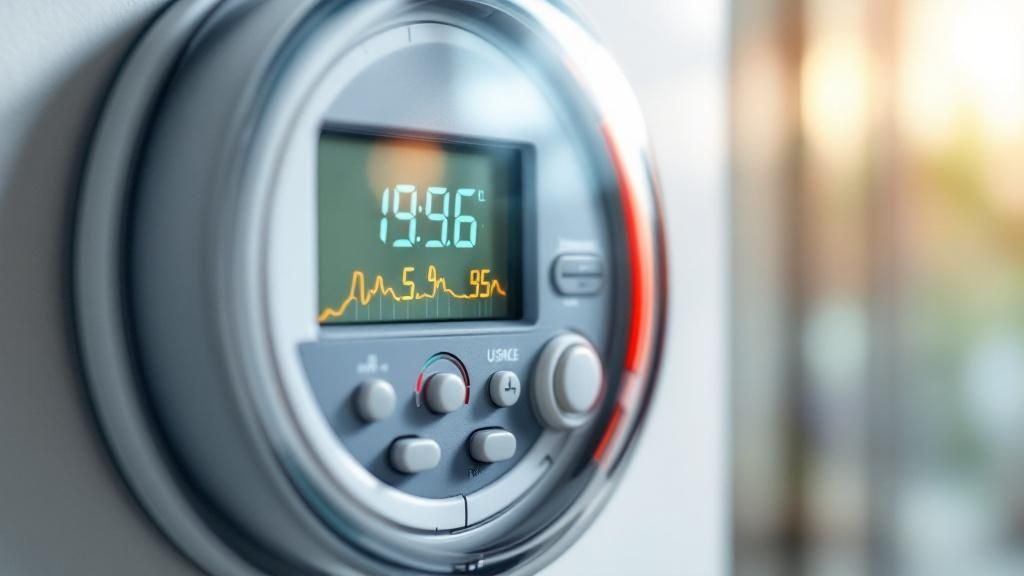
If you’ve checked all the obvious culprits and your power bill is still stubbornly high, the problem might be more subtle. Lurking in almost every room of your house are what we call energy vampires—or, in more technical terms, devices drawing a phantom load.
Think of it like a dripping tap. A single drop seems insignificant, but leave it for a month and you’ve wasted a surprising amount of water. Energy vampires work the same way. They’re appliances and gadgets that continuously sip a small amount of electricity, even when you think they’re turned off.
This constant, silent power drain can be a real budget-killer. In fact, it can be responsible for up to 10% of your total household electricity use. That’s money you’re spending on power that isn’t actively doing anything for you.
These sneaky devices are everywhere in the modern home. They need a trickle of power to stay in standby mode, display a clock, or remember their settings. The more connected gadgets you own, the more likely you have a small army of vampires quietly adding to your bill.
Here are some of the most common offenders:
The issue isn’t one single device; it’s the combined impact of all of them. A dozen small phantom loads dotted around your home can easily add up to the same energy use as leaving a 75-watt light bulb on 24 hours a day, 7 days a week. That’s a cost you’ll definitely notice over a year.
You don’t need to be an electrician to start hunting these vampires down. A simple walk-through is a great first step. Look for anything with a standby light, a digital clock, or a power adapter that feels warm to the touch. These are all tell-tale signs of a phantom load.
If you want to get more precise, grab a plug-in power meter. These are affordable gadgets you plug into an outlet, and they show you exactly how much juice an appliance is drawing—both when it’s running and when it’s “off.” You might be shocked at what your home entertainment setup consumes while it’s supposedly idle.
Another massive, though less obvious, energy drain is poor insulation and air leaks. Your heating and cooling systems have to work much harder to maintain a comfortable temperature if your home is draughty. Think about improving your home’s air tightness to stop paying for heated or cooled air that’s just escaping outside. Once you’ve identified where your energy is going, you can take simple steps to reclaim it.

Ever noticed your power bill seems to follow the weather forecast? It’s no coincidence. When you’re scratching your head wondering, “why is my electricity bill so high?”, the answer is often right outside your window. The simple truth is that extreme temperatures push your most power-hungry appliances into overdrive.
During scorching summer heatwaves and bitter winter cold snaps, your home’s climate control systems are working their hardest. Your air conditioner, for example, is essentially a heat pump, constantly working to move warmth from inside your home to the great outdoors. The hotter it gets, the harder that pump has to work, and that extra effort translates directly into higher electricity consumption. The same principle applies to electric heaters in winter.
For most homes, summer is the biggest culprit. A central air conditioning unit running for hours on end can easily become the single largest expense on your bill. This is especially true in humid, subtropical regions like ours. If you’re a Queenslander, we’ve got some specific advice on managing your home’s climate in our guide to understanding Brisbane’s subtropical climate.
But winter has its own set of challenges, particularly for households that rely on electric heating. Whether it’s radiant heaters, fan heaters, or reverse-cycle air conditioners, they all draw a significant amount of power to generate warmth. This often leads to that all-too-familiar bill shock when the first cold snap hits.
Here’s something many people don’t realise: it’s not just your usage. Extreme weather increases the overall demand on the entire electricity grid. This can trigger sudden, sharp spikes in wholesale power prices, which eventually find their way onto your retail bill.
This is a big deal in Australia’s volatile energy market. For instance, the Australian Energy Regulator reported that during just the first quarter of the year, wholesale electricity prices in the National Electricity Market shot past $5,000 per megawatt hour on 11 separate occasions. These brief but expensive events ripple through the system and impact what you pay.
The good news is you don’t have to choose between comfort and a reasonable bill. You can fight back against these seasonal spikes. Your roof is a key battleground, as it absorbs a huge amount of solar heat during the day. Applying a heat reflective roof coating can make a massive difference by reducing this heat gain, keeping your home naturally cooler and taking the pressure off your air conditioner.
Here are a few other effective strategies you can put into action:
Opening your electricity bill can feel like trying to decipher a secret code. You’re hit with a wall of terms like kWh, supply charges, and peak rates, and it’s all too easy to just skip to the bottom line and wince. But if you want to get a handle on why your bill is so high, getting to know these components is the first and most important step.
Think of your bill as having two key parts. First, there’s the usage charge, which is exactly what it sounds like—the cost for the electricity you actually used. This is measured in kilowatt-hours (kWh). The second part is the supply charge, a fixed daily fee you pay just for being connected to the grid. It doesn’t matter if you’re on holiday or using power around the clock; this charge is always there.
These two charges come together to form your total bill, but what you end up paying can look drastically different depending on where you call home.
One of the most frustrating things about electricity costs in Australia is how much they vary from one state or territory to another. You and a friend in a different state could use the exact same amount of power, yet your bills could be worlds apart.
This isn’t random. It’s the result of a complicated mix of local factors that all contribute to the final price you pay:
This is a good time to remember that it’s not just the big-ticket items racking up costs. Even the smallest devices, humming away in the background, add up.
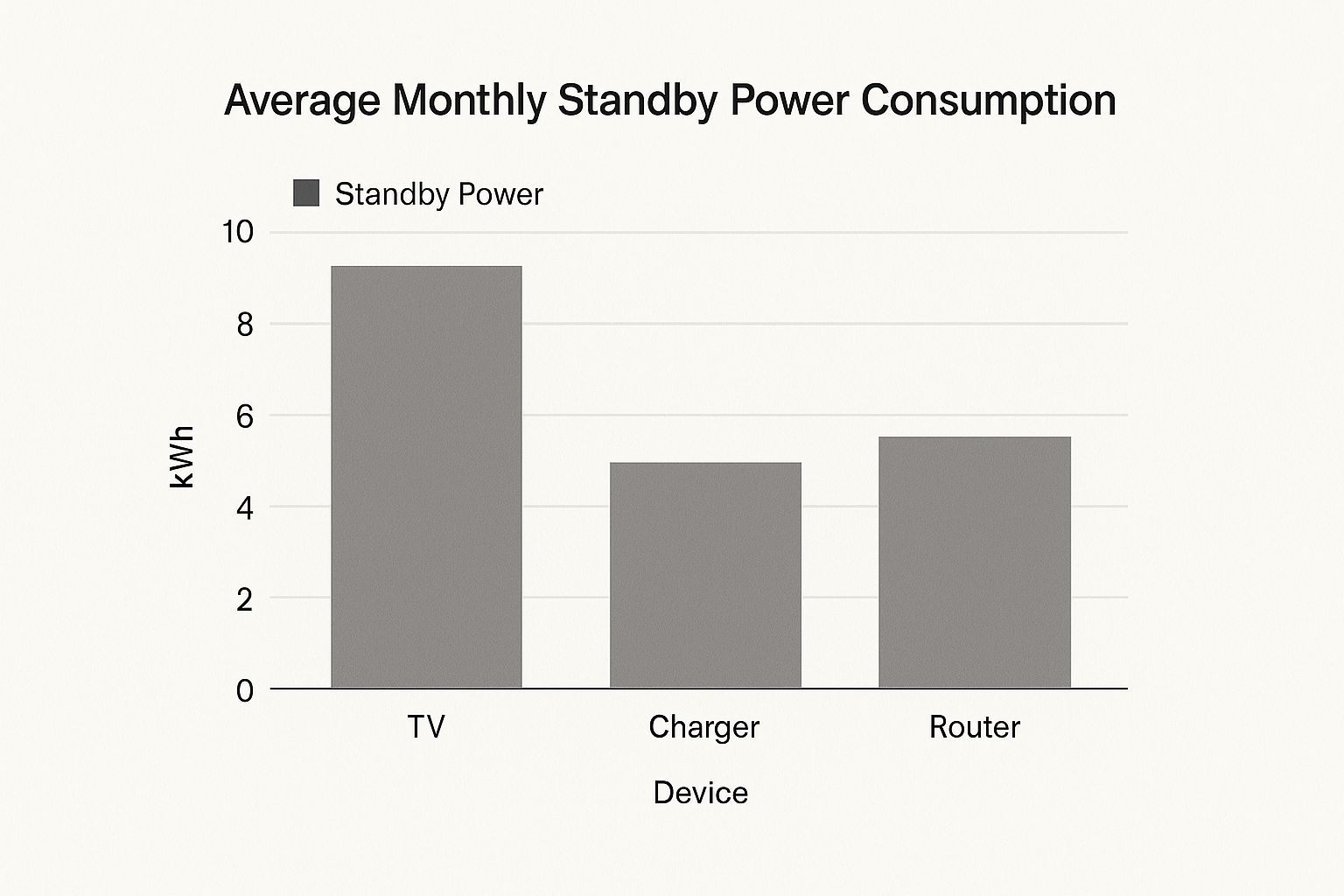
As you can see, those gadgets on standby are constantly sipping power. Over a few months, that small trickle becomes a noticeable drain on your wallet.
To give you a clearer picture of how these regional differences play out, here’s a snapshot of what households are facing across the country.
| State/Territory | Average Annual Bill Estimate | Key Influencing Factors |
|---|---|---|
| NSW | ~$1,800 | High network costs; mix of coal and renewables. |
| VIC | ~$1,650 | Competitive retail market; significant renewable energy investment. |
| QLD | ~$1,950 | Large, dispersed network; climate driving high A/C usage. |
| SA | ~$2,200 | High reliance on renewables and gas; significant network charges. |
| WA | ~$1,850 | Separate grid (SWIS); government-regulated prices. |
| TAS | ~$2,000 | Heavily reliant on hydro; Basslink cable costs impact prices. |
| ACT | ~$2,300 | 100% renewable contracts; network costs are a key factor. |
| NT | ~$2,100 | Isolated grids; heavy reliance on gas generation. |
Note: These figures are estimates and can vary based on individual usage and retailer plans.
This table really highlights that your location is as much a factor in your bill as your own energy habits.
These regional factors often lead to sudden, sharp price increases. For example, households in the Australian Capital Territory recently saw their annual bills jump by about 10.1%, adding an extra $214 per year. Over in the Northern Territory, government-set tariffs pushed prices up by 4%. These hikes aren’t arbitrary; they’re driven by rising energy supply costs and specific regulatory changes. You can dig deeper into these average bill variations at Econnex.com.au.
Understanding your bill is about more than just checking the total. It’s about knowing that your final cost is a combination of your personal usage habits and the unique energy market of the state you live in.
Once you’re familiar with both your own consumption patterns and your local supply charges, you’re in a much better position to hunt for a more competitive deal. This knowledge is your best tool for comparing energy plans and finding one that actually fits your household and your location.
Alright, so you’ve figured out why your electricity bill is looking a bit scary. That’s the first hurdle cleared. Now for the good part: taking back control.
The great news is that you don’t need to completely overhaul your life to see a real drop in your power usage. It’s all about building smarter habits and making a few targeted upgrades. You can make a serious dent in your next bill by focusing on the small stuff that adds up.
We’ll walk you through everything from zero-cost habit changes to small investments that deliver a big return. My advice? Start with the easy wins to get some momentum going.
The quickest way to cut your bill is to simply change how you use energy every day. These habits won’t cost you a cent to adopt, but the savings can start piling up straight away.
Sometimes, a small, strategic investment is all it takes to unlock significant long-term savings. These are the affordable changes that punch well above their weight in energy efficiency. For a much deeper dive, you can find a whole bunch of energy efficiency tips from a Northside electrician to help you out.
Think about your windows. They’re a massive source of heat exchange with the outside world. In summer, they let the blistering sun bake your home, and in winter, they let all your precious warmth escape. This forces your air con and heater to run harder and longer just to keep up.
One of the most effective ways to lower your electricity consumption is by investing in energy-efficient window treatments. Things like insulated blinds, curtains with thermal linings, or even reflective films are designed specifically to minimise this heat transfer. They dramatically improve your home’s ability to hold a stable temperature, which takes a massive load off your air conditioner—tackling one of the biggest power-guzzlers in any home.
Another fantastic upgrade is making the switch to LED lighting. This one is a no-brainer. Modern LEDs use up to 85% less energy and can last up to 25 times longer than those old, power-hungry incandescent bulbs. It’s a simple swap with a huge payoff.
So, you’ve hunted down every energy vampire, tweaked your daily habits, and you’re still staring at a shockingly high electricity bill. If that’s the case, the problem might be deeper than just your power consumption. Sometimes, a high bill is your home’s way of sending up a flare, signalling a serious electrical fault that needs an expert’s attention.
Ignoring these signals isn’t just a drain on your wallet; it can be downright dangerous. Issues like deteriorating wiring or a faulty switchboard aren’t something for a weekend DIY project. They carry a very real risk of electrical fire or shock, quickly turning a financial headache into a genuine safety hazard.
Certain signs are more than just a blip in your usage—they strongly suggest a technical problem is brewing behind your walls. If you spot any of the following, it’s time to put down the tools and get a qualified professional on the phone.
Keep an eye out for these warning signs:
A constantly tripping safety switch is one of the most critical red flags. Think of it as your electrical system’s emergency brake. If it keeps slamming on, it means there’s a recurring danger it’s trying to protect you from. Never, ever ignore it.
If any of these issues sound a little too familiar, finding a trustworthy local electrician near you is the most important next step you can take. A licensed professional can run a full diagnostic to pinpoint the exact cause of the trouble.
They can safely repair faulty wiring, upgrade your switchboard, or identify that one rogue appliance that’s secretly guzzling power. This doesn’t just solve the frustrating mystery of “why is my electricity bill so high?”—it protects your home and, most importantly, your family.
https://www.youtube.com/embed/HkHozg0ckWY
Even after you’ve checked all the usual suspects, it’s natural to have a few more questions. When you’re asking, “why is my electricity bill so high?”, the confusion can be frustrating. Let’s clear up a couple of common points to give you the complete picture.
It’s easy to underestimate just how much old appliances are costing you. That seemingly harmless fridge from the 90s humming away in your garage could genuinely be one of the biggest power drains in your entire home. An appliance that’s over 10-15 years old can use dramatically more electricity than a modern, energy-efficient equivalent.
Let’s take a real-world example. A refrigerator from the early 2000s might easily consume over 700 kWh a year. A new model with a high energy star rating? It could use less than 350 kWh. That’s a massive difference you’ll see printed on your quarterly bill. The simple fact is that older appliances weren’t built to today’s efficiency standards, and their parts degrade over time, forcing them to work much harder to do the same job.
The cost isn’t just about one appliance. A household full of older tech—a plasma TV, an old dishwasher, and a vintage freezer—can collectively add hundreds of dollars to your annual power costs without you even realising it.
Here’s the thing: a smart meter, on its own, doesn’t automatically save you a cent. Its job is to accurately record your electricity usage in real-time and send that information back to your provider. The real savings come from what you do with that data.
By giving you access to a detailed breakdown of your usage, a smart meter empowers you to make smarter decisions. You can:
Think of a smart meter as a tool. It’s incredibly useful, but it only saves you money if you use the insights it provides to change your energy behaviour. It won’t lower your bill by itself.
Still seeing unexplained spikes in your electricity bill after trying everything? It might be time to call in the experts. A hidden electrical fault could be the culprit. At DLG Electrical, our licensed professionals can diagnose and repair issues safely, ensuring your home is both energy-efficient and secure. Contact us today for a free quote and peace of mind.

Master Electrician with over 30 years of experience. Founded DLG Electrical in 2005 after international project work including electrical installations at Stamford Bridge Stadium, London(Home of Chelsea FC).

Local Electricians that can fix all Electric Hot water Systems.
Motion sensor lights are a versatile addition to any home, offering nu
