83 Jean St, Grange QLD 4051
Mon-Fri 07:30 AM - 04:00 PM - Sat - 8:00 - 12 - Sunday Closed
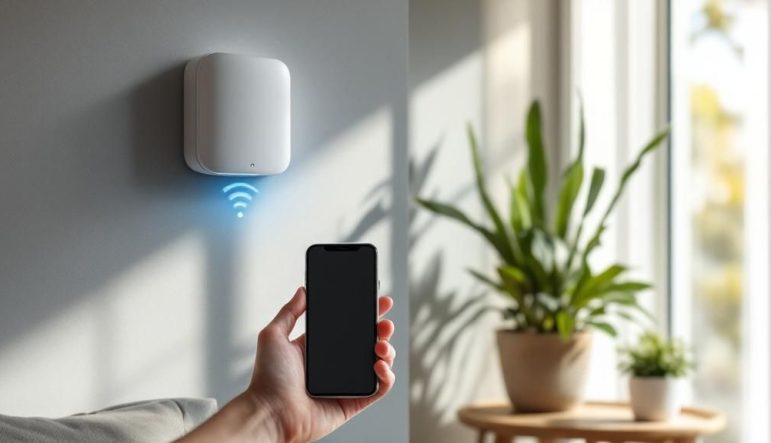
A wifi smoke alarm is a game-changer for home safety. It connects directly to your home’s wireless network, giving it the power to send instant alerts straight to your smartphone, no matter where you happen to be.
Think of it this way: a traditional alarm is great at making a lot of noise inside your house, but what if no one’s home to hear it? A WiFi alarm does that too, but it also shoots you an urgent notification, making sure you know what’s happening the second it starts. It’s a simple upgrade that delivers crucial, real-time information when it matters most.
Let’s be honest, a standard smoke alarm is a pretty basic, standalone device. When it sniffs out smoke, it blasts a loud siren, but its warning is trapped within the four walls of your home. If you’re out, that warning goes completely unheard until it’s far too late.
A WiFi smoke alarm completely flips this script by adding a smart, connected layer.
At its heart, the device works just like any top-quality, modern smoke detector, often using photoelectric sensors to pick up on those slow, smouldering fires that can be so dangerous. The real magic is in its built-in WiFi module. This tiny bit of tech lets the alarm talk to your home’s internet router. When it’s triggered, it does two things at once: it sounds the loud local siren and sends a signal through the cloud to an app on your phone.
This ability to notify you remotely is what truly transforms home safety. You could be at your desk at work, away on holiday, or just down at the shops, and you’ll still be the first to know about a potential fire at home.
Knowing immediately means you can act immediately—whether that’s calling 000 yourself or asking a neighbour to check things out. This can slash emergency response times and dramatically reduce the potential damage.
A WiFi smoke alarm closes the information gap. It turns a passive alert system into an active safety solution that keeps you connected and in control, even when you’re hundreds of kilometres away.
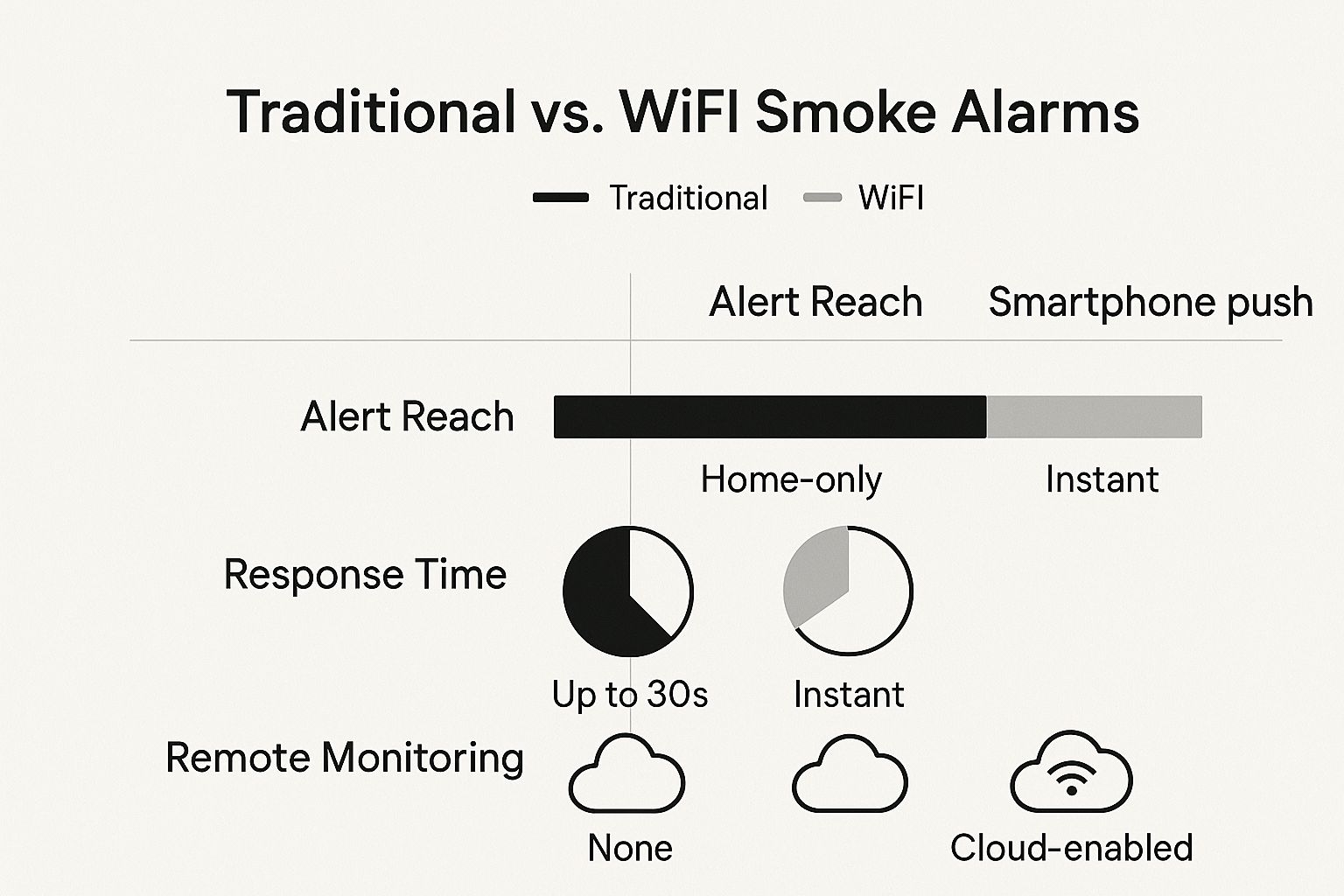
To really see the difference, let’s look at a side-by-side comparison.
The table below breaks down the key functional differences, showing exactly where a connected alarm pulls ahead.
| Feature | Traditional Smoke Alarm | WiFi Smoke Alarm |
|---|---|---|
| Local Siren | Yes, loud audible alarm | Yes, loud audible alarm |
| Alert Method | Sound only | Sound + Smartphone Notification |
| Remote Monitoring | No | Yes, via a dedicated app |
| Low Battery Alert | Audible beeps/chirps | Audible beeps + App notification |
| Interconnectivity | Often requires hardwiring | Wireless interconnection via WiFi |
| Peace of Mind | Only when you are home | 24/7, wherever you are |
As you can see, while both do the fundamental job of detecting smoke, the WiFi model adds a layer of communication that a standard device simply can’t match.
This shift towards connected safety isn’t just a niche trend; it’s growing fast. The global smoke alarm market was valued at around USD 2.2 billion in 2025 and is tipped to more than double by 2035, hitting a projected USD 4.6 billion. Here in Australia, with increasing urban density and stricter building codes, the demand for smarter fire safety solutions is only getting stronger.
WiFi smoke alarms are a key part of the expanding world of the Internet of Things (IoT). These devices are designed to integrate seamlessly into a smart home ecosystem. To get a better sense of how they fit into the bigger picture, it’s helpful to understand the wider context of IoT gateway options and best practices.
A modern wifi smoke alarm does far more than just screech when it detects smoke. It’s a smart device packed with features designed to give you clearer information, more control, and genuine peace of mind. These aren’t just technical bells and whistles; they’re practical upgrades that make your home a safer place.
The biggest leap forward is the instant smartphone notification. The second your alarm detects a potential hazard, it pings your phone with an alert. This means you’re always the first to know, giving you precious seconds to react.
Forget generic warnings. Today’s smart alarms give you specific, actionable information, so you know exactly what’s happening at home.
These intelligent alerts transform a simple noisemaker into a vital information hub.
The ability to silence false alarms from your phone is a true game-changer. Burnt toast no longer means finding a chair and waving a tea towel at the ceiling; a simple tap in the app quiets the alarm instantly.
How do you know your smoke alarm is actually working? With traditional alarms, you have to remember to manually press a test button—a task that’s all too easy to forget.
This is where wifi smoke alarms really shine. They perform automated self-tests, regularly checking their own sensors, batteries, and network connection without making a sound. The system runs these diagnostics in the background, usually daily or weekly, and reports its status back to your app. You get constant, visible confirmation that your safety net is active and ready to go.
Of course, for any smart device to work reliably, its connection needs to be secure. A compromised network can affect your alarm’s performance, so it’s worth understanding the basics of network security assessments to ensure your home network is robust. This proactive approach ensures the intelligent features you rely on are always operational when you need them most.
When you start looking into modern smoke alarms, it’s easy to get tangled up in the terminology. Words like ‘wireless’, ‘interconnected’, and ‘WiFi’ get thrown around a lot, sometimes interchangeably. But they actually describe two very different, powerful technologies. Getting the distinction right is crucial for picking a safety system that truly protects your home. It’s not just about getting an alert; it’s about getting the right alert to the right people, exactly when it matters most.
Think of a standard interconnected system as a tight-knit, highly efficient local team. These alarms chat with each other using their own private radio frequency (RF) signal, which has nothing to do with your home’s internet.
When one alarm in this network senses smoke, it sends a signal to every other alarm, and they all start screaming at once. It’s a massive leap in safety—a fire starting in the garage is instantly announced in the upstairs bedrooms, giving everyone the earliest possible warning. We dive deeper into how these setups work in our detailed guide on wireless interconnected smoke alarms.
Now, imagine that same local team has a correspondent who can report back from anywhere in the world. That’s your WiFi component. A WiFi smoke alarm takes that critical local alert and broadcasts it out over the internet. It’s the bridge between your home’s internal safety network and your smartphone, no matter where you happen to be.
This function is totally separate from the local interconnection. While the interconnected alarms are busy waking everyone inside the house, the WiFi feature is alerting you when you’re at work, on holiday, or just down at the shops.
The most robust home safety solution combines both technologies. Interconnection provides the immediate, in-house warning, while WiFi provides the essential remote notification, creating a comprehensive safety net.
This dual-technology approach really does offer the best of both worlds, giving you complete protection. Here’s a simple scenario of how they work together:
This combination is a game-changer for Australian homeowners, especially when it comes to upgrading older properties. Here in Australia, wireless interconnected alarms are a popular and cost-effective way to meet compliance without the hassle of running new cables, which is a lifesaver in homes with concrete ceilings or heritage restrictions.
While not mandated everywhere, authorities strongly recommend them for that crucial early warning. Adding WiFi on top of this trusted RF technology gives you all the benefits of a modern smart home without having to tear your walls apart.
A sophisticated Wi-Fi smoke alarm offers incredible peace of mind, but it’s only as good as where you put it. Proper placement isn’t just a friendly suggestion; it’s the single most critical factor in making sure your system gives you the early warning your family needs when every second counts.
Think of it like a security guard—if they’re not positioned to see the threat, they can’t raise the alarm in time. It’s the same with your smoke alarms.
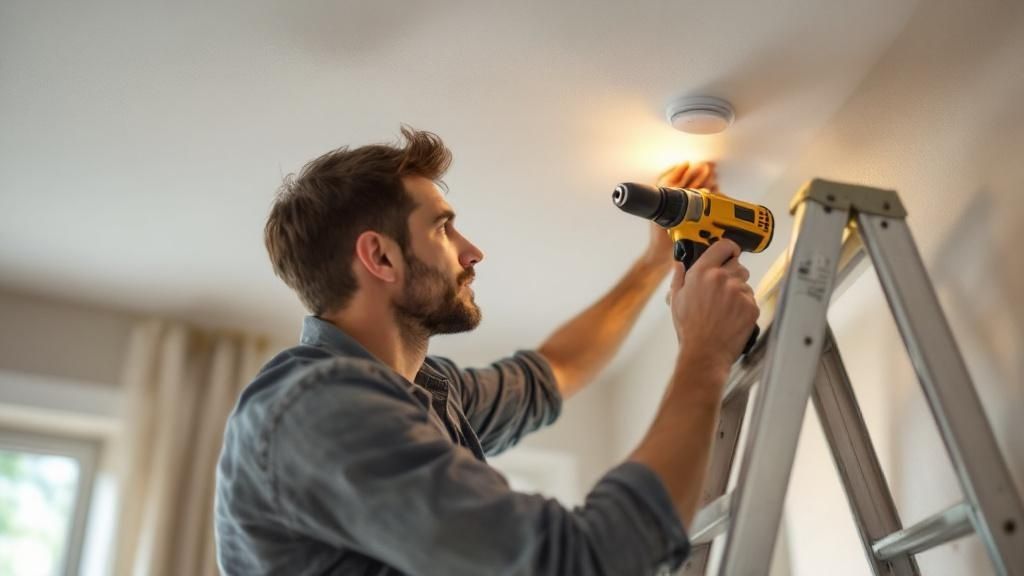
For total coverage in Australian homes, the rules are clear and non-negotiable. Following these guidelines ensures there are no dangerous blind spots in your safety net.
This kind of strategic placement creates layers of protection, making sure an alarm is always close to potential fire hot spots and your sleeping family members.
Knowing where not to put your alarms is just as important. Installing them in the wrong spot can lead to a nightmare of false alarms. Not only is this incredibly annoying, but it can also lead to people ignoring or, even worse, disabling the very device meant to save their lives.
Steer clear of installing smoke alarms too close to kitchens and bathrooms. Cooking fumes, burnt toast, and steam are the usual suspects when it comes to nuisance alerts. A good rule of thumb is to keep alarms at least three metres away from cooking appliances and bathroom doors. This simple step will save you from those frustrating false triggers.
When it comes to picking a Wi-Fi smoke alarm, you’ll generally find two main types: battery-powered units you can install yourself and hardwired models that need a professional touch.
Battery-powered alarms are designed for easy DIY installation. You can pop one on the ceiling or wall in minutes, connect it to your Wi-Fi, and you’re good to go. They’re a fantastic option for adding protection to new areas without the hassle of calling an electrician.
Hardwired alarms, on the other hand, are connected directly to your home’s electrical wiring and must be installed by a licensed electrician. While the initial setup requires a pro like the team at DLG Electrical, they offer far superior reliability. These units almost always have a backup battery, so they keep working even if the power goes out.
Many Australian regulations now mandate hardwired, interconnected smoke alarms in new builds and major renovations. Getting a professional involved ensures your installation is not only safe but also fully compliant with all local laws.
Finally, don’t forget the “Wi-Fi” part of your smoke alarm. For all those smart features to work, it needs a stable connection to your home network. If the signal is weak, you won’t get those critical notifications on your phone.
Before you permanently mount your new alarm, hold it in the exact spot you plan to install it and use the manufacturer’s app to check the signal strength. If it’s weak or patchy, you might need to shift it slightly or look into a Wi-Fi extender to boost your network’s reach. It’s a simple check that guarantees the smart features you’re paying for will be there for you when it really matters.
Navigating the web of Australian safety regulations can feel daunting, but getting it right is non-negotiable when it comes to the safety of your family or tenants. A WiFi smoke alarm adds a powerful, modern layer of protection, but its core technology must first meet strict national and state-based legal requirements.

The key standard you need to look for is AS 3786:2014. This code is your guarantee that the alarm itself has been rigorously tested and approved for use in Australian homes. It’s the absolute baseline for compliance, ensuring the device you install meets high standards for performance and reliability.
Beyond this national standard, each state and territory has its own specific legislation, particularly around how and where alarms must be installed. This is where things can get a bit complex.
While the laws vary slightly between states, several key principles are becoming common across Australia to provide the best possible protection. Getting your head around these helps you make a compliant choice.
Think of it this way: compliance is the solid foundation, and WiFi is the high-tech extension. You must have that compliant foundation in place before you can add the smart features. A fancy app is useless if the alarm itself doesn’t meet the legal standard for actually detecting a fire.
To give you an idea of the landscape, here’s a simplified breakdown of what’s required across Australia. Keep in mind that this is just a summary, and the rules can be quite detailed.
| State/Territory | Key Requirement Summary (e.g., Interconnection, Type) |
|---|---|
| Queensland (QLD) | All alarms must be interconnected, photoelectric, and hardwired or have a 10-year battery. |
| New South Wales (NSW) | Minimum of one alarm per level. Interconnection required in new homes. Photoelectric preferred. |
| Victoria (VIC) | Hardwired, interconnected alarms required in new homes. All homes must have at least one working alarm. |
| South Australia (SA) | Interconnected alarms required for all new homes. Existing homes must have alarms. |
| Western Australia (WA) | Hardwired alarms required in all new homes. Battery-powered alarms permitted in older homes. |
| Tasmania (TAS) | Hardwired, interconnected alarms in new homes. All rental properties must comply. |
| Australian Capital Territory (ACT) | Hardwired, interconnected alarms required in new homes and substantially renovated properties. |
| Northern Territory (NT) | All homes must have working smoke alarms. Interconnection is best practice. |
This table highlights just how important it is to know your local laws. What’s compliant in one state might not be enough in another, especially for rental properties.
For landlords and property managers, the responsibility is even greater. You have a legal duty of care to ensure your rental properties are fitted with compliant, functioning smoke alarms. Failing to do so can result in significant fines and, more importantly, put your tenants’ lives at risk.
The rules for rental properties are often stricter, covering everything from the type and placement of alarms to mandatory testing and maintenance schedules. Because legislation can change and varies by state, staying on top of your obligations is crucial. For instance, you can get a deeper understanding by reading our guide on the current smoke alarm legislation in Queensland.
Ensuring every installation is 100% compliant with all relevant standards and local laws is paramount. Partnering with a licensed expert like DLG Electrical removes the guesswork, guaranteeing your property is not just smart but, most importantly, safe and legal.
Look, a Wi-Fi smoke alarm is a brilliant piece of safety tech, but it’s only as good as its setup. While a DIY approach might seem like a way to save a few dollars, getting it done by a licensed expert like DLG Electrical is the difference between simply having an alarm and having a reliable safety system that actually works when you need it most.
It’s about more than just ticking a compliance box. Our electricians know exactly where to place each alarm for the quickest possible smoke detection, making sure there are no dangerous blind spots in your home. We also properly test your home’s network to guarantee a strong, stable Wi-Fi signal reaches every single device—that’s what makes those critical remote alerts 100% dependable.
Choosing a professional means you’re investing in certainty. It’s the peace of mind that comes from knowing your system is correctly installed, fully compliant with Australian standards, and ready to protect your family without fail.
And our job isn’t done once the alarms are on the ceiling. We handle the complete setup of all the smart features and walk you through how to use the app, so you feel totally confident managing your new system. From the first chat to ongoing support, we make upgrading your home’s fire safety straightforward and professional.
As smart home technology starts showing up in more and more places, it’s only natural to have a few questions about how a modern wifi smoke alarm fits into your home. Let’s tackle some of the most common queries we hear from homeowners, helping you get a clear picture of what upgrading really means for your family’s safety.
This is easily the number one concern, and for good reason. The great news is, if your Wi-Fi network drops out, your smoke alarm still works perfectly as a local detector. It’s designed to be a standalone safety device first and a smart device second.
A loud, piercing siren will sound to alert everyone inside the house, just like any other high-quality alarm. If your alarms are interconnected wirelessly, they’ll all still trigger together. The only thing you lose during an internet outage is the remote notification to your smartphone. Your primary, in-home protection is never compromised.
That really depends on the model you choose. Many of the newer WiFi smoke alarms we install come with a sealed, 10-year lithium battery. This is a game-changer because it’s designed to last the entire lifespan of the unit, meaning you never have to worry about changing batteries again.
For models with replaceable batteries, you can generally expect them to last between one and two years. But one of the best perks of a connected alarm is that it sends a low-battery warning straight to your phone, giving you plenty of notice to sort it out. No more annoying 3 am chirping!
While battery-powered models are often designed for a straightforward DIY installation, Australian law is crystal clear when it comes to hardwired alarms: they must be installed by a licensed electrician.
This rule applies whether you’re replacing an old hardwired unit or installing a new system from scratch. For peace of mind, guaranteed compliance, and correct placement for optimal performance, getting a professional to handle it is always the safest and most reliable path. To get the full picture, check out our detailed article on the benefits of a smoke detector with wifi.
Ready to upgrade to a smarter, safer home? Contact DLG Electrical for a free quote on professional WiFi smoke alarm installation. https://dlgelectrical.com.au

Master Electrician with over 30 years of experience. Founded DLG Electrical in 2005 after international project work including electrical installations at Stamford Bridge Stadium, London(Home of Chelsea FC).

Local Electricians that can fix all Electric Hot water Systems.
Motion sensor lights are a versatile addition to any home, offering nu
