83 Jean St, Grange QLD 4051
Mon-Fri 07:30 AM - 04:00 PM - Sat - 8:00 - 12 - Sunday Closed
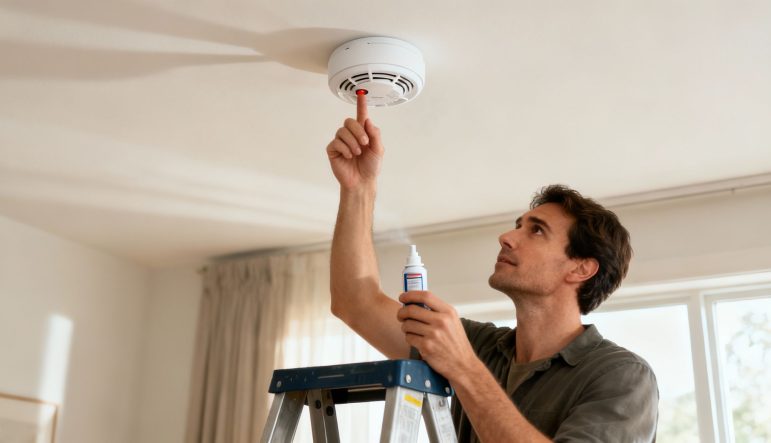
It takes more than a quick press of the “test” button to know if your smoke detector will actually save lives. A proper check involves a physical inspection, a real-world sensor test, and a bit of routine cleaning to be truly effective.
Considering a working smoke alarm can cut the risk of a fire-related fatality in half, these checks are one of the most critical parts of home and workplace safety.
Let’s move beyond the simple button press and walk through what it really takes to ensure your alarms will function correctly in an emergency. A comprehensive check is the only way to have complete confidence in these life-saving devices.
Here in Australia, checking and maintaining smoke detectors is a serious business, driven by some of the most stringent fire safety regulations in the world. According to Fire and Rescue NSW, a preventable fire-related death occurs in an Australian home nearly every week. It’s why new regulations now mandate interconnected photoelectric smoke alarms in every bedroom and hallway. If you own property, it’s vital to understand the updated Australian smoke alarm rules for 2025.
This visual guide breaks down the process into three core actions: Inspect, Test, and Maintain.
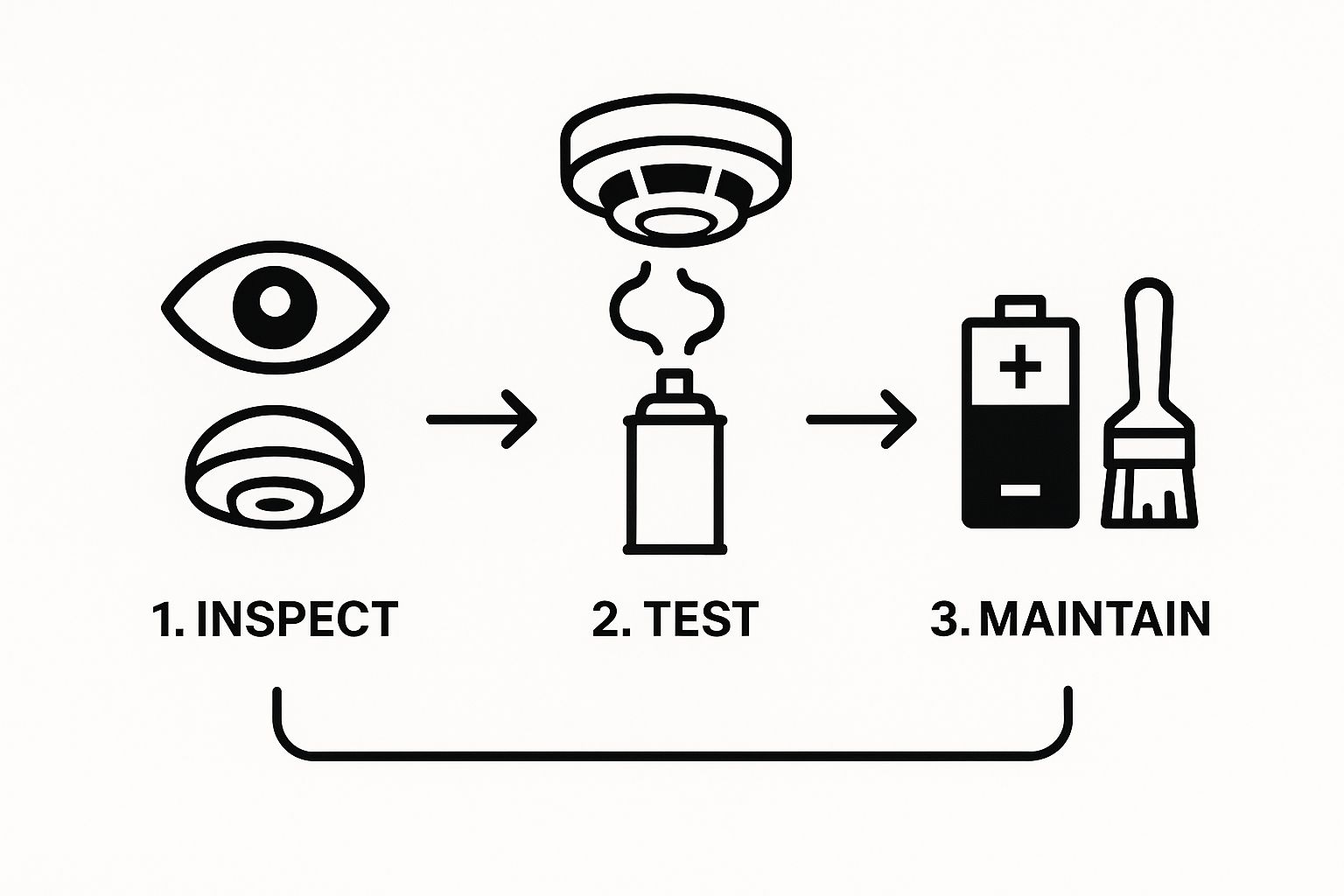
As the infographic shows, a complete check isn’t a one-off task but a continuous cycle. Let’s break down what’s involved in each key area:
To make things easier, here’s a quick-reference table that lays out how often you should be performing these key tasks. Sticking to a schedule like this is the best way to stay on top of your fire safety obligations.
| Maintenance Task | Recommended Frequency | Why It’s Critical |
|---|---|---|
| Push the Test Button | Monthly | Confirms the battery and sounder are working. It’s a quick check, not a full test. |
| Clean the Unit | Every 6 months | Prevents dust, insects, and debris from blocking the sensor and causing false alarms. |
| Real Smoke Test | Annually | Verifies the internal smoke sensor is actually functioning and can detect real smoke. |
| Replace the Battery | Annually (or as needed) | Ensures the alarm has power. Many modern alarms have 10-year sealed batteries. |
| Replace the Entire Unit | Every 10 years | Smoke alarm sensors degrade over time. After 10 years, they are no longer reliable. |
Following this simple schedule turns smoke alarm maintenance from a chore you might forget into a routine that could one day save your life or the lives of others.
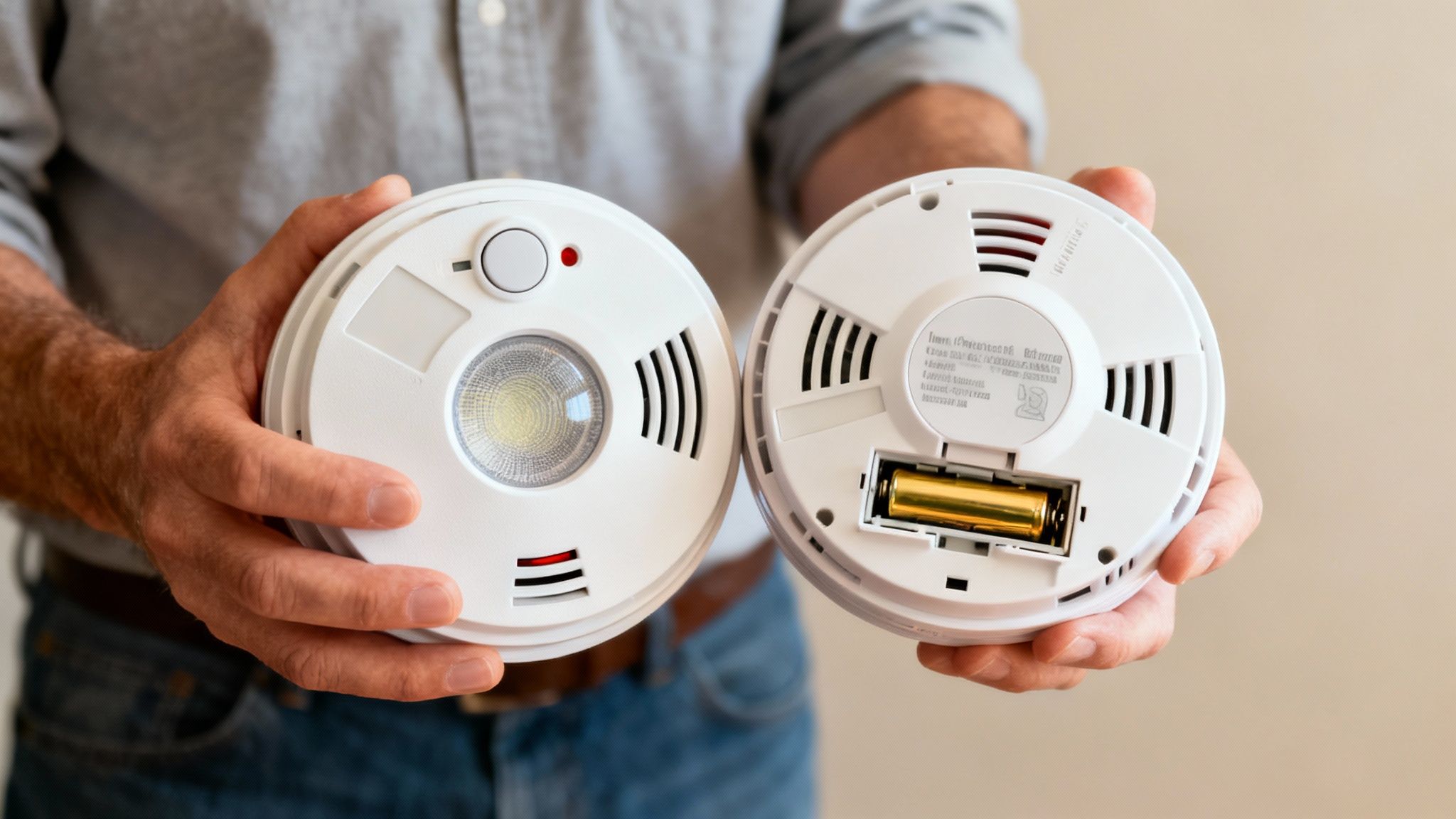
Before you can give your smoke alarms a proper check, you need to know exactly what you’re dealing with. They’re not all built the same, and the differences matter when it comes to how they detect fires and how you should be looking after them.
Most homes will have one of two main types. Photoelectric alarms are your best bet for detecting slow, smouldering fires—the kind that might creep through bedding or furniture, producing heaps of smoke long before any real flames appear. On the other hand, ionisation alarms are typically faster at picking up on fast-flaming fires that produce very little smoke to begin with.
Because they’re so effective against common household fire risks, photoelectric models are now the standard recommended—and often legally required—by Australian building codes.
Figuring out the power source is just as critical. Some alarms are purely battery-operated, which makes changing those batteries annually a non-negotiable job. Others are hard-wired directly into your home’s electrical system, with a battery backup just in case the power goes out. These hard-wired systems are usually interconnected.
When one hard-wired, interconnected alarm detects smoke, every other alarm in the house goes off at the same time. This gives you a much earlier and louder warning, which is absolutely vital in larger or multi-storey homes.
Many modern homes are now fitted with these safer, interconnected systems. If you’re considering an upgrade, it’s worth learning about the benefits of wireless interconnected smoke detectors and how they create a more robust safety net for your family.
If your property is part of a larger complex like an apartment building, it might be part of one of these bigger systems. Getting familiar with multifamily network alarm systems can give you a better understanding of how they all work together. Ultimately, knowing whether your alarm is a standalone unit, hard-wired, or part of a networked system is the first step to testing it properly and keeping everyone safe.
We’ve all done it. That quick press of the test button on the smoke detector is a common monthly habit for many households, and it’s certainly better than nothing. But here’s the hard truth: it doesn’t actually tell you if your alarm can detect smoke.
That little button only confirms two things: the battery has enough juice and the alarm horn is loud. It does absolutely nothing to verify the most critical part—the sensor itself.
Think of it this way: you’re testing the alarm’s ability to make noise, not its ability to sense a fire. A detector with a completely dead or faulty sensor can still pass the button test, giving you a dangerously false sense of security. The only way to truly know if your detector will do its job in an emergency is to see if it responds to something that mimics real smoke.
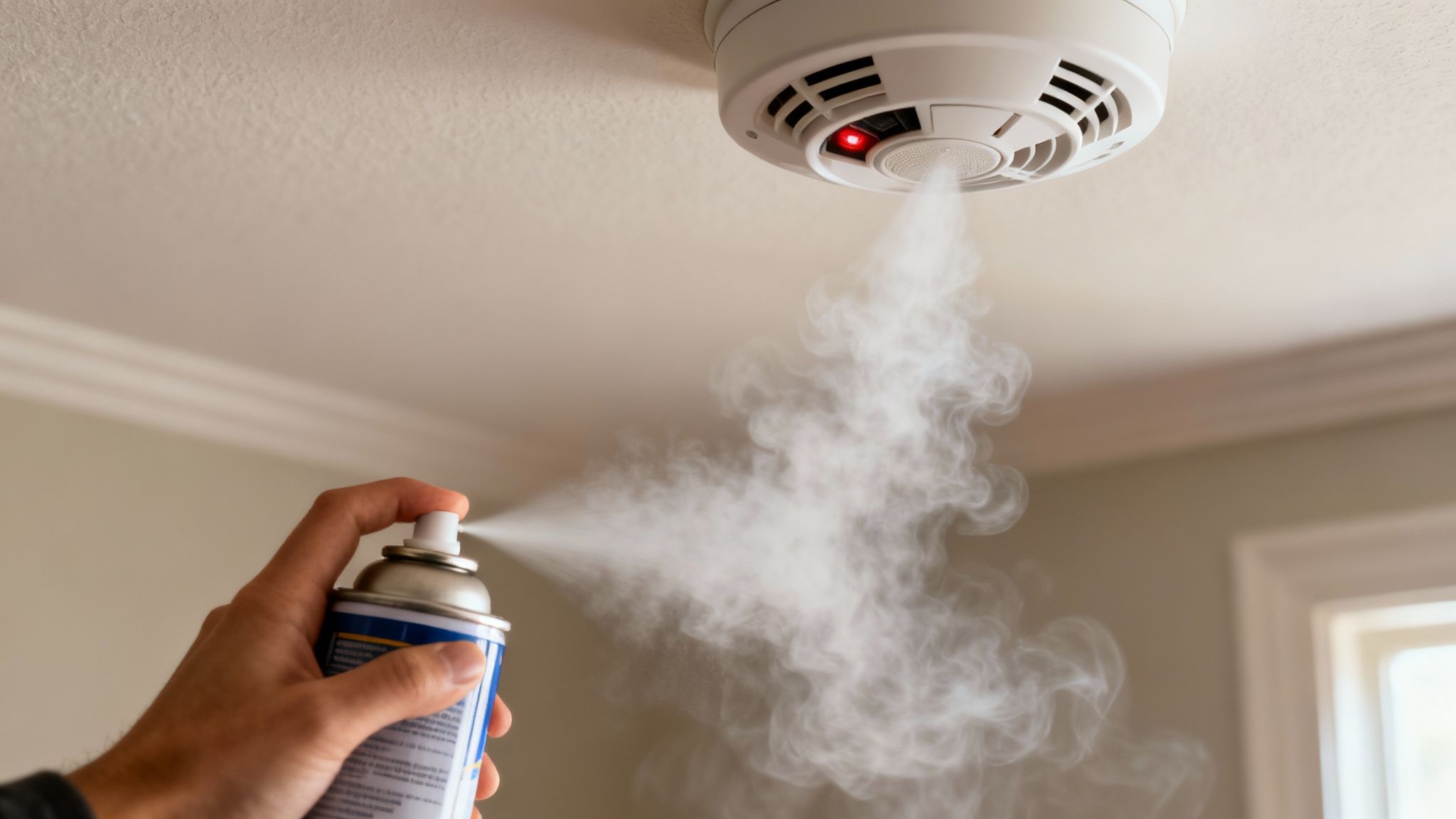
To properly check the sensor, you’ll need a can of aerosol smoke detector tester, which you might hear called “canned smoke.” This is a product specifically designed to safely mimic the particles found in actual smoke, all without creating a fire hazard. It’s the same stuff the pros use.
Getting it right is simple. Just follow these quick guidelines for a far more reliable check:
If that piercing alarm goes off, brilliant. You’ve just confirmed the sensor is working as it should. If you get silence, or just a weak, faltering beep, you could be looking at a serious issue with the unit itself or its power source.
Regular and proper testing is more than just a box-ticking exercise; it’s a proven lifesaver. Australian homes with correctly maintained smoke detectors have up to a 50% lower risk of fatal fire incidents compared to homes without working alarms. If you want to dive deeper, you can learn more about the impact of smoke alarm maintenance on fire safety from official reports.
This more thorough method is the only way to be certain your detector can protect you and your family when it counts. It bridges the critical gap left by the simple push-button test, ensuring the one component designed to actually detect a fire is in perfect working order.
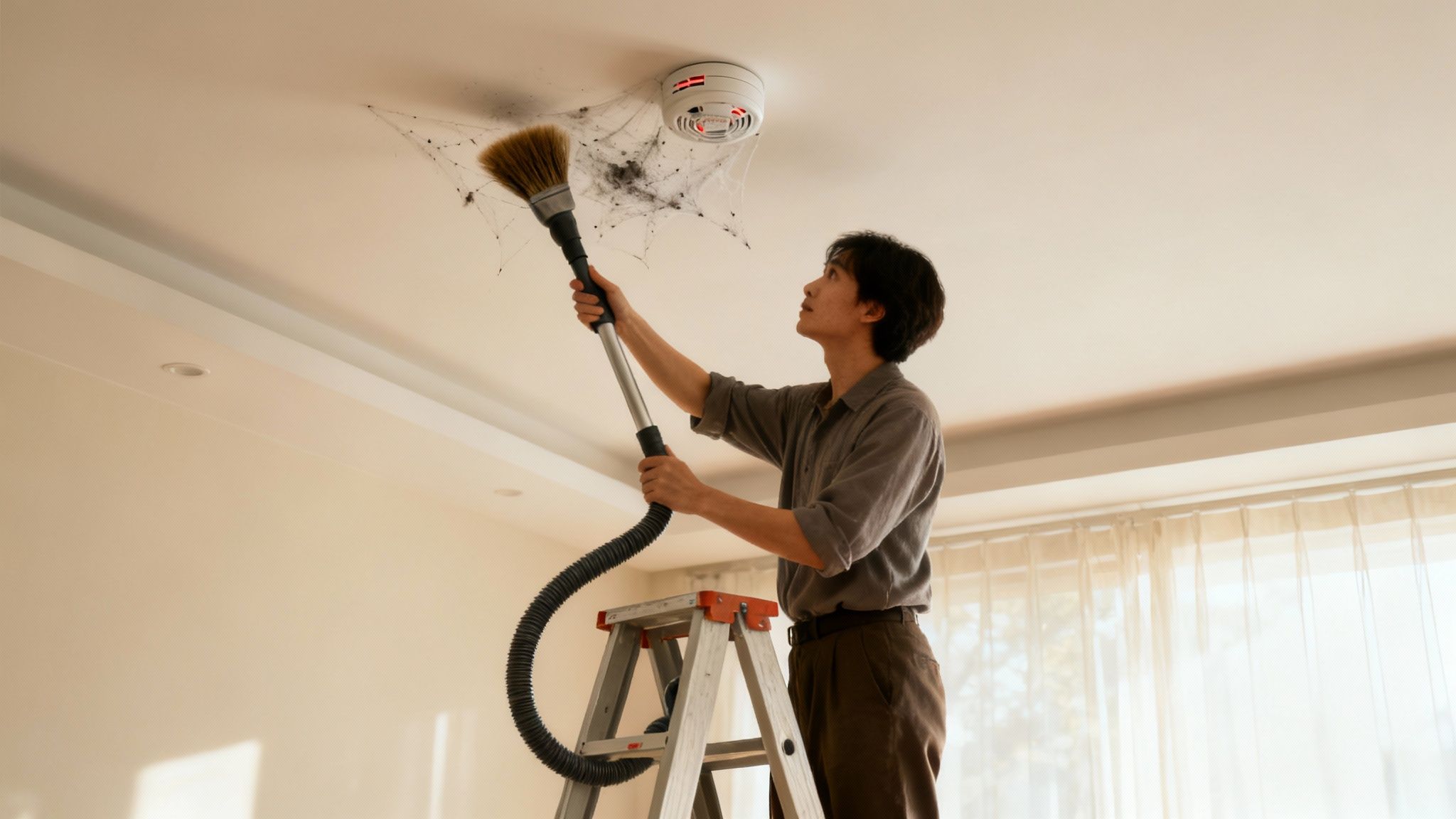
A smoke detector is only useful if its sensors are clean and its battery is fresh. Over time, dust, cobwebs, and even tiny insects can find their way inside the unit, blocking the sensor. This buildup can delay an alert during a real fire, and it’s also the number one cause of those frustrating false alarms that always seem to go off at 3 a.m.
Regular cleaning is a simple but incredibly important part of smoke alarm maintenance. A quick clean every six months can make all the difference, ensuring the internal chamber is clear and ready to detect actual smoke. This little bit of upkeep maintains the detector’s sensitivity and cuts down on those annoying false triggers.
You don’t need any fancy equipment for this—a gentle touch is all that’s required to keep your alarms in top working order.
Even if your alarms are hard-wired into your home’s electrical system, that little backup battery is your only line of defence during a power outage—a time when fire risk can often increase. Because of this, replacing the batteries once a year is completely non-negotiable.
A dead battery is the most common reason a smoke alarm fails to sound during an emergency. Set a recurring annual reminder in your calendar—maybe on a birthday or a public holiday—to make this life-saving task a habit.
When it’s time for a new battery, always use the exact type specified by the manufacturer. Popping in the wrong kind of battery can cause damage or lead to the alarm failing when you need it most. This simple annual task is a core part of regular property maintenance that ensures your home remains safe year-round.
Even the most well-maintained smoke detector won’t last forever. Just like any other piece of electronics in your home, its internal components degrade over time, and that eventually compromises its ability to do its one crucial job: detect a fire. Recognising the signs of an ageing alarm is just as important as knowing how to test it.
Most manufacturers are in agreement: smoke alarms must be replaced every 10 years. This isn’t just a friendly suggestion; it’s a critical safety standard based on the predictable decline of the sensor’s sensitivity. After a decade of service, the device can no longer be trusted to provide the early warning your family or colleagues rely on.
So, how old is your alarm? To find out, you’ll need to safely twist the unit off its mounting bracket. Flip it over, and you should see a label with either a “manufacture date” or a “replace by” date printed on it.
If it only shows the date of manufacture, just add ten years to figure out its expiry. If the alarm is already past that date, it’s time for a new one—no questions asked. An expired alarm is a major safety risk.
But the ten-year rule isn’t the only thing to watch for. There are other clear signs that an alarm needs replacing right away.
Here’s a quick checklist to help you decide if it’s time to install a new smoke alarm. If you spot any of these symptoms, don’t delay.
| Symptom | What It Means | Recommended Action |
|---|---|---|
| Yellowing Plastic Casing | The plastic is degrading from age and exposure to UV light and airborne particles. This is a tell-tale sign the internal parts are also past their prime. | Replace the unit immediately. |
| Frequent False Alarms | While dust can be a culprit, an alarm that constantly chirps or goes off for no reason—even after a good clean—often has a failing sensor. | Clean it first. If the problem persists, replace the alarm. |
| Doesn’t Sound During a Test | If the alarm stays silent during a push-button test or a canned smoke test (even with a fresh battery), it’s completely failed. | Replace it immediately. A silent alarm is a useless alarm. |
| Past the 10-Year Mark | The internal sensor has reached the end of its reliable service life and its sensitivity is compromised. | Replace the alarm without hesitation, even if it seems to be working. |
An outdated or faulty smoke alarm provides a false sense of security, which can be just as dangerous as having no alarm at all.
Key Takeaway: Replacing an outdated smoke alarm is a non-negotiable part of fire safety. An old alarm can’t be trusted and puts lives at risk by creating a dangerous illusion of protection.
When it’s time for a new installation, understanding the professional smoke detector installation cost can help you budget for this essential safety upgrade. Getting it done right ensures your new alarms are fully compliant with local regulations and positioned for optimal performance.
Even a perfectly maintained smoke alarm can act up from time to time. Whether it’s that relentless, high-pitched chirp or a full-blown false alarm in the middle of the night, these issues can be incredibly frustrating.
The good news is, you can often solve the problem yourself with a few simple checks before assuming the unit is faulty.
By far, the most common issue we see is the infamous low-battery chirp. This isn’t the loud, continuous wail you hear in a real emergency. Instead, it’s a single, sharp “chirp” that repeats every 30 to 60 seconds. It’s the alarm’s way of telling you its backup battery is running low and needs to be replaced immediately.
Fixing this is usually as simple as swapping the old battery for a new one. Make sure you use the specific type recommended by the manufacturer. Once it’s in, press and hold the test button for a few seconds to reset the unit and confirm the new battery is working.
If a fresh battery doesn’t quieten it down, there might be something else going on:
A full-blown false alarm—where the siren is screaming but there’s no smoke in sight—is a different beast altogether. These nuisance alarms are not only annoying, but they can also make you lose confidence in your system.
But there’s almost always a logical cause. Understanding why your smoke detector might be going off randomly is the first step to fixing it for good.
The most common culprits are things like cooking fumes from burnt toast, thick steam from a hot shower, or even just high humidity on a muggy Brisbane day. Dust, cobwebs, or even small insects getting inside the sensor chamber are also frequent triggers.
To silence a nuisance alarm, find the “hush” or “silence” button on the unit. Pressing it will usually quieten the alarm for about 10 minutes. Use that time to clear the air by opening a few windows or switching on an exhaust fan. To prevent it from happening again, give the alarm a regular clean with the soft brush attachment on your vacuum cleaner to stop dust from building up.
If you’re dealing with persistent false alarms or just want the peace of mind that your smoke detectors are compliant and working perfectly, the licensed experts at DLG Electrical are here to help. Get in touch with us for a free quote and reliable service.

Master Electrician with over 30 years of experience. Founded DLG Electrical in 2005 after international project work including electrical installations at Stamford Bridge Stadium, London(Home of Chelsea FC).

Local Electricians that can fix all Electric Hot water Systems.
Motion sensor lights are a versatile addition to any home, offering nu
