83 Jean St, Grange QLD 4051
Mon-Fri 07:30 AM - 04:00 PM - Sat - 8:00 - 12 - Sunday Closed
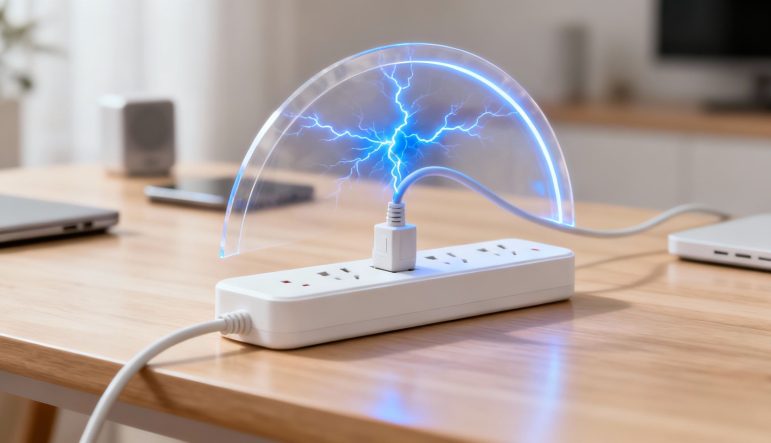
At its core, a surge protector is the essential bodyguard for your valuable electronics. It’s a simple but critical device designed to defend your computers, TVs, and home appliances from those sudden, damaging spikes in electrical voltage. Think of it as a gatekeeper for your home’s power supply.
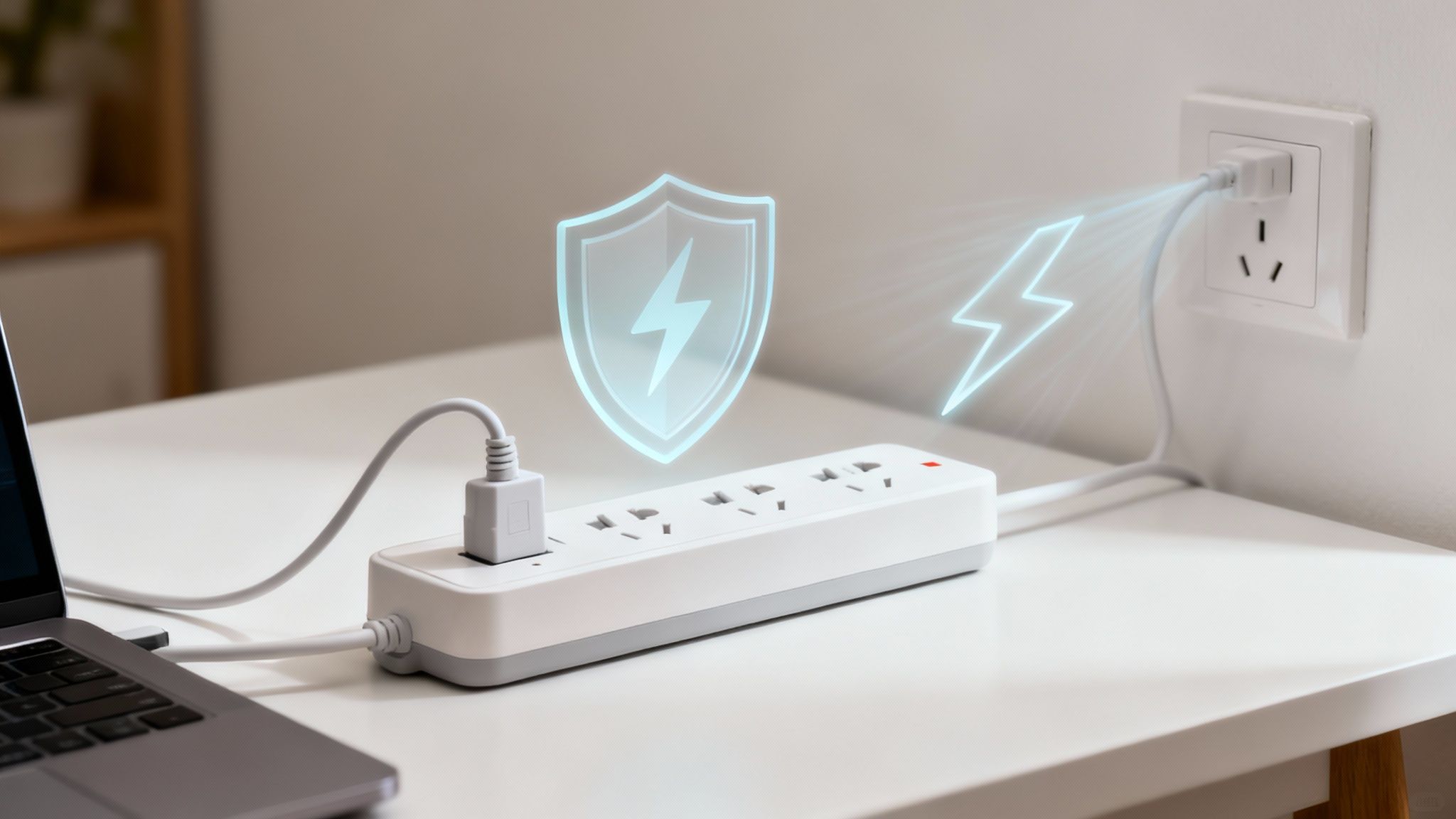
Imagine your home’s electrical wiring is a set of water pipes. The flow of electricity is like the steady, predictable water pressure you get from the tap. A power surge is like a sudden, massive blast of water that rips through the pipe, powerful enough to damage everything connected to it.
A surge protector works by constantly monitoring this electrical “pressure.” It lets the normal, safe level of electricity flow through to your devices without any issue. But the moment it detects a voltage spike that exceeds a safe limit, it instantly diverts that excess energy away from your electronics and safely into your home’s grounding wire.
This protective action is crucial. It’s not just about stopping a catastrophic failure from a nearby lightning strike; it’s also about preserving the delicate internal components of your devices from the small, frequent surges that degrade their performance and shorten their lifespan over time.
These damaging voltage spikes come from two main sources. While most people immediately think of lightning, the vast majority of surges are actually generated from right inside your own home. You can dive deeper into this by exploring the common causes of power surges in our detailed guide.
To give you a quick overview, here’s a simple breakdown of what a surge protector does.
| Key Function | Common Devices Protected | Primary Threats |
|---|---|---|
| To divert excess voltage away from electronics and into the ground wire. | Computers, TVs, gaming consoles, home theatre systems, fridges, washing machines. | Lightning strikes, grid faults, and internal surges from appliances cycling on/off. |
This table shows just how vital these devices are for protecting the expensive, sensitive electronics that are now a staple in every Australian home.
The growing reliance on this kind of tech has made surge protection a non-negotiable part of modern electrical safety. In fact, Australia’s surge protection market hit USD 53.9 million in 2023 and is projected to grow significantly, which really highlights a greater public awareness of these risks.
So, what’s really going on inside that power board when a lightning strike hits a kilometre away? It’s not magic, but it’s close. The real hero is a small, unassuming component working tirelessly in the background: the Metal Oxide Varistor, or MOV for short.
Think of an MOV as a bouncer for your electrical system. Under normal conditions, it’s in a high-resistance state. It just stands there, letting the standard 240-volt current flow through to your devices exactly as it should. Nothing to see here.
But the moment a voltage spike hits—even one that lasts a microsecond—that MOV springs into action.
When the voltage shoots past a safe level, the MOV’s physical properties instantly change. Its resistance drops to almost zero, creating a super-easy escape route for that sudden flood of excess electricity.
Instead of frying your sensitive electronics, this damaging energy is safely diverted. It travels through the MOV and into your home’s grounding wire, an essential safety feature designed to dissipate excess current harmlessly into the earth. The entire process happens in nanoseconds—literally faster than you can blink.
The MOV is a sacrificial component. It takes the hit to protect your gear, but absorbing that energy causes it to degrade a little bit each time. Every surge it stops, big or small, wears it out and reduces its ability to protect you in the future.
It’s critical to understand that the MOV doesn’t block the surge; it diverts it. This is precisely why a properly installed grounding system is non-negotiable for a surge protector to work. If there’s no clear path to the ground, that diverted energy has nowhere to go and can still cause plenty of damage.
To figure out how much punishment a surge protector can take, you need to check its joule rating. A joule is simply a unit of energy. In this context, the joule rating tells you how much total energy the MOVs inside can absorb before they fail for good.
Here’s a simple breakdown:
A higher joule rating means the surge protector can handle either one massive surge or many smaller surges over its lifespan before its protective parts are spent. For expensive gear like home theatre systems or computers with irreplaceable data, you should be looking for a rating of 2,000 joules or more. It’s the best way to ensure you have robust protection when you really need it.
Knowing your electronics need protection is a great first step, but not all surge protection is built the same. The right choice for you really boils down to your needs, your budget, and how much security you want for your property. The two main options on the table are point-of-use protectors and whole-house systems.
These choices aren’t mutually exclusive, either. In fact, the most bulletproof strategy often involves using a combination of both. Let’s break down each type so you can figure out what’s best for your home or business.
This is the kind of surge protector most of us are familiar with. It often looks just like a regular power board, but inside, it contains the vital MOV components needed to stop a power surge in its tracks. They’re designed to protect a specific device or a small cluster of electronics plugged into them.
It’s a common—and potentially very expensive—mistake to think that any old multi-outlet power board is also a surge protector. A basic power board is just an extension cord with more sockets; it offers zero protection against voltage spikes. Always check the packaging for a specific joule rating to be sure you’re buying a genuine surge protector.
For truly comprehensive protection, a whole-house surge protector is the gold standard. Also known as a Type 1 or Type 2 Surge Protection Device (SPD), this bit of kit is installed directly into your main electrical switchboard by a qualified electrician.
Instead of protecting one device at a time, it guards your entire electrical system. Think of it as the first line of defence, stopping powerful external surges right at the source before they even get a chance to enter your home’s wiring. This infographic neatly shows the simple logic of how it works to divert dangerous voltage away from your gear.
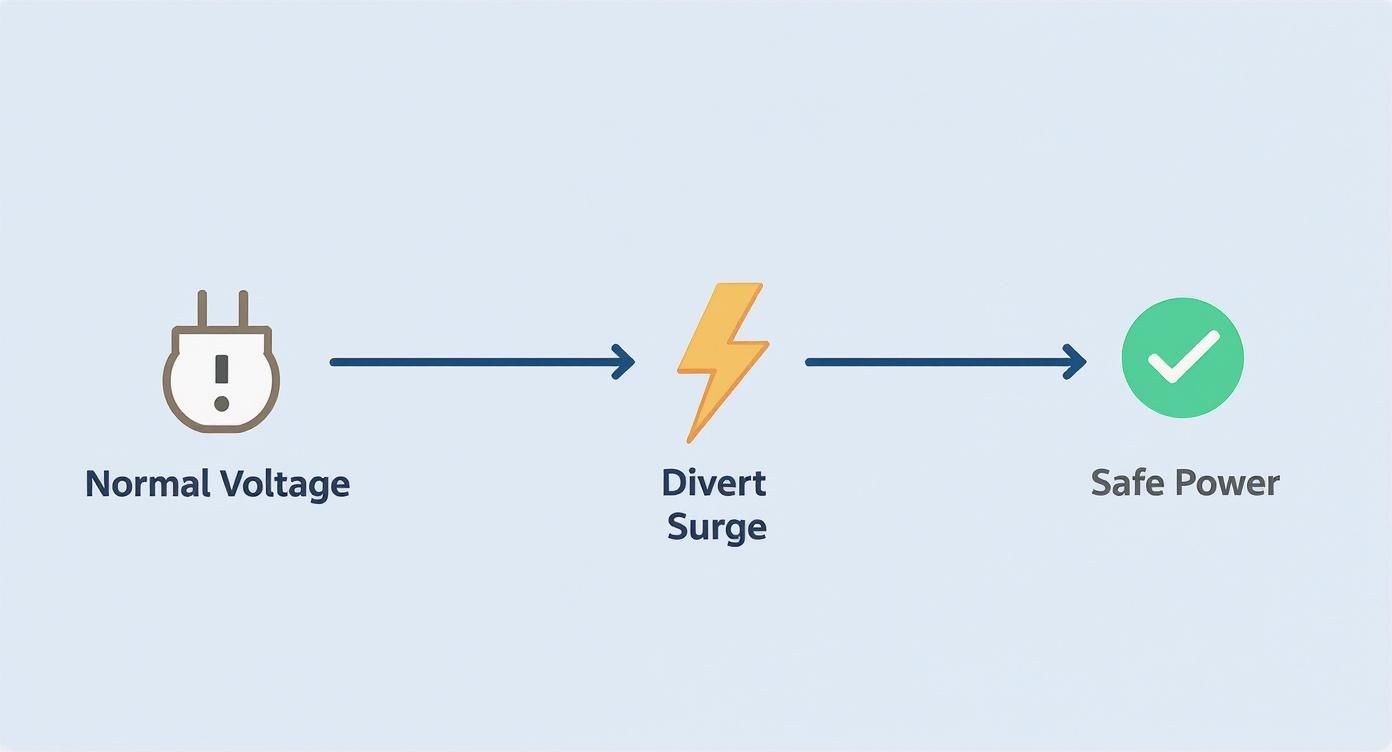
This really gets to the core of what an SPD does: it spots harmful excess voltage and redirects it safely, ensuring only clean, stable power reaches your outlets.
A whole-house SPD is essential for protecting not just your plug-in gadgets but also your major hardwired appliances. This includes your hot water system, smart lighting, and everything else connected to your home’s circuitry.
Given it connects directly to your mains power, installing a whole-house SPD is definitely not a DIY job. It must be done by a licensed electrician to ensure it’s fitted safely and complies with all Australian standards. This is especially true in older homes, where the installation might reveal other safety upgrades are needed. You can learn more by reading our guide on the importance of professional switchboard upgrades in Brisbane.
The market in Australia shows a clear trend towards these more permanent, robust solutions. In 2023, hard-wired surge protection devices were the largest segment, pulling in a 44.53% revenue share. This tells us that Aussies are strongly favouring comprehensive, professionally installed systems for total peace of mind. You can find more insights on the Australian surge protection market on grandviewresearch.com.
To make the choice clearer, here’s a side-by-side look at how these two types of surge protection stack up.
| Feature | Point-of-Use Protector | Whole-House SPD |
|---|---|---|
| Coverage | Protects only the devices plugged directly into it. | Protects every circuit and outlet in the entire property. |
| Protection Scope | Guards against smaller, internal surges. | First line of defence against large, external surges (e.g., lightning). |
| Installation | DIY plug-and-play. No electrician needed. | Requires professional installation by a licensed electrician. |
| Appliances Covered | Electronics like TVs, computers, and gaming consoles. | All electrical devices, including hardwired items like ovens, AC, and hot water systems. |
| Cost | Lower upfront cost ($30 – $150). | Higher upfront cost ($300+ plus installation). |
| Best Use Case | Targeted protection for valuable electronics. | Comprehensive “set and forget” protection for an entire home or business. |
Ultimately, using both types together offers a layered defence. The whole-house SPD handles the big, external threats, while point-of-use protectors clean up any smaller, residual surges, giving your most sensitive electronics maximum protection.
Walking down the electrical aisle at Bunnings can feel a bit much. The boxes are plastered with technical specs and numbers that don’t mean a lot to most people. But if you can get your head around just three key numbers, you’ll know exactly what level of defence you’re buying for your electronics.
Think of these specs as the device’s stat sheet—telling you how strong, fast, and sensitive it is. Getting a handle on them is the difference between buying a genuine bodyguard for your gear and accidentally picking up a glorified extension cord.
The first and most obvious number you’ll see is the joule rating. A joule is simply a unit of energy. This rating tells you exactly how much energy the surge protector can absorb over its lifetime before its internal parts give up the ghost. It’s basically the size of its energy shield.
A higher joule rating is always better. It means the device can handle a single, massive surge or soak up countless smaller hits over the years.
A good analogy is to think of it like a boxer’s chin. A protector with a high joule rating can take a massive haymaker or endure a long series of jabs before it’s knocked out for good. A lower-rated one will go down for the count much, much sooner.
Next up, you’ll see something called clamping voltage, sometimes listed as the Voltage Protection Rating (VPR). This number tells you at what voltage the surge protector actually wakes up and starts diverting the dangerous excess energy away from your equipment. For this spec, a lower number is always better.
A lower clamping voltage means the protector will react to a much smaller, less intense spike, giving you more sensitive protection. Here in Australia, our standard voltage is 240V. A good, responsive clamping voltage for sensitive electronics would be around 400V or less, making sure it kicks in long before the surge has a chance to do any real damage.
Finally, there’s the response time. This measures how quickly the MOV inside can switch from just sitting there to actively diverting a massive flood of energy. When you’re dealing with delicate microprocessors in modern electronics, speed is everything.
A power surge travels at nearly the speed of light, so the protector needs to react almost instantly. You want to see a response time measured in nanoseconds (ns). A protector with a one-nanosecond response time is ideal. Anything slower might let a damaging chunk of that surge slip through to your devices before the protection has even kicked in.
The industry is definitely moving towards devices that can handle bigger and bigger electrical events. The global market for surge protectors is now dominated by units rated for 10 kA–25 kA of discharge current, showing that people want robust, reliable performance. You can read more about the trends in the global surge protection market on mordorintelligence.com.
By checking these three simple specs—joules, clamping voltage, and response time—you can walk out of the store confident you’ve chosen a device that offers real, effective protection.
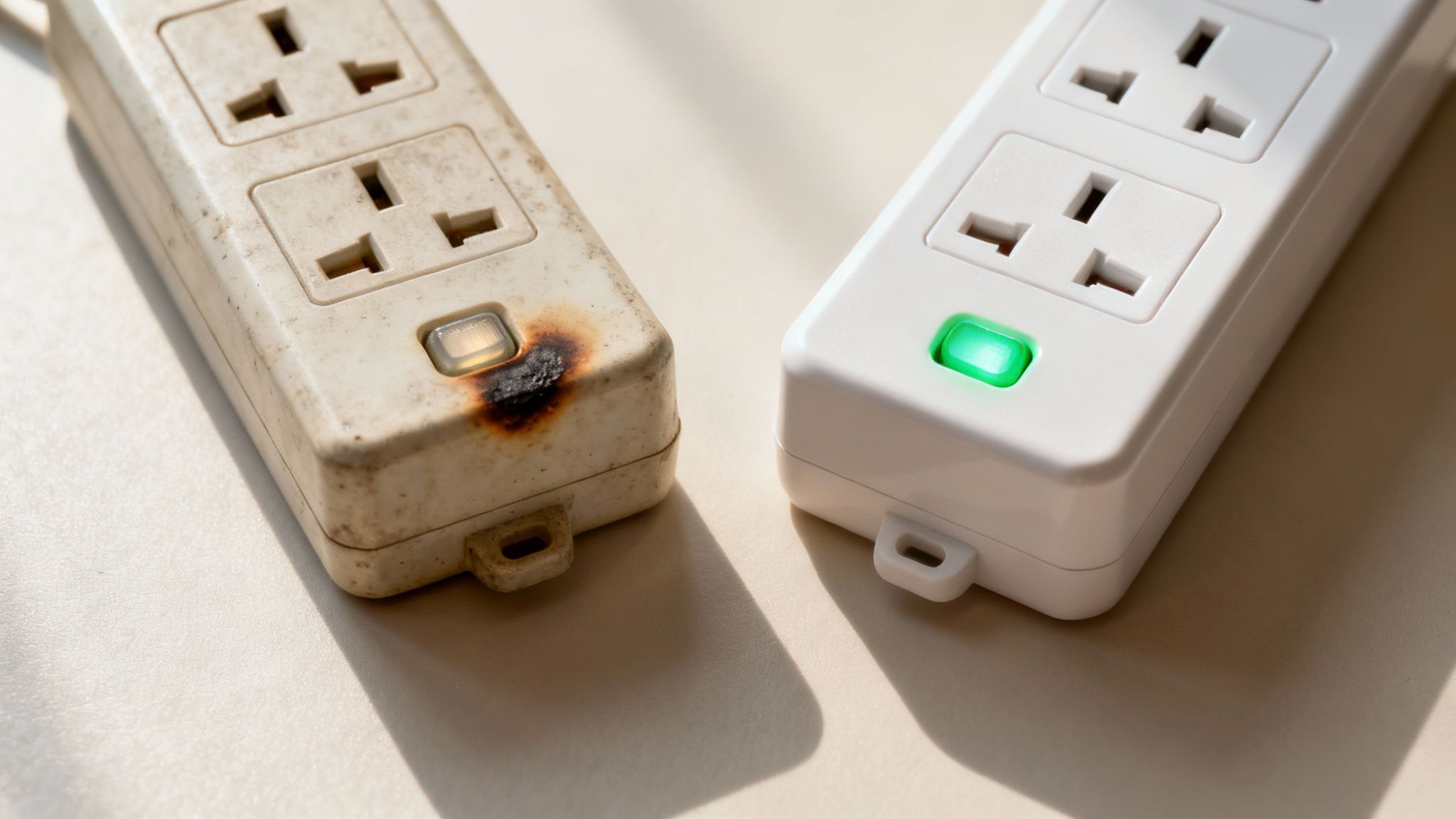
It’s one of the most common—and costly—misconceptions we see in home electrical safety: the idea that a surge protector lasts forever. The reality is these devices have a very definite lifespan. They work by sacrificing their internal components, called MOVs, to absorb the damaging energy from power surges.
With every electrical spike they block, whether it’s big or small, those components degrade just a little more. Think of it like a shock absorber in your car; it can only handle so many bumps before it’s completely worn out. Eventually, your surge protector’s joule rating hits zero, and it becomes nothing more than a glorified power board, offering no protection at all.
So, how do you know when your protector is ready for the bin? While some signs are obvious, others are a bit more subtle. The most common giveaway is the “protection” or “protected” light right there on the unit.
If this indicator light is off, flickering, or has turned red, it’s a clear signal that the internal MOVs have been fried. The board might still power your electronics, but it’s no longer functioning as a surge protector. Your gear is completely exposed.
A common mistake is assuming that just because your devices are still turning on, the protection is active. A surge protector can keep passing electricity through it long after its defensive guts have been completely exhausted, leaving your valuable equipment vulnerable.
Even if the indicator light is still glowing happily, age is a critical factor. The constant barrage of small, everyday surges—from your own air conditioner or fridge cycling on and off—takes a toll over time. That’s why we always recommend a proactive approach to replacement.
A single massive surge can completely exhaust a protector’s capacity in an instant, even if there are no visible signs of damage. Continuing to use it afterwards is a gamble you can’t afford to take with thousands of dollars worth of electronics. Keeping your gear safe means knowing what a surge protector is for and, just as importantly, recognising when it’s time for an upgrade.
While plugging in a simple power board surge protector is something anyone can do, installing a whole-house system is a completely different ball game. This isn’t a weekend DIY project. It involves working directly inside your property’s main electrical switchboard, where the risks are incredibly high. Getting it wrong can lead to no protection at all, serious electrical hazards, or even a fire.
Trying to install a whole-house Surge Protection Device (SPD) yourself is not only dangerous but also illegal under Australian electrical safety regulations. Any work on a home’s fixed wiring must be done by a licensed electrician to ensure the installation is safe, effective, and fully compliant with national standards.
Getting a professional installation from a certified electrician guarantees several critical things that a DIY job simply can’t.
A professional electrician doesn’t just install a device; they verify the integrity of your entire electrical system. This includes checking that other safety mechanisms, such as RCDs, are functioning correctly to provide layered protection.
Proper installation is the only way to be certain that your investment in a whole-house surge protection system actually delivers the protection and peace of mind you’re paying for. It needs to work seamlessly with other safety components in your switchboard. You can learn more about how these systems work together by reading our guide on what a residual current device is.
For Brisbane residents, getting total protection for your home and family is straightforward. To ensure your whole-house surge protector is installed safely and to the highest standard, you need to bring in a qualified expert.
Contact DLG Electrical today for a professional assessment and installation.
Alright, we’ve covered the nuts and bolts of how surge protectors work, but there are always a few lingering questions. Let’s tackle some of the most common ones we hear from Brisbane homeowners.
Yes, you absolutely do. Think of it as a two-stage security system for your electronics. The whole-house surge protector at your switchboard is your frontline soldier, stopping the big, nasty surges from the grid before they even get inside.
But smaller surges can actually be generated inside your home—like when a big appliance cycles on. Those little power boards at the wall socket are the last line of defence, catching any leftover voltage and these internal spikes. This layered approach gives your expensive, sensitive gear the best possible protection.
For the most part, yes—but it all comes down to what you’re plugging in. A higher price tag usually gets you a higher joule rating, a lower (which is better) clamping voltage, and often a warranty that will cover damage to your connected gear.
For a bedside lamp or a simple radio, a basic protector will do the trick. But if you’re plugging in a home theatre system worth thousands, or a computer holding irreplaceable family photos, spending a bit more on a quality protector is a very small price to pay for that peace of mind.
A healthy, working surge protector cannot damage your electronics. Its one and only job is to protect them. The real danger comes from a surge protector that’s old and worn out.
Once its protective bits and pieces inside are fried, it stops being a surge protector and is nothing more than a glorified extension cord. It’ll still power your devices, but it offers zero protection against the next surge. This gives you a false sense of security, which is why checking that little indicator light and replacing your protectors every few years is so important.
Making sure your home is properly protected from the switchboard right through to the socket is a job for the pros. For expert advice and professional installation of whole-house surge protection here in Brisbane, you can trust the licensed team at DLG Electrical. Head over to https://dlgelectrical.com.au to lock in your free quote today.

Master Electrician with over 30 years of experience. Founded DLG Electrical in 2005 after international project work including electrical installations at Stamford Bridge Stadium, London(Home of Chelsea FC).

Local Electricians that can fix all Electric Hot water Systems.
Motion sensor lights are a versatile addition to any home, offering nu
