83 Jean St, Grange QLD 4051
Mon-Fri 07:30 AM - 04:00 PM - Sat - 8:00 - 12 - Sunday Closed
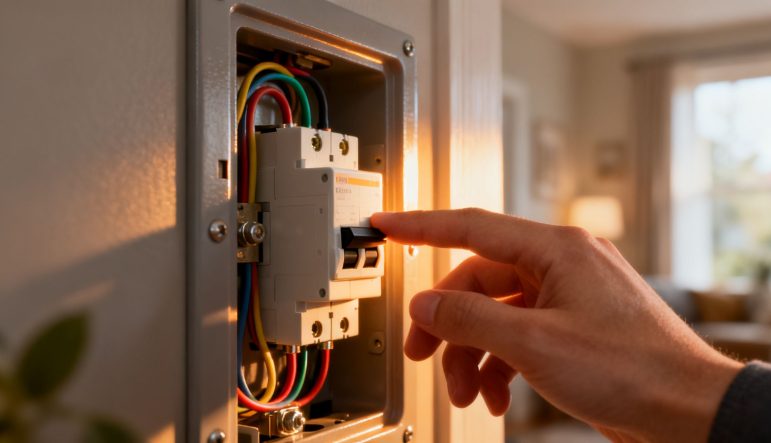
Think of a circuit breaker as the silent, ever-watchful guardian of your home’s electrical system. It’s an automatic safety switch that instantly cuts the power the moment it senses a dangerous overload or a short circuit. Unlike old-fashioned fuses that burn out and need replacing, a modern circuit breaker is a reusable switch. You just flip it back on, making it a cornerstone of modern home safety.
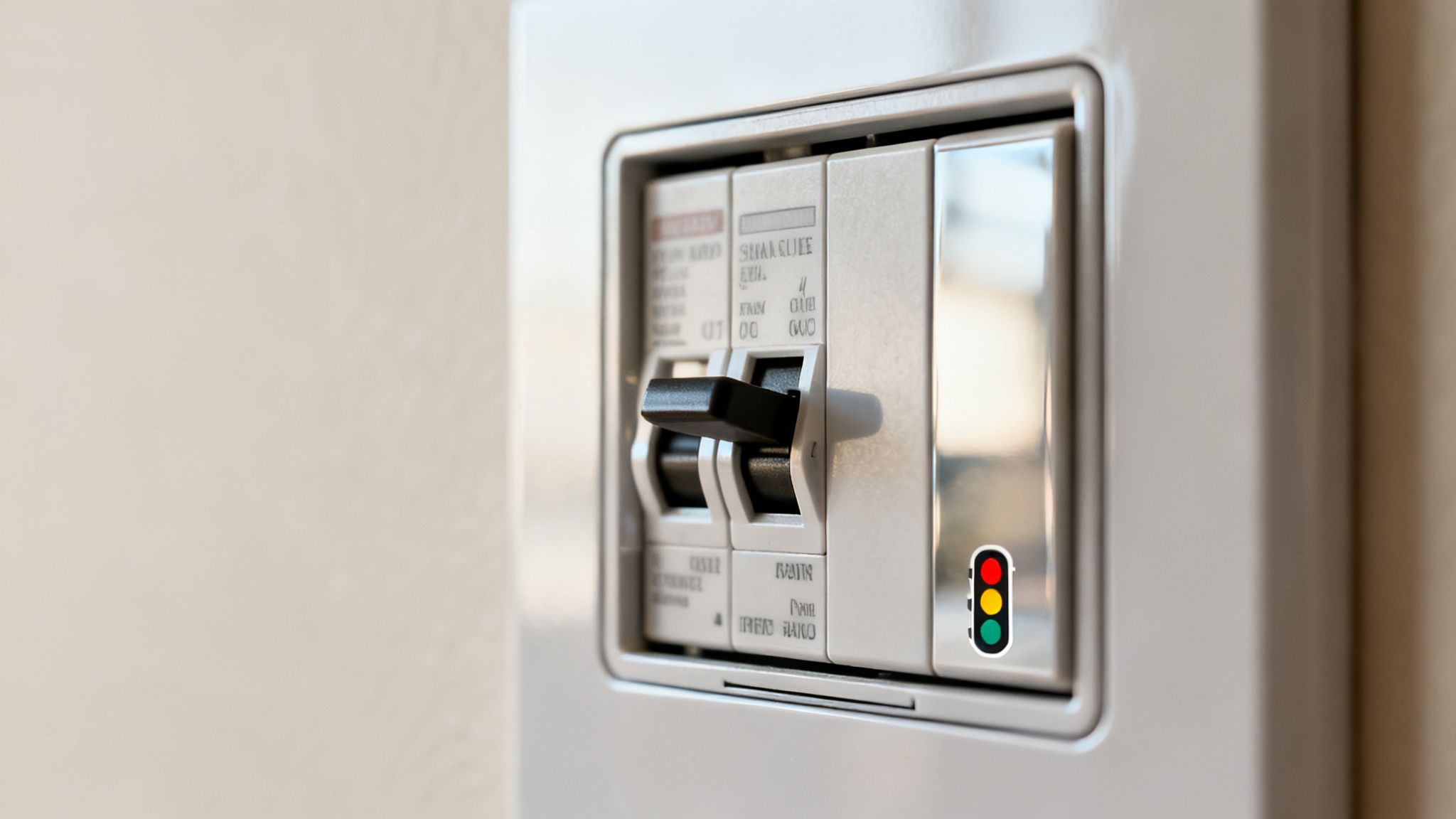
At its core, a circuit breaker is pretty simple. Imagine your home’s wiring is a network of roads, and the electricity is the traffic. The circuit breaker is like an intelligent traffic controller for each major road (or circuit), making sure everything flows smoothly and safely to your lights, appliances, and power points.
When the flow is normal, the breaker stays in the ‘ON’ position, letting the current pass through. But it’s always monitoring that flow, watching out for two specific kinds of danger.
The main job of a circuit breaker is to protect your wiring—and by extension, your home—from electrical disasters. It does this by automatically stopping the flow of electricity, a process we call ‘tripping’, as soon as it detects an unsafe condition. This one small action is vital for preventing fires and keeping your family safe.
Without this automatic trip-switch, an electrical fault could cause wires to get incredibly hot, potentially melting their plastic insulation and starting a fire. It also protects your expensive TVs, computers, and appliances from being fried by sudden power surges.
A circuit breaker is your first line of defence against electrical faults. It’s an automated safety device designed to prevent electrical fires and protect equipment by immediately stopping the flow of dangerous levels of current.
A circuit breaker is specifically designed to guard against two main electrical hazards. Understanding them makes it clear why these devices are non-negotiable in your switchboard.
Essentially, the circuit breaker is a fundamental safety feature in every modern Australian home, offering a reliable and resettable way to manage electrical risks.
To really get what a circuit breaker does, you have to look behind the switchboard panel. It’s more than just a switch; it’s a silent guardian, constantly watching the flow of electricity for two specific dangers that can lead to house fires or fried appliances.
Think of your home’s wiring like a plumbing system. The wires are the pipes, and the electrical current is the water flowing through them. In this scenario, a circuit breaker is an intelligent, automated safety valve, making sure the “water pressure” never gets high enough to cause a disaster.
Your circuit breaker is built to detect and shut down two very different kinds of electrical faults. Each one is a unique threat, and the breaker uses a clever dual mechanism to stop them both.
Overloads: The Slow Burn Danger. An overload is like trying to force too much water through a small pipe for a long time. The pipe isn’t broken, but the constant pressure and friction make it get dangerously hot. Electrically, this happens when you plug too many power-hungry appliances into a single circuit, forcing the wires to carry more current than they’re rated for. This sustained over-current creates a huge amount of heat, which can melt the wire’s plastic insulation and set fire to nearby timber framing.
Short Circuits: The Explosive Threat. A short circuit is much more sudden and violent—it’s the electrical equivalent of a pipe bursting wide open. It happens when a hot (live) wire touches a neutral or earth wire directly, creating a path of almost zero resistance. The result is a massive, near-instantaneous surge of current that can be thousands of times higher than normal, causing sparks, explosions, and an immediate fire.
These two threats are exactly why modern homes rely on the technology packed inside every circuit breaker. While both are dangerous, they need different detection methods to be stopped in their tracks. You can find out more about the differences between protective devices in our guide comparing RCDs and circuit breakers.
So how does it work? A circuit breaker has two distinct internal parts working in tandem to give you complete protection, with each one designed to tackle one of the specific threats we just covered.
The first line of defence is a bimetallic strip. This is a clever little component made from two different metals bonded together, which expand at different rates when they get hot. During a slow overload, the steady increase in current gradually heats this strip up. As it warms, it starts to bend until it physically trips a switch, breaking the circuit and cutting the power. This thermal trip is perfect for stopping the slow-burn danger of an overload.
The second component is an electromagnet (or solenoid coil). This is built for the split-second danger of a short circuit. When that massive surge of current from a short circuit rushes through the breaker, it creates a powerful magnetic field in the coil. This magnetic force instantly yanks a lever that trips the switch, shutting off the power in a fraction of a second—way faster than the bimetallic strip could ever react.
By combining a heat-sensitive strip for slow overloads and a fast-acting electromagnet for short circuits, a circuit breaker provides robust, two-tiered protection against the most common electrical hazards in your home.
This focus on advanced safety isn’t just a good idea; it’s driving the market. The Australian circuit breaker market, valued at US$ 248.22 million, is projected to hit US$ 354.21 million by 2033, pushed by grid upgrades and stricter safety standards. In fact, new rules now require advanced miniature circuit breakers (MCBs) with better performance for all new homes. This dual-action design is what makes the humble circuit breaker such a vital guardian for your home and family.
Opening your switchboard can feel like looking at a complex puzzle. You’ve got rows of switches that all look similar, but each one has a very specific job to do. Getting to know these devices is the key to understanding how your home’s electrical system protects both your property and, more importantly, your family.
At the most basic level, a standard circuit breaker is the guardian of your home’s wiring and the expensive appliances plugged into it. Think of it as a vigilant sentry, constantly watching for the two main enemies of any electrical circuit: overloads and short circuits.
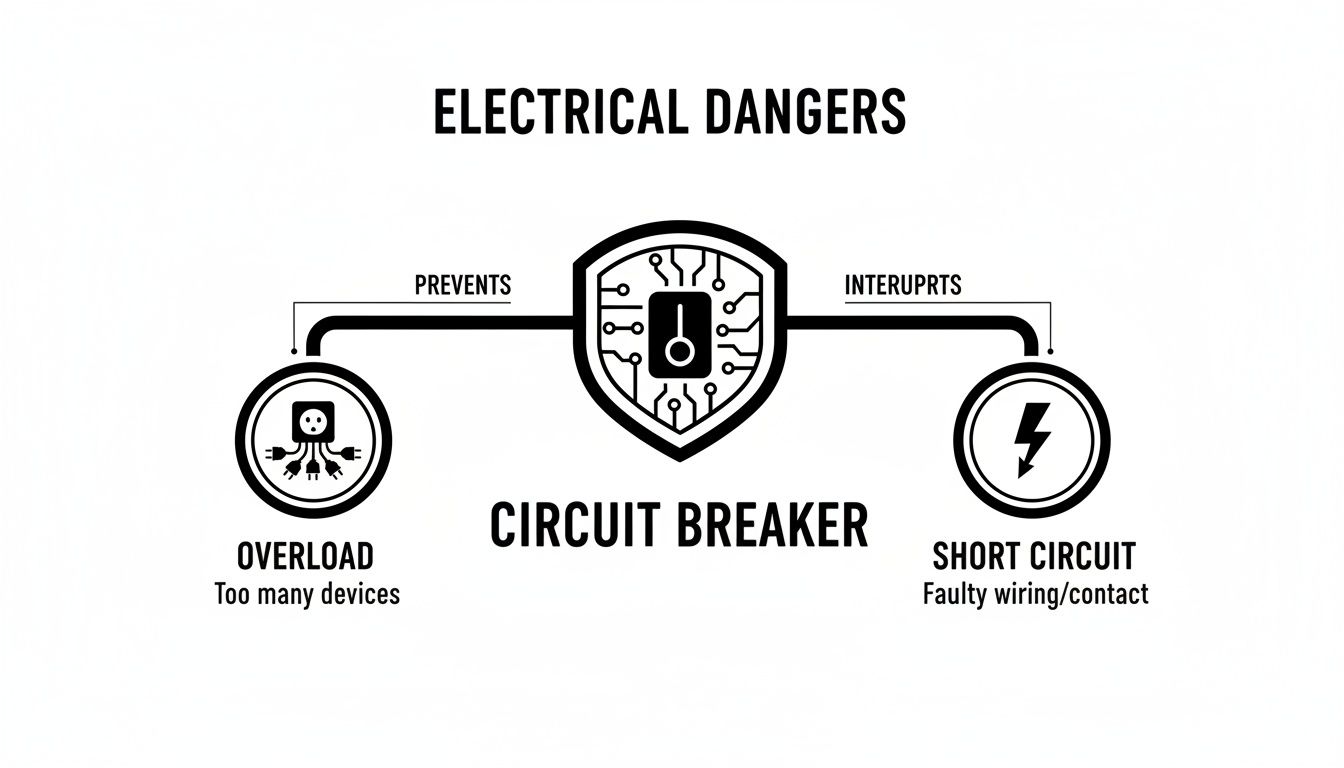
As this graphic shows, a circuit breaker acts as an automatic shield, stopping both the slow-burn danger of an overload and the sudden chaos of a short circuit before they can cause a fire.
The real workhorse of any modern switchboard is the Miniature Circuit Breaker (MCB). These are what most people picture when they think of a circuit breaker, and their one and only job is to protect a specific circuit from drawing too much electrical current.
An MCB is a clever thermal-magnetic device. This means it has two ways of detecting a problem. For a slow, creeping overload—like running a powerful heater and a hairdryer on the same circuit—an internal bimetallic strip heats up, bends, and eventually trips the switch. But for a sudden, violent short circuit, an electromagnet reacts instantly to the massive surge of current, snapping the breaker off in a fraction of a second. You’ll find various types, but the most common in Aussie homes are Miniature Circuit Breakers (MCB).
An MCB’s purpose is equipment protection. It stops the wires inside your walls from overheating and causing a fire, and it shields your electronics from damaging power surges. It does not protect people from electric shock.
This last point is absolutely critical and leads us to the next device.
A Residual Current Device (RCD), which you’ll almost always hear called a “safety switch,” has a completely different—and far more vital—job than an MCB. While an MCB protects your gear, an RCD is designed specifically to protect you from a fatal electric shock.
Here’s how it works: an RCD constantly measures the electrical current flowing in the active and neutral wires of a circuit. In a healthy, safe circuit, the amount of current going out should be a perfect match for the amount coming back.
But if something goes wrong and electricity finds a shortcut to the ground—for example, through your body touching a faulty appliance—the RCD detects this tiny imbalance. It then snaps the power off in as little as 30 milliseconds. That’s faster than a single critical phase of a heartbeat, and it’s this incredible speed that saves lives.
It’s a common and dangerous myth that a standard circuit breaker will save you from being electrocuted. It won’t. Only an RCD has the sensitivity to detect the tiny leakage of current that can be lethal.
In any modern switchboard, you’ll likely find a device that combines the functions of both the MCB and the RCD into one neat package. This is a Residual Current Circuit Breaker with Overload Protection (RCBO).
RCBOs offer the most complete protection available in a single unit. They give you:
Using RCBOs on all circuits is now standard practice in Australia for new builds and switchboard upgrades. This ensures every part of your home, from the lights to the power points, has the highest possible level of protection against fire, equipment damage, and electric shock.
Navigating the different protective devices in your switchboard can be confusing. This table breaks down the key players and their primary roles to give you a clearer picture of how your home is kept safe.
| Device Type | Primary Function | Protects Against | Main Purpose |
|---|---|---|---|
| MCB | Overcurrent Protection | Overloads & Short Circuits | Protects wiring and appliances from fire and damage caused by excess current. |
| RCD | Earth Fault Detection | Electric Shock (Electrocution) | Protects people by detecting tiny current leakages to earth. |
| RCBO | Combined Overcurrent & Earth Fault Protection | Overloads, Short Circuits & Electric Shock | Provides all-in-one protection for both people and equipment on a single circuit. |
Ultimately, understanding the difference is simple: one type of breaker guards your gear, while the other guards your life. Having both is non-negotiable for a safe, modern home.
If you’ve ever lived in an older home, you’re probably familiar with the old ceramic, screw-in fuses. They were the original line of defence for our electrical circuits, and while they did a similar job to a modern circuit breaker, the technology is worlds apart.
Understanding the difference makes it crystal clear why upgrading to a modern switchboard is one of the most important safety improvements you can make to your property.
A fuse is a very simple, one-time-use device. Inside that ceramic or glass casing is a thin piece of metal wire designed to melt at a specific temperature. When a circuit overloads or shorts out, the sudden rush of current heats that wire until it breaks, permanently cutting power to the circuit.
The problem? Once a fuse blows, it’s finished. To get the power back on, you had to find a new one, unscrew the old one, and screw in the replacement—often while fumbling around in the dark.
A circuit breaker, on the other hand, is essentially a reusable, automatic switch. Instead of a wire that melts, it uses a clever internal mechanism—either a bimetallic strip that bends with heat or an electromagnet—to physically trip the switch and break the circuit.
This single difference introduces several critical advantages that made fuses obsolete almost overnight.
The most obvious benefit is convenience. When a breaker trips, you just need to find the cause of the fault (like a faulty toaster), unplug it, and then simply flip the switch back to the ‘ON’ position. No spare parts, no guesswork.
The core difference is simple yet profound: a fuse is a disposable safety device that sacrifices itself to stop a fault, while a circuit breaker is a resettable safety device that can be used again and again.
This resettable nature also acts as a brilliant diagnostic tool. The tripped breaker instantly shows you which circuit has the problem. With fuses, it wasn’t always obvious which one had blown just by looking at it.
Beyond just being easier to use, the switch from fuses to circuit breakers was a massive step forward for home electrical safety. Modern breakers are fundamentally safer for a few key reasons:
This move away from older, riskier technology isn’t just happening in our homes. Major electricity distributors like AusNet are actively replacing outdated oil-filled circuit breakers on the grid with modern vacuum and gas-insulated models. It’s an industry-wide commitment to adopting safer, more reliable technology from the power station all the way to your switchboard.
Your home’s switchboard should be a silent, reliable guardian, working away in the background without you ever noticing it. But when it starts making its presence known with odd sounds, strange smells, or constant interruptions, it’s sending up a flare. It’s telling you something’s wrong.
Learning to read these signals is the first step in stopping a small electrical issue from spiralling into something far more dangerous.
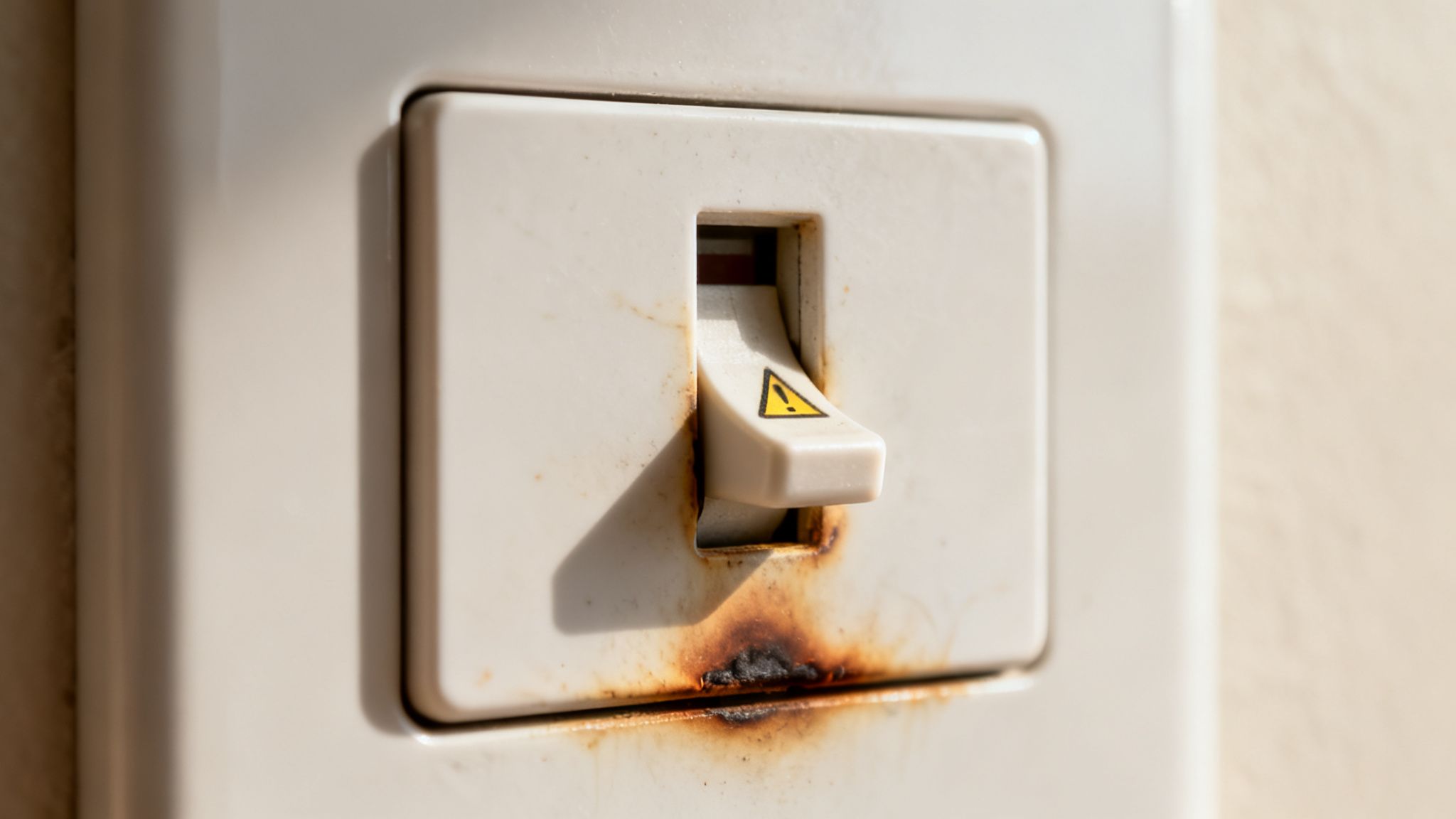
Think of these symptoms as your switchboard’s way of asking for help. Ignoring them can lead to fried appliances, electrical fires, or even the risk of electric shock. Being proactive here isn’t just smart; it’s essential for keeping your home and family safe.
One of the most common red flags is a breaker that just won’t stay on. A one-off trip might just be an overloaded circuit – you tried to run the kettle and the air fryer at the same time, for example. But when it happens regularly without any obvious cause, you’re looking at a deeper problem.
It could be a sign of a persistent overload, a short circuit hiding somewhere in your walls, or that the breaker itself is simply worn out and failing. If you find your circuit breaker keeps tripping even when you’ve barely got anything running, that’s a clear signal it’s time for a professional diagnosis.
Sometimes, all you need to do is use your senses. A quick look, listen, and sniff around your switchboard can tell you a lot about its health. Electrical parts under serious stress often leave physical clues behind.
Keep an eye (and ear) out for these critical signs:
Never ignore the physical signs of electrical distress. A burning smell, buzzing sound, or visible scorch marks are not minor annoyances—they are urgent warnings of a potential fire hazard that could compromise the safety of your entire home.
In some cases, the biggest warning sign is the age of the switchboard itself. If you’re still looking at old ceramic fuses, brittle-looking switches, or a complete lack of modern safety switches (RCDs), you have a hazard waiting to happen. Electrical technology has come a long way, and older panels were never designed for the demands of a modern, appliance-heavy home.
This is becoming more and more relevant as our infrastructure grows. The Australian circuit breaker market is projected to hit USD 376.0 million by 2033, a trend driven by new developments, especially in places like Queensland. As our homes and cities modernise, making sure your switchboard can keep up isn’t just about convenience—it’s about fundamental safety. You can read more about trends in Australia’s circuit breaker market to see just how quickly things are changing.
If any of these symptoms sound familiar—from frequent trips and weird smells to outdated gear—the message is clear. This is not a DIY job. The risk of fire or electric shock is far too high, and only a licensed electrician has the training and tools to safely figure out what’s wrong and fix it properly.
Flipping a tripped circuit breaker back on is a simple fix most homeowners can handle. But that’s where the DIY work should end. Knowing when to put the tools down and call a professional is probably the single most important safety decision you can make for your home.
Electrical work is complex, unforgiving, and genuinely dangerous. A licensed electrician doesn’t just patch up a problem; they diagnose the underlying cause and ensure your entire system is safe and compliant. Attempting to fix things yourself can void your home insurance and, far more seriously, put your family at risk of house fires or electric shock.
Some situations are more than just an inconvenience—they’re flashing red lights warning you of a serious electrical fault. These aren’t issues that will resolve themselves. If you spot any of the following, it’s time to call in an expert immediately.
You should always call a professional if:
Your safety is non-negotiable. While the urge to save a few dollars with a DIY fix is understandable, the potential cost of an electrical fire or a serious injury is infinitely higher. A licensed electrician gives you peace of mind that the job is done right, the first time.
At DLG Electrical, our experienced team can quickly and safely get to the bottom of your circuit breaker problems. We prioritise safety above everything, making sure any repairs or upgrades meet Australia’s strict electrical standards.
Don’t take chances with your home’s electrical system. If you’re in Brisbane and facing any of these issues, give our friendly team a call for a free quote and expert advice.
As electricians, we get a lot of questions from homeowners about their switchboards. It makes sense—that grey box on the wall is the heart of your home’s electrical system, and knowing a bit about what’s inside is key to keeping everything safe and running smoothly.
Here are a few of the most common queries we hear day in and day out.
As a general rule of thumb, it’s a good idea to have a professional sparky give your switchboard a safety inspection every 5 years. This isn’t just a quick look-see; it’s a proper check to make sure every component is doing its job and is up to current Australian safety standards.
But that’s just a baseline. If you’re in a rental property, there are often stricter legal requirements for more frequent checks. And if you live in an older home or you’ve noticed annoying issues like lights flickering or breakers tripping for no reason, don’t wait—get it looked at straight away.
There are a few big reasons you might need to swap out your old switchboard for a new one. The most urgent is if you’re still running an ancient fuse box with those old ceramic fuses. These things are relics and simply don’t have the safety features we rely on today.
The other common trigger is a renovation or a new, power-hungry appliance. If you’re adding an induction cooktop, a pool pump, or an EV charger, your old board probably won’t be able to handle the extra load safely. A modern switchboard isn’t just about more capacity; it’s about installing mandatory safety switches (RCDs) on every circuit to give your home and family proper protection.
A modern switchboard with RCDs on every circuit isn’t just an upgrade; it’s a fundamental safety requirement that protects your family from electric shock and significantly reduces fire hazards.
It’s not unusual for a circuit breaker to feel slightly warm to the touch, especially if you’ve had a big appliance like an air conditioner or the oven running for a while. That’s just a sign of electricity doing its work.
However, there’s a huge difference between warm and hot. If a breaker is genuinely hot to touch, you can smell a faint burning odour, or you see any discolouration or melting around it, that’s a serious red flag. It points to a dangerous problem like a loose connection or a failing breaker that needs to be sorted out immediately by a licensed electrician.
This is probably the most important question we get, and the distinction is crucial for your safety.
A standard circuit breaker (the technical term is MCB, or Miniature Circuit Breaker) is there to protect your wiring and appliances. Its job is to trip and cut the power if it detects an overload (too much current) or a short circuit, preventing the wires from overheating and starting a fire.
A safety switch, on the other hand, is there to protect people. Officially called an RCD (Residual Current Device), its job is to detect tiny imbalances in the electrical current—the kind that happens when electricity finds a path to the ground through a person’s body. If it senses this leakage, it shuts off the power in a fraction of a second, which can be the difference between a nasty zap and a fatality. That’s why modern standards in Australia demand RCDs on all circuits.
If you have any worries about your switchboard or you’re dealing with any electrical dramas at home, please don’t take any chances. Get in touch with the experienced, licensed electricians at DLG Electrical. We’re always happy to offer reliable advice and a free quote to make sure your home is safe.
Learn more about our electrical services at dlgelectrical.com.au

Master Electrician with over 30 years of experience. Founded DLG Electrical in 2005 after international project work including electrical installations at Stamford Bridge Stadium, London(Home of Chelsea FC).

Local Electricians that can fix all Electric Hot water Systems.
Motion sensor lights are a versatile addition to any home, offering nu
