83 Jean St, Grange QLD 4051
Mon-Fri 07:30 AM - 04:00 PM - Sat - 8:00 - 12 - Sunday Closed
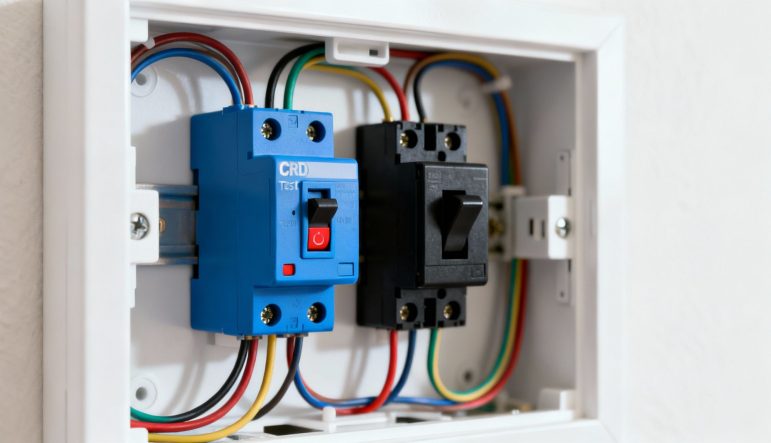
Think of an RCD and a circuit breaker as the essential safety guards for your home’s electrical system—but they have completely different jobs. An RCD (Residual Current Device) is all about protecting people from electric shock. A circuit breaker, on the other hand, protects your home’s wiring and appliances from fire.
It helps to think of an RCD as a personal bodyguard and a circuit breaker as a property guardian. For total protection, you absolutely need both.
That sudden click from the switchboard often leaves homeowners scratching their heads, wondering what just happened. This guide is here to demystify the two most important devices protecting your home: the RCD and the circuit breaker. We’ll cut through the technical jargon to explain their distinct roles in keeping your family safe from electric shock and your property safe from electrical fires.
You’ll learn how to tell them apart, understand what makes them trip, and see why having both is non-negotiable in any modern, safe home. Consider this your practical, easy-to-understand manual for your home’s electrical safety system.
Every single appliance you plug in relies on a stable and safe flow of electricity. When something goes wrong, the consequences can range from a fried TV to a life-threatening incident. That’s where modern safety devices come in—they’re designed to react in milliseconds to prevent a disaster.
The impact of these devices is undeniable. The widespread installation of RCDs is a major reason for the dramatic decline in electrical fatalities across Australia, which saw an incredible 87% reduction from 39 deaths in 2000/2001 to just five in 2017/2018.
A common and dangerous mistake is assuming an RCD and circuit breaker are interchangeable. In reality, they are completely blind to the specific dangers the other is designed to detect. One device simply cannot do the job of both.
As our homes get smarter and integrate more power-hungry technology, like electric vehicle charging, it’s crucial to consult resources like a guide to home EV charger installation to ensure any new additions meet safety standards and work correctly with your existing setup.
This guide will empower you to make informed decisions and ensure your switchboard is up to the task of protecting what matters most. For more information on identifying and sorting out common issues, check out our guide on common electrical repairs.
If an RCD is your personal bodyguard, think of a circuit breaker as the security guard for your entire property. Its mission is totally different: it protects your home’s wiring and expensive appliances from the destructive power of high-current electrical faults.
A circuit breaker is constantly watching for two specific dangers: overloads and short circuits. By keeping an eye on these threats, its job is to prevent electrical fires and stop your valuable equipment from getting fried. It’s all about property protection.
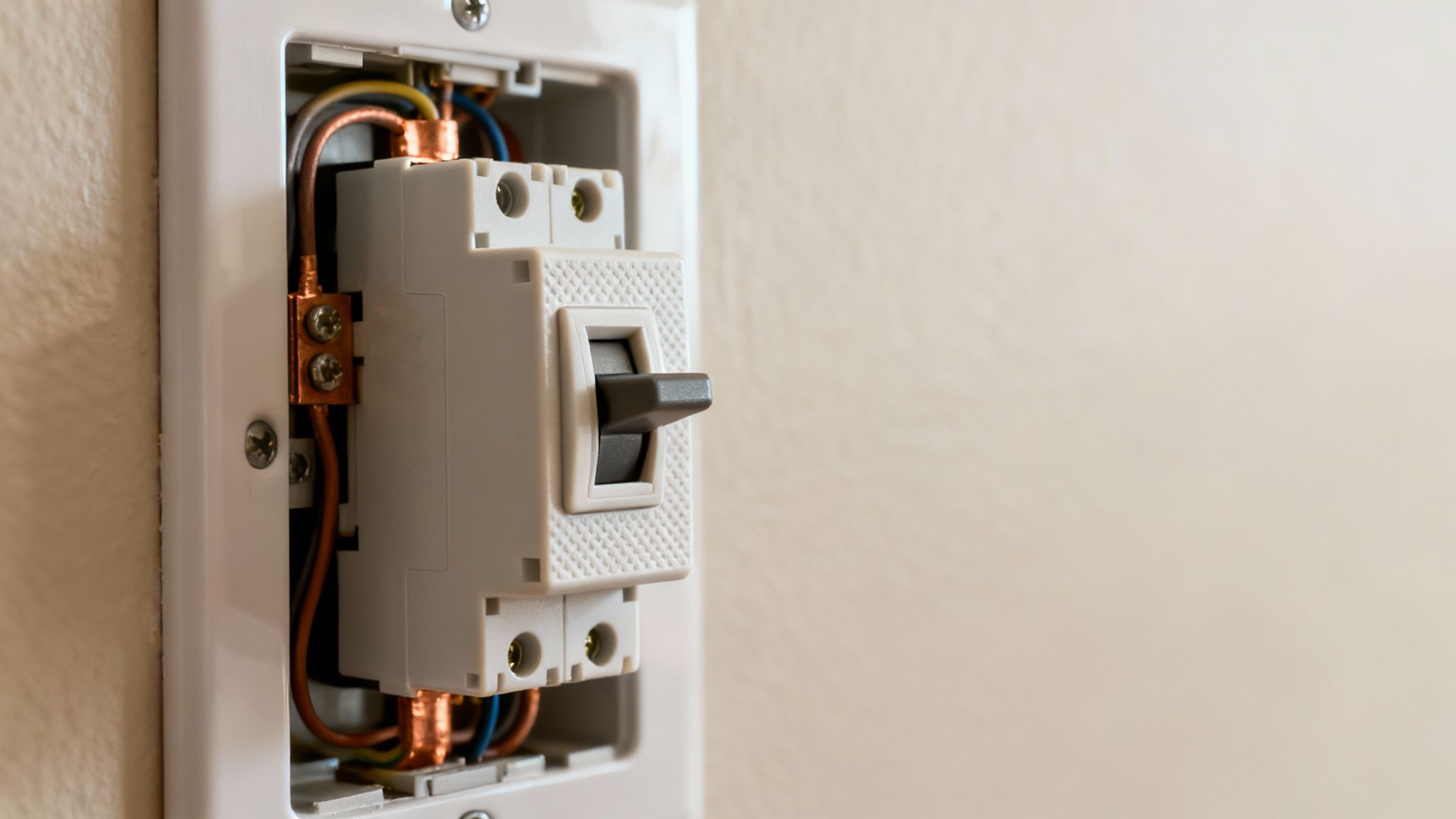
An overload is probably the most common reason you’ll see a circuit breaker trip. Picture it like asking one person to carry the weight of ten—eventually, they’re going to get overwhelmed and give up. It’s the same with an electrical circuit when you try to draw more power from it than it was ever designed to handle.
We see this all the time in kitchens. You plug in a high-powered kettle, a toaster, and the microwave, then turn them all on at once. This huge demand for electricity causes the wires inside your walls to heat up, and if that’s left unchecked, the insulation can melt right off, creating a massive fire risk.
A circuit breaker senses this slow, steady increase in current. It doesn’t trip instantly, but after a short delay, it cuts the power, acting like a smart safety valve to stop the wires from reaching a dangerous temperature.
A short circuit is a far more dramatic and immediate problem. It happens when electricity finds a shortcut it shouldn’t, often because of damaged wiring or a faulty appliance where a live wire makes contact with a neutral one.
This creates a path of almost zero resistance, causing an insane, instantaneous surge of current—sometimes hundreds of times higher than normal. The heat generated is so intense it can spark a fire in milliseconds.
A circuit breaker is engineered to react to this violent surge with incredible speed. It doesn’t hesitate; it trips immediately, severing the connection to stop the dangerous flow of electricity before it can cause a fire or an explosion.
This split-second response is what makes it such an effective guardian for your property. If this is happening a lot at your place, it’s worth reading our guide on what to do when your circuit breaker keeps tripping.
Inside every modern circuit breaker is a clever dual-action mechanism designed to detect both types of faults.
By combining these two functions, a single circuit breaker provides robust protection against both the slow burn of an overload and the sudden danger of a short circuit. It’s a reliable, resettable guardian for every circuit in your home, standing ready to protect your property from damage.
Excellent, let’s get this section rewritten. Here’s a natural, human-written version that follows the expert tone and style of your examples.
While a circuit breaker is busy protecting your home’s wiring and appliances, an RCD (Residual Current Device) has a far more personal and critical job. Think of it as a dedicated bodyguard for you and your family. Its mission is entirely different—it’s designed for one reason only: to protect people from a severe or fatal electric shock.
An RCD couldn’t care less about the overloads or short circuits that threaten your property. Instead, it’s a highly sensitive device on the hunt for tiny, almost undetectable leaks of electrical current. These are the exact kinds of leaks that happen when electricity finds a dangerous new path to the ground—often, straight through a person.
The way an RCD works is both brilliant and surprisingly simple. It constantly watches the electrical circuit, precisely measuring the current flowing out on the active wire and comparing it to the current coming back on the neutral wire. In a healthy, normal circuit, these two numbers should be a perfect match.
It’s all based on a fundamental rule of physics: what goes out must come back. If even a tiny fraction of that current vanishes, the RCD instantly knows something is wrong. It assumes the missing current is “leaking” out of the circuit somewhere it shouldn’t be, and its prime directive is to shut everything down.
The sensitivity of an RCD is astounding. It’s engineered to trip when it detects an imbalance as small as 30 milliamps (that’s just 0.03 amps). This isn’t a random number—it’s the threshold where electricity becomes dangerous to the human heart.
This lightning-fast reaction time is precisely what makes the RCD a true lifesaver.
Let’s paint a picture. Imagine you’re using a hairdryer with a hidden internal fault. You accidentally touch a live part inside while your other hand touches a wet tap. Electricity, always looking for the easiest way to the ground, would start flowing right through your body.
A standard circuit breaker would be completely blind to this. The current is far too small to register as an overload.
For an RCD, though, this is a code-red emergency. It immediately detects the imbalance—the current flowing through you isn’t returning through the neutral wire where it belongs. In response, it slams the brakes on, cutting power to the circuit in as little as 30 milliseconds.
That incredible speed is what saves you. The RCD cuts the power long before the electricity can do serious damage to your heart or nervous system. It’s a level of personal protection you simply can’t get from a circuit breaker alone. This is why when you compare an RCD and circuit breaker, you see they’re not competitors; they’re partners in a complete electrical safety system, each watching for a totally different kind of danger.
To really get your head around their roles in keeping your home safe, it helps to put an RCD and a circuit breaker side-by-side. They might look like cousins sitting next to each other in your switchboard, but they’re designed to protect against completely different dangers. The main difference comes down to what they protect and how they spot a problem.
Think of it this way: a circuit breaker is the guardian of your property. Its job is to protect your home’s wiring and expensive appliances from big, damaging surges of power. An RCD, on the other hand, is the personal bodyguard for you and your family. It’s looking for the tiny electrical leaks that can cause a severe electric shock but are too small for a circuit breaker to even notice.
The easiest way to understand the distinction is to think about sensitivity. A circuit breaker is built to handle the heavy-duty stuff—large, powerful surges of electricity measured in amps. It’s on the lookout for brute-force problems like overloads and short circuits.
An RCD is more like a precision instrument. It’s designed to detect incredibly small imbalances in the electrical current, measured in milliamps (which is just one-thousandth of an amp). This incredible sensitivity is what allows it to react to the small trickles of current that can be lethal to a person but are completely invisible to a standard circuit breaker.
This is what RCD protection is all about.
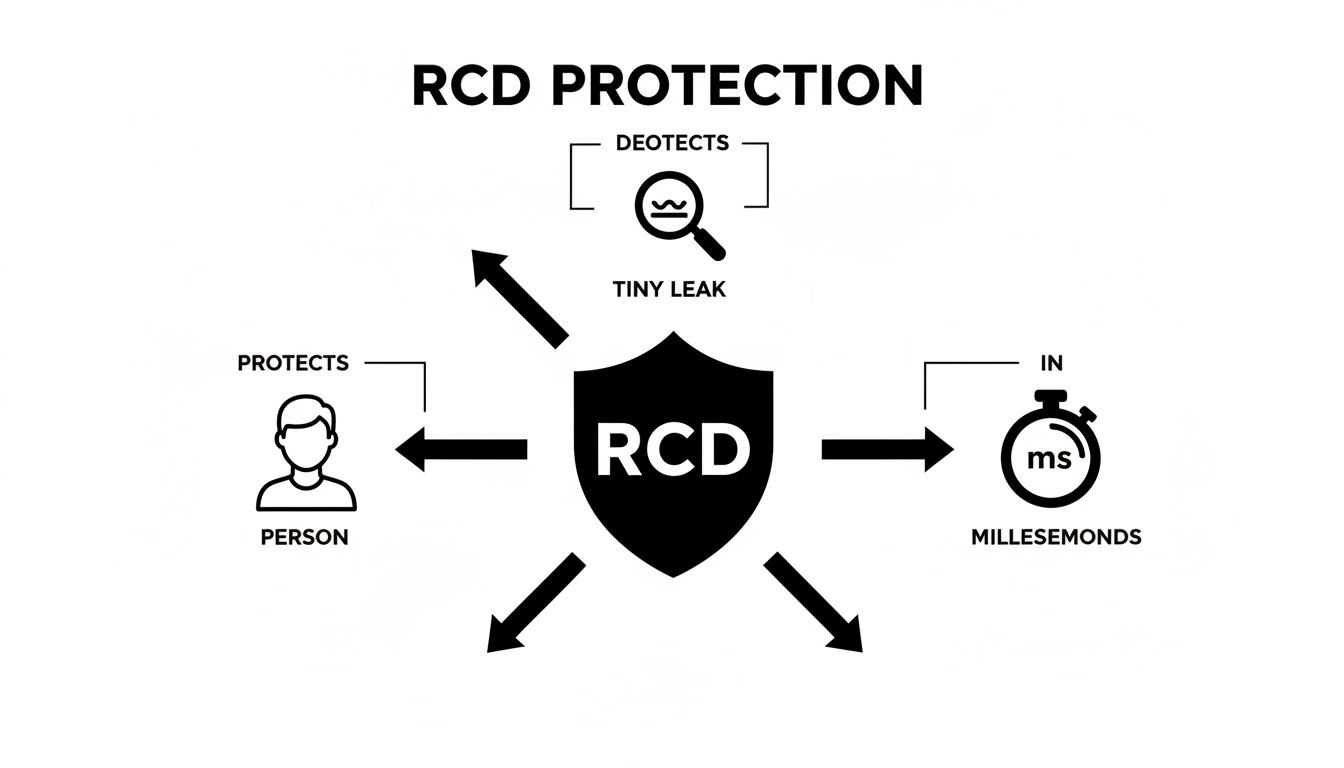
As you can see, an RCD’s primary job is to protect a person by spotting those tiny electrical leaks and shutting the power off in milliseconds, well before any serious harm can occur.
Let’s break it down even further. This simple table clearly lays out their unique jobs and highlights why you absolutely need both for a complete electrical safety system.
| Feature | RCD (Residual Current Device) | Circuit Breaker |
|---|---|---|
| Primary Protection | Protects people from electric shock and electrocution. | Protects property (wiring, appliances) from fire and damage. |
| Detects | Tiny electrical current leaks to earth (imbalances). | Large surges of current (overloads and short circuits). |
| Typical Trip Threshold | Extremely sensitive, tripping at around 30 milliamps (0.03 amps). | Much less sensitive, tripping at its rated load (e.g., 16 amps). |
| Core Function | Monitors the balance of current flowing in and out of a circuit. | Monitors the total amount of current flowing through a circuit. |
| Analogy | A highly sensitive airbag that deploys on direct impact to save a person. | The strong seatbelt and frame that protect the car’s structure in a crash. |
This comparison makes it crystal clear: RCDs are for personal safety, while circuit breakers are for protecting your gear and infrastructure. They aren’t interchangeable because they’re looking for completely different types of electrical faults.
Thankfully, in modern electrical systems, a smarter and more efficient solution has become the standard. It’s called an RCBO, which stands for Residual Current Breaker with Overload protection. This clever device combines the functions of both an RCD and a circuit breaker into one neat unit.
An RCBO provides total protection for a single circuit by:
For all new switchboard installations and upgrades across Queensland, RCBOs are now the required standard. Installing an individual RCBO on each circuit offers far superior safety and convenience. If a fault happens, only that one circuit will trip, leaving the power on for the rest of your home.
This is a massive improvement on older setups where a single RCD might protect several circuits. In those homes, a faulty toaster in the kitchen could plunge the bedrooms and home office into darkness. The combined protection of an RCBO makes it the definitive modern safety switch, delivering complete peace of mind in one reliable package.
In a safe, modern home, trying to choose between an RCD and a circuit breaker isn’t really a choice at all—it’s a dangerous misunderstanding of how they work. These two devices are essential members of the same safety team, each designed to tackle completely different threats.
Having just one is like driving a car with seatbelts but no airbags. You’re only getting half the protection.
Let’s stick with that car safety analogy, because it’s a perfect fit. Think of a circuit breaker as your car’s seatbelt and sturdy frame. In a major collision (like a big electrical overload or short circuit), it locks up tight to protect the vehicle’s structure—your home’s wiring and appliances—from catastrophic damage. Its job is to protect your property.
An RCD, on the other hand, is the airbag. It’s not worried about the car’s frame; its one and only purpose is to protect the occupant—you and your family—from direct, life-threatening harm. It deploys instantly to cushion you from the kind of sudden impact that a seatbelt alone can’t prevent, which in this case is a severe electric shock.
This two-part system works because the dangers in your home’s electrical system are layered. An RCD and a circuit breaker address different scenarios, working together to provide a comprehensive safety net where neither device could succeed on its own. They are fundamentally different tools for different jobs.
Let’s look at a common household scenario to see this in action. An old kitchen appliance, maybe a toaster or kettle, develops an internal fault. A tiny amount of electrical current starts leaking from the wiring to the metal casing of the appliance.
This leak is minuscule, maybe just a few milliamps, but it’s more than enough to deliver a fatal shock if you were to touch it. A circuit breaker would be completely blind to this. The current is far too small to register as an overload, so it would happily let the power flow, leaving a deadly hazard active in your kitchen.
Only an RCD is sensitive enough to detect this tiny, dangerous leak. It would recognise the imbalance in current and cut the power in milliseconds, well before anyone could get hurt. This is the perfect example of a person-centric danger that only RCDs are built to handle.
Now, let’s flip the scenario. You’re running a portable heater and a vacuum cleaner from the same power board in your living room—a classic overload situation. The combined electrical demand is huge, causing the wiring inside your walls to get dangerously hot and start melting its protective insulation.
In this case, an RCD wouldn’t react. There’s no current leaking to the ground; all the power is being drawn correctly, just far too much of it. The RCD sees a balanced circuit and has no reason to trip.
This is where the circuit breaker springs into action. It detects the excessive current, senses the overload, and trips to cut the power. It stops the wires from overheating and potentially starting a fire behind your walls. Each device covers the other’s blind spots, ensuring both your family and your property are fully protected from the diverse electrical risks present in every home.
If you’re a homeowner in Queensland, making sure your home’s electrical protection is up to scratch isn’t just a good idea for safety—it’s the law. The rules are crystal clear: if you’re building a new place, doing a major renovation, or planning to sell or rent out your property, every single one of your electrical circuits must be protected by an RCD. This isn’t just a recommendation; it’s a hard-and-fast standard put in place to save lives.
Take a look at your switchboard. If you see old-school ceramic fuses or circuit breakers that don’t have their own dedicated RCDs, your home is not just running on outdated tech—it’s non-compliant with today’s safety regulations. More importantly, it leaves your family exposed to the very risks modern safety switches were invented to prevent.
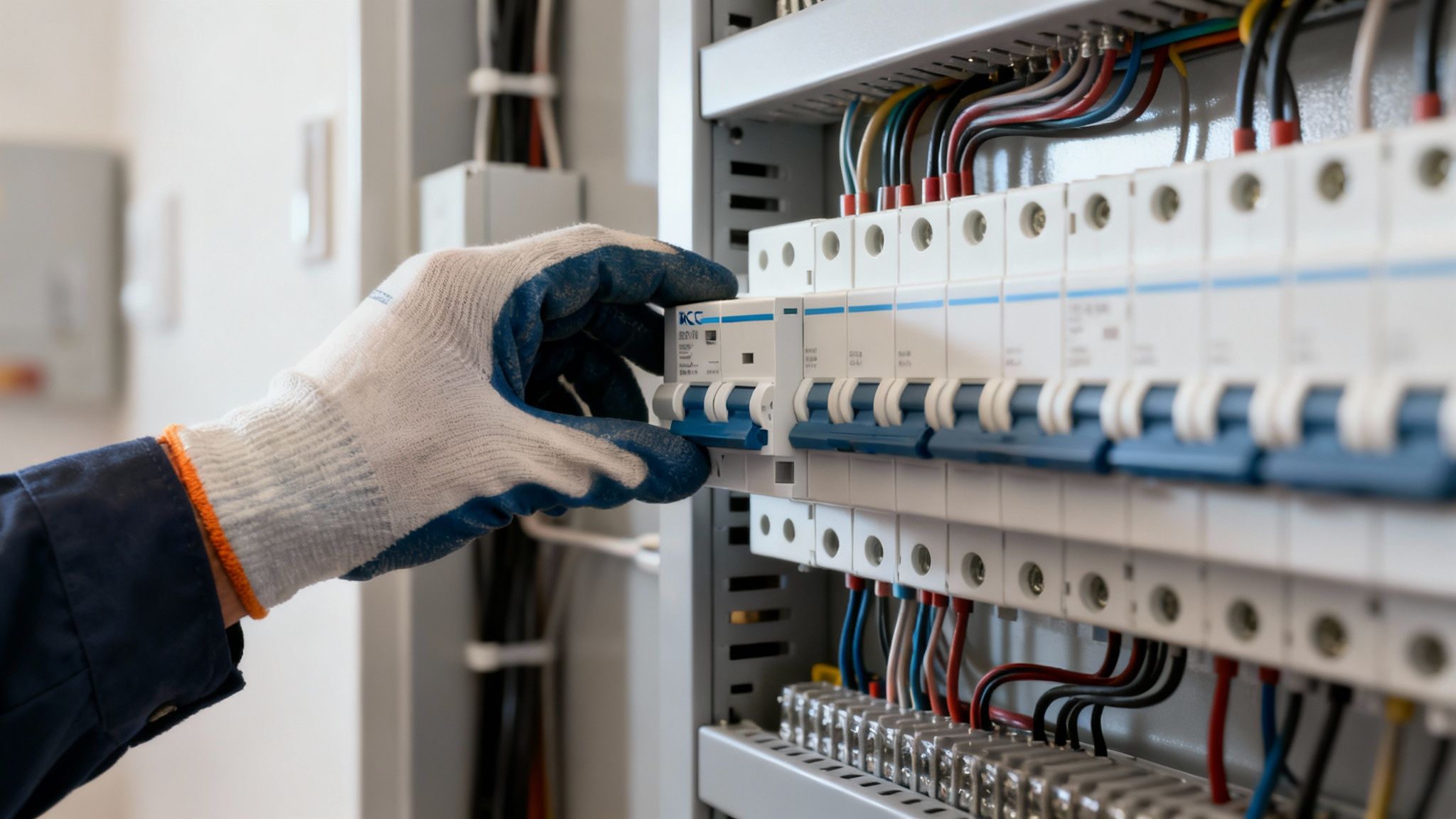
The single most effective way to meet your legal obligations and properly secure your home is a full switchboard upgrade. This isn’t just about swapping out a few parts. It’s a complete overhaul of your home’s electrical nerve centre, replacing an outdated panel with a modern, fully enclosed unit where every circuit gets its own RCBO.
Think of it as a critical investment in your family’s safety. Upgrading ticks several crucial boxes all at once:
A modern switchboard loaded with RCBOs—which combine both an RCD and a circuit breaker in one neat package—is the gold standard. It delivers layers of comprehensive protection that older systems just can’t offer, giving you complete peace of mind.
A switchboard upgrade does more than just get you compliant; it gets your home ready for the future. Let’s face it, the electrical load of a typical household has exploded in recent years. Between air conditioners, home offices, and a growing collection of smart appliances, we’re asking a lot more from our electrical systems. Many older switchboards simply weren’t built for this kind of demand.
And it doesn’t stop there. With high-draw additions like pool pumps and electric vehicle chargers becoming more common, having a robust, modern switchboard is non-negotiable. An upgrade ensures your system can handle these power-hungry devices safely, without constantly tripping circuits or creating a hidden fire risk from overloaded wiring. This is an essential step, especially with projections showing Australia’s circuit breaker market growing to USD 376.0 million by 2033, driven by these very infrastructure upgrades.
When you get DLG Electrical on the job for a switchboard upgrade, our licensed sparkies handle everything from start to finish, ensuring a seamless and perfectly compliant result. We kick things off by assessing your current setup and talking through your future power needs. Our team then safely disconnects the power, removes the old, hazardous fuse box, and installs a brand-new, high-quality enclosure.
From there, every single circuit is fitted with its own RCBO, giving it both RCD and circuit breaker protection in one. We then test every connection meticulously to make sure it’s all working flawlessly before we turn the power back on. This vital upgrade not only makes your home infinitely safer but also adds real, tangible value to your property. To learn more about what’s involved, check out our detailed guide on electrical switchboard upgrades and safety.
Even after getting the basics down, it’s the practical, real-world questions that pop up. What do I actually need to do? Why does that switch keep flicking off? What’s involved if I need to get the whole thing upgraded? Getting straight answers helps you feel in control of your home’s electrical safety.
We’ve put together a no-nonsense FAQ section to tackle the questions we hear most often from homeowners. This will lock in what you’ve learned and give you the confidence to know what to do and when it’s time to call in a professional.
Think of it like checking the batteries in your smoke alarm. Regular testing is the only way to know for sure that your RCD is ready to do its job in an emergency. The good news is, it’s a quick and simple check every homeowner should do.
You need to test your RCDs every six months. Just find the safety switch in your switchboard and press the small button marked ‘Test’ or ‘T’. When you press it, the main switch lever should instantly snap to the ‘Off’ position, killing the power to that circuit.
If that switch doesn’t trip straight away, the RCD is faulty. It can no longer be trusted to save a life and must be replaced by a licensed electrician immediately. That two-second test is a tiny price to pay for genuine peace of mind.
It’s definitely frustrating when a switch trips, but remember—it’s doing exactly what it was built for: protecting you or your home. Figuring out why it tripped usually comes down to which type of switch it was.
When a switch trips, your first move is to play detective. Unplug everything on that circuit, then go and reset the switch. If it stays on, start plugging your appliances back in one by one. The moment it trips again, you’ve found your culprit. If the switch keeps tripping even with nothing plugged in, it’s time to call an electrician right away to diagnose a likely wiring fault.
A switchboard upgrade is a major overhaul of your home’s electrical nerve centre. It’s not just about swapping out a few old parts; a qualified electrician replaces the entire outdated system with a modern one that meets today’s strict safety standards.
First, the power to your entire home will need to be disconnected for several hours. The electrician will then carefully remove your old ceramic fuse box or outdated panel. A new, fire-rated enclosure is then installed in its place.
Inside this new board, every single circuit gets its own modern RCBO—a single device that combines the functions of an RCD and a circuit breaker. This gives every circuit total protection from both electric shocks and overloads. After everything is meticulously wired to current Australian standards, the whole system is rigorously tested before the power is safely switched back on. It’s a job that makes your home profoundly safer and ready for all the demands of modern life.
If you’re looking at your switchboard with a bit of uncertainty or have any concerns about your home’s electrical safety, it’s time to call in the experts. The team at DLG Electrical provides professional switchboard inspections and upgrades across Brisbane, ensuring your home is safe, compliant, and ready for whatever the future holds. Contact us today for a free quote.

Master Electrician with over 30 years of experience. Founded DLG Electrical in 2005 after international project work including electrical installations at Stamford Bridge Stadium, London(Home of Chelsea FC).

Local Electricians that can fix all Electric Hot water Systems.
Motion sensor lights are a versatile addition to any home, offering nu
