83 Jean St, Grange QLD 4051
Mon-Fri 07:30 AM - 04:00 PM - Sat - 8:00 - 12 - Sunday Closed
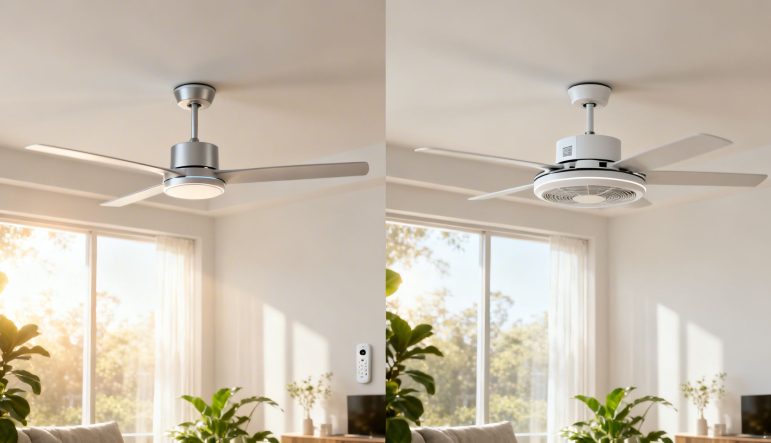
Right, you’re looking for a new ceiling fan in Brisbane and the whole DC vs AC thing has you scratching your head. Let’s cut straight to it. For most modern homes, the answer is clear: DC ceiling fans are the superior choice. They’re quieter, more efficient, and packed with features that older AC models simply can’t compete with.
The real decision comes down to what you value most: a lower upfront cost, or significant long-term savings and better performance.

When you’re choosing a ceiling fan for your Brisbane home, understanding the difference between Direct Current (DC) and Alternating Current (AC) models is key. This isn’t just about a different motor; it’s a fundamental split in performance, running costs, and how you’ll use the fan day-to-day.
AC ceiling fans are the old guard. They’re the traditional standard, connecting directly to your home’s AC power supply. The technology is simple, reliable, and has been around for decades, which is why they are generally cheaper to buy off the shelf.
DC ceiling fans, on the other hand, are the new benchmark. They have a small, built-in transformer that converts the AC power from your wall into DC power for the motor. This clever conversion step is what gives them incredibly precise control over power use and blade speed.
Key Takeaway: The whole debate boils down to efficiency and control. A DC fan’s ability to intelligently convert power leads to massive energy savings and unlocks a bunch of modern features. That makes it a much smarter long-term investment for tackling Brisbane’s sticky climate.
To make things simple, here’s a quick breakdown of the core differences between the two. Think of this as your cheat sheet when you’re weighing up your options.
| Feature | DC Ceiling Fan | AC Ceiling Fan |
|---|---|---|
| Energy Efficiency | Excellent (uses up to 70% less power) | Standard (higher power consumption) |
| Noise Level | Virtually silent operation | Noticeable motor hum, especially on high |
| Speed Options | 5-9 speeds, precise control | Typically 3 speeds (Low, Med, High) |
| Extra Features | Reverse function, breeze modes, smart tech | Basic operation, often pull-cord control |
| Upfront Cost | Higher initial investment | More budget-friendly |
| Motor Lifespan | Longer due to cooler, brushless motor | Shorter, with potential capacitor issues |
As you can see, the trade-off is clear: AC fans save you money upfront, but DC fans deliver superior performance and save you money every time you turn them on.
Here’s the most compelling reason to go with a DC fan: the dramatic difference in energy use. DC ceiling fans are up to 70% more energy-efficient than their AC counterparts. They sip power, using as little as 5-35 watts, while a standard AC fan can guzzle 60-100 watts.
To put that in perspective, analysis from Canstar Blue shows a DC fan can cost as little as 0.17 cents per hour to run, compared to 1.90 cents for some AC fans. It doesn’t sound like much, but when you’re running fans all day and night through a Brisbane summer, those cents add up fast.
While the initial price tag for a DC fan is higher, the savings on your electricity bill accumulate year after year. It makes them a financially sound choice for any household looking to cut down on running costs. Our full guide to ceiling fan options can help you dig into specific models that will suit your home and budget.
To really get to the bottom of the DC ceiling fan vs AC ceiling fan debate, it helps to look under the bonnet and see what makes them tick. The main difference is all about how they use the electricity from your home’s wiring. At its heart, this is a story of raw power versus refined control.
An AC ceiling fan is pretty straightforward. It takes the Alternating Current (AC) directly from your power point and feeds it into its motor. This current rapidly switches direction, creating an electromagnetic field that spins the motor’s rotor, which in turn moves the blades. It’s a simple, robust system that has been the standard for decades.
Think of an AC motor like a basic garden hose. When you turn it on, water flows at a set pressure from the tap. You get a strong, reliable stream, but your ability to fine-tune it is pretty limited.
A DC ceiling fan, on the other hand, is a bit more clever. While it also plugs into the same AC wall socket, it adds an extra step. Tucked inside the fan’s housing is a small transformer, also known as a rectifier. This component’s only job is to take the incoming AC power and convert it into a stable, one-way Direct Current (DC).
This conversion is the secret to a DC fan’s impressive performance. By transforming the power first, the fan’s motor gets a much more manageable and precisely controllable source of energy. This allows for a completely different motor design—one that doesn’t rely on the brute force of alternating current.
A DC motor uses this converted power to energise a series of opposing magnets. This creates rotational force with far greater efficiency and almost no electrical “hum,” which is why they are so whisper-quiet.
This difference in technology has a direct impact on what you experience at home. An AC fan’s speed is controlled by limiting how much power reaches the motor, which is why they usually only have three settings: low, medium, and high. If you tried to fine-tune it any further, the motor would start humming loudly or even stall.
In stark contrast, a DC motor’s speed is managed by regulating the voltage with pinpoint accuracy. Because the internal transformer provides a clean DC signal, the fan’s remote can tell the motor exactly how much power to use. This unlocks a huge range of possibilities, from an ultra-low, gentle spin to a high-velocity blast of air.
Here’s a simple breakdown of that technological divide:
Ultimately, an AC fan motor is a workhorse, using raw power to get the job done. A DC fan motor is more like a finely tuned instrument, using sophisticated technology to deliver superior control, remarkable efficiency, and a level of quietness that AC fans simply can’t match. This foundational difference is what leads to all the practical benefits we’ll explore next.
While smart features and whisper-quiet operation are big selling points, for most Brisbane homeowners, the real decision in the DC ceiling fan vs AC ceiling fan debate comes down to money. Let’s break down exactly how much you can expect to save with a DC fan, putting real dollar figures to those wattage numbers.
Understanding the running cost of an appliance is key to managing your household budget. The formula is simple, but the long-term impact is often eye-opening. Once you see how much electricity a fan uses over time, the return on investment becomes crystal clear. If you want to dive deeper into the numbers, we’ve got a detailed guide on https://dlgelectrical.com.au/dlg-blog/how-to-calculate-electrical-energy-consumption/.
Let’s start with a head-to-head comparison. A standard AC ceiling fan might pull around 75 watts on a medium speed. A comparable DC fan, however, needs only 25 watts to create the same cool breeze.
When you apply Brisbane’s average electricity tariff to this, the difference is immediate.
It might not sound like much, but those cents add up fast, especially during a long, sticky Brisbane summer when the fans barely get a break.
The infographic below shows the core technology that makes this efficiency gap possible.

As you can see, the AC motor is a power-hungry design that runs directly from your home’s supply. In contrast, the DC motor’s internal transformer is the secret to its incredible efficiency and precise control.
Now, let’s look at what this means for a typical family home in Brisbane with four fans spinning through the summer months.
Running on a low 20W setting for 12 hours a night over 120 summer days, a single DC fan saves $25 per year compared to a 60W AC fan (at Queensland’s average tariff of 31c/kWh). For a five-room rental property, that could add up to $500 over 21 years. The lifetime financial advantage of DC technology is undeniable.
Over a single decade, a household with four DC fans could save approximately $1,000 on electricity bills compared to using AC fans. This effectively pays back the higher initial purchase price and then continues to deliver savings for years to come.
One of the smartest ways to cut down your summer power bills is by using your ceiling fans in tandem with your air conditioner. A fan doesn’t actually cool the air, but the wind-chill effect it creates makes you feel several degrees cooler.
This simple trick allows you to dial up your air conditioner’s thermostat without feeling any less comfortable. For every single degree you raise the thermostat, you can save up to 10% on your cooling costs. By pairing efficient DC fans with your air con, you can slash your total cooling bill by a massive 25-40%.
Of course, the fan is just one piece of the puzzle. Truly significant savings come from designing an energy-efficient house from the ground up.
Choosing a DC fan is more than just an appliance purchase; it’s a strategic move towards a more comfortable and cost-effective home. When you consider the lifetime cost—the upfront price plus a decade of running costs—the DC fan almost always comes out as the clear financial winner for savvy Brisbane residents.
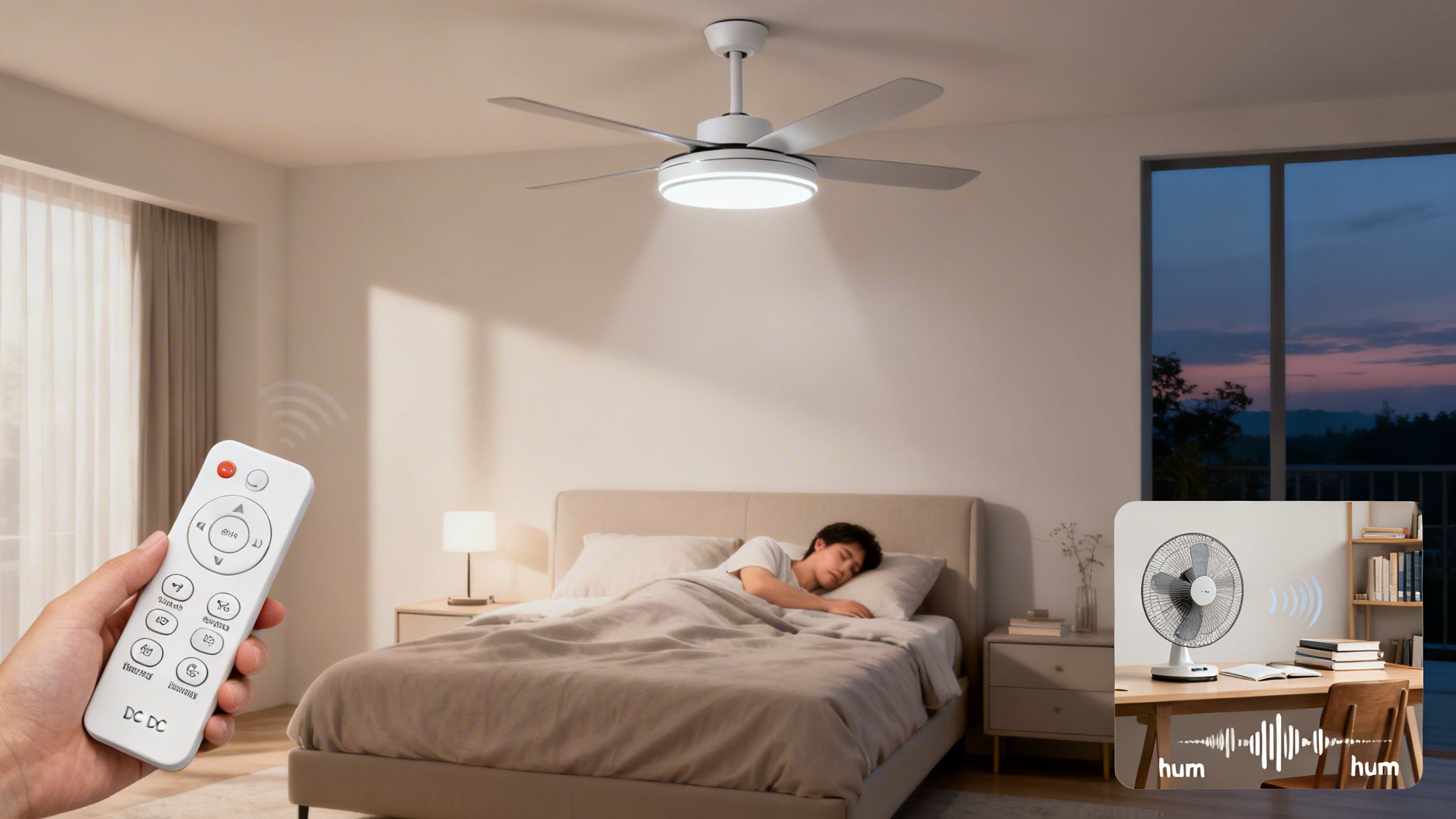
While the long-term energy savings are a big plus, the DC ceiling fan vs AC ceiling fan debate really comes to life when you compare how they actually perform in your home. The day-to-day experience is where you’ll feel the difference, affecting everything from your sleep quality to your year-round comfort.
Let’s talk about noise. It’s one of the biggest differentiators. An AC fan’s motor is directly connected to your home’s alternating current, which creates a distinct electrical “hum.” It might be subtle on the lowest setting, but crank it up, and that hum can become a persistent background noise—not exactly ideal for a bedroom or a quiet study.
In stark contrast, DC fans are engineered for silence. Their modern brushless motors run on a stable direct current, which almost completely eliminates the electrical hum that plagues older AC models. The only sound you typically hear is the gentle whoosh of the blades moving through the air.
For many Brisbane homeowners we work with, especially light sleepers or families with young kids, the noise factor alone is enough to make the decision. The quietness of a DC fan means you can enjoy a cool breeze all night without any disruptive buzzing.
The Bottom Line on Noise: If a peaceful, quiet space is a top priority, a DC ceiling fan is the undisputed winner. It gives you all the cooling power you need without the noise pollution, making it a perfect choice for bedrooms, nurseries, and living rooms where you want to relax.
Beyond just the noise, the level of control you get is a major point of difference. AC fans are typically limited to a standard three-speed setting, usually operated by a pull-cord or a basic wall controller. It’s functional, but it’s a very one-size-fits-all approach to comfort.
DC fans, on the other hand, offer a whole new world of flexibility. Thanks to the precise electronic control of their motors, they almost always come with a remote that provides multiple speed settings. It’s not uncommon to see DC models with anywhere from five to nine speeds.
This precision allows you to dial in the perfect level of airflow for any situation—from an ultra-low, gentle breeze for sleeping to a high-velocity setting for quickly cooling down a room after a hot Brisbane afternoon. You just can’t get that level of granular control with a traditional AC fan.
To make this crystal clear, let’s break down how these fans stack up on key features and performance metrics.
| Performance Metric | DC Ceiling Fan | AC Ceiling Fan | What This Means For You |
|---|---|---|---|
| Noise Level | Near-silent operation; no motor hum, only blade noise. | Audible electrical hum, especially on higher speeds. | DC fans are far better for bedrooms, nurseries, and quiet spaces where noise is a concern. |
| Speed Options | Typically 5-9 speed settings via remote control. | Usually limited to 3 speed settings (low, medium, high). | DC fans give you precise control to find the perfect airflow for any time of day or activity. |
| Reverse Function | Easily reversed via a button on the remote control. | Requires manually flipping a switch on the motor housing (needs a ladder). | DC fans make it simple to switch to winter mode to help circulate warm air and improve heating. |
| Advanced Features | Often includes smart controls, breeze simulation, and timers. | Rarely includes advanced features; basic on/off/speed control only. | If you want modern conveniences like app control or voice commands, DC is the way to go. |
As you can see, the DC fan isn’t just a minor upgrade; it represents a significant leap forward in user experience and functionality.
The technology gap gets even wider when you look at the advanced features that are now becoming standard on many DC ceiling fans. These functions turn the fan from a simple appliance into a key part of your home’s comfort system.
Common features you’ll find on DC fans include:
These modern comforts are almost never found on standard AC models. The comparison makes it clear: a DC fan isn’t just more efficient—it’s a smarter, more versatile, and far more user-friendly piece of technology for today’s homes.
When you’re weighing up a DC ceiling fan vs an AC ceiling fan, it’s easy to get focused on performance and cost. But the practical side of things—installation and long-term ownership—is just as important. While both types need a licensed electrician to be installed safely and legally, their internal workings create a few key differences you should know about.
The physical mounting process for both fan types is pretty much identical. The main difference with a DC fan is an extra step: fitting a small electronic receiver into the fan’s ceiling canopy. This little box is what converts your home’s AC power to DC and also picks up the signals from the remote control. For a qualified sparkie, this is all in a day’s work, but it’s a good reminder that installing a DC fan isn’t a DIY job.
If you’re curious about what a professional installation involves, have a look at our guide on how to install a ceiling fan. It really highlights why getting an expert in is non-negotiable for a safe and correct setup.
Once your fan is up and running, the next big question is reliability. This is where the simpler, more advanced design of a DC motor really gives it an edge for long-term peace of mind.
DC motors are brushless, which is a game-changer. It means there are fewer internal parts to rub, wear down, and eventually fail. They also run significantly cooler than their AC cousins, which puts less stress on the motor windings and other components. All this smart engineering translates to a much longer operational life.
Key Insight: The simpler mechanics and cooler operation of DC motors mean they are built to last. Manufacturers know this, and it’s why they often offer much longer warranties—motor coverage of up to 10 years is becoming standard, reflecting their confidence in the technology.
Over a decade or more of use, the differences in reliability really start to show. AC fans are workhorses, but they have a known weak point: the capacitor. This small component helps kickstart the motor and regulate its speeds, and when it fails, the fan will either stop working or get stuck on one speed. It’s one of the most common repair jobs for an AC fan, and while it’s fixable, it’s a maintenance headache that DC fans just don’t have.
In a DC fan, the main electronic part is the receiver. While a receiver can fail, it’s generally much less common than a capacitor burning out in an AC fan. The sealed, brushless DC motor itself is exceptionally reliable and isn’t prone to the same mechanical wear and tear that can plague AC motors after years of continuous service.
Here’s a quick breakdown of what to expect over the long run:
For Brisbane property owners, choosing a DC fan is about more than just saving on power bills; it’s an investment in durability. The longer warranties and more reliable motor technology give you lasting confidence that your fan will keep you cool quietly and effectively for many summers to come.
Making the final call in the DC vs AC ceiling fan showdown really comes down to your specific situation. While DC fans are technically the superior option, the best choice for you depends on your budget, how you’ll use the space, and what your long-term goals are.
Let’s walk through a few common Brisbane scenarios to help you decide.
If you’re renovating on a tight budget, you know that every dollar counts. In this case, a high-quality AC fan is a perfectly sensible choice, especially for secondary spaces like a guest room or a study that isn’t used every day.
You still get effective cooling without the higher upfront cost of a DC model. The trick is to select a reputable AC fan known for its reliability. This ensures you get a durable product that moves a good amount of air without breaking the bank.
For those building a new home from the ground up, the decision is much clearer. The small additional investment in DC fans across the entire property is a smart long-term play. You’ll start benefiting from lower energy bills from day one, which quickly offsets the higher initial purchase price.
By integrating energy-efficient DC fans throughout a new build, you’re not just buying an appliance; you’re future-proofing your home’s comfort and operational costs. It’s an investment that pays dividends in both savings and lifestyle for years to come.
This approach also ensures you have a consistent, modern look and feel throughout your new home, with whisper-quiet operation and advanced features in every single room.
If you’re someone who is easily woken up by noise at night, a DC ceiling fan in the bedroom is non-negotiable. The near-silent operation of a brushless DC motor is an absolute game-changer for sleep quality.
That persistent, low-level hum from an AC fan can be just enough to disrupt sleep. A DC fan, on the other hand, provides a cooling breeze without that distracting noise. For a peaceful night’s rest during Brisbane’s hot, humid nights, the extra cost is absolutely worth it.
When you’re managing a commercial space, an office, or a portfolio of rental properties, the numbers do the talking. The energy savings from DC fans, when multiplied across several units, deliver a significant return on investment that’s hard to ignore.
Here’s a quick look at how the choice plays out in different contexts:
While this guide focuses on indoor cooling, don’t forget about your outdoor areas. For patios and alfresco spaces where a ceiling fan isn’t practical, other solutions like misting fans can provide excellent cooling for entertaining.
Ultimately, your choice depends on balancing that initial cost with the long-term benefits. If you’re ready to discuss the best solution for your Brisbane property, the expert team at DLG Electrical can provide a professional recommendation and a clear, upfront quote.
Even after laying out all the specs, we find Brisbane homeowners still have a few lingering questions when deciding between an AC and a DC fan. That’s perfectly normal. Here are the most common queries we get at DLG Electrical, answered in plain English to help you make your final choice with total confidence.
The short answer is a hard no. In Queensland, it’s a legal requirement that any fixed electrical wiring, which includes all ceiling fan installations, must be carried out by a licensed electrician. This isn’t just red tape; it’s a mandate for your safety under Australian Standard AS/NZS 3000.
DC fans come with an electronic receiver that must be wired correctly into the fan’s canopy. Trying to do this yourself is not only illegal but also introduces a serious risk of fire. It will also instantly void your fan’s warranty and could even jeopardise your home insurance policy. Always bring in a professional to get the job done safely and to code.
For the vast majority of our clients here in Brisbane, the answer is a resounding yes. While you will pay more at the checkout for a DC fan, the investment almost always pays for itself in energy savings, typically within just 3 to 5 years.
When you’re saving up to 70% on running costs, the initial price difference gets eaten up pretty quickly. But it’s not just about the money. You’re investing in a better quality of life: whisper-quiet operation perfect for bedrooms, more speed settings for precise comfort, a reverse function for year-round efficiency, and a motor built to last longer. It’s a genuine upgrade to your home.
Yes, absolutely. There’s a common myth that the lower energy consumption of a DC fan must mean it has weaker airflow. That’s just not true. A fan’s ability to move air, measured in cubic metres per hour (CMH), comes down to blade design, motor power, and speed (RPM)—not the type of electrical current it uses.
In fact, modern high-performance DC fans are engineered to produce powerful, consistent airflow, often outperforming their AC counterparts while sipping a fraction of the power. When you’re weighing up dc ceiling fan vs ac ceiling fan options, always check the CMH rating on the box. A quality DC fan will deliver all the breeze you need to take on Brisbane’s stickiest summer days.
That’s a fair question, especially since most DC fans rely solely on their remote for control. Unlike old-school fans with pull cords, the remote is the key. The good news is that manufacturers have made this an easy problem to solve.
Ready to upgrade your home’s comfort with the silent efficiency of a DC ceiling fan? The licensed and experienced team at DLG Electrical is here to help you choose and install the perfect solution for your Brisbane property. We’ll make sure the job is done right, the first time.
Contact us today for a free, no-obligation quote.

Master Electrician with over 30 years of experience. Founded DLG Electrical in 2005 after international project work including electrical installations at Stamford Bridge Stadium, London(Home of Chelsea FC).

Local Electricians that can fix all Electric Hot water Systems.
Motion sensor lights are a versatile addition to any home, offering nu
