83 Jean St, Grange QLD 4051
Mon-Fri 07:30 AM - 04:00 PM - Sat - 8:00 - 12 - Sunday Closed
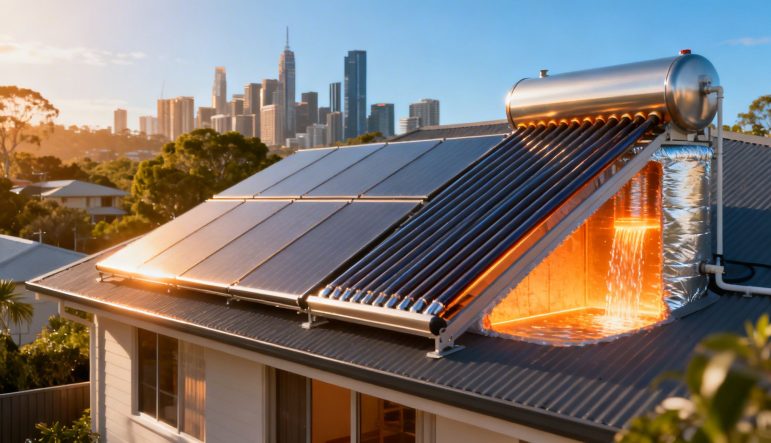
Tapping into the sun to heat your water is a smart decision for any homeowner, but for those of us in Brisbane, it’s a no-brainer. With sunshine practically on tap all year round, installing a solar hot water Brisbane system is one of the most effective ways to slash your energy bills and move towards a more self-sufficient home. This isn’t just an eco-friendly choice; it’s a financially sound one.
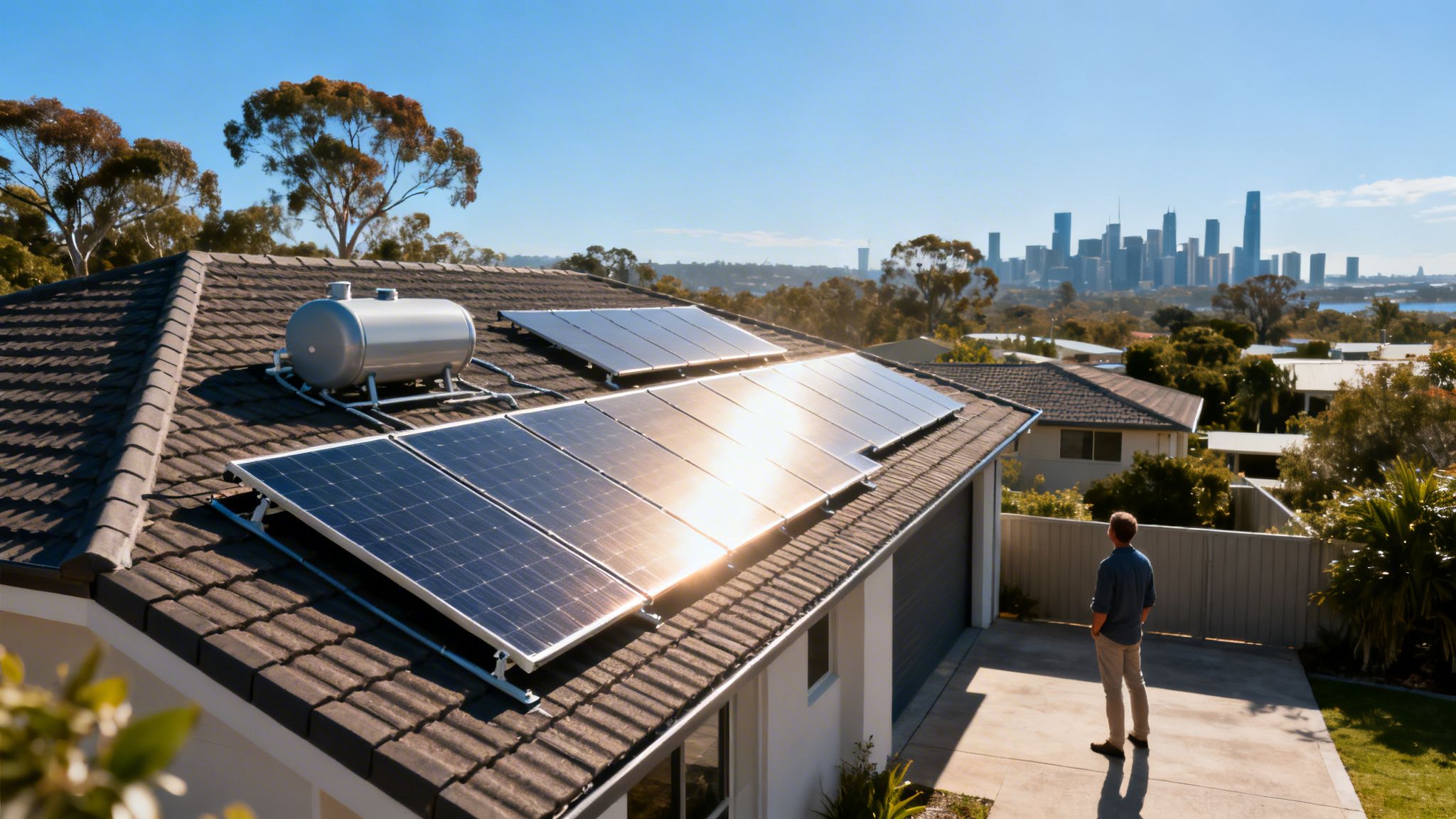
Think of your roof as a personal power plant, quietly working to drive down your household running costs every single day. In Brisbane, that’s not just wishful thinking—it’s a reality. Our city’s climate is the single biggest reason why making the switch makes so much sense.
With an average of over 280 sunny days each year, Brisbane’s weather provides a powerful and reliable source of free energy. All that sunlight means your hot water system doesn’t have to rely on expensive grid electricity nearly as much. For most families, water heating is a huge chunk of their power bill, often accounting for up to 30%.
By switching to solar hot water, a typical Brisbane household can cut its water heating energy use by a massive 50% to 90%. It’s one of the most powerful moves you can make against rising electricity prices.
For anyone living in suburbs from Grange to Windsor and right across the city, putting in a solar hot water system is more than just a home improvement—it’s a solid, long-term investment in your property. The financial payback is clear, offering a strong return for years to come.
Here are the key advantages that really hit home in the Brisbane climate:
While the benefits are clear, figuring out the right system and making sure the installation is done by the book can feel overwhelming. Every home is different—your roof’s direction, how many people live there, and your daily hot water habits all play a part. This is where getting help from a trusted local expert is crucial.
A qualified installer who knows the Brisbane area inside and out understands the unique challenges and opportunities our climate offers. They can properly assess your home, recommend the most efficient system for your needs, sort out any council permits, and make sure your installation is fully compliant with strict Australian safety standards. Making the right choice from the start begins with getting the right advice, ensuring your investment pays off from day one.
Ever wondered how all that brilliant Brisbane sunshine can be turned into a hot shower? The idea behind it is actually much simpler than most people think. In fact, you’ve probably seen the basic principle in action without even realising it.
Think about a garden hose that’s been left lying out in the sun. When you first turn the tap on, that initial spray of water is often surprisingly hot. That’s because the sun’s warmth has been absorbed by the hose and transferred straight to the water inside. A solar hot water Brisbane system does the exact same thing, just far more efficiently.
These systems use special solar collectors on your roof to grab the sun’s thermal energy. This heat is then used to warm up the water in a well-insulated storage tank, so it’s ready and waiting for you whenever you turn on a tap.
The collectors are the real workhorses of your solar hot water system. They’re the part responsible for capturing the sun’s warmth. Here in Brisbane, you’ll mainly come across two types, and understanding the difference is key to picking the right one for your home.
The performance of these systems is built on advanced solar power technology designed to convert as much sunlight as possible into usable heat for your household.
Flat Plate Collectors: These are the classic, most common type you’ll see around. They look like a shallow, weatherproof box with a glass top. Inside, there’s a dark plate with tubes running through it. As the sun heats the plate, the fluid in the tubes gets hot, and this heat is then sent to your water tank. They are incredibly durable, cost-effective, and perform brilliantly in Brisbane’s sunny climate.
Evacuated Tube Collectors: This is a more modern design that looks like a series of glass tubes. Each one has an inner tube with a special coating that absorbs solar energy. The real magic is that the air between the inner and outer tube is pumped out, creating a vacuum. This vacuum is a fantastic insulator, meaning very little heat is lost, making them super-efficient, especially on cloudy days.
No matter which type you choose, the job is the same: the collector uses free sunlight to get hot, and that heat is used to warm your water. It’s a beautifully simple and effective way to lower your energy bills.
To help you decide which collector is the right fit for your Brisbane home, we’ve put together a quick comparison. Your choice will often come down to your roof space, budget, and how you use hot water.
| Feature | Flat Plate Collectors | Evacuated Tube Collectors |
|---|---|---|
| Best For | Sunny climates like Brisbane; budget-conscious buyers. | Colder climates, overcast days, or limited roof space. |
| Efficiency | Very good in direct sunlight but less effective on cloudy days. | Highly efficient due to the vacuum insulation; works well in low light. |
| Durability | Extremely tough and resistant to hail and physical damage. | More fragile due to the glass tubes, though individual tubes can be replaced. |
| Cost | Generally lower upfront cost, offering great value for money. | Higher initial investment, but can offer better long-term performance. |
| Roof Footprint | Requires a larger surface area for the same output. | More compact, generating more heat from a smaller area. |
Ultimately, for most Brisbane homes, a flat plate system offers a fantastic, reliable balance of performance and cost. However, if your roof is partially shaded or you want to maximise efficiency, evacuated tubes are an excellent choice.
Once your collectors have done their job and captured the sun’s heat, the next step is getting that energy into your storage tank. This happens in one of two ways, which defines the type of system you have.
A thermosiphon system (often called a close-coupled system) is clever in its simplicity. It works on the basic law of physics that hot water rises. The storage tank is mounted on the roof right above the collectors. As the fluid inside the collectors heats up, it gets lighter and naturally flows up into the tank. This pushes the cooler, denser water at the bottom of the tank down into the collectors to be heated, creating a natural, pump-free circulation loop.
A split system, on the other hand, gives you more flexibility with where your tank goes. The lightweight collectors are on the roof, but the heavy storage tank is installed on the ground, out of sight. A small, efficient electric pump circulates fluid between the collectors and the tank. A controller makes sure the pump only runs when the collectors are hotter than the water in the tank, so no energy is wasted.
Figuring out the right size for a solar hot water system in Brisbane is a bit like Goldilocks—you don’t want one that’s too small or too big. Go too small, and you’ll be running out of hot water on cloudy days. Go too big, and you’ve simply paid for capacity you’ll never use. The real goal is hitting that sweet spot where the system perfectly matches your daily needs without breaking the budget.
It’s not just about counting how many people are in your house, either. A proper sizing calculation digs much deeper, looking at your family’s specific water habits, our sunny Brisbane climate, and even the direction your roof faces. Any good installer worth their salt will do a full assessment before even thinking about recommending a particular system.
To make sure your solar hot water system can keep up, it needs to be sized correctly. While it’s about PV panels, this guide on what size solar system do I need has some useful ideas on matching capacity to your usage that apply here too.
Here’s what a professional will look at for your Brisbane home:
This simple diagram shows how it all comes together, turning sunshine into real savings on your power bill.
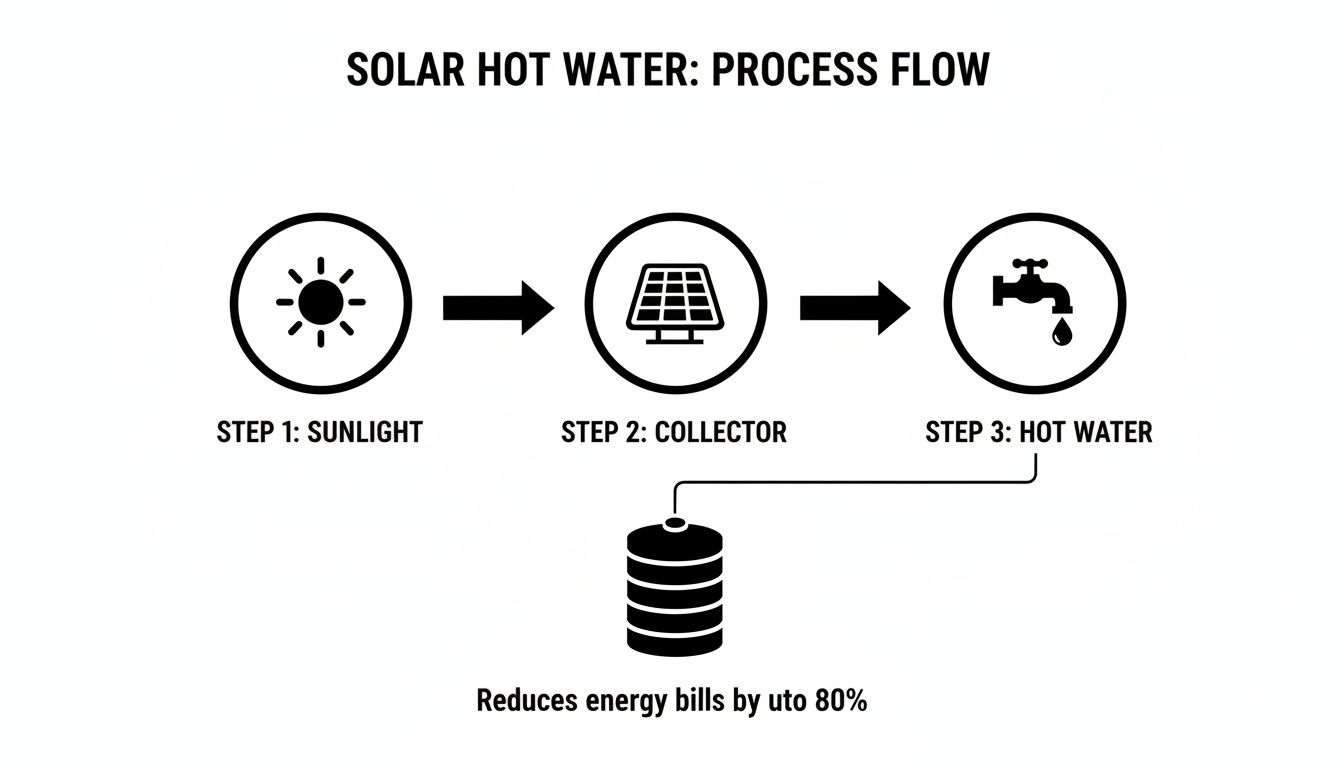
As you can see, it’s a beautifully efficient process. Energy from the sun is captured and transferred directly to your water supply, working silently day in and day out.
Yes, there’s an upfront cost to installing a solar hot water system, but it’s best to see it as a long-term investment that pays you back for years. The final price tag will depend on the system size, the type you choose (flat plate or evacuated tube), the brand, and how complex the installation is.
For a standard Brisbane household of three to four people, you can expect the fully installed cost of a quality system to be somewhere in the $4,000 to $7,000 range. This typically covers the solar collectors, storage tank, and all the work by a licensed plumber and electrician to get it running.
Remember, this upfront cost gets a significant haircut thanks to government incentives. Federal Small-scale Technology Certificates (STCs) can knock anywhere from several hundred to over a thousand dollars right off the top.
It’s easy to forget that heating water can make up a massive 20-30% of your home’s entire energy bill. Slashing that figure is where the real value lies. Even a small system can make a huge dent in your household’s energy needs.
When you weigh the initial investment against the ongoing savings, the numbers speak for themselves. To see how these costs stack up against other options, have a look at our detailed guide on the cost of a new hot water system. By cutting your water heating energy use by up to 90%, the system quickly starts paying for itself and puts money back in your pocket.
Let’s talk about the money side of things. When you’re looking at a solar hot water Brisbane installation, the initial price tag is a big consideration. The good news is, you don’t have to bear the full cost alone.
There are government incentives designed specifically to make the switch easier on your wallet. They’re not complicated forms you fill out after the fact; instead, the main incentive works as an instant, upfront discount. It makes a real, tangible difference to the price you see on your quote.
The biggest financial help comes from the Australian Government’s Small-scale Renewable Energy Scheme. Through this scheme, your new solar hot water system earns a number of Small-scale Technology Certificates, or STCs.
The easiest way to think of STCs is as a form of green currency. The number of certificates you get is based on your system’s size, its efficiency, and where in Australia you live. Since Brisbane is blessed with so much sunshine, systems installed here generate a high number of valuable STCs.
Your installer handles all the paperwork for you. They calculate the STCs your system is eligible for and give you a point-of-sale discount in exchange for them. This means you never have to worry about trading certificates yourself—you just see a lower final price on the invoice.
For a typical family-sized solar hot water system in Brisbane, the STC discount can knock anywhere from $600 to over $1,200 off the total cost. That’s a serious saving that makes the investment much more manageable from day one.
In the past, the Queensland government has offered its own rebates to help homeowners go solar. These programs, however, usually run for a limited time and have specific funding caps. As of 2026, the federal STC program is the primary incentive available for solar hot water.
While there are no active state-wide rebates right now, it’s always a good idea to check. Sometimes local councils or energy providers launch smaller, targeted schemes. Any reputable local installer will be on top of the latest news and can let you know if new programs pop up that could save you even more.
Another thing homeowners often worry about is dealing with council paperwork and regulations. Thankfully, for most standard solar hot water installations on existing Brisbane homes, the process is incredibly straightforward.
A professional installer manages this entire process for you. Their job is to make sure the installation ticks every box required by the Brisbane City Council and meets the strict Australian Standards for plumbing and electrical work. This covers:
When you choose a fully licensed and accredited installer, you get complete peace of mind. They handle all the compliance checks and paperwork, so you end up with a system that’s not only efficient but also 100% safe and legal. This professional oversight isn’t just a bonus; it’s essential for protecting your home and your investment.
When you’re looking at solar hot water in Brisbane, you’re tapping into a history that’s unique to our state. Queensland didn’t just stumble into solar; we were pushed into it by a landmark government policy that completely changed the game for homeowners and builders.
This wasn’t just a small shift. For years, solar hot water became the default choice for new homes, not just a green alternative. That legacy is why Brisbane has such a mature market today, filled with genuine expertise you won’t find elsewhere.
Let’s rewind to 2006. The Queensland government made a bold move: it essentially banned new electric storage hot water systems in all new homes. This single piece of legislation was a massive catalyst, forcing the entire building industry to find a better, more sustainable way to heat water.
This wasn’t just about being eco-friendly; it was a practical decision. Builders, plumbers, and homeowners had to adapt, and solar hot water quickly proved to be the most reliable and cost-effective solution for countless Queensland families.
The effect was huge. This law, which ran from March 2006 to early 2013, ignited a solar installation boom. It lined up with a national trend, where solar water heater installations skyrocketed from 85,385 in 2008 to an incredible 194,695 just a year later in 2009. Queenslanders were right at the centre of it, claiming 76% of all rebates in Australia during that peak, a fact highlighted in the Australian Energy Council’s detailed solar report.
That early boom did more than just get systems onto roofs. It created a generation of installers with years of hands-on experience and a population of homeowners who understood the day-to-day benefits of solar. Those early systems weren’t perfect, but the lessons learned helped refine the technology to what it is today.
This history is precisely why you’re in such a good position now. The systems available today are more efficient, tougher, and more affordable because they’ve been tested and improved over more than a decade in our local climate.
Here’s what that legacy means for you right now:
At the end of the day, Queensland’s solar history isn’t just an interesting story. It’s the foundation that makes choosing solar hot water in Brisbane a smart, safe, and financially sound investment for your home.
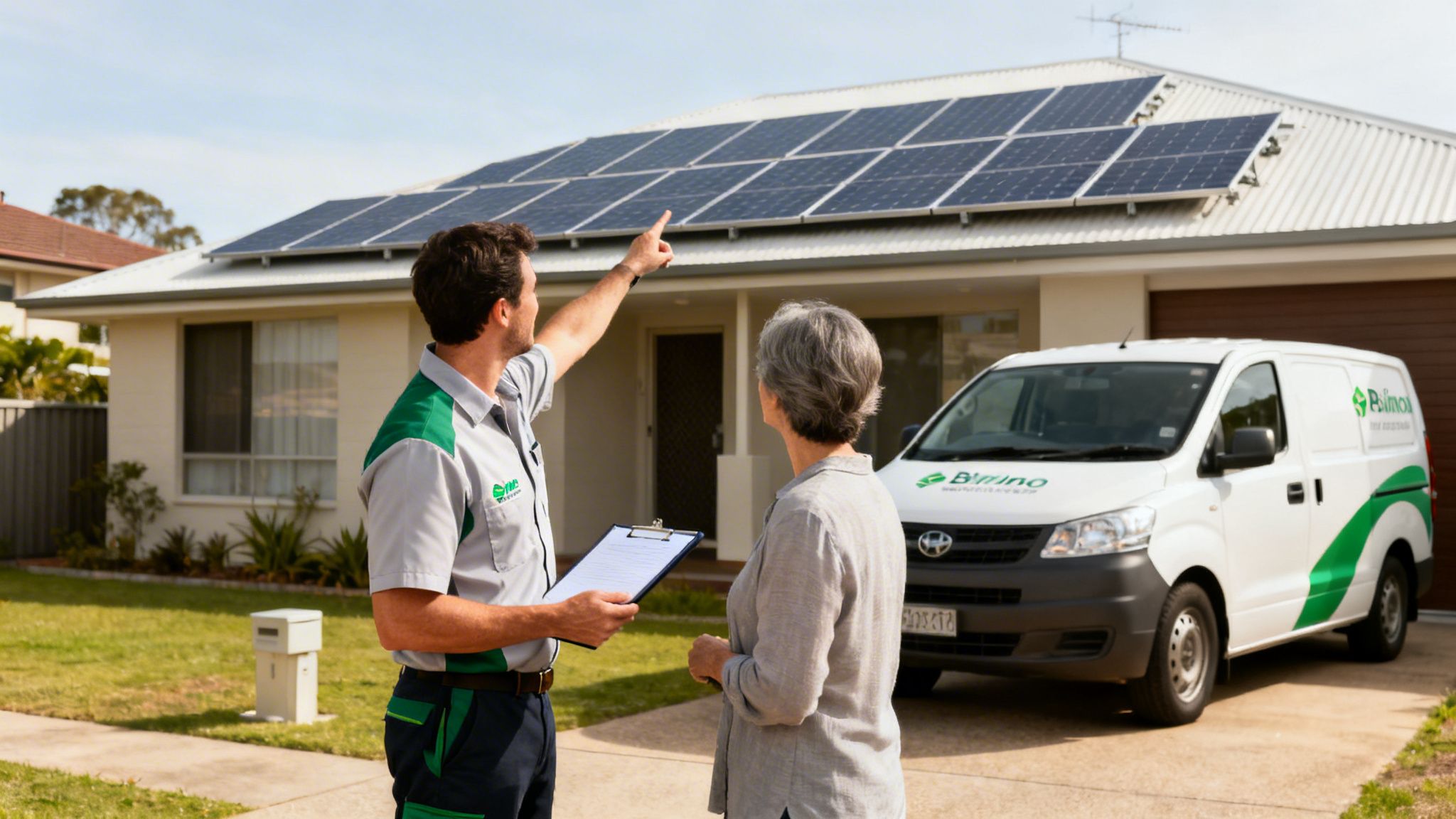
Choosing the right system for your home is only half the battle. The other half—and arguably the more important part—is finding the right person to install it. A top-of-the-line solar hot water Brisbane system can be a complete letdown if it’s installed poorly, leading to leaks, poor performance, or even serious safety issues.
Your installer is your partner in this project. Picking a trustworthy professional is the single best thing you can do to protect your investment. A good team doesn’t just bolt panels to your roof; they offer expert advice, ensure the work is safe and compliant, and provide support long after they’ve packed up their tools.
This is our checklist to help you find a quality local installer and avoid the cowboys.
This is the first step, and it’s completely non-negotiable. Any legitimate installer will have no issue showing you their qualifications. Don’t just take their word for it—ask to see the proof.
A solar hot water installation involves both plumbing and electrical work, so the person you hire needs to be licensed for both. In Queensland, that means they must hold a plumbing licence for the water connections and, if your system has an electric booster, an electrical licence for the wiring. Without these, the install isn’t compliant and could even void your home insurance.
An installer’s credentials are their proof of professionalism. Insist on seeing both their Queensland Building and Construction Commission (QBCC) licence for plumbing and their electrical contractor licence before you sign anything.
On top of that, make sure they are Clean Energy Council (CEC) accredited. This is the national benchmark for solar professionals, proving they’re trained in current industry best practices. It’s also often a requirement to claim government incentives like STCs.
An installer with deep roots in Brisbane understands our climate, our building codes, and our common roof types. They know from experience which systems stand up to the relentless Queensland sun and how to deal with local council requirements.
Look for a company that’s been around for a while and has a solid portfolio of local work. A business that has survived in a competitive market for years has done so by building a reputation for quality. That local knowledge is priceless.
A great way to check their reputation is to read online reviews. Go beyond the star rating and see what real customers are saying about things like:
Reading through genuine feedback gives you a real feel for the experience you can expect. This local expertise is also why having a skilled Brisbane electrician on the team is critical for a safe, compliant job.
Finally, a trustworthy installer will always provide a detailed, itemised quote that leaves no room for nasty surprises. A vague, one-page quote is a massive red flag. Your quote should clearly break down every single cost: the collectors, the tank, the booster, labour, and any certificates or permits.
Be wary of quotes that seem too good to be true—because they usually are. Shady operators often cut corners with cheap, inferior parts or unlicensed labour, which puts your home and your investment at risk. A professional quote reflects quality components and expert workmanship, which is what ensures your solar hot water system will deliver reliable savings for years to come.
Even with all the clear benefits, it’s completely normal to have a few questions before you invest in a solar hot water Brisbane system. Getting straight, honest answers is the best way to feel confident about your decision.
We get asked about this stuff all the time. Brisbane homeowners want to know what to expect day-to-day and how well these systems hold up in our sunny—and sometimes wild—Queensland weather. Let’s tackle some of the most common queries we hear.
A quality solar hot water system that’s been looked after is a serious long-term asset. You can easily expect it to last 21 years or more.
Of course, different parts have different lifespans. The storage tank will typically have a warranty for 5-10 years, while the solar collectors on your roof often come with warranties of up to 15 years.
The real secret to hitting that 20-year mark? A little bit of consistent care. Simple, professional check-ups will keep your system running at peak efficiency for decades to come.
This is probably the number one concern we hear, but rest assured—you will never be left shivering in a cold shower. Every single solar hot water system we install comes with a backup booster, which can be either gas or electric.
Here’s a simple breakdown of how you’re always covered:
It’s a hybrid approach that gives you the best of both worlds: maximum savings from the sun and complete reliability, no matter what the weather is doing.
Solar hot water systems are famously low-maintenance, but “low-maintenance” doesn’t mean “no-maintenance.” To keep your system in top-notch condition and ensure it delivers a long service life, we recommend a professional service every 3-5 years.
During a maintenance visit, a qualified technician will inspect the collectors for damage, check for any potential leaks, test all the valves and sensors, and make sure the booster is ready to go. You can find out more on why this is so important in our guide to hot water maintenance.
In between professional visits, simply ensuring the panels are reasonably clean from dust and debris is all you need to do to help maintain performance.
A bit of preventative care goes a long way. These scheduled inspections catch small issues before they become expensive problems, protecting your investment and ensuring you get maximum savings.
Ready to explore the benefits of solar hot water for your Brisbane home? For expert advice and a seamless installation, trust the team at DLG Electrical. Get your free, no-obligation quote today at https://dlgelectrical.com.au.

Master Electrician with over 30 years of experience. Founded DLG Electrical in 2005 after international project work including electrical installations at Stamford Bridge Stadium, London(Home of Chelsea FC).

Local Electricians that can fix all Electric Hot water Systems.
Motion sensor lights are a versatile addition to any home, offering nu
