83 Jean St, Grange QLD 4051
Mon-Fri 07:30 AM - 04:00 PM - Sat - 8:00 - 12 - Sunday Closed
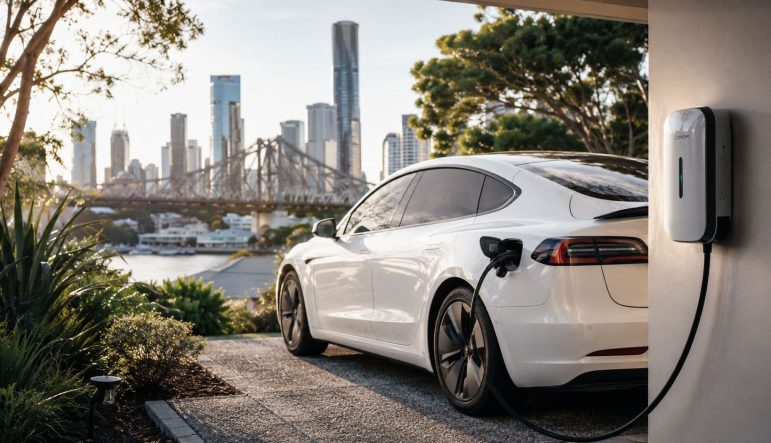
Driving a new EV home in Brisbane is the easy part. The question usually hits that night, when the car is in the driveway and the battery isn't full. Do you plug it into a normal socket, book a charger install straight away, or wait until you understand what your house can support?
Most homeowners start in the same place. They've heard terms like Level 2, smart charger, load management and three-phase power, but they don't yet know which parts matter for their own property. A newer home at North Lakes, a post-war house in Grange, and a townhouse in Windsor can all need very different solutions even if the cars are the same.
In Brisbane, the practical side matters more than the marketing. Where the car parks. How far the charger is from the switchboard. Whether the existing board has modern protection. Whether Energex requirements come into play. Whether body corporate approval slows things down. Those details decide whether the install is simple or turns into a bigger electrical job.
A common scenario goes like this. The car dealer gives a quick handover, mentions charging apps and cables, and sends you off. You get home, open the boot, pull out the portable lead, and suddenly realise the car is ready long before the house is.
The first instinct is often to use the standard portable charger and sort the rest out later. That can work for some households, especially if the car doesn't do many kilometres each day. But for many Brisbane homes, that setup becomes frustrating fast. Charging is slower, the cable arrangement is less tidy, and the powerpoint you want to use may not be in the best location or condition for repeated long charging sessions.
Practical rule: Treat EV charging like adding a major appliance to the house, not like buying a new phone charger.
That mindset helps. An EV charger isn't just a convenience item on the garage wall. It's part of your home's electrical system. It needs the right circuit, the right protection, and the right placement so daily charging is easy instead of awkward.
Most homeowners are really deciding between three questions:
In Queensland, that last point matters more than people think. Public charging is improving, and Australia's fast-charging network reached 1,272 locations nationwide by mid-2025, with the Queensland Electric Super Highway set to grow to 54 sites by June 2025. That helps for road trips. It doesn't replace a home setup that works every day without fuss.
Charger types are best understood by speed, wiring requirements, and how the car is used at home. For most Brisbane households, the choice is not between every charger on the market. It is between slow charging from a standard outlet and a proper AC wall charger on a dedicated circuit.
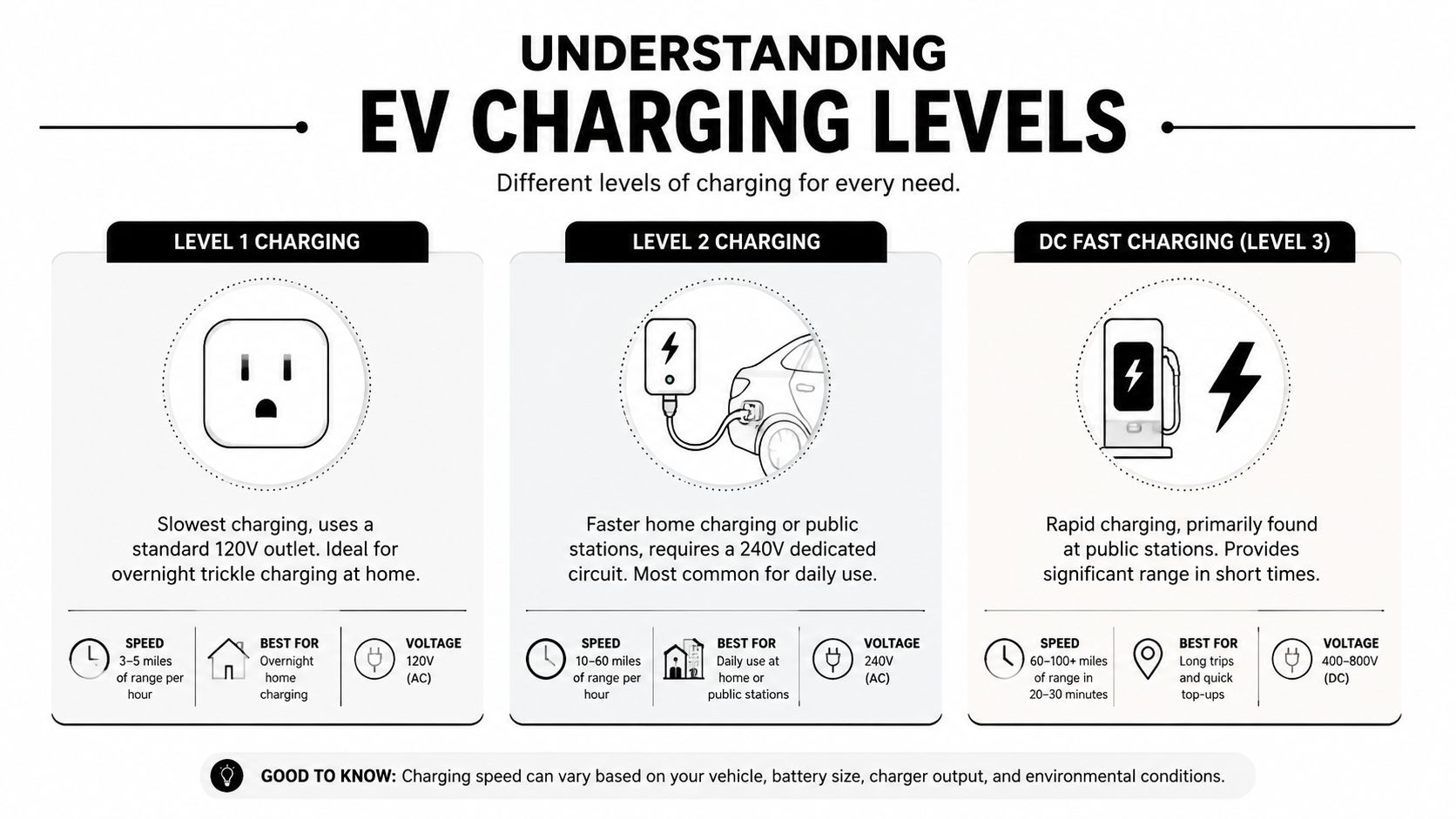
A simple way to size charging is to match it to parking time. If the car sits at home overnight every night, you usually do not need public-fast-charger performance. You need enough charging speed to recover your normal daily driving without pushing the house electrical system harder than it should be.
Level 1 is the slowest option. In practical terms, this is the portable charger plugged into a standard household outlet.
It can work for drivers with short daily trips, plenty of overnight parking time, and a newer circuit in good condition. It is also a common short-term setup while the owner decides whether to install a dedicated charger.
The trade-off is speed and circuit stress. A general-use socket may run for long hours, night after night, and that is not ideal on every property, especially in older Brisbane homes where the outlet, cable, or protection may not suit repeated EV charging loads. It is workable in some houses. It is not the setup I would call the best long-term plan for most homeowners.
Level 2 is the standard home charging option most homeowners should assess first. It uses a dedicated circuit and gives a charging rate that fits normal family use far better.
If the car is used for commuting, school runs, shopping, and weekend driving, Level 2 usually keeps the battery topped up without drama. It also gives the electrician much more control over safety, cable sizing, circuit protection, isolation, and charger placement.
What Level 2 does well:
The charger itself is only part of the decision. The supply behind it matters just as much. Some homes will suit a single-phase charger. Others benefit from three-phase, particularly if the property already has it or the owner wants to plan for a second EV later. This guide to single-phase and three-phase power for EV charging explains that difference clearly.
DC fast charging belongs in public, fleet, highway, and commercial settings. It is not a normal residential installation.
Homeowners often see fast-charging figures in vehicle ads and assume that is the target for the garage. In practice, home charging works differently. The car is parked for long stretches, so the job is to recharge steadily and safely over time, not to fill the battery in a short stop.
A simple comparison helps:
| Charging type | Best fit | Typical home role |
|---|---|---|
| Level 1 | Light driving, temporary setup | Backup or entry-level option |
| Level 2 | Daily household charging | Best all-round home solution |
| DC fast | Public network, travel corridors | Not a normal residential install |
In Brisbane and across south east Queensland, that distinction matters because the local decision is usually about practical home charging, not chasing headline speed. The better setup is the one that fits your driving pattern, your supply capacity, and the way Queensland homes are wired and approved.
Before anyone picks a charger model, look at the property. The house usually tells you what's realistic.
Start where the car currently parks. Not where you'd like it to park one day, but where it sits most nights. Garage, carport, side driveway, undercroft parking, or an open slab beside the house. Cable reach matters. Charger position matters. Weather exposure matters.
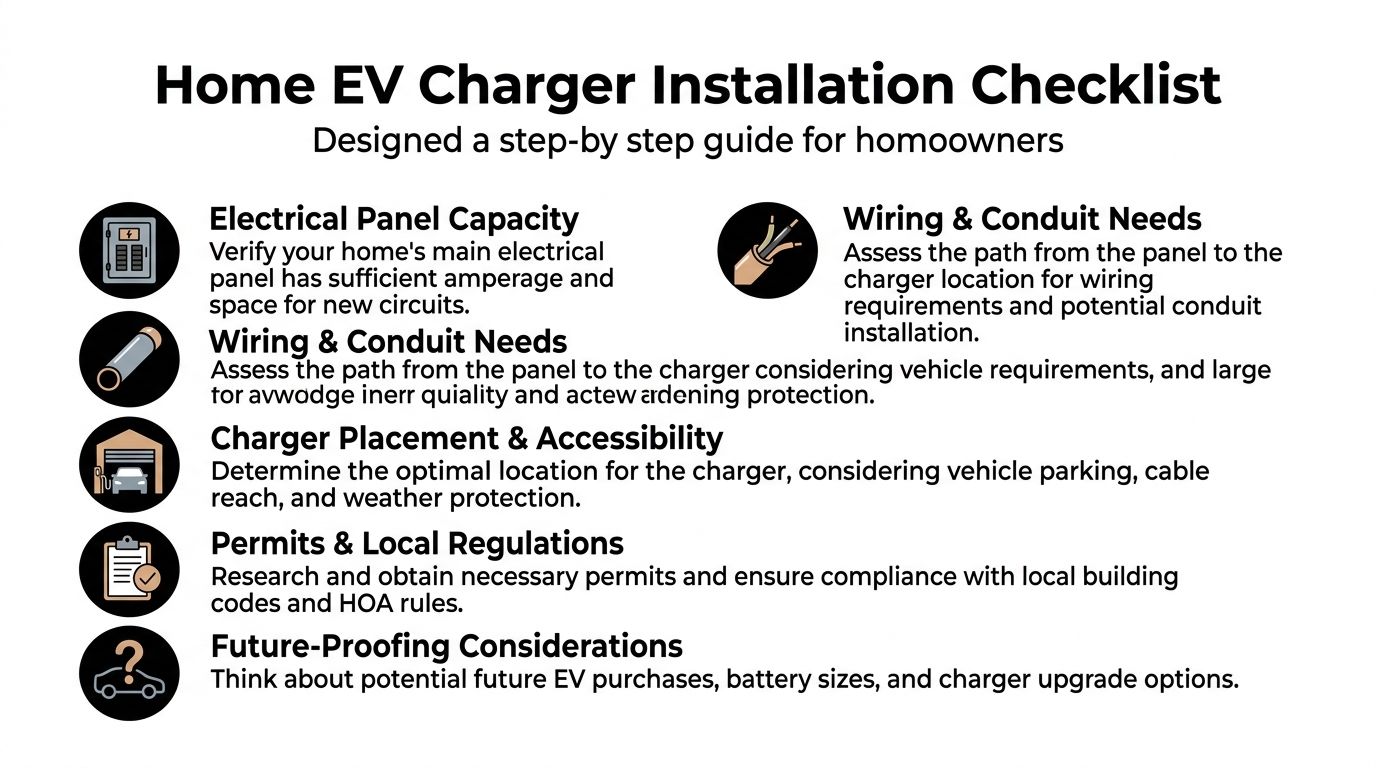
Walk through these points before requesting quotes:
These aren't minor details. They shape the job from day one. A charger on the “wrong” wall may still work electrically, but it can be annoying every single day.
A proper site assessment isn't just about whether a charger can be installed. It's about whether it can be installed neatly, safely and without creating future headaches.
An electrician will usually look at:
| Area | Why it matters |
|---|---|
| Switchboard condition | Determines whether the existing board can safely support the new circuit |
| Cable route | Affects labour, conduit visibility and protection from damage |
| Main supply type | Helps decide charger size and whether load management is needed |
| Earthing and protection | Essential for compliance and safe operation |
| Access constraints | Ceiling space, wall cavities and concrete surfaces can complicate the install |
If you're not sure what supply your home has, this guide on single-phase and three-phase power helps explain why it matters for charger selection.
Multi-unit dwellings add another layer. In a townhouse complex or apartment building, the charger may be technically possible but administratively slower. Shared supply arrangements, common-property cabling and body corporate approval can all affect timing.
A house install is usually about electrical capacity and layout. A unit or townhouse install is often about those things plus permissions.
For Brisbane homeowners in strata properties, get clarity early on who owns the car park wall, who approves common-area works, and whether any metering conditions apply. Waiting until after you've bought hardware is the wrong order.
Your home's electrical capacity is finite, and an EV charger adds a large new demand to it. In Brisbane homes, the primary question is not just whether a charger can be connected. It is whether the switchboard, protection devices, and incoming supply can support it safely under Queensland rules.
That is why many charger jobs are decided at the switchboard before any cable is run to the garage or driveway.
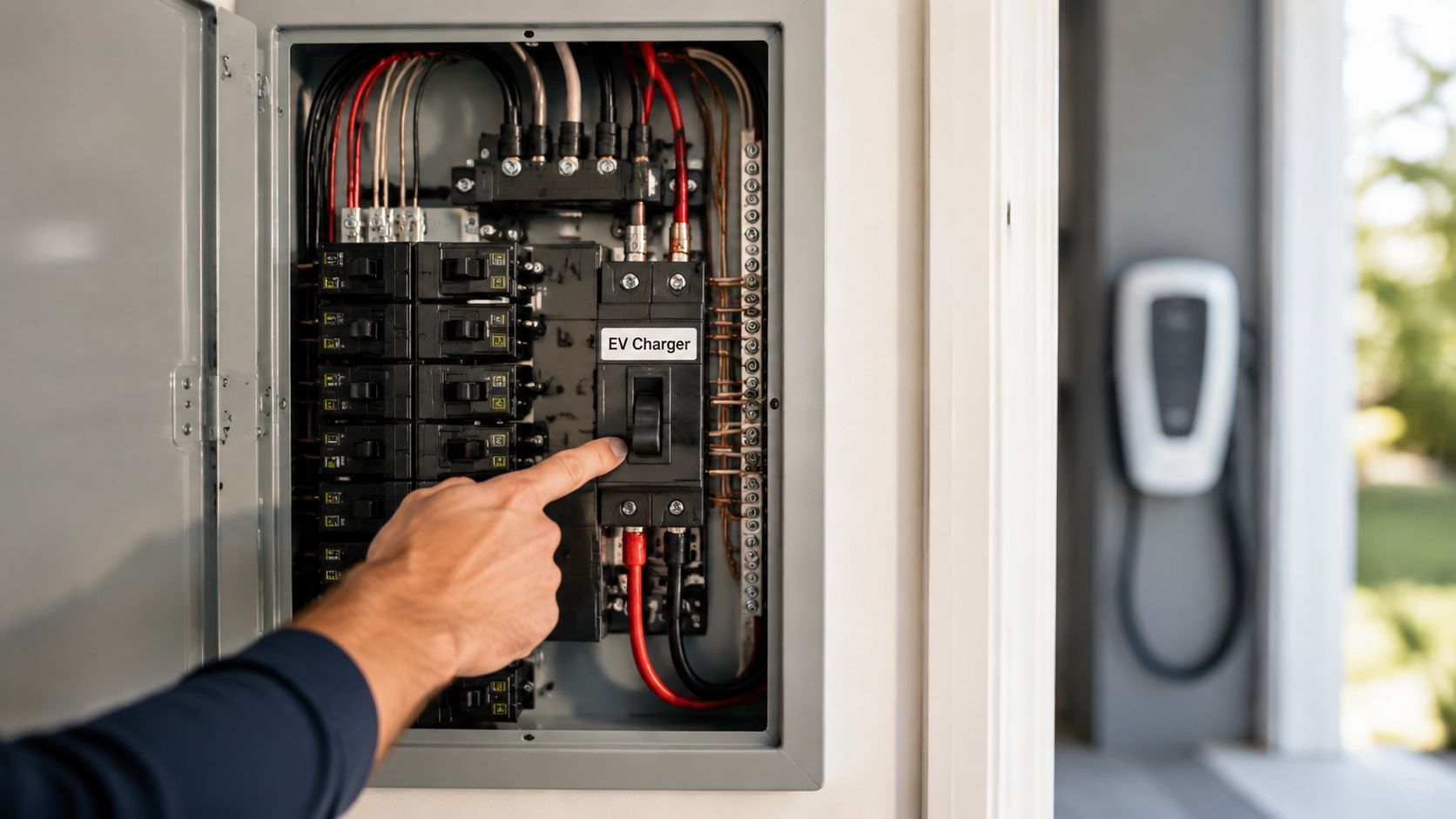
An EV charger is often one of the biggest continuous loads in a house. Kettles and ovens draw a lot of power too, but only for short periods. A charger can sit there pulling solid current for hours, usually at the same time air con, cooking appliances, hot water, and pool gear are also in use.
That changes the conversation.
A sound board gives you proper circuit protection, room for the right breaker and safety devices, and a cleaner way to separate the charger from existing house circuits. An older board can create problems fast. No spare poles, outdated fuse gear, mixed brands, heat damage, or poor layout are all signs the installation needs closer attention before a charger is added.
In practice, load works a lot like a household budget. If too much is committed at once, something gives. With electricity, that can mean nuisance tripping, overheating, poor compliance, or a board that was already overdue for upgrade.
Some issues are visible straight away. Others only show up once a licensed electrician removes the cover and checks the condition, available space, and existing protection.
Common warning signs include:
If those issues sound familiar, this guide to switchboard upgrades in Brisbane explains what usually needs to be brought up to standard.
On-site reality: A lot of homeowners ask for a charger only. Sometimes the correct answer is to sort out the board first, then install the charger on a clean, compliant foundation.
Homeowners often ask whether they have "enough power." That matters, but it is only one part of the assessment. The full picture includes maximum demand, cable sizing, breaker selection, earth and fault protection, board arrangement, and how the home is used during peak periods.
A Brisbane house with ducted air con, electric hot water, an induction cooktop, and a pool pump has a very different evening load profile from a smaller home with gas cooking and fewer fixed appliances. The charger has to fit into that pattern safely.
That is where practical design decisions matter. Some homes are fine with a dedicated circuit and a fixed charger size. Others are better suited to a smart charger with load management so the car backs off when the house demand rises. In some properties, especially older ones on single-phase supply, the smartest long-term move is upgrading the board first instead of trying to squeeze the charger into an already stressed setup.
For Brisbane and wider South East Queensland homes, this also ties into supply authority requirements. If larger supply changes are needed, Energex rules and the property's existing connection arrangement can affect what is possible and how the work is staged.
This short overview gives a good visual on why the board itself matters before any charger is energised.
A switchboard upgrade does more than make room for the charger. It usually improves the whole installation and leaves the house better prepared for future electrical upgrades, which is particularly relevant in Queensland homes adding solar batteries, electric cooking, more air conditioning, or a second EV.
Benefits usually include:
| Upgrade outcome | Why homeowners care |
|---|---|
| Safer protection | Better fault protection for people, cabling, and connected equipment |
| Cleaner circuit layout | Easier maintenance, testing, and fault finding later |
| Room for future additions | More practical if you later add solar battery storage, induction cooking, or another charger |
| Better compliance position | Fewer legacy problems left hidden behind an old board |
A charger is often the job that exposes the board's condition. In many Brisbane homes, that is useful. It is better to fix capacity and protection properly now than discover the weak point after the car is already in the driveway.
Your car might be in the driveway already, but the charger budget is rarely just the box on the wall. In Brisbane, the final cost often depends more on the house than the EV.
A straightforward install in a newer home with spare switchboard capacity, an easy cable run and a garage wall near the board will usually be simpler and cheaper than the same charger in an older Queenslander with a full board, long cable route or awkward access. That is why online price ranges can mislead homeowners. They usually assume ideal conditions.
The charger itself is only one part of the spend. The rest comes from the work needed to install it safely, neatly and in a way that still makes sense five years from now.
Main cost drivers include:
For a clearer local pricing breakdown, see this guide to EV charger installation cost.
Incentives change. Product marketing often lags behind policy. Check the current Queensland and federal settings before you buy anything.
For homeowners, the practical question is simple. Does any current support apply to the vehicle, the charging equipment, or other electrification works at the property? In Queensland, that can shift with state budget decisions, program funding and eligibility rules. A rebate that existed last year may be gone by the time your car arrives.
There is also a Brisbane-specific angle that gets missed. Some households focus so hard on chasing a rebate that they overlook the bigger cost issue, which is whether the home can support the charger properly. A modest incentive will not help much if the installation later needs rework because the original setup ignored board capacity, charger placement or future plans for solar and battery storage.
The best value usually comes from getting the electrical side right first. I'd rather see a homeowner choose a good mid-range charger with proper protection and sensible load management than buy a premium unit and leave no budget for the installation details that matter.
A useful way to set priorities is:
Electrical load works like water through a pipe. Your house can only carry so much at once before something has to give. A charger that can adjust its draw to suit the rest of the home often gives better long-term value than installing the largest unit the brochure advertises.
The cheapest quote can cost more later if it leaves you with an awkward charger position, visible conduit across the front of the house, or hardware that cannot adapt when your electricity use changes.
Your car turns up on Friday. By Sunday, someone in the house is asking whether the charger can just go on the garage wall near the nearest power point. That is usually where bad decisions start.
A home EV charger is a fixed electrical installation with a sustained load, not a plug-in appliance you can treat casually. In Queensland, the work needs to be done by a licensed electrician, installed to the applicable wiring rules, and matched to the conditions at the property. The charger, the cable route, the circuit protection, and the switchboard all need to work together.
Brisbane jobs are usually straightforward at a standard detached house, but local requirements still matter. If the work involves mains upgrades, meter changes, supply alterations, or other network-side changes, Energex may need to be involved. If the charger location requires building work, affects a heritage-listed property, or sits outside a typical private garage setup, council approval can also come into play. In townhouses and apartments, body corporate approval often becomes part of the job before any cable is run.
The practical checks are not complicated, but they do need to be done properly:
I explain electrical load to homeowners like this. Your switchboard works like a driveway gate with a fixed width. You can bring a car through it easily, but if you try to push a ute, a trailer, and a caravan through at once, something jams. A charger adds a large, continuous demand, so the installation has to be set up with the rest of the house in mind.
Unlicensed work is where the risk climbs quickly. The common failures are not dramatic at first. Heat builds up at a poor termination, nuisance tripping starts, moisture gets into the wrong enclosure, or a charger ends up mounted where the lead is always under strain. Then the call comes months later because something smells hot, the charger keeps faulting, or the switchboard starts showing its age.
The paperwork matters as well. If the installation is not compliant and a fault causes damage, insurance and warranty claims become harder to sort out. Rectification also tends to cost more than doing the job properly the first time, especially if walls, paving, or finished surfaces need to be reopened.
Public charging across Queensland is improving, as noted earlier. That helps on the road. It does not change the standard required at home. A safe Brisbane installation comes down to licensed work, the right approvals where they apply, and a setup that still makes sense when the house adds more electrical demand later.
The right home charging setup usually comes down to four decisions. Where the car parks, how quickly you need it charged, what your switchboard can support, and whether the solution still makes sense a few years from now.
For most Brisbane homeowners, the strongest option is a properly installed Level 2 charger on a dedicated circuit. Not because it sounds impressive, but because it fits real life. You come home, plug in, and the car is ready when you need it. No hunting for public chargers during the week. No stretching leads to a powerpoint that was never meant to carry the load that way long term.
If the house is older, the charger decision should trigger a proper electrical health check. That's often where the primary value sits. You're not only preparing for the EV. You're improving safety and making the property more ready for future upgrades like batteries, induction cooking or a second electric car.
Townhouses and apartments need more planning. Newer detached homes usually need better assessment, not guesswork. Either way, the best results come from treating electric vehicle charging infrastructure as part of the home's core electrical design, not an afterthought bolted onto the nearest wall.
If you're ready to install an EV charger at home, DLG Electrical can help with practical advice, site assessment, switchboard checks, and a safe, compliant installation designed for your Brisbane property. Reach out for a free quote and get a charging setup that works properly from day one.

Master Electrician with over 30 years of experience. Founded DLG Electrical in 2005 after international project work including electrical installations at Stamford Bridge Stadium, London(Home of Chelsea FC).

Local Electricians that can fix all Electric Hot water Systems.
Motion sensor lights are a versatile addition to any home, offering nu
