83 Jean St, Grange QLD 4051
Mon-Fri 07:30 AM - 04:00 PM - Sat - 8:00 - 12 - Sunday Closed

You're probably looking up at your hallway ceiling, then at the bedroom doors, then at the fan in the middle of the room and wondering whether the alarms already installed are right. That's where most homeowners in Brisbane get stuck. They know smoke alarms matter, they've heard about the compliance deadline, but they're not sure whether the issue is the alarm itself, the location, or both.
That uncertainty matters because where to install smoke alarms isn't just a box-ticking exercise. A perfectly good alarm in the wrong spot can respond late, false alarm constantly, or miss the room that matters most when people are asleep. In practice, placement is what turns a smoke alarm from a device on the ceiling into a working warning system.
You walk through the house at night and count the alarms. One in the hallway. One near the living room. Maybe an older unit that still chirps after a battery change. That setup often gives homeowners a false sense of security, especially in older Brisbane homes where ceiling fans and ducted air can complicate placement.
Queensland's standard is specific, and the upcoming 1 January 2027 deadline for existing homes has pushed a lot of owners and landlords to check whether their current setup meets it. The key test is practical. Are the alarms photoelectric, interconnected, in the required locations, and mounted where airflow will not interfere with how they detect smoke? If you want the legal detail in one place, this guide to Queensland smoke alarm laws is a useful reference.
Landlords have another layer to manage. Smoke alarm compliance sits alongside maintenance records, tenancy obligations, and budgeting for upgrades. If you are reviewing an investment property as part of a wider cost and compliance check, VerticalRent tax savings for landlords may help on the property management side.
Good placement has to do two things. It needs to give early warning, and it needs to avoid nuisance alarms that lead people to silence the unit, remove the battery, or ignore it the next time it activates.
I see that second problem regularly in Brisbane. An alarm can be legally required in a bedroom or hallway, but if it is shoved too close to a fan blade path, an air-conditioning supply vent, or a bathroom door, the airflow and moisture can trigger repeated false alarms or delay smoke reaching the sensor properly. The alarm itself is often fine. The position is the problem.
A compliant setup should operate unobtrusively in the background until it is needed. Every sleeping area is covered. Every storey is protected. Every alarm communicates with the others. And each unit is installed in a position that suits both the law and the way air moves through the home.
A lot of Brisbane homeowners only realise there is a problem after an alarm goes off for the wrong reason. The unit may be legally required, but if it is installed too close to a ceiling fan or supply vent, the placement can create nuisance alarms and poor performance at the same time. Queensland law sets the minimum standard. Good installation work applies that standard properly to the way your home works.
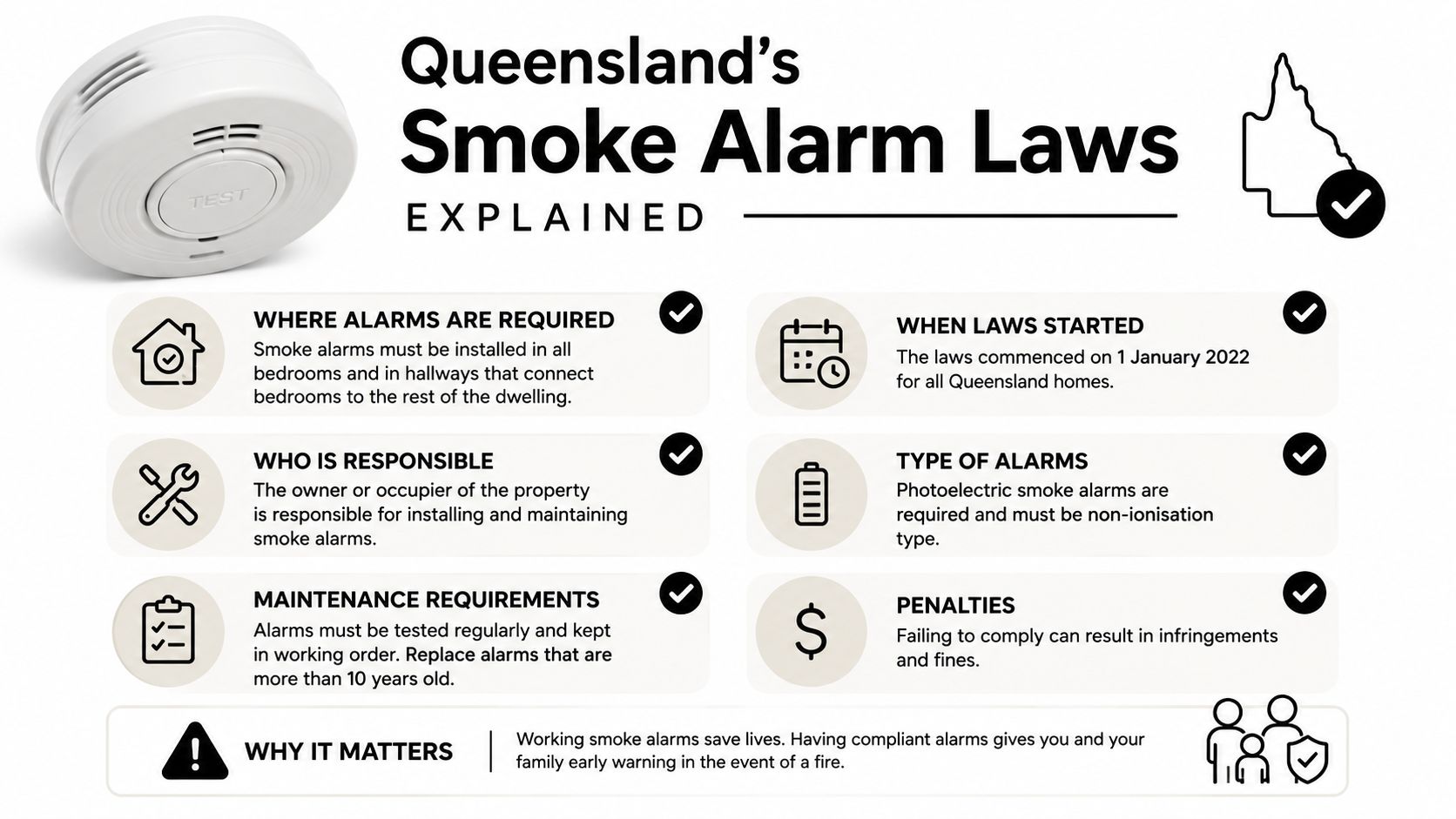
For homes that fall under Queensland's current smoke alarm requirements, the baseline is clear. Alarms must be photoelectric, hardwired to the mains power supply where required, and interconnected so that when one activates, they all activate. They are required on every storey, inside each bedroom, and in the hallways that connect bedrooms to the rest of the dwelling.
That changes the old habit of putting one alarm in a central corridor and calling the job done. In many homes, that layout no longer meets the standard.
If you want the legal detail set out clearly, this guide to Queensland smoke alarm laws is a useful reference.
These words get repeated a lot, but they matter because they affect both compliance and installation method.
I see the benefit of interconnection most often in larger Brisbane homes, split-level layouts, and houses where air conditioning and closed doors can delay how quickly smoke or sound travels.
Queensland's rules also deal with where the alarm sits on the ceiling or wall. A ceiling-mounted alarm needs to be at least 300mm away from the nearest wall. If ceiling mounting is not possible, wall mounting must be on an internal wall between 300mm and 500mm below the ceiling line.
Then there is the placement issue many homeowners miss. Fans and air-conditioning matter. In practical terms, alarms should be kept clear of ceiling fan blade paths and supply air from vents because strong moving air can interfere with how smoke reaches the sensor and can also contribute to nuisance alarms.
For existing homes, any reference to a 1 January 2027 deadline should be read as the scheduled compliance date under Queensland's current framework, subject to any future change by the state. The safe approach is not to wait and assume the details will become easier later.
The legal minimum is only the starting point. A compliant alarm still has to be positioned so it will detect smoke properly in a real home, with fans running, air conditioning on, and bedroom doors closed.
Once the legal baseline is clear, the next step is mapping it onto the actual layout of your home. That's where people usually stop thinking in abstract terms and start noticing the awkward bits. Fan in the middle of the bedroom. Bulkhead near the hallway. Open-plan kitchen and living area. Stair void between levels.
The easiest way to approach where to install smoke alarms is to work room by room, then check how those spaces connect to each other.
Bedrooms are not optional. If someone sleeps there, it needs an alarm inside the room under Queensland's requirements.
Hallways matter because they connect sleeping areas to the rest of the house. In many homes, that hallway is the first likely escape path. If smoke reaches that corridor before anyone opens a door, the alarm there helps warn everyone quickly.
Living spaces are more situational. On single-level homes with compact layouts, the required bedroom and hallway coverage may already provide strong protection. On larger homes, open-plan areas, split levels, or layouts with sleeping zones separated from common areas, additional alarms can make sense for earlier warning and better coverage.
Here's a practical guide.
| Room / Area | Required by Law? | Ideal Location | Key Considerations |
|---|---|---|---|
| Main bedroom | Yes | On the ceiling, clear of walls, fans, and air vents | Don't place it where fan airflow crosses the sensing path |
| Child's bedroom | Yes | On the ceiling in a central position within the room | Avoid corners and don't crowd it near the wall line |
| Guest bedroom | Yes, if used for sleeping | On the ceiling or compliant inside wall position if ceiling mounting isn't possible | Treat occasional sleeping rooms the same as regular bedrooms |
| Hallway outside bedrooms | Yes | Centrally in the hallway serving the sleeping area | In long hallways, placement may need coverage at both ends |
| Open-plan living area | Sometimes additional coverage is sensible | Ceiling area away from kitchen steam and mechanical airflow | Consider layout, travel path, and separation from sleeping zones |
| Stair landing or upper-level circulation area | Required by level-based coverage | Ceiling near the circulation path on that storey | Multi-level homes need coverage on every storey |
| Kitchen-adjacent area | Not usually directly in the kitchen zone for practical placement | Nearby circulation space, not in a spot prone to cooking fumes | Too close to cooking activity leads to nuisance alarms |
| Study used as a bedroom | Yes, if someone sleeps there | Same treatment as any bedroom | The room use matters more than the label on the floorplan |
A short visual walkthrough can help when you're checking your own layout:
In a standard Brisbane lowset home, the most reliable pattern is usually straightforward. Put alarms inside each bedroom, place one in the hallway connecting those bedrooms to the rest of the dwelling, and make sure every storey has interconnected coverage. Then fine-tune the exact position to avoid fans, vents, and wall dead zones.
Open-plan homes need more judgement. A huge living, dining, and kitchen area can make owners think one alarm in the middle solves everything. Sometimes it helps, sometimes it creates nuisance alarms if it's too close to cooking vapour or moving air. In those layouts, the sleeping zones still take priority.
If you're standing in one room wondering whether an alarm belongs there, ask a simple question. Would someone be asleep behind a closed door in this space, or rely on this path to get out? If the answer is yes, that room deserves close attention.
Good placement on a floor plan is only half the job. I see plenty of Brisbane homes with alarms in the right rooms and mounted in the wrong spots. The result is slower smoke entry, nuisance alarms from airflow, or both.
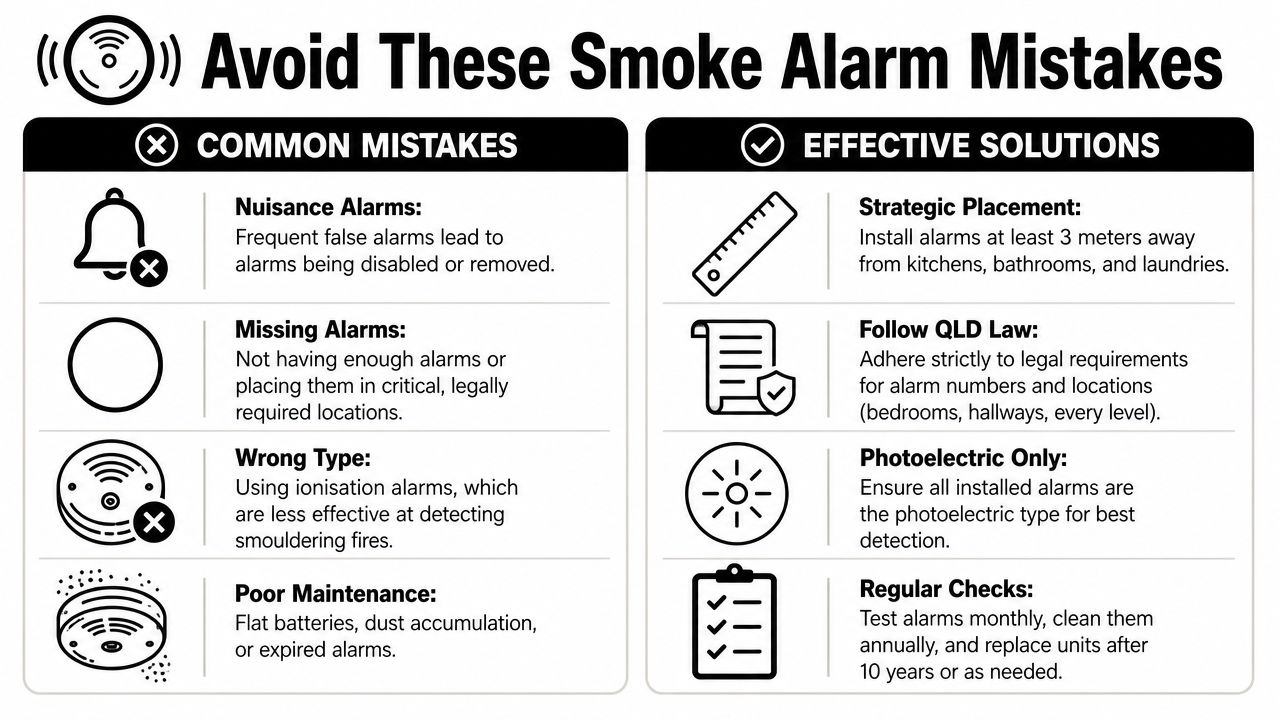
Smoke alarms need to sit where smoke will reach them. The dead air zone near the wall to ceiling junction, or tight up near an apex, can delay that.
For flat ceilings, keep the alarm clear of the wall line. As noted earlier in the article, Queensland placement guidance requires a minimum offset from surrounding walls for ceiling-mounted alarms. If wall mounting is used instead, it must sit within the permitted band below the ceiling line on an inside wall.
Those measurements matter in practice. Mount too close to the corner and the alarm can sit in stagnant air. Mount too far into moving air from a fan or supply vent and you create a different problem.
Raked and cathedral ceilings need a different approach. The highest point is often close to correct, but the exact mounting spot still matters.
As noted earlier from the manufacturer guidance already cited, alarms on sloped ceilings should be installed at or near the high side, within the specified distance of the highest point rather than hard into the apex itself. In rooms with a steeper pitch, high-side mounting becomes even more important because smoke will bank there first.
This is a common issue in Brisbane renovations. A neat, centred position may look right from the floor, but ceiling shape controls smoke movement, not symmetry.
A long bedroom wing can catch people out. One alarm in the middle does not always cover the full length properly.
Where the hallway length exceeds the manufacturer limit noted earlier, install alarms at both ends. That comes up in larger homes, extensions, and converted layouts where a short corridor has turned into a long sleeping-zone passage.
Practical experience is essential. The easiest cable path is not always the best alarm location.
In Brisbane homes, ceiling fans and ducted air conditioning are the usual troublemakers. If a fan blade path or supply outlet is too close to the alarm, moving air can push smoke away from the sensor or trigger nuisance alarms. That is why I check the final location from the floor before any cable goes in. Look up, find the fan sweep, find the air-conditioning outlet, then pick the mounting point.
A compliant install also needs the right product and interconnection method. If you are comparing options, this guide to wired smoke alarms explains what a modern hardwired setup should include.
Mounting does not fix an alarm that has reached the end of its service life. If the unit is 10 years old, replace it. Do not keep an ageing alarm just because it still chirps on a test button.
Most mounting problems come from treating every ceiling the same. They are not the same, and airflow in a Brisbane home can change how an alarm performs.
A common Brisbane callout goes like this. The new alarm is installed, it keeps going off under the ducted air con, and someone has started taking the battery out at night. By that point, the problem is no longer the alarm. It is the installation.
The mistake I see most often is treating smoke alarm placement like a cabling job instead of a life-safety job. An alarm can be legal on paper and still perform poorly if it is shoved into the easiest ceiling position, ignored after repeated nuisance alarms, or left contaminated by paint, dust, or renovation debris.
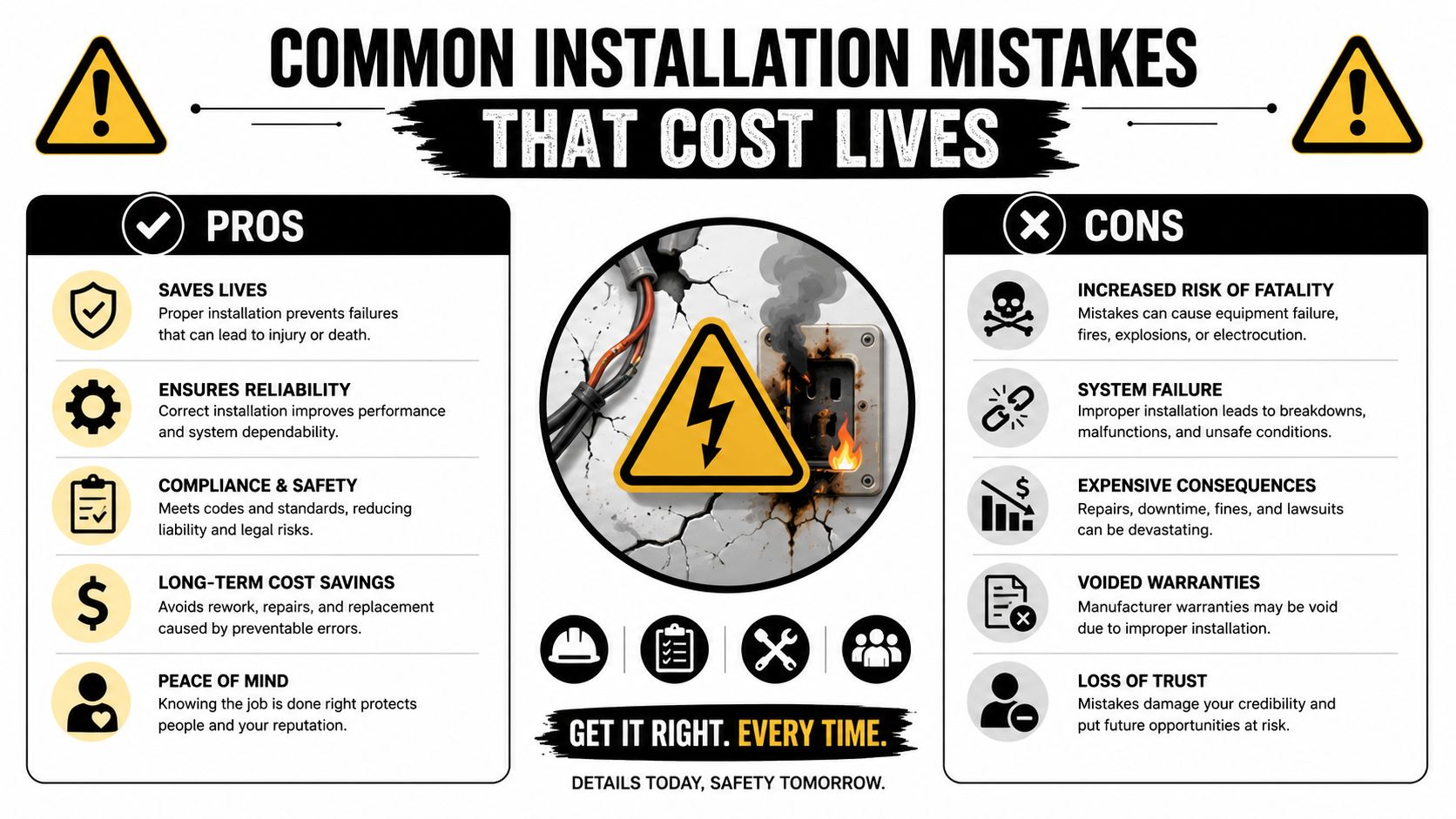
False alarms create bad habits. Once an alarm starts sounding for no good reason, people silence it, disconnect it, or stop trusting it. That is how a small installation error turns into a serious safety failure.
In Queensland homes, nuisance alarms are often tied to real airflow issues inside the room. Ceiling fans, split system discharge, ducted supply outlets, return air paths, and even strong cross-ventilation can interfere with how smoke reaches the sensor. The result is predictable. The alarm either reacts when it should not, or responds later than it should.
Some faults are obvious once you know what to look for. Others are hidden until testing day, or worse, until there is smoke in the house.
I also see homeowners mix compliant and non-compliant units in the same house after a renovation or extension. That creates confusion fast. One alarm sounds, another does not, and nobody is sure whether the system is doing what it should.
Start with the rooms Queensland requires. Then choose positions that still make sense once the fan is on, the air conditioning is running, and the doors are closed at night. That practical check matters in Brisbane more than many homeowners realise.
Good installation is not just about meeting a diagram. It is about making sure the alarm will still detect smoke promptly without becoming a nuisance every summer. If you want the system assessed properly, book a professional smoke detector installation service and have the whole layout checked, not just the nearest ceiling point.
The logic is similar to why professional water damage repair is better. Hidden problems are the ones that cost the most when they are missed. Smoke alarms are the same. The wiring matters, the location matters, and the testing matters.
Changing a battery is DIY territory. Hardwiring and interconnecting smoke alarms isn't.
Queensland requires a setup that goes beyond sticking a unit to the ceiling. Once you're dealing with mains power, interconnected operation, correct circuit integration, and compliant positioning across the house, the work becomes electrical installation. That means safety, testing, and accountability matter just as much as product choice.
A DIY smoke alarm job can fail in more than one way. The wiring can be wrong. The interconnection can be incomplete. The location can be technically convenient but operationally poor. The result is a house that looks compliant until the day the system is called upon to perform.
That logic applies across home repairs. The same reason people read about why professional water damage repair is better applies here. Hidden damage, hidden risk, and hidden mistakes are what make specialist work worth paying for.
A licensed electrician doesn't just install alarms. They verify the whole system.
If you're arranging compliant smoke alarm work, these smoke detector installation services outline what professional installation should include.
There's also the age issue. Plenty of homes still have alarms that appear functional but are already beyond service life. A professional installation doesn't just add devices. It identifies expired units, poor legacy locations, and missing coverage that homeowners often don't notice.
The main benefit is peace of mind. You're not guessing whether the system is close enough. You know it has been installed properly, tested properly, and set up to work as a single warning system throughout the home.
If you want your smoke alarms installed correctly the first time, DLG Electrical can help with compliant hardwired, interconnected smoke alarm installation across Brisbane. Their licensed team can assess your current setup, replace outdated units, and make sure every alarm is in the right place for safety, reliability, and Queensland compliance.

Master Electrician with over 30 years of experience. Founded DLG Electrical in 2005 after international project work including electrical installations at Stamford Bridge Stadium, London(Home of Chelsea FC).

Local Electricians that can fix all Electric Hot water Systems.
Motion sensor lights are a versatile addition to any home, offering nu
