83 Jean St, Grange QLD 4051
Mon-Fri 07:30 AM - 04:00 PM - Sat - 8:00 - 12 - Sunday Closed
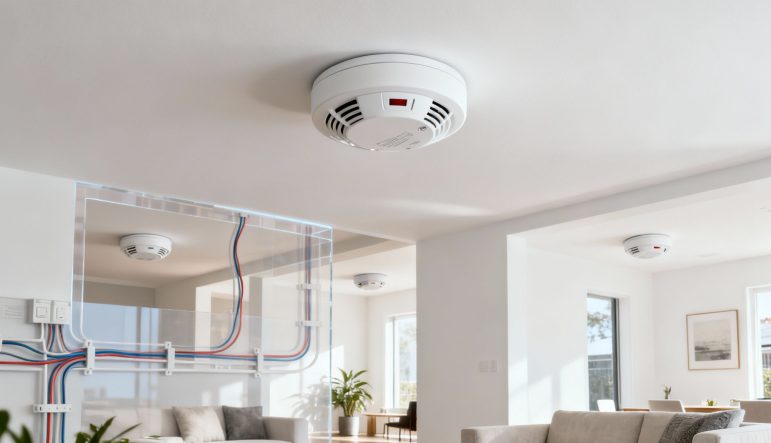
Wired smoke alarms are the devices we install most often, and for good reason. They connect directly to your home’s 240V mains power, so you’re not just relying on a little battery to keep your family safe.
They also have a crucial battery backup for protection during a blackout and are interconnected. This is the game-changer: when one alarm detects smoke, all the alarms in the house sound at once. It creates a powerful, property-wide alert that you simply can’t ignore.
Think of your home’s safety system like a central nervous system. A problem in one part—say, a smouldering fire in the kitchen—instantly triggers a response everywhere else. This is exactly how modern wired smoke alarms work. They aren’t just individual sentinels; they operate as a unified, intelligent network.
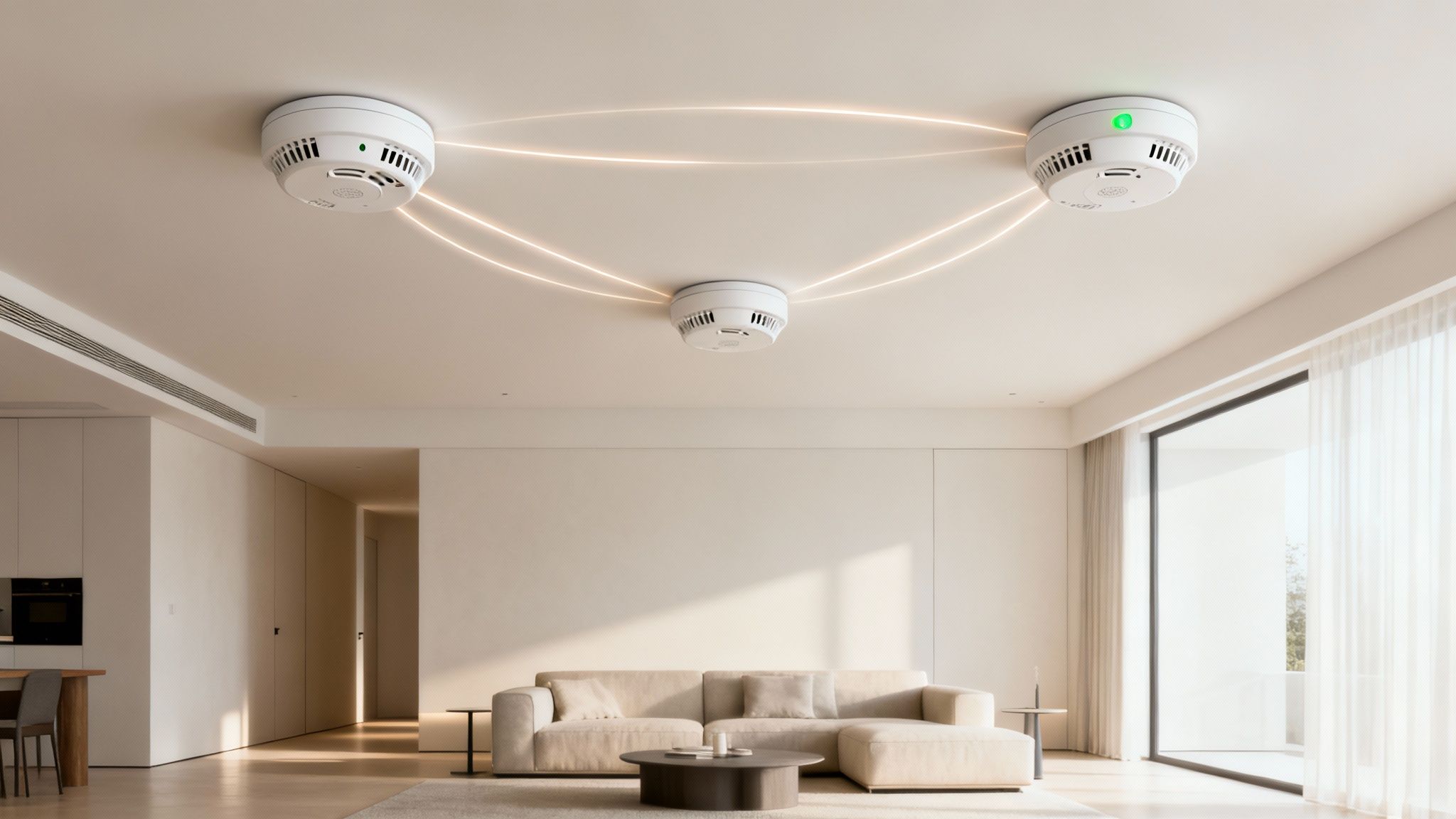
This interconnected safety net is achieved by hardwiring each unit not only to your home’s electrical circuit but also to each other. A dedicated trigger wire runs between every alarm, allowing them to communicate instantly.
The biggest advantage of a hardwired system is this interconnection. In a multi-storey home, a fire starting in the garage might go unnoticed by someone sleeping upstairs until it’s dangerously advanced.
With an interconnected system, the moment the garage alarm detects smoke, the alarm in the bedroom sounds at full volume. This immediate, house-wide alert provides the earliest possible warning, dramatically increasing the time your family has to get out safely. It’s a non-negotiable part of Australian building codes for a reason—it saves lives.
The core benefit is simple yet profound: an interconnected system ensures a fire in one room becomes an immediate, house-wide emergency alert. This eliminates dangerous delays in detection, no matter where you are on the property.
A common question we get is, “What happens during a blackout?” This is where the hybrid design of wired smoke alarms really shines. Every mains-powered unit includes a backup battery, which can be either a standard 9V or a sealed 10-year lithium battery.
If the mains power is cut, the battery automatically takes over. Your home remains protected without any lapse in coverage. This dual power source provides rock-solid reliability, removing the sole reliance on battery life that makes standalone units so vulnerable.
Before we move on, let’s quickly compare the two main types of alarms.
| Feature | Wired Smoke Alarms | Battery-Only Alarms |
|---|---|---|
| Power Source | 240V mains power with battery backup | Battery only (9V or lithium) |
| Reliability | Very high; constant power | Dependent on battery life |
| Interconnection | Standard feature; all alarms sound at once | Only available on specific wireless models |
| Installation | Requires a licensed electrician | DIY installation |
| Best For | New builds, renovations, compliance upgrades | Older homes where wiring is difficult |
| Compliance | Meets all current Australian Standards | May not meet requirements for new builds/rentals |
While battery-only alarms have their place, the interconnected, mains-powered system is clearly the superior choice for comprehensive safety.
This combination of constant mains power, battery backup, and interconnection makes wired smoke alarms the undisputed gold standard for home fire safety. They form the backbone of fire-detection systems across Australia, with industry analysis confirming that hardwired units are the dominant type installed in new homes and apartment buildings.
This preference reflects their reliability and is set to drive steady growth in the Australia–New Zealand market, fuelled by mandatory upgrades and replacement cycles. You can dig into more data on the smoke alarm market from Future Market Insights.
Ultimately, choosing a wired system isn’t just a purchase; it’s an investment in a more robust and responsive safety net for your property.
When it comes to wired smoke alarms, the technology inside the unit is just as important as how it gets its power. Not all alarms “see” fire in the same way, and understanding the difference is absolutely critical for keeping your family safe. The two main players in smoke detection are photoelectric and ionisation.
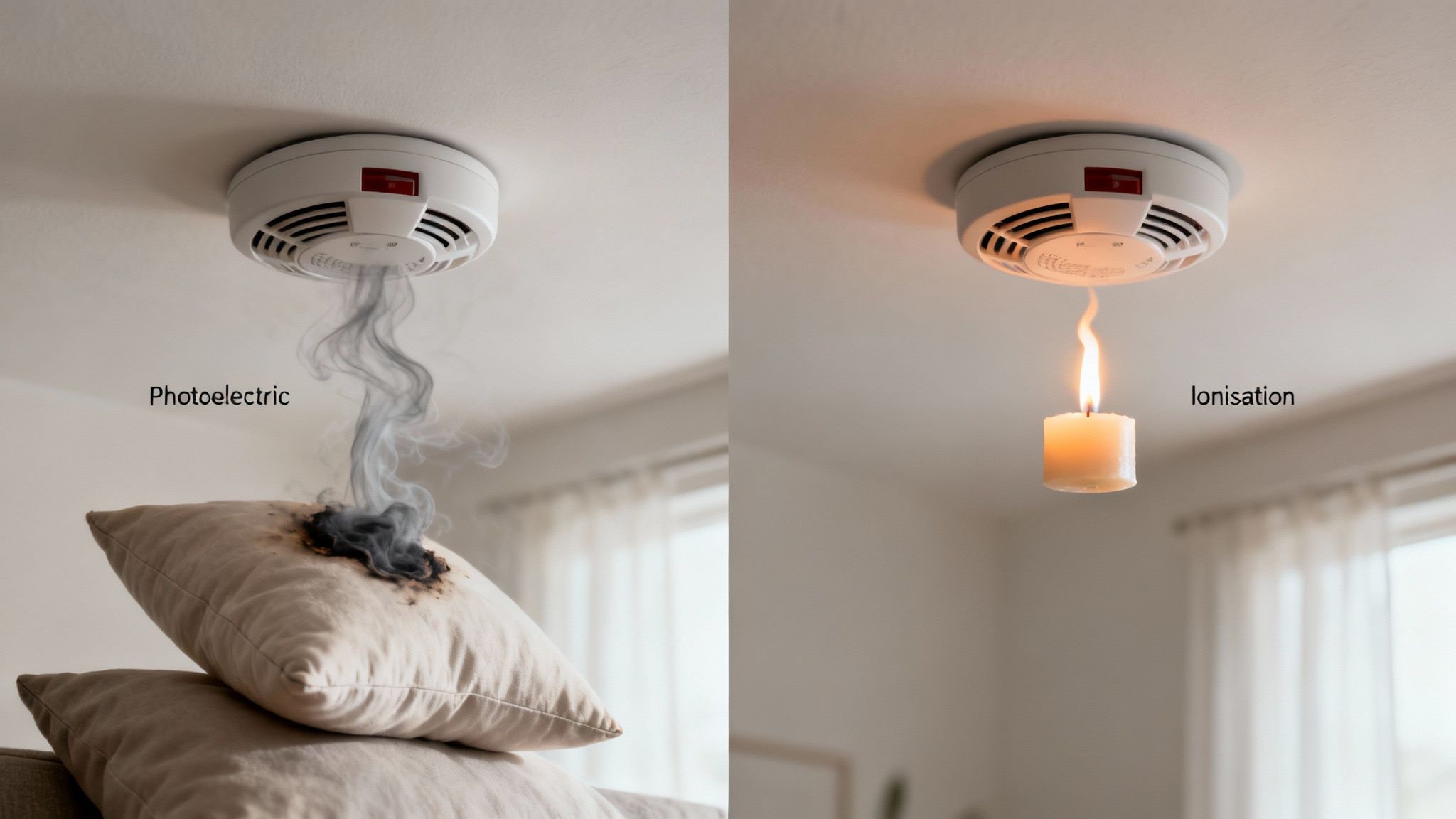
Think of these two technologies as specialists, each trained to spot a different kind of danger. Choosing the right one for your home isn’t just a good idea; here in Queensland, it’s the law.
Photoelectric smoke alarms are the undisputed champions at detecting smouldering fires. These are the slow-burners that can creep through a home for hours, often starting from things like faulty wiring, a cigarette butt on the couch, or an overheating appliance.
They work by using a beam of light inside a sensing chamber. When the large, thick smoke particles from a smouldering fire drift into this chamber, they scatter the light beam. This scattered light hits a sensor, which then triggers the alarm.
Imagine a dark, still room with a single laser beam shooting from one wall to the other. If you blew a puff of thick smoke into its path, you’d instantly see the light scatter and illuminate the smoke. A photoelectric alarm works on this exact principle, making it brilliant at detecting the most common types of house fires long before they erupt into flames.
Because they are superior at detecting slow, smouldering fires, photoelectric alarms provide the earliest possible warning for the fire types most likely to occur in a residential setting while people are asleep.
On the other hand, ionisation smoke alarms are built to react quickly to fast-flaming fires. These are the fires that produce a lot of open flame and much smaller smoke particles, like you’d get from burning paper, cooking oil, or other flammable liquids.
This type of alarm uses a tiny amount of radioactive material to create a small electrical current between two plates. When the fine particles from a flaming fire enter the chamber, they disrupt this current, which sets off the alarm.
While this makes them very responsive to open flames, they can be much slower to react to the dense smoke from a smouldering fire. They are also notorious for nuisance alarms from things like burnt toast, which is a big reason why their use in homes is now discouraged.
The science is crystal clear, and Australian fire authorities have taken decisive action. Overwhelming research has shown that photoelectric alarms give a more reliable and timely warning for the most dangerous types of residential fires. As a result, legislation across the country, and especially here in Queensland, has made them mandatory.
This legal shift is based on a critical fact: in a real-world house fire, early detection of smoke is far more important than the detection of flames. By the time a fire has visible, fast-moving flames, the amount of toxic smoke produced can already be lethal. By choosing compliant wired smoke alarms with photoelectric technology, you’re giving your home the best defence there is.
Getting your head around the rules for smoke alarms isn’t just a box-ticking exercise. It’s about installing a system that’s genuinely designed to give you and your family the best possible protection. The laws in Queensland have changed a lot over the years, shifting from standalone, battery-operated alarms to a much smarter, interconnected network. These laws aren’t just red tape—they’re based on serious research into how fires behave in modern homes and what gives people the best chance to get out.
The whole point of the legislation is simple: early warning saves lives. With all the synthetic materials in our furniture and building supplies, a house fire can become deadly in less than three minutes. An interconnected system means that when one alarm detects smoke, every single alarm in the house goes off. This property-wide alert can buy you the precious seconds needed to escape safely.
Meeting your legal duties comes down to putting the right alarms in the right spots. The rules are crystal clear and don’t leave any room for interpretation. Every home in Queensland must have interconnected, photoelectric smoke alarms. These must be either hardwired into your mains power or powered by a sealed, non-removable 10-year lithium battery.
Here’s a simple breakdown of exactly where they need to be:
Following these placement rules creates a complete safety net around your home. For a more detailed look at the specifics, check out our guide to smoke alarm compliance in QLD.
At the end of the day, Queensland’s legislation is designed to make sure that no matter where you are in the house, you’re close enough to a sounding alarm to be alerted to danger. By requiring alarms in and around sleeping areas, the law tackles the time when you’re at your most vulnerable.
The deadlines for compliance depend on your property type, so it’s vital to know which category you fall into. The government has rolled this out in phases to give everyone enough time to get their homes up to standard.
That final deadline is getting closer every day. Waiting until the last minute will likely mean a mad scramble for qualified electricians. Acting now doesn’t just tick a legal box—it protects your family with the best available technology as soon as possible.
There’s a crucial part of the law that often gets missed: you must replace every smoke alarm every 10 years. You can find the manufacturing date printed on the back of every unit. After a decade, the internal sensors start to degrade and just aren’t as reliable anymore.
This isn’t just a friendly suggestion; it’s a legal requirement. An alarm that’s 11 years old is not compliant, even if it still chirps when you press the test button. Sticking to this replacement schedule ensures your wired smoke alarms are always working at their best. While you’re ensuring your home meets local fire safety laws, it’s also useful to be aware of the legal requirements for a fire watch, which can apply in situations where alarm systems are temporarily out of action.
When it comes to installing wired smoke alarms, there’s a bright, uncrossable line between a DIY weekend project and a job that is strictly for a professional. Unlike battery-operated units you can just screw to the ceiling, hardwired alarms connect directly to your home’s 240V mains power. This makes professional installation not just a good idea, but a legal and safety requirement.
Trying to wire in a mains-powered system yourself is incredibly dangerous. You’re working with live electrical circuits, which brings a very real risk of electric shock or starting a fire through incorrect wiring. Worse, a botched installation could lead to the exact tragedy you’re trying to prevent: an alarm system that completely fails to go off during a real fire.
The dangers of DIY installation go far beyond just getting a zap. An improperly wired smoke alarm system can create ongoing problems that completely undermine your home’s safety and your peace of mind.
A professional electrician knows the strict placement rules needed to ensure your home is compliant with Queensland legislation.
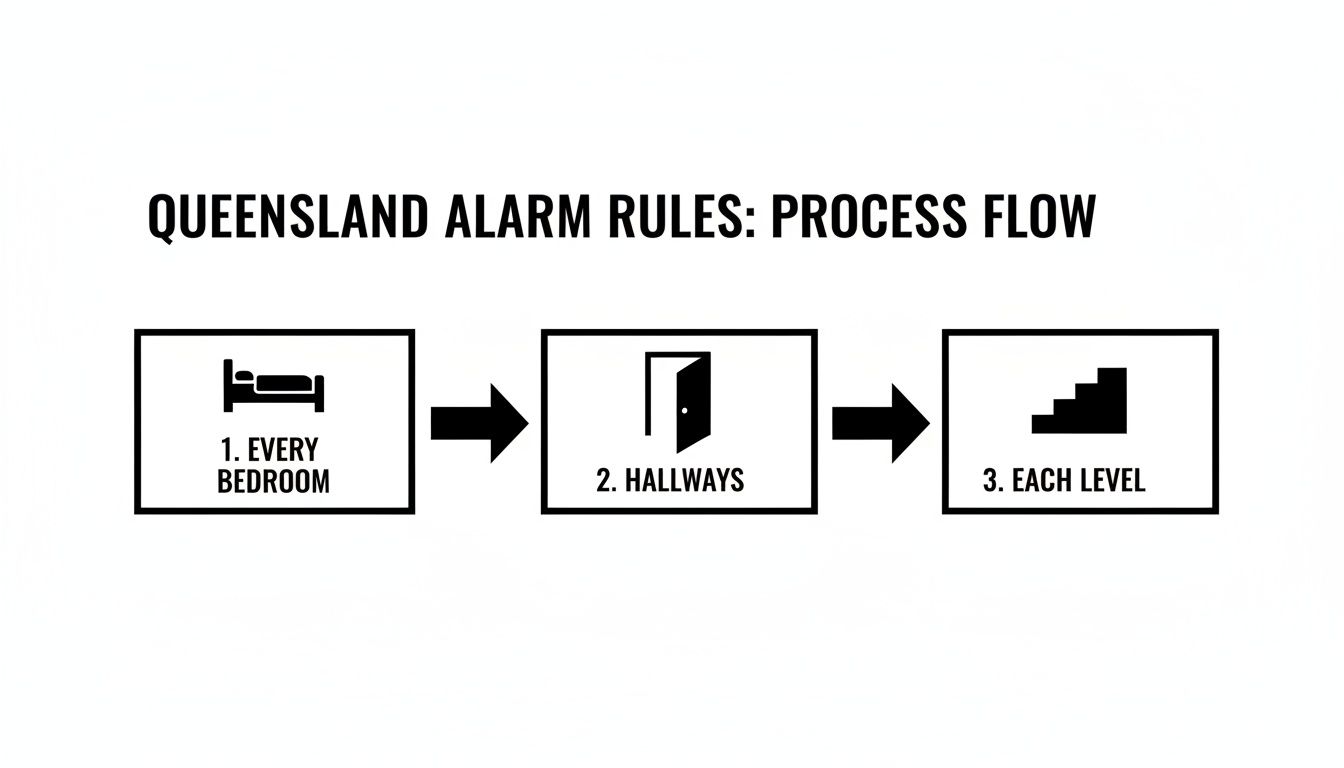
This process shows the mandatory spots for alarms—every bedroom, hallways that connect them, and on each level of the house—to create a complete safety net.
Hiring a licensed electrician like DLG Electrical guarantees the job is done safely, correctly, and in full compliance with Australian Standards (AS 3786). A professional isn’t just connecting a few wires; they are putting a strategic safety system in place.
The process involves running dedicated wiring from your switchboard to each alarm location, giving them a reliable power source. They will then carefully interconnect each unit, testing the trigger function to confirm that when one alarm sounds, they all do. This step is absolutely critical.
A qualified electrician’s job isn’t just about the physical installation; it’s about certification. They provide an electrical safety certificate when the job is done, which is your official proof that the work was performed to code and is legally compliant.
A huge part of a professional installation is knowing exactly where to place the alarms. There are strict rules designed to maximise early smoke detection while minimising those frustrating false alarms from burnt toast. An expert will follow these “rules of placement” to the letter.
For instance, alarms must be installed on the ceiling, ideally in the centre of the room. They have to be positioned:
These specific distances prevent “dead air” pockets in corners where smoke might not reach the alarm quickly. They also keep the unit away from drafts or heat sources that could interfere with its sensors. This expertise ensures your system is both sensitive to real threats and resistant to nuisance triggers.
Given the technical complexity and legal requirements, it’s clear why professional installation is the only safe and responsible choice. To get a better idea of what this involves financially, check out our detailed guide on the typical smoke detector installation cost. Investing in a professional ensures your life-saving system is installed for flawless performance when you and your family need it most.
Getting a network of interconnected wired smoke alarms installed is a massive step towards making your home safer, but it isn’t a “set and forget” job. Think of it like a car—it needs a regular service to run reliably. Your alarms are no different; they need simple, consistent maintenance to guarantee they’re ready to go in an emergency.
This small investment of your time gives you incredible peace of mind, knowing your life-saving system will work perfectly when every single second is critical. Setting up a maintenance routine is easy, and it’s one of the most important things you can do to keep your family safe.
A straightforward schedule helps you stay on top of alarm maintenance without it feeling like a chore. Just think of it as a quick safety check-in you do throughout the year to keep everything in peak condition.
Here’s a routine that’s easy to follow:
If you want a more detailed guide on testing, we’ve got more helpful advice in our post on how to test a smoke alarm.
Now for the most important rule of all: every smoke alarm in your home must be replaced every 10 years. You’ll find the manufacture date printed right on the back of the unit. After a decade, the internal sensors that detect smoke start to degrade and become unreliable, no matter how well you’ve looked after the alarm.
An alarm that’s over 10 years old is no longer considered compliant or effective. It doesn’t matter if it still beeps when you press the test button. Replacing them on schedule is non-negotiable for ensuring your home is protected by sensors that are actually sensitive enough to do their job.
This mandatory replacement cycle is a key part of modern fire safety because it ensures the technology guarding your home is never out of date. The reliability of wired smoke alarms is a huge reason they’re prioritised in regulations. Safety reports consistently show that mains-powered alarms work far more reliably than battery-only units, and having a working alarm slashes the risk of dying in a house fire by more than 50%.
Just like these regular checks keep your alarms ready, other simple home maintenance, like these expert dryer vent cleaning tips, is crucial for total home fire safety. Sticking to this routine ensures your investment continues to provide the protection you rely on for its entire service life.
Throughout this guide, we’ve walked through how modern safety standards are all built on one life-saving idea: getting the earliest possible warning. We’ve seen how wired smoke alarms give you constant, reliable power, how interconnection creates a powerful, house-wide alert, and why Queensland’s laws now demand this technology to keep families safe.
This isn’t just information; it’s a clear signal to take action. Getting your home up to standard isn’t about ticking a box for the government. It’s one of the most important things you can do to protect the people you care about most. An upgrade is a direct investment in their safety.
The way forward is actually pretty straightforward. Here are the crucial takeaways:
Gaining peace of mind comes from knowing your home’s fire safety system isn’t just compliant, but professionally installed for absolute reliability. It takes all the guesswork out of the equation and ensures your family is protected by a system you can actually trust.
Now is the perfect time to get a professional to take a look. At DLG Electrical, our licensed experts are ready to handle the entire process, from the initial assessment right through to final certification. We’ll make sure your home is safe, fully compliant, and kitted out with the best protection available.
Even after getting your head around the technical side of things, it’s normal to have a few practical questions. When it comes to something as important as your home’s safety, you want clear, straightforward answers.
We’ve pulled together the most common questions our licensed electricians hear from homeowners just like you. The goal here is to cut through the noise and give you the real-world info you need to feel confident about protecting your property and family.
Yes, they absolutely do. This is a common point of confusion, but it’s a critical safety feature. While your wired smoke alarm runs on your home’s 240V mains power day-to-day, every single unit is legally required to have a battery backup.
Think of it like this: the mains power is the primary engine, but the battery is the emergency generator. If you have a power cut—which can easily happen during a storm or grid fault—that battery instantly kicks in to keep your alarms fully operational. Your home is never left unprotected. Depending on the model, this will either be a standard replaceable 9V battery or a sealed, non-replaceable 10-year lithium battery.
This is a big one, and every homeowner needs to know the answer. All smoke alarms, whether they’re hardwired or just battery-powered, have a strict 10-year lifespan. This isn’t just a friendly suggestion from the manufacturer; it’s a legal requirement and a non-negotiable safety standard.
Why ten years? Over time, the internal sensors that do the actual job of detecting smoke degrade. Dust, humidity, insects, and simple ageing mean an old alarm just won’t be sensitive enough to react quickly in a real fire. You’ll find the manufacturing or expiry date printed on a sticker on the back of the alarm. If it’s over 10 years old, it’s no longer compliant and needs to be replaced immediately.
Your smoke alarm’s 10-year expiry date is a hard deadline. Don’t be fooled if the unit still beeps during a test—its internal sensors are past their prime and can’t be trusted with your family’s safety.
Absolutely not. In Australia, any electrical work that involves a direct connection to your home’s 240V wiring must be performed by a licensed electrician. No exceptions. Replacing a hardwired smoke alarm falls squarely into this category.
Trying to DIY this kind of job is not only illegal but incredibly dangerous. You’re running a serious risk of electric shock or causing a fire hazard from incorrect wiring. A professional electrician will make sure the new alarm is installed safely, properly interconnected with the other alarms in your home, and is fully compliant with all the latest regulations.
That annoying, intermittent chirp is your smoke alarm’s way of telling you something needs attention. It’s almost always a simple fix, but it’s a sound you should never ignore.
Here are the usual suspects behind that pesky chirping:
If you’ve swapped the battery and given the unit a clean but the chirping won’t stop, it’s time to call an electrician to diagnose the problem properly.
Your family’s safety is too important to leave to chance. If your smoke alarms are old, non-compliant, or you’re simply unsure about their status, it’s time for a professional check. At DLG Electrical, our licensed and experienced electricians can provide a comprehensive safety assessment and install a fully compliant, interconnected system to give you complete peace of mind. Contact us today for a free quote on upgrading your wired smoke alarms.

Master Electrician with over 30 years of experience. Founded DLG Electrical in 2005 after international project work including electrical installations at Stamford Bridge Stadium, London(Home of Chelsea FC).

Local Electricians that can fix all Electric Hot water Systems.
Motion sensor lights are a versatile addition to any home, offering nu
