83 Jean St, Grange QLD 4051
Mon-Fri 07:30 AM - 04:00 PM - Sat - 8:00 - 12 - Sunday Closed
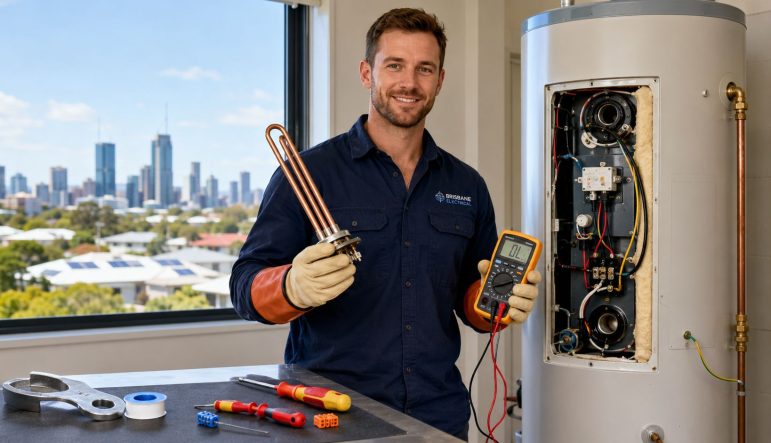
You step into the shower, turn the tap, and get hit with cold water. Not lukewarm. Properly cold. For most Brisbane homeowners, that sends them straight to the switchboard, then to Google, then into a maze of videos telling them a hot water element replacement is a quick afternoon job.
Sometimes the heating element is the problem. Sometimes it isn't. A tripped breaker, a failed thermostat, a wiring fault, or a larger tank issue can look almost identical from the bathroom. That's why the first decision isn't which spanner to grab. It's whether you're dealing with something you can safely assess, or something that crosses into dangerous and restricted work.
When hot water disappears without warning, the immediate priority is often to restore a normal shower. That's fair. An electric storage system can stop heating with very little warning, and the element is one of the usual suspects.
Still, the worst move at this point is assuming the element has definitely failed and jumping straight into removal. A failed thermostat can mimic an element fault. So can a supply issue. So can a breaker that has tripped once and stayed off. Before anyone talks about parts, it makes sense to work through a proper no hot water troubleshooting guide so you don't chase the wrong fault.
If your system is electric, the element sits at the centre of the heating process. When it burns out, water recovery slows down badly or stops altogether. But the element doesn't live in isolation. It's part of a pressurised tank, connected to wiring, controlled by a thermostat, and surrounded by enough stored heat and power to hurt someone who treats it like a basic appliance repair.
A more practical starting point is to identify symptoms, not parts. Ask a few plain questions:
For Brisbane households, it also helps to review the wider fault-finding process before focusing on the element itself. A local overview like this hot water system troubleshooting article helps narrow down what's gone wrong before anyone assumes the fix.
A cold shower is frustrating. A rushed repair on a live, pressurised hot water service is worse.
The right mindset is simple. Diagnose first. Respect the legal limits. Treat safety as the first job, not the last check.
A proper diagnosis starts with the easy checks. If the breaker has tripped, you need to know why before resetting it and walking away. If the thermostat has failed, replacing the element won't fix the problem. If the tank itself has issues, replacing either part may only waste time and money.
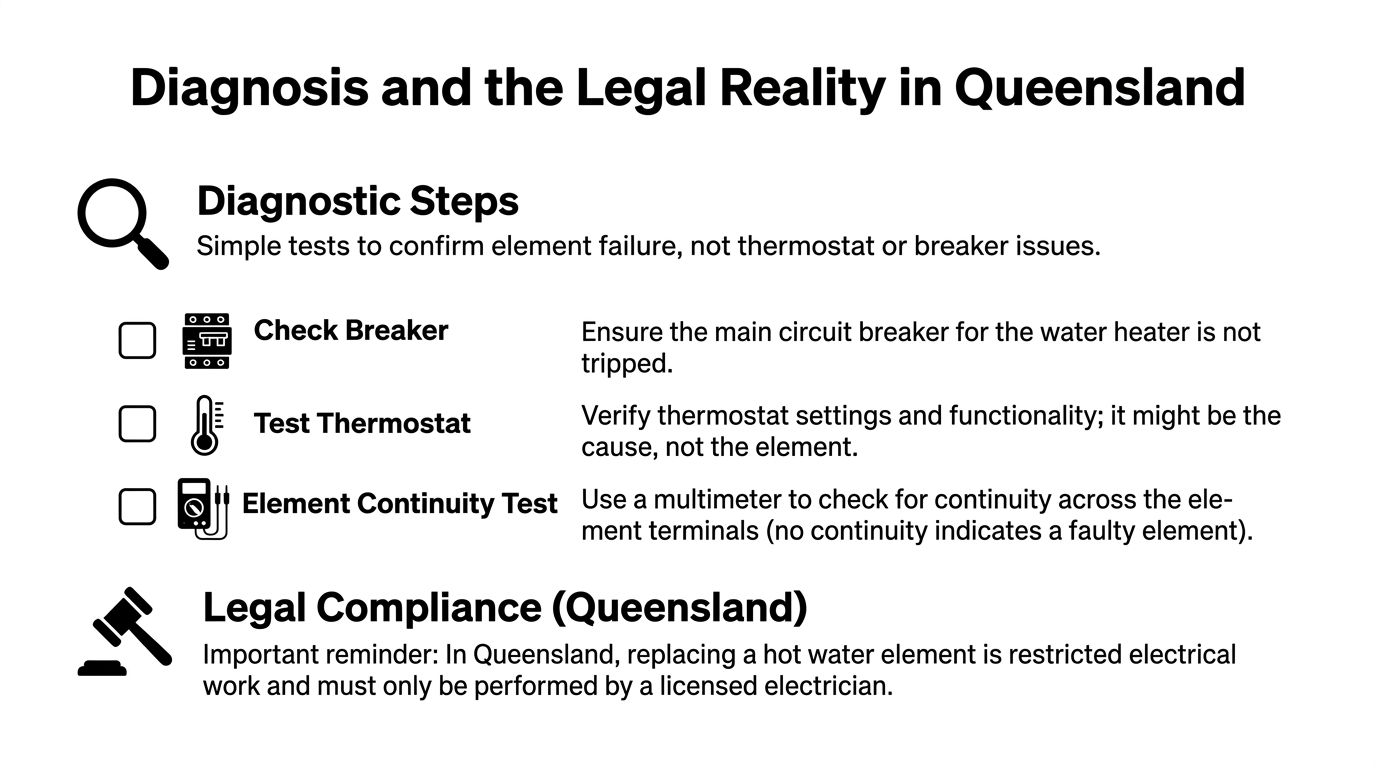
Before any covers come off, check the obvious items first:
If those checks still point toward the element, the usual test is a continuity test across the element terminals with a multimeter. No continuity generally indicates the element has failed. That sounds simple on paper. In practice, that test sits inside a job that involves live electrical isolation, stored hot water, and a pressurised vessel.
Most online how-to content goes wrong by treating a hot water element replacement as routine DIY. In Queensland, that framing is dangerous.
Data cited in an Australian DIY repair discussion says 85% of DIY repair attempts fail due to violations of Australian plumbing and electrical regulations that mandate licensed tradespeople for work involving pressurised water and electricity, with risks including voided warranties, insurance claim denials, and legal fines. The same source notes that Brisbane homeowners also face specific obligations under the Electrical Safety Act and Plumbing Code in Queensland, as outlined in this discussion of DIY hot water repair legality in Australia.
That's the practical go or no-go decision.
| Situation | Go or no-go |
|---|---|
| You're checking for obvious symptoms only | Go, if you stay external and don't open live equipment |
| You need to remove covers, disconnect wiring, test terminals, or disturb the water heater element | No-go unless you're a licensed professional |
| You're unsure whether the issue is electrical, plumbing, or both | No-go for DIY. Get qualified help |
Legal reality: In Queensland, once the work involves restricted electrical tasks and a pressurised hot water system, this is not a casual home repair.
There's also the paperwork side. Professional work should include the right safety and compliance process, not just a swapped part. If you've never dealt with one before, it's worth understanding what an electrical certificate of compliance is and why it matters after electrical repair work.
A homeowner can still be useful before the tradesperson arrives. Clear access around the unit. Note when the hot water failed. Record whether the breaker tripped. Check whether the issue affects the whole house or only one outlet. That information speeds up diagnosis.
What you shouldn't do is pull the element, disconnect conductors, or rely on a YouTube shortcut that ignores Queensland law. That's the point where a frustrating cold shower turns into an unsafe and illegal mistake.
Good preparation decides whether this job goes smoothly or turns into a leak, a burnt-out new element, or a call-out for the same fault a week later. In Brisbane, part selection also affects price more than homeowners expect. Two elements can look nearly identical on the bench and still be wrong for the tank, the thermostat, or the household's hot water demand.
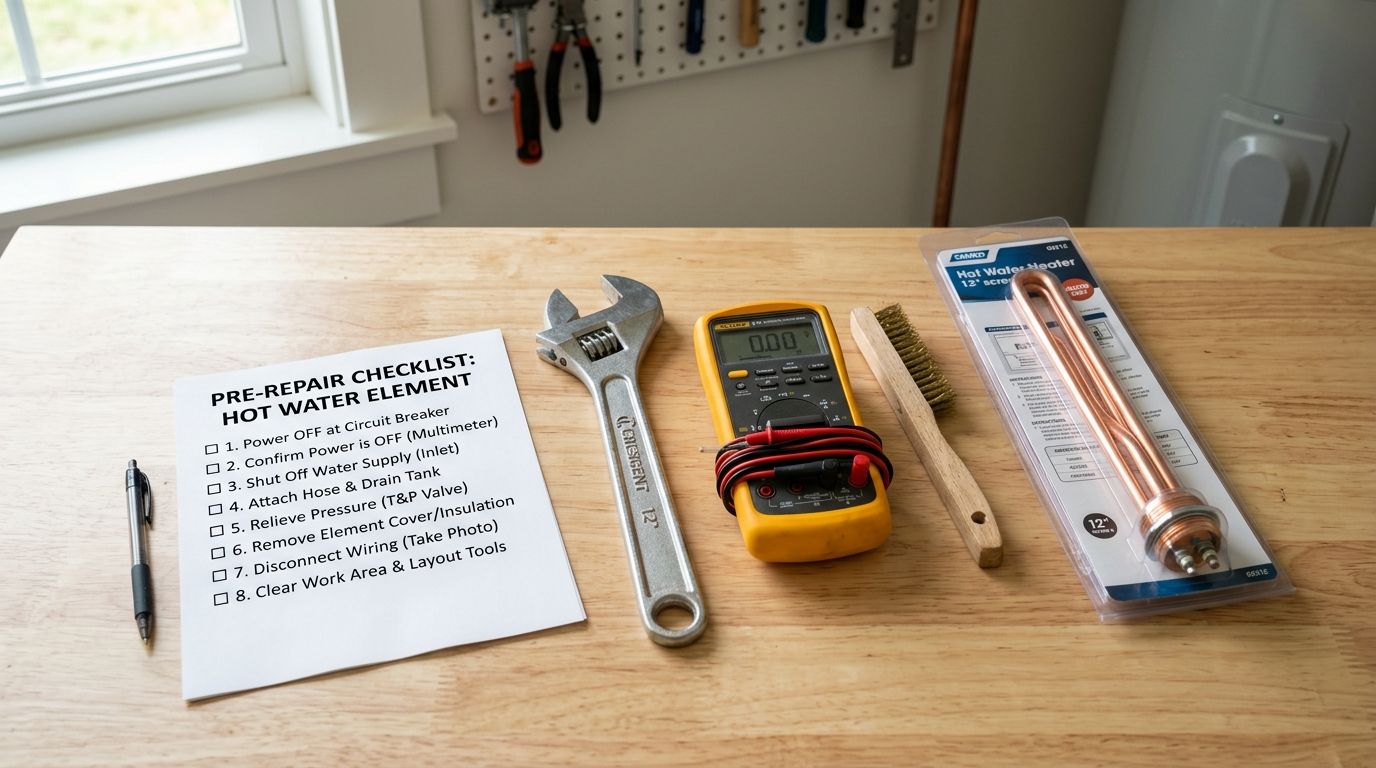
For a licensed electrician, the tool kit is straightforward. For a homeowner, the point is not to assemble this gear and press on anyway. The point is to recognise what proper replacement involves, why the labour cost is not just “unscrewing a part”, and why guessing at the element usually wastes time and money.
A proper setup usually includes:
The missing tool in a lot of DIY attempts is not the spanner. It is the ability to confirm the right circuit is isolated and dead, then put the system back into service without creating an electrical or water leak risk.
The replacement element has to match the unit exactly enough to seal, heat correctly, and work with the existing controls. “Close enough” is how people end up paying twice.
The licensed technician will usually confirm:
Bring the model number and compliance plate details if you are arranging a repair. A clear photo of the unit helps too. That can be the difference between one visit and two.
Element choice is not always just a yes or no match. On some systems, a lower wattage replacement may run gentler and last longer under hard water or heavy cycling. The trade-off is slower recovery. In a smaller household that may be acceptable. In a Brisbane family home with back-to-back showers, it usually is not.
That is why the cheapest compatible part is not automatically the best choice. A good replacement suits the tank, the tariff setup, and how the household uses hot water.
One more point. If the old element has failed because the tank is heavily scaled, corroded, or leaking at the flange, replacing the element alone may be poor value. At that point, the smarter decision may be a broader repair assessment or a full unit replacement rather than spending money on a part that will not solve the underlying problem.
A hot water element change goes wrong in very ordinary ways. Someone isolates the wrong circuit. Someone cracks the element loose before the water level is below it. Someone restores power too early and burns out the new part in seconds. In Queensland, there is another problem. If you are not licensed to do the electrical work, the job crosses from risky into illegal.
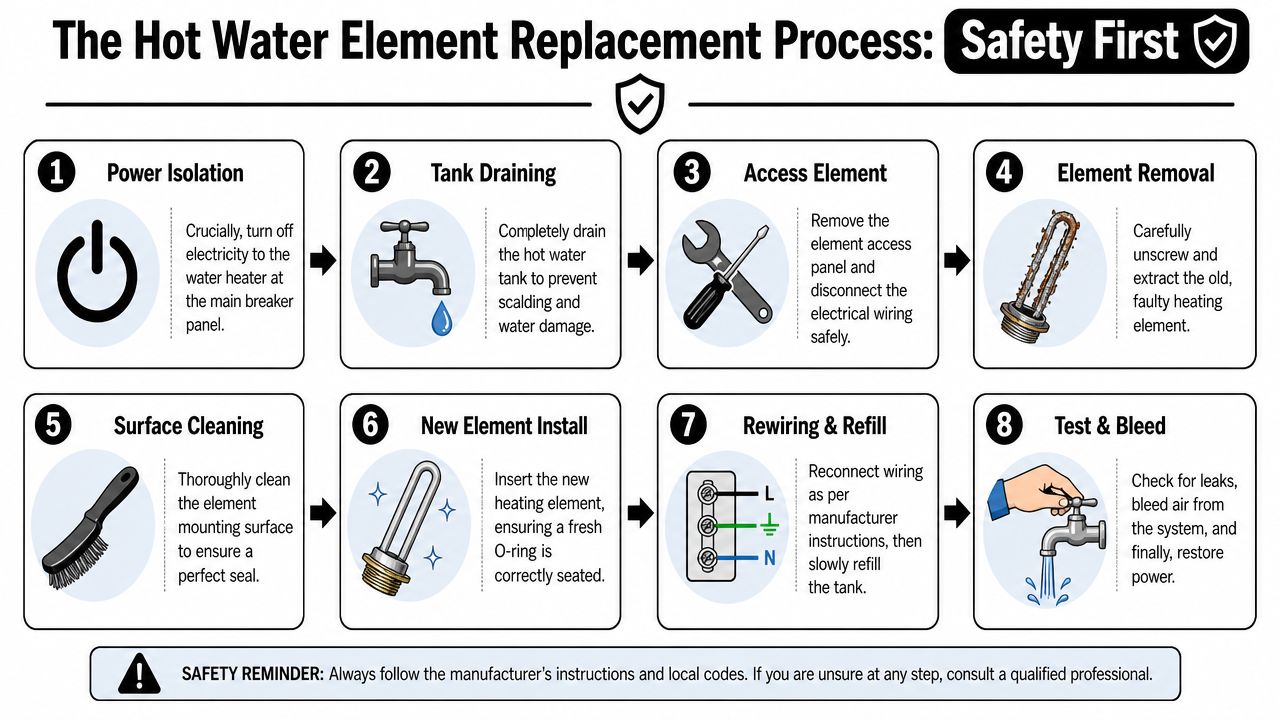
Start at the switchboard and the local isolator at the water heater. Both need to be off. After that, prove the circuit is dead with a properly functioning multimeter at the terminals, not just with a non-contact pen.
That distinction matters. I have seen plenty of people trust a pen, open the cover, and still find live conductors because the wrong breaker was labelled or a second supply path was missed.
Never assume the circuit is dead. Test it properly at the unit.
Once isolation is confirmed, drain the cylinder far enough that water is below the element opening. Use the drain point, connect a hose if needed, and open a hot tap to let air into the system so it can empty properly.
This step is slower than many people expect. It also decides whether the rest of the job stays controlled or turns into a rush with hot water pouring out around live wiring positions and insulation.
Take off the access cover, pull back the insulation, and note the wiring layout before disconnecting anything. If the terminals show heat damage, brittle insulation, or signs of arcing, stop and assess the broader condition of the unit before fitting a new part.
Use the correct element spanner or socket. Old elements can be tight with scale and corrosion. Forcing them out with multigrips or an ill-fitting tool can distort the boss, damage threads, or create a sealing problem that only shows up once the tank heats.
The sealing surface must be clean and sound. Old gasket material, scale, and corrosion around the opening can cause a slow leak even when the new element itself is correct.
Fit the new element with the new gasket or O-ring supplied for that part. Where the manufacturer requires thread sealant or PTFE tape, use it correctly and sparingly. Then:
A video can help you visualise the sequence, but it does not change the licensing rules in Queensland.
Open the cold supply and refill the tank completely. Leave a hot tap open until water runs in a steady stream without air spitting or surging. Then inspect the element seal carefully and give it a few minutes. Some leaks do not show immediately.
Only restore power once the tank is full and the new fitting is dry.
That is the point where many DIY jobs fail. Dry-firing a new element because the cylinder is only partly full will destroy it fast. Restoring power with a poor connection or a leaking seal can do worse than that. If the job involves removing covers, disconnecting wiring, testing live circuits, or reconnecting the new element, that is electrician work in Queensland, not handyman work and not legal DIY.
A hot water service can look fixed at 4 pm and fail again by the next morning. In Brisbane, I usually see the same causes repeated. The part was fitted, but one decision around sealing, part selection, or reconnection set the job up to fail.
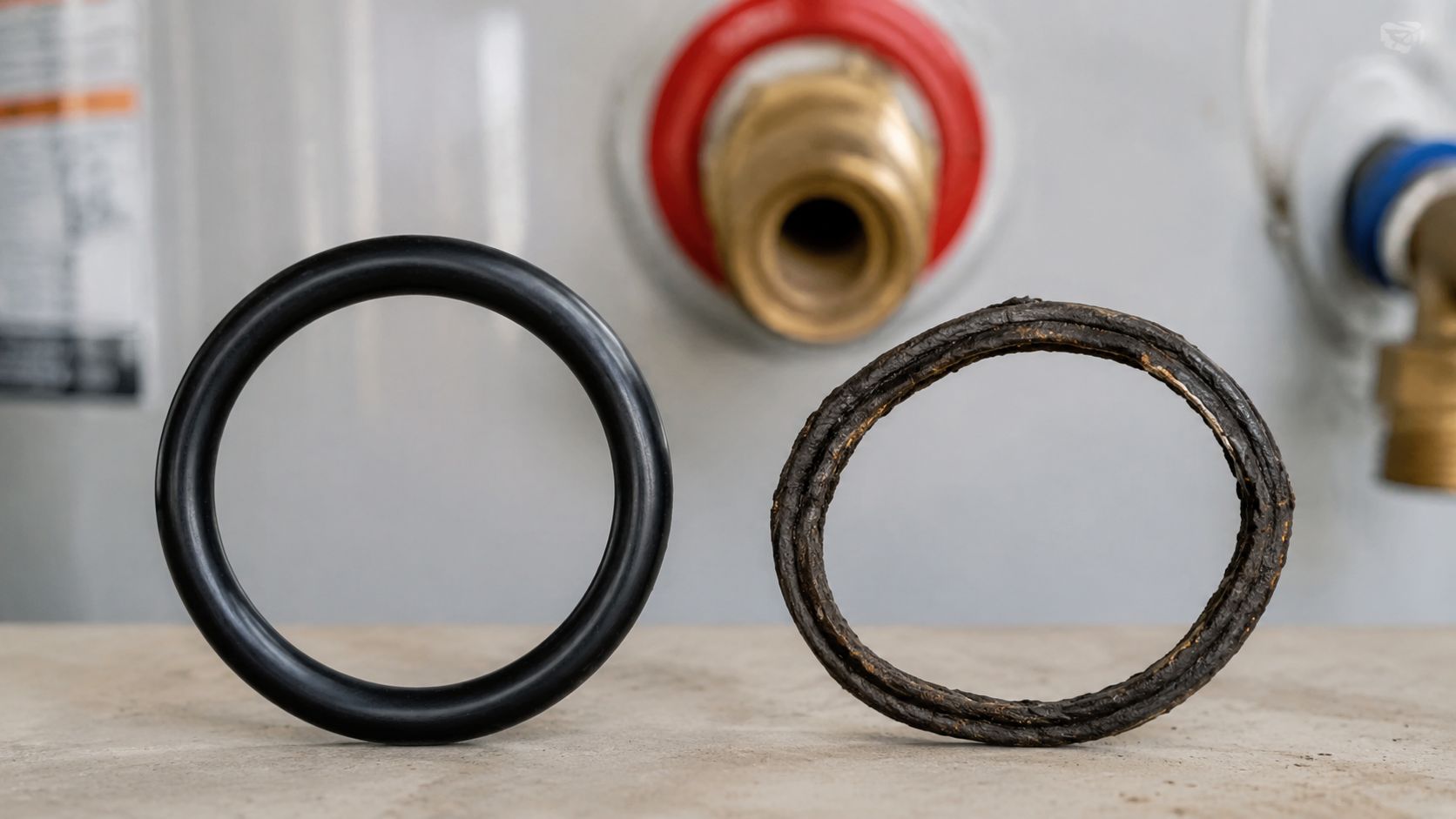
This is the shortcut that causes a lot of repeat call-outs. The old gasket or O-ring may look usable, but once it has been compressed, heated, and removed, it is no longer trustworthy.
A reused seal often holds for long enough to fool someone into thinking the repair worked. Then the tank heats, cools, expands, and contracts, and a slow leak starts around the element plate. That leak can damage insulation, rust the surrounding metalwork, and leave the owner paying for the same repair twice.
A replacement element needs more than the right thread or flange. Wattage, voltage rating, length, sheath material, and brand compatibility all matter.
Changing wattage is a trade-off, not a free upgrade. A lower-rated element can reduce stress on the system, but it also slows recovery. A higher-rated element may heat faster, but it can increase current draw and create problems if the circuit, controls, or manufacturer specification do not support it. If the unit is older and already showing its age, it is worth comparing repair against the full electric hot water system replacement cost before throwing more money at the wrong fix.
One rushed refill can kill a brand-new element.
If any part of the element is heating in air instead of water, it can burn out almost immediately. That is one of the most common reasons a new element gives you one hot shower, or none at all, and then fails again. The mistake usually starts with assumption. Water is heard entering the tank, a tap spits a bit, and someone decides it must be full enough.
It is not full enough until the tank is properly bled and water runs steadily from a hot outlet.
Loose terminals create heat at the connection point. Overtightened terminals can damage the conductor, strip the terminal, or distort the connection enough to cause intermittent faults later.
Such scenarios highlight the importance of experience. A hot water system may appear to run normally after replacement, but a poor termination can lead to nuisance tripping, burnt cable ends, damaged thermostats, or a melted cover cavity after a few heating cycles. In Queensland, once the job involves disconnecting and reconnecting fixed wiring, it is electrical work. An unlicensed DIY repair is not just risky. It is illegal.
Some second cold showers happen because the original diagnosis was incomplete. A failed thermostat, damaged wiring, heavy sediment buildup, or a leaking tank can all be present at the same time.
Replacing the element alone will not solve those faults. If the system is older, tripping the circuit breaker, leaking from the cylinder body, or heating inconsistently across different times of day, stop treating it like a simple parts swap. That is the point where a DIY attempt turns from frustrating into dangerous and expensive.
Cold water at 6 am makes people focus on the part price. That is usually where the confusion starts.
A heating element can look inexpensive online, but the invoice in Brisbane is rarely just for the element. A proper job can include fault-finding, isolation, drain-down, removal, fitting the correct replacement, refill, testing, and checking whether the thermostat, wiring, or tank condition has also contributed to the failure. In Queensland, the legal side matters too, because fixed electrical work must be done by a licensed person.
That gap between part price and job price is why homeowners often feel overcharged. In one Brisbane discussion on AusRenovation, a homeowner questioned a total of $489.50 for an element and thermostat replacement. You can see the pricing frustration in that Brisbane water heater replacement discussion. The thread is useful for one reason. It shows how often quotes are compared without comparing what is included.
A licensed repair is priced on scope, risk, and time on site. If access is poor, the tank will not isolate properly, the element is seized, or testing shows a second fault, the job can move well beyond a basic parts swap.
| Cost Item | DIY Attempt | DLG Electrical Professional Service |
|---|---|---|
| Call-out and diagnosis | Often skipped, then added in time, extra parts, or a failed first attempt | Included in the service scope |
| Correct part selection | Easy to order the wrong wattage, thread, gasket, or matching thermostat | Part matched to the system and fault findings |
| Electrical isolation and testing | Dangerous and illegal in QLD if it involves fixed wiring | Carried out by licensed electricians with test equipment |
| Drain, removal, install, refill | Messy, slow, and easy to get wrong on an older unit | Completed as part of the repair process |
| Leak and pressure checks | Commonly missed after reassembly | Checked before the system is left in service |
| Compliance documentation | Not available for unlicensed electrical work | Managed where required as part of compliant work |
| Warranty and insurance confidence | Can be affected by illegal or non-compliant work | Better protection when the repair is done correctly |
Price alone is not the right comparison. Scope is.
A cheap quote that excludes testing can leave you paying for a second visit when the thermostat is also faulty. A cheap DIY attempt can end with a burnt terminal, a leak around the new gasket, or a breaker that keeps tripping because the original diagnosis was wrong. I have seen all three. The customer pays twice, and sometimes still needs a full replacement because the tank or wiring should have been condemned earlier.
If the system is old enough that replacement is already being discussed, check this guide on electric hot water system replacement cost before spending money on a repair that may only buy a short amount of time.
In Brisbane, a fair price for hot water element replacement is the price for a safe, legal repair with the fault properly confirmed. That is the standard that matters.

Master Electrician with over 30 years of experience. Founded DLG Electrical in 2005 after international project work including electrical installations at Stamford Bridge Stadium, London(Home of Chelsea FC).

Local Electricians that can fix all Electric Hot water Systems.
Motion sensor lights are a versatile addition to any home, offering nu
