83 Jean St, Grange QLD 4051
Mon-Fri 07:30 AM - 04:00 PM - Sat - 8:00 - 12 - Sunday Closed
That late-night chirp usually starts the same way. You stand in the hallway, half awake, staring at a plastic disc on the ceiling and wondering whether you need a new battery, a whole new alarm, or a complete upgrade to meet Queensland rules.
I see the same confusion when people are selling, renovating, renting out a property, or moving into an older Brisbane home. Someone has told them they need “new smoke detectors”, they've gone online, and now they're comparing cheap standalone units that look fine on the box but won't meet the standard their property needs.
If you're searching for the best smoke detector Australia homeowners can buy, the answer isn't a single brand or flashy feature list. It's the right smoke alarm system, installed in the right places, using the right technology, and set up to comply with the rules that apply to your home.
Most homeowners don't have a smoke alarm problem until they suddenly do. It might be a pre-sale inspection that flags non-compliance. It might be a rental requirement. It might be the realisation that the alarms already installed in the house are old, disconnected from each other, or the wrong type entirely.
The biggest mistake I see is treating smoke alarms like a basic retail purchase. People compare price, battery type, or app features before they've worked out whether the unit is even suitable for an Australian home, and more specifically, a Queensland property. That's where the confusion between a standalone detector and a compliant interconnected alarm causes trouble.
Practical rule: The best smoke detector Australia buyers choose isn't the cheapest unit on the shelf. It's the alarm that will actually warn your family early and satisfy the legal standard for your property.
There are a few essential considerations that matter more than marketing.
A lot of online buying guides blur the line between commercial fire system components and domestic smoke alarms. That's how people end up ordering something labelled as a “detector” that sounds technical and advanced, but doesn't match what their house requires.
This guide cuts through that. It deals with what works in real homes, what doesn't, and where homeowners and landlords in Brisbane most often get caught out.
A common Brisbane callout goes like this. The owner has bought a cheap “smoke detector” online, fitted it, and assumes the job is done. The problem is that the sensing technology might be wrong for a home, and even a good standalone unit can still leave a Queensland property short of the interconnected smoke alarms the law requires.
For residential use, photoelectric alarms are the right starting point. They respond better to the visible smoke produced by many smouldering fires, which are the fires that often build unnoticed while people are asleep.
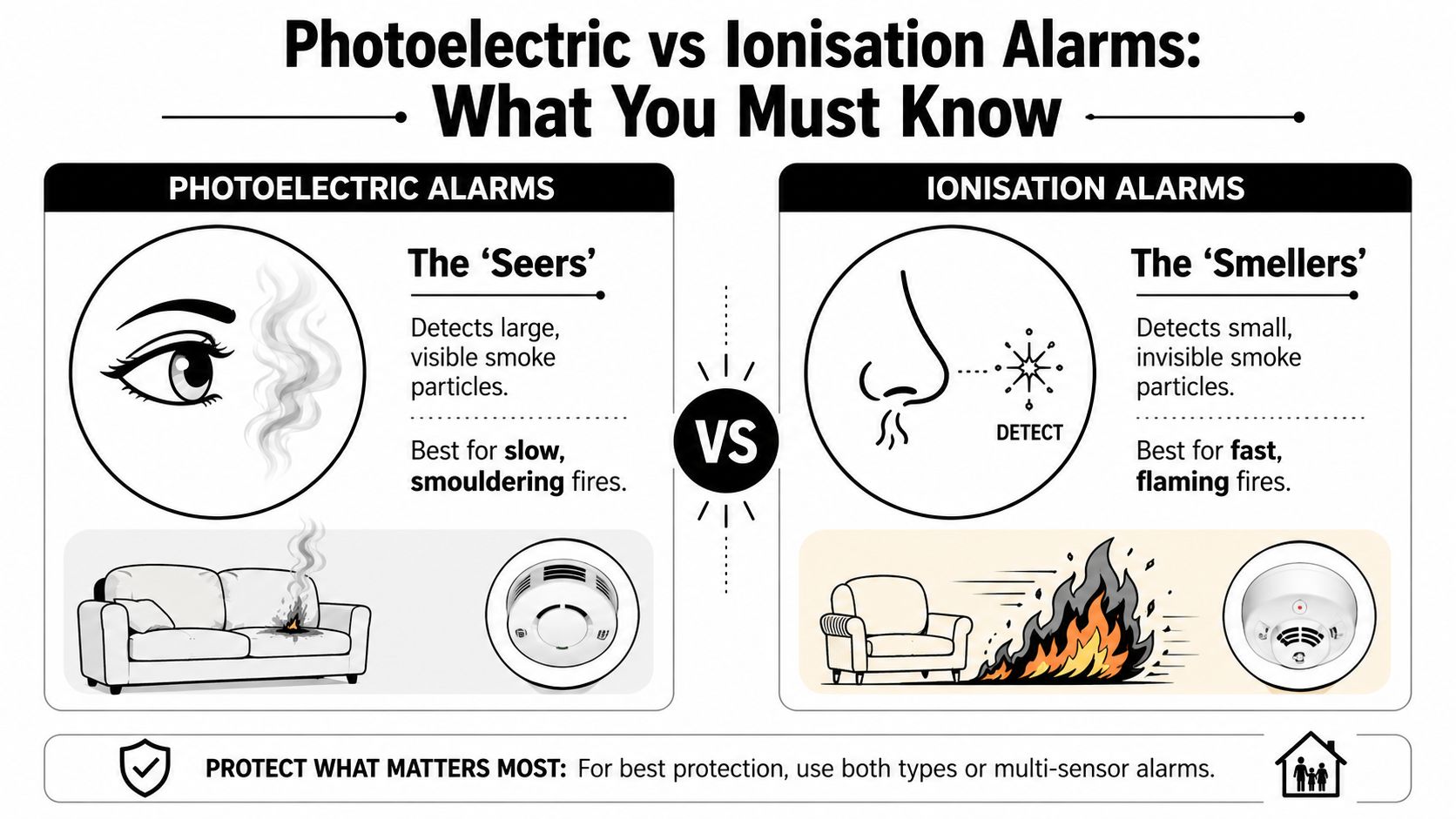
Photoelectric alarms use a light sensor to detect smoke particles entering the chamber. In a house, that makes them better suited to fires involving bedding, lounges, wiring insulation, chargers, and appliances that can smoulder before open flame appears.
Ionisation alarms are more reactive to the smaller particles produced by fast-flaming fires. You still find them in older homes, but they are not the preferred choice for domestic installations, and I do not recommend choosing one for a Queensland home upgrade.
That distinction matters in bedrooms, hallways, and paths of travel. The goal is early warning while occupants are sleeping, not a faster reaction to a fire type that is less representative of how many domestic fires begin.
The wording on the box catches people out. A product can be sold as a detector, alarm, sensor, or smart device, but that does not mean it is the right domestic smoke alarm for the property.
In practice, I tell homeowners to separate two decisions:
That second point is where people waste money. They buy a perfectly functional standalone detector, install it themselves, and later find out it does not meet the required interconnection standard for the home.
If you want a QLD-specific explanation of why photoelectric units are now the default choice, this guide on photoelectric smoke alarms in QLD explains the practical reasons clearly.
| Alarm type | Best fit | Main limitation |
|---|---|---|
| Photoelectric | Bedrooms, hallways, living areas, general residential protection | Can nuisance alarm if installed too close to kitchens, bathrooms, dust, or poor airflow points |
| Ionisation | Older existing installations still found in some homes | Not the preferred residential option for current home upgrades |
| Heat alarm | Garages and some kitchen-adjacent areas where smoke alarms would nuisance trip | Does not replace required smoke alarms in sleeping areas and escape paths |
Heat alarms are useful in the right spot. They suit areas where normal smoke, steam, or cooking fumes would cause repeated nuisance alarms.
They are not a substitute for smoke alarms protecting bedrooms and the route out of the house.
I see this mistake regularly. Someone gets tired of a hallway alarm going off because it was badly located near cooking fumes, then swaps it for a heat alarm. That reduces protection instead of fixing the placement problem.
The better fix is choosing the correct alarm type, then installing it in the correct position. It is the same principle you see in building design and approvals. Good compliance comes from matching the product to the rule and the location, much like how architects manage project regulations.
For most Australian homes, the safest choice is straightforward. Use photoelectric smoke alarms for living and sleeping areas, use heat alarms only where they are appropriate, and do not confuse a standalone detector with the interconnected smoke alarm system your Queensland property may be required to have.
A Brisbane owner buys a few cheap “smoke detectors” online, clips them to the ceiling, and assumes the house is sorted. Then the property goes up for lease, or a sale contract is being prepared, and those units are found not to be the interconnected smoke alarms Queensland law expects. I see that mistake often.
The first point to get clear is the language. In everyday speech, people say detector and alarm as if they mean the same thing. For compliance, they do not. A domestic smoke alarm is the unit used to protect the home. A smoke detector can also mean a sensing device that forms part of a larger fire panel system, or a standalone product that does not meet the setup required for a Queensland house.
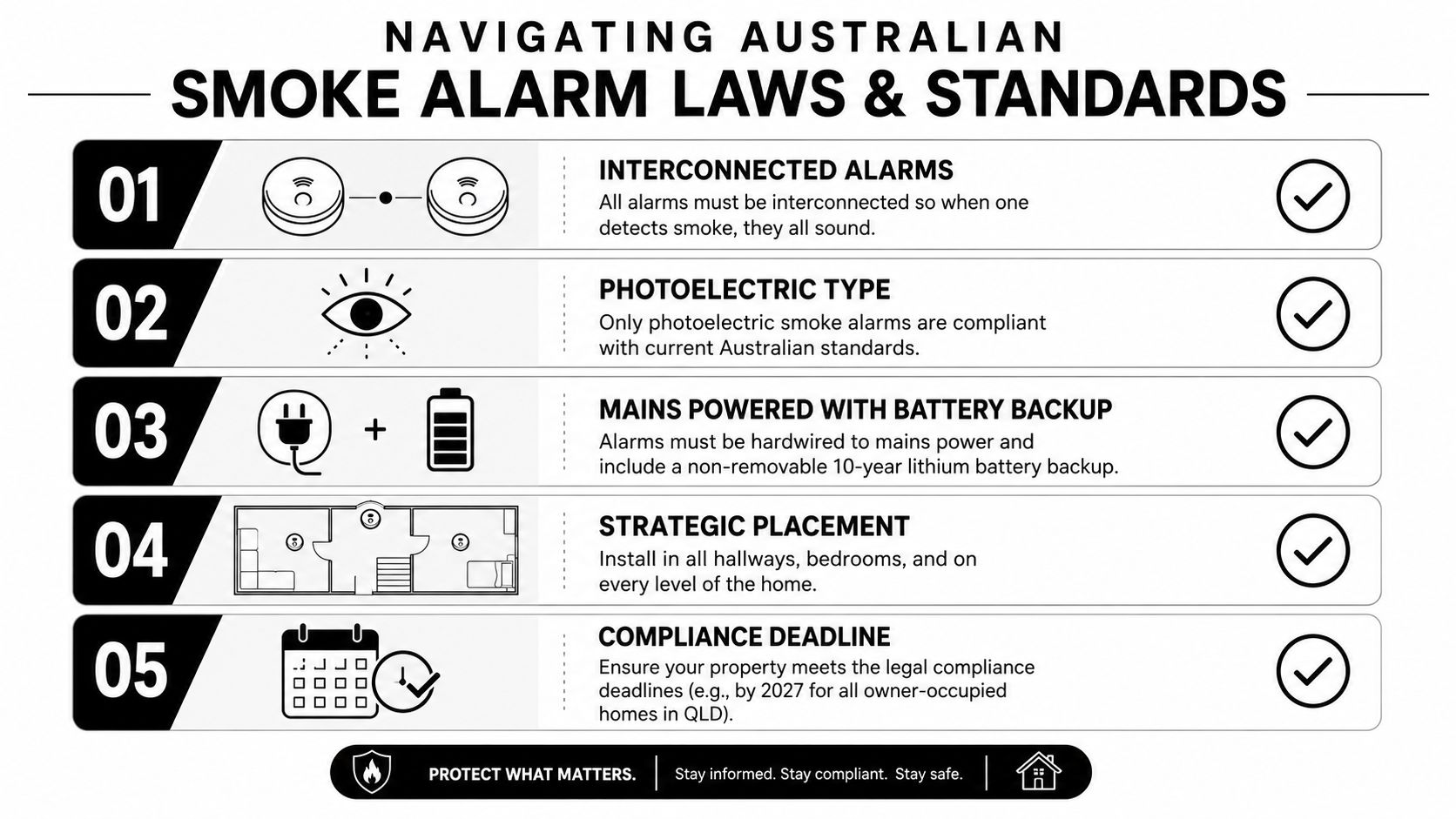
Queensland compliance is not about having something on the ceiling that makes noise. It is about having the right type of alarm, in the right locations, working together as a system.
That is why standalone units cause trouble. A single battery alarm bought room by room may look modern and still leave the property short of the legal requirement if the alarms are not interconnected, not photoelectric, or not suitable for the class of property and work involved. That is the trap.
For practical purposes, owners should stop asking, “Do I have smoke detectors?” and start asking, “Do I have interconnected photoelectric smoke alarms installed to suit this property?” That wording gets much closer to the actual legal test.
When I inspect a home, I am not interested in packaging claims first. I check whether the installation would hold up under a compliance review and whether it gives the occupants early warning throughout the house.
These are the questions that matter:
That last point matters more than many owners realise. I regularly find houses with one new alarm in a hallway, an older unit in a bedroom, and another alarm that was installed after a renovation without considering the rest of the dwelling. The owner has spent money, but the system still has gaps.
For renovations and approvals, the same principle applies as it does in other regulated parts of a project. Compliance goes better when someone reads the requirements and applies them to the building, much like how architects manage project regulations.
This video gives a useful visual overview before you start planning an upgrade.
For Brisbane homeowners, landlords, and renovators, the safe approach is to treat smoke alarms as a property-wide system, not a shelf purchase. The common compliance failure is buying a standalone detector when the home requires interconnected alarms.
If you want a broader starting point, this guide to smoke alarms in Australia gives a useful overview before you match the rules to your own property.
If one alarm cannot trigger the others, the house is missing a key part of the protection it should have.
Once you know the alarm needs to be interconnected, the next question is how that interconnection happens and how each alarm is powered.
Homeowners often get conflicting advice. One person says hardwired only. Another says battery is fine. Another recommends a wireless kit. The right answer depends on the home, the stage of the project, and what level of work is being done.
A hardwired smoke alarm is connected to the property's electrical supply. In practice, that gives you a stable power source and is the standard approach in new builds and major renovations.
For homes under construction or substantial renovation, hardwired interconnected alarms are usually the cleanest solution because wiring can be run while ceilings are accessible. It's durable, tidy, and well suited to long-term compliance.
Hardwired doesn't mean “no battery”. These alarms still need backup capability so they continue to function if mains power is interrupted.
Wireless interconnection means each alarm communicates with the others by radio link rather than a dedicated interconnect cable. This can be a very practical option in existing homes where you want all alarms linked but don't want to open walls and ceilings unnecessarily.
That's often the better retrofit path in finished homes with difficult access, ornate ceilings, or layouts where cable runs would cause more disruption than the owner wants.
A simple comparison helps:
| Option | Where it suits | Trade-off |
|---|---|---|
| Hardwired interconnected | New builds, major renovations, homes with easy cable access | More installation work in finished homes |
| Wireless interconnected | Existing homes, retrofits, properties where cable access is difficult | Must be selected and configured carefully so the full system works together |
| Standalone non-interconnected | Very limited domestic use cases | Often the wrong choice for Queensland compliance goals |
For a renovation, I'd usually lean hardwired if the walls or ceilings are already being opened. For an established home with good finishes and minimal appetite for patching, wireless interconnection can make more sense if the selected alarms are appropriate for the property.
The poor choice is buying unrelated alarms one at a time and assuming they form a system because they're all mounted on ceilings. They don't. A compliant setup has to function as a network, not as isolated points.
One Brisbane option homeowners use for this kind of work is DLG Electrical, which installs compliant smoke alarm systems including interconnected photoelectric alarms for residential properties. The important part isn't the brand on the van. It's that the installer understands how to match the power method and interconnection method to the house.
A fire starts in the living area at night. The alarm in the hallway eventually sounds, but the bedroom doors are closed and the smoke takes too long to reach it. That is exactly why placement matters, and why Queensland owners get caught out when they treat smoke alarms as simple standalone detectors instead of an interconnected warning system.
In Queensland, compliance is not just about having alarms on the ceiling. The required setup is about putting interconnected alarms where they will warn sleeping occupants early enough to act. A single detector in the wrong spot can leave bedrooms without timely warning, even if the home has technically been fitted with alarms.
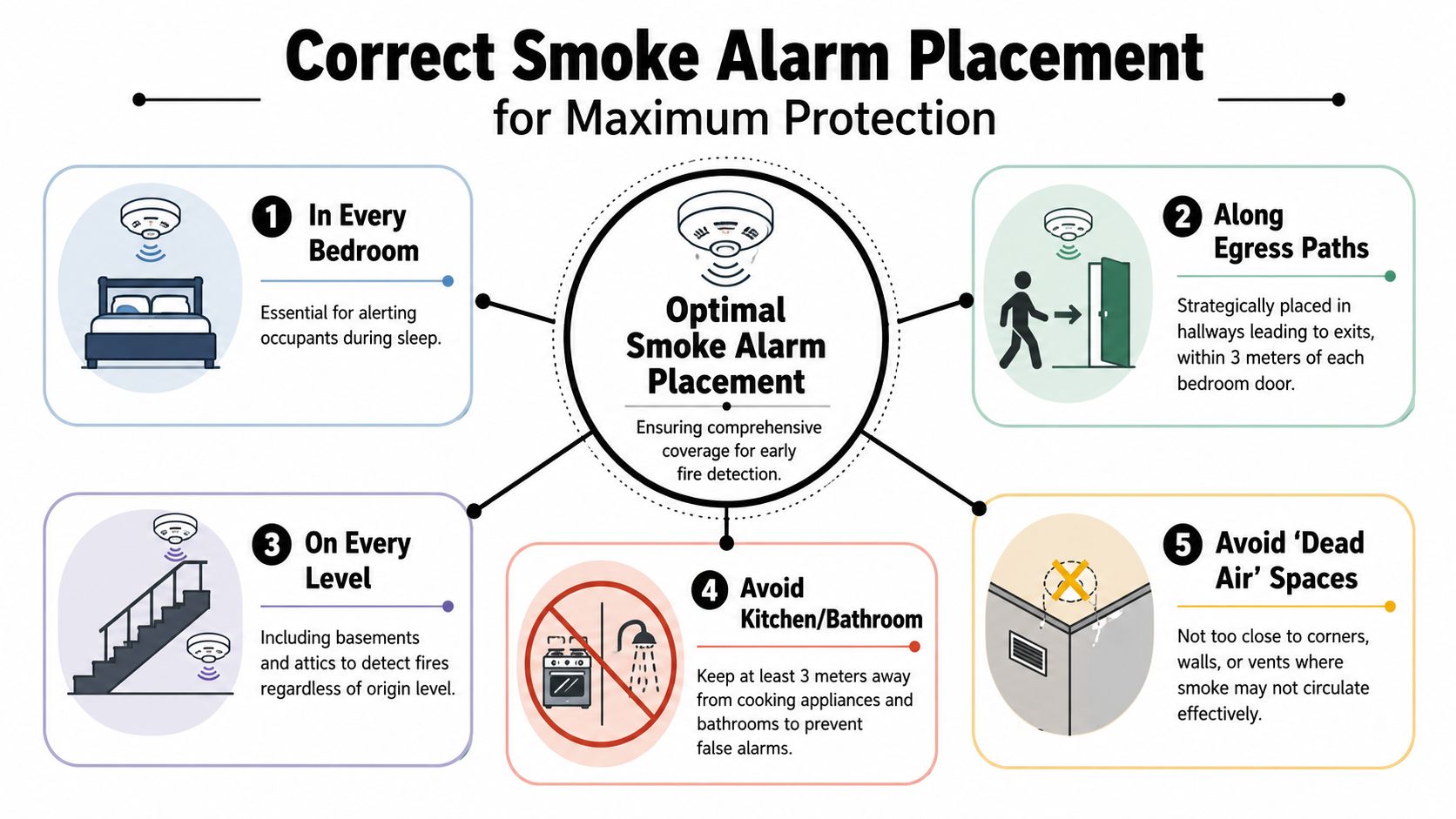
Two clearance rules stop a lot of poor installations.
These measurements affect performance. I see plenty of alarms installed neatly and still placed badly enough to reduce the warning time that people rely on.
For most homes, the starting point is straightforward.
That last point is the one owners and landlords miss. A few standalone detectors spread around the house are not the same thing as interconnected smoke alarms. If one alarm activates, the others need to sound too. That legal distinction matters in Queensland, especially in homes with multiple bedrooms, split levels, long corridors, or closed doors at night.
In a small single-storey home, bedroom alarms plus the hallway alarm may cover the sleeping zone properly, but the living area can still need its own alarm depending on the layout. In a larger home, one hallway alarm will not cover open-plan spaces, rear extensions, or separated bedrooms well enough.
For two-storey homes, each level needs alarm coverage that gives an early warning throughout the property, not just near the stairs. Interconnection is what turns separate alarm points into a system. If upstairs smoke triggers one unit, people downstairs need to hear it immediately.
Bad placement usually happens for convenience.
Those choices create blind spots. They also lead to a common compliance problem. Owners assume that because they have several alarms, they have met the standard. If those alarms are isolated units, or if they are placed where smoke or sound warning is delayed, the setup can still fail the practical safety test and the legal one.
If you are checking an existing home, start with placement before you spend money replacing units at random. A proper smoke alarm testing checklist for homeowners helps confirm whether the alarms you already have are positioned and working as they should be.
A smoke alarm system can look fine on the ceiling and still fail when it matters. I see this in Brisbane homes all the time. The alarms are in place, but one unit is past its expiry date, another is full of dust, and nobody has tested whether the interconnected system still sounds across the whole house.
That last part gets missed. Homeowners often test one alarm, hear a beep in that room, and assume the job is done. For Queensland compliance, the critical question is whether the required interconnected alarms still trigger together. A standalone detector that only makes noise in one spot is a weak link, even if the battery is fresh.
Use a simple schedule and stick to it:
The 10-year replacement point is where many properties fall out of compliance. Owners replace batteries and ignore the date stamp. The sensor does not last forever, and an old alarm can still chirp, still light up, and still give a false sense of security.
Pay attention to the sounds. A full alarm tone means treat it as a possible fire until you confirm otherwise. A short periodic chirp usually points to low backup battery, contamination, fault, or end of life. The pattern depends on the brand and model, so check the manual before guessing.
Do not remove batteries to stop nuisance alarms. Do not leave a faulty unit isolated from the rest of the system. If one alarm is disconnected or dead, the house may no longer have the interconnected warning Queensland law requires.
For a practical step-by-step routine, use this guide on how to test a smoke alarm.
Choosing the best smoke detector Australia homeowners should trust isn't really about choosing a single device. It's about getting a full chain of decisions right. Detection type, legal suitability, interconnection method, power supply, room coverage, and installation position all affect whether the system does its job.
That's why smoke alarm work is one of those areas where DIY confidence can create false confidence. A homeowner can mount a unit neatly and still get the wrong outcome if the alarm isn't compliant, isn't interconnected correctly, or is placed where smoke won't reach it properly.
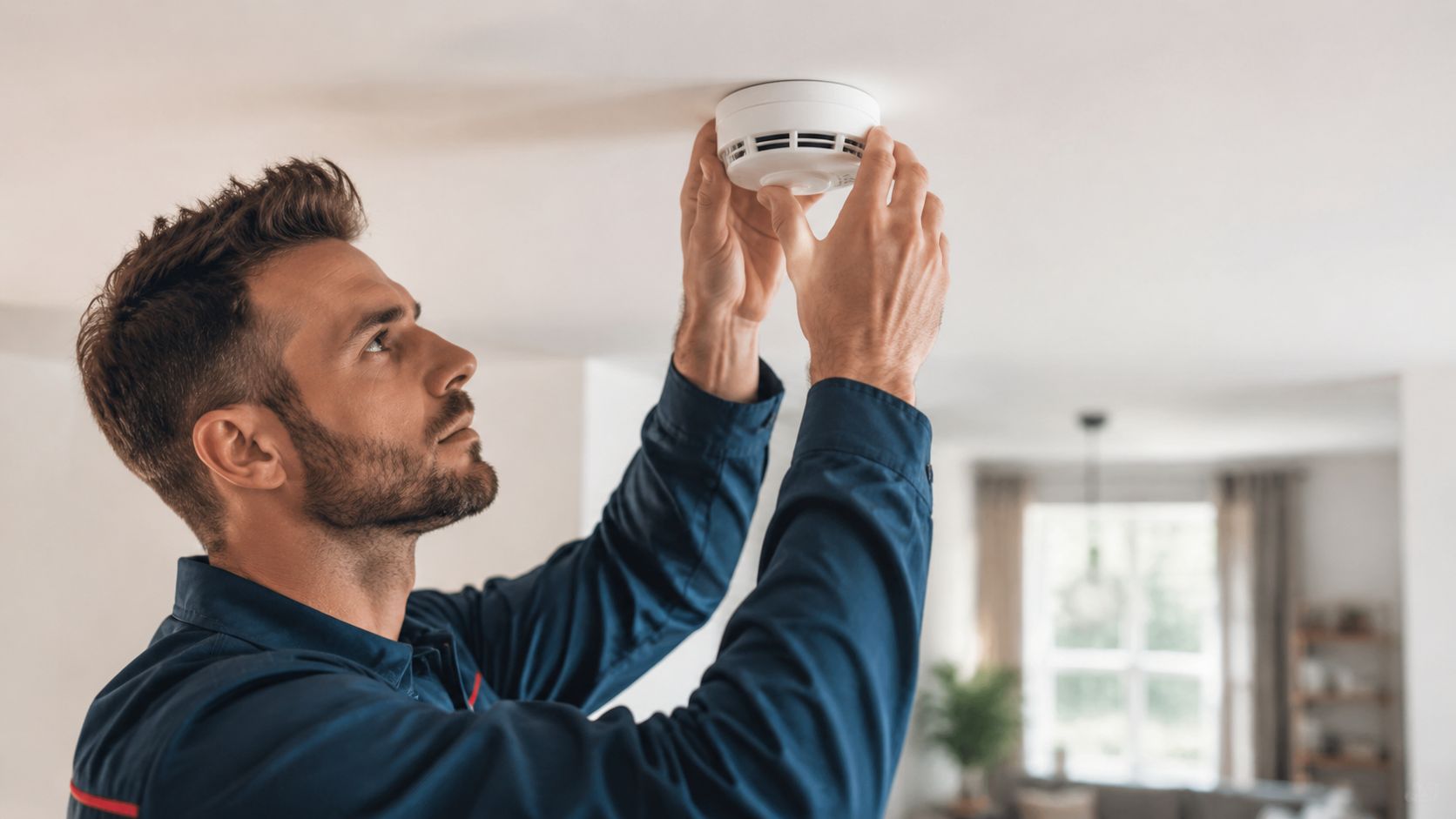
A licensed electrician doesn't just install alarms. They work out the right system for the building.
That includes:
Brisbane homes vary a lot. Queenslanders, split-level homes, brick lowsets, townhouses, renovated post-war homes, and investment properties all create different installation constraints. Ceiling access, existing wiring, bedroom layout, stair positions, and renovation history all influence the best alarm setup.
That's where experience matters. DLG Electrical has been operating in Brisbane for over 19 years, and that kind of local electrical experience helps when a house doesn't fit a neat retail checklist.
For landlords and property managers, professional installation also gives you a clearer record of what was installed, where it was installed, and why that layout was chosen. For owner-occupiers, it means you can stop second-guessing whether the system is compliant or just looks compliant.
A smoke alarm isn't the place to improvise. If you get one part wrong, the system may fail at the exact moment you need it.
If you want practical help sorting out smoke alarm compliance, upgrades, or a full interconnected photoelectric setup for your Brisbane property, contact DLG Electrical. They handle residential smoke alarm installation, maintenance, and compliance work, and can assess what your home needs rather than guessing from a product box.

Master Electrician with over 30 years of experience. Founded DLG Electrical in 2005 after international project work including electrical installations at Stamford Bridge Stadium, London(Home of Chelsea FC).

Local Electricians that can fix all Electric Hot water Systems.
Motion sensor lights are a versatile addition to any home, offering nu
