83 Jean St, Grange QLD 4051
Mon-Fri 07:30 AM - 04:00 PM - Sat - 8:00 - 12 - Sunday Closed
In Australia, having a functional and compliant smoke alarm isn’t just a good idea—it’s a legal requirement designed to save lives. State-specific rules are in place for a reason: these devices are your first and most critical line of defence against a house fire, giving you that precious early warning needed to get out safely.
When it comes to home safety, smoke alarm compliance is so much more than ticking a box or dodging a fine. It’s one of the single most effective things you can do to protect your property and, more importantly, the people inside. For homeowners and landlords across Australia, this is a serious responsibility.
Think of an old, non-compliant smoke alarm like the brakes on a classic car you haven’t serviced in years. You might drive it around town for months feeling perfectly safe. But in that split second when you desperately need them to work, they fail, and the outcome is devastating. An alarm that’s expired, in the wrong spot, or the wrong type gives you a false sense of security that can vanish in an instant.
The guiding principle behind all Australian smoke alarm laws is early detection. A house fire can become deadly in as little as three minutes, and most fatal fires happen at night while people are asleep. An alarm gives you the crucial seconds needed to wake up and escape. This is why the laws are constantly updated to keep pace with the best technology available.
Queensland, for instance, has rolled out some of the toughest requirements in the country, mandating interconnected, photoelectric smoke alarms in all homes. This approach creates a synchronised warning network that’s a real game-changer.
When one alarm detects smoke, every single alarm in the house sounds off at the same time. This means a fire starting in the lounge room will instantly alert someone sleeping behind a closed door on another floor.
This interconnected system is fast becoming the gold standard for home fire safety. It directly tackles the major weakness of older, standalone battery alarms that might not be heard until it’s far too late.
For property owners and managers, these rules are not optional. Ignoring them can lead to hefty fines, but the real risk is the potential for tragedy. Landlords have a non-delegable duty of care to their tenants, which means providing a safe home that meets all fire safety laws.
Beyond the immediate safety concerns, there are serious landlord insurance considerations to think about, as many policies can be voided if a property isn’t compliant. A fire in a non-compliant rental could lead to a denied claim, turning a devastating loss into a financial catastrophe.
Ultimately, keeping up with smoke alarms australia regulations is a fundamental part of responsible property ownership.
While every Australian state has rules for smoke alarms, Queensland’s legislation is arguably the most comprehensive in the country. Getting your head around these laws isn’t just about ticking a box for compliance—it’s about giving your family the absolute best chance of getting out safely during a house fire.
The new rules were designed to fix the single biggest flaw in older smoke alarm setups: a fire starting at one end of the house while everyone is asleep at the other. A lone alarm beeping in a hallway might not be enough to wake someone behind a closed door, especially during a slow, smouldering fire that produces more deadly smoke than noise.
The game-changer in Queensland’s legislation is the mandate for interconnected photoelectric smoke alarms. Think of it like a digital neighbourhood watch system for your home. When one alarm detects smoke, it doesn’t just sound off by itself. It sends a signal to every other alarm, and they all go off at once.
This creates an unmissable, house-wide alert. A fire starting in the kitchen will instantly trigger the alarm in a bedroom down the hall, buying you precious, life-saving seconds to wake up and evacuate.
The logic behind interconnection is simple but incredibly powerful: an early warning anywhere in the home must become an immediate, unavoidable alert for everyone in the home.
The law is also very specific about the type of technology you must use. Photoelectric alarms are now mandatory because they are far better at detecting the slow, smouldering fires most common in homes. These are the fires that can fill a house with toxic smoke long before any flames are visible.
The government rolled out these laws in stages to give homeowners and landlords time to get their properties up to scratch. The deadline that applies to you depends on your property type.
Here’s a simple breakdown of the timelines:
While these rules are specific to Queensland, they are built on principles outlined in national building standards. For a deeper dive into the overarching framework, you can refer to the Building Code of Australia (BCA).
The legislation is crystal clear on where smoke alarms must be located. Getting this wrong means you aren’t compliant, and more importantly, your family isn’t as safe as they could be.
To meet the legal requirements, smoke alarms must be installed in these locations:
On top of the location rules, the alarms must be either hardwired to your 240V mains power (with a battery backup, of course) or be powered by a non-removable 10-year lithium battery. The old-school, user-replaceable 9-volt battery alarms are no longer compliant for new installations.
For a more detailed look at the requirements, you can read our complete guide on the current smoke alarm legislation in QLD.
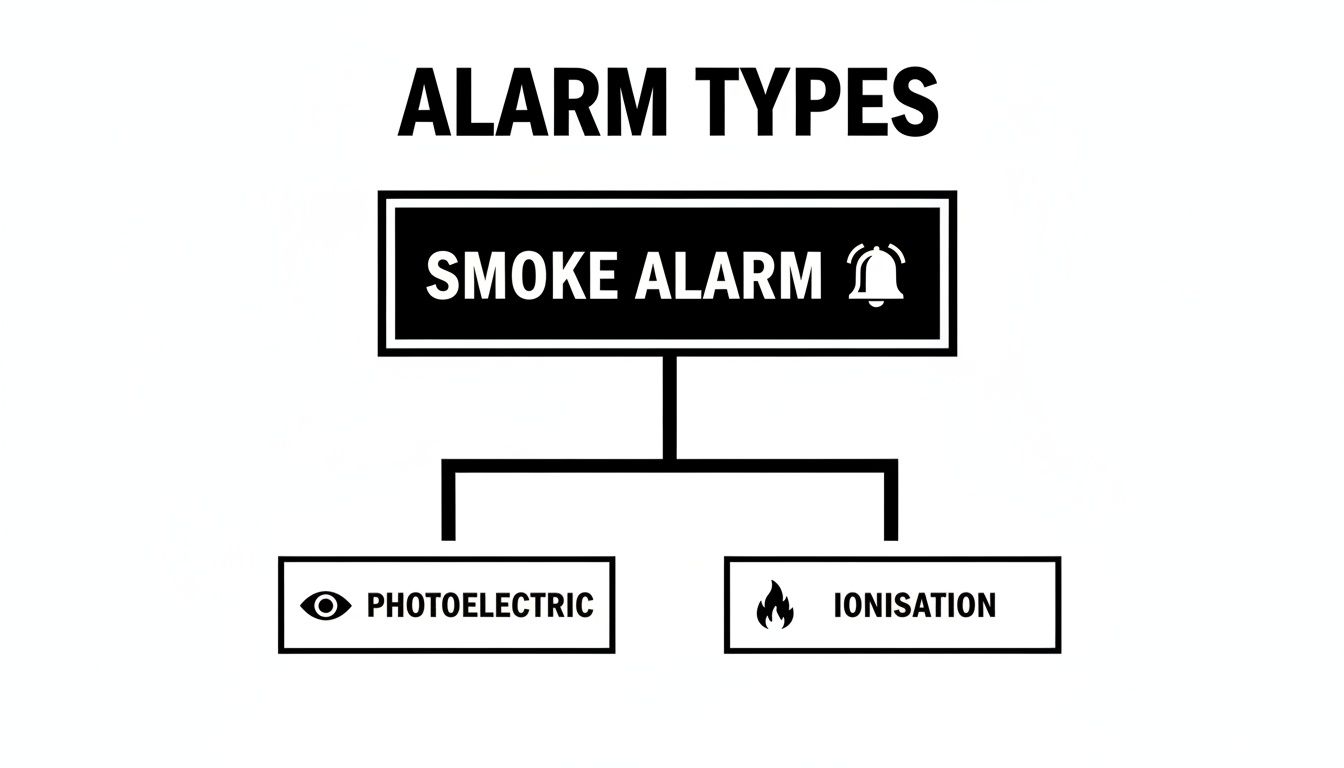
Not all smoke alarms are created equal, and knowing the difference isn’t just about ticking a box for compliance—it’s about choosing the technology most likely to save your family’s life. The two main types you’ll come across are photoelectric and ionisation alarms, and they detect fires in completely different ways.
Think of a photoelectric alarm as an alarm that sees smoke. It uses a small beam of light inside a chamber. When smoke particles from a slow, smouldering fire drift in, they scatter that light onto a sensor, which then triggers the alarm. This design makes them incredibly effective at detecting the most common and dangerous types of house fires, which often produce heaps of thick smoke long before any real flames appear.
On the other hand, an ionisation alarm essentially feels the fire. It uses a tiny amount of radioactive material to create a constant electrical current. When tiny, invisible particles from a fast-flaming fire enter the chamber, they disrupt this current, setting off the alarm.
While ionisation alarms have their place, they are notoriously slow to react to the smouldering fires that often start in furnishings or faulty wiring. This is a critical flaw, because early warning is everything.
It’s for this very reason that Australian fire authorities and state legislation now mandate the use of photoelectric smoke alarms. They simply give you and your family the most time to get out safely.
The golden rule of fire safety is catching it early. Photoelectric technology is proven to be far better at detecting the first signs of smoke, providing those crucial extra minutes to escape before a fire takes hold.
This isn’t just a friendly suggestion; it’s a life-saving standard written into law. If your home is still fitted with ionisation alarms, they are considered obsolete and don’t meet the protection levels required today.
To make the difference crystal clear, here’s a quick comparison:
| Feature | Photoelectric Alarms | Ionisation Alarms |
|---|---|---|
| Detection Method | Senses visible smoke particles by scattering light. | Senses invisible combustion particles by disrupting an electrical current. |
| Best For | Slow, smouldering fires (e.g., from furniture, bedding, electrical faults). | Fast-flaming, clean-burning fires (e.g., a grease fire in the kitchen). |
| Response Time | Responds much faster to the most common types of house fires. | Can be slow to respond to smouldering fires, providing less warning. |
| Nuisance Alarms | Less likely to be triggered by cooking fumes or steam. | Prone to false alarms from burnt toast or steam. |
| Legislation | Mandated by law across all Australian states and territories. | Not compliant with current Australian building codes for residential homes. |
The verdict is in: for home safety in Australia, photoelectric is the only way to go. It’s the technology trusted by experts to provide the earliest possible warning.
Once you’ve settled on photoelectric technology, the next big decision is how your alarms are powered. Your choice is between battery-only units and alarms that are hardwired into your home’s electrical system.
A battery-only alarm is a standalone device. It relies completely on the battery inside it, which means if that battery goes flat, you have no protection at all. We’ve all been guilty of forgetting to change a battery, and in this case, it could have devastating consequences.
A hardwired alarm is connected directly to your home’s 240V mains power, giving it a constant, reliable source of energy. It also has a backup battery (either a standard replaceable one or a sealed 10-year lithium unit) that takes over instantly if the power goes out.
This dual-power system is what makes hardwired alarms so incredibly dependable. You don’t have to worry about a dead battery silently leaving your family vulnerable. If you want to dive deeper, have a read of our guide explaining why wired smoke alarms are the gold standard for home safety.
The tragic reality of failing to upgrade was highlighted by fire statistics in Victoria in 2020, which saw a shocking spike in preventable deaths from house fires. In half of these fatal incidents, there was no working smoke alarm. Even more concerning, only 15% of homes surveyed had the interconnected systems that are now mandatory. The full official report on this fatal fire threat makes for sobering reading, showing that most of these fires started at night.
This is exactly why modern laws, particularly here in Queensland, demand both photoelectric technology and interconnected, hardwired systems. It’s about creating the strongest possible safety net to protect what matters most.
So, you’ve bought the right type of smoke alarm. That’s a great first step, but it’s only half the battle won. The best photoelectric alarm in the world is useless if it’s installed in a dead spot where smoke can’t reach it.
Proper placement isn’t just a friendly suggestion—it’s a critical factor that determines how quickly you’re alerted to a fire, and it’s strictly dictated by Australian law.
Think of smoke like water filling a room, but in reverse. It rises to the ceiling first and spreads outwards. Placing an alarm in the right location ensures it’s in the direct path of that initial smoke, giving you and your family the earliest possible warning.
This diagram breaks down the two main smoke alarm technologies. You’ll quickly see why Australian standards now favour photoelectric alarms for their ability to ‘see’ the smouldering smoke typical of house fires.
To meet Australian Standards and ensure your alarms actually work when you need them most, they must be installed according to very specific guidelines. The main goal here is to avoid ‘dead air’ spaces—these are pockets of air where smoke gets trapped or delayed, preventing it from reaching the alarm’s sensor.
Here are the non-negotiable placement rules every home must follow:
An incorrectly placed alarm is dangerously slow. A sensor tucked into a corner or too close to a ceiling fan might not go off until a fire is well-established, robbing your family of precious seconds to escape.
If a ceiling installation just isn’t possible, an alarm can be mounted on a wall. But it has to be positioned between 30cm and 50cm down from the ceiling to make sure it’s high enough to catch that rising smoke early.
Beyond the specific placement on a ceiling or wall, the legislation—especially here in Queensland—mandates exactly where alarms must be located throughout your home to create a complete safety net.
Your home is required to have smoke alarms installed in these specific locations:
This strategic layout ensures that no matter where a fire starts, an alarm is nearby to detect it. And thanks to interconnection, when one goes off, they all go off.
When it comes to hardwired smoke alarms, this is absolutely not a DIY job. Australian law is crystal clear: any electrical work that involves connecting to your home’s 240V mains power must be performed by a licensed electrician.
Trying to install a hardwired alarm yourself is not only illegal and incredibly dangerous, but it can also void your home insurance policy in a heartbeat. A licensed sparkie ensures the system is safely wired into your home’s circuitry, works correctly, and meets every single legal compliance standard.
For homeowners in Brisbane, trusting a professional from DLG Electrical guarantees your smoke alarm installation is done right the first time, giving you complete peace of mind.
Having a fully compliant, interconnected smoke alarm system is a massive step towards protecting your home and family. But here’s the thing: an alarm is only as good as its last test. If it’s not working on the one day you need it, it’s just a piece of plastic on the ceiling.
Regular maintenance isn’t some complicated chore reserved for electricians. It’s a simple, life-saving habit that ensures your alarms are always ready to do their job. Think of it like checking the oil in your car—you don’t wait for the engine to seize up to realise there’s a problem. A quick, regular check-up prevents disaster, and the same logic applies to your home’s most critical safety devices.
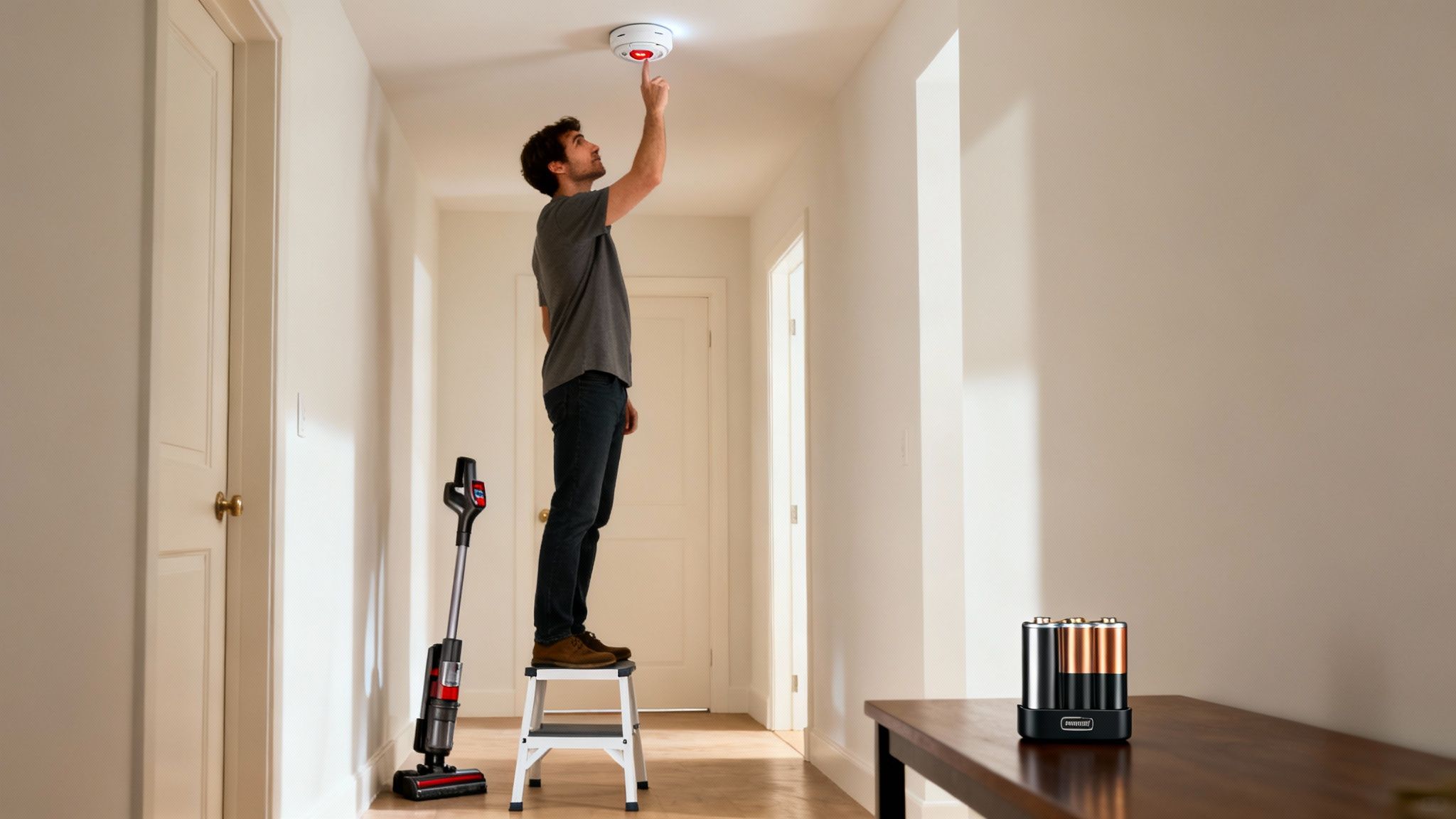
Keeping your smoke alarms in top shape is surprisingly straightforward. By breaking it down into a simple rhythm of monthly, quarterly, and yearly tasks, you can turn maintenance from a forgotten job into a simple, repeatable routine.
Here’s a simple schedule to lock in:
An Australian study uncovered a pretty worrying gap between owning alarms and actually looking after them. While 95.4% of households have alarms installed, about one in three people never test them. Even more concerning, for the older battery-only units still out there, up to 20% of people admit to never changing the batteries, a habit that directly leads to alarm failure in a real fire.
If you only remember one thing from this guide, make it this: every smoke alarm must be replaced 10 years after its manufacture date. This isn’t a friendly suggestion; it’s a non-negotiable safety standard right across Australia. You’ll find the manufacture or expiry date printed on the alarm unit itself.
Over a decade, the internal sensors that do the crucial job of detecting smoke degrade and lose their sensitivity. Even if the test button still beeps loudly and the battery is brand new, an expired alarm simply cannot be trusted to detect a fire when it counts.
An alarm that’s yellowed, faded, or over 10 years old gives a false—and incredibly dangerous—sense of security. Tossing it out and getting a new one is the only way to be sure your home is properly protected.
We’ve all been there. You’re searing a steak or just making toast, and suddenly the smoke alarm is screaming bloody murder. That urge to rip it off the ceiling or pull the battery out is strong, but it’s one of the riskiest things you can do.
Instead of disabling it, here’s what to do:
For a more detailed walkthrough, check out our guide on how to test a smoke alarm and properly manage its functions. This simple routine is all it takes to ensure your network of smoke alarms australia provides reliable, life-saving protection year after year.
Here’s the rewritten section, crafted to sound like an experienced human expert in line with the provided examples and requirements.
Let’s be honest, navigating the smoke alarm regulations in Queensland can feel like wading through mud. The rules are dense, the deadlines are non-negotiable, and the consequences of getting it wrong are serious. Knowing why you need to do something is one thing, but actually putting it all into practice is what keeps your property and the people inside it safe.
This is exactly where bringing in a professional makes all the difference. It turns a stressful legal headache into a simple guarantee of safety. For homeowners and landlords across Brisbane, you don’t have to figure this out alone. At DLG Electrical, we take the guesswork completely out of the equation.
Our team of licensed Brisbane electricians lives and breathes this stuff. We specialise in making sure local properties aren’t just ticking a box for compliance, but are genuinely safe. We’ve built our name on a clear, straightforward process that gives you total confidence in your home’s fire safety system.
Getting your property up to scratch shouldn’t be complicated. Our service is designed to handle every single detail, from the first look at your property to the final compliance certificate. Nothing gets missed. It’s a complete solution covering every angle of the Queensland legislation.
Here’s a quick look at how we help Brisbane homeowners and landlords:
Trusting a certified professional isn’t just about meeting the legal requirements. It’s about investing in a safety system you know has been installed by an expert and will work without fail when you need it most. That’s real peace of mind.
Whether you’re renovating and need a certified installation, a landlord meeting your legal duties, or a homeowner just wanting to protect your family, DLG Electrical is Brisbane’s trusted expert. With our deep local experience and commitment to safety, we get the job done right—the first time, every time.
Even with all the rules laid out, it’s the real-world questions that pop up most often. We get calls about these things all the time, so let’s tackle some of the most common queries we hear from Brisbane homeowners and landlords.
Think of this as the practical part of the guide, clearing up any lingering confusion so you can be confident your property is safe and compliant.
This is one of the easiest and most important checks you can do. Find any smoke alarm in your home, press the ‘test’ button, and hold it down for a few seconds.
If every alarm in the house starts screaming at once, you’re all set. That’s an interconnected system. But if only the one you’re pressing makes a noise, they are working as standalone units and don’t meet the current standards. In Queensland, an interconnected system is a non-negotiable legal requirement for all new builds and upgrades.
Every single smoke alarm comes with a 10-year lifespan from its date of manufacture. It doesn’t matter if it’s hardwired or battery-powered; after a decade, the internal sensors that do the crucial job of detecting smoke particles start to degrade. They just aren’t as reliable anymore.
You’ll find the manufacture or expiry date printed directly on the alarm itself. If yours is older than 10 years, it’s no longer compliant with Australian Standards and needs to be replaced immediately. It’s a safety-critical deadline.
An expired alarm is a major safety risk, even if it still beeps during a test. The internal components can’t be trusted to detect a real fire in time, giving you a dangerously false sense of security.
That consistent, annoying chirp every minute or so is the universal signal for a low battery. If you have a hardwired alarm, this chirp is telling you its backup battery is flat and needs replacing. Pop a new one in, and that should solve it.
But what if you’ve changed the battery and it still won’t stop chirping? This usually points to a bigger problem. It could be an internal fault, or it might be the alarm’s way of telling you it has hit its 10-year end-of-life. Either way, a persistent chirp is a clear warning sign that needs immediate attention.
As a landlord in Queensland, the buck stops with you when it comes to smoke alarm compliance. This duty can’t be delegated.
You are legally required to:
These aren’t just recommendations; they are binding legal duties. A 2019 survey from Queensland Fire and Emergency Services (QFES) highlighted a worrying gap, finding that only 84% of residents had tested their alarms in the last year. You can read the full QFES survey findings to see just how vital these landlord responsibilities are for keeping tenants safe.
Navigating all these rules doesn’t have to be a headache. The expert team at DLG Electrical offers professional smoke alarm audits, installations, and compliance checks across Brisbane, making sure your property is safe and fully up to standard. Contact us today for a free quote!

Master Electrician with over 30 years of experience. Founded DLG Electrical in 2005 after international project work including electrical installations at Stamford Bridge Stadium, London(Home of Chelsea FC).

Local Electricians that can fix all Electric Hot water Systems.
Motion sensor lights are a versatile addition to any home, offering nu
