83 Jean St, Grange QLD 4051
Mon-Fri 07:30 AM - 04:00 PM - Sat - 8:00 - 12 - Sunday Closed
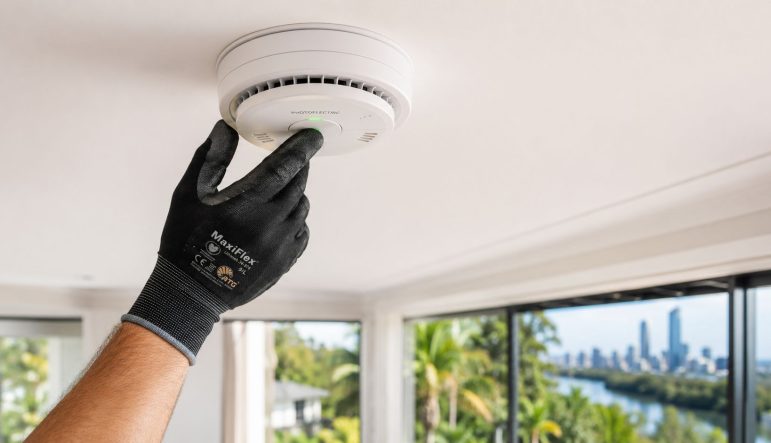
You're probably in one of three spots right now. You've checked the ceiling and found old alarms you haven't thought about in years, you're getting ready to sell or rent a property, or you've heard about the Queensland deadline and aren't sure what applies to your home.
That confusion is common, especially around one point that catches people out. A lot of homeowners assume any new alarm with a sealed battery will do the job. Sometimes it will. Sometimes it won't. If your home already has hardwired alarms, swapping them for battery-only units can leave you non-compliant.
That's the part worth getting right the first time. The rules aren't just about ticking a box for a sale or lease. They're about making sure the alarms in your home detect the type of fire people sleep through, and making sure everyone in the house hears the warning at the same time.
The old smoke alarms in many Queensland homes were ionisation alarms. They were once common, but they're no longer acceptable for residential compliance in Queensland. Under Queensland legislation for domestic smoke alarms, compliant domestic alarms must use photoelectric sensor technology only, meet AS 3786:2014, and contain no ionisation component.
That isn't just legal wording. It reflects how these alarms work in a real house fire.
A simple way to think about it is this. A photoelectric alarm is built to “see” smoke particles. Inside the unit, a light beam and sensor work together so the alarm activates when smoke scatters the light in the sensing chamber. That makes photoelectric alarms faster at detecting smouldering fires, which are common in homes and often involve bedding, upholstery, or furnishings.
Ionisation alarms work differently. They're better at reacting to the tiny particles from a fast-flaming fire, but Queensland doesn't permit them as compliant residential alarms, even if the unit still works.
Practical rule: If the alarm says ionisation, or it's a combination photoelectric and ionisation unit, it doesn't meet Queensland's current residential requirement.
The reason the law moved this way is straightforward. Many house fires don't begin as dramatic flames. They begin as smoke, heat, and a slow burn while people are asleep.
The legal requirement exists because photoelectric alarms give a faster response to smouldering fires in residential settings, according to the Queensland smoke alarm regulation. That matters most at night, when early warning is everything.
Another practical benefit is fewer false assumptions. Homeowners often look at an old alarm and think, “It still beeps when I press test, so it must be fine.” That's not how compliance works. The sensor type matters, not just whether the sounder still operates.
Here's the difference in plain terms:
| Feature | Photoelectric Alarm (QLD Compliant) | Ionisation Alarm (Non-Compliant in QLD) |
|---|---|---|
| Sensor type | Photoelectric only | Ionisation |
| Queensland residential compliance | Yes, if it also meets the other legal requirements | No |
| Response focus | Faster response to smouldering fires | Better response to fast-flaming fires |
| AS 3786:2014 requirement | Required | Not enough on its own if ionisation is present |
| Combination units | Prohibited if they include ionisation | Non-compliant |
In the trade, the best outcomes come from treating smoke alarms as a complete system, not as isolated devices. A compliant photoelectric unit in the wrong house layout, or mixed with old non-compliant alarms, still creates problems.
What works is simple:
What doesn't work is keeping one old alarm because “it still seems okay” or mixing technologies to save money. That's where people end up doing the job twice.
The law has been rolled out in stages, which is one reason people get mixed up. Different homes had to comply at different times, depending on whether they were new, renovated, sold, leased, or owner-occupied.
By 1 January 2027, all existing private homes, townhouses, and units in Queensland must be compliant with mandatory interconnected photoelectric smoke alarm laws, according to this Queensland compliance summary. That's the final stage. It applies to the homes that weren't already captured by the earlier rollout.
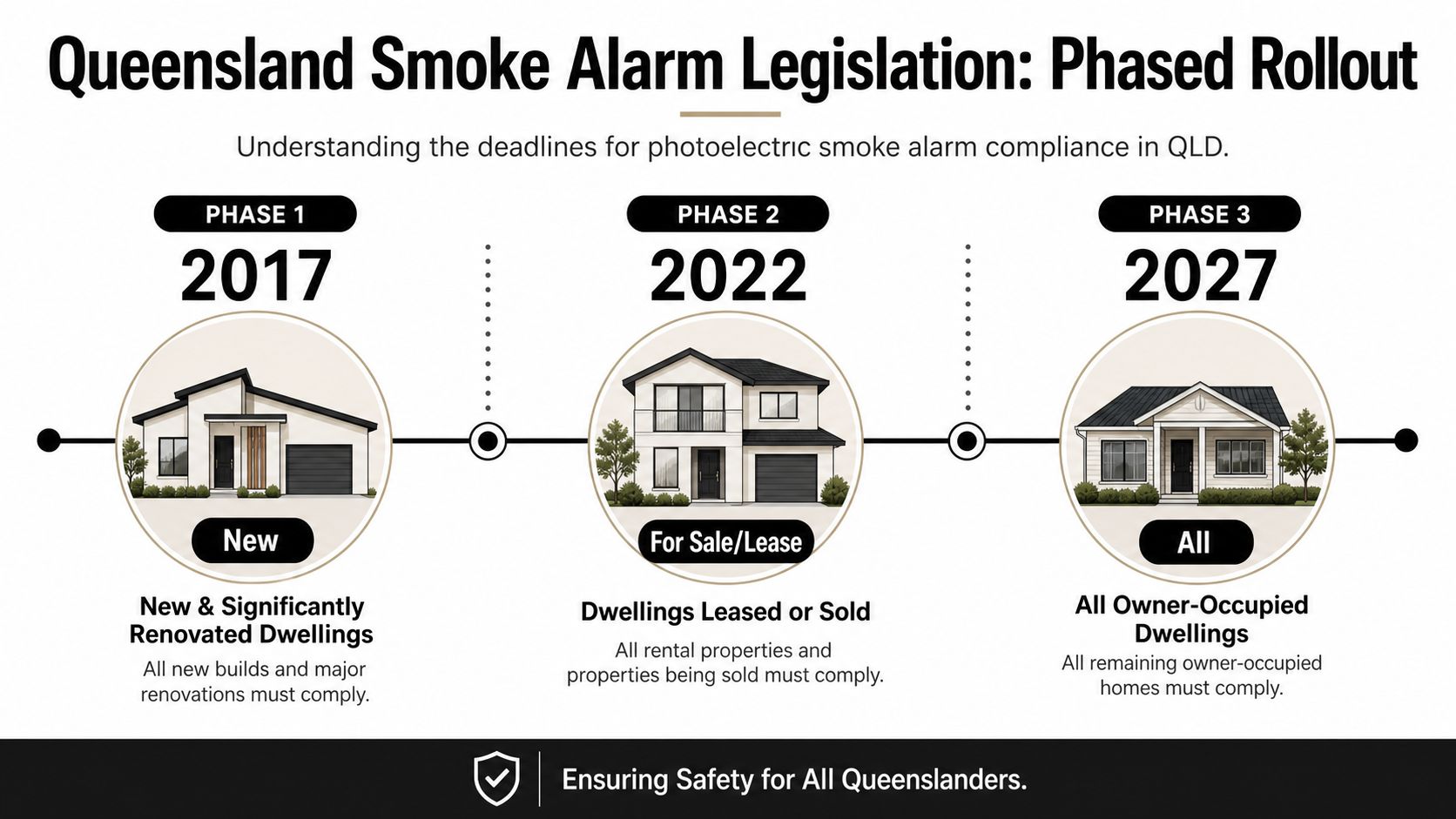
The easiest way to understand it is as a timeline:
2017
New builds and substantially renovated homes had to comply from that stage of the rollout.
1 January 2022
Homes being sold or leased had to meet the newer smoke alarm standard before settlement or lease commencement.
1 January 2027
The remaining owner-occupied dwellings must also comply.
If you want a broader plain-English overview of the rules, DLG has also covered the topic in its guide to smoke detector regulations in Queensland.
A compliant smoke alarm setup in Queensland isn't just “new alarms”. The system must meet several requirements together.
Photoelectric only
The alarms must use a photoelectric sensor and comply with AS 3786:2014.
Interconnected
If one alarm activates, all alarms in the dwelling must sound at the same time.
Approved power source
The alarms must be either hardwired to mains power with backup battery, or powered by a sealed, non-removable 10-year lithium battery.
No replaceable 9V alarms
Alarms that rely on replaceable 9V batteries are non-compliant and need replacement.
Properties sold or leased must already comply
If a property is entering a sale or lease, compliance isn't something to put off until later.
A smoke alarm system only counts as compliant when the sensor type, power source, interconnection, and installation method all line up with the law.
Most compliance failures don't happen because people ignored the law completely. They happen because the owner fixed only one part of the problem.
Common examples include replacing old alarms with standalone units that don't interconnect, leaving a hardwired alarm disconnected in one part of the house, or assuming sealed battery units are automatically acceptable in every property. They aren't.
The cleanest approach is to assess the whole dwelling at once. Check what type of alarms are currently installed, how they're powered, whether they talk to each other, and whether any older units are still on the ceiling. If one part of that chain is wrong, the property can still fail a compliance check.
Many Queensland homeowners commonly make the wrong call.
They hear that sealed 10-year lithium battery alarms are legal, so they buy a set and start swapping out whatever is already on the ceiling. That can be fine in some homes. It can also create a compliance issue straight away.
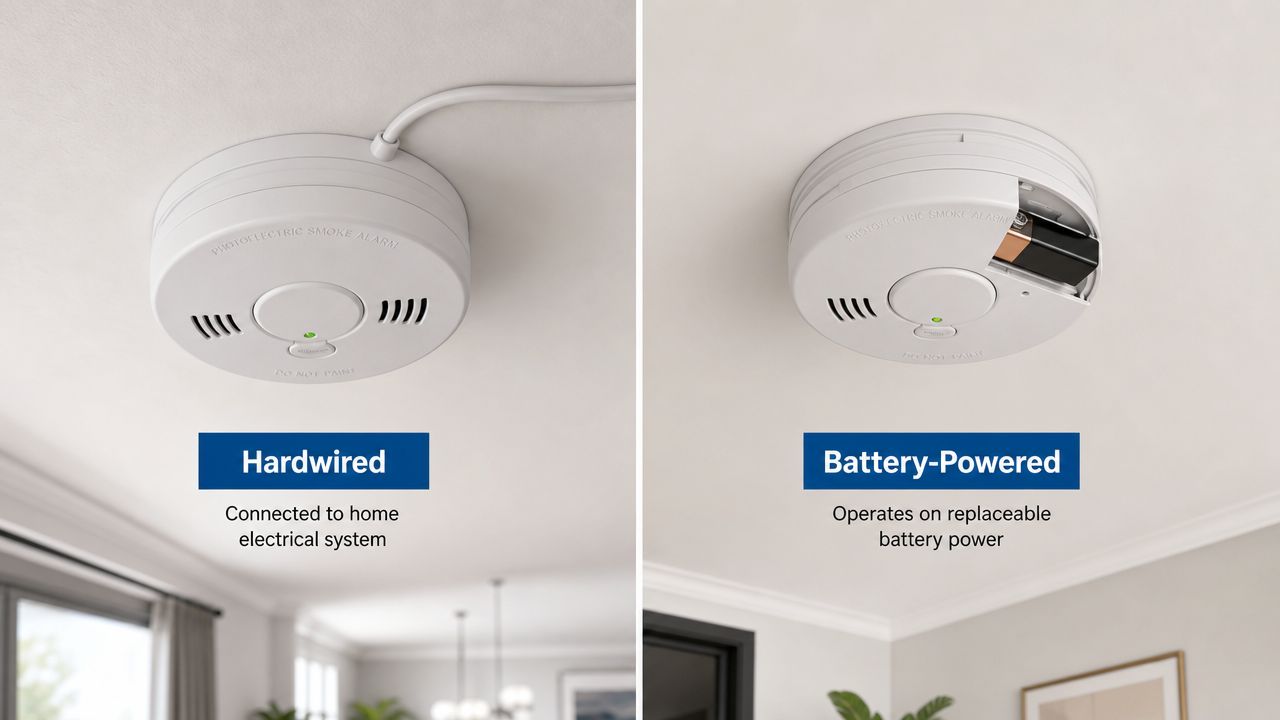
If your property already has pre-existing hardwired smoke alarms, those alarms must be replaced with new hardwired units by a qualified electrician. Homeowners can't legally remove that setup and replace it with battery-only alarms. That point is highlighted in this Queensland smoke alarm compliance discussion, and it's a common reason properties fail pre-sale inspections.
That's the distinction that matters most.
A battery-powered system can be compliant in the right home. But it isn't a universal shortcut.
Battery-powered alarms do have a place. Under Queensland rules, a compliant alarm can be powered by a non-removable 10-year lithium battery. For homes that don't already have a hardwired smoke alarm system, these can be a practical option, provided the units are compliant and interconnected.
That can suit:
Battery units can also be installed without a qualification requirement, unlike hardwired replacements that involve the existing 240-volt system.
If the home already has 240V smoke alarms, the replacement needs to maintain that arrangement. You don't get to downgrade the power source because a battery unit is easier to fit.
From a practical trade point of view, that makes sense. The wiring is already there. The home was set up for a mains-powered alarm system. Replacing like-for-like keeps the installation aligned with the property's electrical setup and avoids the problem of abandoned wiring and patchwork compliance.
If there's already a hardwired base on the ceiling, stop before buying battery alarms. That's the point where you need a proper assessment.
A quick visual explainer helps here:
Use this as a starting point:
| Existing situation | Usually the right path |
|---|---|
| No hardwired alarms in the home | Interconnected 10-year battery photoelectric alarms may be suitable |
| Existing hardwired alarms present | Replace with hardwired compliant alarms |
| Old ionisation hardwired alarms | Remove and replace with compliant hardwired photoelectric alarms |
| Unsure what is on the ceiling | Have an electrician identify the system before buying anything |
What works is checking first, then buying the right gear.
What doesn't work is assuming the packaging at the hardware store tells you whether the alarm suits your house. The product might be compliant in general, but still wrong for your specific installation.
A compliant alarm in the wrong place can give you poor performance when it matters most. Queensland's rules are specific because smoke movement inside a house is affected by ceilings, corners, fans, and air-conditioning.
According to the Queensland Fire Department guidance on smoke alarm placement, you need at least one photoelectric alarm on every storey, inside every bedroom, and in hallways connecting bedrooms to the rest of the dwelling. If there's no hallway, the alarm needs to sit between the bedrooms and the other living areas. If a storey has no bedrooms, an alarm needs to be installed in the likely path of travel to the exit.
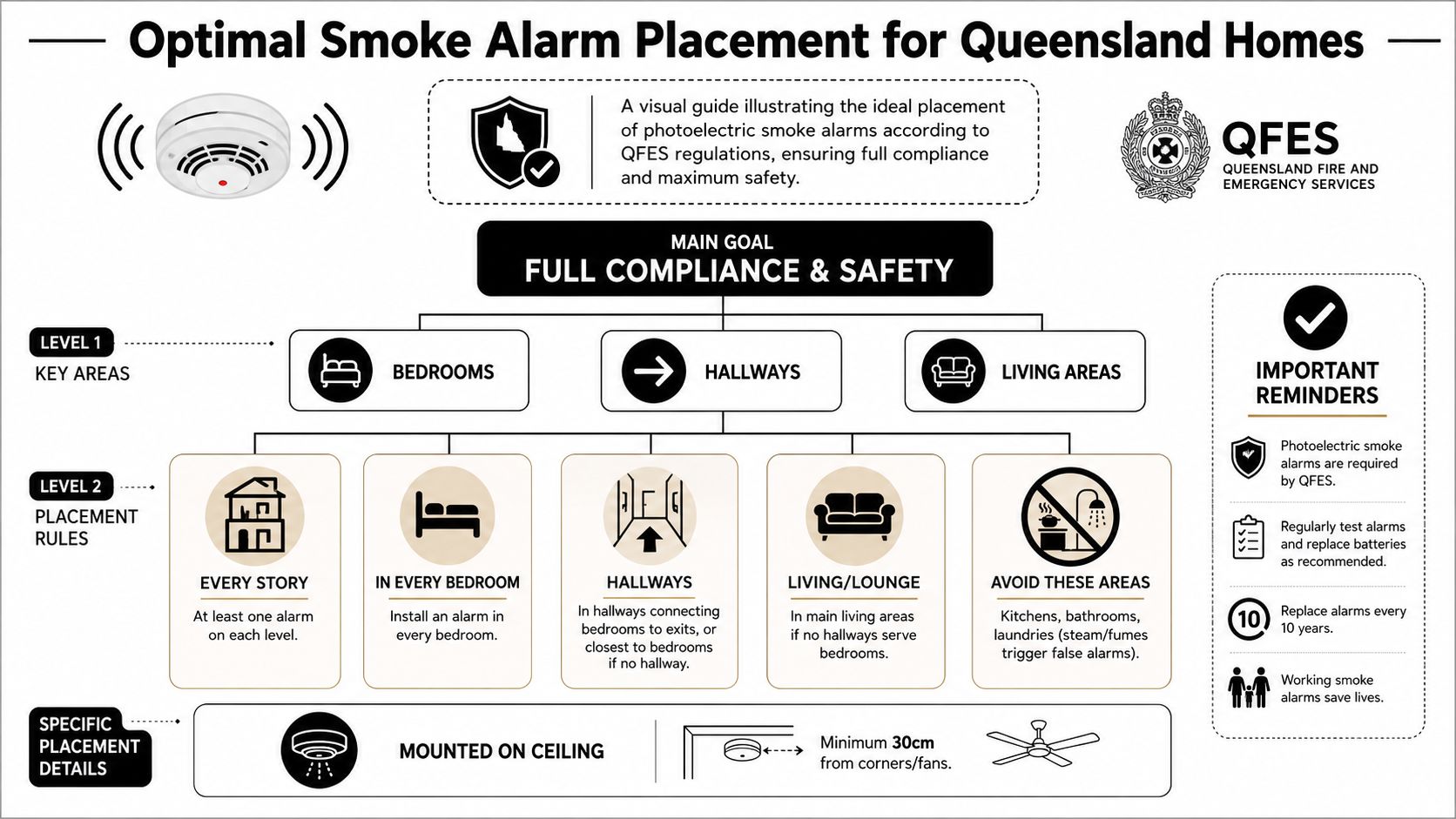
For most homes, think through the floorplan in this order:
Bedrooms first
Every bedroom needs its own alarm. Not one near the bedroom. In the bedroom.
Hallways next
If a hallway connects sleeping areas to the rest of the home, put an alarm there as well.
Each storey after that
Every level needs coverage, even if that level isn't where people sleep.
If your home has an open-plan layout without a hallway, the placement has to reflect the path someone would take from the bedroom area toward the exit. That's where a lot of DIY installs go wrong. People place alarms where they look neat, not where smoke and travel paths make sense.
For a more practical layout guide, DLG also has a page on where to install smoke alarms.
The mounting position matters just as much as the room choice. The Queensland guidance requires alarms to be mounted on the ceiling, at least 300 mm from any wall, corner, or light fitting, and at least 400 mm from air-conditioning vents or ceiling fan blades.
Those clearances aren't arbitrary.
Corners trap dead air
Smoke may not move into the sensor chamber quickly if the alarm is jammed near a wall or corner.
Fans and air-con disturb smoke flow
Moving air can push smoke away from the alarm and delay activation.
Light fittings create placement conflicts
Crowding the alarm beside another ceiling fitting often puts it in the wrong air pocket.
Airflow is one of the biggest practical issues. An alarm can be technically installed, but still badly positioned if a fan or vent keeps smoke away from the sensor.
Before installing or replacing any alarm, stand in the room and look up:
That small check avoids a lot of rework.
The duties are different depending on whether you live in the property or rent it out. That's where owners and landlords often talk past each other. The system may look the same on the ceiling, but the legal responsibility around timing, testing, and lease preparation isn't the same.
For rented and sold homes, the phased compliance rules already applied by 1 January 2022, and landlords must test and clean alarms within 30 days before a new lease starts or is renewed, as set out by WorkSafe Queensland's smoke alarm guidance.
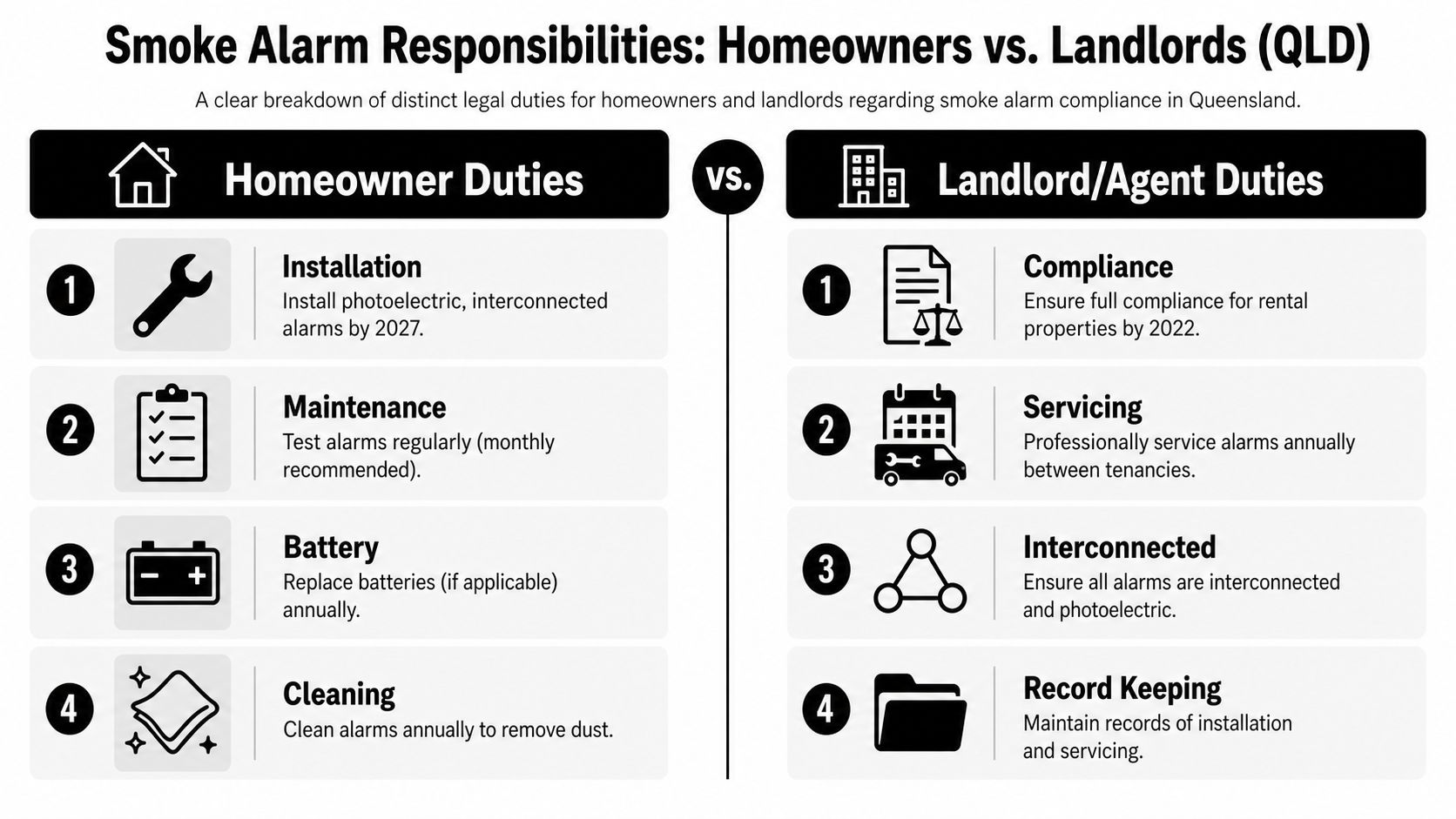
For an owner-occupied home, the big responsibility is making sure the property is fully compliant before the final deadline that applies to that dwelling type. It's easy to push this job down the list because the alarms are out of sight and usually quiet.
In practice, homeowners should also keep an eye on basic upkeep:
The main point is that compliance isn't a one-off purchase. Once the right alarms are installed, they still need to remain operational.
A landlord's duties are tighter because they attach to tenancy events. If the property is leased, the alarms must already be compliant, and the landlord must ensure they are tested and cleaned within the required pre-lease timeframe.
That means landlords need a process, not just a receipt from an old install.
Before a lease starts
Confirm the alarms are compliant, working, and clean.
Before a lease renewal
The same check applies. Don't assume last year's setup is still fine.
When alarms age out
Units older than 10 years from the manufacture date need replacement, even if they still chirp on test.
Rental compliance usually falls over on maintenance records and last-minute assumptions, not on the original install alone.
The cleanest way to manage photoelectric smoke alarms in QLD is to treat them like any other safety system in the property. If you wait until settlement, leasing, or handover week, everything becomes rushed. When owners plan ahead, the job is simpler, the placement can be checked properly, and any hardwired issues can be sorted without pressure.
Smoke alarm compliance looks simple from the floor. Once you get into power type, interconnection, placement, age of the alarms, and whether an existing hardwired system must stay hardwired, it becomes a job where experience matters.
A good Brisbane electrician won't just install new alarms. They'll identify what's already in the home, tell you what can stay and what must go, and explain why. That matters most in older Brisbane properties where the ceiling layout, previous alarm upgrades, and wiring history aren't always straightforward.
Ask direct questions.
If the answers are vague, keep looking.
One local option is DLG Electrical, which handles smoke detector compliance and installation as part of its Brisbane electrical services. For homeowners comparing providers, it also helps to read a practical checklist on finding a trusted electrician in Brisbane.
Brisbane homes vary more than people think. A low-set brick house in the suburbs, an older Queenslander, and a townhouse renovation all present different installation issues. The right electrician will account for ceiling access, fan locations, existing alarm circuits, and whether battery interlinking or hardwired replacement is the correct path.
DLG Electrical is a family-owned Brisbane contractor with over 19 years of experience, fully licensed and insured electricians, and a five-star Google rating, according to the business profile provided for this article. That kind of background matters when you need the job done once, cleanly, and in a way that won't create issues later during a sale, lease, or inspection.
Most expensive smoke alarm mistakes aren't caused by buying a dearer product. They happen when the wrong type of alarm is installed, or when someone replaces hardwired alarms with battery-only units and has to pay for a second round of work.
That's why the better question isn't only “How much per alarm?” It's “Will this setup comply in my home?”
If you're in Grange, Windsor, North Brisbane, or nearby suburbs and you're not sure what you've got on the ceiling, the sensible first step is a proper assessment. Once you know whether the home needs hardwired replacement or a compliant battery interlinked system, the rest becomes straightforward.
If you want a clear answer on what your home needs, contact DLG Electrical for a free, no-obligation quote. We can assess your current alarms, confirm whether your property needs hardwired replacement or a compliant battery system, and help you get your smoke alarm upgrade done safely and correctly.

Master Electrician with over 30 years of experience. Founded DLG Electrical in 2005 after international project work including electrical installations at Stamford Bridge Stadium, London(Home of Chelsea FC).

Local Electricians that can fix all Electric Hot water Systems.
Motion sensor lights are a versatile addition to any home, offering nu
