83 Jean St, Grange QLD 4051
Mon-Fri 07:30 AM - 04:00 PM - Sat - 8:00 - 12 - Sunday Closed
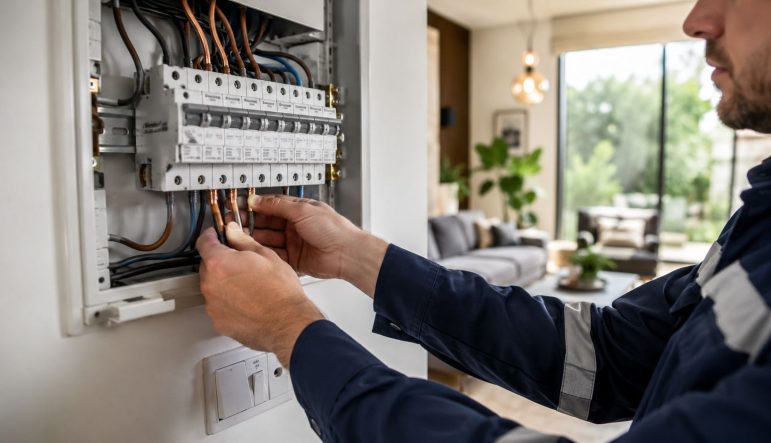
You've probably landed here because your home is trying to tell you something.
Maybe the lights dip when the air con starts. Maybe you've added an EV charger, or you're planning solar, and suddenly the old switchboard doesn't look so harmless anymore. Or maybe you're renovating a Brisbane home and your electrician has said the words “consumer mains” and “service upgrade”, and now you're wondering whether this is a simple tidy-up or a much bigger job.
That confusion is normal. A residential electrical service upgrade sits in that awkward category of home work that homeowners rarely consider until the power starts tripping, the switchboard looks ancient, or a new appliance pushes the system past what it was built to handle.
The other part people don't expect is the downtime. The job itself matters, but so does the disruption around it. If you work from home, have tenants, store food and medication that need refrigeration, or share access with other occupants, the outage can become a major headache. In Brisbane homes, especially older ones being modernised while the family is still living there, that practical side often gets overlooked.
A lot of Brisbane homes were wired for a different era.
They were built when the biggest loads might have been a fridge, a few lights, and maybe a single air conditioner. Now the same house might be running split systems, induction cooking, office equipment, entertainment systems, pool gear, chargers, and plans for solar or an EV. The result is a home that feels fine until two or three bigger loads overlap, then the cracks start to show.
A homeowner in Grange starts with a kitchen renovation. Then they decide to add better lighting, a new oven, and an EV charger in the garage. None of those choices sound extreme on their own. But once the electrician checks the existing switchboard and incoming mains, it becomes clear the electrical system wasn't built for that combination.
That's usually the point where people ask, “Can't we just add one more circuit?”
Sometimes you can. Often you can't. If the switchboard is outdated, the consumer mains are undersized, or the service arrangement doesn't suit the new load, adding more at the edges is like bolting extra shelves onto a wall with failing anchors. The problem isn't the new shelf. It's the structure behind it.
A service upgrade isn't just about getting more power. It's about making the whole entry point of the home safe, compliant, and ready for the way you actually live.
Electrical problems interfere with ordinary routines faster than most home issues. A dripping tap is annoying. A weak electrical supply affects breakfast, showers, internet, work calls, dinner prep, and sleep if the cooling cuts out.
Homeowners usually notice one or more of these patterns first:
In Brisbane, the technical work is only part of the story. The local compliance rules matter, and so does outage planning. If the job includes a switchboard and mains upgrade, you may be without power for much longer than initially anticipated. That can affect tenants, neighbours in some property layouts, and anyone trying to stay productive during the job.
That's why a good upgrade plan doesn't start with “What amp supply do I need?” It starts with a clearer question.
What is this home trying to do now, and what will it need to do next?
A residential electrical service upgrade improves the path electricity takes from the street to the circuits inside your home. It deals with the parts that bring power in, measure it, and distribute it safely.
A simple way to picture it is to compare your electrical supply with a road network. Your appliances are the cars using the road. The switchboard acts like the traffic control point. The consumer mains are the main road feeding the property. If the road into the suburb is too narrow, adding more cars does not fix congestion. The same logic applies to electricity. A larger oven, EV charger, or new air conditioner will not perform properly if the incoming supply or protection equipment is undersized or outdated.
That is why an upgrade can involve more than one component. In some Brisbane homes, the switchboard is the obvious weak point because it still uses older fuse protection. In others, the primary constraint sits earlier in the supply path, such as the consumer mains or the metering setup. If the visible part is upgraded but the supply feeding it is left behind, the result can be disappointing, and sometimes non-compliant.
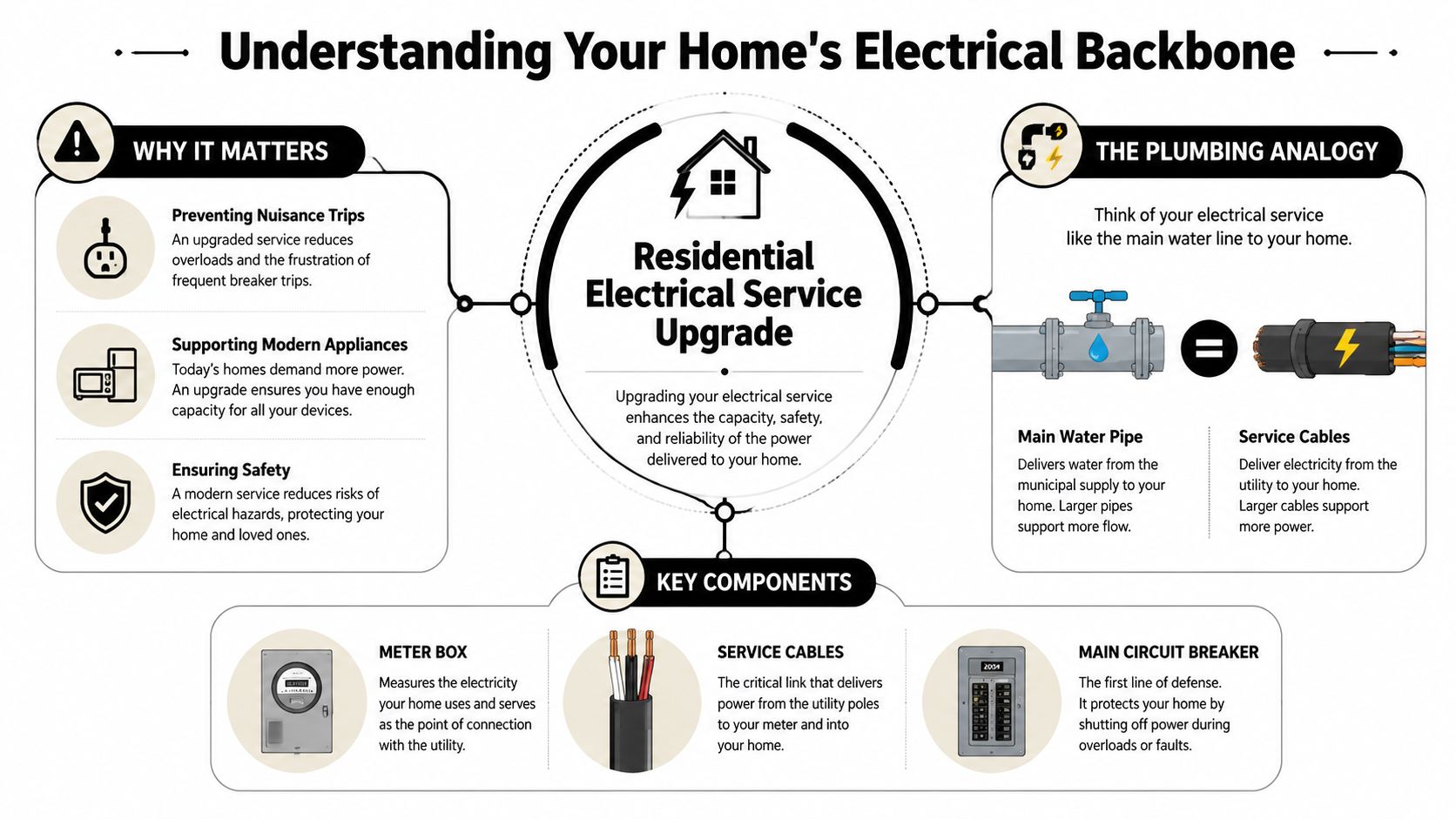
Homeowners often use one phrase for several different jobs. Electricians separate them because each solves a different problem, affects downtime differently, and may trigger different approval steps in Brisbane.
| Work type | What it usually means | Why it matters |
|---|---|---|
| Switchboard upgrade | Replacing old fuses or an outdated board with modern breakers and safety switches | Improves fault protection, circuit control, and layout |
| Consumer mains replacement | Replacing the cable that feeds power from the supply point to the switchboard | Addresses supply limits, ageing insulation, and voltage drop |
| Service increase | Increasing the available supply capacity for higher household demand | Supports larger loads such as ducted air conditioning or EV charging |
If you want to see what board replacement work involves in more detail, this guide to electrical switchboard upgrades explains the switchboard side of the job clearly.
A kitchen renovation might appear to call for a bigger switchboard. An electrician may inspect the home and find the board is only part of the story. The new appliances increase demand, but the consumer mains may also be too small for the load. In that case, treating the switchboard alone is like replacing the taps while leaving the supply line restricted.
This is also where downtime planning starts to matter. A board change on its own may be fairly contained. Work involving mains, metering, or supply coordination can lead to a longer outage window, especially if scheduling with the distributor or meter provider is required. For Brisbane households working from home, storing medication, running a business from the property, or managing tenants, that interruption has a cost beyond the electrician's invoice.
Older homes often still function with ageing equipment, which is why the need for upgrade work can be confusing. "Still working" does not always mean "suited to current demand" or "ready for permitted upgrade work." Once alterations are made, the installation usually has to meet current requirements for the parts being upgraded. In Brisbane, that local compliance step can shape the scope of work just as much as the technical fault itself.
The practical takeaway is simple. A residential electrical service upgrade is not one product. It is a coordinated update to the home's incoming supply and protection system, chosen to suit how the property is used now, how long the outage can be managed, and what Brisbane approval requirements apply to the job.
Most homes don't fail all at once. They give warnings.
The trouble is that many homeowners get used to those warnings and treat them as quirks. A fuse that “always goes when the kettle and toaster are on” starts to feel normal. It isn't. Repeated interruptions usually mean the system is reaching its practical limit, or the protection setup is outdated.
Some signs are obvious. Others are subtle.
A post-war home in Grange may still have an older switchboard arrangement that's been patched over time. A rental in Windsor might technically “work”, but only because the occupants haven't yet added the same appliances an owner-occupier would. Once usage changes, the weak points appear quickly.
That's why older homes often seem fine right up until a renovation begins.
If your electrician keeps finding one more issue every time a new circuit is proposed, that usually means the home needs a bigger rethink at the supply level.
Use this as a practical filter before you call for quotes.
| Symptom at home | What it may mean |
|---|---|
| Breakers or fuses keep operating | The board or supply may be undersized for current demand |
| Lights change brightness under load | The system may be struggling with heavy appliance startup or cable limitations |
| You're adding EV charging or solar equipment | Future demand may exceed what the current service can sensibly support |
| The board looks old and crowded | There may be limited space, outdated protection, or compliance issues |
Replacing a single breaker, splitting a circuit, or tidying a few cables can be worthwhile if the core service is sound. But if the switchboard is old, the mains are borderline, and your plans include bigger electrical loads, piecemeal work often ends up costing more in frustration.
A lot of homeowners want certainty. They don't want to keep guessing whether the next appliance will trigger the next problem. That's often the strongest reason to upgrade.
A proper upgrade does more than stop nuisance trips. It resets the electrical foundation of the house so future work becomes easier, safer, and less compromised.
The biggest mistake homeowners make here is thinking only about today's appliances. In practice, many upgrades are driven by what the home needs next, not what it needed last year.
Data cited in this guide to residential power upgrades notes that 30–40% of Australian homes now face service capacity limits specifically because of future EV charger and solar integration, not current usage. The same source notes that standard 100A services are often insufficient for dual EV charging, requiring 200A+, and that supply upgrades for EV and solar can cost $800–$2,200 when consumer mains are the bottleneck.
That changes how homeowners should think about timing. Waiting until the system fails can leave you redesigning a renovation halfway through.
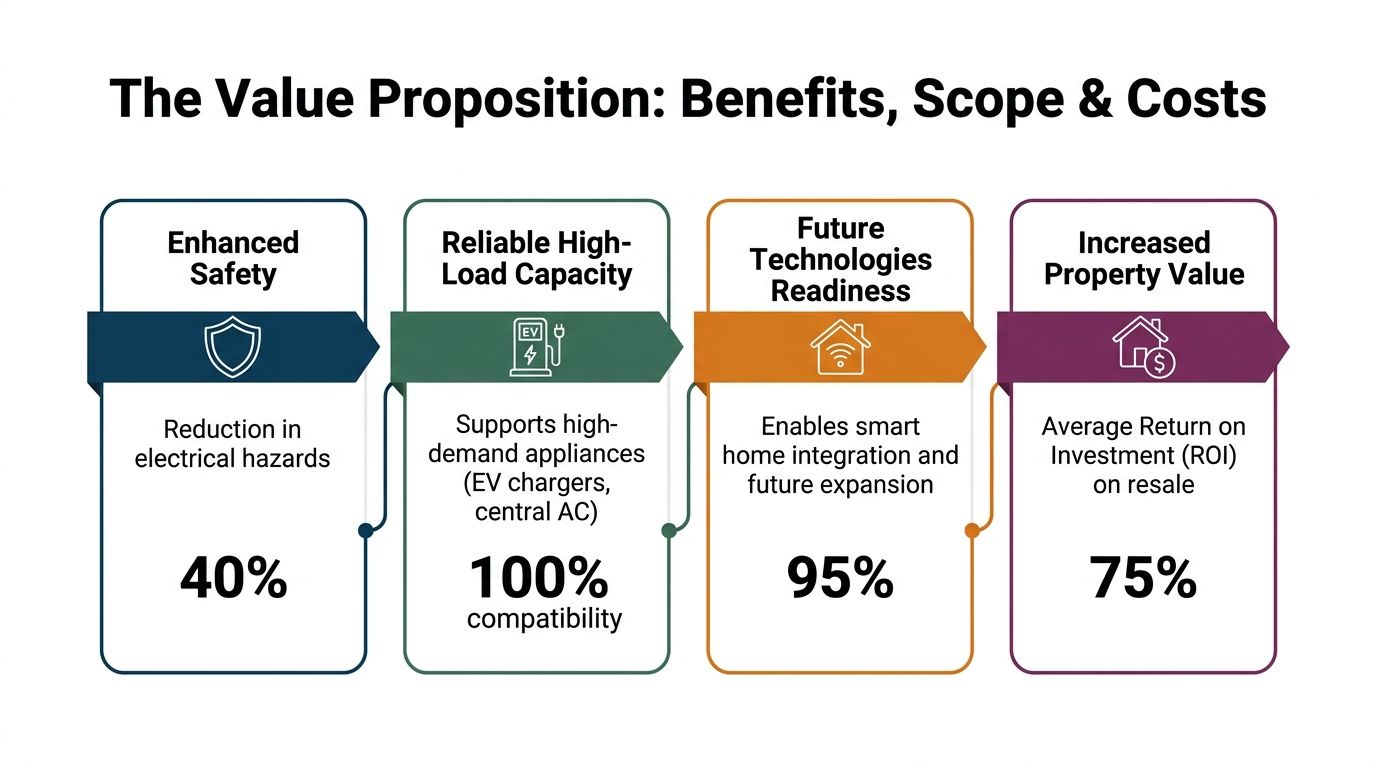
Not every project is identical, but many Brisbane service upgrades involve a combination of the following:
Pricing changes with access, property layout, existing condition, and whether the upgrade is overhead or underground. The biggest swing factors are usually how much of the existing infrastructure can stay and whether the consumer mains are the bottleneck.
Here's the practical way to read a quote:
Practical rule: The right upgrade scope is the one that suits the next stage of the home, not just the current inconvenience.
At this point, many projects slow down.
Homeowners often assume the electrician turns up, swaps the board, and reconnects the power. For service upgrades in Brisbane, there's usually more coordination involved, especially when the job affects the supply connection, metering, or consumer mains.
For service upgrades in Australia, the minimum consumer mains cable size for a single-phase domestic installation is 10 mm² copper for up to 63A, while 16 mm² or 25 mm² copper conductors are required for 125A or 200A upgrades under AS/NZS 3008.1.1 to manage voltage drop and thermal performance, according to the electrical requirements reference used here.
That same reference also notes that utilities such as Energex require a Level 1 electrician to carry out the network connection upgrade, and the metering assembly must suit the upgraded amperage. It also specifies a minimum clear working space of 1,000mm x 600mm x 1,000mm around the switchboard.
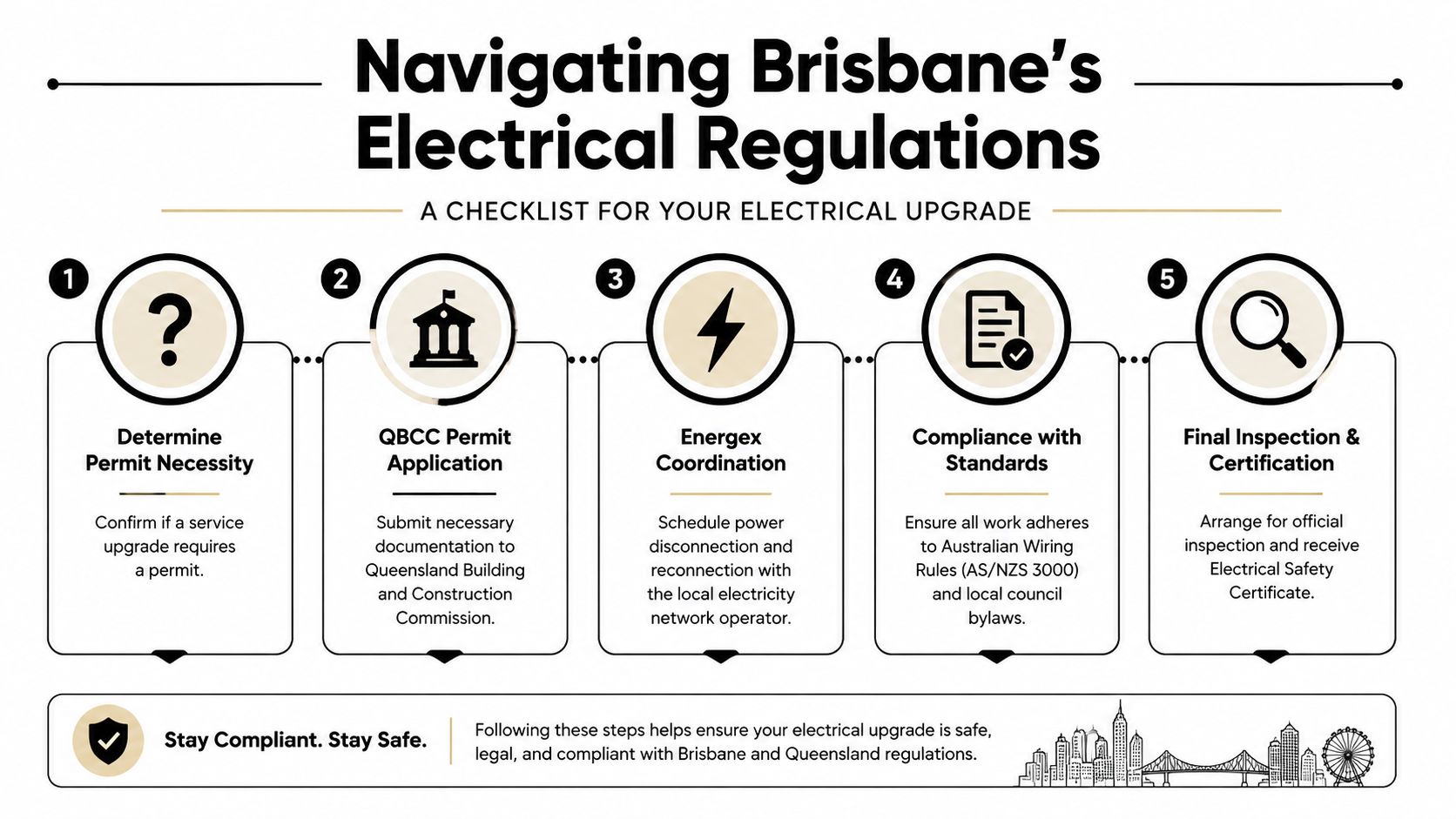
The process typically involves more than one party.
Site assessment by the electrician
They inspect the existing board, mains path, metering location, and access clearances.
Scope confirmation
The electrician works out whether the job is a switchboard-only project or a true service upgrade involving the supply side.
Network coordination
If the connection itself is changing, the work has to be coordinated with the local network operator.
Compliance documentation
The installation must be completed to the applicable standards and certified correctly.
If you're not sure what certificate paperwork means after the job, this explainer on an electrical certificate of compliance helps clarify what you should receive.
The delays usually aren't dramatic, but they are predictable.
A smooth project usually comes down to one thing. The more accurately the electrician defines the supply work at the start, the fewer surprises appear when approvals and isolation are arranged.
Most homeowners feel better once they know the order of events.
A service upgrade sounds disruptive because it is. But when you understand the sequence, it becomes much easier to plan around food storage, work-from-home needs, tenant notice, and access to the switchboard area.
Here's the process in the order it usually happens.
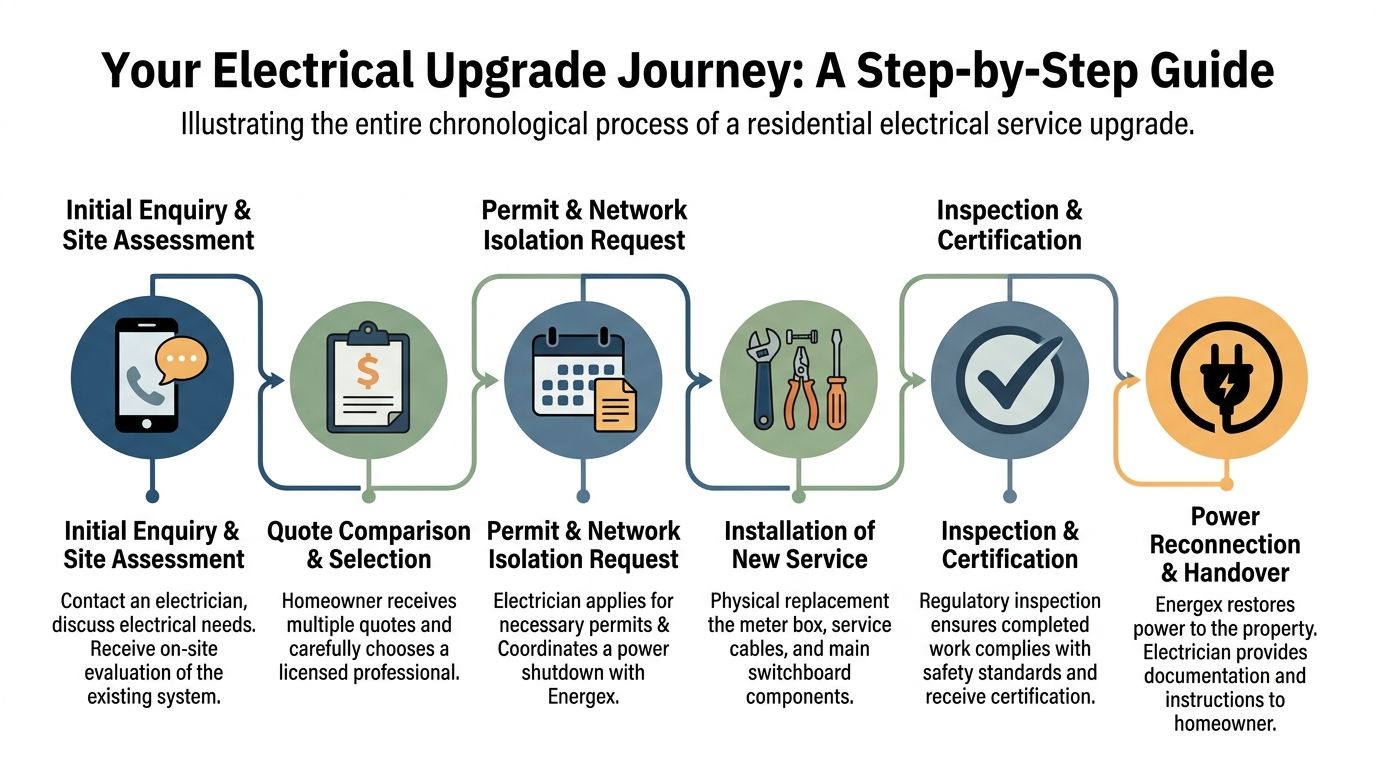
The upgrade usually starts with a site visit. The electrician checks the existing service, asks what loads you want now and later, and confirms whether the limiting factor is the switchboard, the mains, or both.
After that comes the quote stage. During this stage, comparing scope, not just price, is beneficial. Two quotes can describe the same job very differently.
A visual walkthrough can help if you want to see the sort of work involved in practice.
Once the work is approved and the required coordination is done, the power is isolated so the upgrade can proceed safely.
Typical outage windows cited in this consumer mains upgrade guide are 4–6 hours for overhead upgrades and 4–8 hours for underground upgrades. The same source notes that combined switchboard and consumer mains upgrades in Brisbane can extend isolation to 5–10 hours.
That's the part many articles skip, but homeowners feel it immediately.
Power downtime isn't just an inconvenience. It can interrupt remote work, affect refrigeration, delay other trades, and create access issues if tenants or neighbours are involved.
The homeowners who cope best usually do a few simple things beforehand:
After the physical installation, the electrician tests the new work, confirms the protection devices operate correctly, labels circuits, and handles the required certification. Once the supply is restored, they should walk you through the updated board so you know what each circuit controls and how the safety devices are arranged.
A good handover feels simple. That simplicity usually means the planning was done well.
Service upgrades often look finished the moment the new switchboard is on the wall and the lights come back. That is only the visible part.
The part that protects your home sits in the testing, the paperwork, and the electrician's ability to handle Brisbane supply rules without delays. A clean-looking board can still hide missed identification, incomplete verification, or compliance problems that slow final approval. For homeowners, that matters because a failed inspection or missing document can mean extra visits, extra outage time, and extra cost.
A proper handover works like a roadworthy check for your electrical system. The hardware is installed first, then the electrician confirms it is safe to put back into service.
That usually includes testing safety switches, checking circuit identification, confirming protective devices are operating as intended, and making sure the installation matches the approved scope of work. You should also be told what documents you will receive and what they mean. If the explanation is vague, ask for it in plain language.
For background on what inspectors and electricians look for, this guide to an electrical safety inspection is a useful reference.
Start with practical checks, not polished sales wording.
One local option homeowners may consider is DLG Electrical, a Brisbane-based electrical contractor that provides residential services including switchboard upgrades.
Price matters, but it is not the whole job.
A low quote can become an expensive one if it leaves out permit steps, defect corrections, or return visits after an inspection issue. That is where many homeowners get caught. They compare hardware, then discover later they were not comparing coordination, compliance work, or the disruption to the household.
Ask questions like these instead:
| Better question | Why it matters |
|---|---|
| What exactly is being upgraded? | It shows whether the quote covers only the board or the full service path |
| Who handles permits and supply-side coordination? | It reduces confusion about approvals, bookings, and who is responsible if timing slips |
| What outage should I plan for in a normal case and if defects are found? | It helps you plan around work-from-home, refrigeration, tenants, and other trades |
| What testing and certification will I receive at handover? | It confirms the work finishes with the right checks and documents |
The right electrician does more than install new equipment. They help you avoid compliance problems, explain the downtime properly, and leave you with a system that is safe, documented, and easier to live with.
Often, yes. Older Brisbane homes can have layout, access, and existing-material issues that newer homes don't. The upgrade approach may need to respect the home's structure while still bringing the electrical service up to modern expectations.
Sometimes. If the existing switchboard and consumer mains have enough capacity, an electrician may be able to add circuits without a full service upgrade. But if every addition is pushing against a bigger supply limit, adding circuits only delays the necessary fix.
No. A switchboard upgrade updates the control and protection side. A service upgrade can include that, but it may also involve the incoming mains, metering, and supply capacity. That distinction matters when you're planning for future loads.
That's common in Brisbane, and it's where outage planning matters most. If the work requires a long isolation window, organise your day around it. Think about internet access, refrigerated food, garage doors, medical equipment, and any trades who also need power.
Ask how the outage will affect occupants, whether notices need to go out in advance, and whether access arrangements are likely to slow the job. In tenanted properties, communication is often as important as the technical work.
A short list helps:
If you're staying in the house and already planning electrification, future-proofing usually gives a cleaner result. If the home is being prepared for sale or only needs a targeted compliance improvement, the right answer may be narrower. The key is to make that decision deliberately, not accidentally through repeated patch jobs.
If your home is showing signs that the current supply or switchboard can't keep up, DLG Electrical offers free, no-obligation quotes for Brisbane homeowners. Their family-owned team has worked across residential upgrades, maintenance, and compliance for over 19 years, and they're available Monday to Friday from 7:30 AM to 4:00 PM to discuss your project and help you plan the safest path forward.

Master Electrician with over 30 years of experience. Founded DLG Electrical in 2005 after international project work including electrical installations at Stamford Bridge Stadium, London(Home of Chelsea FC).

Local Electricians that can fix all Electric Hot water Systems.
Motion sensor lights are a versatile addition to any home, offering nu
