83 Jean St, Grange QLD 4051
Mon-Fri 07:30 AM - 04:00 PM - Sat - 8:00 - 12 - Sunday Closed
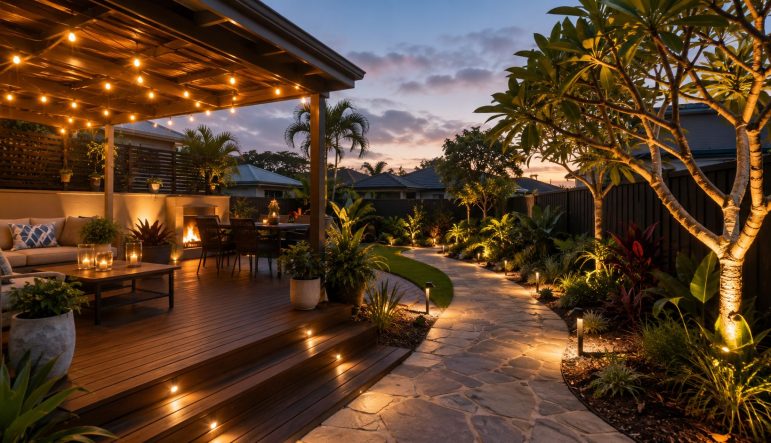
A Brisbane backyard can look fine at 6 pm and still feel unfinished by 8 pm. The kids are still outside, someone's on the patio with a drink, and the side path to the bins is already awkward to use because the only light is the kitchen spillover. That's usually the moment homeowners start looking at garden lighting Brisbane options, and it's also the moment the rules start to matter as much as the look.
Brisbane outdoor lighting isn't just about mood anymore. The city's lighting ordinance summary sets clear deadlines and technical limits that will shape garden designs for years, including 1 March 2029 for existing commercial lighting, 1 March 2034 for existing residential lighting, and 1 March 2039 for streetlights and other City facilities, with outdoor lights needing to be fully shielded, garden fixtures limited to 300 lumens per fixture or 100 lumens per fixture for dynamic lighting, property-line lighting switching off within 10 minutes after motion activation, and colour temperature capped at 3,000 Kelvin or less. Those details turn a simple backyard upgrade into a compliance-sensitive project, not a weekend aesthetic tweak. Outdoorbrite is a useful starting point if you want design ideas before you talk to an electrician, but the smart move is to plan with Brisbane's rules in mind from the outset. For climate-specific context, this guide to Brisbane's subtropical climate is worth a look because weather and lighting choices are tightly linked here.
A warm Brisbane evening changes how people use a house. The alfresco becomes the primary living room, the lawn turns into play space, and the side yard becomes the route everyone keeps taking with drinks, trays, or laundry. If the lighting is poor, people stop using those spaces properly, and if the lighting is too harsh, the yard loses the relaxed feel you wanted in the first place.
That's why garden lighting Brisbane projects are no longer just decorative upgrades. They're part safety improvement, part lifestyle improvement, and part compliance job, because Brisbane's outdoor lighting rules now have real consequences for existing homes and future renovations. The city's ordinance summary makes that clear with the 2029 and 2034 compliance milestones for existing lighting, so any installation done now should be built to last rather than patched later. Brisbane lighting ordinance summary
What catches homeowners out is that outdoor lighting has to do several jobs at once. It needs to help people see steps and paths, support security, highlight the garden, and stay comfortable for neighbours. The best projects treat those jobs separately instead of blasting the whole yard with one bright fitting.
Practical rule: if a light is doing everything, it's usually doing none of it well.
In Brisbane, that means thinking about how the garden looks on a humid summer night, not just how it looks on install day. Queensland weather, leaf litter, and long outdoor evenings all push the design toward fittings that are controlled, shielded, and easy to live with. Good lighting should make the yard feel calmer, not busier.
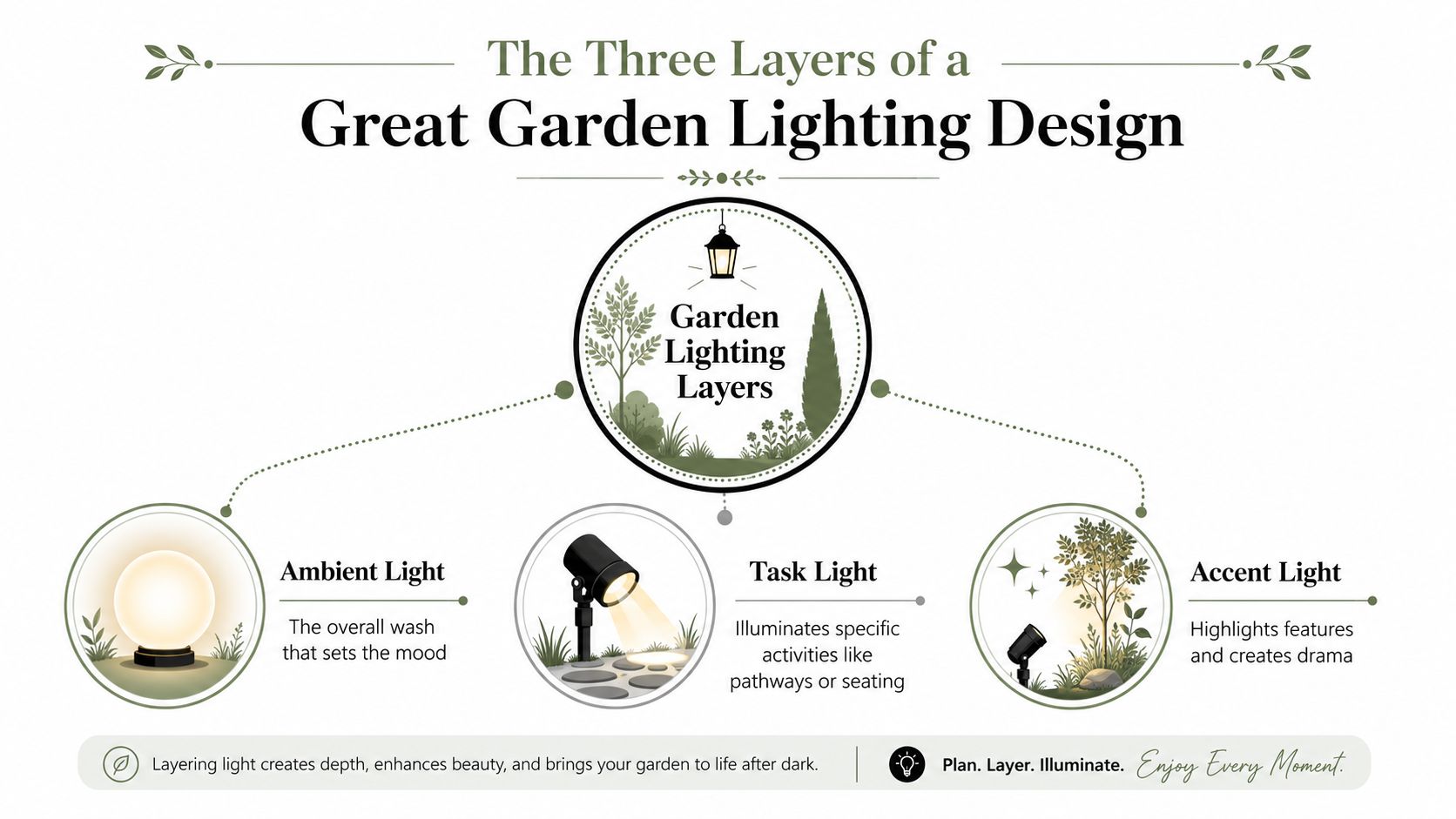
A useful lighting plan starts with three layers, not with fixture shopping. Ambient light gives the space its overall mood, task light helps people move and work safely, and accent light draws attention to the parts of the garden worth noticing. If one layer tries to do another layer's job, the result usually feels flat or overlit.
Ambient light is the soft wash that makes a covered alfresco usable without turning it into an office. In a Brisbane courtyard, that might be a few shielded fittings under the eaves or a gentle wash across a seating zone. The goal is comfort, not brightness for brightness' sake.
Australian garden-lighting advice pushes this same direction, favouring warm white globes, shadow, and staggered lighting instead of lighting every corner evenly. That keeps the garden from looking like a runway and preserves depth in the planting. It also works better for neighbours because the light stays where it belongs.
Task light belongs on the side path, at steps, near the bin run, and at the gate latch. It should be functional first and decorative second. Engineering guidance for garden lighting notes that pathway fittings are typically mounted at 18 to 24 inches so the light is directed downward and glare stays down, which suits Brisbane's low-glare expectations well. Landscape lighting standards for engineers
Accent light is where you make a frangipani, Poinciana, stone wall, or textured fence line stand out. This is the layer people usually overdo, because a strong beam looks impressive for a night or two. The smarter move is restraint, with focused light where there's a feature worth separating from the background.
If you sketch those three layers on paper before you buy anything, the installation gets easier and the result looks more intentional. It also makes compliance simpler, because you're deciding what deserves light rather than lighting everything and hoping it passes.
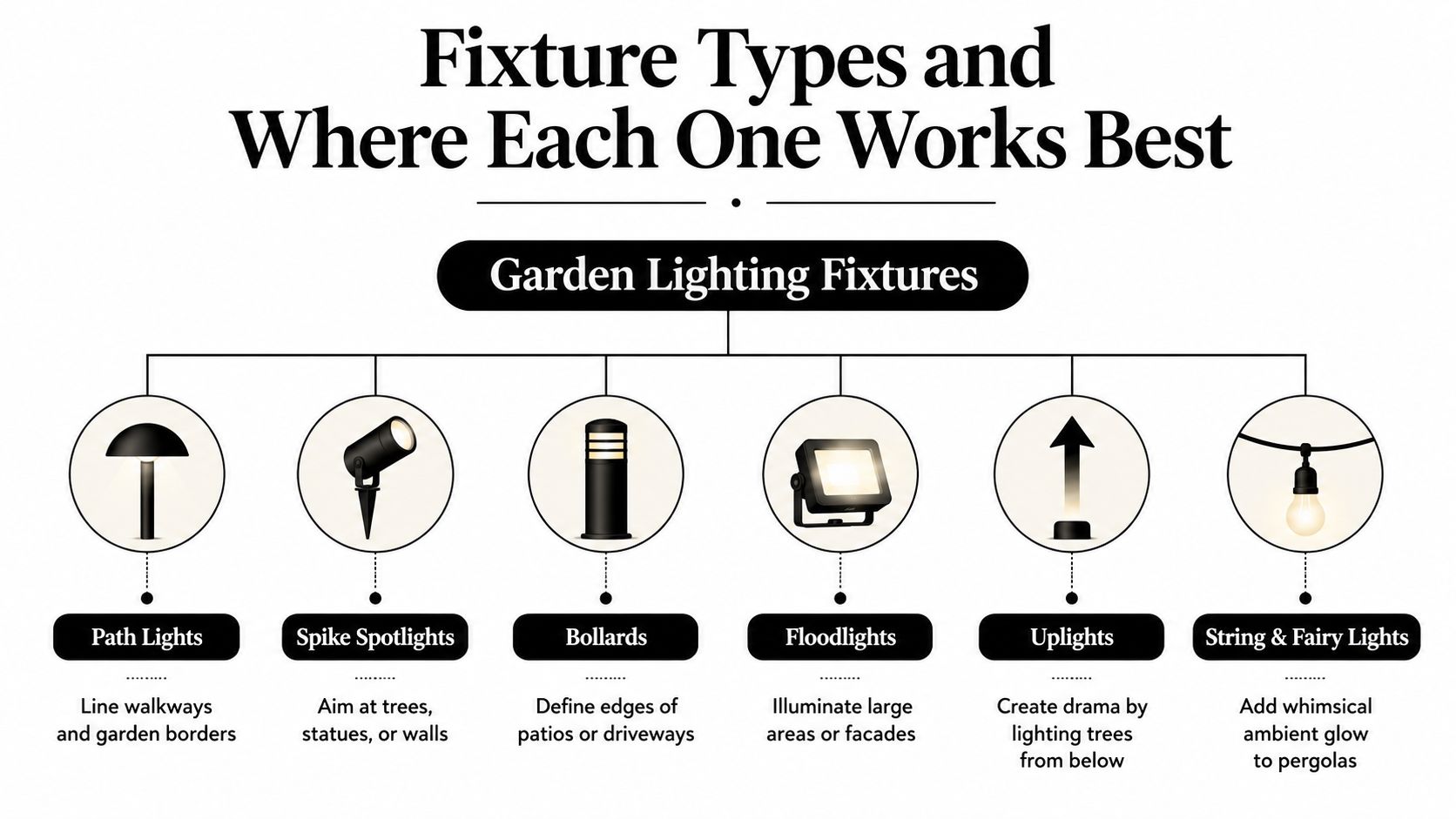
The right fixture depends on the job, not the trend. A small courtyard needs a different mix from a long suburban block with trees, retaining walls, and a side access path. In Brisbane, that choice matters even more because the wrong fitting can spill light where it doesn't belong and create a retrofit headache later.
Path lights are the quiet workhorses of a garden. They line walkways, pick out garden edges, and help guests move without feeling like they're walking through a car park. Bollards do a similar job but suit broader edges, such as the boundary of a driveway or the edge of a patio where a more solid visual marker helps.
Keep low-level lighting low and directional. If it starts throwing light sideways, it's usually too tall, too bright, or both.
Spike spotlights are the flexible option for trees, sculpture, and wall washing. They're useful because they can be repositioned when the garden changes, which it always does. Uplights can look beautiful on trunks and canopies, but they need restraint, because too many of them make the yard feel theatrical instead of calm.
Engineering guidance recommends narrow beams under 30° for accenting trees or architectural features, while wide beams over 60° suit general area illumination. That beam choice matters more than fixture count, especially when you're lighting a feature tree versus trying to spread useful light across a larger zone. Landscape lighting guidance
Floodlights are for broad coverage, usually where visibility matters more than mood. They can work well near side yards or larger service areas, but they're the easiest fittings to make intrusive if they're not shielded or aimed properly. Deck and step lights sit in a different category again, because they should guide movement without announcing themselves.
If you want ideas that lean more decorative, it helps to look at how planting, walls, and pathways are being combined in real outdoor projects. R.E. and Sons Landscaping ideas are useful as a visual reference, even if you're adapting the concept to a Brisbane block.
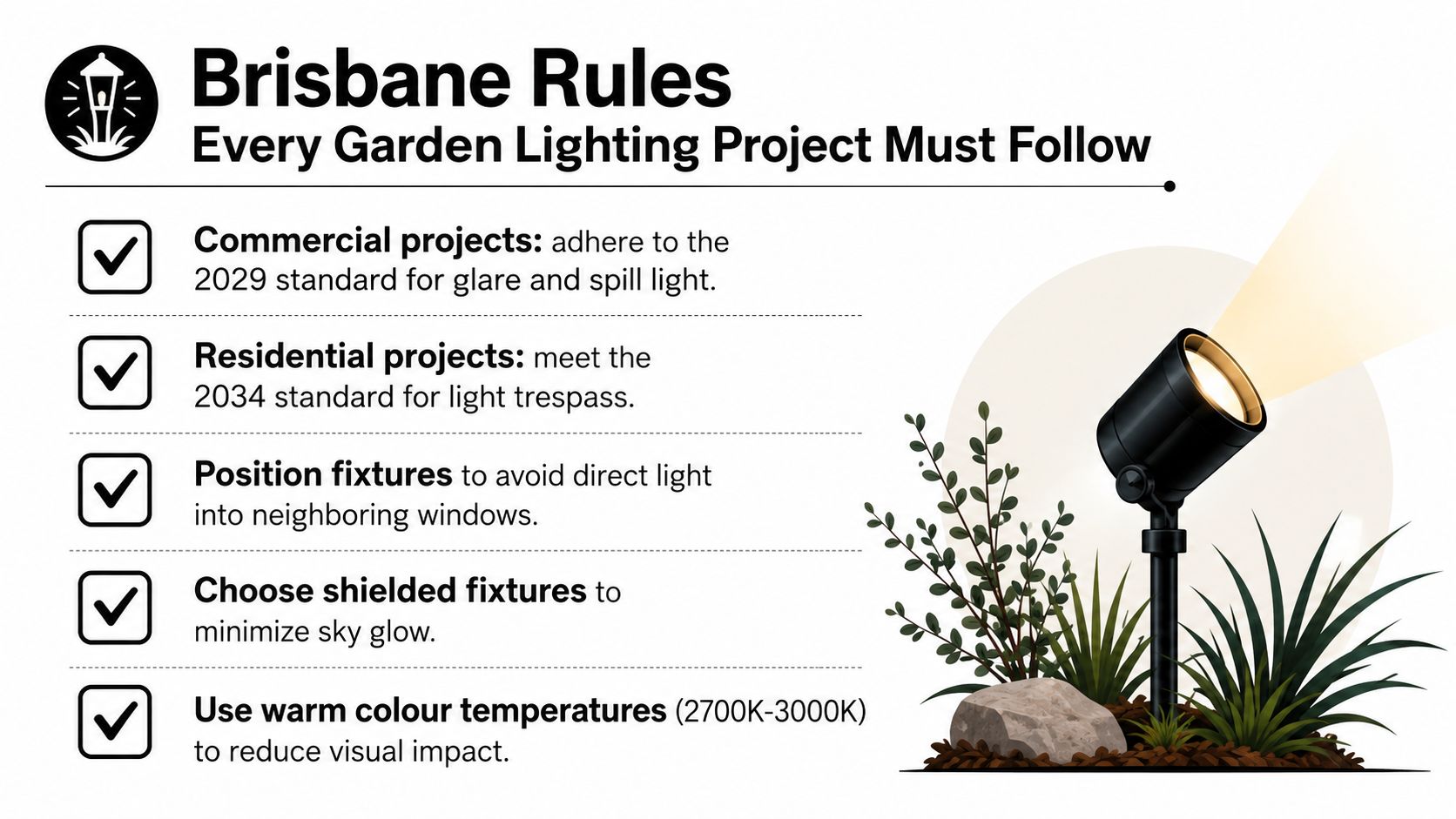
Brisbane's lighting ordinance summary is the part people often skip, and it's the part that can force an expensive rework later. The key dates are straightforward. Existing commercial lighting must comply by 1 March 2029, existing residential lighting by 1 March 2034, and streetlights and other City facilities by 1 March 2039. Brisbane lighting ordinance summary
The technical limits shape your fixture choices from day one. Low-intensity lighting is defined as 300 lumens per fixture, or 100 lumens per fixture for dynamic lighting, so this isn't the place for oversized decorative fittings that flood the yard. The same summary requires outdoor lights to be fully shielded, property-line lighting to switch off within 10 minutes after motion activation, and outdoor light colour temperature to be 3,000 Kelvin or less. Brisbane lighting ordinance summary
That means a warm-white path light makes more sense than a harsh cool-white fitting, and a shielded spike light makes more sense than an exposed globe that throws light into a neighbour's window. It also means motion control isn't just a security add-on, it's part of a compliant edge-lighting strategy.
A Brisbane-ready plan usually does four things well. It keeps fittings downward aimed, keeps colour temperature warm, keeps brightness modest, and avoids light trespass at the boundary. If you do that from the start, the garden still looks good, but the design is more likely to survive an ordinance check or a future inspection without changes.
Australian garden-lighting advice also lines up with this approach, because it warns against over-bright, cool-white lighting that flattens the garden and creates glare. In other words, the compliance direction and the design direction are finally pointing the same way.
A good lighting layout can still fail if the power source doesn't suit the yard. In Brisbane, the three main choices are 240V mains, 12V low-voltage, and solar, and each one has a different sweet spot depending on how much light you need, how shaded the garden is, and how much future expansion you want.
| Power Source | Typical Cost | Best For | Brisbane Climate Fit |
|---|---|---|---|
| 240V mains | Higher install complexity | Bright, permanent feature work and larger runs | Strong where reliability matters, but it needs proper electrical work |
| 12V low-voltage | Moderate, flexible | Courtyards, pathways, and systems you may extend later | Well suited to LED garden systems and easier to add onto |
| Solar | Lowest upfront for small jobs | Simple path markers and spots with full sun | Mixed, because shade and weather reduce consistency |
Mains-fed fixtures give the most reliable output, but they need a licensed electrician and proper circuit protection. Low-voltage systems are easier to expand later and suit LED well, which is why they're often the sensible choice for a garden that may grow over time. Solar is appealing for quick wins, but it struggles when a path sits under trees or when the yard doesn't get enough direct light.
For more background on how solar and battery thinking translates to outdoor electrics, this solar panel and battery guide is a practical reference point. It's especially helpful if you're weighing up whether a solar light is a convenience item or a serious part of the lighting plan.
A small courtyard can cope with a few solar fittings if the goal is gentle navigation. A full landscaping job with uplights, steps, and feature trees usually works better with a wired system that's built to handle the job properly. The rookie mistake is stretching solar lights across a long shaded run and expecting them to behave like mains-powered fixtures.
The first quote usually surprises people for one reason, there's more in the job than the light fittings. Brisbane market pricing gives a useful baseline, with a single security floodlight typically quoted at $200 to $380 installed, garden path lighting sets starting from $650, and full outdoor lighting packages of 6 to 10 lights priced around $1,500 to $3,500 depending on scope. Brisbane garden lighting pricing
That's the visible part. The full budget also needs cabling, a transformer if the system uses one, the electrician's labour, and in some cases an RCD-protected circuit or switchboard work. If the yard has existing irrigation, mature planting, or tight access, the labour side can grow quickly because the electrician has to work around what's already there.
Budgeting rule: don't ask for a fixture price alone. Ask for the complete installed price, including control gear and cabling.
A good quote should make clear whether it includes trenching, whether extra wiring runs are charged separately, and whether the design allows for future additions. It should also say what happens if the switchboard needs an upgrade, because older boards can change the job substantially. When you compare quotes, make sure the same scope is being priced, otherwise the cheapest number is usually the least useful one.
The local market has enough maturity to make pricing meaningful. Brisbane specialists have been working on homes here for years, which suggests the demand is steady and the price bands are established rather than experimental. That helps homeowners budget properly, especially when the lighting is being treated as a safety and compliance upgrade as well as a design feature.
Brisbane weather is hard on outdoor fittings. Heat, humidity, summer storms, and leaf litter all shorten the life of lights that aren't cared for, and even well-installed systems need regular attention to stay reliable. The good news is that the maintenance routine is simple if you stay consistent.
Wipe lenses every few months so dirt doesn't steal output. Clear mulch, palm fronds, and soil away from spike lights, because buried fittings run hotter and are easier to damage. After cyclone season or major storms, check seals, housings, and joins for moisture ingress, especially in bollards and deck lights where water can sit longer than you expect.
The other job is electrical safety. Test the RCD on the lighting circuit as part of your normal home safety routine, and don't ignore a fitting that flickers, trips a breaker, or shows signs of water inside the housing. That's not a cosmetic problem, it's an electrician problem.
For LED life expectations and why some fittings last better than others, this LED light lifespan guide is a sensible read before you buy replacement parts. It helps set realistic expectations around maintenance and replacement.
A few tasks are reasonable DIY work, like replacing a lamp in a safe, accessible fitting or cleaning a solar panel. Anything involving wiring faults, persistent tripping, or water ingress should go straight to a licensed electrician. Outdoor lighting gets expensive only when minor problems are ignored until the whole circuit needs rework.
Garden lighting looks simple from the patio, but the wiring behind it still has to meet Queensland electrical safety rules. That's why the job should always go through a licensed electrician, not a handyman, especially when the system involves mains power, switchboard changes, or anything near wet areas and garden traffic. Insurance and compliance both depend on that being done properly.
A good electrician should give you a licence number, proof of insurance, recent local references, and a written quote that separates fixtures, labour, and any control gear. Ask how they handle weatherproofing, how they approach RCD protection, and what warranty applies to the workmanship. If they can't answer those questions clearly, keep looking.
Some fittings also need compatible accessories to perform well, which is why a product source like deck lighting supplies can be useful as a reference when you're comparing caps, trims, and decorative details. The key is still getting the electrical side right first, then layering the look on top.
A solid Brisbane sparky should also understand local conditions, because a garden light that survives in a dry climate can fail fast in Queensland humidity. DLG Electrical stands out here as a family-owned Brisbane contractor with over 19 years of residential experience, a five-star Google rating, fully licensed and insured electricians, free quotes, and weekday availability from Monday to Friday, 7:30 AM to 4:00 PM. That combination makes the process straightforward, from first call to final test, and it matters when you want the job done once rather than revisited later.
If you're ready to turn a dim, underused yard into a safer and better-looking space, get a proper quote, check the compliance details, and plan the lighting once. A well-designed Brisbane garden lighting system should suit the climate, meet the rules, and still feel good to live with every night. A CTA for DLG Electrical.

Master Electrician with over 30 years of experience. Founded DLG Electrical in 2005 after international project work including electrical installations at Stamford Bridge Stadium, London(Home of Chelsea FC).

Local Electricians that can fix all Electric Hot water Systems.
Motion sensor lights are a versatile addition to any home, offering nu
