83 Jean St, Grange QLD 4051
Mon-Fri 07:30 AM - 04:00 PM - Sat - 8:00 - 12 - Sunday Closed

You're standing at the kitchen bench with two quotes in front of you. One says split system, the other says ducted, and both installers are telling you theirs is the sensible choice for a Brisbane summer. If you've got a humid house, kids moving between rooms, and an electricity bill that already stings, this isn't a brand decision. It's a usage decision.
| Criterion | Split System | Ducted System |
|---|---|---|
| Best use case | One or a few rooms at a time | Whole-home comfort |
| Running cost | Lower when you only cool selected rooms | Higher when you cool the whole house |
| Zoning | Built-in room-by-room control | Strong only if zoning is properly designed |
| Appearance | Visible wall units or compact indoor heads | Mostly hidden, cleaner look |
| Comfort spread | Excellent where you install it, weaker elsewhere | More even across the house |
| Installation fit | Great for renovations, units, bedrooms | Better when the house layout suits ducts |
Brisbane makes the decision sharper than cooler cities do. Long, sticky summers punish poor sizing, and homes that cool the wrong spaces at the wrong time waste money fast. On top of that, Australian households are already feeling the pinch of energy spend, with the ABS reporting that households spent about 11.4% of total household energy expenditure on energy in 2023–24 in Australia, so the stakes aren't small. Electricity costs are also shaped by how well the home avoids cooling load, not just by the box on the wall, which is why the layout and usage pattern matter so much in practice.
A lot of people walk in asking, “Which one is better?” That's the wrong question. The right one is, which system matches the rooms you use, the way your home is built, and what you can live with on the bill?
A Brisbane family gets two quotes after a renovation. One installer pushes ducted air for whole-home comfort. Another suggests split systems for the bedrooms and living area, and the price looks easier to swallow. Both can be the right answer, but only if they suit how the home is used.
Brisbane is not the place to guess and hope. The humidity hangs around, the afternoons stay hot, and bedrooms can still feel sticky well after sunset. A system that misses the mark in this climate does more than underperform. It keeps chewing through power in a way that never really fits the house.
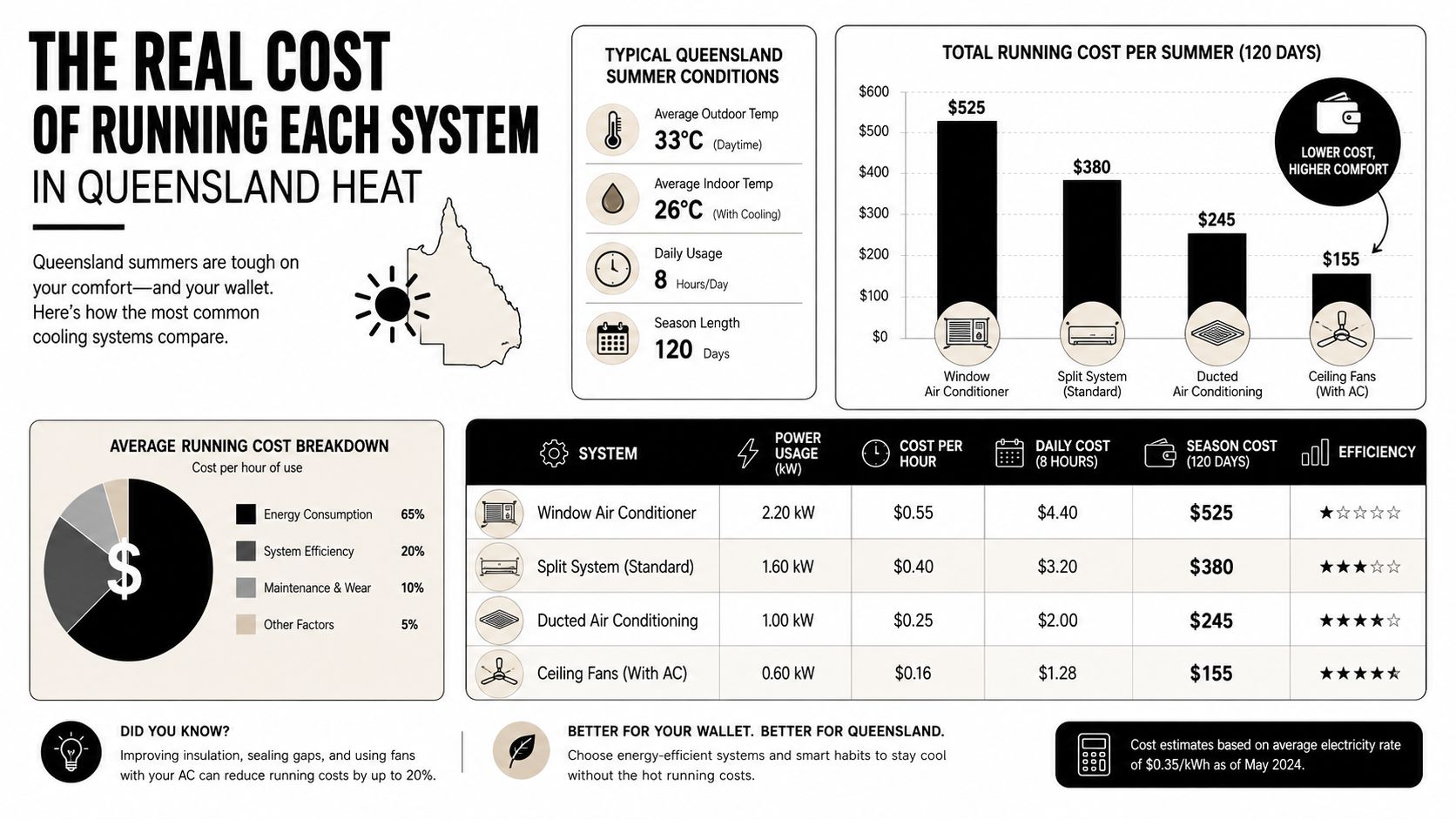
The running cost gap is real. One HVAC guidance source puts a split system at about 0.9 to 1.2 kWh per hour, roughly $0.30 to $0.40 per hour, while a ducted system sits around 3 to 4 kWh per hour, roughly $1.00 to $1.40 per hour under the same source's assumptions. Over a 6-hour-per-day, 90-day cooling period, that source estimates about $216 for split systems versus $720 for ducted when the whole house is being conditioned.
That difference is why Brisbane homeowners should think in zones, not labels. A system that suits a big open-plan house used all day can be a waste in a townhouse where only the main bedroom and living room are cooled most evenings.
Practical rule: If you only cool part of the home most days, do not pay whole-home running costs for no reason.
A lot of people assume ducted is the “proper” choice and split systems are the budget compromise. That is too simple. ActronAir's AU guidance says ducted is generally better for large areas and split systems are better for targeted, room-by-room use (ActronAir comparison). That matches what I see on the tools every week.
If you are renovating a Brisbane home, ask this instead. Which rooms need cooling at the same time, how often, and for how long? Answer that properly, and the right system usually becomes clear.
A lot of quote confusion comes from people not visualising the hardware. If you can picture what sits on the wall, in the roof space, and outside, you'll read the quote more clearly and stop comparing apples with oranges.
A split system has two main parts, an outdoor unit and an indoor unit. The outdoor side holds the compressor and condenser, and the indoor wall-mounted head blows cooled air into one room or one defined area. The two are connected by refrigerant lines and electrical wiring, so the system can move heat out of the house and dump it outdoors.
In practical terms, you'll usually see:
If you want several rooms covered, you can install multiple split heads or use a multi-head arrangement. That's where room-by-room control gets strong, because each area can run only when needed.
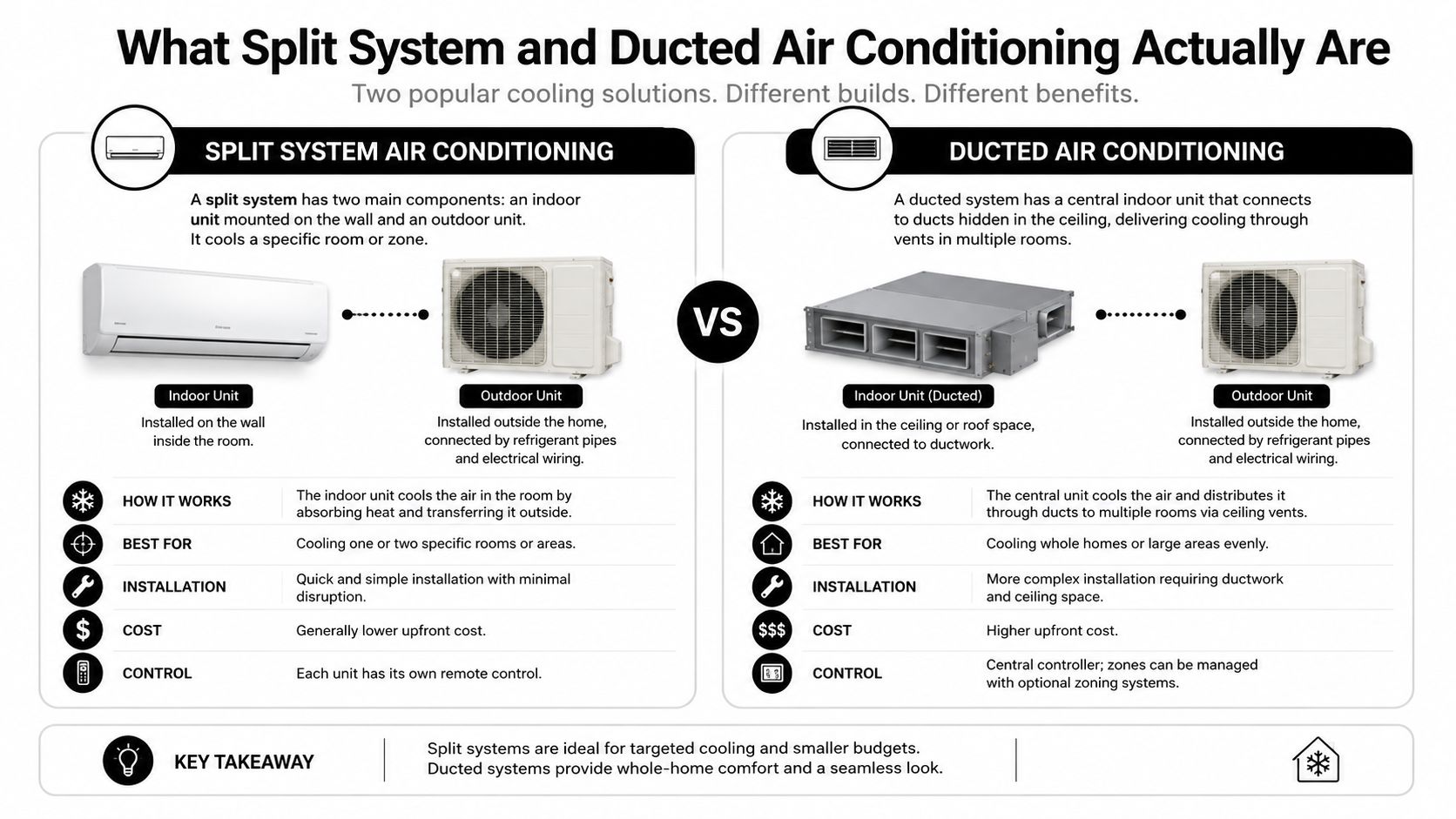
A ducted system hides the indoor unit in the roof space or under the floor, then pushes conditioned air through insulated ducts to ceiling grilles in each room. You'll still have an outdoor compressor outside the house, but the indoor hardware disappears into the building fabric.
What that usually means on site is:
The upside is clean presentation and even distribution. The trade-off is that the system depends heavily on duct design, return air planning, and the way the house is used. If the ducts are badly designed, the whole setup can become expensive comfort theatre.
Split systems usually win on simplicity. If the room layout is straightforward and you only need to cool selected areas, installation is lighter and the job is easier to scope. Ducted systems become more involved because the installer has to deal with roof space access, ducts, grilles, returns, and often switchboard capacity.
That said, a ducted system can make sense in a home that already has the right ceiling void and layout for it. When the house is built to accept ducts, the extra hidden work can be worth it. If the home fights the installation, the quote tends to balloon fast.
For Brisbane homeowners, split systems often pull ahead. The earlier figures show the gap clearly when one room or a few rooms are being cooled. Ducted systems become harder to justify if the family is only using part of the home most days, because you're paying to condition space nobody's in.
Split systems win here. You can cool the bedroom without freezing the lounge, or keep the home office bearable without dragging the whole house into it. Ducted only competes when zoning is designed properly from the start, because otherwise it treats the house as one large climate zone.
Ducted systems usually look cleaner inside. You see grilles, not wall boxes, which suits owners who care about a low-clutter interior. Split systems are more visible, but modern indoor heads are compact and the trade-off is often worth it for the control they give.
Ducted isn't automatically better because it's hidden. Hidden gear can still be the wrong gear for the way you live.
Brisbane bills expose the difference fast. A quote can look reasonable, then the first summer runs the air conditioner hard every night and the running cost tells the truth. A cheaper install is no bargain if you are cooling rooms that sit empty most of the day.
The usual running-cost guides line up with what I see on jobs. A split system typically sits around 0.9 to 1.2 kWh per hour, which the source turns into roughly $0.30 to $0.40 per hour. A ducted system usually lands around 3 to 4 kWh per hour, or about $1.00 to $1.40 per hour. That gap matters once Brisbane humidity drags on and the unit keeps cycling for long stretches (running cost source).
Over the source's 6-hour-per-day, 90-day scenario, the estimate works out to roughly $216 for split systems and $720 for ducted cooling. That does not make ducted a bad choice. It means ducted is paying to condition more rooms, more ductwork, and more load. If you want whole-home comfort, that cost sits inside the deal from the start.
Tariff structure changes the final number. A flat rate, a time-of-use plan, and the way your household runs in the evening can all push the bill up or down. Insulation, ceiling heat gain, and how often you chase colder setpoints do the same thing. A house that leaks heat will make either system work harder.
Roof space heat matters too. If the ceiling cavity is roasting, the air conditioner starts behind before it even reaches the room. That is why Arizona attic heat protection is a useful reminder, because attic heat control changes how hard the cooling system has to work.
For a Brisbane-specific view of usage and operating cost, DLG Electrical's aircon running cost guide is worth reading because it focuses on how people use the system, not just on the label on the box.
The blunt answer is simple. If you cool one bedroom and a living area most nights, ducted is expensive overkill. If you want the whole house comfortable from one control point, the higher running cost is the price of that convenience.
A small two-bedroom unit, a granny flat, or a compact renovation usually suits split systems better. In a tight footprint, a ducted setup can feel oversized, and the roof space often works against you before the job even starts. If only one or two rooms are used daily, a wall-mounted unit or two gives you direct control without paying for hidden distribution you don't need.
That's where a practical sizing approach matters. If you want a rough external reference point for room sizing, the BTU per square foot guide can help you understand how load generally scales with space, but the installer still needs to assess the actual Brisbane house, not a generic chart.
A single-storey family home on a standard Brisbane block is the middle ground. If most rooms are occupied for long stretches, ducted starts to make more sense, especially if the layout is open and the roof cavity can handle the duct run cleanly. But if the family only cools bedrooms at night and the living zone in the evening, a multi-head split arrangement can beat ducted on cost and control.
People get sold a big ducted unit that does more than they need. It looks neat on paper, but if only half the house is conditioned, the running cost follows the bigger system whether you like it or not.
Multi-storey work is where ducted with proper zoning can finally earn its keep. The upstairs and downstairs load differences, stairwell movement, and different room usage patterns can make a whole-home ducted design more practical than hanging wall units everywhere. Even then, ceiling cavity space and return air design decide whether the system will work properly.
A switchboard with enough capacity also matters here, because larger systems can push the electrical infrastructure harder than homeowners expect. If the board is already crowded, or the house is being renovated for electrification, that needs to be sorted before the air conditioning quote gets treated as final.
If the installer hasn't looked at the roof space, the board, and the room layout, they've only half-priced the job.
A good decision takes ten minutes if you've got your floor plan in front of you and you answer. Don't start with brand names. Start with how the house is used.

If you want to know how a proper service mindset looks after installation, see DLG Electrical's split system service page. It's a useful reminder that maintenance matters as much as the install.
A quote that arrives without a site visit is a red flag. So is one that doesn't ask how many people are home during the day, which rooms get shut off, or whether you already have three-phase power. A serious installer should want the layout, the usage pattern, and the electrical limits before they recommend anything.
Air conditioning isn't just a comfort job. In Brisbane, it's an electrical job, and the compliance side matters because a sloppy install can create safety issues, performance issues, or both. Homeowners don't need to become electricians, but they do need to know what paperwork and credentials should exist.
For a start, the installer should be a licensed electrical contractor where electrical work is involved, and refrigerant work needs the right handling licence for fluorinated gases. That matters because air conditioning systems rely on both electrical and refrigerant expertise, not one or the other. If the job includes circuit work, isolators, or a board upgrade, the wiring rules and installation standards apply to the lot.
You should also expect a proper conversation about dedicated circuits, isolators, and whether the existing switchboard can support the new load. Large ducted systems can push older boards too far, and some homes will need a switchboard upgrade before the air conditioner is even connected. Three-phase power can become relevant on bigger ducted jobs, especially where the home already runs a heavy electrical load.
Ask for the installer's licence details and verify them through the Queensland Worksafe channels before the work starts. Don't let a salesperson blur the line between quoting, refrigerant handling, and electrical installation. If the same person can't explain who does what on your property, keep looking.
For a straightforward local overview of the install side, DLG Electrical's air-con installation page is the kind of reference that helps homeowners understand the expected process, especially around wiring and compliance.
When the job is done properly, you should get the right paperwork, the right circuit protection, and an install that doesn't overload the house. That's not a bonus. That's the minimum.
Take your floor plan, mark the rooms you cool most nights, and narrow the field to two or three realistic configurations. Don't ask for “the best system”. Ask for the system that fits your usage pattern, ceiling space, switchboard, and comfort preferences. That's how you stop paying for features you won't use.
A proper on-site assessment should check the roof cavity, the number of zones, the return air path, and whether your electrical setup can take the load without drama. If an installer doesn't ask those questions, they're guessing. In Brisbane, guessing gets expensive fast.
DLG Electrical can provide a free, no-obligation quote and assess the electrical side properly before anything is installed. They work as a local Brisbane electrical contractor, so the quote can account for switchboard capacity, room usage, and the practical fit between split system or ducted options.
If you want a straight answer based on your actual house, not a sales pitch, talk to DLG Electrical and get a Brisbane quote that's built around your needs. Bring your floor plan, tell them which rooms you really use, and let the installer size the job around your home instead of pushing the biggest system on the page.

Master Electrician with over 30 years of experience. Founded DLG Electrical in 2005 after international project work including electrical installations at Stamford Bridge Stadium, London(Home of Chelsea FC).

Local Electricians that can fix all Electric Hot water Systems.
Motion sensor lights are a versatile addition to any home, offering nu
