83 Jean St, Grange QLD 4051
Mon-Fri 07:30 AM - 04:00 PM - Sat - 8:00 - 12 - Sunday Closed

You probably don't think much about the switchboard until something odd happens, a faint burning smell, a breaker that keeps tripping, a light that flickers when the air-con starts. Then you're suddenly choosing between a rushed repair, a worried phone call, and an insurance conversation you wish you'd never needed. In Brisbane, that's exactly why an electrical maintenance plan matters. It turns electrical care from guesswork into a written record of what's been checked, what's due next, and what needs a licensed electrician before it becomes a bigger problem.
Australia's compliance background makes that shift even more important. The national model work health and safety framework introduced in 2011 pushed electrical upkeep into the realm of systematic risk control, not optional good practice, and a written plan now fits the safe-system-of-work thinking that applies to workplaces and rental properties Infraspeak's maintenance statistics and trends overview. For Brisbane homes, that approach also fits the climate. Heat, storms, humidity, and coastal corrosion all punish switchboards, cabling, and protective devices in ways a calendar-only checklist won't catch.
A lot of Brisbane owners only call an electrician after the warning signs get hard to ignore. I've seen homes in suburbs like Grange and Windsor where a small smell at the switchboard was brushed off for weeks, then the kitchen fault that followed turned into a bigger repair and a messy insurance conversation. The electrical issue was only half the problem. The other half was the missing paper trail.
That is why a written maintenance plan matters. The national model work health and safety framework introduced in 2011 reframed electrical upkeep as systematic risk control, not optional good practice. For Brisbane homes and rentals, that approach fits the climate as well. Heat, storms, humidity, and coastal corrosion all punish switchboards, cabling, and protective devices in ways a calendar-only checklist will miss.
A plan changes how you deal with electrical risk. You stop asking, “What broke today?”, and start asking, “Which item is most likely to fail in this property, and what proof do I have that it is still safe?” That is a stronger position with insurers and property managers, especially when the property has older hardware or has been through heavy summer weather.
Practical rule: if you cannot show when something was inspected, tested, or fixed, you are relying on memory, and memory does not hold up well after an incident.
A written plan gives you a running record of switchboard checks, smoke alarm servicing, and corrective action. It also makes patterns easier to spot, such as the same circuit overheating after a new appliance is added. That is where reactive maintenance becomes expensive, because the problem keeps returning and the cause never gets properly recorded.
Queensland properties also need a plan that captures evidence in a way that stands up later. A dated inspection note, a photo of the fault, and a record of the repair help when a property manager asks what happened, or when an insurer wants proof that the issue was handled properly. For a practical local benchmark on what a proper inspection can include, the electrical safety inspection guide is a useful reference for the kinds of issues a Brisbane electrician typically checks during a visit.
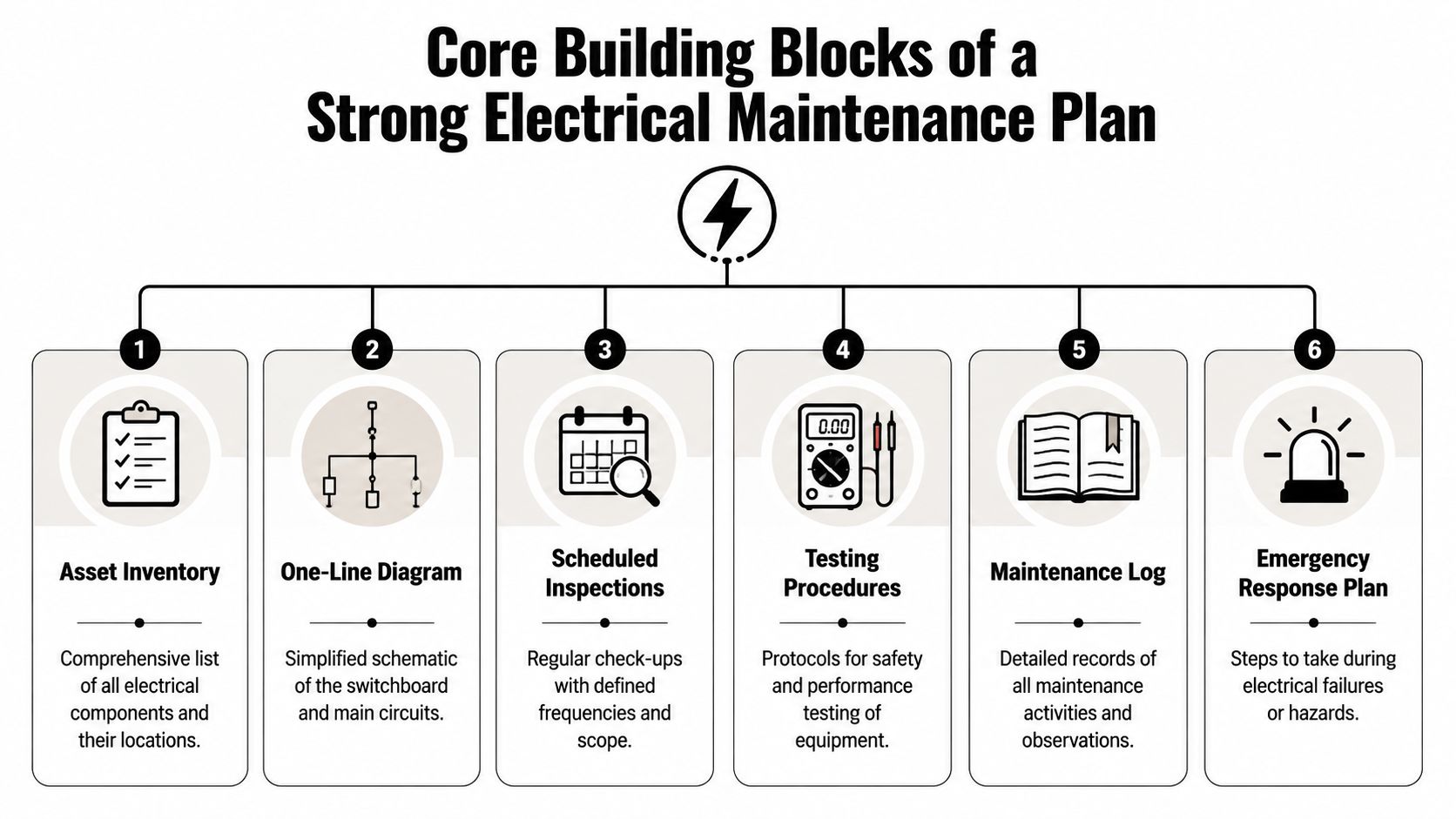
A good plan doesn't need fancy software on day one. It needs six things that hold up when you need proof, not just tidy notes. Start with an asset inventory, then build a one-line diagram, inspection intervals, test results, a corrective action log, and an annual review date.
The asset inventory should list every circuit and major fitting, with location, installation date if known, and any failure history. The one-line diagram should show the switchboard and main circuits in a simplified format, so anyone who inspects the property can trace what feeds what. The inspection intervals should be assigned per asset, not copied from a generic checklist, because the highest-risk items deserve earlier attention.
The test results section is where a lot of homeowners fall short. If there are no baseline readings, you've got no proof of improvement later. That matters when you're trying to show that a recurring fault was tracked, not guessed at. The corrective action log then records what was found, what was done, and what still needs attention. Finally, the annual review date stops the whole document from becoming stale.
No baseline readings means no proof of improvement later.
What to leave out is just as important. Don't clog the plan with vague notes like “checked okay”. Don't bury it under appliance warranties, paint colours, or unrelated home maintenance. Keep it focused on electrical assets, electrical findings, and the actions taken.
If you want a template-style reference for how maintenance programmes can be organised, the guide from Facility Management Insights shows the sort of structure that helps keep records usable instead of decorative. For a home, a spreadsheet and a labelled folder are usually enough, provided the information is complete.
A one-size-fits-all annual checklist sounds neat, but Queensland homes rarely behave that neatly. A townhouse in North Brisbane, a coastal rental, and an older house with ceramic fuses don't carry the same risk profile, so their inspection cycles shouldn't look identical either. The sensible approach is to match the interval to criticality, age, and environment.
Heat and load matter first. Switchboards that run warm in summer, or that feed heavily used air-conditioning circuits, deserve earlier attention than lightly loaded gear. Humidity and salt exposure near the bay can speed up corrosion on enclosures and connections. Rental turnover also changes the game, because smoke alarms, RCDs, and general condition need checking when people move in and out more often.
Older ceramic-fuse boards sit in their own category. They don't just look dated, they usually deserve tighter thermal monitoring and a lower threshold for upgrade because their condition is harder to read at a glance. That's where infrared thermography earns its place on a loaded switchboard, since heat patterns can show stress before a component fails outright.
RCDs need to be treated differently from simple visual checks. The push-button test is a quick functional check, while a timed trip test tells you more about how the device performs under test conditions. Smoke alarms need recorded function checks and attention to expiry dates, not just a glance on the ceiling. For higher-risk or compliance-heavy assets, the point isn't to do more work for its own sake, it's to make the right work happen sooner.
The strongest maintenance plans track inspection date, components involved, results, anomalies, and corrective action. That record-keeping approach mirrors electrical preventive maintenance standards and helps with later trend review UTWIN's electrical maintenance plan guidance.
If you want a practical benchmark for inspection and test tagging, the electrical testing and tagging guide is a useful companion piece for understanding how licensed testing fits into a broader plan.
The easiest way to use a plan is to split it by season and by asset. That keeps you from doing everything at once and forgetting half of it by the next hot spell. It also reflects the way Brisbane weather hits electrical gear, with summer storms, damp shoulder seasons, and long periods of heavy air-con use.
After storm season or heavy rain, check for water ingress near exterior fittings, corrosion around outdoor GPOs, tripped breakers, and any sign of moisture in the switchboard area. Before summer, look at air-conditioner circuits, as heavy load can expose loose connections or weak devices. After rental changeovers, test smoke alarms, confirm RCD operation, and make sure nothing has been damaged by tenant turnover or hurried furniture moves.
A useful rule is to write down what you observed, not just that you “looked at it”. Note heat marks, discolouration, buzzing, cracked outlets, loose cover plates, or external fittings that no longer seal properly. If an item looks wrong, don't keep prodding it. Stop there and call a licensed electrician.
Good habit: if a check needs you to open a switchboard enclosure, it's no longer a homeowner inspection, it's licensed trade work.
For homeowners who also keep an eye on other building systems, the 2026 HVAC checklist template is a useful reminder that electrical upkeep works best when it sits alongside other seasonal maintenance, not apart from it.
| Asset | Routine Check | Full Test | Adjust If |
|---|---|---|---|
| Switchboard | Visual check for heat marks, moisture, loose covers | Thermal or licensed inspection | Home is older, heavily loaded, or near coastal air |
| RCDs | Push-button function check | Timed trip test by electrician | Rental property, recent fault, or frequent tripping |
| Smoke alarms | Test button and clean dust build-up | Compliance-focused service and expiry review | Tenancy change, after renovations, or alarm age is unknown |
| Outdoor GPOs and lighting | Look for cracks, water ingress, corrosion | Licensed inspection if damaged | Storm exposure or coastal conditions |
| Air-con circuits | Watch for nuisance trips and unusual heat | Load-focused electrician check | Summer use is heavy or the circuit has been altered |
| Cabling and visible fittings | Check for damage, loose plates, and exposed wear | Inspection where faults are suspected | Older home or repeated fault history |
Do not treat the checklist as a DIY licence. Replacing a circuit breaker, opening a switchboard, or rewiring damaged fittings belongs with a licensed electrician, not a weekend attempt.
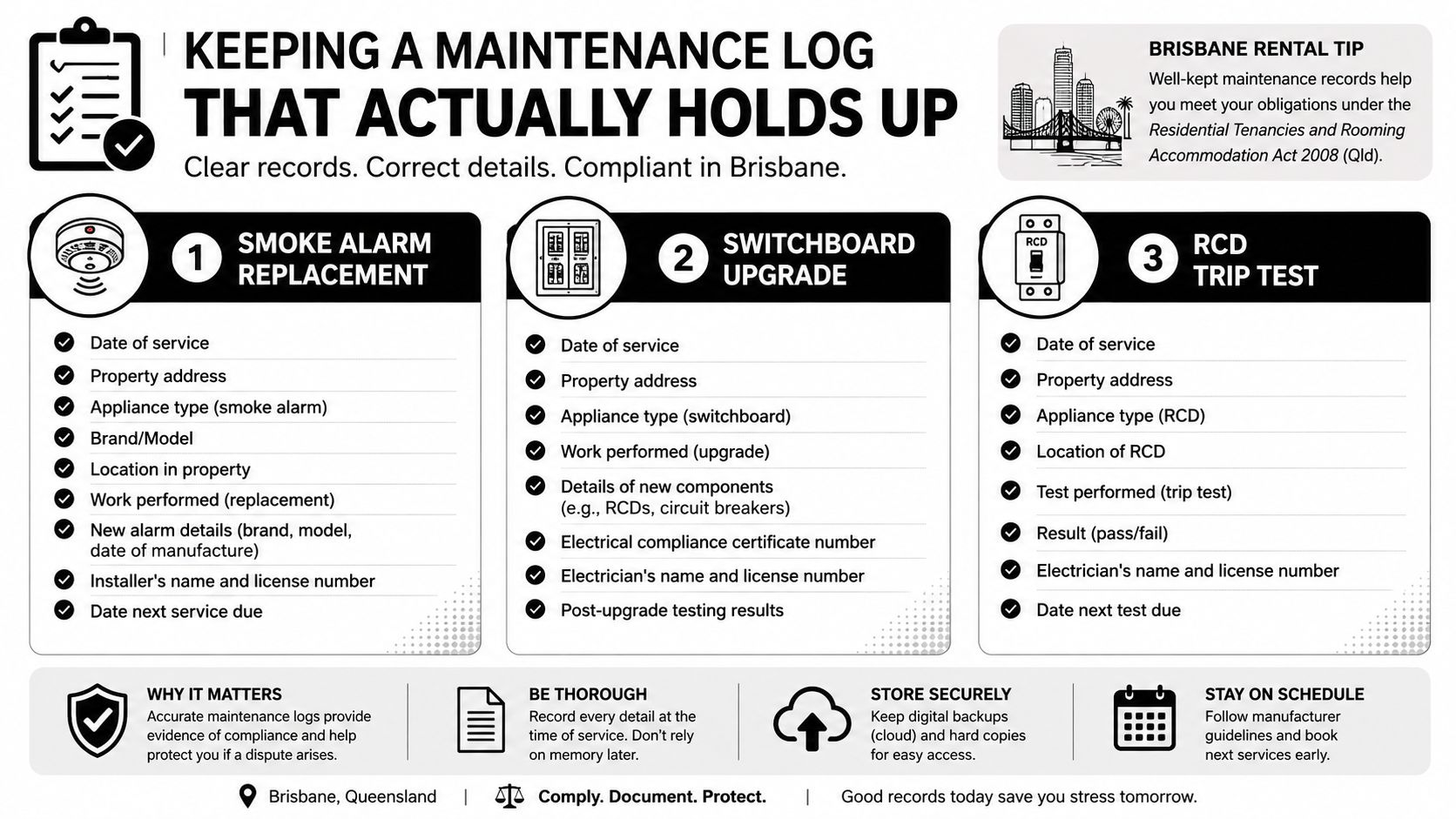
A Brisbane rental I'd treat as typical, not unusual, might have a smoke alarm replacement after a tenancy change, an RCD trip test, and a switchboard upgrade in the same year. If those jobs are recorded on scraps of paper in a kitchen drawer, that record is weak. If they're logged properly, the owner, tenant, and property manager can all show what happened, when it happened, and who did the work.
A useful log captures the date of service, the property address, the appliance type, the work performed, and the result. It should also include the technician's name and licence number, the brand or model where relevant, and the next service date. For upgrades, add the compliance certificate number and post-work testing results. For RCDs, record pass or fail, plus the location of the device.
That level of detail matters because a claim, inspection, or dispute usually comes down to evidence. Photos help, especially before and after a switchboard upgrade or when replacing a smoke alarm. So do clear notes about corrective action, not just the fault itself. If a fault recurs later, the log should show the trail that led to the fix.
The visual checklist below is the kind of structure that works well in a rental portfolio.
If you're a landlord or property manager, keep the records in one place and don't scatter them across emails and phone photos. A folder that's easy to hand to an insurer or tenant after an incident is worth far more than a neat-looking note that can't be verified later.
Most homeowners don't hate maintenance, they hate surprise invoices. That's fair, because emergency electrical work can arrive at the worst time, and the bill often includes the stress premium as much as the labour. A maintenance plan turns that into line items you can forecast.
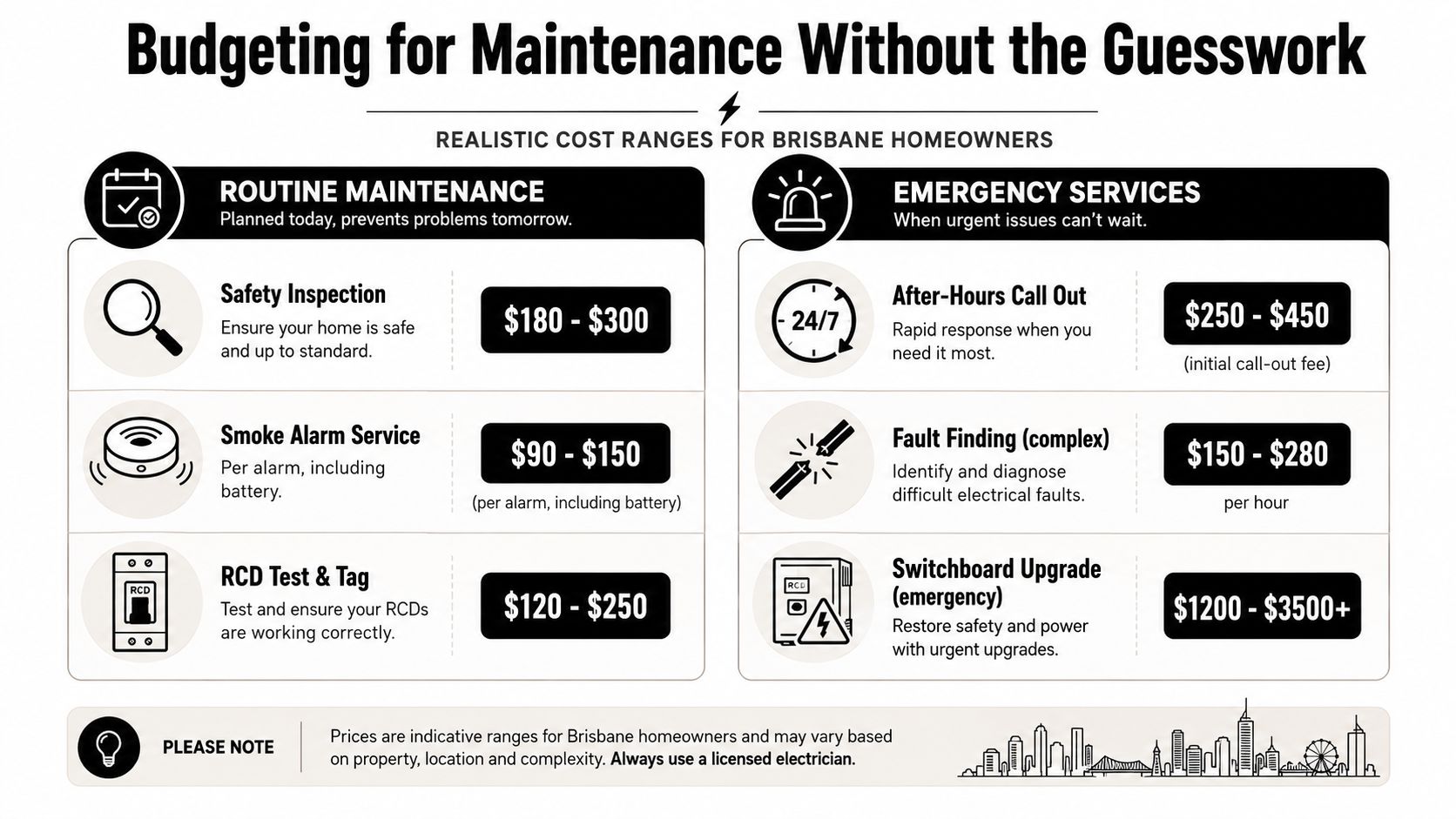
| Job | Budget Approach |
|---|---|
| Safety inspection | Plan for a routine inspection fee rather than waiting for a fault |
| Smoke alarm service | Budget per alarm so replacements and batteries don't become last-minute purchases |
| RCD test and tag | Treat this as a planned compliance and safety cost |
| After-hours call out | Keep a reserve for emergency access and diagnosis |
| Complex fault finding | Allow for labour time if a fault can't be isolated quickly |
| Emergency switchboard upgrade | Treat this as a capital event, not a routine service |
The point of the plan is to move spend from reactive to planned. That also fits the maintenance benchmarking noted earlier, where maintenance cost is often managed as a share of replacement asset value rather than left to chance Tractian's maintenance KPI guide. For a Brisbane owner, that means budgeting for routine checks, then holding a separate reserve for the jobs you hope never show up.
If you're looking for another practical mindset on cost control, the Pine Country Window Cleaning cost guide makes the same core point from a different trade. Planned upkeep usually costs less than waiting for a breakdown to dictate the timing.
Burning smells, scorch marks, repeated breaker trips, buzzing outlets, flickering under load, and any water near the switchboard are stop signs. Don't keep testing, don't keep guessing, and don't open anything live. Call a licensed electrician and describe exactly what you saw, when it started, and whether it changes with heat, rain, or appliance use.
A good first visit starts with the right brief. Have the property address, the symptoms, any photos, and your maintenance log ready. Ask for licence details, a clear scope, and a written quote before work starts. If you're in Brisbane, a local contractor like DLG Electrical can assess the fault, explain whether it's a repair or upgrade issue, and leave you with records you can file straight into the plan.
DLG Electrical handles maintenance, inspections, smoke alarm compliance, switchboard upgrades, and fault finding for Brisbane homes and rentals. If you want a plan that's practical, documented, and built around Queensland conditions rather than a generic checklist, visit DLG Electrical and ask for a quote that fits your property.

Master Electrician with over 30 years of experience. Founded DLG Electrical in 2005 after international project work including electrical installations at Stamford Bridge Stadium, London(Home of Chelsea FC).

Local Electricians that can fix all Electric Hot water Systems.
Motion sensor lights are a versatile addition to any home, offering nu
