83 Jean St, Grange QLD 4051
Mon-Fri 07:30 AM - 04:00 PM - Sat - 8:00 - 12 - Sunday Closed

The production line has stopped, a breaker keeps tripping, or an ageing switchboard has been flagged during a lease inspection. At the same time, a landlord may be arranging an EV charger, replacing smoke alarms, or renovating a property with a roof space full of cables. These jobs look unrelated, but they share the same risk: the wrong electrician can treat a larger electrical problem as a quick domestic repair.
A genuine industrial electrician in Brisbane works beyond ordinary lighting and power-point installation. They understand three-phase distribution, motors, machine controls, isolation procedures, switchboards, maintenance shutdowns, testing, and the paperwork that proves the work was completed safely. That expertise can matter in a factory, warehouse, workshop, strata complex, retail fit-out, home business, or large residential property.
A production fault rarely arrives at a convenient time. A machine loses a phase, a motor trips under load, or a switchboard fault interrupts several parts of a site at once. The electrician's first job isn't just to replace a component. It's to make the area safe, identify the fault, understand what the equipment is doing, and restore reliable operation without creating a second problem downstream.
An industrial electrician deals with electrical systems that support work, production, storage, processing, or building operations. That can include three-phase distribution, motor starters, variable speed drives, machine connections, control circuits, emergency systems, and planned maintenance. The work often involves equipment that can't be assessed properly by looking only at a wall outlet or a household circuit.
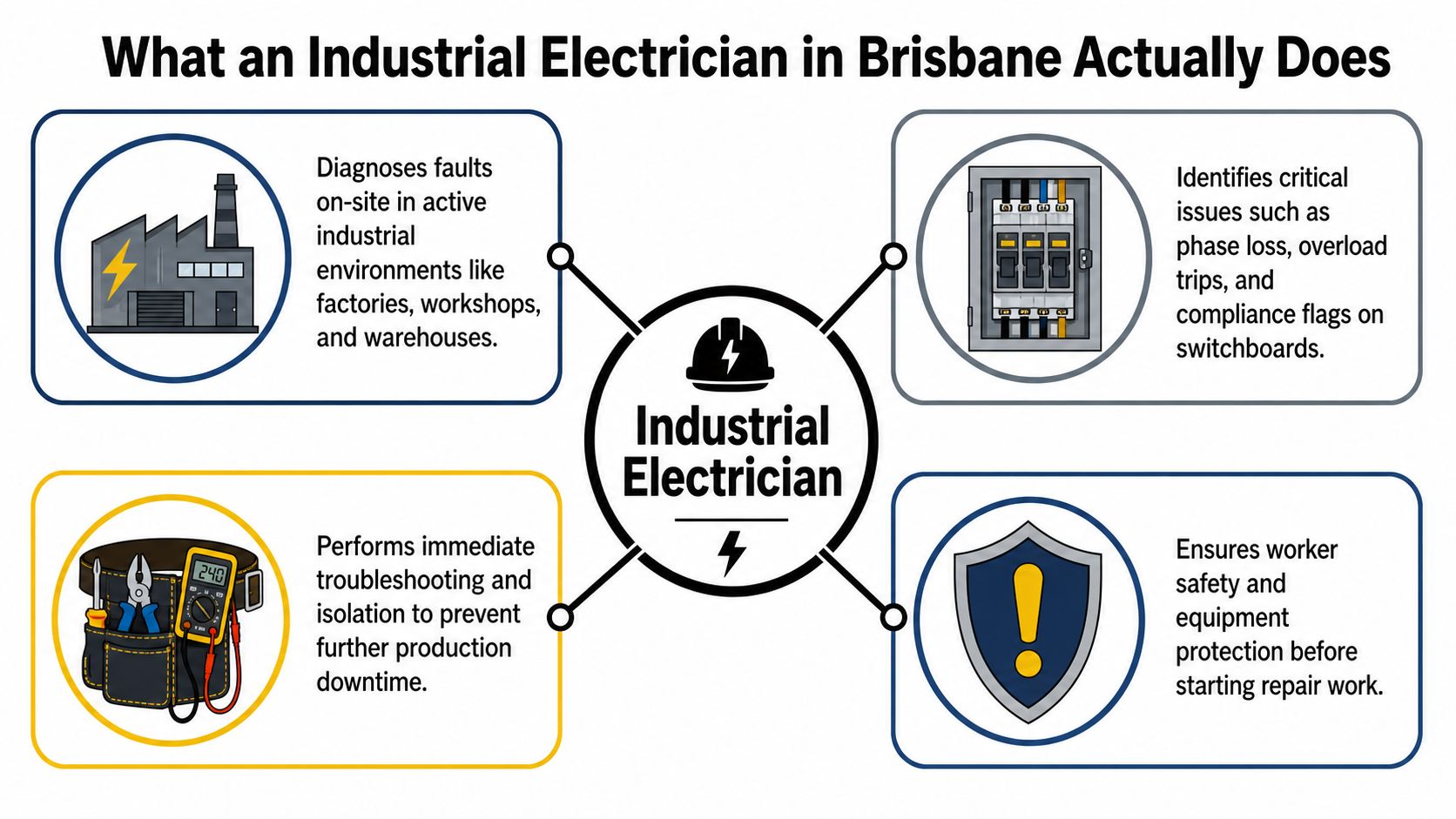
The job sheet might come from:
The difference between a residential generalist and an industrial specialist is often visible in the questions asked before work begins. A capable contractor wants to know what the machine does, when the fault occurs, what isolation points exist, whether production can stop, and which records the site needs after testing.
Practical rule: If electrical work can stop production, affect several tenants, energise machinery, or require a planned shutdown, choose a contractor who regularly works in industrial environments.
Maintenance also needs a deliberate method. A useful overview of the difference between preventive vs predictive maintenance guide can help an owner decide whether the site needs scheduled inspections, condition-based checks, or both. The electrician then turns that approach into practical tasks, such as checking terminations, testing protective devices, inspecting control gear, and recording defects before they become an outage.
Industrial electrical work is easiest to understand when the voltage boundary is used as the starting point. Queensland guidance defines extra-low voltage as up to 50 V AC RMS or 120 V ripple-free DC, low voltage as above that level up to 1000 V AC RMS or 1500 V ripple-free DC, and anything above those low-voltage limits as high voltage. These thresholds affect isolation, testing, equipment selection, approach distances, and the controls needed before work starts. Queensland electrical risk guidance sets out the framework that shapes those decisions.
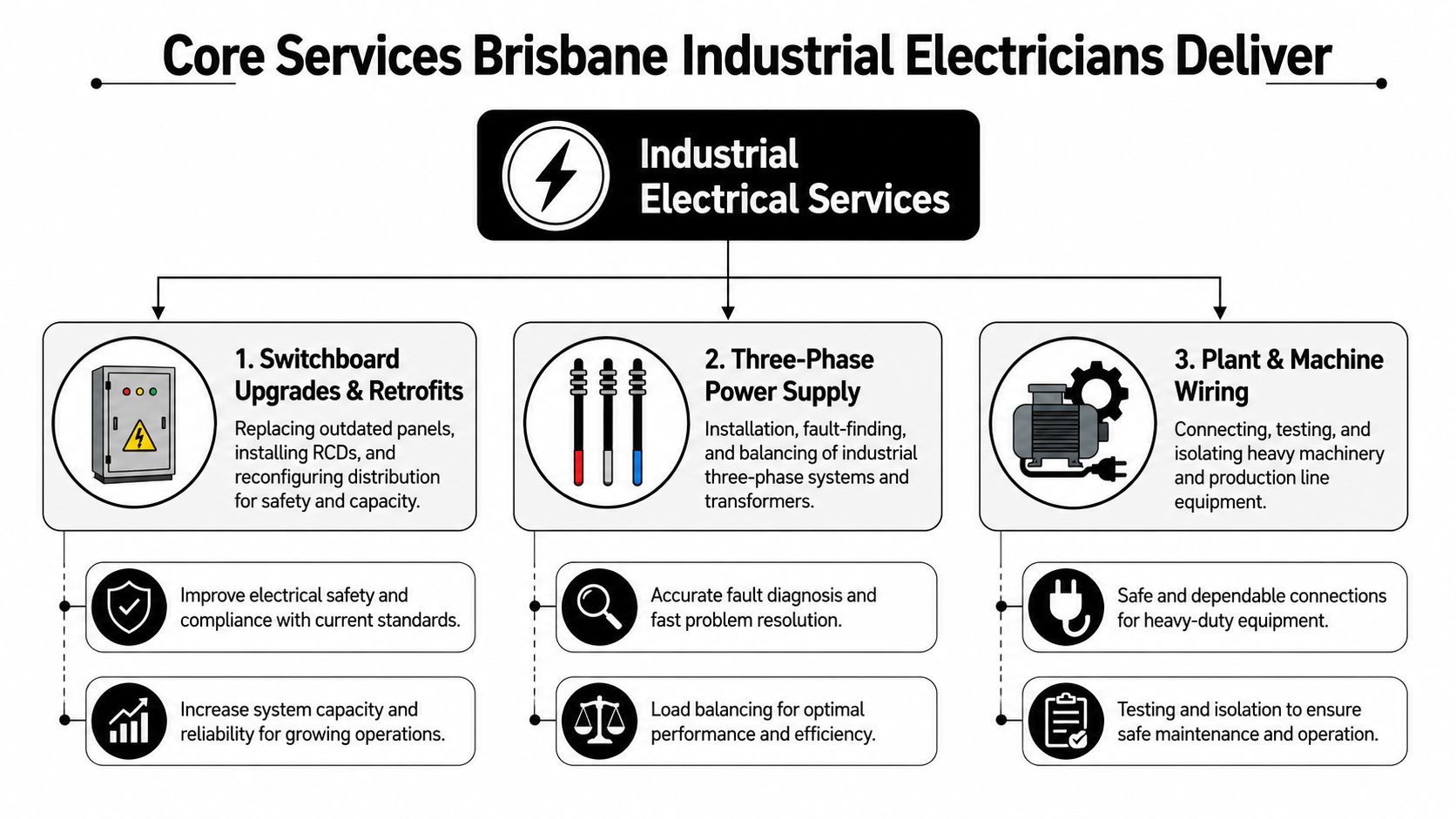
A switchboard upgrade may involve replacing damaged or obsolete equipment, improving circuit identification, installing protective devices, reorganising distribution, or allowing for new plant. The trigger might be an audit finding, repeated nuisance tripping, a new tenant, or equipment that no longer fits the original electrical design.
Three-phase work requires more than connecting conductors. The electrician may need to investigate phase balance, motor rotation, protective settings, cable capacity, fault levels, and the relationship between the site's main switchboard and downstream boards. A quote should make clear whether it covers design coordination, isolation, testing, labelling, and certification, rather than treating the board as a box that can be swapped without wider checks.
Machine wiring includes connection, control circuits, emergency stops, interlocks, sensors, motors, contactors, overload protection, and variable speed drives. A fault-finding visit should distinguish between a supply problem, a control fault, a failed component, and a mechanical issue that is causing electrical protection to operate.
VSDs can improve motor control, but they also introduce commissioning and compatibility questions. The electrician needs to consider settings, cable routing, earthing, heat, isolation, and the manufacturer's requirements. A proper handover includes test results and clear identification of what was changed.
Planned maintenance is different from emergency response. During a shutdown, the contractor can inspect accessible equipment, tighten or replace components, test protective systems, clean suitable enclosures, and record defects while the plant is already offline. Emergency fault response focuses on safe isolation, diagnosis, and restoring the essential service.
Other common deliverables include emergency and exit lighting checks, structured cabling around production areas, equipment relocations, temporary supplies, and reports for site managers. The right scope depends on the installation, not on the label printed on the van.
On a Brisbane site, a switchboard upgrade or plant connection is only complete when the paperwork, testing, and handover match the work performed. Queensland requires an electrical contractor to issue a certificate of testing and compliance after installation work and retain a copy for five years, according to the Queensland certificate requirements. The certificate links the completed installation to the contractor, site, testing, and compliance record.
The certificate is an actionable record that gives a property owner or manager something to retain with the asset file and provide during a handover. For a switchboard upgrade, machine installation, or new distribution circuit, file it with drawings, labels, test results, isolation information, and relevant equipment documentation.
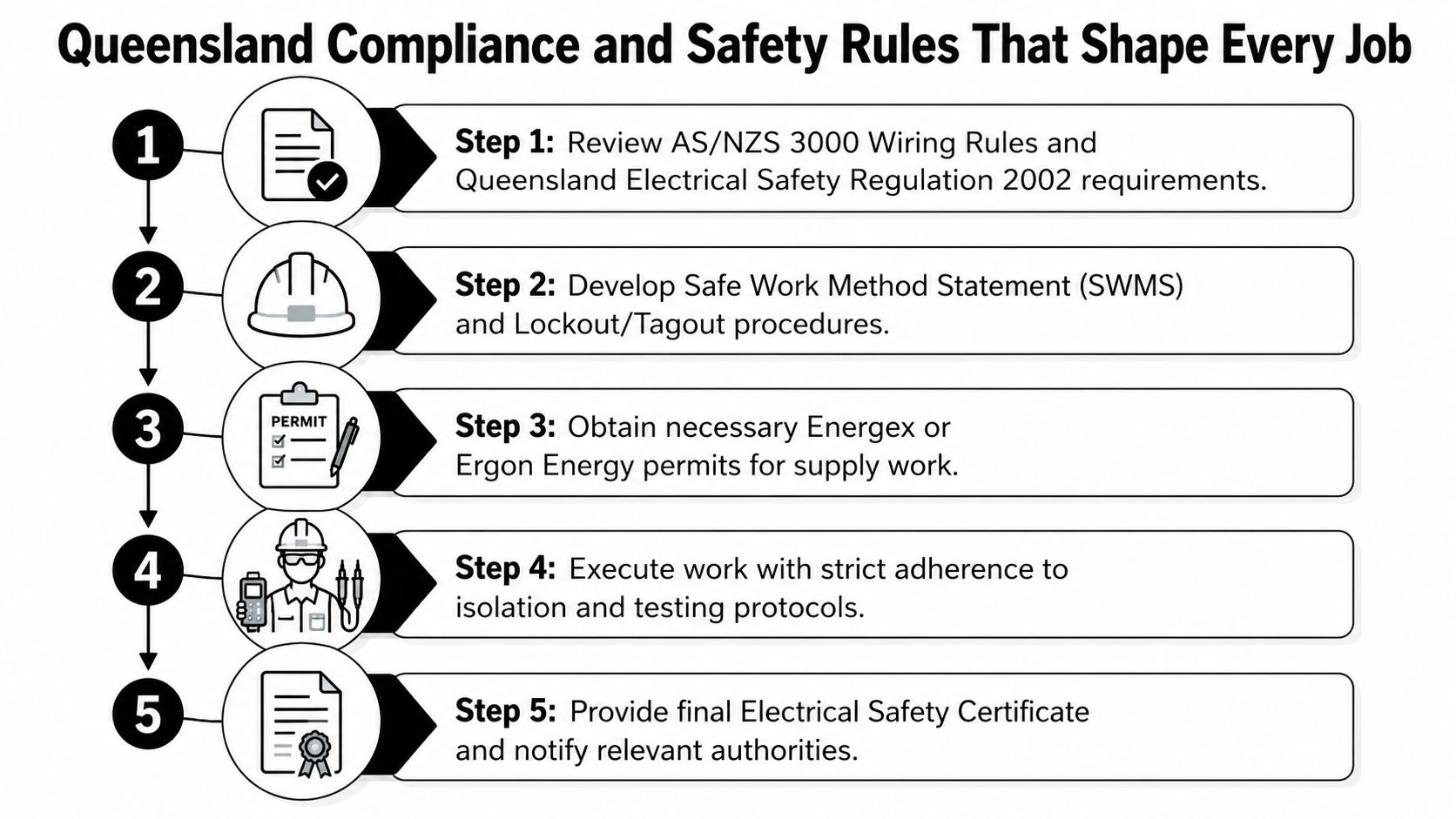
Allow for compliance administration in the project budget from the beginning. Electrical variations, shutdown labour, access delays, and documentation can alter the final building record. Owners coordinating broader works may also use the Everglow Prosperity construction guide when tracking those costs.
Keep this guide to eliminating electrical hazards in the workplace with the site's safety documentation. It provides workplace hazard-control context, while the electrician's risk assessment must address the actual equipment, access conditions, and work sequence on that job.
Since 1 January 2025, Queensland electrical safety laws require relevant installations to be de-energised before roof-space entry, extend controls to work within three metres of exposed live parts, and allow on-the-spot fines for some breaches. The Queensland Government's electrical safety update explains the changes and their enforcement context.
For Brisbane owners, landlords, and renovators, these rules affect project planning before an electrician arrives. Roof-mounted air-conditioning, solar equipment, smoke alarms, insulation, ceiling access, and cabling above a tenancy may require a defined isolation and access plan. A switchboard or EV charger project also needs the electrician to identify exposed live parts, required clearances, and the equipment that must be isolated.
The risk increases on mixed-use properties where several contractors work in the same area. A carpenter, air-conditioning technician, solar installer, or communications contractor can unknowingly create an unsafe condition for the next trade if the electrical scope and isolation boundaries are unclear.
Speed that skips isolation isn't efficiency. It's an unpriced risk that can stop the job, expose workers, and force rework.
Queensland regulators recorded 641 audits and 60 infringement notices in Q1 2024–25, according to the same electrical safety update. The figures show why a low quote that leaves out planning can become expensive through access changes, notices, rectification, and delays.
Before approving work, ask whether the job involves roof-space entry, exposed live parts, isolation of the relevant installation, or coordination with other trades. Confirm who controls access and how the site will be left safe between work stages.
Keep the certificate, test results, labels, and job records with the property file. This electrical certificate of compliance explanation outlines the documentation landlords and renovators should request after completion.
A homeowner doesn't need an industrial electrician for every domestic repair. Replacing a light fitting or adding a standard outlet may suit a residential specialist. The decision changes when the property has an older or complex supply, high-load equipment, multiple dwellings, a home business, or a switchboard that needs more than a simple circuit addition.
An EV charger is a good example. The visible task is mounting the charger and connecting it, but the electrician also needs to assess the existing supply, demand, protection, cable route, isolation, and future loads. If the property may need three-phase power or has a business use, an industrial-capable contractor can assess the wider system rather than treating the charger as an isolated appliance.
A switchboard replacement in a large home, duplex, workshop, or heritage property may involve unknown circuits, outdated equipment, limited space, and difficult access. A contractor comfortable with industrial boards and fault-finding can approach the work methodically, identify what must be retained or replaced, and provide the testing records needed for the completed installation.
Smoke alarms can also become a coordination issue in larger or mixed-use properties. Interconnection, circuit protection, access, tenancy obligations, and documentation all matter. The contractor doesn't need to turn a domestic job into a factory project, but they should recognise when the installation's scale creates industrial-style planning requirements.
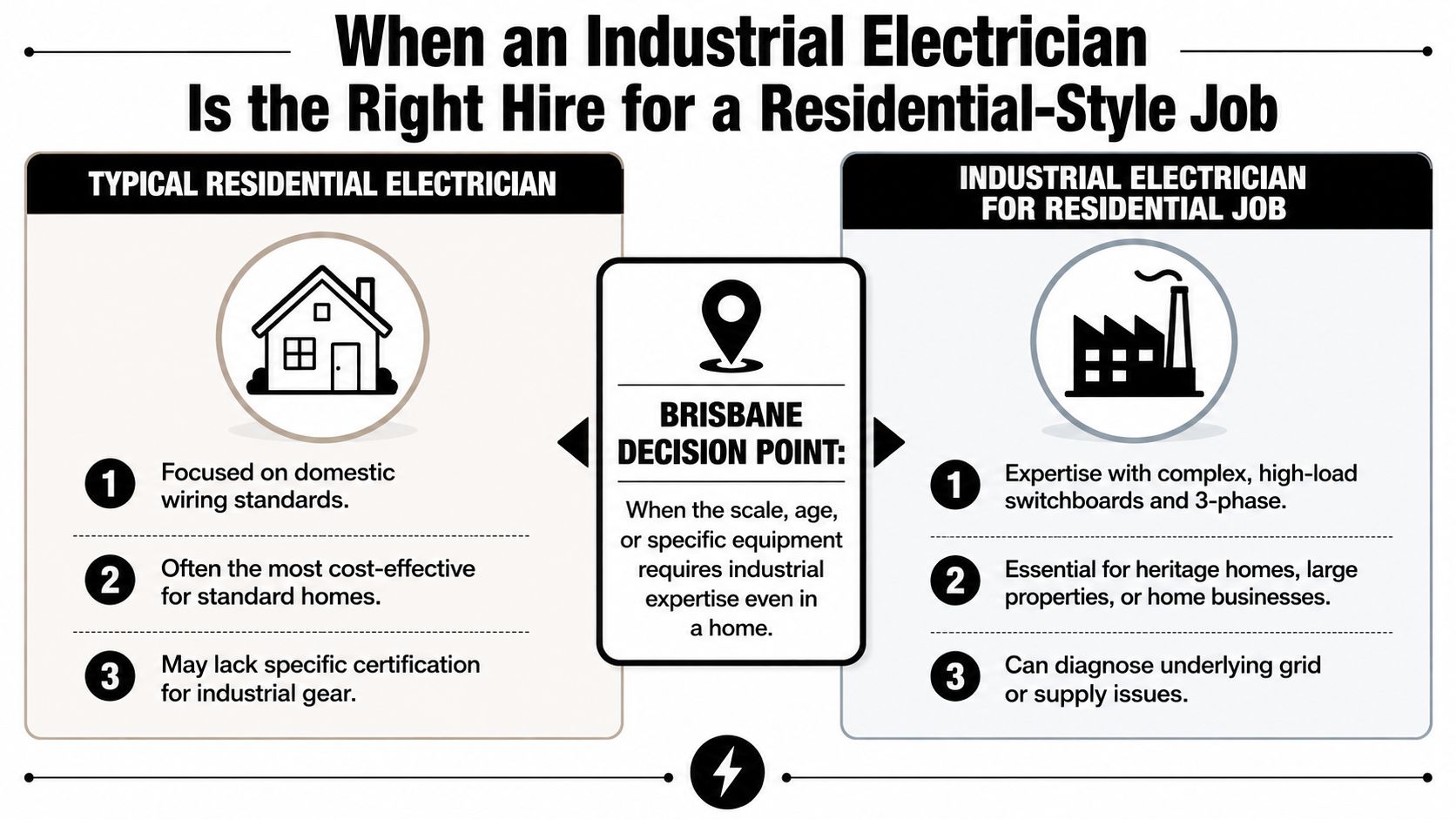
The practical test is simple:
This video provides useful visual context for the differences between electrical environments and equipment demands:
The industrial option isn't automatically the cheapest on the first invoice. It may be the better value when it prevents a charger, switchboard, or alarm project from needing a second contractor to correct missing protection, poor load planning, or incomplete records.
Industrial quotes vary because the work varies. A fault call on an accessible motor is a different job from a switchboard retrofit that requires a planned shutdown, new protective equipment, coordination with the site manager, and a complete testing pack. The useful comparison isn't just the hourly rate. It's the total scope and the risk the quote leaves with the client.
Australia had an estimated 197,300 electricians employed, with Queensland representing 24.0% of that workforce, annual employment growth of 7,200, median weekly earnings of $2,191, and a median age of 33, according to Jobs and Skills Australia. Those figures describe the broader occupation, not a Brisbane industrial quote, but they help explain why experienced electrical capacity has genuine value.
Queensland's energy trades workforce was reported at about 65,000 workers at the close of 2024, compared with 52,500 in 2010, and one projection places demand at around 85,000 by 2030, according to the Queensland workforce plan. The same source identifies 696 new Brisbane jobs by 2027–28 under the relevant electricity sector projection. These are workforce projections, not promises about a particular contractor's availability, but they reinforce the need to compare capability rather than chase the lowest figure.
| Cost driver | What it covers | Why it changes the price |
|---|---|---|
| Labour and diagnosis | Fault-finding, isolation, testing, installation, commissioning | Complex faults take longer to prove and rectify |
| Materials | Switchboards, breakers, contactors, cables, VSDs, enclosures and labels | Equipment ratings, availability and compatibility affect selection |
| Shutdown timing | Planned outages, production coordination and return-to-service checks | Work outside normal operations requires additional planning |
| Compliance records | Testing, certificates, labels, reports and handover information | Proper close-out takes time and creates an auditable record |
| Site access | Travel, inductions, escorts, restricted areas and other trades | Delays and access controls add labour without adding installed equipment |
A cheap quote often hides one of these items. Ask whether the price includes testing, certification, isolation, disposal, temporary supply, commissioning, and return visits. A useful quote makes exclusions visible, so a lower number can be compared fairly rather than mistaken for a lower project cost.
Start with the licence, not the logo. Ask for the Queensland electrical contractor licence number and check that it belongs to the business responsible for the work. If the contractor supplies only a personal name, avoids the question, or says another business will issue the paperwork, clarify responsibility before accepting a quote.
Insurance needs the same attention. Request current evidence of the required $5 million public and products liability cover and check that the insured entity matches the contractor you are engaging. The policy should also relate to the proposed electrical work, rather than being treated as a generic box-ticking exercise.
Use the first call to test the contractor's planning:
A written quote should list equipment, quantities, testing, certification, exclusions, access assumptions, and shutdown requirements. The industrial electrical contractor guide gives property owners a useful checklist for comparing contractors and framing those questions before requesting prices.
Read exclusions closely. Verbal-only pricing, unexplained allowances, missing licence details, refusal to discuss insurance, or a proposal to work live because isolation is inconvenient all deserve clarification. These signs do not prove poor workmanship, but they indicate that safety controls, documentation, or the full job scope may not have received enough attention. A contractor who explains the method, records, limits, and approval points is easier to assess before work begins.
The right hiring decision rests on three checks. Confirm the contractor can handle the system, confirm the quote includes safe isolation and compliant close-out, and confirm the business can work within the site's access and shutdown conditions. For residential-style projects, add a fourth check, whether the electrician can assess the wider supply instead of installing a high-load device without considering what else the property will need.
DLG Electrical is a family-owned and operated electrical contractor based in Brisbane, with over 19 years of residential and commercial experience. Its listed work includes switchboard upgrades, smoke detector compliance and installation, repairs, maintenance, security systems, and custom electrical design. The business focuses on Brisbane, with particular service coverage around North Brisbane, Grange, and Windsor, and lists availability from Monday to Friday, 7:30 am to 4:00 pm.
For a first conversation, prepare photographs of the switchboard, the equipment nameplate, the affected area, and any previous inspection report. Explain whether the site can shut down, whether roof-space access is involved, and which certificate or handover records you need. DLG Electrical offers free quotes, so the enquiry can begin with scope clarification before a price is accepted.
DLG Electrical provides Brisbane electrical installations, maintenance, repairs, switchboard upgrades, smoke alarm work, and practical commercial solutions, with industrial-capable support for more involved systems. To discuss your switchboard, plant, EV charger, smoke alarm, or compliance requirements, visit DLG Electrical and request a free quote.

Master Electrician with over 30 years of experience. Founded DLG Electrical in 2005 after international project work including electrical installations at Stamford Bridge Stadium, London(Home of Chelsea FC).

Local Electricians that can fix all Electric Hot water Systems.
Motion sensor lights are a versatile addition to any home, offering nu
