83 Jean St, Grange QLD 4051
Mon-Fri 07:30 AM - 04:00 PM - Sat - 8:00 - 12 - Sunday Closed
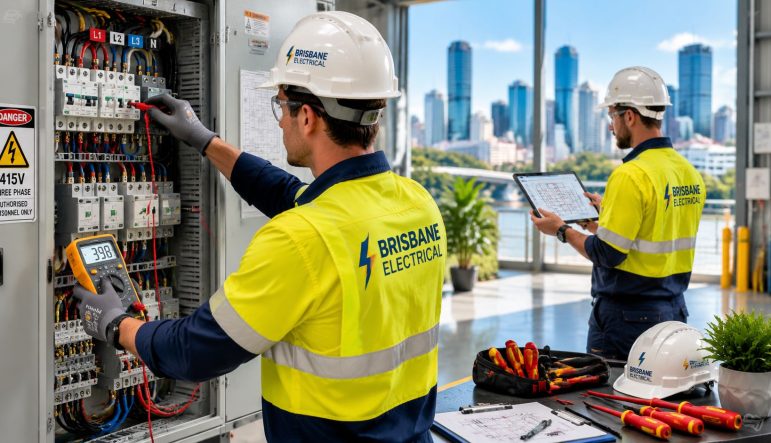
If you're dealing with a tripping breaker in a Geebung workshop, planning a warehouse fit-out near Windsor, or trying to add new plant without overloading an ageing switchboard, the contractor you choose will affect far more than the install date. It affects downtime, safety, compliance, and whether the next upgrade becomes simple or painfully expensive.
A lot of Brisbane business owners start with the same question. “Who can do the work for the best price?” That's understandable. But with industrial electrical contractors, the cheaper price on day one can become the expensive decision six months later if the scope was thin, the board was undersized, or nobody asked how the site will handle future electrification.
The better question is this. Which contractor can install the job properly, keep it compliant, and help the site stay reliable as your power demands change?
Industrial electrical work sits in a different category from household electrical jobs. You're not just paying for someone to wire a circuit. You're trusting a contractor with production uptime, staff safety, equipment protection, and legal compliance.
That matters in a market with a lot of choice. The Australian Bureau of Statistics reported 94,162 employed Electricians in May 2024, with 91.1% working full-time, showing just how large the available workforce is across Australia's industrial and commercial sectors, according to these electrician workforce figures. A large field is good for competition. It also means you need a way to separate competent operators from people who sound convincing.
Most hiring mistakes happen because owners define the job too narrowly.
If your brief is “install a new sub-board” or “run power to new machinery”, you might receive prices that look comparable but aren't. One contractor may include shutdown planning, testing, certification, and spare capacity. Another may price only the minimum needed to energise the circuit.
That's why the first step is to define what failure would cost you. For some Brisbane businesses, failure means inconvenience. For others, it means spoiled stock, idle staff, missed dispatch windows, damaged equipment, or a non-compliant site.
Practical rule: Hire for the consequence of failure, not just the visible task.
A sensible hiring process usually works like this:
Confirm the business is properly licensed to contract for electrical work in Queensland.
Don't rely on a logo on a ute or website footer.
Check the type of work they handle.
A contractor who mainly does shops and offices may not be the right fit for motor controls, switchboard upgrades, or plant shutdown coordination.
Ask how they approach maintenance after installation.
If they disappear once the invoice is paid, you're buying a project, not a long-term solution.
Look for clear communication around exclusions and shutdown risks.
Vague language early usually turns into disputes later.
Strong contractors think beyond the first energisation. They ask about load growth, operating hours, access restrictions, maintenance windows, and what has failed on site before. They don't treat those questions as extras. They use them to avoid giving you the wrong solution.
In Brisbane, that often means thinking about heat, dust, washdown areas, older tenancy infrastructure, and the practical reality that many industrial sites have been expanded in stages over time. What looks tidy on a plan can be messy in a live facility.
A reliable contractor won't just tell you they can do the work. They'll help you understand what needs to be done now, what can wait, and what should be planned properly so you don't pay twice.
A lot of people hear “industrial electrical” and picture a huge manufacturing plant. In practice, the work is much broader than that. In Brisbane, it can apply to warehouses, workshops, food production spaces, distribution centres, strata-commercial buildings, service yards, and light industrial units that run heavier loads than a standard office.
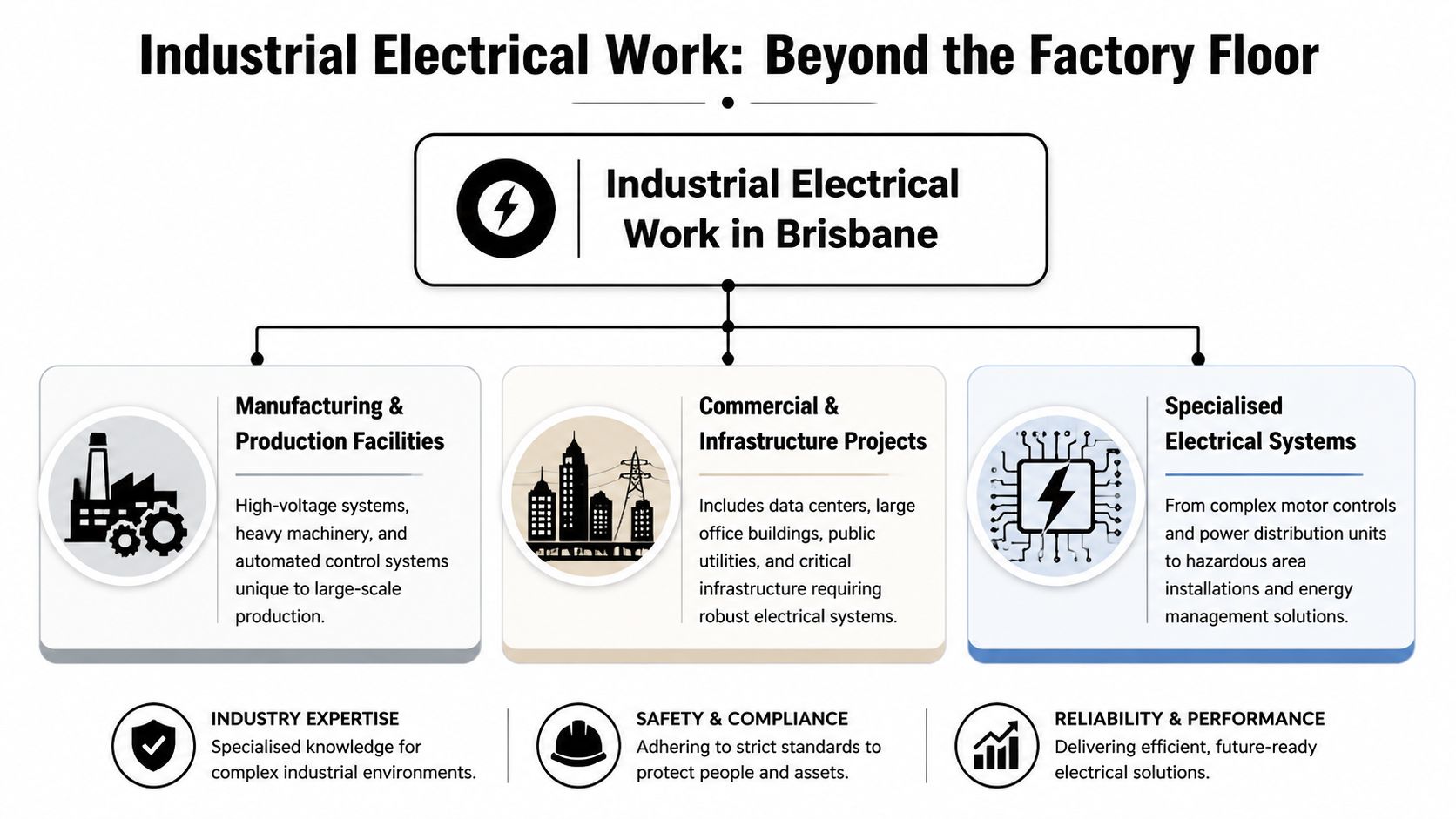
At site level, industrial electrical contractors often deal with things such as:
Industrial work differs from straightforward commercial fit-out work. The job isn't only to make power available. It's to make power dependable under real operating conditions.
One change many Brisbane businesses are underestimating is how often electrical projects now connect to wider electrification plans. A site might ask for one EV charger today, then discover the main switchboard, connection capacity, or distribution layout can't support the next stage without major rework.
That concern isn't theoretical. As Australia's energy systems change, EV adoption is growing in eastern states like Queensland, and contractors need to be able to integrate EV charging, solar, and battery systems without overloading existing electrical capacity, as noted in this discussion of electrification and contractor capability.
A warehouse doesn't need to be a factory to have industrial-grade electrical problems. One new charger, one larger machine, or one tenancy change can expose limits that were already there.
For a Brisbane business owner, the distinction usually becomes obvious when any of these are true:
| Site condition | Why it points to industrial electrical work |
|---|---|
| Machinery with significant starting load | The installation has to handle more than simple lighting and GPO circuits |
| Board capacity is tight | The contractor needs to assess present and future load properly |
| Operations can't stop easily | Shutdown planning and staged work become part of the job |
| New tech is being added | EV chargers, solar, batteries, and controls need integration, not bolt-on guesswork |
Industrial electrical work also has a heavier compliance burden. In Queensland, the work has to be completed by properly licensed people, and installations need to align with the applicable electrical rules and Australian or New Zealand standards relevant to the site. For owners, the key point is simple. If a contractor can't explain the compliance pathway in plain English, they probably shouldn't be touching your switchboard.
The right contractor should be able to look at your site and tell you whether you're dealing with a routine install, an operational risk issue, or a broader infrastructure upgrade. Those are not the same job, and they shouldn't be quoted as if they are.
Before you discuss programme dates, materials, or value engineering, check whether the contractor is legally and operationally fit to do the work. This step isn't administrative box-ticking. It protects your business if something goes wrong.
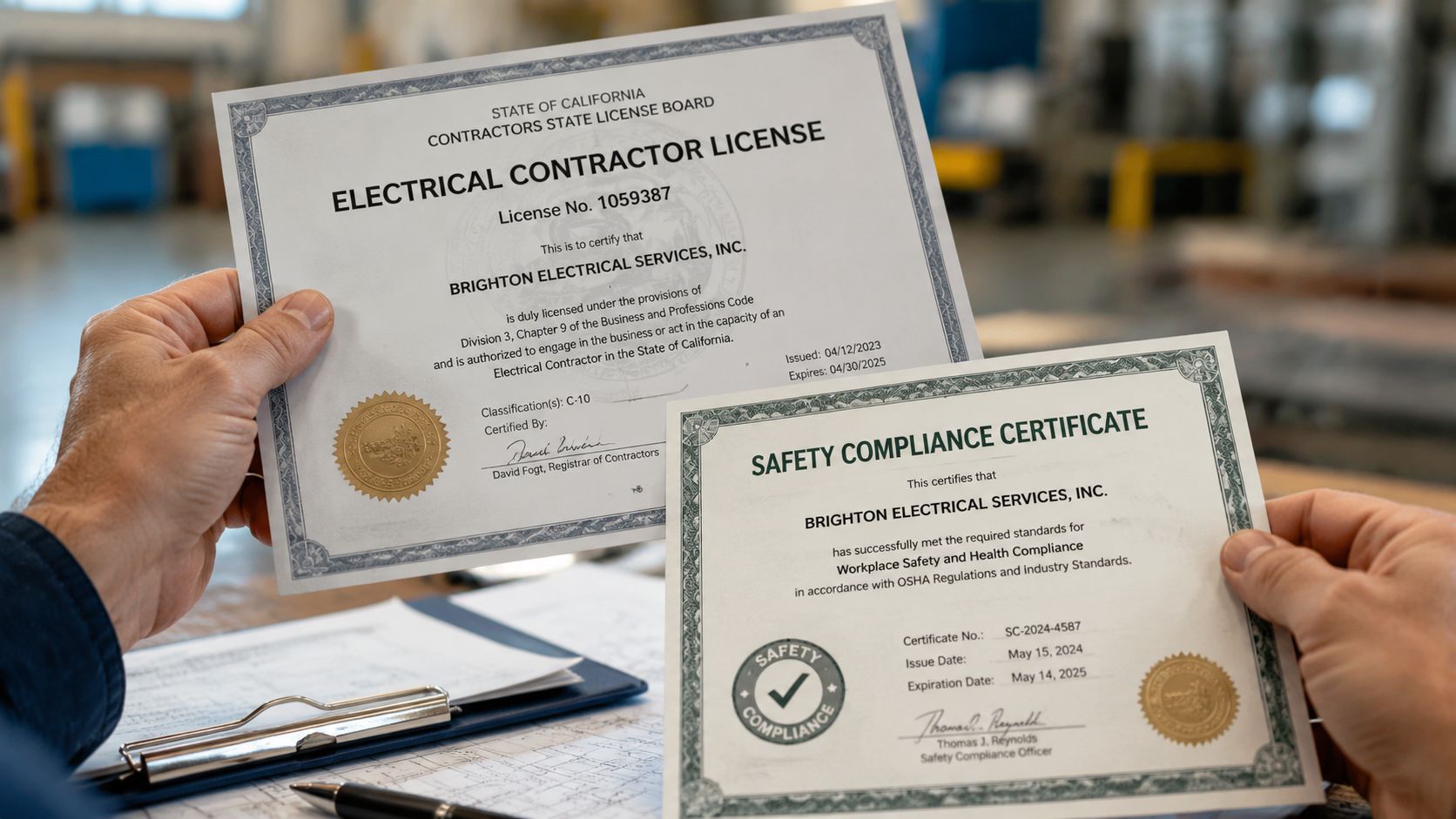
For electrical contracting in Queensland, you need to be sure the people and the business are properly authorised.
Ask for:
Those are different things. A qualified electrician working under a business name is not the same as a properly licensed contracting business. If the business can't show the correct contractor credentials, stop there.
Any industrial site should also ask for current insurance documentation. Beyond the policy itself, pay attention to how quickly they provide it and whether the names match the quote, licence, and trading entity. Sloppy paperwork often points to sloppy admin elsewhere.
You should also ask what documentation you'll receive at completion. If you need a better sense of what compliant sign-off looks like, this guide to an electrical certificate of compliance is a useful reference point.
A contractor who does this work regularly won't get defensive when you ask. They'll expect it.
Every contractor says safety matters. That doesn't tell you much. Ask them how they plan work on a live or partially live site, how they manage isolation, what site-specific paperwork they prepare, and what they require from their own team before starting.
Useful questions include:
How do you handle shutdown and isolation planning?
You want a clear process, not a vague assurance.
Do you prepare Safe Work Method Statements where required?
If the job has higher-risk elements, they should have a structured method.
Who supervises subcontractors or apprentices on industrial jobs?
This tells you whether accountability is real.
If a contractor rushes past licence checks and safety questions because they “just want to get started”, that's a warning, not a strength.
The site visit often reveals more than the quote.
A capable contractor will inspect access, existing boards, cable routes, heat, moisture, operating constraints, and whether the installation can be maintained after it's built. They'll ask who needs to be consulted before shutdowns. They'll want to know which loads are critical and what can be safely isolated.
That kind of attention reduces surprises later.
For a simple visual overview of what proper compliance thinking looks like in electrical work, this short video is worth a look before you sign off on any contractor.
They don't dodge direct questions. They don't minimise risk to make the price look easier to swallow. And they don't pretend all industrial jobs are the same.
Good industrial electrical contractors know that compliance is part of the deliverable. Not a paperwork exercise after the cables are pulled.
A Brisbane manufacturer gets three prices for a switchboard upgrade. One is far lower than the others, so it gets attention first. Six months later, the cheap job has already cost more through variations, shutdown overruns, and a board that leaves no room for the next machinery upgrade.
That happens because many quotes are priced for installation day, not for the next ten years of operation.
A good industrial quote shows how the contractor has thought through the job. It should break down the scope, identify exclusions, note assumptions, and explain how testing, commissioning, shutdowns, access equipment, and disposal are being handled. If your site has operational constraints, those should appear in writing, not as a casual promise during the walk-through.
Strong estimating also relies on process. Procore's guidance on estimating for electrical contractors points to checking drawings against specifications, reviewing scope gaps, and using a second review before the quote goes out. That matters on industrial work because small omissions become expensive quickly once labour, access, and production downtime are involved.
The best quotes are rarely the shortest.
Put competing quotes into one table and compare the actual work being priced. Business owners often look at the bottom line first, but the essential question is whether each contractor has priced the same job, to the same standard, with the same operational constraints.
| Verification Item | Contractor A | Contractor B | Notes |
|---|---|---|---|
| Contractor licence confirmed | |||
| Scope itemisation clear | |||
| Exclusions listed clearly | |||
| Shutdown requirements addressed | |||
| Testing and commissioning included | |||
| Maintenance support available |
Add a few rows that reflect your site. Spare capacity in the board. Allowance for future circuits. Cable routes that can still be accessed later. Labelling and as-built documentation. Response time if something fails after handover.
Those items affect resilience. They also affect what your next upgrade costs.
Some quote problems are obvious once you know what to look for:
Low pricing is not always a problem. Sometimes a contractor is efficient or has better buying power. But if the gap is large, ask what has been assumed, what has been left out, and how variations will be managed.
A contractor has to price enough labour, supervision, compliance, and aftercare to stand behind the work. If the quote is cut too fine, corners tend to show up later in slower defect response, rushed commissioning, poor documentation, or limited support once the final invoice is paid.
Trade-offs have tangible consequences. A cheaper board with no spare ways may save money today and force a replacement earlier than planned. Minimal testing may shorten the install window and leave you chasing nuisance trips later. Tight cable routing may look neat at handover and make maintenance harder for years.
For Brisbane businesses planning electrification or plant changes, ask whether the contractor is designing for future capacity or just fitting the current brief into the cheapest footprint. If your site has motors, demand issues, or supply constraints, it also helps to see whether they can discuss related topics such as power factor correction for commercial and industrial sites. That does not mean every project needs it. It shows whether the contractor is thinking about the system as a whole.
Ask these before accepting any proposal:
What assumptions could change the final cost?
This brings hidden risk into the open.
What is excluded, specifically?
Ask for plain examples tied to your site.
How have you allowed for shutdowns, staging, and access constraints?
Industrial pricing should reflect live operating conditions.
What spare capacity are you leaving for future loads or electrification?
A contractor focused on long-term value will have an answer.
How will variations be approved before extra work proceeds?
Clear approval steps prevent arguments later.
What documentation do we get at handover?
As-builts, labels, test results, and asset information save time on every future service call.
A solid quote gives you enough detail to compare risk, not just price. If the document leaves you guessing, the job usually will too.
The install is only the beginning. Electrical systems earn their value over years of operation, not on the day the power is switched on. That's why Brisbane businesses should choose industrial electrical contractors based on what happens after handover as much as during the project itself.
For operating sites, downtime often costs more than the original electrical work. A failed switchboard component, nuisance tripping on a production line, or a poorly planned shutdown can interrupt dispatch, idle staff, and put pressure on customer commitments.
That's why resilience deserves a place in the contractor selection process. In Australia, energy market agencies continue to flag reliability and system-constraint pressure, and the practical takeaway for businesses is clear. Contractor selection should focus on downtime prevention, emergency response times, and compliance with AS/NZS standards in operating facilities, not just the lowest install price, as outlined in this discussion of resilience and maintenance capability.
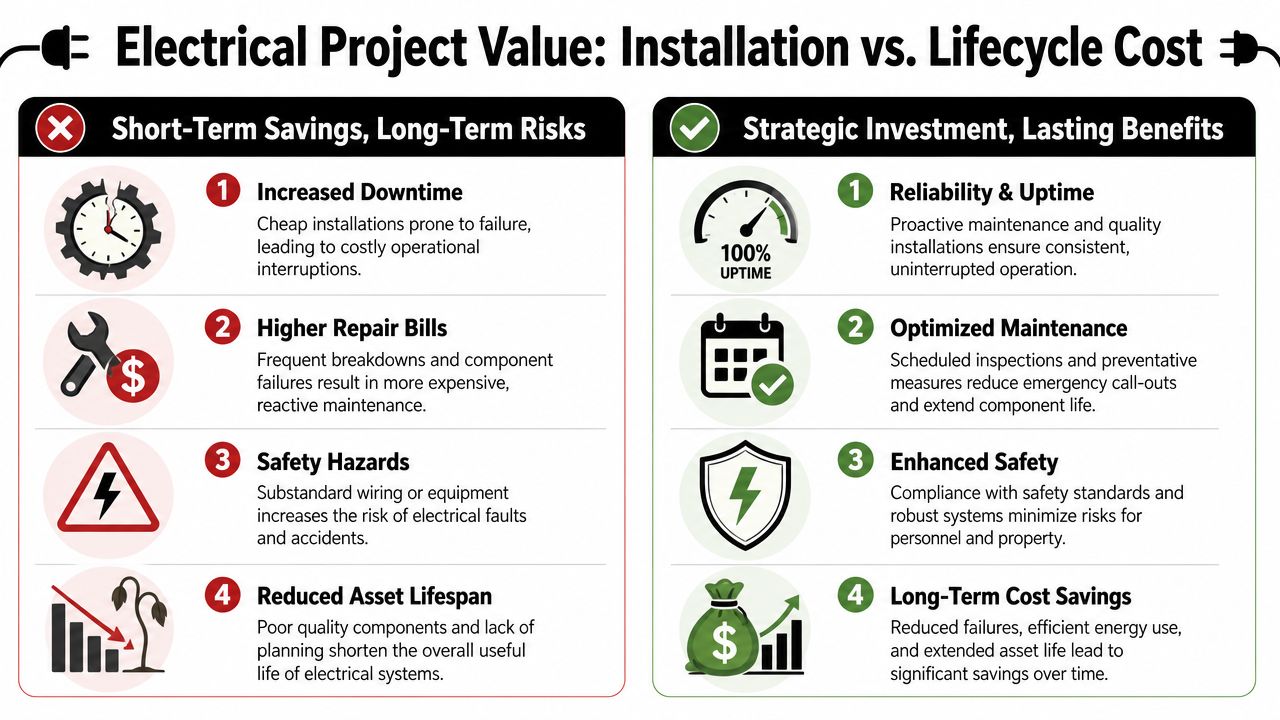
A contractor who's worth keeping will usually be able to explain:
Some Brisbane sites don't need a formal maintenance programme. Others absolutely do. The point is to find out whether the contractor can help you think in lifecycle terms.
Don't ask only, “Can you install this?” Ask, “How do we keep this reliable when the site is under pressure?”
A common mistake is adding new technology one piece at a time with no overall plan. First a charger. Then more refrigeration. Then a tenancy change. Then battery storage gets discussed. Suddenly the main board, metering arrangement, or distribution layout no longer makes sense.
A capable contractor should be able to map the likely sequence. What can be added now. What should be provisioned for. What should wait until a larger upgrade is justified. That planning is where long-term value sits.
When a site loses power, owners don't care about polished proposals. They care about response. Who answers the phone, who knows the site, and who can isolate the fault safely without turning a bad day into a dangerous one.
That's one reason local knowledge matters. A Brisbane contractor who understands industrial estates, access conditions, weather exposure, and the way local facilities operate is usually in a better position to support the site over time.
The best hiring decision often isn't the contractor who promises the fastest install. It's the one who thinks clearly about maintenance, outage risk, and what your business will need next.
A Brisbane site manager usually notices the true measure of a hiring decision after the install is finished. Six months later, a breaker keeps tripping under load, a tenant asks for new machinery, or storm season exposes weak points in the switchboard room. That is when the difference shows between a contractor who got the job done and one who set the site up to stay reliable.
The right industrial electrical contractor helps protect uptime, safety, and future capacity. They should be able to explain what they are installing, why it suits your current operation, and what it means for the next stage of growth. For Brisbane businesses planning electrification, equipment upgrades, or heavier maintenance demands, that long view matters more than a low upfront number.
Look for a contractor with disciplined systems, clear documentation, and a consistent service process. You may never see their internal scheduling, job costing, or reporting, but you will see the result in how they quote, communicate, arrive on site, and close out defects. Well-run contractors tend to ask better questions early and leave fewer loose ends later.
Local fit matters too. A team that works across Brisbane warehouses, workshops, offices, and mixed-use properties will usually have a better read on access issues, heat, moisture, storm exposure, and the practical limits of older infrastructure. If you want a clearer picture of that local experience, this guide to choosing a commercial electrical contractor in Brisbane gives useful context.
You probably will.
Loads change. Tenancies change. Production lines change. The contractor you choose now may also be the one you call for fault-finding, switchboard upgrades, after-hours outages, testing, and maintenance planning. That makes the hiring decision less about price alone and more about whether the business is organised enough to support your site over time.
Cheap work often becomes expensive in stages. It shows up as cramped boards with no allowance for expansion, poor circuit identification, hard-to-service installations, and upgrade paths that were never thought through. A better contractor prices for safe access, sensible capacity, clean documentation, and work that can be maintained without unnecessary disruption.
For most Brisbane businesses, the strongest choice is the contractor who communicates plainly, scopes the work properly, and treats the job as part of your site's longer operating life.
If you need a reliable local team for electrical installation, maintenance, upgrades, or fault-finding, DLG Electrical brings family-owned Brisbane service, fully licensed and insured electricians, and a practical focus on doing the job right the first time. Reach out for a free quote and a straightforward conversation about what your site actually needs.

Master Electrician with over 30 years of experience. Founded DLG Electrical in 2005 after international project work including electrical installations at Stamford Bridge Stadium, London(Home of Chelsea FC).

Local Electricians that can fix all Electric Hot water Systems.
Motion sensor lights are a versatile addition to any home, offering nu
