83 Jean St, Grange QLD 4051
Mon-Fri 07:30 AM - 04:00 PM - Sat - 8:00 - 12 - Sunday Closed
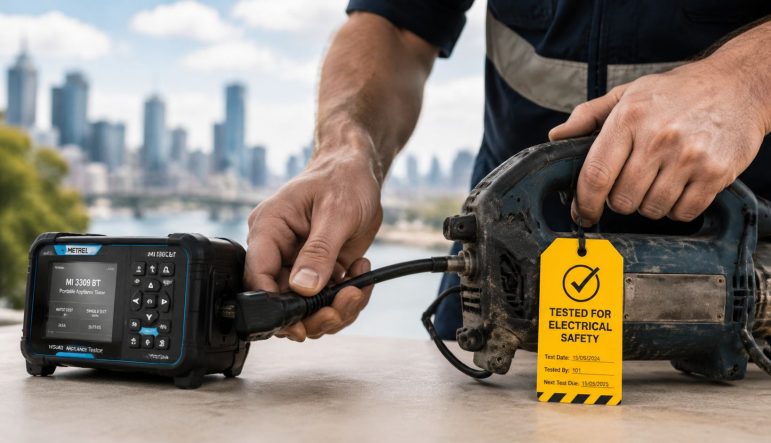
A Brisbane landlord opens a cupboard in a Paddington rental and finds a kettle, extension lead and vacuum cleaner with no visible tags. A café operator in Newstead discovers the same problem during a fit-out, while an owner-builder in Morningside is asked for test records before a contractor will continue work. The question sounds simple, but Queensland test and tag requirements depend on where equipment is used, who is responsible for it and who performed the testing.
The straight answer is that a sticker alone doesn't prove compliance. You need the correct environment classification, a competent tester, the right licensing arrangement where testing is offered commercially, and records that show what happened to each item. Queensland's framework is risk-based, so copying a generic annual schedule can leave a high-risk site under-tested while sending a low-risk workplace through unnecessary visits.
The confusion usually starts when someone treats test and tag as a universal rule for every appliance in every building. A landlord may assume every item in a residential property needs a tag before a tenancy begins. A renovator may believe a tool tested in a home workshop remains covered after it moves onto a building site. A café owner may book annual testing without checking whether the equipment's use exposes it to heat, moisture, movement or repeated handling.
Queensland's regulator takes a different approach. The equipment's use environment matters, and the inspection outcome matters just as much as the date on the label. WorkSafe Queensland explains that maximum intervals vary from three months for building, construction and demolition work through to five years for low-risk equipment that isn't prone to flexing or abuse (WorkSafe Queensland's testing and tagging guidance).
A Paddington rental used only as a private home isn't automatically the same as a commercial workplace. A Newstead café has staff, customers, portable appliances and a trading environment that creates different responsibilities. A Morningside renovation can change again when power tools, leads or hired equipment enter a worksite controlled by a builder or another PCBU.
The practical rule: classify the workplace first, then choose the interval. Don't start with a calendar reminder and work backwards.
Three decision points cause most Brisbane compliance mistakes:
Get those answers right and the paperwork becomes manageable. Get them wrong and a current-looking sticker can create false confidence.
Queensland's legal foundation is the Electrical Safety Act 2002 and the Electrical Safety Regulation 2013. These rules place duties on a person conducting a business or undertaking, commonly called a PCBU, to ensure specified electrical equipment is inspected, tested and tagged as safe at suitable intervals. A University of Queensland compliance guideline describes test and tag as work performed by a certified, competent person to identify damage, wear and unsafe conditions, with defective equipment removed from service (the University of Queensland's electrical equipment guideline).
For a Brisbane business, the duty chain is straightforward:
The tag must show prescribed details, including the test or retest date. It is not permanent approval. It records the item's condition at the time of inspection and testing. A crushed lead, damaged plug or appliance exposed to moisture requires attention as soon as the fault is found, regardless of what date appears on the tag.
The record should let a property manager, supervisor or inspector identify the equipment and check its testing history. Use an asset register with the physical tag, especially when a business operates across multiple rooms, vehicles or sites.
| Required Field | What It Means | Typical Entry |
|---|---|---|
| Equipment identification | Connects the tag to a specific appliance, lead or tool | Asset number, location or equipment description |
| Test or retest date | Shows when the inspection and test occurred | Date recorded by the tester |
| Tester identification | Shows who carried out the work | Tester name or identifying details |
| Safety outcome | Confirms the item passed, or identifies that it was removed from service | Passed, failed or repaired before return |
| Next review information | Helps the duty-holder manage the next required assessment | Retest date where the testing system provides it |
AS/NZS 3760 is the commonly used in-service inspection and testing framework, while the legal obligation comes from Queensland legislation and regulation. Construction and demolition work can also bring AS/NZS 3012 into the picture. A generic interval chart cannot replace classifying the worksite and equipment.
Environment classification matters more than the property address. A low-risk office may qualify for a longer interval. A factory, warehouse or production area faces a shorter maximum period, while construction equipment sits under a more demanding regime. The responsible PCBU must identify the setting, equipment use and exposure to damage before deciding how testing is managed.
Landlords should keep test-and-tag records separate from an electrical safety certificate for landlords. The documents serve different purposes and cannot be used interchangeably. A rental property, renovation site and hired-equipment arrangement may involve different duty-holders, so confirm who controls the equipment and who must arrange the testing.
Queensland does not apply one blanket retest period. The correct interval depends on the work environment, how equipment is used, and its exposure to flexing, impact, moisture or rough handling. For Brisbane property owners, classify the equipment first, then set the schedule.
| Environment | Typical Brisbane Setting | Maximum Interval | Standard Basis |
|---|---|---|---|
| Building, construction and demolition | Active renovation, building or demolition site | 3 months | Queensland requirements and AS/NZS 3012 where applicable |
| Factory, warehouse and production | Manufacturing or production workplace | 6 months | Queensland test and tag framework |
| Equipment prone to flexing or abuse | Portable leads, cords and equipment handled heavily | 12 months | Queensland test and tag framework |
| Low-risk equipment not prone to flexing or abuse | Suitable low-risk office or similar use | 5 years | Queensland test and tag framework |
These are maximum periods, not a substitute for checking equipment between scheduled visits. A lead in a busy hospitality venue may be dragged, bent, moved around cleaning work or exposed to spills. A desktop appliance in a quiet office may face far less physical stress. The environment and treatment of the item determine the practical risk.
Use the Queensland's official interval guidance to confirm the three-month, six-month, twelve-month and five-year categories. Select the shortest applicable category when the work setting or handling conditions increase exposure to damage. A landlord, renovator or hire-equipment user should also confirm who controls the equipment while it is being used, because responsibility can change when equipment moves between sites.
A small workshop in Yatala may fit the factory, warehouse or production category. Manage its portable tools and leads with a register and defined retest schedule, rather than treating them like equipment in a quiet office.
A Woolloongabba office may contain low-risk equipment that is not prone to flexing or abuse. That classification still needs a sensible basis. Staff must report damaged cords, cracked plugs and overheating equipment, and the duty-holder must remove unsafe items from use.
A construction site in North Lakes is different. Equipment used for building, construction or demolition work can fall under the three-month maximum, with construction-specific requirements applying through AS/NZS 3012. Once a tool changes location and use, its old tag does not preserve the previous classification.
Do not let the sticker choose the interval. The workplace, equipment and handling conditions choose it.
Queensland separates competence from the authority to offer testing as a commercial service. WorkSafe Queensland states that testing and tagging must be performed by a competent person. It also states that a PCBU carrying out testing and tagging as part of a business or undertaking must hold an electrical contractor licence that permits the work (WorkSafe Queensland's test-and-tag licensing update).
That gives property owners two checks, not one. Ask who physically performed the inspection and test, then ask whether the business supplying the service is properly licensed for the commercial work. A person may have technical training without being authorised to sell the service through a business.
A competent person needs the knowledge, skills and practical ability to inspect and test the equipment safely. They should understand the tester, the procedure, the meaning of results and the action required when an item fails. A tag applied by someone who can't identify a damaged lead or interpret a failed test isn't a useful control.
Routine in-service testing shouldn't be confused with electrical repair. Opening equipment, replacing components, altering fixed wiring or carrying out restricted electrical work requires the appropriate licensed electrical worker. Test-and-tag operators must not turn a failed appliance into an unrecorded repair job.
| Role | Can Inspect and Tag? | Can Repair or Open Equipment? | Proof to Request | Typical Use |
|---|---|---|---|---|
| Competent person working within the correct arrangement | Yes, for tasks they are competent to perform | Not automatically | Competency evidence, operator details and testing records | In-house workplace programs or supervised testing duties |
| Licensed electrical contractor | Yes, where the licence permits the work | Licensed electrical work within the licence scope | Contractor licence details, invoice and test records | Commercial testing, repairs and broader electrical services |
| Unverified operator | Don't accept without evidence | No | No reliable proof | Not suitable for compliance work |
Before booking, request the contractor's licence details and ask how they demonstrate operator competence. Also ask whether the portable appliance tester is maintained and calibrated. The tag and asset register should identify the operator, the test date and the retest due date where applicable.
A competent operator and a licensed contractor are separate questions. Check both before the work starts.
Most test-and-tag failures begin with an assumption that sounds reasonable. The problem is that Queensland's rules follow the equipment's actual setting, not the owner's shortcut.
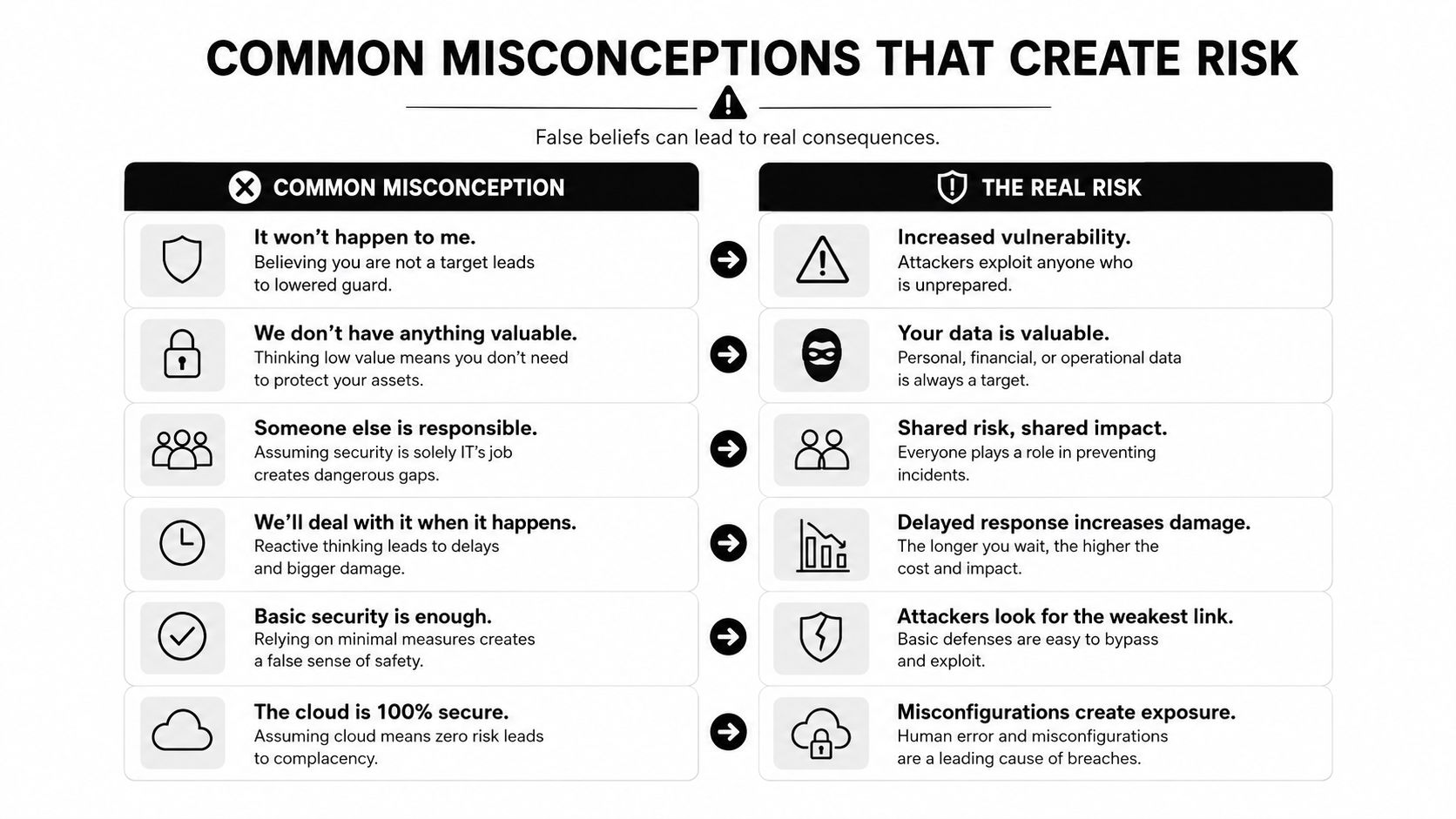
It doesn't. A construction site can require a shorter maximum interval, while low-risk equipment may fall into a longer category. An annual visit can therefore be excessive in one setting and inadequate in another. The correct schedule starts with classification.
New equipment isn't a permanent exemption from inspection and testing. Queensland's regulation distinguishes new equipment from equipment that has already been inspected and tested before tagging. Once the item enters a workplace or a higher-risk environment, the PCBU must manage it under the applicable safety system.
A new power tool taken directly onto a construction site shouldn't be treated as permanently outside the site regime because it came out of a box. Confirm its status before use and record it properly.
Domestic equipment hired for domestic use can be treated differently from ordinary workplace equipment. But a homeowner's tool may become workplace equipment when a business, contractor or builder uses it during renovation work. The facts of the use matter more than the appliance's appearance.
Visual inspection is essential, but it doesn't replace the required electrical testing where the regime applies. A cord can look acceptable while an electrical fault remains. A competent person needs to carry out the inspection and testing process, then tag safe equipment immediately.
An electrical licence alone isn't a substitute for a proper test, suitable equipment, accurate records and the correct commercial licensing arrangement. WorkSafe Queensland's position is that the person must be competent and the PCBU performing testing as a business or undertaking must hold the relevant contractor licence.
A tag proves a process occurred. It doesn't excuse the business from managing damage, movement or changing site conditions.
Construction and demolition work is where Brisbane owners most often carry the wrong assumptions across from ordinary premises. Queensland's regulation brings equipment used in certain construction settings under AS/NZS 3012, rather than allowing a generic AS/NZS 3760 approach to answer every question (Queensland's in-force electrical safety regulation).
A Morningside kitchen renovation can look domestic to the homeowner but operate as a worksite once tradespeople and a business undertaking are involved. The owner shouldn't decide the testing regime by calling the job a home project. Ask who controls the workplace, who supplies the tools and how the equipment is being used.
A small builder moving between North Brisbane sites needs a portable equipment register that follows each item. A drill or extension lead tested in an office, workshop or private garage may face a different regime after deployment to construction work. The new site conditions need to be assessed before the item is used.
Hire equipment creates another trap. A hire company may supply the same type of drill to a household for domestic use and to a builder for commercial construction work. The hiring status, customer, site and actual use must be checked rather than assumed from the equipment label. Queensland guidance also notes that domestic equipment hired for domestic use is treated differently from ordinary workplace equipment.
The sensible handover process is simple:
Queensland's legislation site publishes current in-force versions and updates, so don't rely on an old checklist copied from a national summary (the current Queensland legislation publication).
Start with an equipment walk-through, not a phone call to the first tester in a search result. List portable appliances, power tools, extension leads, chargers and other plug-connected equipment, then record where each item is used. Separate home-only items from workplace assets and identify anything that travels between sites.
Ask the provider four direct questions:
A proper visit generally combines visual inspection with electrical checks such as insulation resistance, earth continuity and polarity, as appropriate to the equipment and testing procedure. If an item fails, it must be clearly marked as unsafe and removed from service until a licensed person repairs it or the business disposes of it.
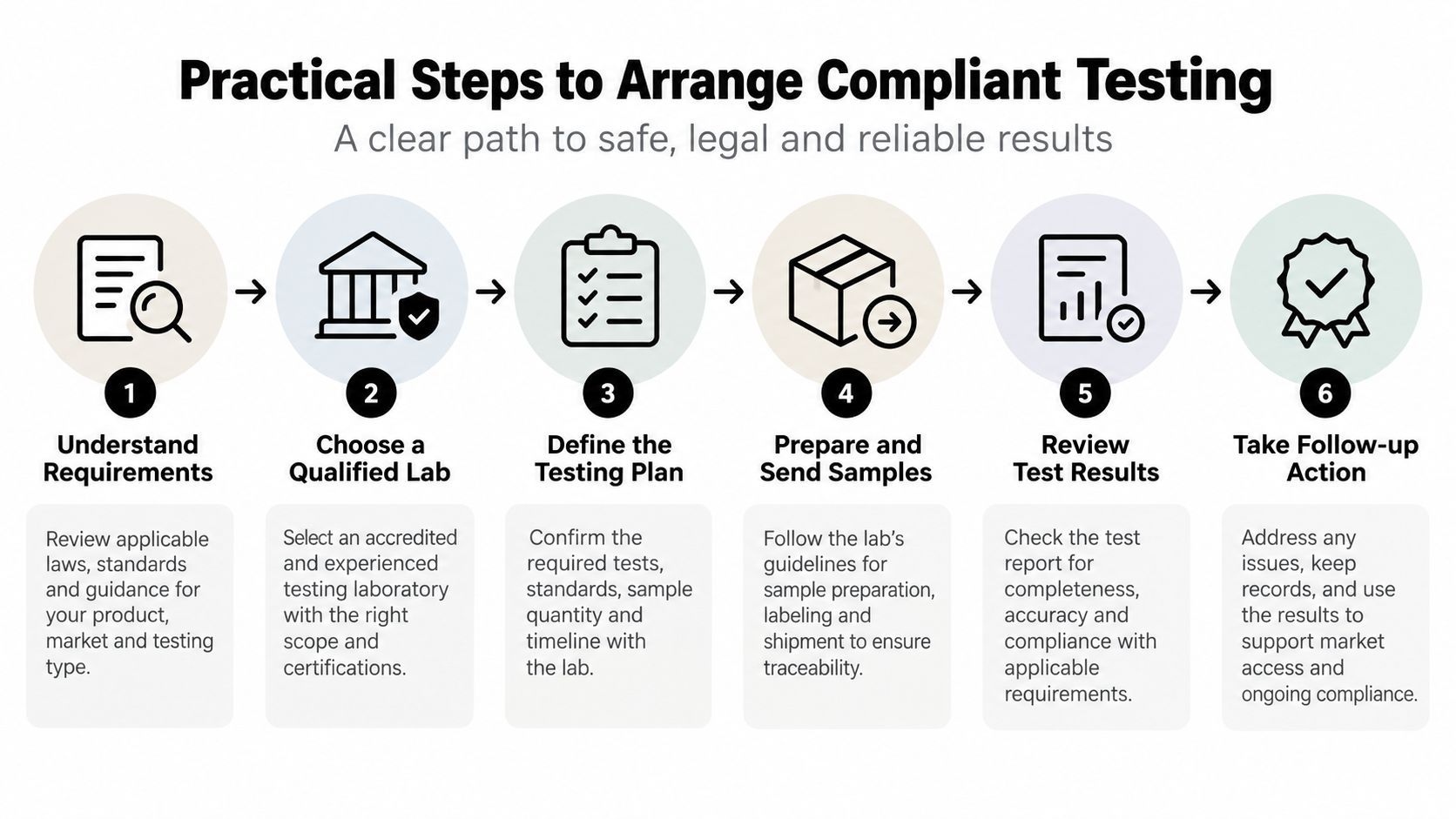
Keep the physical tags legible and store the electronic or printed asset register somewhere the responsible manager can access. The register should connect each asset to its location, result, defects, repairs and retest date. Businesses that need a broader records system can also review these small business record keeping rules so electrical records don't disappear into individual inboxes.
For practical guidance on what a Brisbane service may include and how pricing can vary, review testing and tagging prices, then compare providers on scope rather than sticker count. Confirm insurance, site access requirements, turnaround time and the ability to service multiple properties under one organised register.
Don't book a provider that refuses to explain the paperwork. A complete audit trail is more valuable than a bag of tags with no asset identification.
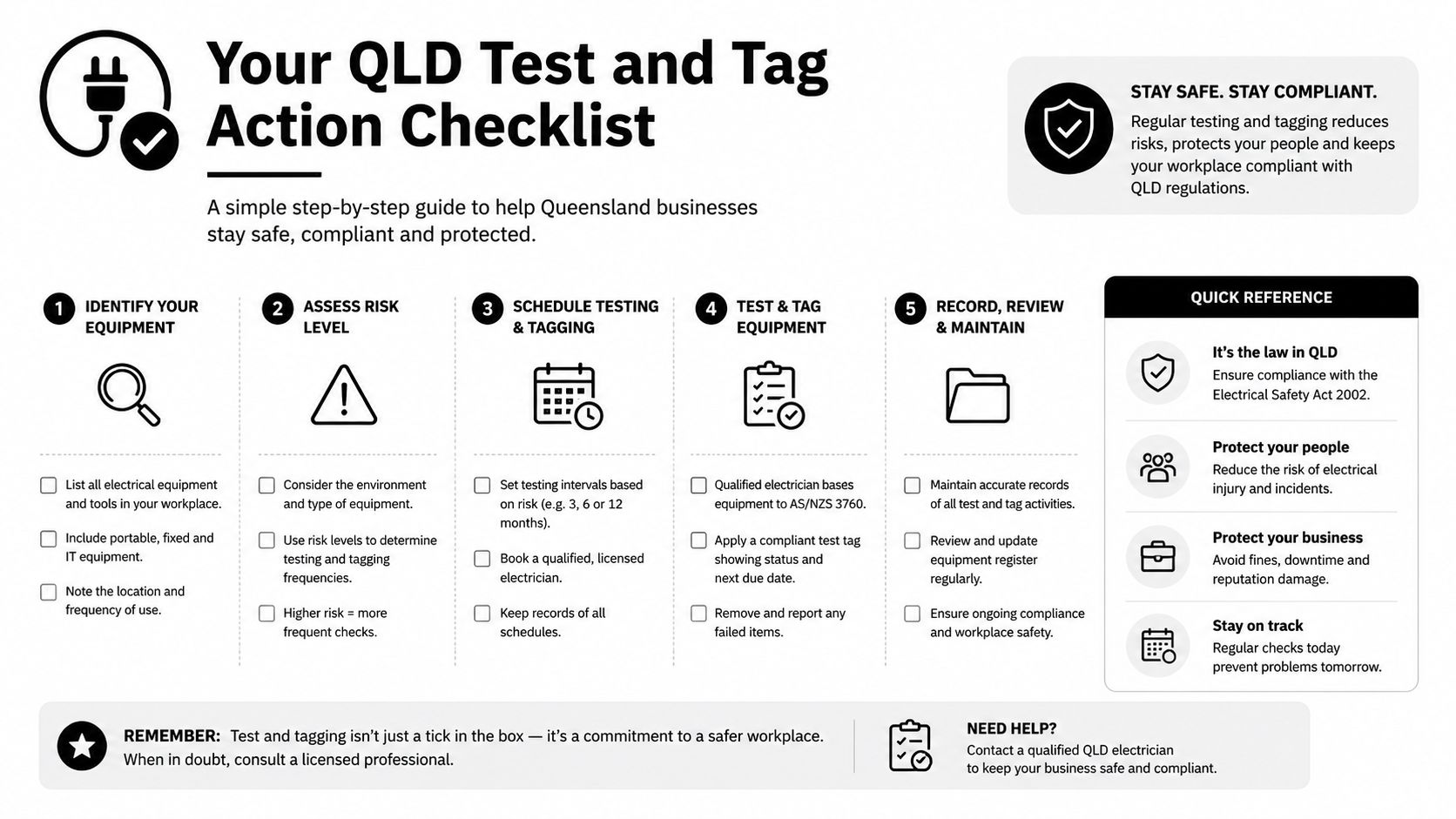
Work through this list before arranging a visit. It will tell you whether you need testing, what schedule fits and what evidence to demand.
The items most often missed are flexing leads in hospitality, power tools moving between Brisbane sites and second-hand appliances with no reliable test history. For construction, manufacturing, hire and other higher-risk operations, arrange a licensed Brisbane contractor within the next month. For a low-risk home or office setup, first confirm which equipment is in scope so you don't pay for a blanket program that doesn't match the legal duty.
For a broader review of your property's electrical condition, an electrical inspection report can help separate test-and-tag issues from fixed wiring, switchboard and installation concerns.
DLG Electrical helps Brisbane landlords, renovators and businesses arrange professional test-and-tag services, electrical inspections and practical safety upgrades matched to the equipment's real environment. Visit DLG Electrical to request a quote and discuss the records, site conditions and compliance support your property needs.

Master Electrician with over 30 years of experience. Founded DLG Electrical in 2005 after international project work including electrical installations at Stamford Bridge Stadium, London(Home of Chelsea FC).

Local Electricians that can fix all Electric Hot water Systems.
Motion sensor lights are a versatile addition to any home, offering nu
