83 Jean St, Grange QLD 4051
Mon-Fri 07:30 AM - 04:00 PM - Sat - 8:00 - 12 - Sunday Closed
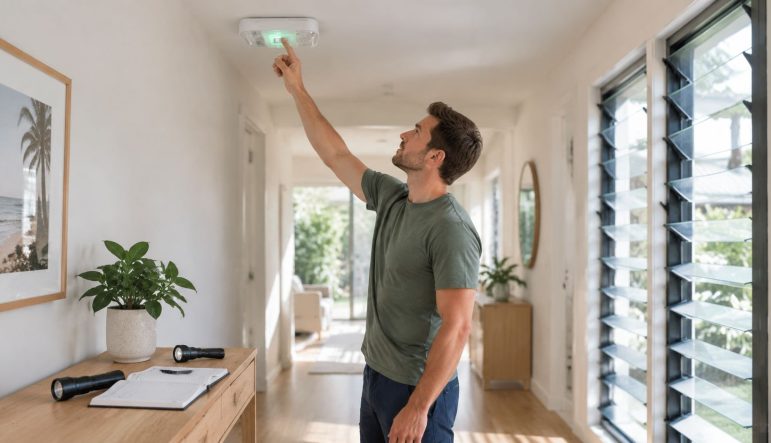
A Brisbane storm rolls through, the power drops out, and the hallway that looked perfectly safe a moment earlier becomes a dark route filled with corners, doors and trip hazards. A torch might help one person, but it doesn't prove that an emergency fitting, exit sign or battery-backed circuit will guide everyone out safely.
That's why an emergency lighting test needs to be more than pressing a button and assuming the green indicator means everything is fine. The correct frequency depends on the system architecture, and the result needs to be checked, recorded and acted on when a fitting fails.
During a mains failure, emergency lighting supports movement through corridors, stairs, shared paths and exit routes. In a Brisbane house, that might mean a common hallway or a path leading from a shared garage. In a townhouse complex or small shop, it can include multiple fittings serving different occupants and escape routes.
A fitting can appear healthy during normal operation and still fail when its battery has to carry the load. The warning signs are practical: a light doesn't transfer to battery mode, an exit sign goes dark, illumination flickers, or a fitting starts brightly and then drops out before the required duration.
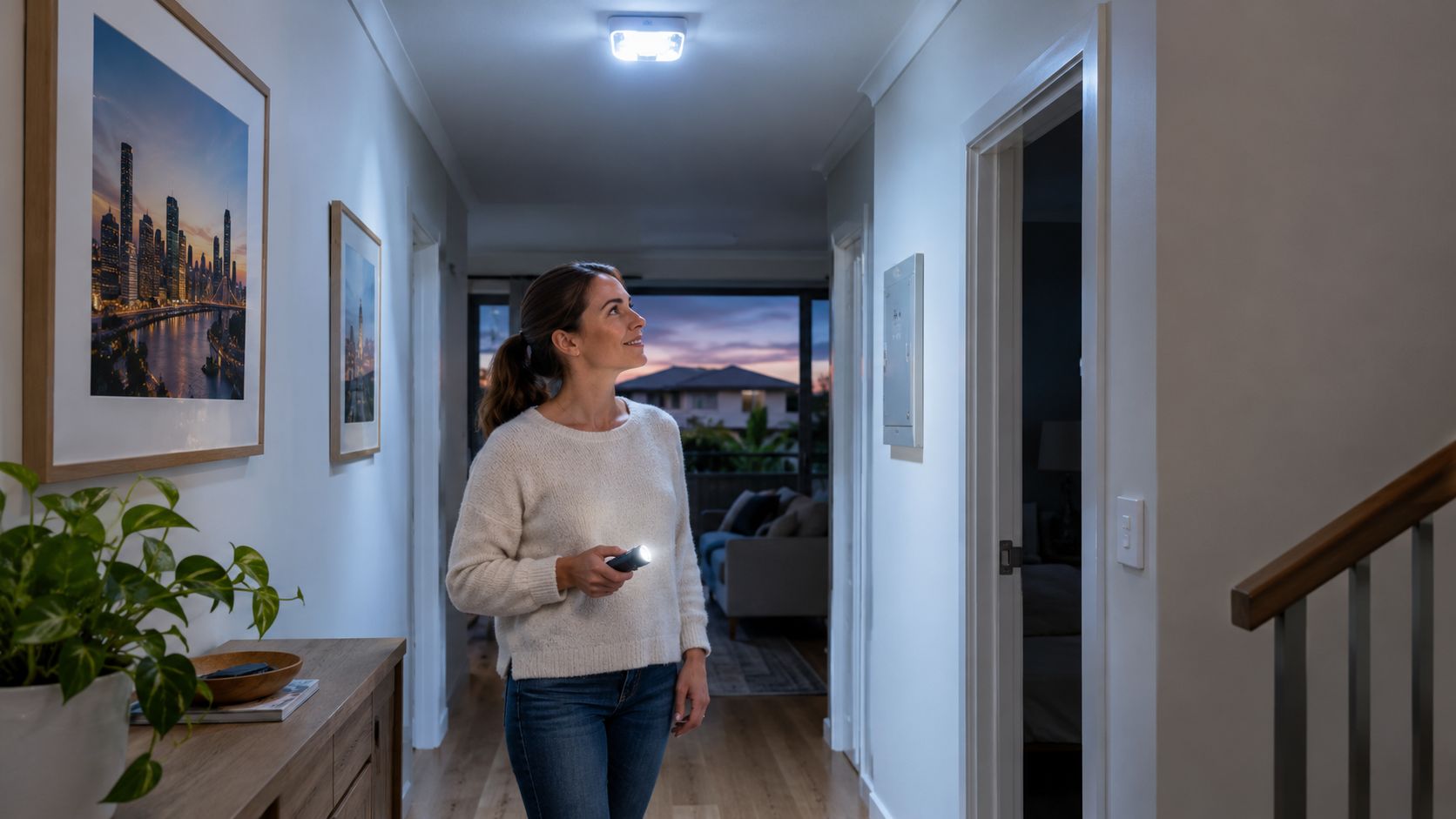
Australia's emergency lighting framework is built around AS/NZS 2293, with separate parts covering design and installation, routine service and maintenance, and product performance. The National Construction Code references AS/NZS 2293.1 for required emergency lighting systems, so the standard sits at the centre of building compliance rather than being an optional maintenance preference. Australian emergency lighting testing guidance explains how these parts work together.
AS/NZS 2293.2 sets a six-monthly routine service cycle, including a full-duration discharge test of every emergency luminaire and exit sign, with the result recorded for each fitting. The underlying design assumption is a 90-minute emergency duration, so the test checks whether the battery-backed system can sustain illumination during a simulated power failure.
Practical rule: A charge indicator tells you that a charger is operating. It doesn't prove that the battery will last through the required discharge test.
A failed emergency lighting test can create more than an inconvenience. Occupants may struggle to find exits, landlords may face questions about safety obligations, and business operators may have difficulty demonstrating that maintenance has been carried out. A clear electrical safety reference such as the Upchurch Inspection electrical guide can also help homeowners understand why routine inspection matters across the wider electrical installation.
The most useful first question isn't whether the property is residential or commercial. It's which emergency lighting system is installed.
A self-contained fitting has its own battery and charging circuit inside the unit. A central battery system supplies multiple emergency fittings from a shared battery installation, usually located in a dedicated cupboard or plant area. Those arrangements behave differently during testing, so a townhouse complex shouldn't automatically be given the same routine as a standalone rental house.
Australian guidance commonly distinguishes between monthly functional checks for self-contained units and six-monthly functional testing for central battery systems, while both arrangements still require a 90-minute annual duration test. The six-monthly AS/NZS 2293.2 service cycle remains the key Australian maintenance reference, and the responsible person should confirm the exact schedule for the installed system and building.
| Property and System Type | Functional Check Frequency | Duration Test Requirement |
|---|---|---|
| Standalone Brisbane rental house with self-contained emergency fittings | Commonly monthly functional checks, with routine service arrangements confirmed for the installation | Annual 90-minute duration test |
| Townhouse complex with self-contained fittings in shared areas | Commonly monthly functional checks for the individual units, with shared-area maintenance coordinated by the body corporate or appointed contractor | Annual 90-minute duration test for the emergency fittings |
| Small shop with self-contained emergency lights and exit signs | Commonly monthly functional checks, plus scheduled servicing and individual fitting records | Annual 90-minute duration test |
| Small commercial premises with a central battery system | Commonly six-monthly functional testing through the central system | Annual 90-minute duration test for the connected emergency lighting system |
The distinction matters because a central battery fault can affect several fittings at once, while a self-contained failure may be limited to one battery, charger, lamp or LED module. Treating every installation as a simple wall switch test can miss a system-wide problem.
For broader Queensland electrical maintenance context, the Queensland test and tag requirements guide is useful, although emergency lighting has its own testing and documentation considerations.
A test is only useful when it's performed safely and under controlled conditions. Turning off the wrong circuit can interrupt equipment that occupants rely on, and opening a switchboard without the right training can expose you to electrical hazards.
Before touching a fitting or isolating a supply, work through the following checks.
Walk the property and identify every emergency luminaire and exit sign. In a small commercial premises, compare the fittings with the existing plan or logbook so a concealed fitting, remote head or rear exit isn't missed.
Check for cracked covers, loose heads, water entry, corrosion, paint over the diffuser, blocked light output and damaged signs. These faults can make a fitting unsuitable even if its battery still operates.
The battery also needs enough time to recharge before a meaningful discharge test. If the supply has recently been interrupted, or a fitting has just been installed or repaired, record that condition and arrange the test when the system has returned to its normal charged state.
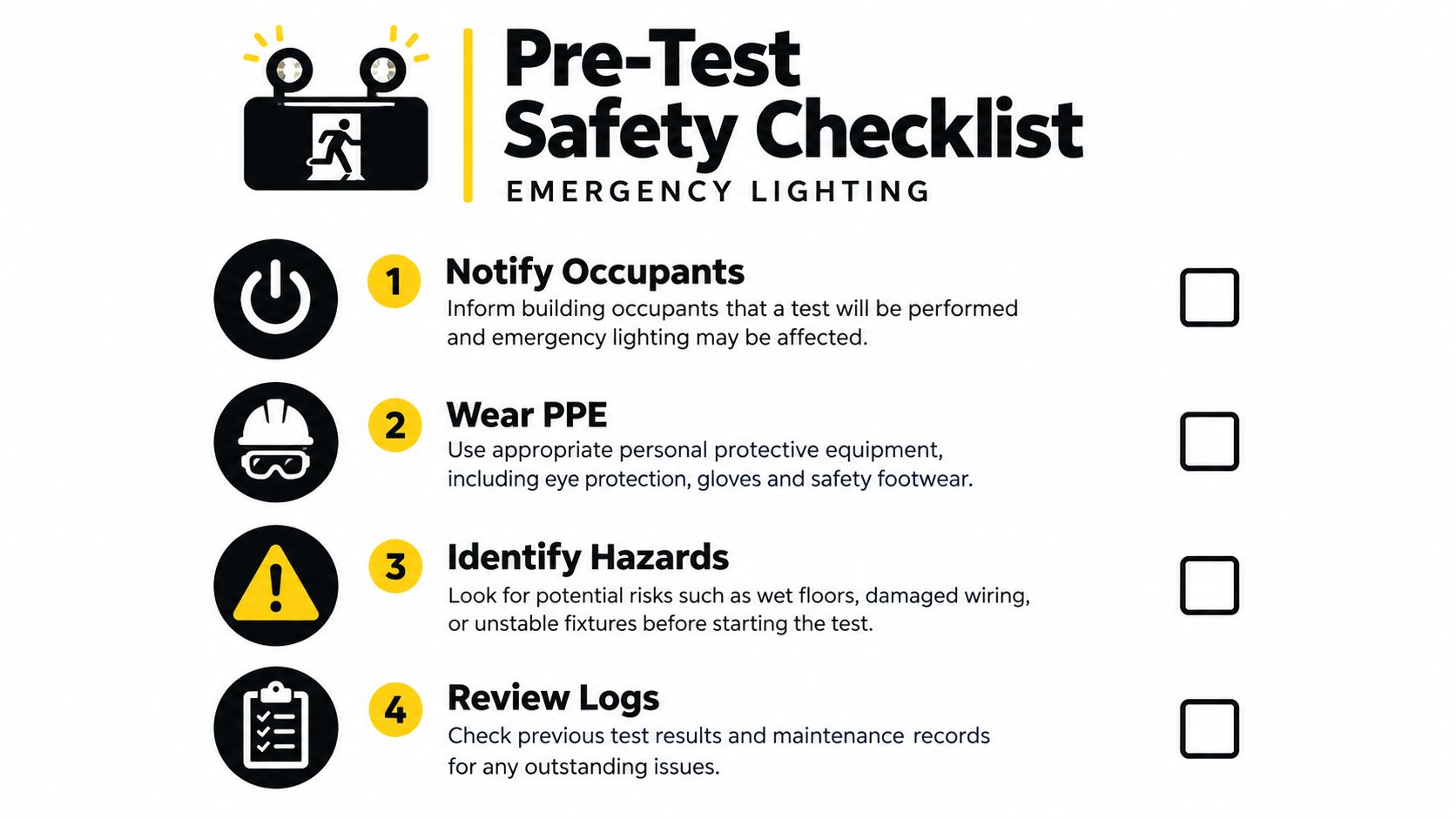
Set out the logbook before starting. Each fitting needs its own identification, location and result, not one general note saying “lights checked”. Record any defect while it's fresh, including a dark indicator, damaged diffuser or fitting that fails to transfer to battery mode.
Never create a false pass by resetting a tripped circuit without finding out why it tripped.
For a central battery installation, don't improvise at the panel. Confirm the correct test controls, understand which areas will lose normal supply, and engage a licensed electrician where the isolation method or battery system isn't clear.
The test should simulate the condition the system is designed to handle, then assess every fitting individually. A quick press of a local test button can confirm basic transfer, but it doesn't replace the required duration assessment.
Start with the prepared logbook and the fitting list. Mark the location of each emergency luminaire and exit sign, then note whether it is self-contained or connected to a central battery system. For a small shop, include signs above rear and side exits, not just the fitting above the main customer entrance.
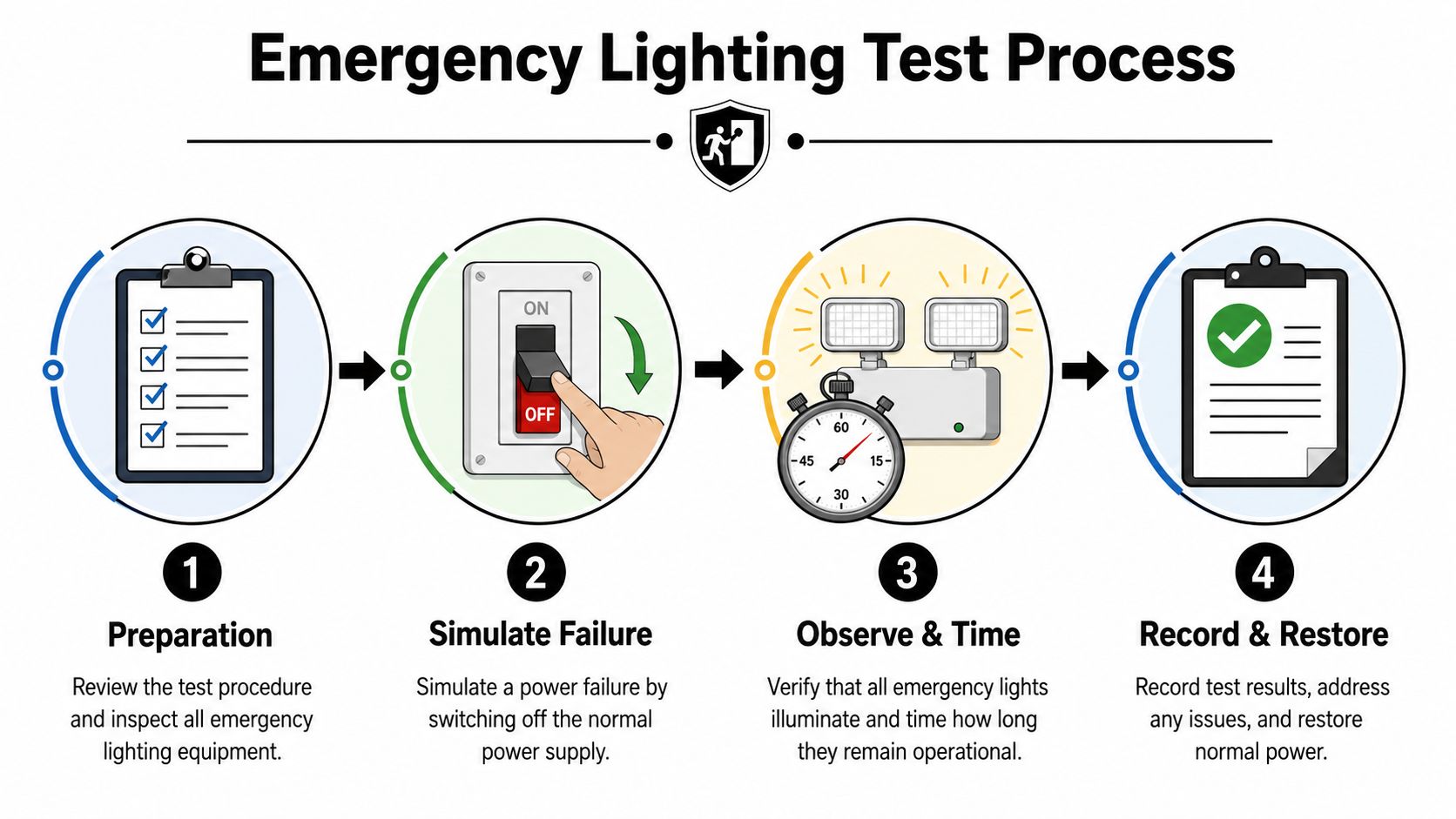
Use the fitting's approved test facility or the correct isolation method for the installation. The objective is to remove normal mains supply while leaving the emergency system available to operate. Don't pull random plugs or switch off unrelated circuits, because that can produce an invalid result or create a nuisance interruption.
When the normal supply is removed, observe each fitting. Emergency luminaires should transfer to battery operation, and illuminated exit signs should remain visible. Check the route from the occupied area to the exit, including turns, stair landings, doorways and shared access areas.
Look for:
For the applicable full-duration test, monitor the installation for the required 90-minute period, as specified within the Australian emergency lighting framework. Record the start time, observe the fittings during the test and record the finish condition for every unit. AS/NZS 2293 testing guidance describes the full-duration discharge requirement and the need to record results for each fitting.
A pass means the fitting transfers correctly, provides usable illumination, remains steady and continues operating for the rated period. A premature drop-out, severe dimming or complete failure is a fail, even if the fitting worked during a short functional check.
Testing at a low-traffic time reduces disruption, but it doesn't remove the need to keep people safe. In larger shared areas, have a second person walk the route while the test is running. Photos of a failed fitting, damaged diffuser or obscured exit sign can support the repair record.
This short video provides a visual introduction to the general testing process. The exact Australian schedule and method still need to follow the installed system and applicable requirements.
Return the normal supply using the approved control. Check that every fitting returns to its normal charging state and that the indicator behaves as expected. A fitting that remains in emergency mode, shows a fault indication or doesn't recharge needs further investigation.
Record the result beside the fitting ID. A practical log includes the location, system type, test date, test type, start and finish condition, pass or fail result, defect description, repair action and retest result. When discussing wider site security and occupant safety planning, resources such as community security savings South Wales may be relevant to a broader property risk review, but they don't replace emergency lighting maintenance.
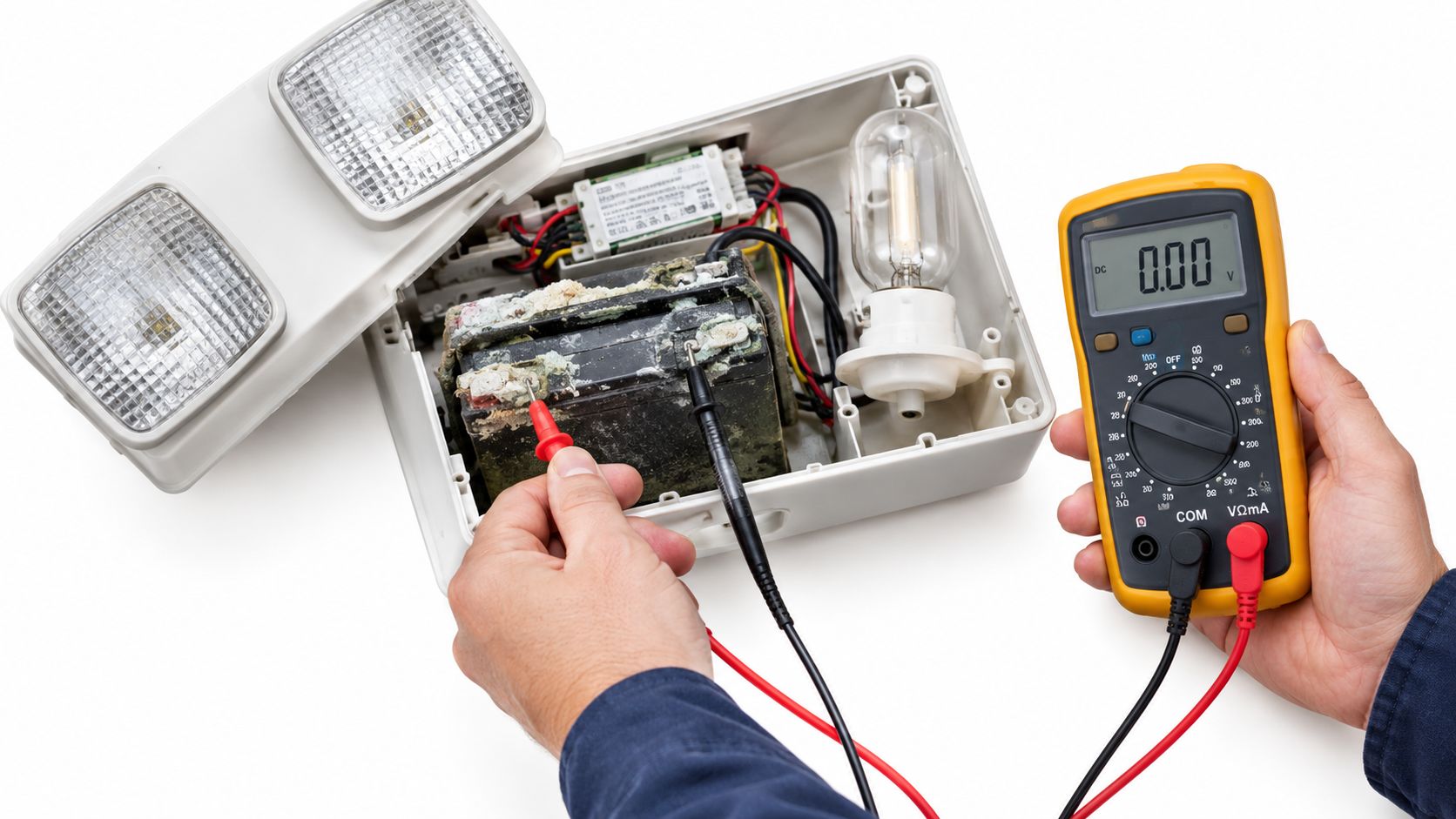
Most emergency lighting faults fall into a small group of causes. The useful approach is to match the symptom with the likely fault, then decide whether a visual check is enough or a licensed electrician needs to test the circuit.
| Symptom | Likely cause | Safe next action |
|---|---|---|
| Fitting stays dark during the test | Flat battery, failed charger, lamp or LED module, or a supply problem | Check the indicator and visible condition. Arrange electrical testing rather than opening the fitting |
| Light starts brightly then fades | Battery capacity is poor or the connected load is excessive | Record a duration failure and have the battery, charger and load assessed |
| Charge indicator is off or abnormal | Charger fault, loss of supply or internal electronics fault | Confirm the normal supply hasn't been isolated, then call an electrician if the indication remains incorrect |
| Exit sign is dim or incomplete | LED or lamp fault, diffuser damage or internal wiring issue | Keep the sign on the defect list and arrange repair |
| Fitting flickers | Loose connection, failing lamp or unstable driver | Don't rely on it. Isolate only through the correct procedure and arrange diagnosis |
| Diffuser is dirty or blocked | Dust, paint, storage or later building changes | Clean accessible surfaces safely and remove obstructions. Electrical repairs require a licensed electrician |
A weak battery can pass a short functional check and still fail the longer discharge test. Central battery systems need extra care because one battery bank, charger or control fault may affect multiple fittings across a shared area.
Keep fittings free from dust, paint and stored items. Don't cover ventilation openings, alter the head direction without checking the route, or add remote heads without confirming that the base unit can support the connected load.
Homeowners can usually identify a dirty diffuser, blocked fitting or damaged cover from the floor. They shouldn't dismantle a fitting, probe battery terminals or work inside a central battery cabinet unless they're appropriately licensed and equipped.
Battery replacement isn't always the correct answer. A charger fault, incorrect replacement, corrosion, wiring defect or overloaded remote circuit can cause the new battery to fail as well. A technician should test the complete assembly and carry out a retest after repairs.
For properties that also rely on battery-backed power for other equipment, the uninterruptible power supply guide offers useful background on the difference between backup power arrangements. Emergency lighting still needs to be assessed as its own life-safety system.
A working fitting is only one part of compliance. The owner, manager or body corporate also needs to show what was tested, when it was tested, which fitting passed or failed, and what happened after a defect was found.
Australian guidance states that emergency lighting records should be retained for seven years. Australian emergency exit light testing guidance highlights this record-keeping expectation and the difference between self-contained and central battery systems.
For each fitting, record:
A logbook with unexplained failures is not complete. Attach photographs, invoices or service notes where they help identify the work carried out, particularly in townhouse complexes where shared-area responsibilities may change between managers or contractors.
Call a licensed electrician if a fitting repeatedly fails, a breaker trips, the wiring is damaged, the charger or central battery panel shows a fault, or several fittings fail together. Professional support is also appropriate when a new tenancy, renovation, changed exit route or building alteration affects the existing emergency lighting layout.
DLG Electrical lists emergency lighting installation services alongside electrical work for residential and commercial properties. For Brisbane homes, townhouse common areas and small shops, the practical outcome should be a tested system, a clear defect list and records that match the fittings on site.
Start by identifying the system type and locating every fitting. Complete the applicable functional and duration tests, repair failures promptly, and keep the records organised for the full retention period. That routine gives occupants a safer escape route and gives owners a defensible maintenance history.
DLG Electrical can inspect emergency and exit lighting, carry out scheduled function and discharge testing, and investigate failures across Brisbane residential and small commercial properties. Visit DLG Electrical to discuss the system at your property and arrange practical electrical support.

Master Electrician with over 30 years of experience. Founded DLG Electrical in 2005 after international project work including electrical installations at Stamford Bridge Stadium, London(Home of Chelsea FC).

Local Electricians that can fix all Electric Hot water Systems.
Motion sensor lights are a versatile addition to any home, offering nu
