83 Jean St, Grange QLD 4051
Mon-Fri 07:30 AM - 04:00 PM - Sat - 8:00 - 12 - Sunday Closed
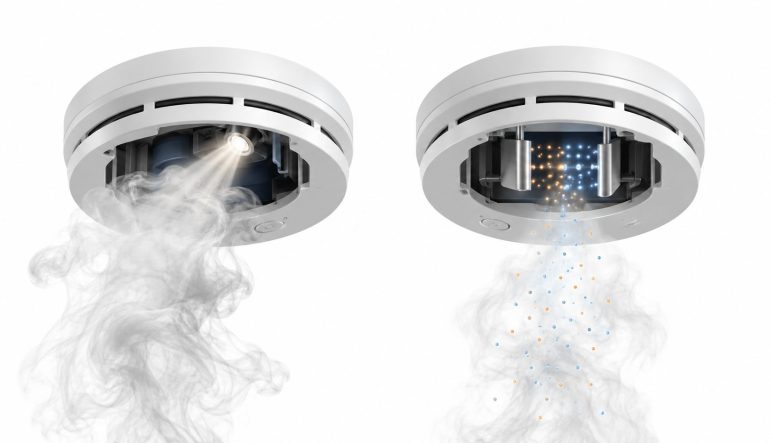
The popular advice says the photoelectric vs ionisation smoke alarm decision is still an open contest: choose ionisation for fast flames and photoelectric for smouldering fires. That comparison is technically fair, but it gives Brisbane homeowners the wrong practical answer. In Queensland, the question is now largely which compliant photoelectric system you need, where it belongs, and who should install it, not which sensor technology wins a general debate.
Queensland's smoke-alarm requirements say alarms must be photoelectric and must not contain an ionisation sensor. The statewide rollout to existing homes culminates on 1 January 2027, so an ionisation alarm in an older Brisbane property is not a future-proof choice. Queensland Fire and Emergency Services explains the current smoke-alarm requirements and the limitations of ionisation alarms in smouldering fires.
| Decision point | Photoelectric | Ionisation |
|---|---|---|
| Main detection method | Light scattered by smoke particles | Disruption of an ionised electrical current |
| Strongest response | Smouldering fires | Some fast-flaming fires |
| Queensland residential position | Required for current compliant installations | Must not be used in Queensland residential alarms |
| Best general location | Bedrooms, hallways and living areas | Replacement rather than new residential selection |
| Whole-home strategy | Interconnected photoelectric alarms | Not a future-proof Queensland solution |
The physics still matters because it explains why Queensland moved in this direction. Photoelectric alarms provide earlier warning in the kind of slow, smoky fire that can develop while people are asleep, while ionisation alarms can respond more quickly in certain flaming-fire tests. The sections below separate those facts from the installation decision that applies in Queensland homes, rentals, caravans and motorhomes.
The assumption that every Brisbane homeowner should weigh two equally acceptable technologies is outdated. Queensland's rules require photoelectric alarms without ionisation sensors, and the transition to all Queensland homes is scheduled to finish on 1 January 2027. That turns the technology question into a compliance decision for homeowners, landlords, property managers and renovators. The Queensland Government's smoke-alarm guidance sets out the statewide rollout and interconnected photoelectric requirement.
Older Brisbane houses often still have ionisation alarms because that technology was once common in residential stock. A battery change can make one appear serviceable, but a test button only confirms that the alarm can sound. It doesn't make an ionisation sensor compliant, and it doesn't turn an old alarm into an interconnected photoelectric system.
New homes and substantially renovated properties have already driven the move towards photoelectric protection, while rental properties have faced earlier upgrade obligations than many owner-occupied homes. For an older owner-occupied dwelling, the practical deadline is approaching rather than hypothetical. A renovation, sale, tenancy change or routine electrical assessment is a sensible time to identify outdated alarms instead of waiting for the final compliance date.
Queensland's position also applies beyond the conventional detached house. The state's requirements cover private homes, townhouses and units, and the broader rollout includes caravans and motorhomes. That matters for owners who have treated a caravan alarm as a separate consumer purchase rather than part of the state's fire-safety framework.
Practical rule: If an alarm contains an ionisation sensor, plan to replace it with a compliant photoelectric alarm. Replacing only the battery solves a power problem, not a technology or compliance problem.
The remaining choice is about execution. You still need to select hardwired or sealed-battery units, confirm interconnection, place alarms correctly, and avoid installing a compliant product in a poor location. A photoelectric alarm in the wrong part of a house can provide less useful warning than a properly positioned, interconnected system.
A photoelectric alarm works a little like headlights in fog. Inside the sensing chamber, an LED sends light across an open path towards a sensor positioned away from the direct beam. Clean air leaves the sensor undisturbed, but smoke particles scatter the light, allowing some of it to reach the photocell. The alarm detects that change and sounds.
That arrangement suits visible smoke from smouldering material. Overheated wiring, insulation, bedding, upholstery and electronics can produce thick smoke before a room develops an obvious flame. Photoelectric sensing is designed to recognise that smoke profile early, which is particularly valuable near sleeping areas and along escape routes.
An ionisation alarm uses a small radioactive source to ionise the air between electrically charged plates. That creates a small, stable current. When smoke enters the chamber, particles interfere with the ionised air and alter the current. The circuitry interprets that change as smoke.
Ionisation sensors tend to favour the smaller combustion particles associated with a fast-flaming fire. That gives them a genuine speed advantage in some open-flame conditions, but the same sensitivity can make them more prone to unwanted alarms from cooking particles, steam and other airborne contamination. In a home, frequent nuisance alarms can lead residents to silence, remove or ignore an alarm, which undermines the purpose of having it.
| Feature | Photoelectric | Ionisation |
|---|---|---|
| Sensing mechanism | An LED and photocell detect scattered light | A radioactive source and charged plates detect current disruption |
| Smoke profile | Larger, visible particles from smouldering material | Smaller particles associated with fast combustion |
| Typical strength | Earlier warning from slow-burning smoke | Faster response in some clean-flaming tests |
| Residential implication | Better aligned with bedrooms and escape routes | Not permitted in current Queensland residential installations |
| Main placement concern | Steam, dust and cooking smoke can still cause alarms | Greater sensitivity to airborne contaminants |
Neither sensor predicts every fire perfectly. Fire behaviour depends on the material burning, airflow, room layout and alarm position. The relevant point for a Brisbane home is that Queensland has selected one technology as the residential baseline, then paired it with requirements for audibility and interconnection.
The Australian test data shows why the legislation isn't based on marketing language. In NSW Fire and Rescue's domestic smoke-alarm analysis, the mean activation time for photoelectric alarms in smouldering scenarios was 17.03 minutes, compared with 44.19 minutes for ionisation alarms, a difference of 27.16 minutes. Those figures come from the Australian Building Codes Board and Fire and Rescue NSW domestic smoke-alarm study.
The same research found that ionisation alarms tended to activate first in flaming fires, while photoelectric alarms activated first in most smouldering fires. Another FRNSW test set recorded average flaming-test activation times of 123.71 seconds for ionisation and 187.60 seconds for photoelectric. The result isn't that ionisation is useless. It responds faster in a defined fire profile. The residential decision depends on which detection gap presents the more serious escape risk.
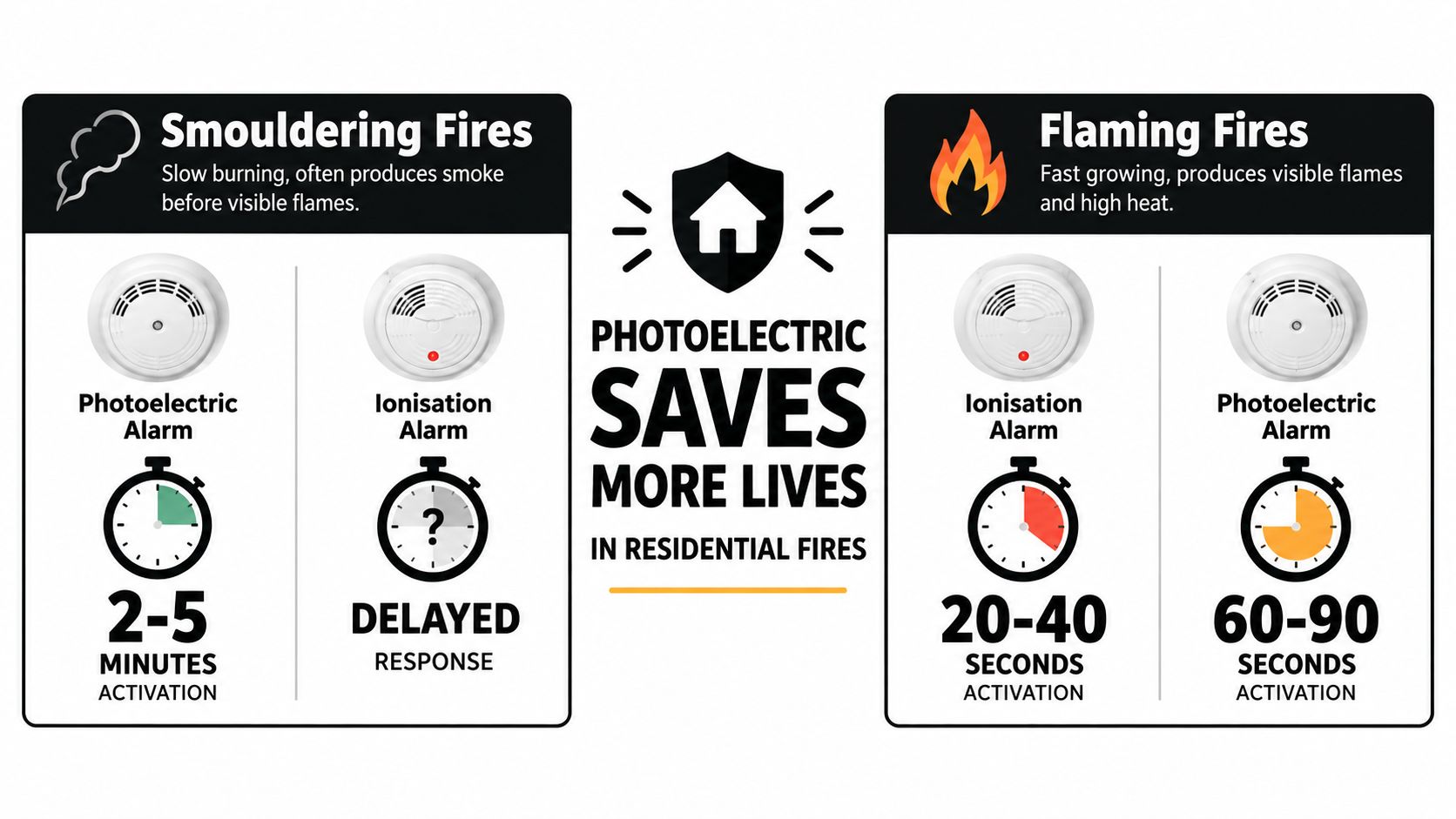
A smouldering fire in a bedroom, hallway or living room can fill a home with smoke before occupants see flames. That makes early warning especially important at night, when a sleeping person may not notice odour, heat or visual smoke promptly. The photoelectric advantage in those scenarios supports its use near bedrooms and on the path towards an exit.
An ionisation alarm's faster flaming-fire response remains a real technical trade-off, but it doesn't override Queensland's residential rule. The state has chosen interconnected photoelectric alarms as the standard, rather than asking each homeowner to calculate a fire-type probability and maintain a mixed system.
The useful question isn't which alarm wins every laboratory scenario. It's which compliant system gives everyone in the home an audible warning early enough to act.
Interconnection changes the practical outcome as well. A detector in a remote living area can alert occupants in bedrooms, while an alarm near a sleeping area can sound throughout the home. That whole-home warning is more useful than relying on a single sensor's advantage in one fire profile.
Sensor type is only one part of alarm performance. A compliant photoelectric unit still needs suitable output, reliable power, correct placement and effective interconnection. The product standard for residential smoke alarms is AS 3786:2014, and Queensland-relevant guidance specifies a minimum output of 85 dBA at 3 metres. This Queensland compliance guidance discusses AS 3786:2014 and the 85 dBA requirement.
| Feature | Photoelectric | Ionisation |
|---|---|---|
| Audibility | Must meet the applicable residential output requirement | Must meet the applicable residential output requirement |
| Smouldering-fire response | Stronger response in comparative domestic testing | Slower in the cited smouldering tests |
| Flaming-fire response | Can be slower in some fast-flaming tests | Can activate faster in some fast-flaming tests |
| Cooking and steam nuisance risk | Can still alarm if poorly positioned | More prone to unwanted alarms from airborne particles |
| Queensland residential compliance | Required for current installations | Must not contain an ionisation sensor |
| Interconnection | Available in hardwired and wireless systems | Not a suitable basis for a new Queensland home system |
| Power choices | Hardwired, battery backup or sealed battery options | Older units may use replaceable batteries or mains power |
| Replacement decision | Replace at the product's stated end of life | Replace rather than continue older stock |
Both technologies can be manufactured as mains-powered or battery-operated alarms, and both depend on maintenance. A sealed battery can reduce battery-change errors, while a hardwired alarm with battery backup can suit a permanent installation. Wireless interconnection can be useful where running cable would require substantial access work, but the system still has to communicate reliably across the property.
What works is a coordinated system with alarms in the required positions, a power arrangement suited to the building, and a test routine that residents do follow. What doesn't work is buying the cheapest standalone alarm, mounting it beside a cooking appliance, then assuming the compliance problem is solved because the siren sounds.
Photoelectric alarms don't eliminate nuisance alarms. Steam, dust and cooking smoke can still affect any smoke sensor. The answer is correct positioning and, where appropriate, professional advice about a heat alarm in an unsuitable cooking location, while preserving smoke detection along the nearby escape route.
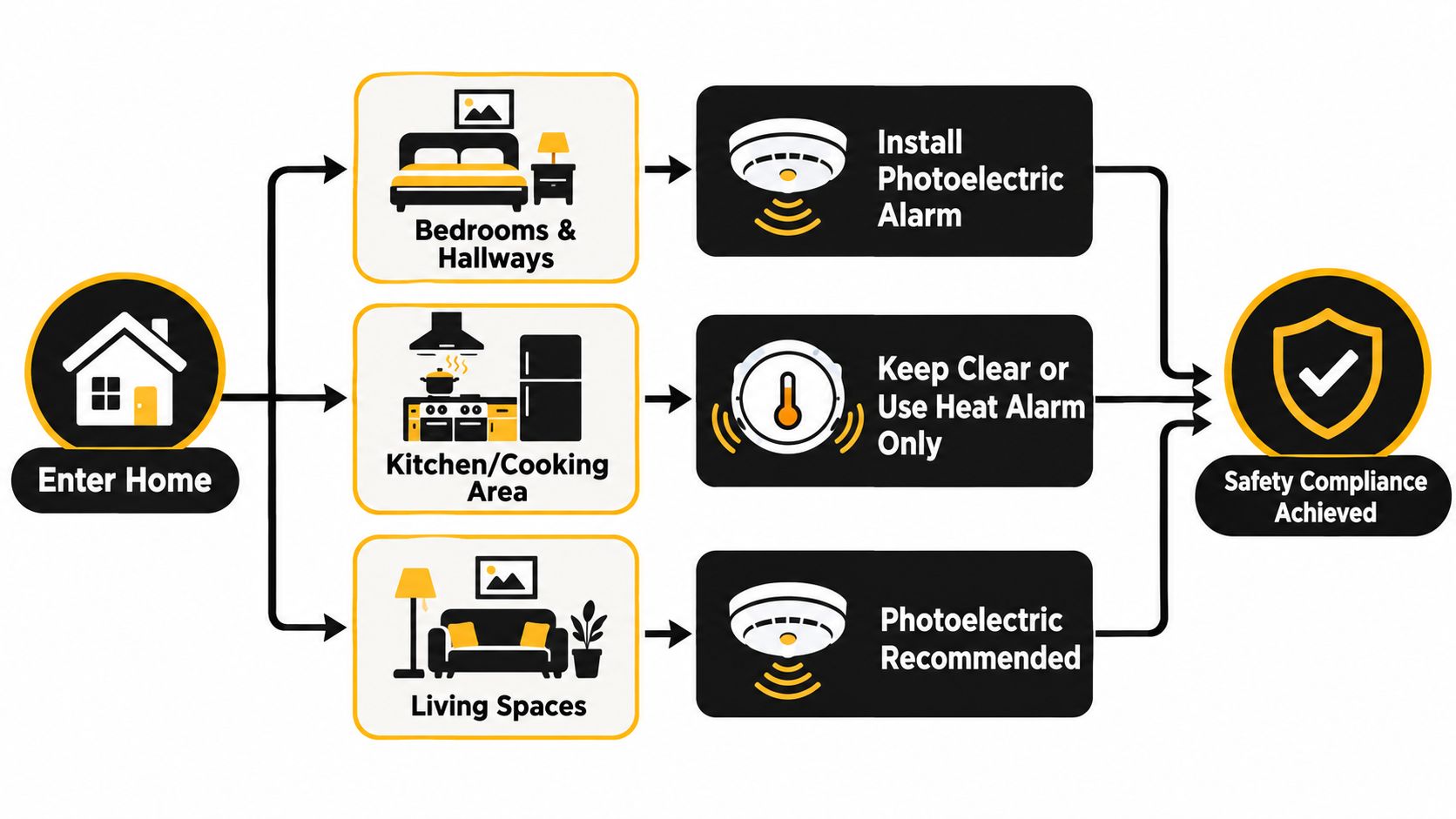
Bedrooms and the hallways connecting sleeping areas to the rest of the house should use interconnected photoelectric alarms. These locations need early warning from smoke, not just confirmation that flames have developed. A closed bedroom door can delay a person's awareness of a fire elsewhere, so an alarm sounding inside the sleeping zone matters.
Living rooms also suit photoelectric protection. Upholstery, electronics, chargers and wiring can smoulder, producing smoke before an obvious open flame. Place the alarm according to the manufacturer's clearance instructions and Queensland requirements, rather than treating the ceiling as a generic mounting surface.
A smoke alarm directly exposed to cooking vapour will create frustration regardless of its quality. A photoelectric unit positioned at a suitable distance from the cooktop can provide residential protection without being placed in the plume of normal cooking. Where a particular location is unsuitable for smoke detection, a heat alarm may be considered for that immediate area, but it shouldn't replace smoke alarms in bedrooms, hallways or living spaces.
Queensland homes vary widely. A modern townhouse, a high-ceilinged Queenslander and a compact unit can all need different mounting decisions because airflow, ceiling geometry and access differ. The Queensland photoelectric smoke-alarm guidance from DLG Electrical provides a useful starting point, but a complicated layout deserves an assessment rather than a guess.
Ionisation technology once had a defensible argument in areas where a rapid flaming fuel or solvent fire was the dominant concern. In Brisbane homes, garages and workshops also bring dust, fumes and temperature variation, all of which can make smoke-alarm selection and placement difficult. The current Queensland residential direction is simpler: use compliant photoelectric alarms where required, and obtain specific advice for unusual spaces rather than installing an old ionisation unit by default.
Interconnected photoelectric alarms across required positions provide a more coherent warning network than mixing old standalone ionisation units with newer alarms. If you find an ionisation alarm during a battery change, don't treat the battery replacement as the finish line. Replace the alarm when practical, and address the rest of the system if the home lacks interconnection.
Queensland's rules establish a clear sequence. From 1 January 2017, photoelectric alarms became mandatory in new dwellings and substantially renovated homes. Rental properties moved to the newer requirements from 1 January 2022, and the remaining statewide rollout for existing homes culminates on 1 January 2027. DLG Electrical's Queensland smoke-alarm compliance guide covers the practical implications for residential properties.
For rental homes, compliance is not just about placing a working alarm somewhere on each level. Domestic dwellings require interconnected photoelectric alarms, with alarms positioned in the required locations, including on each storey. Interconnection means that when one alarm detects smoke, the other connected alarms can warn occupants elsewhere in the property.
Hardwired alarms must be installed by a licensed electrician. A compliant installation also needs the correct electrical protection, suitable cable routes and reliable communication between alarms. In Queensland, alarms on the same storey must communicate with each other, so a system that looks complete but fails its interconnection test isn't an acceptable result.
Battery-powered photoelectric units can be an option where the rules and property conditions permit them, particularly sealed units designed for a long service interval. The choice between hardwired and battery power should account for the dwelling, existing wiring, access, renovation work and the owner's maintenance habits.
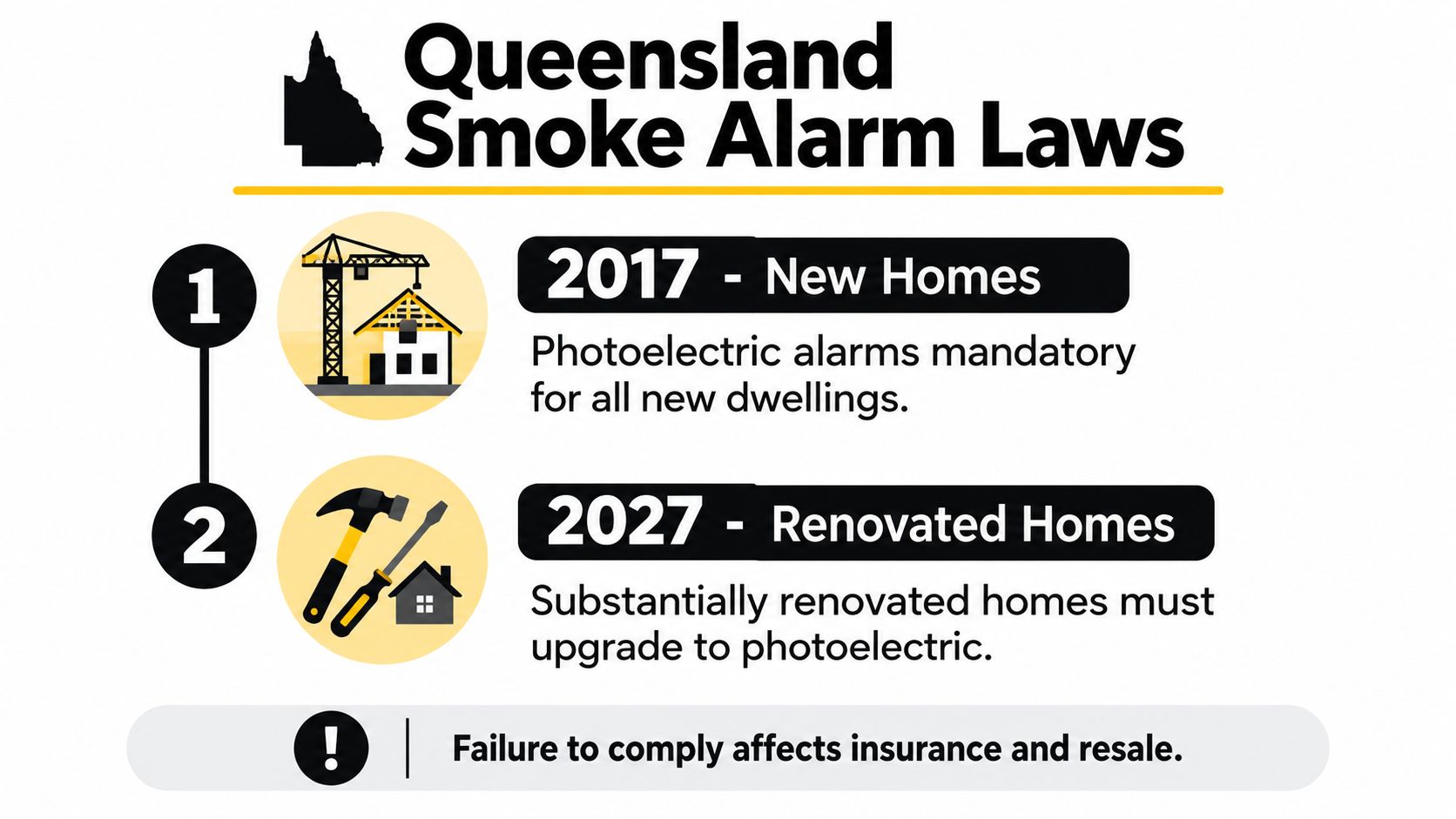
The cost of non-compliance is not limited to the purchase price of an alarm. Landlords can face substantial on-the-spot penalties, and unresolved compliance issues can complicate property management, inspections and transactions. Those consequences make it poor economy to retain an ionisation alarm just because it still passes a sound test.
Compliance is the floor. A well-designed system places interconnected photoelectric alarms where occupants sleep and move towards an exit, then tests every unit as a network.
A renovation is the logical point to upgrade wiring, replace obsolete alarms and resolve inaccessible ceilings. Owner-occupiers shouldn't wait until the final deadline if their existing alarms are ionisation, standalone, damaged or beyond their service life.
A compliant purchase starts with the label, not the colour of the casing. Use this checklist before ordering alarms for a Brisbane property:
Check AS 3786:2014 certification. The product should be clearly identified as meeting the relevant residential smoke-alarm standard. Avoid listings that describe a unit as “compliant” without showing the standard or certification details.
Confirm the sound output. Queensland-relevant guidance specifies at least 85 dBA at 3 metres. The compliance reference for residential smoke alarms explains why audibility is part of real-world protection, particularly in larger homes and closed bedrooms.
Choose photoelectric only. Don't rely on a product title that says “smoke and fire”. Read the specifications and confirm that it doesn't contain an ionisation sensor.
Decide how the alarm will be powered. Hardwired mains power with battery backup can suit a permanent installation, while a sealed long-life battery may suit properties where cabling is impractical. The right choice depends on the dwelling and applicable requirements.
Verify interconnection before installation. Ask whether the alarms will communicate as a complete system. Wireless units need a reliable signal across the property, and older Queenslander homes with dense timber construction may require careful placement or a different system design.
Confirm the electrical protection and installer. Hardwired work belongs with a licensed electrician and should be connected to the appropriate protected circuit. Don't treat a DIY mounting job as equivalent to a tested electrical installation.
Plan testing and replacement. Press each test button regularly, investigate any alarm that fails to sound or communicate, and record the installation date. Smoke alarms have a finite service life, so replacement should be planned rather than postponed until the casing becomes visibly damaged.
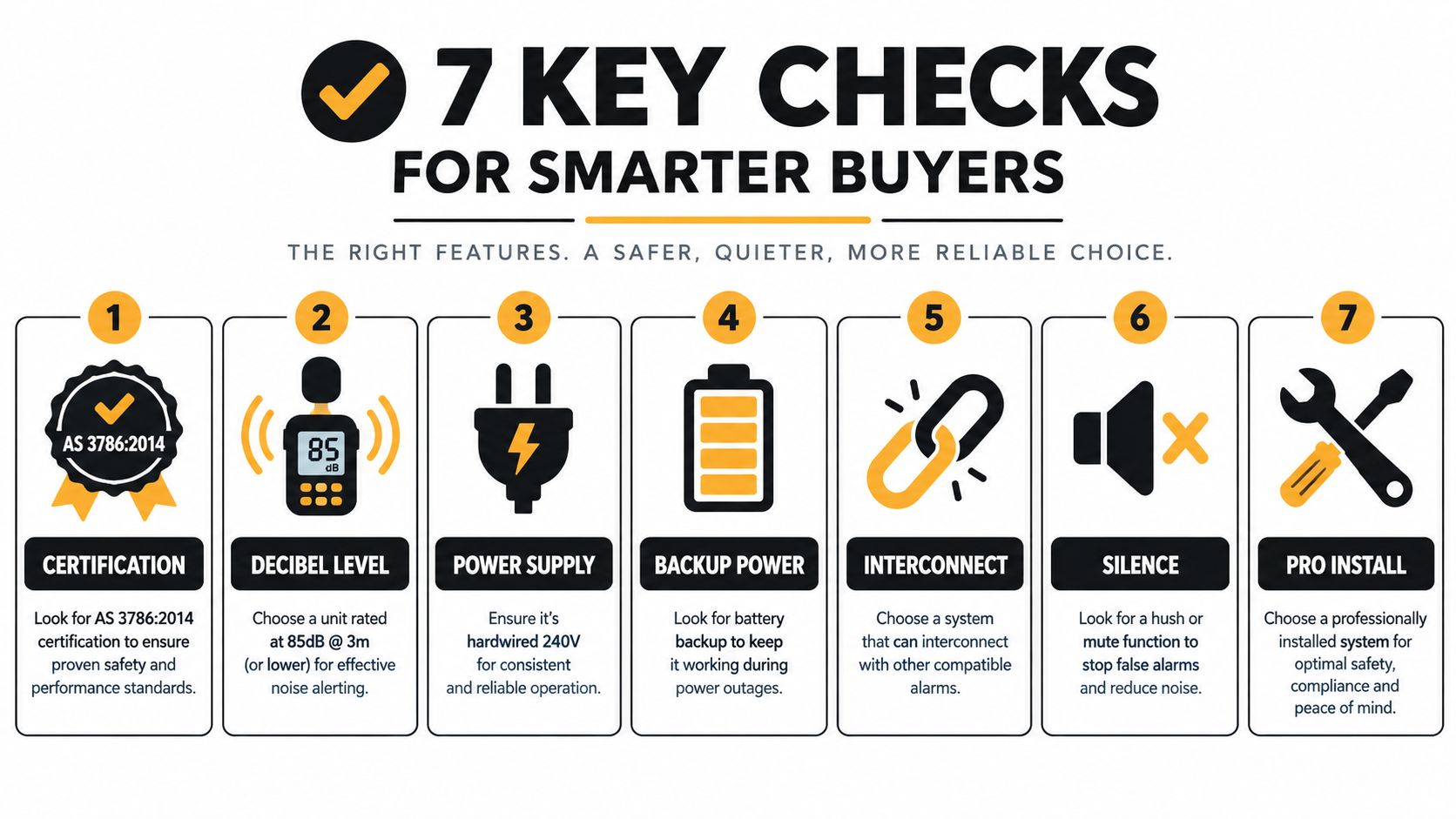
A low-priced alarm can become expensive if it lacks interconnection, has no clear date marking, or needs frequent battery replacement. Combination products also deserve scrutiny. A label such as “dual sensor” doesn't automatically establish Queensland compliance, especially if the unit includes an ionisation sensor.
Solar panels and battery storage don't remove the need for correctly powered, tested smoke alarms. If a property has a backup-power system, ask the electrician to assess how the smoke alarms are supplied and protected. For a practical maintenance reference, use this guide to how often smoke alarms should be replaced, then keep a written record for the property.
| Question | Answer |
|---|---|
| Are dual-sensor alarms worth choosing? | Not as a shortcut. If a dual-sensor product contains ionisation technology, confirm its Queensland suitability with a licensed professional. A compliant photoelectric system is the straightforward residential direction. |
| Can ionisation alarms remain in a Queensland home? | Older alarms may still be found in existing properties, but they aren't the future-proof choice. Replace them with photoelectric units as part of the required upgrade. |
| What about caravans and motorhomes? | Queensland's smoke-alarm requirements extend to these vehicles, with staged requirements applying to newly registered or transferred vehicles and then the wider registered fleet. Check the current state guidance for the vehicle's status. |
| Should a renovation include alarm replacement? | Yes. Treat obsolete ionisation alarms, missing interconnection and poor locations as part of the electrical scope, not as a later maintenance task. |
| Do wireless alarms count as interconnected? | They can form an interconnected system when the products are designed for that purpose and communicate reliably. Test the installed network, not just each individual alarm. |
| Does solar-battery backup change the alarm choice? | No. It may affect the electrical design, but it doesn't change the Queensland preference for interconnected photoelectric alarms. |
The caravan and motorhome transition is part of Queensland's broader move away from ionisation sensing. The practical dates and vehicle categories can change how an owner plans an upgrade, so the state guidance remains the appropriate reference rather than an old product leaflet.
From a Brisbane installation perspective, the photoelectric vs ionisation smoke alarm debate is settled for ordinary Queensland residential work. Ionisation has a defensible technical advantage in some fast-flaming tests, but Queensland requires photoelectric alarms without ionisation sensors, and the photoelectric choice also addresses the smouldering-fire warning gap that matters around bedrooms and escape routes. Buy a compliant product, interconnect it properly, position it carefully and test the finished system.
DLG Electrical can assess Brisbane homes, rentals and renovation projects, then install and test compliant photoelectric alarms, including hardwired and interconnected systems. Visit DLG Electrical to discuss your property, request a quote and arrange an upgrade before an outdated alarm becomes a compliance problem.

Master Electrician with over 30 years of experience. Founded DLG Electrical in 2005 after international project work including electrical installations at Stamford Bridge Stadium, London(Home of Chelsea FC).

Local Electricians that can fix all Electric Hot water Systems.
Motion sensor lights are a versatile addition to any home, offering nu
