83 Jean St, Grange QLD 4051
Mon-Fri 07:30 AM - 04:00 PM - Sat - 8:00 - 12 - Sunday Closed

You've probably had that moment. It's late, the house is quiet, the panel starts chirping, the dog wakes up, and your phone is face down on the kitchen bench. You're trying to decide whether it's a real issue, a low battery, or just another false alert while half the family sleeps and the neighbour's lights are still on.
That's where an alarm monitoring service stops being a gadget and becomes a decision system. It's not just about making noise, it's about getting an alarm from the wall, through a communication path, into a staffed centre, and then to a human who can decide what happens next. In property work, that chain matters because one weak link can turn a working alarm into an expensive siren that nobody acts on.
For homeowners, landlords, and small businesses in Brisbane, that chain also sits beside other risks, like smoke compliance, tenant changeovers, and what happens when the network drops out. If you're weighing security against power cuts, 3G shutdowns, and false alarms, a practical starting point is a business crime insurance guide that helps frame loss exposure alongside the system itself.
At 2am in Brisbane, the problem usually isn't the siren. It's the silence after it stops, when nobody in the house is sure whether the event is real, the panel is faulty, or the phone never rang because it was on do-not-disturb.
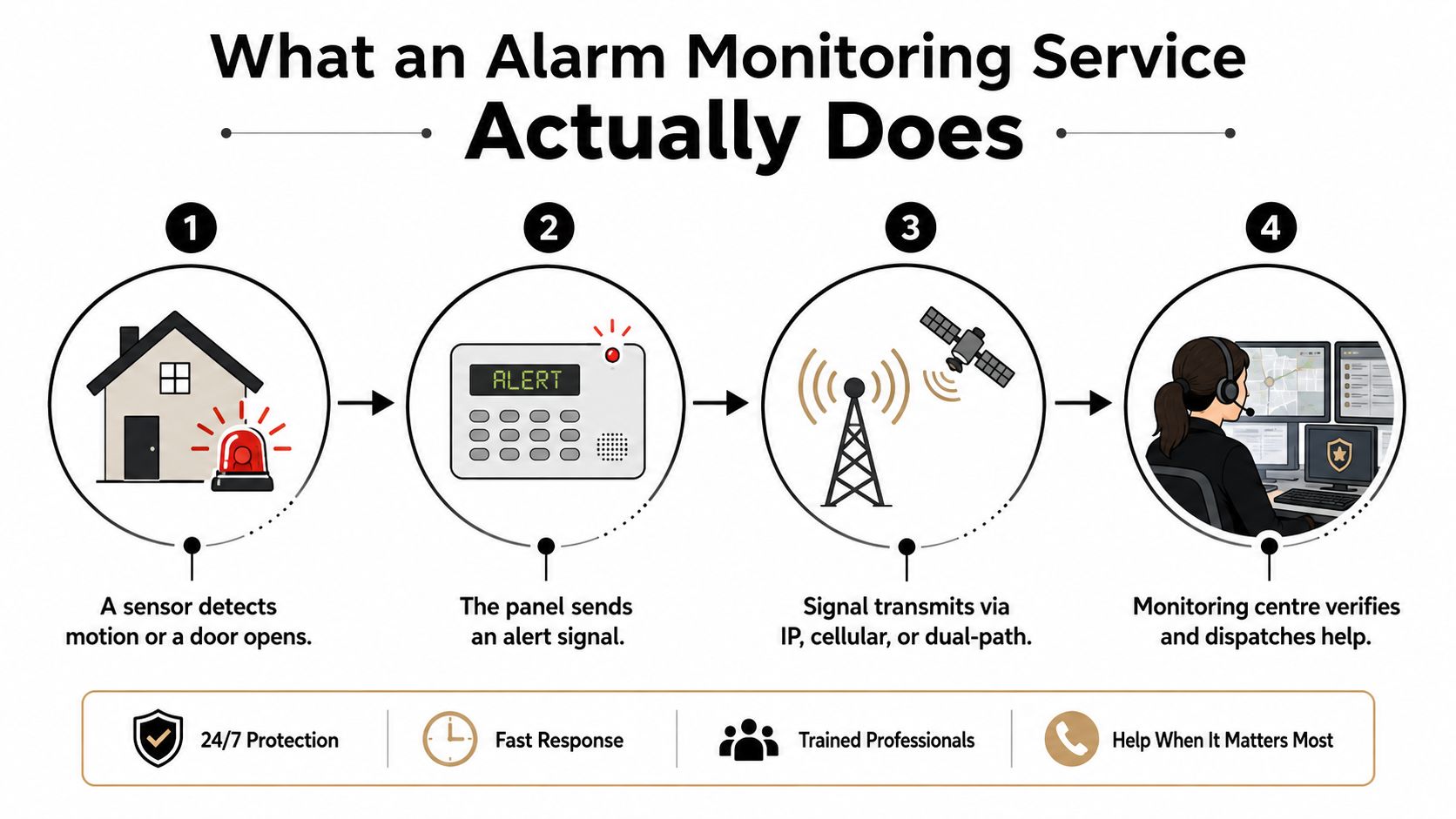
A monitored setup does four separate jobs. First, a sensor detects an event, like a door opening or movement where it shouldn't be. Second, the panel sends an alert signal. Third, that signal travels by IP, cellular, or dual-path to a monitoring centre. Fourth, a human operator verifies and escalates if needed.
That sounds simple until you've wired one in a roof space on a humid January morning. A self-contained siren only handles the first part, the noise. An alarm monitoring service has to carry the event all the way through to a response path, and that's why it belongs in a different category.
The home starts behaving differently. Someone is watching the event after-hours, key-holder lists matter, panic activations can be separated from routine openings, and the system becomes part of a response workflow instead of just a deterrent.
That also means homeowners and landlords need to judge the system as part of a wider risk plan. If you are checking how an insurer or loss-prevention plan fits around it, the practical move is to treat alarm monitoring as one layer, not the whole solution. For a broader look at how app-connected protection sits beside traditional monitoring, DLG's smart home security systems guide is a useful companion read.
Practical rule: if the signal doesn't leave the premises reliably, it isn't really monitored. It's just a loud local alarm with extra paperwork.
That difference matters most when the risk of power cuts, 3G shutdowns, and false alarms hits at the same time.
A good monitored system is like a four-link chain. If one link fails, the whole point of the system weakens, even if the rest of the hardware still looks fine on the wall.
The first job belongs to the detectors. A reed contact on a door, a motion sensor in a hallway, or a smoke device in the ceiling picks up the event. The control panel then has to decide that the event is meaningful, log it correctly, and prepare it for transmission.
That panel is not just a box with a keypad. It's the decision point that turns a local trigger into a remote event. If the panel is poorly installed, underpowered, or patched badly after a renovation, the rest of the chain inherits that weakness.
Next comes the communication path. Installers talk about transmission-path supervision because the path itself has to be watched, not just used. That's the difference between “the alarm went off” and “the monitoring centre received the alarm.”
An answering workflow is a decent business analogy here. If you're comparing how call handling is structured in a service business, the principle is similar to what an answering service does, it receives, interprets, and routes an event rather than merely making noise about it. An alarm centre has to do the same thing, only under tighter conditions and with higher stakes.
The final step is the person at the monitoring centre. They verify whether the event looks genuine, decide whether escalation is needed, and follow the site's response instructions. That might mean calling a key holder, calling the owner, or dispatching according to the agreed protocol.
A monitored alarm is only as good as the weakest point between the detector and the operator.
That's why installers don't just say “the panel is online”. Online is not the same thing as supervised, verified, and actionable.
A panel can send the same alarm signal either way. The difference is who takes the next step when that signal lands. With professional monitoring, a trained operator handles it. With self-monitoring, the alert lands on your phone and the follow-up sits with you.
| Criterion | Professional Monitoring | Self-Monitoring |
|---|---|---|
| Who checks the alert | A staffed monitoring centre | The homeowner or tenant |
| What happens at 2am | An operator follows the response process | The user has to wake, read, and decide |
| Network dependency | Usually designed around supervised transmission paths | Often depends heavily on app connectivity |
| Escalation | Follows agreed call-out and response rules | Relies on the user acting quickly |
| Best fit | Busy homes, rentals, mixed-use properties, small businesses | Low-risk properties, owners who always want direct control |
Professional monitoring suits properties where the owner cannot guarantee they will see every alert. In Brisbane, that usually means family homes with shift workers, rentals with tenant turnover, and sites where a missed event creates a bigger problem than a delayed response.
Self-monitoring can suit a lower-risk place where the owner wants direct control and checks their phone often. It is simpler on paper because there is no centre in the middle, but that simplicity has a trade-off. The system only works if the phone is charged, the person is reachable, and the alert is noticed in time.
A professional setup usually gives you a clearer paper trail. A self-monitored setup gives you more direct control, but every judgement call stays with the user, and that matters in disputes as well as during site changes or long gaps between test alarms.
For a broader view of how that decision fits into the rest of the home-security setup, the 2026 smart home security systems guide covers the other moving parts you need to compare against any quote.
24/7 monitoring sounds tidy until the power fails, the NBN drops out, or an older communicator cannot keep talking to the network. That is the point where resilience engineering matters more than sales copy.
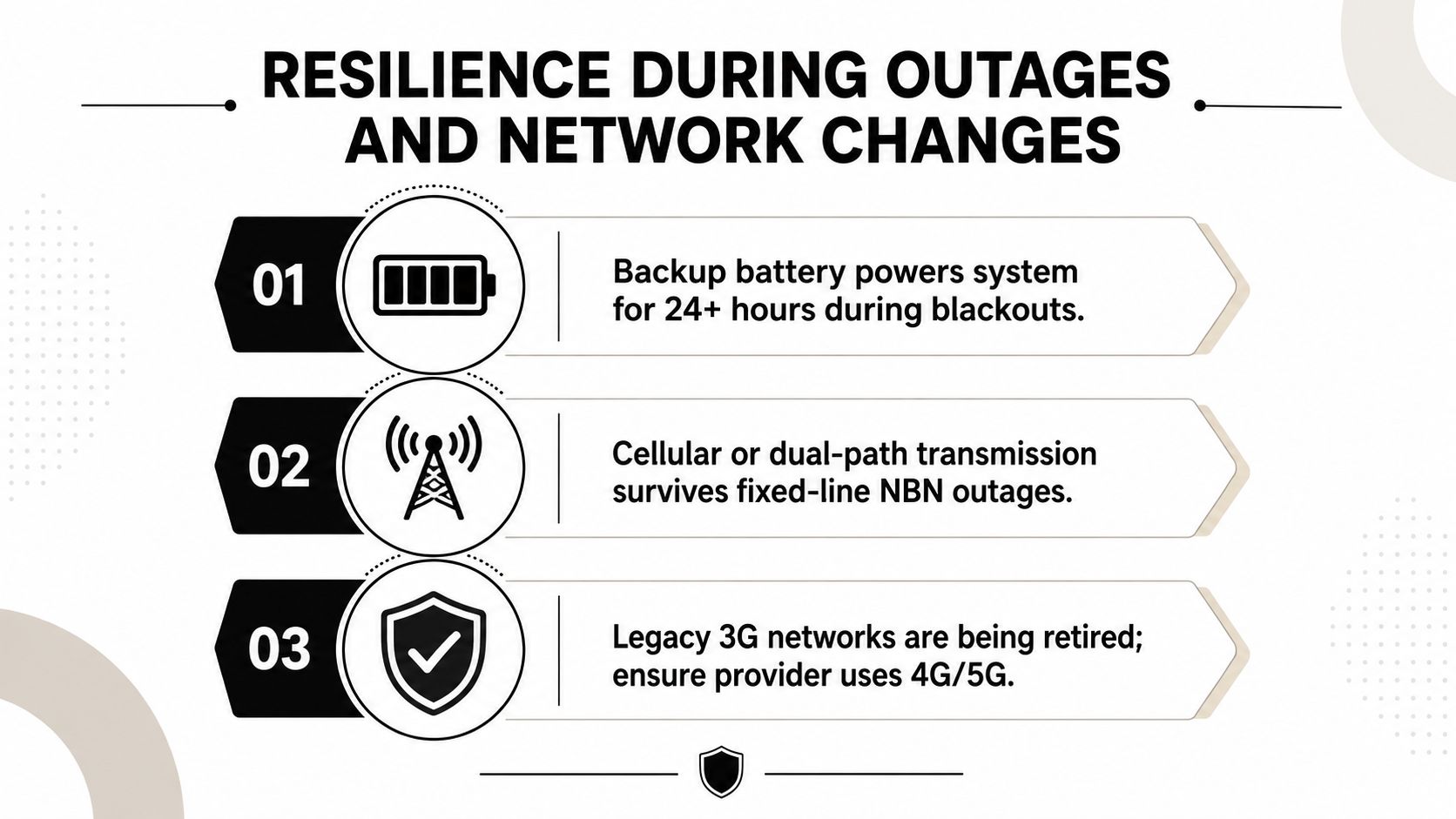
The ACCC has reported that the closure of the 3G mobile network is forcing older alarm and telemetry devices to be replaced or upgraded. That matters because a system that ran fine for years can turn into a compatibility problem once its communicator depends on an ageing network path.
So when someone says a panel is “connected”, the next question is connected how. If the communicator only speaks one network language, it is brittle. If it has a modern cellular path or a proper dual-path arrangement, it is in a better position to keep working through carrier changes and fixed-line outages.
A power cut is where the battery earns its keep. The panel, communicator, and any linked devices need enough backup to stay alive long enough for the monitoring centre to keep receiving events. Supervision matters too, because the system needs to know whether the path is healthy, not just whether it worked yesterday.
Ask the installer this: what survives if mains power fails at the same time as the internet? If the answer is vague, the design probably is too.
NSW Police recorded thousands of false alarm calls in 2023 to 2024. That is a reminder that resilience is not only about outages, it is also about preventing avoidable dispatches when the site itself is the problem.
False alarm reduction comes from sound installation, user training, and proper verification before escalation. A good centre does more than receive events. It checks whether the signal fits the site and the time of day, which cuts noise for everyone and keeps genuine events moving. For Queensland sites, smoke-alarm compliance sits alongside alarm reliability, so the system needs to suit both the monitoring setup and the rules around the property. The basics are set out in this guide to smoke alarm laws in Queensland.
Alarm monitoring in Australia isn't just a software subscription wrapped around a panel. For fire systems, the design sits under AS 1670.1 and AS 4428.6, and monitored signalling needs a compliant transmission path to a dispatch centre. In plain English, the alarm has to be engineered so it can still deliver the message when things go wrong.
If you're a homeowner or landlord, the first question is whether the system can legally and reliably communicate with the monitoring centre in the way your site needs. The second is whether the centre itself is graded and supervised to the level expected for monitored response, because a firewall of paperwork doesn't help if the centre can't handle the event.
Australian monitoring-centre specifications commonly require an intruder alarm system graded Class 3 or higher and an alarm transmission system classified C3S2 or higher. Real tender requirements also commonly call for 24 hours per day, 7 days per week, 365 days per year staffed monitoring and line supervision. That means the service is supposed to be alive all the time, not just available during business hours.
Queensland property owners don't usually deal with alarm monitoring in isolation. Smoke-alarm compliance sits beside it, especially in rentals and changeover situations, so the panel, smoke devices, and monitoring workflow need to play nicely together. If the smoke side of the property is out of date, the monitoring service won't fix that.
A practical starting point is the Queensland smoke alarm laws guide from DLG, because it helps place the monitored system inside the broader compliance picture rather than treating it as a separate gadget.
Compliance is not paperwork first. It's wiring, supervision, and response design that happen to leave paperwork behind.
Brisbane pricing usually breaks into three parts, the equipment, the installation, and the recurring monitoring fee. The cheapest quote on the page is often not the cheapest system to live with, because it can hide weaker monitoring, poor supervision, or a system that needs more call-outs later.
Don't look at monthly cost on its own. Look at what that fee buys, a supervised transmission path, a staffed centre, escalation rules, and compatibility with the panel you already have. Then compare it with the risk you're trying to reduce, like burglary, fire, or an after-hours fault that no one notices until morning.
If you want a broader benchmark on how providers package recurring monitoring, the home monitoring cost guide is a useful comparison point. For a more local view of installation and system build-out, DLG's home security system cost guide helps you think through the upfront side as well.
A low monthly fee can be fine if the centre is properly staffed and the system is resilient. It can also mean the provider is trimming in the wrong place, like weak transmission options or limited support when a fault appears after hours.
Rule of thumb: price the system like a loss-prevention tool, not a utility bill.
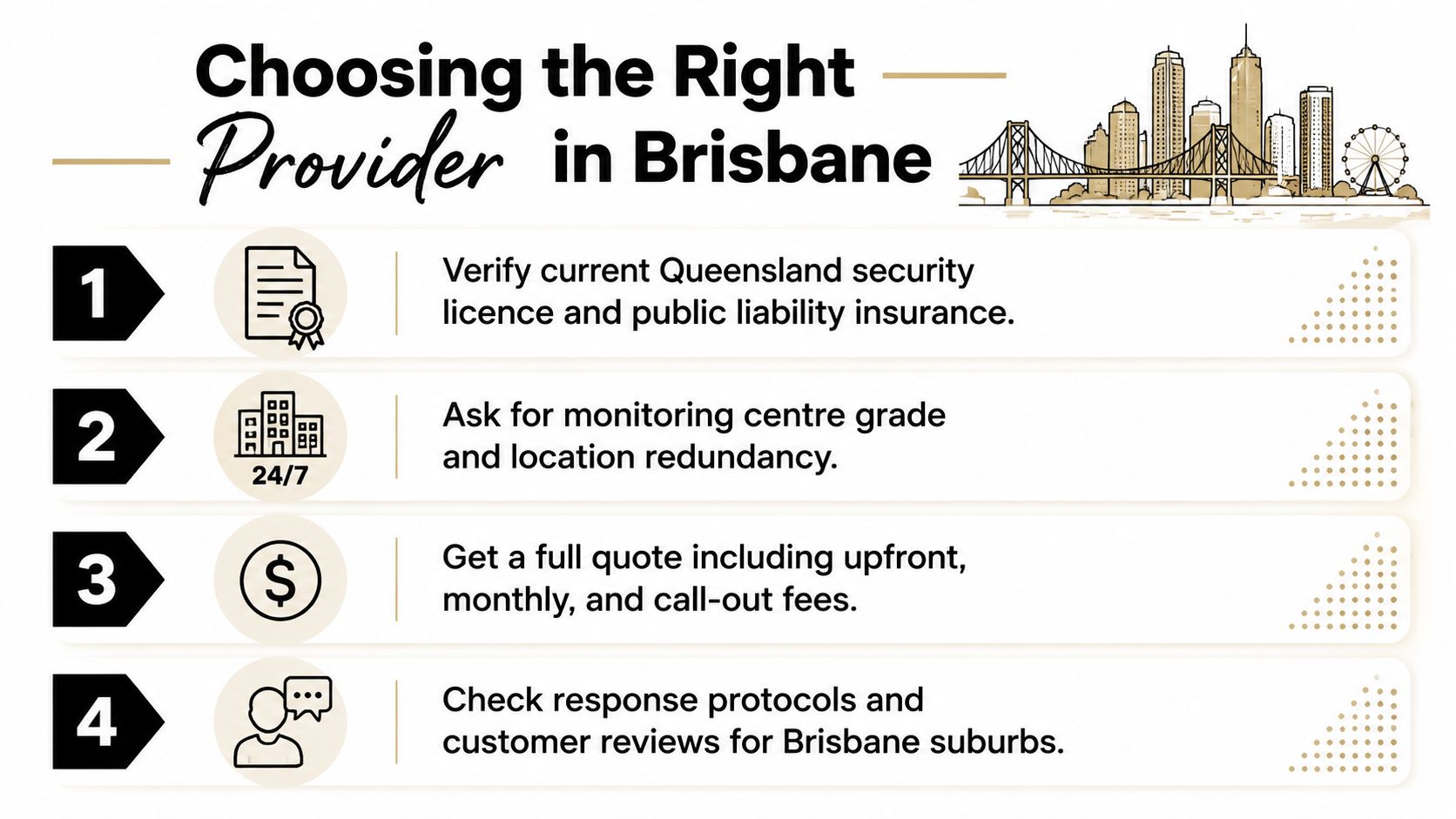
If you're comparing quotes, ask for the recurring fee, any call-out fees, and what grade of monitoring centre the service uses. A proper answer should be specific, not vague.
A provider should be judged on what happens when the panel misbehaves at 6am, not just what the website says on a good day. In Brisbane, that usually means checking the licence, the monitoring centre, the support footprint, and whether someone can get on-site when needed.
Landlords need clearer escalation rules. Who gets called first, who holds keys, what happens if a tenant changes the Wi-Fi password, and how are smoke-alarm tests tracked between tenancies. Those questions matter because the system has to survive turnover, not just intrusions.
A five-star review helps, but it doesn't replace a physical response when something is wrong with the panel or the smoke equipment. A local address matters because there's a real difference between phone support and someone who can turn up with the right parts.
DLG Electrical fits into that selection process as one local option for design, installation, and servicing, including monitored security work and smoke-alarm compliance. That combination matters because the installer is often the person who decides whether the monitoring chain is resilient or fragile from day one.
Start with a site assessment from a licensed Brisbane electrician who understands both security and compliance. The first job is to confirm what you've already got, what survives an outage, and whether the transmission path is modern enough for today's network environment.
Next, check your smoke-alarm obligations if the property is rented or likely to be rented. Don't separate the alarm panel from the smoke side of the house, because the practical risks usually arrive together.
Finally, ask for a written quote that names the monitoring-centre grade, the transmission path, and the standards references. If a provider can't put those details in writing, they probably haven't thought hard enough about failure modes.
If you want a local team to inspect the system, explain the options plainly, and handle installation or servicing, DLG Electrical can help with monitored security and smoke-alarm compliance across Brisbane. Visit DLG Electrical to organise a quote and get the monitoring chain checked properly before the next fault, outage, or compliance deadline turns into a bigger problem.

Master Electrician with over 30 years of experience. Founded DLG Electrical in 2005 after international project work including electrical installations at Stamford Bridge Stadium, London(Home of Chelsea FC).

Local Electricians that can fix all Electric Hot water Systems.
Motion sensor lights are a versatile addition to any home, offering nu
