83 Jean St, Grange QLD 4051
Mon-Fri 07:30 AM - 04:00 PM - Sat - 8:00 - 12 - Sunday Closed
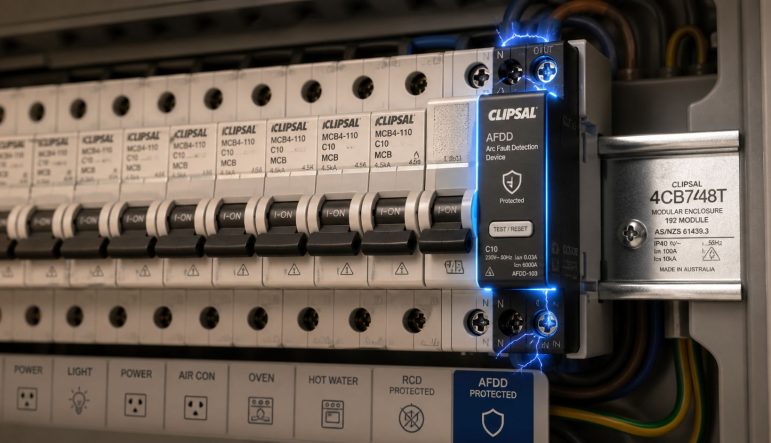
Electrical faults were the fourth-highest cause of residential fire deaths in Australia, accounting for nearly 11% of all causes, according to an Australasian Fire and Emergency Service Authorities Council report covering July 2003 to June 2017. The same report recorded at least 900 preventable residential fire deaths, an average of 64 deaths each year. The Australian electrical fire data is summarised by IPD.
That doesn't mean every Brisbane home needs an arc fault detection device fitted to every circuit. It does mean homeowners and landlords should understand the protection gap between ordinary circuit breakers, RCDs and the newer technology designed to identify dangerous arcing. In older Queensland properties, during renovations, or when an ageing switchboard is being replaced, that gap can become a practical safety decision rather than a theoretical one.
A fault inside a wall doesn't always behave like the electrical fault many picture. A conventional breaker is looking primarily for excessive current, while an RCD is looking for current escaping from its intended path. An arc fault can sit between those two detection methods, producing damaging heat without creating the electrical conditions that make either device operate.
The Australian fire burden gives that issue real weight. Electrical faults were linked to nearly 11% of residential fire deaths in the AFAC data, and arc faults are one mechanism through which damaged wiring, loose connections or deteriorated insulation can ignite nearby materials. That's why an AFDD should be viewed as supplementary fire-risk protection, not as a replacement for existing switchboard devices.

Brisbane homes present plenty of situations where wiring deserves closer attention. Older properties may have ageing cable insulation, tired terminations, altered circuits or wiring that has been disturbed during renovations. Roof spaces can also expose cables to heat, movement and pest damage. The age or condition of a circuit matters more than the mere presence of an old-looking switchboard.
A frayed cable behind furniture is a useful example. If the conductor remains connected and the appliance still draws a normal load, an MCB may see nothing unusual. If the fault doesn't send current to earth, an RCD may also remain on. The damaged point can still generate localised heat and become an ignition source.
Practical rule: An AFDD is most valuable where the consequence of an unnoticed arc is high and the wiring condition is uncertain or deteriorating.
AS/NZS 3000:2018 recognises AFDDs as a fire-risk mitigation measure for final subcircuits in higher-risk installations, including situations involving sleeping accommodation, combustible construction and other higher fire-risk conditions. They're not currently mandatory across Australian homes, but the standards-based option gives electricians a defined way to specify them during switchboard work. Queensland wiring guidance discusses the role of AFDDs under the Wiring Rules.
If an electrical fire occurs, householders should know the basics of safe response before considering any protective device upgrade. The guidance on putting out an electrical fire safely is useful, but an AFDD's role comes earlier, by disconnecting a circuit when its electronics identify a dangerous arc pattern.
Think of a garden hose with a kink in it. When the hose is intact, water follows a continuous path. If the hose splits and the flow has to jump across a gap, the behaviour changes. An electrical conductor can behave similarly when damage, a loose terminal or degraded insulation creates a gap that current bridges through the air.
An arc fault is not a larger version of an overload. It's an unintended electrical discharge that can occur while the connected load continues operating. The danger comes from the concentrated heat and repeated electrical discharge at the damaged point, particularly when that point is close to insulation, timber or other combustible material.
A series arc occurs along one conductor. A broken wire, loose connection or damaged termination creates a gap in the normal current path, but current can continue through the arc. Because the circuit may still be drawing an ordinary amount of current, an MCB might not operate.
A parallel arc occurs between conductors at different electrical potentials. The fault may form between live and neutral, or between a conductor and earth. Some parallel faults create enough current for conventional protection to respond, while higher-impedance faults may not. That distinction is why an AFDD adds a different type of monitoring rather than merely increasing the rating of an existing breaker.

An AFDD continuously monitors the electrical waveform on the final subcircuit. Arcing creates irregular high-frequency components and a distinctive pattern that differs from ordinary operation, including the electrical noise produced by motors, power tools or electronic power supplies.
The device's internal detection logic analyses those patterns over very short periods. It isn't looking for one random spike and immediately disconnecting every time. It compares the signal with conditions associated with a genuine arc, then trips when the pattern meets its operating criteria.
That filtering matters because nuisance tripping is a real trade-off. A quality device should distinguish normal equipment behaviour from a hazardous arc, but repeated operation still needs investigation. A tripping AFDD may be identifying a deteriorating connection, damaged cable or troublesome appliance. Resetting it repeatedly without finding the cause defeats the purpose of the protection.
This video provides another visual explanation of the detection principle:
The practical sequence is straightforward:
These devices answer different safety questions. An MCB asks whether current has become excessive. An RCD asks whether current has escaped the intended circuit. An AFDD asks whether the waveform shows the signature of dangerous arcing.
| Device | Protects Against | How It Trips | What It Misses |
|---|---|---|---|
| MCB | Overcurrent and short circuits | Responds when current exceeds its operating conditions | Many series arcs and some lower-current arcing faults |
| RCD | Residual current and earth leakage | Detects an imbalance between current leaving and returning through the circuit | Series arcs that don't create earth leakage |
| AFDD | Dangerous series and parallel arc patterns | Analyses irregular electrical signatures and disconnects the circuit | It doesn't replace the earth-leakage or overcurrent functions of other devices |
A frayed lamp cord behind a bedside table shows the practical difference. If the damage creates a break in one conductor while the lamp continues operating, the MCB may not detect an overload. If current does not escape to earth, the RCD may not trip either. An AFDD may recognise the irregular arcing pattern those devices are not designed to detect.
An arc fault is a distinct phenomenon from an overload. The AFDD therefore adds a different form of protection rather than replacing the existing devices. For a plain-language explanation of RCDs and circuit breakers, see RCDs and circuit breakers explained.
An MCB protects cables from excessive current, including overloads and short circuits that can overheat conductors. It remains part of the basic overcurrent protection arrangement.
An RCD helps reduce the risk from current flowing somewhere it should not, including faults that may expose people to electric shock. It does not analyse the high-frequency signature of a series arc.
An AFDD detects hazardous arc patterns on the circuits it protects. It should not be specified as a standalone answer to every switchboard risk. A modern board may require overcurrent protection, earth-leakage protection and arc-fault protection, with the arrangement chosen for the board design, circuit characteristics and manufacturer's instructions.
That distinction matters during a Brisbane switchboard renovation. An older home with deteriorating cable, loose terminations or heavily used final subcircuits may justify AFDD protection as a sensible risk-reduction upgrade, even where it is not mandatory for an ordinary residential installation. A quote that removes an RCD or MCB without clearly explaining the replacement protection deserves careful scrutiny.
Australian rules recognise AFDDs as a standardised protection option, but they do not make them mandatory for every ordinary residential installation. That distinction matters when a Brisbane switchboard is altered or replaced. The decision may involve the homeowner, electrician, designer and, for rental properties, the landlord.
AS/NZS 62606:2022 is the local product standard for arc fault detection devices. It was published on 18 February 2022 and adopts IEC 62606:2013+AMD1:2017, with modifications for the Australian and New Zealand market. It covers AFDDs for household and similar AC circuits, including standalone devices and units integrated with residual-current and/or overcurrent protection. Standards New Zealand identifies AS/NZS 62606:2022 and its publication details.
| Requirement Level | Applicable Standard / Context | Scope |
|---|---|---|
| Codified product compliance | AS/NZS 62606:2022 | AFDD products for household and similar AC circuits must be assessed against the applicable local technical framework |
| Recognised risk mitigation | AS/NZS 3000:2018 | AFDDs may be used on final subcircuits where fire risk, wiring deterioration or the building environment warrants added protection |
| Discretionary residential upgrade | Existing ordinary homes and many alterations | The owner and electrical designer can consider AFDDs as a targeted upgrade, but they are not mandatory across Australia |
Queensland Wiring Rules guidance places the AFDD at the switchboard supplying the final subcircuit. Selection also depends on the associated protective device and circuit arrangement. It is not a universal clip-on accessory that suits every board.
The Wiring Rules identify sleeping accommodation, combustible construction and fire-propagating structures as settings requiring additional fire-risk consideration. A Brisbane bedroom circuit does not automatically require an AFDD. The assessment should consider who occupies the property, the building materials, the condition of concealed wiring and the likely consequences of a fire.
For an older Queensland home, the practical threshold often appears during a switchboard renovation. If the board is being replaced and the cabling is serviceable, AFDD protection can be a sensible risk-reduction investment for selected circuits. If testing finds damaged insulation, loose terminations or unsafe alterations, repair or replacement comes first.
Ask whether the proposed device complies with AS/NZS 62606:2022, which final subcircuits it will protect, how it will coordinate with existing RCDs and MCBs, and whether the alteration changes the board's compliance documentation. The electrician should explain why particular circuits were selected and why others were not.
The legal minimum and the sensible upgrade are not always the same. Choose based on the property's actual risk, the switchboard work being carried out and the condition of the wiring, rather than a blanket claim that AFDDs are required everywhere or useful nowhere.
After 19 years working around Brisbane properties, the useful question isn't “Are AFDDs mandatory?” It's “What risk am I trying to reduce, and is an AFDD the right way to reduce it?” A new device can't compensate for a burnt connection, overloaded circuit, damaged cable or unsafe alteration that should have been repaired first.
An older Queensland home with an unknown wiring history deserves a closer look. The inspection should consider cable condition, terminations, previous renovations and the switchboard's ability to accept modern protective equipment. Where the wiring is serviceable but the risk of concealed arcing remains a concern, an AFDD may be a sensible targeted addition.
Renovations are a natural decision point because circuits may already be exposed, extended or moved. Drilling, new wall linings, altered outlets and added loads can introduce fresh risks if the existing wiring isn't properly assessed. A switchboard alteration also gives the electrician an opportunity to consider AFDD placement and coordination rather than forcing a difficult retrofit later.
The right approach is selective. A homeowner might prioritise final subcircuits serving sleeping areas or circuits routed through combustible construction, while a circuit with seriously deteriorated insulation may need replacement instead of an AFDD.
For a rental property, the issue isn't only the device. It's the quality of the inspection, the documented condition of the installation and the response to known defects. An AFDD can add a layer of protection, but it doesn't remove the landlord's responsibility to address unsafe outlets, damaged cords, loose connections or non-compliant alterations.
A sensible rental-property assessment considers:
If the switchboard uses obsolete equipment, lacks usable space, contains damaged components or has poor circuit identification, adding an AFDD alone may be the wrong priority. A complete board upgrade can improve organisation, isolation, RCD coverage and future serviceability, while allowing the electrician to design AFDD protection into the correct circuits.
A good AFDD decision is therefore risk-based. It favours homes with ageing or uncertain wiring, greater fire consequences, renovation activity or a board upgrade already under consideration. It doesn't favour installing a device just because it sounds advanced.
AFDD installation starts with the switchboard, not the product brochure. The electrician needs to identify the final subcircuit, confirm the protective-device arrangement, inspect the neutral configuration and check whether the board can accept equipment approved for that switchboard range.
AS/NZS 62606:2022 allows a standalone AFDD or an integrated device that combines arc-fault detection with residual-current and/or overcurrent protection. That choice affects board space, circuit separation, fault finding and coordination. The right product may be a combined unit in one installation and a separate arrangement in another.

Assessment comes first. The electrician identifies the circuits, checks cable condition, reviews existing MCBs, RCDs and surge protection, and looks for heat damage, loose terminations or previous alterations. If the circuit itself is unsafe, replacing or repairing the wiring takes precedence.
Compatibility comes next. AFDDs aren't universal modules that can be mixed freely across brands. The electrician must verify the device's approved combination with the switchboard, its current rating and its relationship with the associated protective device. Queensland guidance notes that the AFDD load current rating should be no less than that of the associated protective device. Workplace safety and Wiring Rules commentary provides additional Australian installation context.
Neutral arrangements matter. Depending on the device design, the protected circuit neutral may need to pass through the correct sensing path and remain isolated from other circuit neutrals. Incorrect neutral sharing can cause unwanted operation or prevent the protection from working as intended.
Testing completes the job. The electrician checks operation, confirms circuit identification, tests associated protection and labels the board clearly. The homeowner should receive the relevant electrical compliance documentation and a clear explanation of which circuits the AFDD protects.
The NHP product material illustrates the market's move towards combined AFDD units with defined current ratings and residential applications. NHP's AFDD product brochure is useful for understanding why product selection must be tied to switchboard topology rather than treated as a generic add-on.
A new AFDD that trips repeatedly needs diagnosis. The cause may be an appliance, electronic equipment, a damaged connection or a circuit defect. Repeatedly resetting the device without testing the circuit is not a solution, and replacing the AFDD with a less sensitive device can remove the protection you paid to install.
Homeowners considering a broader switchboard upgrade should understand the applicable regulations and process, especially where the existing board is crowded or outdated.
The strongest case for arc fault detection devices is a property where the fire risk is meaningful, the wiring has a plausible path to deterioration, and the switchboard is already being assessed or renovated. The weakest case is a rushed retrofit onto an unsafe or incompatible board, with no investigation into why the circuit may be at risk.
Start with the property, not the product. Consider its age and wiring history, whether previous owners altered circuits, whether renovation work is planned, and whether occupants sleep close to concealed wiring routes. A rental property also deserves a documented decision because landlords need to demonstrate that known electrical risks were identified and addressed.

AFDDs aren't cheap compared with a basic breaker, and they don't prevent every electrical fire. They do address a fault type that ordinary MCBs and RCDs weren't designed to identify. For a Brisbane homeowner with sound wiring and a modern board, the upgrade may be optional. For an older property undergoing renovation, or a rental with uncertain circuit history, it can be a rational risk-reduction investment.
A licensed electrician should be able to explain whether a standalone retrofit is practical or whether the money is better spent on a complete switchboard replacement. Ask for a written assessment, not just a device price, and make sure the proposed equipment complies with AS/NZS 62606:2022.
DLG Electrical can assess Brisbane switchboards, identify ageing or unsuitable protection, and explain whether arc fault detection devices belong in a targeted upgrade or a complete replacement. Visit DLG Electrical to request a practical assessment and a clear, itemised quote from a licensed local team.

Master Electrician with over 30 years of experience. Founded DLG Electrical in 2005 after international project work including electrical installations at Stamford Bridge Stadium, London(Home of Chelsea FC).

Local Electricians that can fix all Electric Hot water Systems.
Motion sensor lights are a versatile addition to any home, offering nu
