83 Jean St, Grange QLD 4051
Mon-Fri 07:30 AM - 04:00 PM - Sat - 8:00 - 12 - Sunday Closed
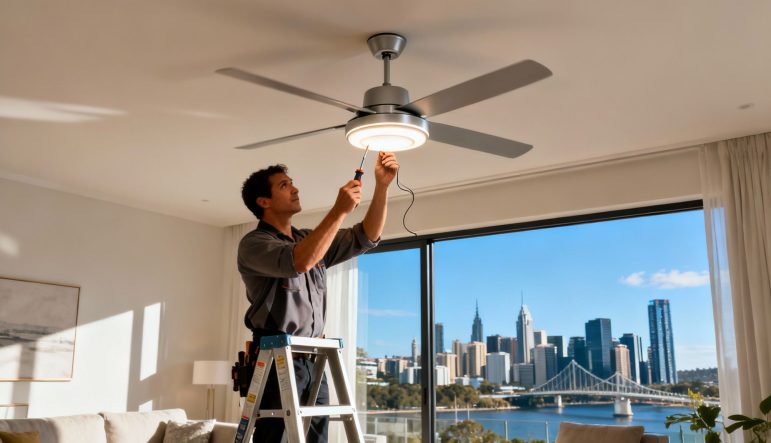
A ceiling fan with a built-in light is exactly what it sounds like: a single fixture that pulls double duty, giving you both air circulation and illumination from one spot on your ceiling. It’s an incredibly practical solution for Brisbane homes, where we’re constantly juggling the need for comfort and light without wanting to clutter up our living spaces.
In short, it’s one elegant unit that solves two common household problems at once.
Living in Brisbane means dealing with a classic subtropical climate—warm days, balmy nights, and the odd sweltering heatwave. While air conditioning is great, the running costs can be eye-watering. A ceiling fan and light combo offers a smarter, more cost-effective way to stay comfortable while keeping your home bright and welcoming.
Think of it as the Swiss Army knife for your ceiling. It’s not just about surviving the heat; it’s about creating a home that’s more liveable, stylish, and energy-efficient. For most Brisbane homeowners, it’s a non-negotiable appliance that proves its worth every single day.
The biggest win here is the dual functionality. You save precious ceiling space, which is a real bonus in rooms with lower ceilings or where multiple fixtures would just look messy. Instead of having to choose between a fan or a light, you get the best of both worlds in one streamlined package.
This clever combination directly tackles the challenges we face as locals:
It’s not just us in Brissie, either. The demand for these fixtures is growing right across the country. The Australian ceiling fan market was valued at around USD 220.38 million in 2024, largely driven by homeowners looking for energy-efficient cooling. You can dive deeper into the numbers with this TechSci Research report on the Australian ceiling fan market.
A ceiling fan and light combo isn’t just another appliance; it’s a smart investment in your home’s everyday comfort and efficiency. It works quietly in the background to make your space more enjoyable, whether you’re kicking back on a humid summer arvo or just need a gentle breeze on a still night.
Picking the right ceiling fan and light combo can feel like a bit of a headache, but it’s actually more straightforward than you might think. The trick is to match the fan to the room. It’s a lot like choosing the right-sized air conditioner – get it wrong, and you’re either sweating it out or living in an arctic breeze.
We just need to look at three things: your room’s size, the height of your ceiling, and the type of motor powering the fan. Nail these three, and your new fan won’t just look great; it’ll do its job perfectly for years to come.
The most important bit of info you need is the blade span – that’s the total width from the tip of one blade to the tip of the opposite one. A fan that’s too small for a big living area will just spin its heart out without creating a decent breeze. On the flip side, a massive fan in a small study will feel like a wind tunnel. It’s all about finding that sweet spot.
Here’s a simple table to help you find the right fit for your space. It’s a quick reference guide to match fan blade span to your room size for the best possible air circulation.
| Room Size (Square Metres) | Recommended Blade Span (cm) | Ideal For |
|---|---|---|
| Up to 15 sq m | 90cm – 112cm | Home offices, laundries, or smaller bedrooms. |
| 15 to 25 sq m | 112cm – 132cm | Most standard Brisbane bedrooms and family rooms. |
| Over 25 sq m | 132cm or more | Open-plan living areas, master bedrooms, or outdoor patios. |
Getting the size right means you’ll feel the difference without cranking the fan up to full speed. For a more in-depth look at measuring your space correctly, check out our comprehensive ceiling fan size guide. It’s packed with expert advice to help you choose with total confidence.
Your ceiling height is the next piece of the puzzle, as it dictates how the fan needs to be mounted. For most Brisbane homes with standard ceilings (2.4 to 2.7 metres high), a regular mount with a short downrod works perfectly. This gives you safe clearance while keeping the fan low enough to actually move the air around you.
Got lower ceilings? No problem. A flush mount or “hugger” style fan is what you need. These sit right up against the ceiling, so you get maximum headroom. And for those beautiful high or vaulted ceilings, you’ll need an extended downrod to bring the fan down to its happy place, which is usually about 2.4 metres off the floor.
A fan’s height is just as important as its size. Positioning it correctly ensures the air circulates throughout the entire room, rather than just swirling uselessly near the ceiling.
This is where you can see how picking the right fan solves common problems for Brisbane homeowners.
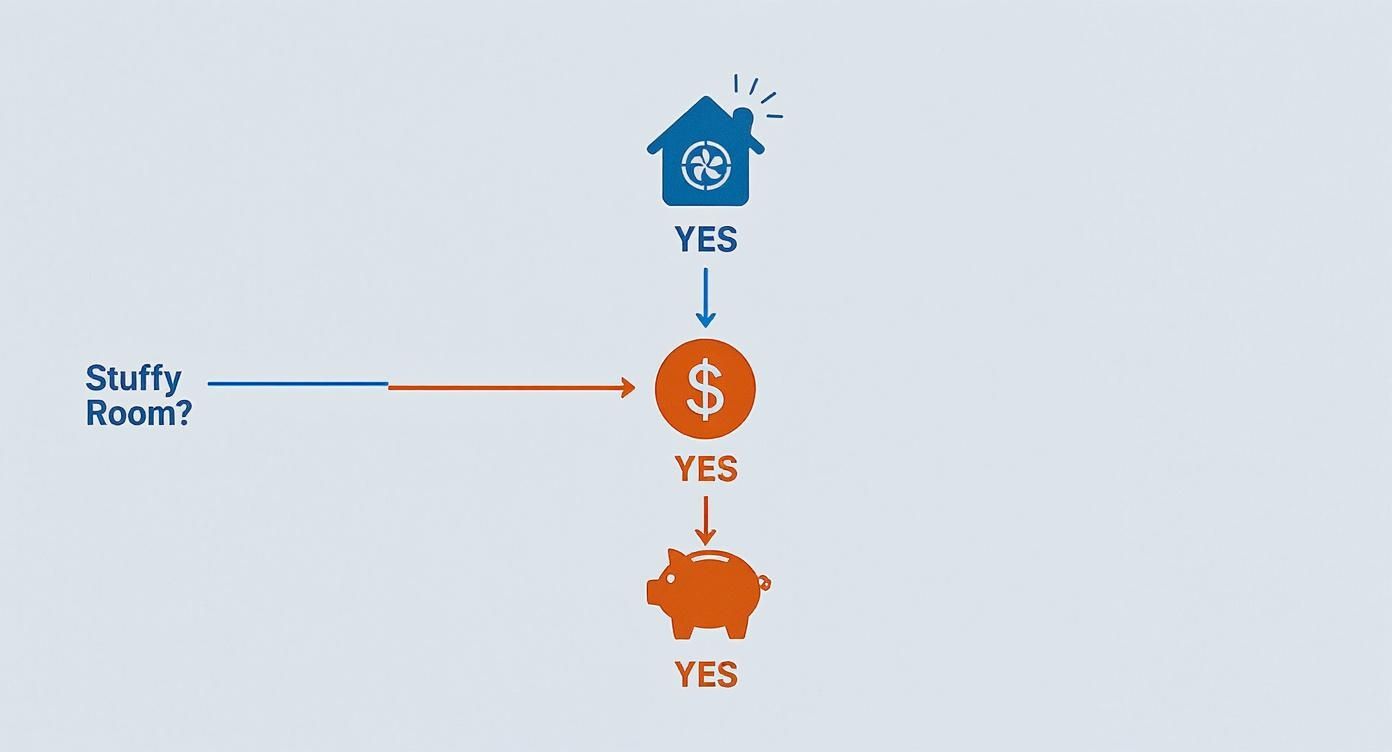
The image makes it clear: choosing an energy-efficient fixture is a direct fix for both scary power bills and stuffy rooms with poor airflow.
Last but not least, let’s talk looks. You want a fan that blends in with your home’s decor, not one that sticks out like a sore thumb.
If your style is modern and minimalist, a sleek three-blade design in a simple black or white is a great choice. For that classic Hamptons or coastal vibe, a fan with timber-look blades adds a beautiful, warm touch. The goal is simple: your ceiling fan and light combo should feel like it was always meant to be there.
Gone are the days of fumbling for a pull chain or flicking a basic wall switch. Today’s ceiling fan and light combos have seriously evolved, becoming sophisticated pieces of smart home tech. The latest models are packed with features that bring a whole new level of convenience and control, turning a simple appliance into something that truly works for you.
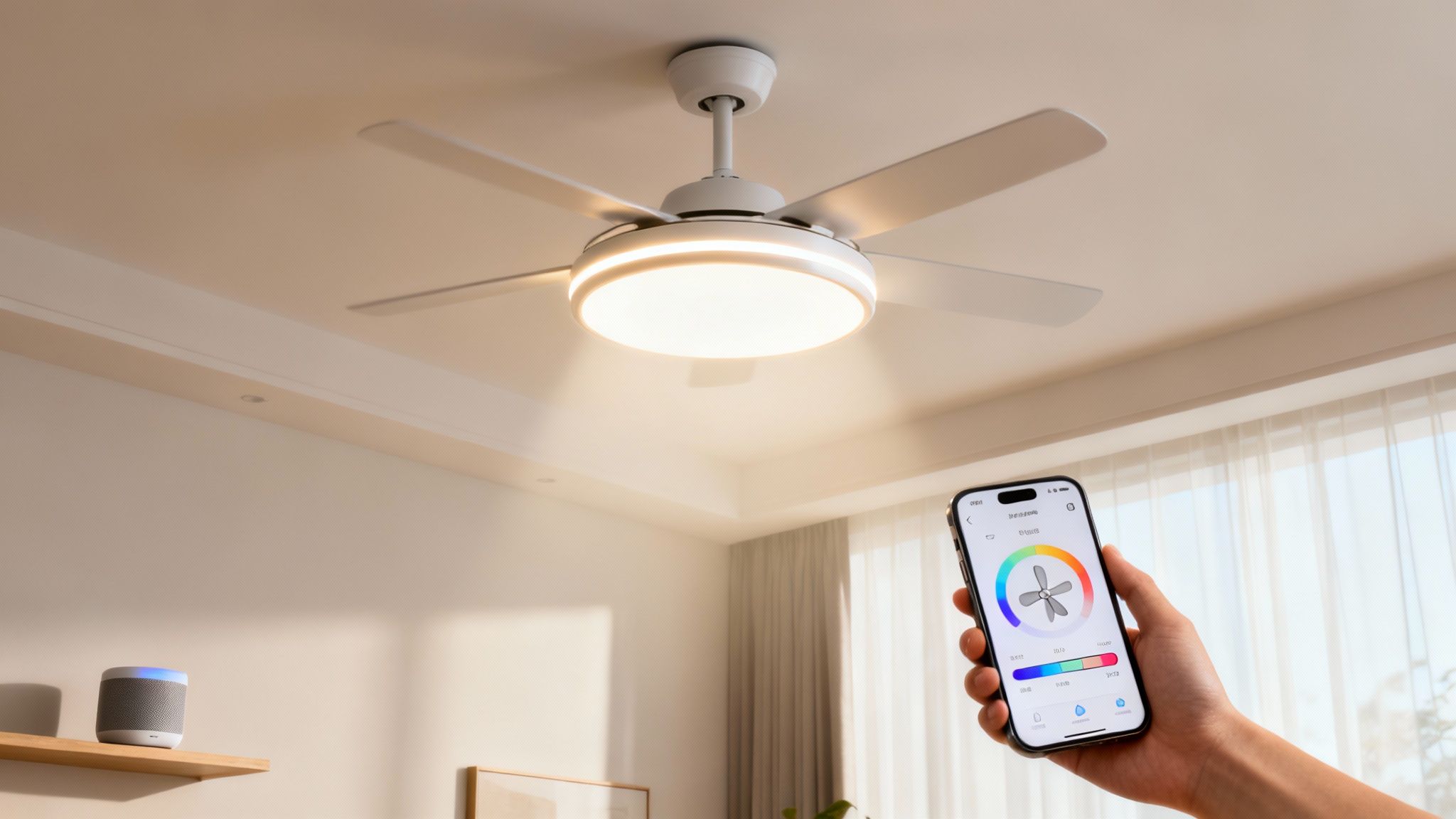
Imagine being able to tweak the fan speed or dim the lights right from the sofa. That’s exactly what you get with smart fans. They connect to your home’s Wi-Fi, letting you manage everything from an app on your phone.
This isn’t just a niche feature anymore; it’s rapidly becoming the standard. Here in Australia, the ceiling fan market is heavily influenced by smart technology. More and more, we’re seeing people choose models that offer app control, voice commands, and easy integration with their home assistants. For a deeper dive into this trend, the IMARC Group report offers some great insights into what’s driving the market.
This is where modern fans really come into their own. When you link your ceiling fan and light to a system like Google Home or Amazon Alexa, you can control them with simple voice commands. It sounds like a small thing, but it makes a massive difference in your day-to-day life.
Think about these real-world scenarios:
Smart control isn’t just a gimmick; it’s about making your home more responsive to your needs. This functionality provides enhanced accessibility and efficiency, allowing you to fine-tune your environment with minimal effort.
The “light” part of the fan and light combo has also had a major glow-up, mostly thanks to LED technology. Modern fixtures now give you incredible control over your home’s ambience. Forget a single, harsh light—now you can tailor your lighting to suit any activity.
One of the most useful features is adjustable colour temperature. This lets you shift the light from a cool, crisp white all the way to a warm, soft glow.
This level of customisation ensures your lighting is always both functional and comfortable, no matter the time of day.
It’s easy to get swept up in choosing the perfect style and features for your new ceiling fan and light combo. But honestly, the most important part of the job happens long before the fan even comes out of the box. Here in Brisbane, and right across Queensland, electrical work is governed by some very strict safety laws—and for good reason. They’re there to protect you, your family, and your home.
Under Australian law, installing any hardwired electrical fixture, including a ceiling fan, is not a DIY job. It is illegal for an unlicensed person to carry out this kind of work. This isn’t just red tape; it’s a critical safety measure. The risks of getting it wrong are incredibly serious, ranging from electrocution to house fires caused by dodgy wiring. Only a licensed sparkie has the training and qualifications to do the job safely and to code.
Getting a professional in isn’t just about ticking a legal box; it’s about the long-term safety and structural integrity of the installation. A licensed electrician will perform several crucial checks that an amateur would almost certainly miss.
First up is a structural check. Your electrician will make sure the ceiling joist can actually handle the weight and constant motion of the fan. A standard ceiling fan can weigh over 10kg, and the dynamic force it creates while spinning puts a surprising amount of stress on its mounting. An improperly secured fan is a serious hazard waiting to happen.
They’ll also inspect your home’s existing wiring to confirm it’s safe, compliant, and up to the task of handling the new load. A pro ensures every connection is secure and all the necessary safety devices are in place and working correctly.
A word of warning: attempting DIY electrical work not only puts your safety on the line but can also void your home insurance policy. If a fire or other incident is traced back to illegal electrical work, your insurer may refuse to cover the damages, leaving you with a massive and devastating financial burden.
A key part of a professional installation is making sure every component meets Australian safety standards. This includes the proper use of safety switches, which you might know as RCDs (Residual Current Devices). These lifesaving devices are designed to shut off the power in a fraction of a second if they detect a fault, preventing a serious electric shock. If you’re not familiar with them, understanding RCDs (Residual Current Devices) is crucial for home electrical safety.
Once the job is done, a licensed electrician will provide you with a Certificate of Compliance. This document is your official proof that the installation was performed by a qualified professional and meets all the relevant safety regulations. To see why this piece of paper is so important, you can learn more about what a Certificate of Compliance for electrical work entails and why every homeowner needs one.
So, you’ve picked out the perfect ceiling fan and light combo. What actually happens on installation day? Knowing the process can take all the guesswork and stress out of it. When one of our licensed electricians turns up, they follow a methodical process designed for safety, stability, and making sure your new fan works perfectly from the get-go.
It’s about much more than just connecting a few wires; it’s a detailed procedure that protects your home and ensures you get years of reliable service.
First things first: safety. Before a single tool comes out, the electrician will head to your switchboard and turn off the power to the circuit they’ll be working on. This is a non-negotiable first step that eliminates any risk of electric shock and makes the work area completely safe.
With the power safely off, the focus shifts to the ceiling. The electrician will inspect the existing mounting point to confirm it’s secured to a solid ceiling joist or a proper fan-rated brace. A typical ceiling fan can weigh over 10kg, and when it’s spinning, it generates forces that demand a rock-solid anchor. You can’t just hang it anywhere.
If the old electrical box isn’t up to the task, a new, fan-rated one will be installed. This isn’t an optional extra—it’s absolutely critical for safety. An improperly secured fan can wobble, create annoying noises, and in the worst-case scenario, could even fall from the ceiling.
Once the mounting point is confirmed to be strong and secure, the bracket that came with your new fan is installed. This little piece of hardware is the foundation for the entire unit, so it has to be perfectly level and fastened tightly.
The initial safety and structural checks are easily the most important part of the job. A true professional takes their time here to get it spot on, making sure your fan will run safely and whisper-quiet for years to come.
With the bracket firmly in place, the electrician will usually assemble the main parts of the fan—the motor, downrod, and housing—on the ground before carefully lifting it into position. Next comes the wiring. They’ll connect the fan and light to your home’s electrical circuit, following the strict Australian standards to the letter.
Finally, the fan blades and the light kit are attached. The power is then switched back on for a complete function test. Our sparkie will run the fan through all its speeds, test the reverse function for winter mode, and check the light to make sure everything is working exactly as it should. They’ll also balance the blades if there’s any hint of a wobble.
This careful, step-by-step approach is precisely why getting a professional in is so important. If you want to know more about what separates a great local sparkie from the rest, check out our guide on choosing a Brisbane electrician you can trust. Understanding the expertise needed for specialised jobs, like an integrated skylight exhaust fan installation, also shows why complex combination units always benefit from a professional touch.
Your new ceiling fan and light combo is a real investment in your home’s comfort, and a little bit of care goes a very long way. Think of regular maintenance as a quick health check-up; it’s the key to making sure your fan runs smoothly, quietly, and efficiently for years to come. The best part? Most of it is dead simple to do yourself.
Just a few small tasks every six months can head off common headaches like wobbling, annoying noises, and poor airflow. This tiny bit of effort not only keeps your fan performing at its best but also helps extend its lifespan.
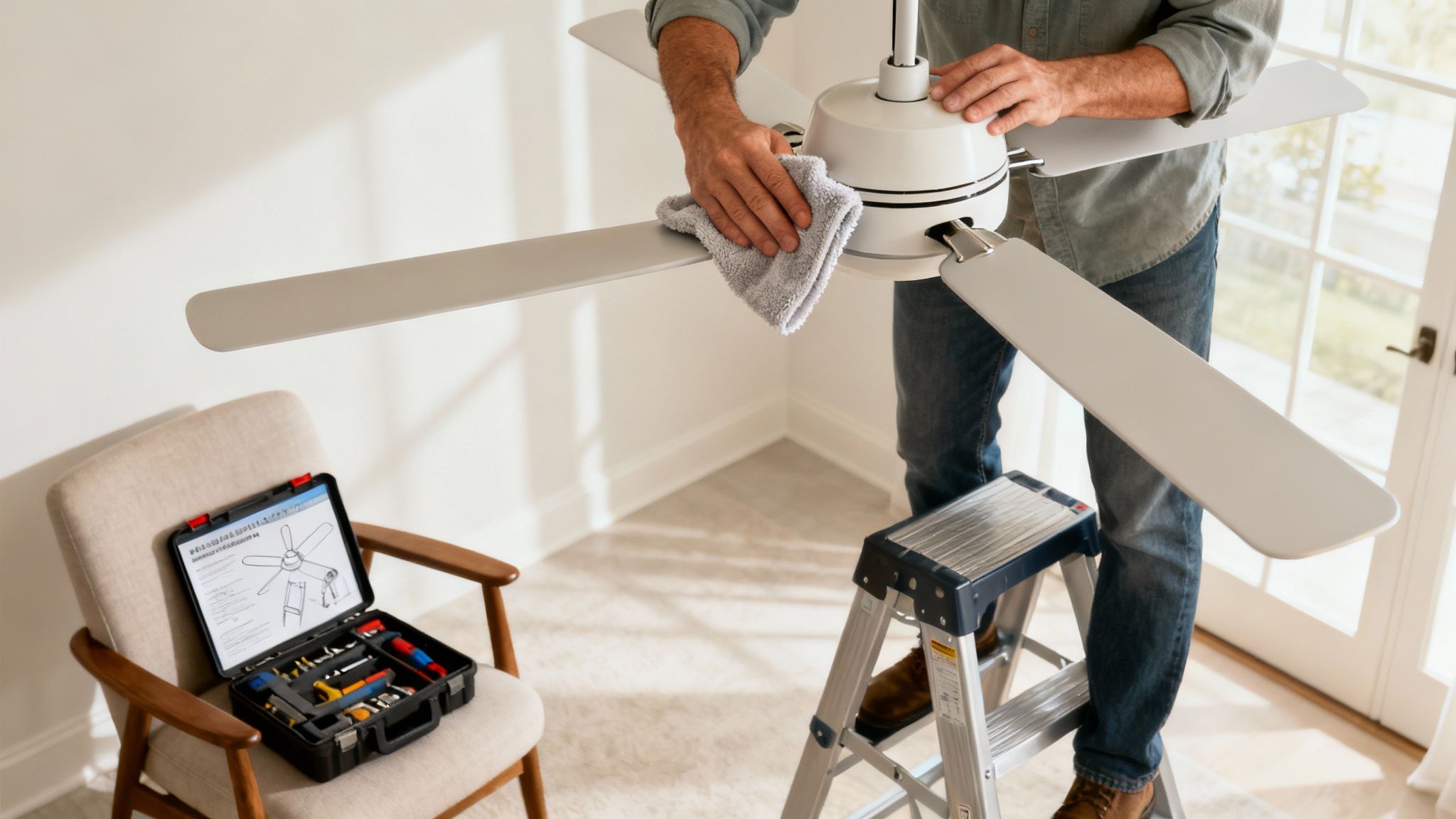
Keeping your fan in top shape is pretty straightforward. First things first: always turn off the power at the switchboard for safety. Once that’s done, you can work through these simple steps.
Think of fan maintenance like caring for your car’s tyres. Keeping them clean, balanced, and properly secured ensures a smooth, safe ride. The same principle applies to your fan’s blades for quiet, efficient operation.
While you can handle most of the basic upkeep, some issues are a clear signal it’s time to call in the experts. It’s never a good idea to ignore persistent problems, as they can point to deeper electrical or mechanical faults that need a professional eye.
If you notice any of the following, it’s best to contact a licensed electrician like the team at DLG Electrical:
These symptoms could be a sign of trouble with the internal wiring, the motor bearings, or other electrical components. When it comes to your ceiling fan and light, especially with anything electrical, getting a professional diagnosis is always the safest bet.
Even after covering all the details, there are always a few questions that pop up. Getting straight answers to these common queries helps clear up any lingering doubts, so you can feel completely confident in your choice for your Brisbane home.
Here are the most common questions we get from homeowners just like you.
In Queensland, that’s a hard no. It’s not just a bad idea; it’s illegal for anyone but a licensed electrician to install a ceiling fan. DIY electrical work is incredibly dangerous, creating a real risk of fire or electrocution. Plus, it will almost certainly void your home insurance policy if something goes wrong.
Most modern fans have a small switch on the side of the motor housing. Just flick it to reverse the blade direction from counter-clockwise (which creates a cooling downdraft for summer) to clockwise (for winter). Some newer models with remotes or smart features let you do this with the push of a button.
Reversing your fan in winter is one of the easiest energy-saving tricks in the book. It gently pushes the warm air that naturally rises and gets trapped at the ceiling back down into the room. This helps your heater work more efficiently without creating a chilly breeze.
This really comes down to what your room needs. If the fan is going to replace the only light source in the space, then a fan and light combo is the logical choice.
But if you already have plenty of lighting from downlights or lamps, a fan without a light can offer a much cleaner, more streamlined look.
To keep it running smoothly and maintain good air quality, you should give the blades a wipe-down every three to six months. A surprising amount of dust can build up, which not only looks messy but can also throw the blades off balance, causing wobbling and putting extra strain on the motor.
Ready to upgrade your home’s comfort and style with the perfect ceiling fan and light? The licensed professionals at DLG Electrical are here to help with safe, compliant, and expert installation. Contact us today for a free quote

Master Electrician with over 30 years of experience. Founded DLG Electrical in 2005 after international project work including electrical installations at Stamford Bridge Stadium, London(Home of Chelsea FC).

Local Electricians that can fix all Electric Hot water Systems.
Motion sensor lights are a versatile addition to any home, offering nu
