83 Jean St, Grange QLD 4051
Mon-Fri 07:30 AM - 04:00 PM - Sat - 8:00 - 12 - Sunday Closed
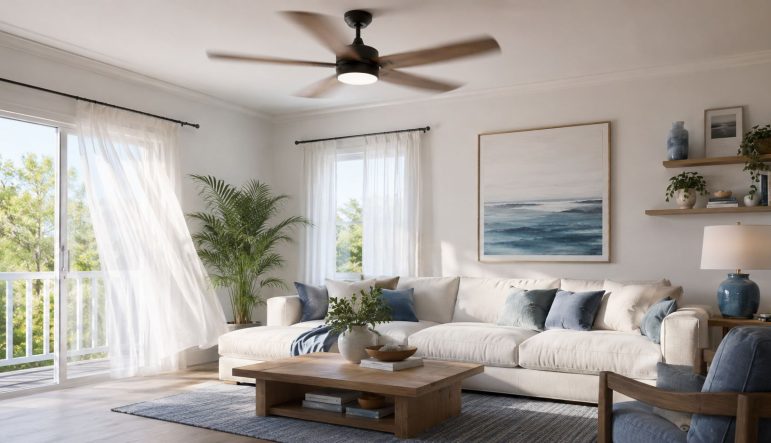
Set your ceiling fan to counterclockwise for summer. In the right setting, that downward airflow can make you feel up to 4 degrees cooler, even though it does not lower the room temperature.
If you're in Brisbane, you've probably had that moment where the fan is on, the room still feels stuffy, and the air seems to be doing nothing useful. That usually means the fan is spinning the wrong way, running too slowly, or trying to do a job that really needs help from ventilation or air conditioning.
A ceiling fan is one of the simplest tools in the house, but only when it's set up properly. The summer setting matters because Brisbane heat isn't just hot. It's often humid, sticky, and persistent. Small setup mistakes can leave you uncomfortable and push you to lean harder on the air con than you need to.
Good summer comfort usually comes from a few things working together. Correct fan direction, sensible speed, and practical heat management inside the home all help. Even soft furnishings can make a difference, which is why guides on Lewis and Sheron's breathable home fabrics are useful if your bedrooms and living areas tend to trap heat.
You get home after a sticky Brisbane afternoon, switch the fan on, and the room still feels flat and heavy. In a lot of houses, the fix is simple. The fan is set the wrong way.
For summer, your ceiling fan should spin counterclockwise when viewed from below. That setting throws air down into the occupied part of the room, which is what gives you that cooling breeze on your skin. In Brisbane's humid conditions, that small adjustment can make a noticeable difference to how quickly a bedroom or living area feels comfortable.
It also helps you use cooling more efficiently. If the fan is doing its job, many homeowners can run the air conditioner less aggressively and improve comfort without driving power use higher. We cover more practical ways to cut cooling costs in this guide on reducing power bills in Brisbane homes.
Our summer heat lingers well into the evening, and the humidity is often what makes a room feel unpleasant, not just the temperature reading. In older Queenslanders, rooms with high ceilings, and houses with poor cross-ventilation, fan setup matters more than people expect.
A fan spinning in the correct summer direction should create clear airflow directly underneath it. If the air feels weak, the issue might be the direction switch, the speed setting, blade pitch, or the fan itself. I see this regularly in Brisbane homes where the fan is working, but not effectively helping the people in the room.
Soft furnishings also affect how a space feels in summer. Heavy bedding, dense curtains, and heat-trapping fabrics can make a bedroom feel warmer than it needs to. That is why guides on Lewis and Sheron's breathable home fabrics are useful if you are trying to make bedrooms and living spaces feel lighter through the hotter months.
Start with the basics.
If you switch the direction and still get very little breeze, it may be more than a settings problem. That is usually the point where a licensed electrician should inspect it, especially if the fan hums, wobbles, runs slowly, or the wall control is behaving oddly.
Brisbane homeowners feel this most on sticky summer nights. The room thermometer barely moves, but the space feels far more comfortable once the fan is pushing air down where people are sleeping or sitting.
That change comes from the wind-chill effect. Air moving across your skin helps sweat evaporate faster, which is how your body sheds heat. In a humid Brisbane summer, that airflow matters because heavy, still air makes rooms feel more oppressive than the temperature alone suggests.
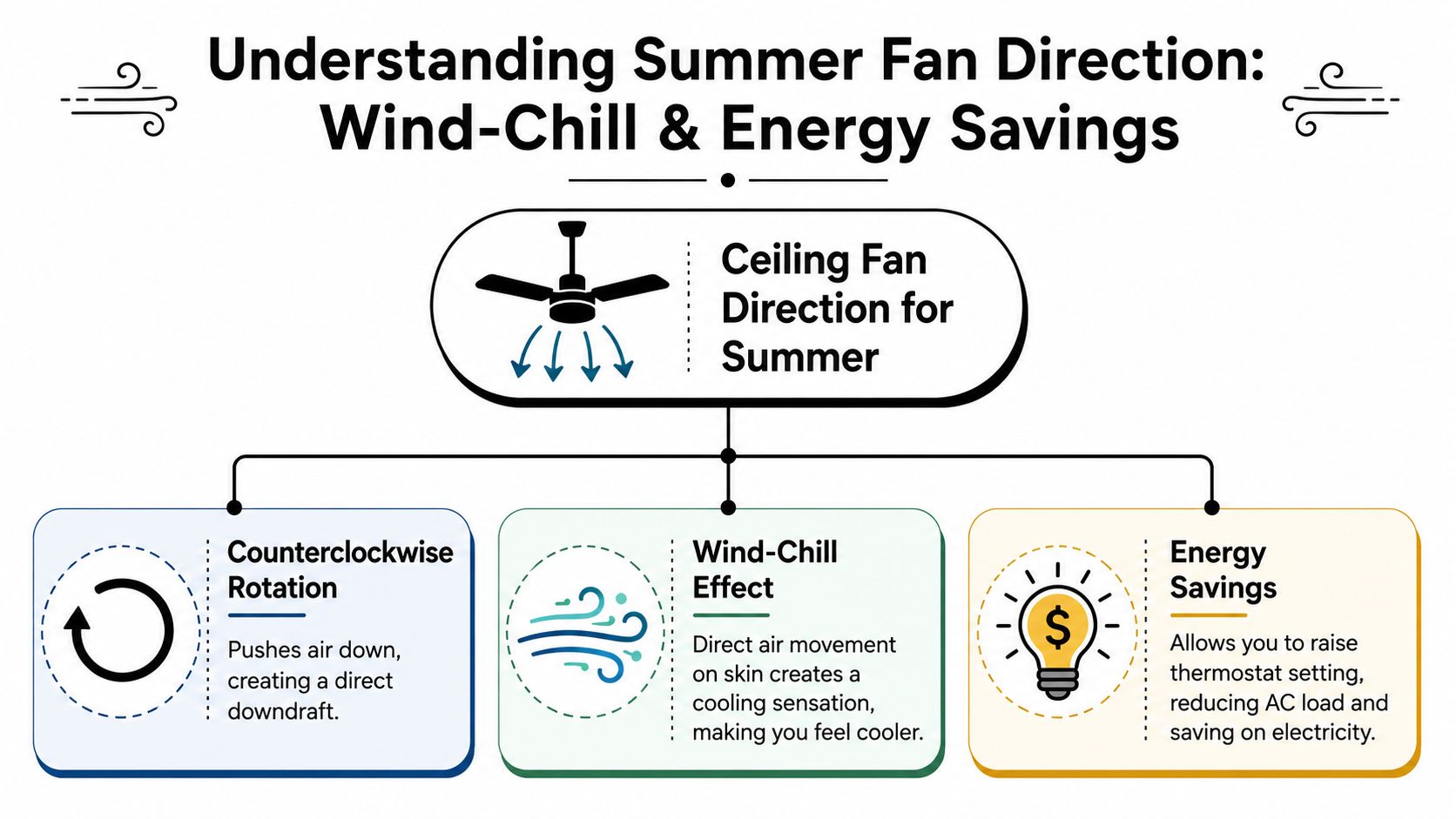
In summer mode, the blades rotate counterclockwise and force air downward into the occupied part of the room. That downdraft is what creates the cooling sensation under the fan.
The air itself is not being chilled. Your body is losing heat more effectively.
That distinction matters, because it explains why fans save money best when they are used to improve comfort around people, not left running in empty rooms.
The savings usually come from reducing how hard the air conditioner has to work. If a room feels comfortable with moving air, many households can run the air con less aggressively or delay turning it on. In Brisbane, where cooling can run for long stretches through humid weather, that small adjustment adds up across the season.
For a broader look at ways to reduce home energy bills, fan setup works well alongside other household efficiency measures. If you want local, practical advice, DLG has also shared Brisbane-specific tips on how to reduce power bills at home.
In the homes I work on, the best results usually come from using both systems properly instead of relying on one alone.
| Setup | Likely result |
|---|---|
| Fan only in a mildly warm room | Often enough for personal comfort |
| Air con only in a humid room | Cooler air, but some spots can still feel stagnant |
| Fan plus air con together | Better circulation, more even comfort, and less strain on the cooling system |
A ceiling fan is a support tool for summer cooling. Used well, it helps the room feel better at the temperature you are already paying to maintain. If the fan direction is right and the room still feels stuffy, there may be a sizing, control, or performance issue that needs a licensed electrician to sort out.
This is usually a simple job, but the method depends on the fan. Newer models often use a remote or wall control. Older units commonly have a small reverse switch on the motor housing.
Before touching anything, turn the fan off and let the blades stop completely. If your fan uses a manual switch on the body, it's smart to isolate power at the circuit breaker first, especially if you'll be on a ladder reaching near the motor.
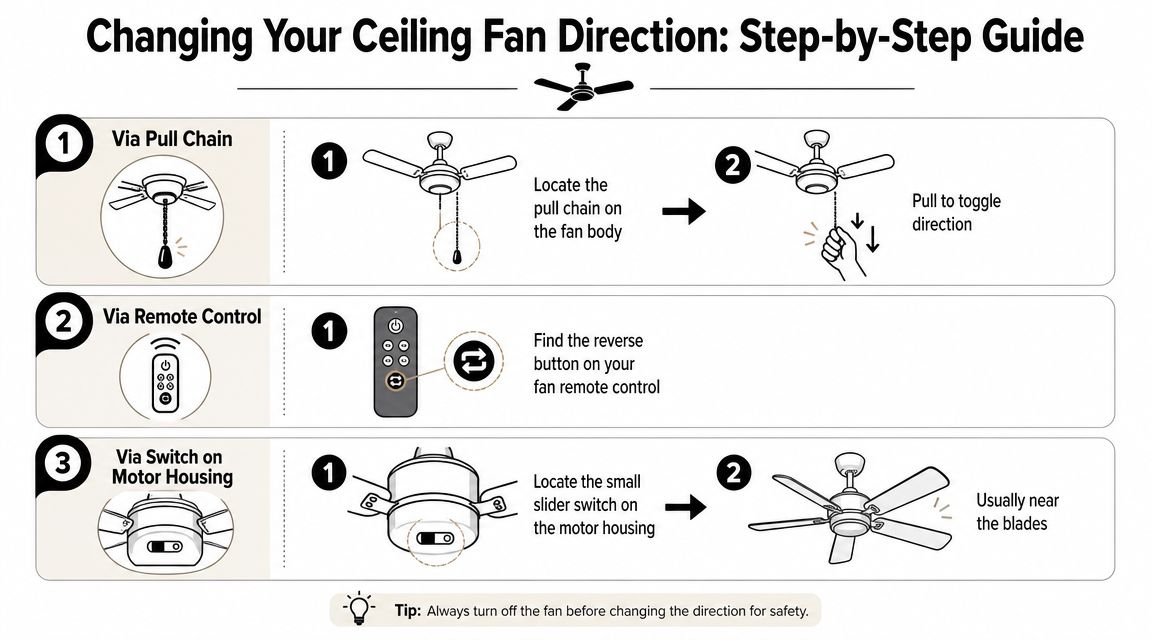
Many modern fans have a summer/winter, forward/reverse, or similar button on the remote.
This is the easiest setup because you don't need to get up near the motor housing.
Some homes have a dedicated wall switch or fan controller that handles direction.
Look for labels such as reverse, summer/winter, or directional icons. If the switch isn't clearly marked, don't guess with force. A stiff or damaged control can indicate wear in the mechanism or a control setup that needs checking.
This is still common, especially on older fans.
A lot of homeowners stop here and assume it's done. Test it properly.
A practical way to check the summer setting is to stand directly beneath the fan. If the blades move left-to-right from your viewpoint, the fan is in counterclockwise summer mode and should create a downward airflow, as explained in Lumens' guide to ceiling fan direction.
If you're under the fan and you don't feel a strong downdraft, it's not set up for summer properly, regardless of what you think the switch says.
This short demonstration can also help if you want to see the process on a typical household fan.
The switch itself is usually straightforward. The risk comes from how people reach it.
| Situation | Best approach |
|---|---|
| High ceiling fan | Use a proper ladder and avoid overreaching |
| Unclear controls | Check the fan manual if you still have it |
| Motor housing feels loose | Stop and get it checked |
| Remote or switch doesn't respond | Don't open electrical parts yourself |
If the fan has no accessible reverse function, or the controls don't behave consistently, that's often a sign the unit is dated, the receiver is faulty, or the fan wasn't designed with easy seasonal adjustment in mind.
A fan set to summer mode can still leave a Brisbane room feeling sticky if the speed, placement, and the room conditions are working against you.
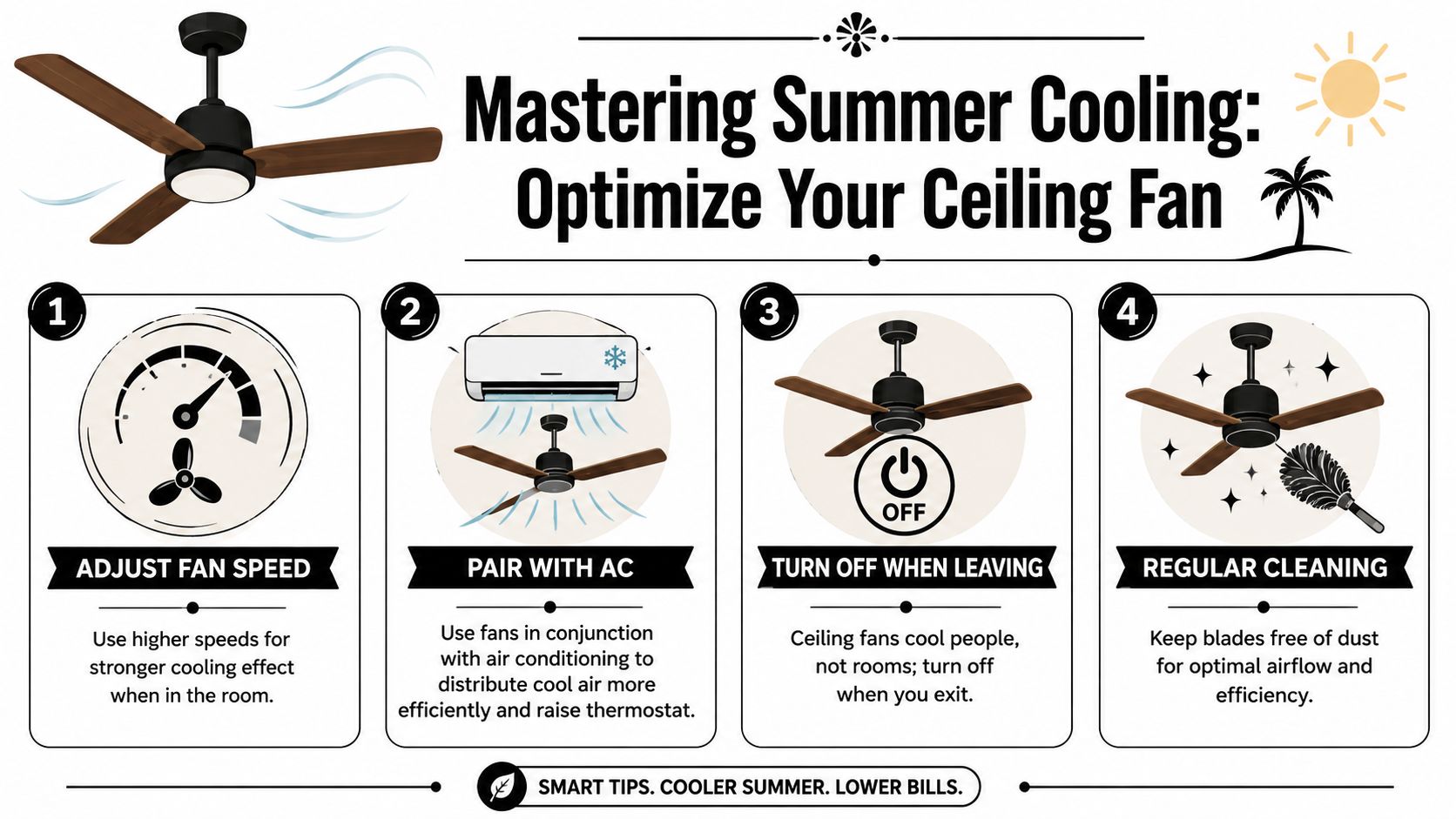
For summer, the aim is a noticeable breeze on your skin. Higher speed usually gives the best cooling effect during the day, especially in living areas that heat up fast in the afternoon sun.
That said, comfort matters more than raw speed. Bedrooms often feel better on medium overnight, while a family room with poor cross-ventilation may need high speed to feel useful. Set the fan to the lowest speed that still gives you a clear downdraft where people are sitting or sleeping.
A fan can be working properly and still do a poor job if it does not suit the space.
I see this a lot in open-plan homes. Owners assume the fan is weak, but the underlying problem is that the room is too wide for a single small unit, or the fan is mounted too high to deliver much air where it counts.
If your fan has never cooled the room properly, even when the direction and speed are right, it may be worth checking our guide on how to fix a ceiling fan before deciding whether it needs adjustment, repair, or replacement.
Local conditions are particularly relevant.
In a dry room, moving air feels cooler quickly. In a humid Brisbane summer, the same fan can feel far less effective because sweat does not evaporate as well. The fan is still helping, but it has limits. On those heavy, stormy afternoons, airflow alone often will not make the room comfortable.
That is why the best energy-saving setup is often a combined one. Use the air conditioner to lower temperature and humidity, then let the ceiling fan push that treated air around the room. You can often stay comfortable without driving the air con as hard.
For most Brisbane homes, this approach is reliable:
Small adjustments make a real difference in summer. If the room still feels flat, muggy, or uneven after that, the issue is often fan sizing, installation height, a faulty controller, or a worn motor rather than the direction setting alone.
Sometimes the direction is right and the fan still isn't doing the job. When that happens, the issue is usually mechanical, control-related, or just plain wear and tear.
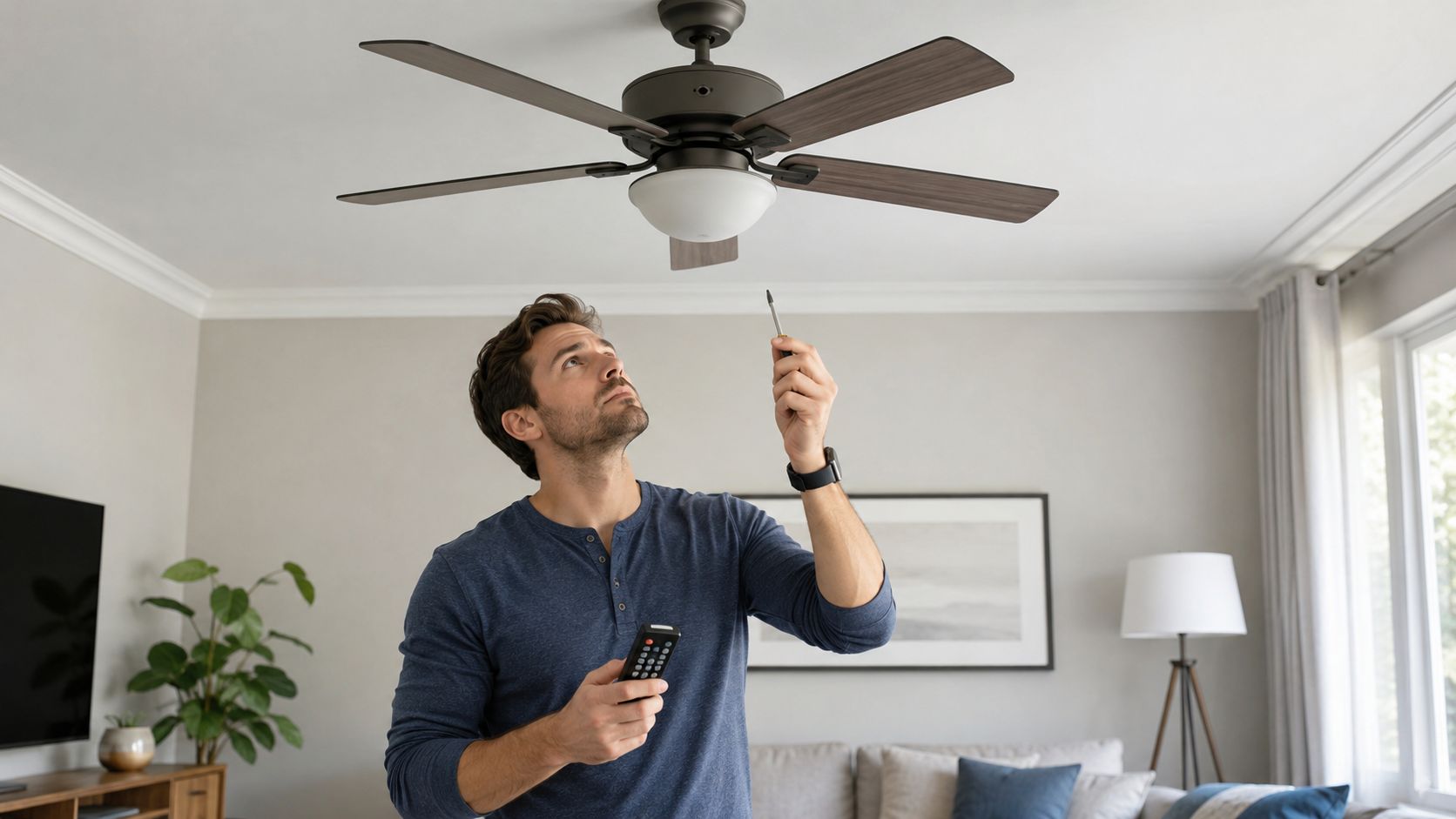
Some older fans don't make seasonal changes easy. Others hide the control in the remote system, wall control, or on the motor body where it's easy to miss.
If you've checked the housing, remote, and wall switch and still can't find a direction control, the fan may not have a practical reversing feature or the control components may have failed. If your fan needs deeper diagnosis, DLG has covered common faults in this guide on how to fix a ceiling fan.
These are the complaints electricians hear all the time.
| Problem | Likely cause | First thing to check |
|---|---|---|
| Humming | Motor wear, loose parts, control issue | Screws, canopy fit, speed control behaviour |
| Clicking | Blade hardware, loose fittings | Blade arm screws and alignment |
| Wobbling | Imbalance, loose mount, bent blade arm | Blade screws, bracket tightness, balance kit |
A little wobble isn't something to ignore. It can point to loose hardware, poor balancing, or mounting issues overhead.
A careful homeowner can handle a few basic checks.
Persistent wobble usually means stop experimenting and get the mounting checked before the problem gets worse.
If the fan body rocks, the ceiling point looks unstable, or the controls behave unpredictably, it's time to move from DIY to a licensed electrician.
There's a clear line between a simple household adjustment and electrical work that shouldn't be guessed through.
Call a licensed electrician if the fan has no working reverse control, the wall switch or remote isn't responding properly, the fan hums constantly, or the whole unit wobbles even after basic screw checks. Modern fan controls can include reverse switches on the motor housing or remote and app-based controls, and if your fan lacks these or the controls are faulty, a professional upgrade may be needed, as noted in Universal Fans' guide to summer fan direction.
If you're comparing replacement options, it helps to understand the installation side before you buy. This guide to ceiling fan installation options is a solid starting point.
For Brisbane homes, licensed electrical work matters because ceiling fans sit at the point where comfort, safety, wiring, and mounting all meet. That's not the place for trial and error.
If your ceiling fan still isn't cooling properly, the controls are faulty, or you want to upgrade to a better summer-ready setup, DLG Electrical can help. We're a family-owned Brisbane electrical contractor with 19 years of experience, fully licensed and insured electricians, and free quotes, so you can get the problem sorted properly the first time.

Master Electrician with over 30 years of experience. Founded DLG Electrical in 2005 after international project work including electrical installations at Stamford Bridge Stadium, London(Home of Chelsea FC).

Local Electricians that can fix all Electric Hot water Systems.
Motion sensor lights are a versatile addition to any home, offering nu
