83 Jean St, Grange QLD 4051
Mon-Fri 07:30 AM - 04:00 PM - Sat - 8:00 - 12 - Sunday Closed
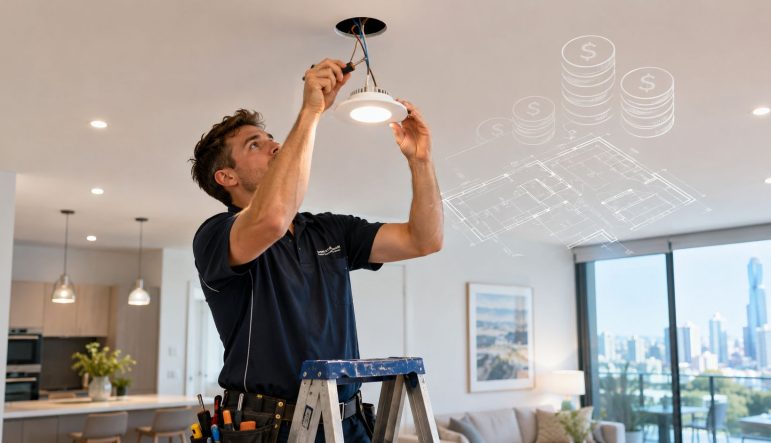
In Brisbane, a typical downlight installation cost usually falls between $60 and $110 per unit, and that rate can shift depending on job complexity and how many lights you're installing. If you're only changing a few fittings, the cost per light is usually higher. If you're fitting out a whole area at once, the per-light rate often becomes more favourable.
If you're reading this, you're probably standing in a room that feels dim, dated, or full of old halogen fittings that run hot and don't give you the clean finish you want. That's where most homeowners start. They don't usually want “lighting advice”. They want to know what the job will cost, whether the wiring in their ceiling is going to cause trouble, and whether the quote they've been given is reasonable for Brisbane.
That's a fair question, because national price guides only tell part of the story. Brisbane homes vary a lot. A newer plasterboard ceiling with easy roof access is one type of job. An older home in Windsor or Grange with tight access, insulation, and older cabling is another.
A proper quote should reflect that difference. It should also explain what you're paying for. In most cases, the labour is the biggest part of the bill, not the light itself. If you're still deciding on layout, spacing, and ceiling suitability, this downlight guide for ceiling planning is a useful starting point before you lock in fixture numbers.
You flick on the light in an older Brisbane living room, and the result is familiar. One tired fitting in the centre of the ceiling, dark corners, and a quote in your inbox that is hard to judge.
That is usually the practical starting point. Homeowners are not chasing lighting theory. They want to know what a fair downlight installation cost looks like for their house, whether the ceiling space is going to slow the job down, and whether old wiring will turn a simple upgrade into extra electrical work.
Brisbane homes vary more than many price guides allow for. A low-set home with clear roof access is usually straightforward. A post-war or Queenslander-style home can be different, especially where access is tight, insulation is packed around existing fittings, or the lighting circuit has been altered over the years. In suburbs with older housing stock such as Windsor, Grange, or Camp Hill, those details often shape the quote more than the fitting you choose.
The other point that catches people out is what the quote is really covering. On a downlight job, you are paying for site setup, safe isolation, cut-outs or alterations to existing holes, wiring checks, installation, testing, and clean-up. The fitting matters, but the condition of the house and the time on site usually matter more.
A useful quote should make that clear.
It should tell you whether the price is for replacing existing fittings or adding new light points, whether there is enough ceiling access to run cable efficiently, and whether any switch upgrades or circuit corrections are likely. If you are still working out spacing, beam spread, or how many fittings a room needs, this downlight guide for ceiling planning will help you sort the layout before you lock in numbers.
The goal is not just to get a lower figure. It is to get a quote that matches the house, the scope, and your budget without surprises once the electrician gets into the ceiling.
A Brisbane homeowner might see a downlight on the shelf for under $20, then wonder why the installed price lands much higher. The answer is usually in the labour, the ceiling conditions, and the electrical work needed to make the fitting safe and compliant in that specific house.
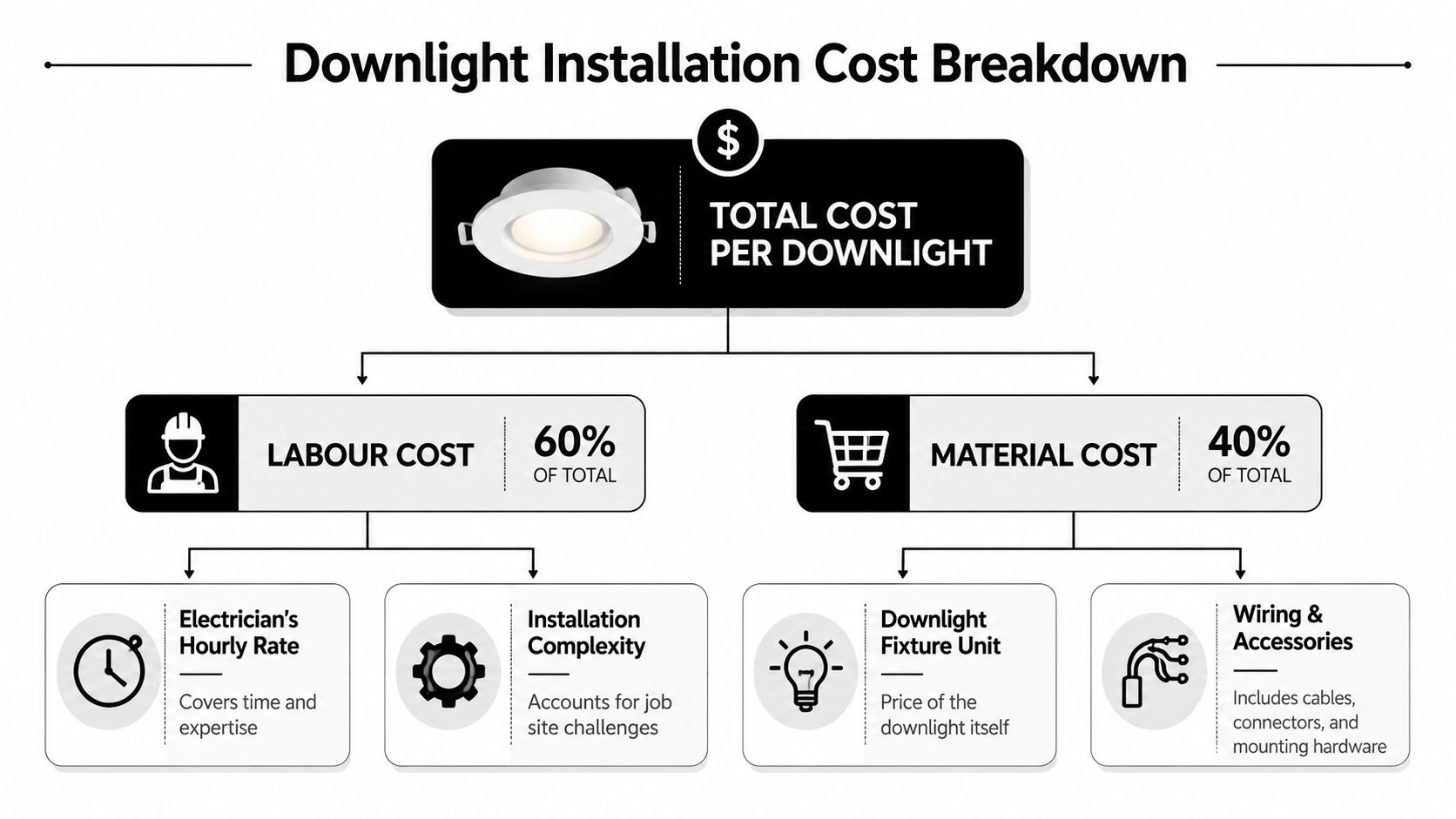
In Brisbane, a practical way to read pricing is to split the job into two parts. First is the fitting itself. Second is the time on site to install it properly. On straightforward replacement work with good access, the per-light cost is usually more reasonable. Once you are adding new light points, working around insulation, or dealing with older wiring, the labour share climbs quickly.
A per-downlight figure usually covers a lot more than the fitting:
That is why comparing retail shelf price to an installed quote rarely gives a clear picture.
| Cost Component | Standard Range (per light) | Higher-spec Range (per light) |
|---|---|---|
| Downlight fixture unit | Standard LED fitting used for general living areas | Dimmable, colour-selectable, bathroom-rated, or branded architectural fitting |
| Labour and installation allowance | Lower on simple replacement jobs with easy roof access | Higher where new cabling, difficult access, insulation clearance, or electrical rectification is involved |
On many Brisbane jobs, the difference between a cheaper quote and a realistic quote is not the fitting. It is the time allowed to do the work cleanly and safely. A low-set brick home in Carindale with open roof space is one thing. An older home in Paddington or Camp Hill with tight access and previous alterations above the ceiling is another.
Bathroom and wet-area pricing can also shift if the fitting needs the right rating for the location. If you are comparing options for wet areas, this guide for Melbourne homeowners covers bathroom-specific considerations from a renovation angle, and our article on fire-rated downlights for Australian ceilings explains where the fitting type itself can affect cost.
The electrician is not just clipping a light into plasterboard. The job includes safe isolation, checking the existing circuit, confirming there is clearance around the fitting, making connections, testing, and leaving the area tidy. In older Brisbane homes, it can also include sorting out problems found once the ceiling is opened, such as brittle cable, crowded junctions, or holes that do not suit the new fitting.
The quality of the quote can determine whether homeowners save money or get caught out. If the quote only gives a flat per-light figure with no note about access, replacement versus new points, or possible corrective work, there is a fair chance the final cost will move once the job starts.
A good quote makes the installed price make sense.
Two houses can have the same number of downlights and very different quotes. That's normal. The difference is usually in the ceiling, the access, and the condition of the existing electrical work.
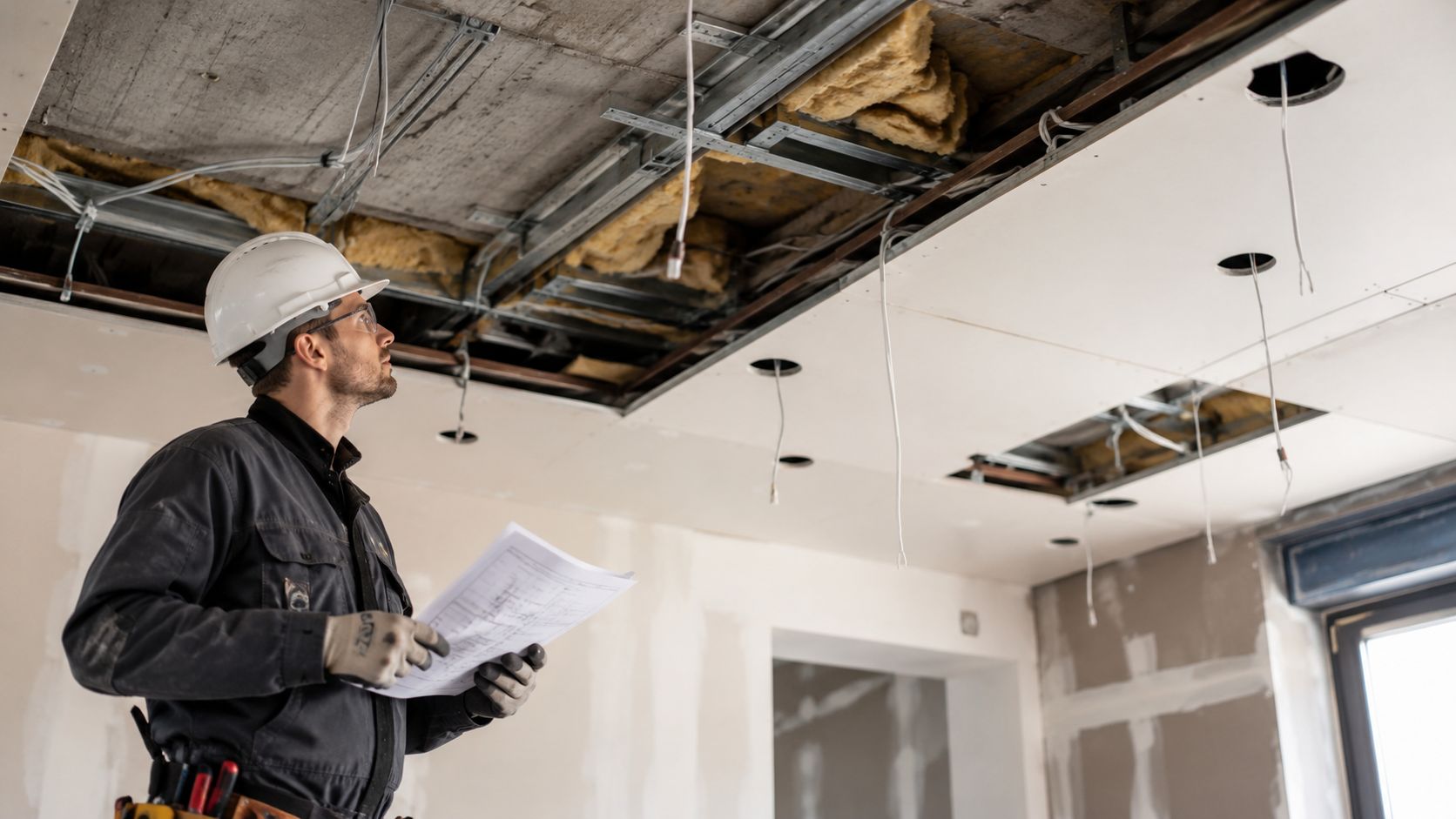
Replacing an old fitting is like using an existing doorway. The opening is already there, the path is known, and the work is more predictable. A new install is more like cutting a fresh doorway into a wall. It needs checking, marking, cutting, and a safe route to the wiring.
That distinction matters in Brisbane homes. In older suburbs, I often see houses where the owner wants to replace a single centre light with several downlights across the room. That can look simple from below, but above the ceiling there may be timber framing, insulation, or wiring that changes the job completely.
Brisbane homes have a few patterns that affect labour:
If you want a room-by-room planning reference from outside Brisbane, this guide for Melbourne homeowners is useful for seeing how wet areas and ceiling conditions can change the approach.
Not every downlight belongs in every ceiling. Some ceilings need fittings that are suitable for insulated spaces, and some locations call for extra care around fire separation. If a job involves insulated cavities or specific compliance requirements, the fitting choice affects the final price.
Generic online quotes often fall apart, as they assume all ceilings behave the same. They don't. If your home has insulation above the ceiling or you're working between levels, it's worth understanding the role of fire-rated downlights in Brisbane homes before choosing the cheapest fitting available.
The neatest-looking light isn't always the right light for the ceiling it's going into.
A downlight job usually costs more when:
Homeowners don't need to know every technical detail. You just need the quote to tell you whether the price is based on a clear, simple install or a ceiling that's likely to fight back.
The base installation gets you light. Upgrades change how that light behaves. That's where a lot of homeowners drift outside the original budget without realising it.
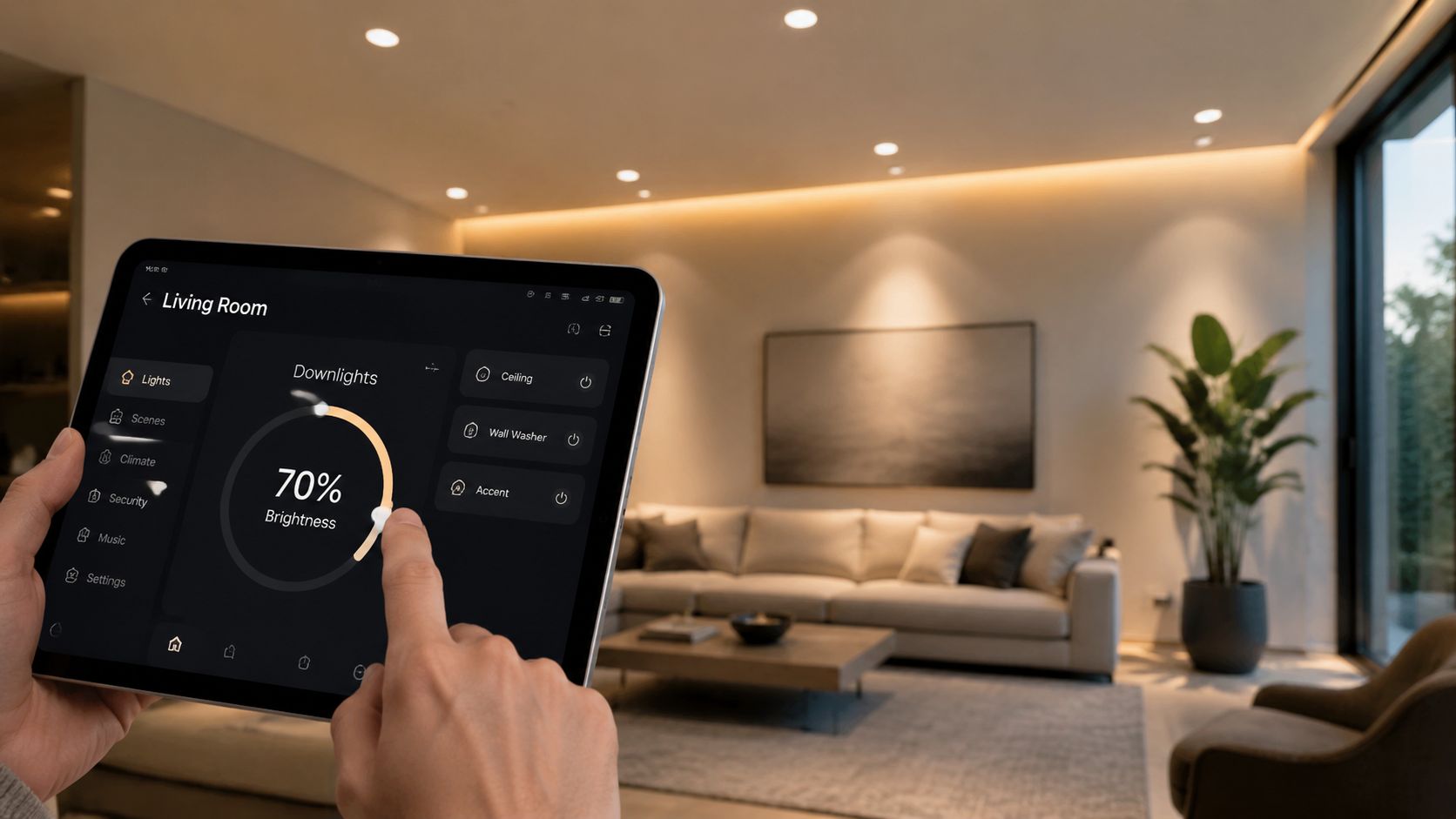
A standard LED downlight is usually the cleanest option for budget and reliability. It turns on, gives steady light, and does the job.
A dimmable setup adds another layer. The fitting has to be dimmable, and the switch has to be compatible with that fitting. If either side is wrong, homeowners often end up with flicker, buzzing, poor dimming range, or lights that drop out at low brightness.
That doesn't mean dimmers aren't worth it. In living rooms, bedrooms, and open-plan spaces, they can make a room far more usable. But they aren't a cosmetic extra. They're an electrical selection issue.
Smart lighting gives you convenience, scenes, scheduling, app control, and in some cases voice integration. It also creates more decisions.
You need to choose whether you want:
For some households, a standard wall switch with quality LED fittings is the right answer. It's simple, familiar, and easy for everyone in the house to use.
For others, especially renovators and homeowners planning whole-home control, smart lighting makes sense. If you're comparing those options, this smart lighting system guide for Brisbane homes gives a practical overview of what changes once you move beyond standard switching.
A quick visual example helps here:
The comparison isn't “basic versus premium”. It's simple versus layered.
The wrong approach is choosing features first and compatibility second. That's how people end up replacing switches or fittings they've just paid for. Decide how you want the room to work, then choose the control system that fits that use.
Brisbane-specific examples are where pricing starts to make sense. A broad national guide is helpful, but local jobs are shaped by access, age of the house, and whether the work is a replacement or a fresh layout.
For context, Airtasker's Queensland downlight cost guide notes that Brisbane jobs show a median project cost of $217 per job, with totals ranging from $117 to $393, depending on fixture numbers and ceiling complexity. Those figures line up with the reality that a small, simple job and a more involved Brisbane install can sit far apart.
A common Windsor scenario is an older brick home with existing halogen fittings in a living area.
Example scope
What usually affects the quote
How I'd describe the budget
This type of job often sits near the more straightforward end of Brisbane residential work if the points are already there and the cabling is serviceable. If the existing wiring is brittle, altered, or inconsistent, the quote moves up because the job stops being a quick swap and becomes corrective electrical work.
Small replacement jobs often look cheap from the floor. The ceiling decides whether they stay cheap.
A Grange extension is usually a different animal. The homeowner often wants a fresh layout in a kitchen or open-plan room rather than a one-for-one replacement.
Example scope
What usually affects the quote
How I'd describe the budget
Homeowners may be surprised by the budget. The room may be modern and easier to work in visually, but new point creation is labour-heavy. The clean final look comes from careful setup and measured placement, not speed.
Rental upgrades are often more practical. The owner wants safer, cleaner, lower-maintenance lighting without overcapitalising.
Example scope
What usually keeps this quote under control
The useful lesson isn't the suburb name. It's the pattern.
When a homeowner asks for a realistic downlight installation cost, those are the details that matter more than any generic online average.
If you want to lower the total spend, the goal isn't to cut corners. It's to remove avoidable labour and make better decisions before the electrician arrives.
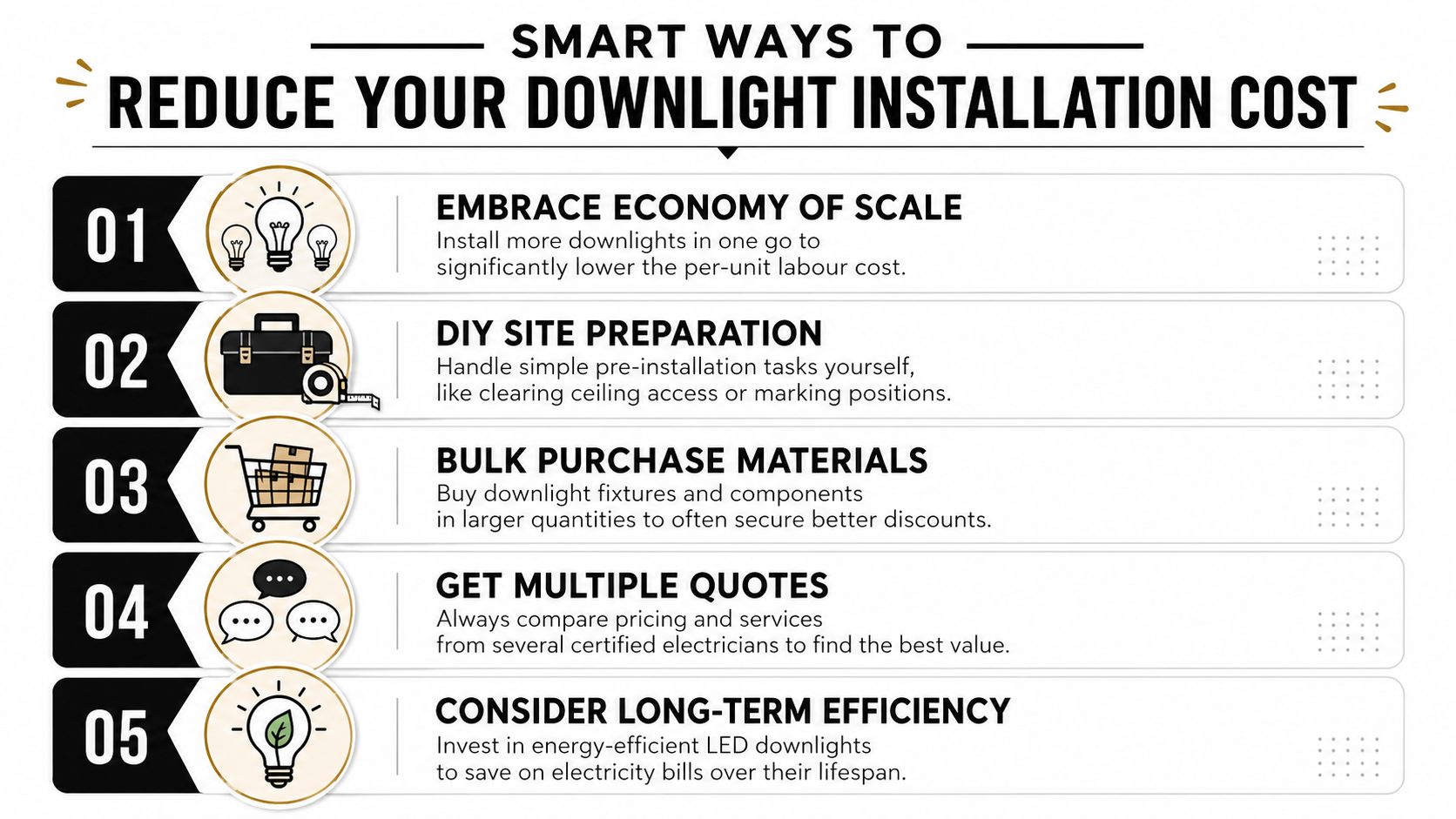
One of the most practical ways to reduce downlight installation cost is to do more of the work in one visit. The per-light rate often becomes better when the electrician is installing several fittings instead of attending for one room now and another room later.
There's also a separate rebate and volume angle worth knowing. Efficient Energy Group's Australian downlight rebate guide notes that some programs can bring installed downlights down to $20 each after rebates when a minimum of 25 lights is installed. The same guide says the standard cost for that unit would otherwise be around $75 each, which it describes as a 73% saving for qualifying bulk projects.
That won't apply to every Brisbane home, but it shows why it's worth asking about volume and program eligibility before splitting the work into smaller stages.
Homeowners usually save more by planning well than by chasing the cheapest fitting.
Trying to source random fittings online without checking compatibility often creates the opposite result. If the cut-out, driver, dimmer, or ceiling suitability is wrong, the install slows down or parts need replacing.
Doing the project room by room can also cost more overall. It feels easier on the budget in the short term, but repeated callouts and repeated setup time usually work against you.
A smarter approach is to map the whole job, prioritise the rooms, and decide whether staging is necessary or just habitual.
It depends on whether the work is a replacement or a new install, and on how accessible the ceiling is. A straightforward replacement job can move along quickly because the points already exist. A new layout takes longer because the electrician has to check, cut, wire, fit, and test each point carefully.
The best answer comes from an on-site look, especially in Brisbane homes with older ceilings or previous electrical alterations.
Yes. This is electrical work connected to your home's wiring, and it needs to be done safely and compliantly. Homeowners sometimes focus on the visible part of the job, which is the light in the ceiling. The invisible part is what matters more. Circuit condition, termination, testing, and fitting suitability all sit behind that finish.
For most homes, yes. The practical benefits are usually immediate. LED downlights run cleaner, look more modern, and avoid a lot of the heat and maintenance frustration that older halogen fittings create.
Many Brisbane homeowners make the switch because they want a cleaner ceiling line and fewer issues over time, not because they're chasing every possible feature.
You can ask questions, but the useful approach is to negotiate scope, not safety. Ask what's included, what assumptions the quote relies on, and what would trigger a variation. If you want help with the conversation itself, these Edinhart Realty negotiation strategies give a reasonable framework for comparing contractor quotes without turning the process into a race to the bottom.
A good electrical quote should already be clear about the trade-offs. Cheaper isn't always cheaper once rework, compatibility problems, or hidden exclusions show up.
If you want a clear Brisbane quote for your home, DLG Electrical can inspect the ceiling conditions, explain the practical options, and price the job based on the actual work rather than a generic allowance. That gives you a realistic downlight installation cost before the holes are cut.

Master Electrician with over 30 years of experience. Founded DLG Electrical in 2005 after international project work including electrical installations at Stamford Bridge Stadium, London(Home of Chelsea FC).

Local Electricians that can fix all Electric Hot water Systems.
Motion sensor lights are a versatile addition to any home, offering nu
