83 Jean St, Grange QLD 4051
Mon-Fri 07:30 AM - 04:00 PM - Sat - 8:00 - 12 - Sunday Closed
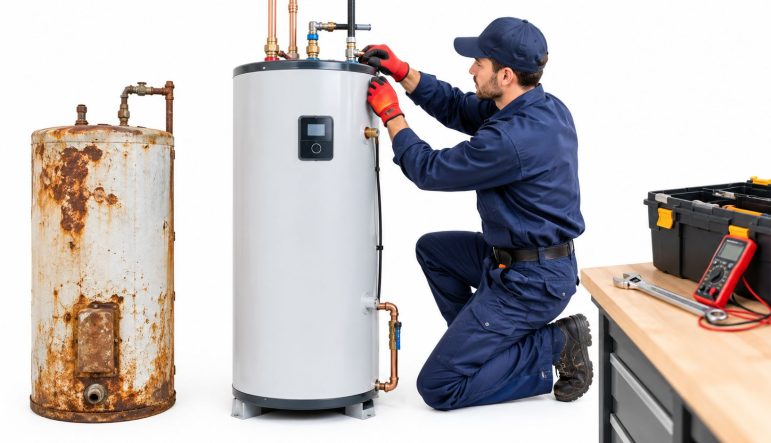
A cold shower before work is usually the moment a hot water problem stops being background maintenance and becomes urgent. You may hear the tank recover slowly, find water around the base, or reset a tripped breaker, then wonder whether a repair will buy more time or just delay the inevitable. In Brisbane homes, the right answer depends on the tank's condition, household demand, electrical supply, access, and the running cost of the replacement.
An electric hot water tank replacement isn't automatically a like-for-like exercise. A smaller household might benefit from downsizing, a growing family may need more stored capacity, and a controlled tariff or eligible heat-pump rebate can change the financial calculation. The safest approach is to make that decision before the old cylinder is disconnected.
The first clue is often simple. The shower turns cold, the hot tap produces rusty or lukewarm water, or the tank starts making unfamiliar noises. Brisbane's heat, humidity, outdoor exposure, hard-to-access service areas, and occasional plumbing modifications can all make a small fault harder to diagnose than it appears.
Three fault patterns deserve particular attention:
A useful homeowner checklist is available in this guide to new water heater needing signs, but a qualified tradesperson still needs to inspect the actual unit. You can also use DLG Electrical's guidance on why a hot water service may not be working to distinguish a power interruption from a system fault.
Replacement demand dominates Australia's hot water market. Queensland Government information places the domestic installed base at about 10.2 million hot water units for roughly 10 million households, with around 830,000 units sold each year. About 660,000 sales, or 79%, are replacements, not first-time installations, as outlined in the Queensland Government hot water guidance.
That scale matters because it shows you're not dealing with an unusual household failure. Electric tank replacement is a mainstream maintenance event with established installation practices, available parts, and familiar compliance requirements.
Still, urgency can lead homeowners to accept the first available unit without asking whether the old configuration suited the household. Before approving the quote, record the existing tank size, note when hot water runs out, check where the unit sits, and ask whether the electrical circuit, tray, valves, and pipework are suitable for the proposed replacement.
A like-for-like swap makes sense when the existing capacity meets demand, the installation location is sound, and the household has no reason to change its energy strategy. It saves decision time and may reduce site work. It isn't automatically the best choice, especially if the old tank regularly ran out during morning showers or occupied valuable space in a narrow side passage.
Household size provides a starting point, not a final answer. Peak demand matters more than the number of residents alone. A couple with long showers, frequent baths, or heavy laundry use may need more capacity than a larger household with efficient fixtures and staggered routines. In North Brisbane properties, access also matters. A tank that fits the water demand may still be impractical if the replacement path includes stairs, tight gates, low roof clearance, or a confined enclosure.
| Household size | Recommended capacity | Ideal use case |
|---|---|---|
| 1–2 people | 125–160 litres | Smaller homes, units, or households with moderate peak demand |
| 3–4 people | 250 litres | Typical family use with morning and evening demand |
| 5+ people | 315 litres or larger | Larger households with overlapping showers and appliance use |
These sizing ranges reflect Australian installer guidance compiled by Pivot Trade Services. Treat them as a practical starting point, then have the installer confirm the choice against actual usage, available space, tariff arrangements, and the manufacturer's requirements.
Downsizing can work when children have moved out, the property has become a rental with lower demand, or the previous tank was oversized for the household. The benefit is a smaller footprint and potentially lower purchase cost, but an undersized tank creates predictable complaints. Users may need to stagger showers, and the element may run more often during peak periods.
Upsizing can improve comfort, but it also affects physical handling, placement, pipework, and recovery behaviour. A larger cylinder may not fit the existing base or enclosure, and moving it can require additional labour. Don't choose a bigger unit solely because running out of hot water is inconvenient. First identify whether the problem is insufficient storage or a failing element, thermostat, valve, or tariff-controlled heating schedule.
A heat pump can be a sensible alternative where the household is planning broader electrification, has suitable ventilation and drainage, and can use available rebates. It may also require different clearances, condensate management, noise consideration, or electrical work. If the site is cramped or the replacement is urgent, a compliant electric storage unit may remain the practical option.
The best quote should explain three choices where relevant:
A cheaper cylinder isn't a saving if it produces recurring hot water shortages or requires modifications after installation. Ask the installer to state what stays, what changes, and why.
An electric hot water cylinder combines mains electrical supply, stored water, pressure, heat, and substantial weight. The replacement must follow a controlled sequence, not an improvised disconnection and reconnection. Australian installation instructions require a licensed tradesperson and alignment with AS/NZS 3500.4 for plumbing and AS/NZS 3000 for electrical work, as set out in the Australian electric storage installation instructions.
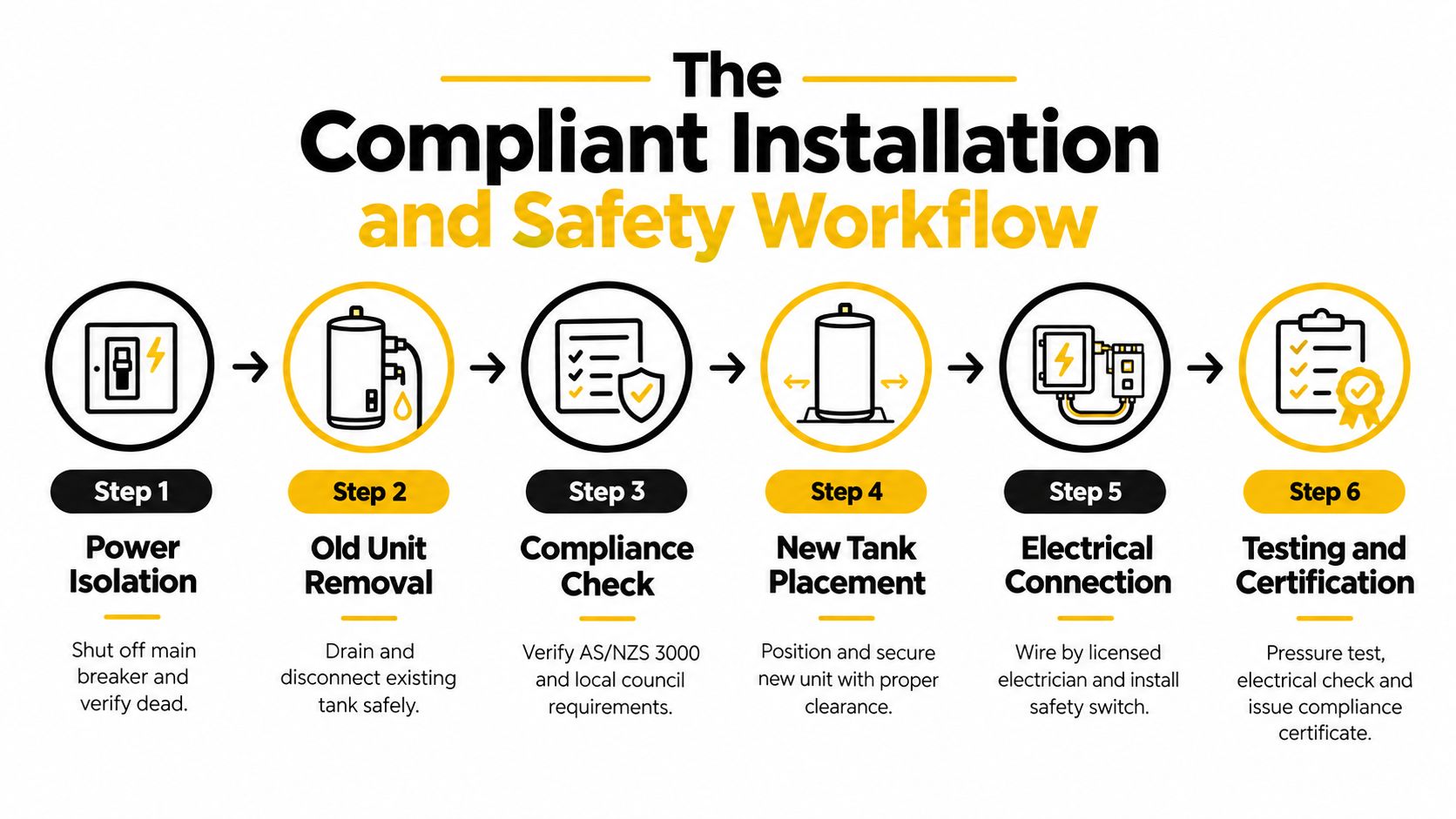
1. Isolate the electrical supply. The electrician switches off the relevant circuit, applies safe isolation procedures, and verifies that the supply is dead before touching the wiring. A wall switch alone isn't proof that the conductors are safe.
2. Isolate water and drain the tank. The water supply is shut off and the cylinder is drained through the appropriate connection. The water may remain hot, and the tank can be heavy even after draining, so controlled discharge protects the occupants, property, and tradesperson.
3. Remove the failed unit. The installer disconnects plumbing and electrical connections, manages residual water, and removes the cylinder without damaging nearby walls, flooring, pipework, or the base. Disconnection unions make future servicing easier and should be considered where the existing arrangement lacks them.
4. Check the installation location. The new unit needs a level, stable base and suitable service clearance. A safe tray is important where a leak could damage internal flooring, cupboards, adjoining rooms, or stored property. Outdoor placement still requires protection from site conditions and adequate access.
5. Reconnect services correctly. The tank must connect to a dedicated 240V AC, 50Hz supply with suitable over-current protection and an isolating switch. Plumbing connections, valves, tempering arrangements, and discharge lines must be positioned as required by the product instructions and applicable standards.
6. Test and commission. The installer checks for leaks, confirms pressure behaviour, verifies electrical operation, and commissions the system before energising it for normal use. The homeowner should receive the relevant compliance documentation and instructions for isolation and routine maintenance.
Practical rule: A tank isn't ready simply because it heats water. It must also remain accessible, protected from preventable property damage, correctly wired, leak-free, and documented.
Older Brisbane homes may have cramped service cupboards, uneven concrete pads, altered pipework, or electrical circuits that have been extended over time. A direct swap can become a more involved job if the base has deteriorated, the tempering valve is missing or unsuitable, or the existing cable and protection don't match the new unit.
The safe tray, drain path, and service clearance should be confirmed before the old tank is removed. Omitting those details can turn a small relief-valve leak into flooring damage, while poor access can make the next element or thermostat repair unnecessarily difficult.
A replacement tank can fit the existing plumbing and still be the wrong long-term choice. Before approving a like-for-like swap, compare household demand, tank capacity, heating times, tariff structure, and the electrical work required at the Brisbane property. A controlled load arrangement may reduce the usage rate, but it can also limit when the cylinder reheats.
Published Australian pricing data for 2026 reports annual electric storage running costs of about $2,246.09 on a residential rate and $1,153.51 on a controlled rate. It also reports supply-and-install pricing of roughly $1,747 to $2,525, depending on the state. See the Australian hot water service pricing and tariff data for those reference figures. They are not a Brisbane quote. Retailer charges, household consumption, tank size, access, and required site work can all change the final result.
Ask the electrician or energy retailer these questions before selecting the replacement:
Review the full arrangement in the AU electricity tariff nuances, rather than comparing advertised usage rates alone. Capacity should be decided first. Downsizing may lower standby losses and purchase costs, but it can leave a larger household short of hot water. Upsizing may improve recovery and comfort, while increasing space, demand, and operating costs.
Recent Australian market coverage reports rebates that can reduce heat-pump costs by $1,000 to $3,000 or more, depending on eligibility and the applicable programme. Rules can change, and eligibility may depend on the product, property, installer, and replacement circumstances. Confirm current Queensland requirements before treating an advertised rebate as part of the budget.
A heat pump also needs suitable placement, service clearance, condensate management, and an operating pattern that matches the household. Brisbane conditions, including limited side access, outdoor noise concerns, and confined service areas, can affect whether the installation is practical. A standard electric tank may suit an urgent replacement, while a heat pump can make more sense during planned renovation when the whole site can be assessed.
Compare upfront cost, annual running cost, tariff fit, rebate eligibility, capacity, access requirements, and future electrical demand together. That comparison supports a deliberate choice to upsize, downsize, retain electric storage, or investigate a different system.
An electric hot water tank isn't a plug-in appliance that a handyman can safely substitute without checking the circuit. The installation combines electrical connection, plumbing pressure, thermal protection, isolation, and compliance certification. Queensland homeowners and landlords need work completed by appropriately licensed tradespeople, with the electrical component performed by a licensed electrician.
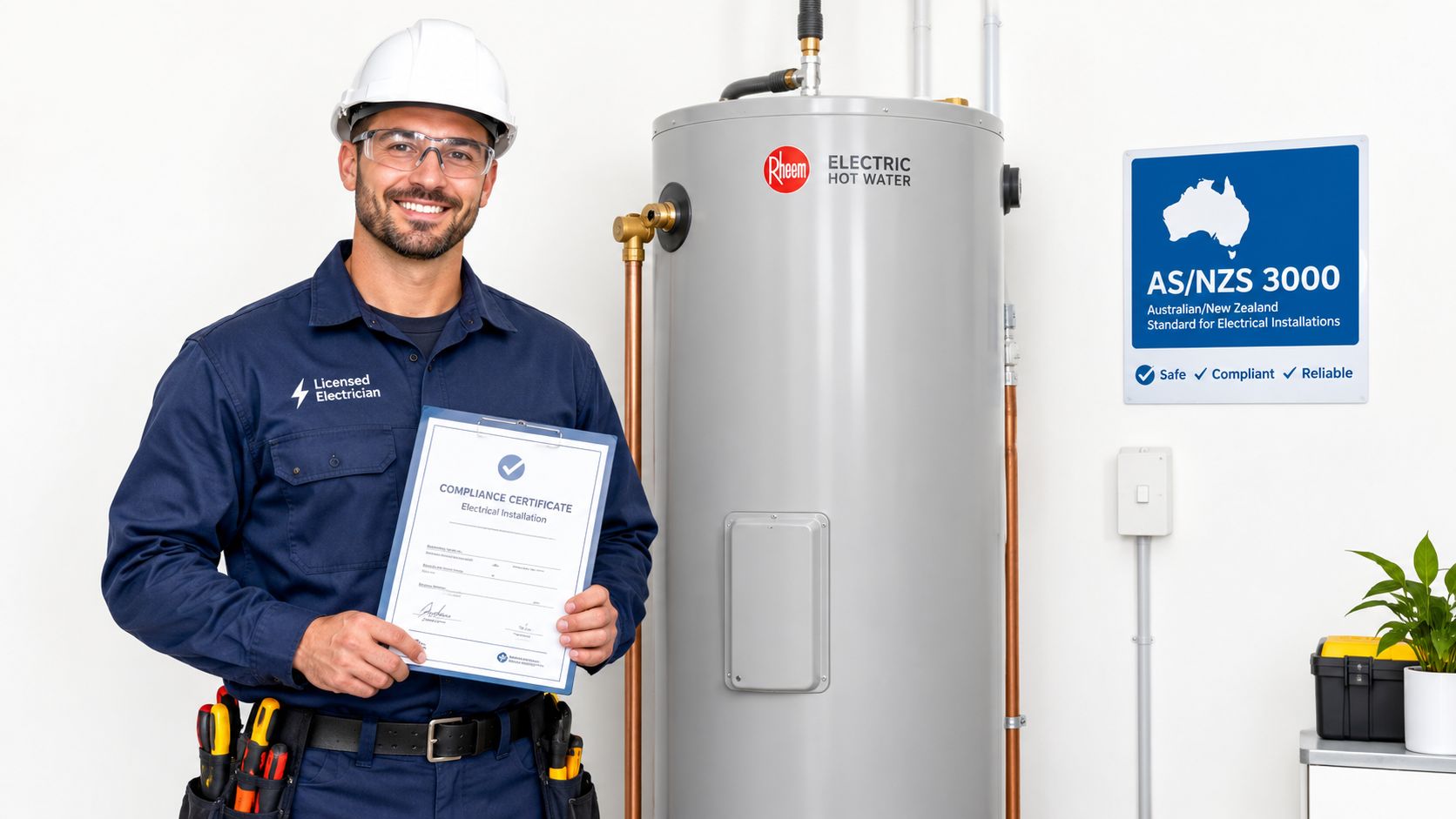
The replacement requires a dedicated supply with appropriate over-current protection and an isolating switch. If the breaker trips as the element energises, the electrician needs to investigate the element, thermostat, cable, terminations, and protective device. Installing a larger tank or different model without checking those components can leave the fault unresolved or create a new one.
Australian installation requirements reference AS/NZS 3000 and AS/NZS 3500.4, covering electrical and heated-water installation practices. The manufacturer's instructions also control practical details such as clearances, valve placement, wiring arrangements, and service access. Ignoring those instructions can affect safe operation, maintenance, and warranty support.
A relief valve that drips continuously, a missing disconnection union, or an unsuitable discharge arrangement isn't cosmetic. Pressure and temperature controls protect the cylinder and occupants, while correct pipework directs discharge safely. A safe tray and drainage path can limit damage if a component leaks, particularly inside a home or in a location above vulnerable flooring.
The lowest installation price often removes the checks you discover only after something fails.
A licensed electrician can also identify whether the old installation has hidden defects, such as damaged insulation, loose terminations, inadequate isolation, or a circuit shared with another load. Those faults may not appear during a quick visual inspection, but they matter when the new element draws power.
Homeowners should ask about licensing, insurance, compliance paperwork, the proposed unit, capacity, circuit arrangements, tray requirements, valves, and what the quote excludes. DLG Electrical's guide to questions to ask an electrician before hiring provides a practical starting point for that conversation.
DLG Electrical provides electric hot water repairs, electrical connections, and licensed installation work in Brisbane, including standard electric unit replacements and direct swaps where the site is suitable. It should be treated as one local option to assess alongside other properly licensed contractors.
A good Brisbane replacement begins with a site assessment, not a product catalogue. For a home in Grange, Windsor, or North Brisbane, the contractor should check the tank location, access path, base condition, safe-tray requirements, pipework, valves, discharge route, electrical board, isolation switch, and dedicated circuit.
The assessment should also establish whether the household is choosing the right capacity. A technician may ask when hot water runs out, how many people shower during the busiest period, whether the property uses controlled load, and whether future work such as an induction cooktop, solar installation, or electric vehicle charger could affect the broader electrical plan. Those questions prevent a rushed replacement from becoming an avoidable compromise.
A clear proposal should identify:
For further context on the cost of hot water cylinder replacement, compare the scope rather than selecting the lowest figure. A quote that omits a circuit upgrade or tray may appear cheaper until those items become urgent during installation.
If your tank has failed, turn off the electrical supply if you can do so safely, avoid opening electrical covers, and arrange an assessment before ordering a replacement. Ask DLG Electrical for a practical Brisbane quote covering the tank, capacity decision, circuit, valves, access, compliance, and commissioning in one organised scope.
DLG Electrical can assess, repair, or replace electric hot water systems across Brisbane, with licensed and insured electricians handling the electrical connection and compliance requirements. Visit DLG Electrical to request a quote and discuss whether your home needs a like-for-like tank, a capacity change, or a broader electrification review.

Master Electrician with over 30 years of experience. Founded DLG Electrical in 2005 after international project work including electrical installations at Stamford Bridge Stadium, London(Home of Chelsea FC).

Local Electricians that can fix all Electric Hot water Systems.
Motion sensor lights are a versatile addition to any home, offering nu
