83 Jean St, Grange QLD 4051
Mon-Fri 07:30 AM - 04:00 PM - Sat - 8:00 - 12 - Sunday Closed

You're standing in the kitchen at 10pm, staring at a dead power point while the lights flicker overhead. Outside, Brisbane rain is hammering the roof, the ceiling fan has started sparking, and the switchboard keeps tripping. You search “emergency electrician near me”, but the first decision isn't which sparky can arrive fastest. It's whether the fault is inside your home, on the network, or serious enough to involve the fire service.
That distinction can save you an unnecessary callout, but it can't justify taking risks. Electrical injuries remain a serious residential safety issue. The Australian Institute of Health and Welfare recorded almost 1,100 hospitalised electrical injury cases over a two-year period, while 73% of electrocution deaths occurred in the home. The AIHW electrical injury summary makes the practical point clear: isolate danger first, then get qualified help.
A summer storm can turn an ordinary fault into a dangerous one quickly. In a Paddington Queenslander, a power outage might leave only part of the house without electricity. In The Gap, a lightning strike could knock out the network while a separate surge damages appliances inside the property. From the street, both situations look like the same thing: darkness and confusion.
The wrong call wastes time. If the network has failed, Energex needs to restore supply. If your switchboard, fixed wiring, or appliance has failed, you need a licensed electrician. If there's smoke, visible arcing, or a fire, leave the house and contact emergency services before arranging electrical repairs.
The first question isn't “Who can come now?” It's “Where is the fault?”
Storm response creates another problem. Brisbane homeowners often search for urgent help at the same time after severe weather, but the cause may sit beyond the property boundary. Recent reporting recorded 322,772 Energex outages during ex-Tropical Cyclone Alfred in March 2025, showing how quickly network demand can overwhelm ordinary troubleshooting. The Energex outage coverage from WattClarity is useful context for understanding why a private electrician can't restore a damaged street network.
Smoke alarms are driving a different kind of urgency. Queensland's staged reforms began after the 2011 Slacks Creek house fire, which killed 11 people, including eight children under 18. The state introduced deadlines running from 1 January 2017 to 1 January 2027, with interconnected, photoelectric alarms required in bedrooms, hallways, and on each storey. Queensland's electrical safety performance information outlines the timetable and why sales, leases, renovations, and compliance checks keep generating electrical work.
Before panic sets in, save the practical guidance in this 24-hour electrical service guide, and keep clear advice on electrical fire risks available, such as these Restore Heroes electrical fire tips. Preparation matters more than scrolling through search results with one hand while holding a torch in the other.
Your job before the electrician arrives is not to repair the fault. Your job is to reduce exposure, isolate what you can safely isolate, and give the technician accurate information.
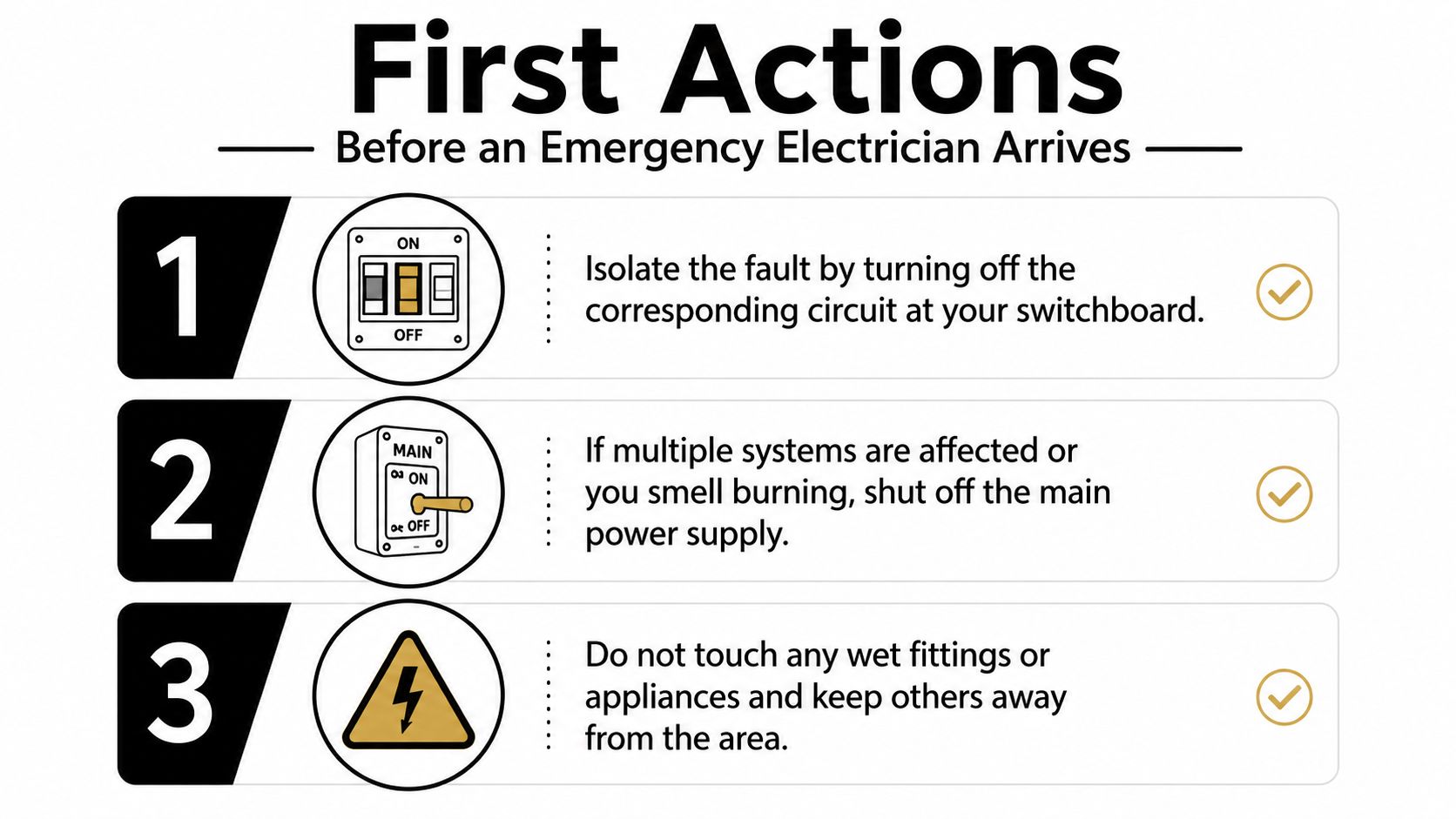
If one room, power point, light, or appliance is affected, move away from it and go to the switchboard only if the path is dry and safe. Turn off the corresponding circuit breaker or safety switch. Don't remove covers, pull apart a fitting, or handle a damaged cord to “see what happened”.
A safety switch that trips once may have detected a fault. If it trips again after you reset it, leave it off. Repeatedly restoring power keeps the fault energised and can expose people to damaged wiring, moisture, or a failed appliance.
If several circuits are affected, or you smell burning plastic, see smoke, or notice arcing, switch off the main supply if you can reach the board without entering danger. Keep children, pets, and other household members away from the switchboard and affected area.
Never touch a wet appliance, outlet, light fitting, ceiling fan, or switch. Don't stand in pooled water while trying to reach a breaker. If water is entering around electrical equipment, move away and wait for qualified help.
Smoke changes the situation. Get everyone outside, call the fire service, and don't re-enter because the visible smoke has stopped. Only approach the electrical system after emergency responders say it's safe.
For practical advice on containing an electrical fire without creating a second hazard, read how to put out an electrical fire. Water is not a safe response to an energised electrical fire.
Write down what happened before the failure. Tell the electrician:
That information helps the technician bring the right equipment and decide whether the job needs immediate isolation, fault-finding, or coordination with Energex.
Start outside the house. Look at the neighbours' lights, street lighting, and any visible network equipment from a safe distance. If nearby properties are also dark, the fault is more likely to sit on the network side. Check the Energex outage information before paying a private electrician to investigate a blackout the distributor must restore.
A total outage after lightning, a storm, or a visible fallen line points strongly towards the network. Stay well clear of fallen or damaged powerlines, including anything touching a fence, tree, roof, or vehicle. Don't inspect a service pillar or damaged network equipment by approaching it. Report the hazard to Energex and keep people away.
A private electrician becomes the right call when the street has power but your home doesn't, only certain rooms are affected, or your switchboard is tripping. Flickering that begins when one appliance runs also points towards an appliance, circuit, or installation fault rather than a general network outage.
| Symptom | Likely home fault | Likely network fault |
|---|---|---|
| Only one room or circuit is dead | Tripped breaker, safety switch, appliance, or fixed wiring fault | Less likely unless the supply is partially damaged |
| Neighbours still have power | Service, switchboard, or internal installation problem | Possible isolated service issue, report symptoms to Energex |
| Several nearby homes are dark | Unlikely to be limited to your property | Network outage or storm damage |
| Power fails after lightning | Surge damage or internal fault if neighbours have power | Network fault if the surrounding area is also affected |
| One appliance causes repeated trips | Faulty appliance, cord, outlet, or circuit | Unlikely |
| Fallen line or damaged street equipment | Not a homeowner repair | Network emergency, keep clear and report it |
Queensland's serious electrical incident profile reinforces why you shouldn't assume a tripping appliance is harmless. The Electrical Safety Office reports an average of 16 serious worker electrical incidents per year, with about 2 fatal incidents annually. Its breakdown identifies 68% as accidental contact with electricity, 29% as faulty equipment or plant, and 52% occurring in electrical installations. The Queensland Electrical Safety Office incident infographic supports a cautious workflow: isolate first, then investigate whether the switchboard or fixed installation is involved.
If neighbours have power and your switchboard is behaving badly, stop waiting for a network restoration. Call a licensed electrician.
Search results don't prove competence. A professional emergency electrician should give you verifiable information before anyone starts work.
The first requirement is a current Queensland Electrical Contractor Licence. Ask for the licence details and verify them through the appropriate Queensland register. A business that becomes evasive when you ask for licence information isn't worth the risk, especially when the job involves a live switchboard or damaged fixed wiring.
Insurance matters too. Confirm that the contractor carries public liability cover and workers' compensation insurance. You're not being difficult by asking. You're checking whether the business is organised to take responsibility for work carried out at your home.
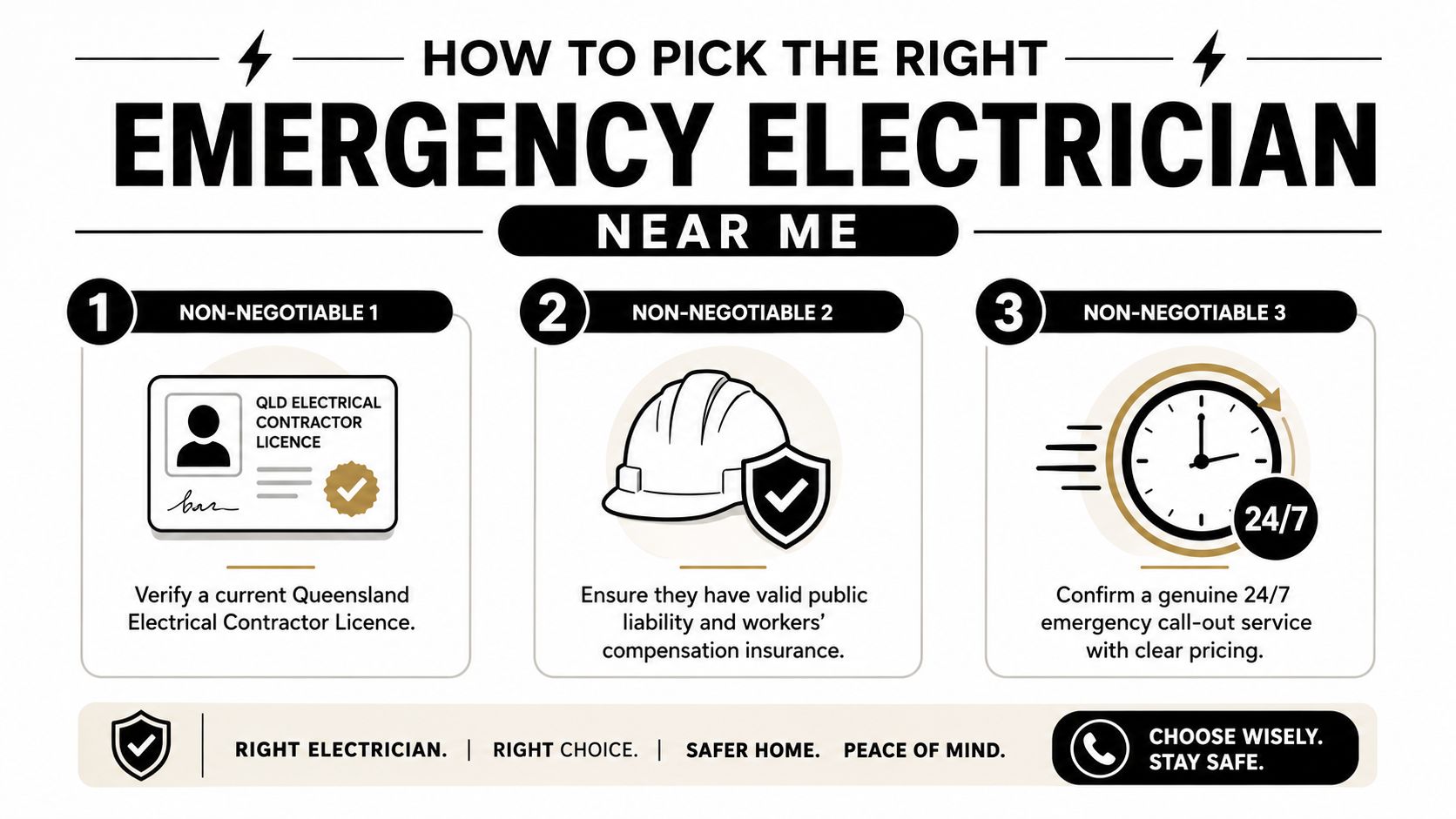
Don't settle for “we'll send someone”. Ask:
A door-knocker who appears after a storm is a poor choice. So is anyone demanding cash before explaining the work, refusing to provide an ABN, or declining to email licence details. You're allowed to say no.
Use this two-minute ranking: licence proof, genuine Brisbane coverage, equipment on board, transparent pricing, and post-job paperwork. The electrician who answers those questions clearly is more useful than the advertiser with the loudest “24/7” badge.
This short video can also help you recognise situations that need professional electrical attention before you make the call:
Emergency electrical pricing varies because the job varies. A straightforward isolation and repair isn't priced the same way as a switchboard fault, concealed wiring problem, or storm-damaged installation.
You'll usually encounter one of three structures. Some contractors charge a flat callout that includes an initial period of labour. Others bill time and materials, often in defined increments. After-hours pricing may also change between evenings, weekends, public holidays, and overnight attendance.
The number that matters is not the headline callout. It's the total scope covered by the quote.
| Pricing model | How it works | Indicative Brisbane range |
|---|---|---|
| Flat callout | A set attendance fee may include an initial period of diagnosis or labour | Ask whether travel, GST, and the initial labour period are included |
| Time and materials | Labour and parts are billed according to the work performed | Confirm the billing increment and whether diagnosis is charged separately |
| After-hours or urgent rate | The attendance rate may change outside ordinary business hours | Request the evening, weekend, public holiday, or overnight rate before booking |
The figures supplied for this topic suggest a standard after-hours callout may start around $180 to $250, while complex fault-finding or switchboard replacement can move well beyond $500 once labour and parts are included. These are indicative expectations, not a universal Brisbane tariff. No reputable electrician should promise a final price before identifying the fault.
Travel is another variable. One contractor may absorb local travel into the callout, while another may charge by distance. Ask directly: “Is the price for attendance only, diagnosis only, or the complete repair if the fault is straightforward?”
A Browns Plains homeowner with a failing switchboard might pay the attendance fee, then face a substantially higher total after testing identifies damaged components and replacement work. The sensible approach is to approve diagnosis first, request a written repair price, and stop the work if the new scope isn't clear.
Smoke alarm work is becoming a common reason Queensland homeowners search for urgent electrical help. The deadline isn't just about installing an alarm on a wall. From 1 January 2027, all remaining domestic dwellings in Queensland must meet the updated requirements for interconnected, photoelectric smoke alarms in every bedroom, hallways connecting bedrooms, and on each storey. Queensland Fire and Emergency Services' smoke alarm reform information explains the legislative transition.
The earlier deadlines already apply in specific circumstances. New dwellings and substantial renovations have required the updated arrangement from 1 January 2017, while properties sold or leased have faced requirements from 1 January 2022. That makes smoke alarms relevant to landlords, sellers, renovators, and property managers now, not just at the final deadline.
A home may have alarms and still fall short. Standalone alarms might not communicate with each other. A unit might sit in a living area while bedrooms lack coverage. An alarm may be the wrong type, or a storey may have no required device.
A proper audit moves room by room and storey by storey. The electrician should confirm the alarm type, location, interconnection, power arrangement, and any gaps before replacing or rewiring devices. Hardwired alarms require licensed electrical work, and wireless interconnection still needs correct product selection and testing.
The safest response is to schedule compliance work before it becomes an emergency. Don't wait until a settlement, tenancy handover, or inspection exposes missing alarms. For broader guidance on how alarm maintenance should comply with Australian Standards for alarms, use a qualified fire and electrical professional rather than relying on a hardware-store checklist.
This Queensland smoke alarm compliance guide is also useful when you're preparing a property for sale, lease, renovation, or full-dwelling compliance. Treat the work as a safety upgrade and a handover safeguard, not as a last-minute box-ticking exercise.
Save this list before the next storm. In a real emergency, you won't want to remember the sequence from scratch.
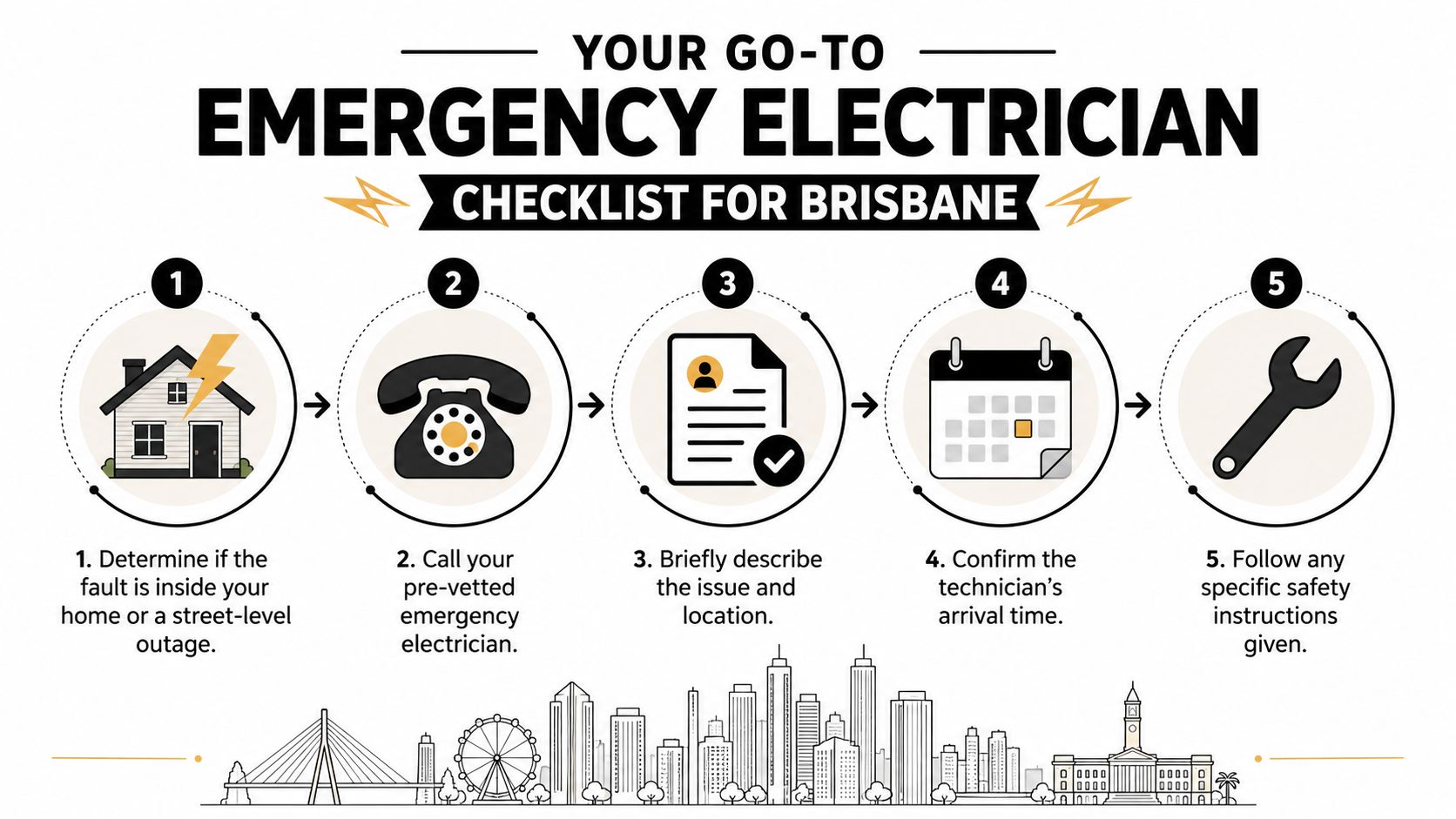
Check whether neighbours and streetlights have power, without approaching fallen lines or damaged network equipment. If the wider area is out, check Energex outage information and report network hazards. If the street has power but your home doesn't, treat it as a private electrical fault.
At the switchboard, turn off the affected breaker or safety switch if you can reach it safely. If there's smoke, burning smell, widespread failure, or visible arcing, shut off the main supply only when doing so doesn't expose you to water, fire, or damaged equipment.
Take a photograph from a safe position. Note the time, what was running, which rooms are affected, and whether the safety switch tripped once or repeatedly. Don't touch the fitting or appliance to get a clearer image.
Give the suburb, property type, symptoms, switchboard status, and any storm or water connection. Ask for the electrician's licence details, expected arrival time, after-hours callout fee, and what the first charge includes.
Follow the safety instructions given over the phone. Keep children and pets out of the area, leave damaged equipment isolated, and evacuate if smoke or fire is present.
Before the work is closed, ask what testing was completed and whether you'll receive a Certificate of Testing or other required documentation. Keep the paperwork with your property records, particularly if you're a landlord, selling, renovating, or preparing for a tenancy handover.
DLG Electrical is one Brisbane-based option that provides residential electrical repairs, power fault assistance, switchboard work, and smoke alarm services, with licensed and insured electricians described by the business as available for urgent requirements. Check availability and after-hours response directly before booking, because an emergency provider's capacity can change during widespread storms.
DLG Electrical can help Brisbane homeowners triage urgent electrical faults, investigate power issues, handle switchboard repairs, and prepare smoke alarms for Queensland's compliance requirements. Visit DLG Electrical to discuss your situation, confirm availability, and arrange the right licensed electrical response.

Master Electrician with over 30 years of experience. Founded DLG Electrical in 2005 after international project work including electrical installations at Stamford Bridge Stadium, London(Home of Chelsea FC).

Local Electricians that can fix all Electric Hot water Systems.
Motion sensor lights are a versatile addition to any home, offering nu
