83 Jean St, Grange QLD 4051
Mon-Fri 07:30 AM - 04:00 PM - Sat - 8:00 - 12 - Sunday Closed

That relentless, high-pitched chirp from your smoke alarm isn’t just an annoying interruption—it’s your home’s safety system trying to tell you something is wrong. While a low battery is the usual suspect when a home fire alarm keeps beeping, that sound could also be a warning about dust contamination, high humidity, or even that the unit has reached its end of its service life.
Figuring out what the alarm is saying is the first step to restoring both your peace of mind and your home’s safety.
Before you can fix the problem, you need to play detective. Different beep patterns point to different issues, from simple maintenance reminders to critical warnings that need immediate attention. If you think of the chirp as a code instead of just noise, you can diagnose the issue much faster.
It’s a sound that’s tempting to ignore, but a constantly beeping smoke alarm is often a sign of poor maintenance—a major fire risk. According to Fire and Rescue NSW’s fire safety research, modern house fires can become deadly in just a few minutes because of all the synthetic materials in our furniture and decor. This makes a fully functional alarm non-negotiable.
It’s not always the battery. Several other common issues can trigger that persistent beeping, so it’s worth checking these before you assume a simple battery swap will fix it.
This decision tree infographic can help you quickly work out the most likely cause based on how your alarm is behaving.
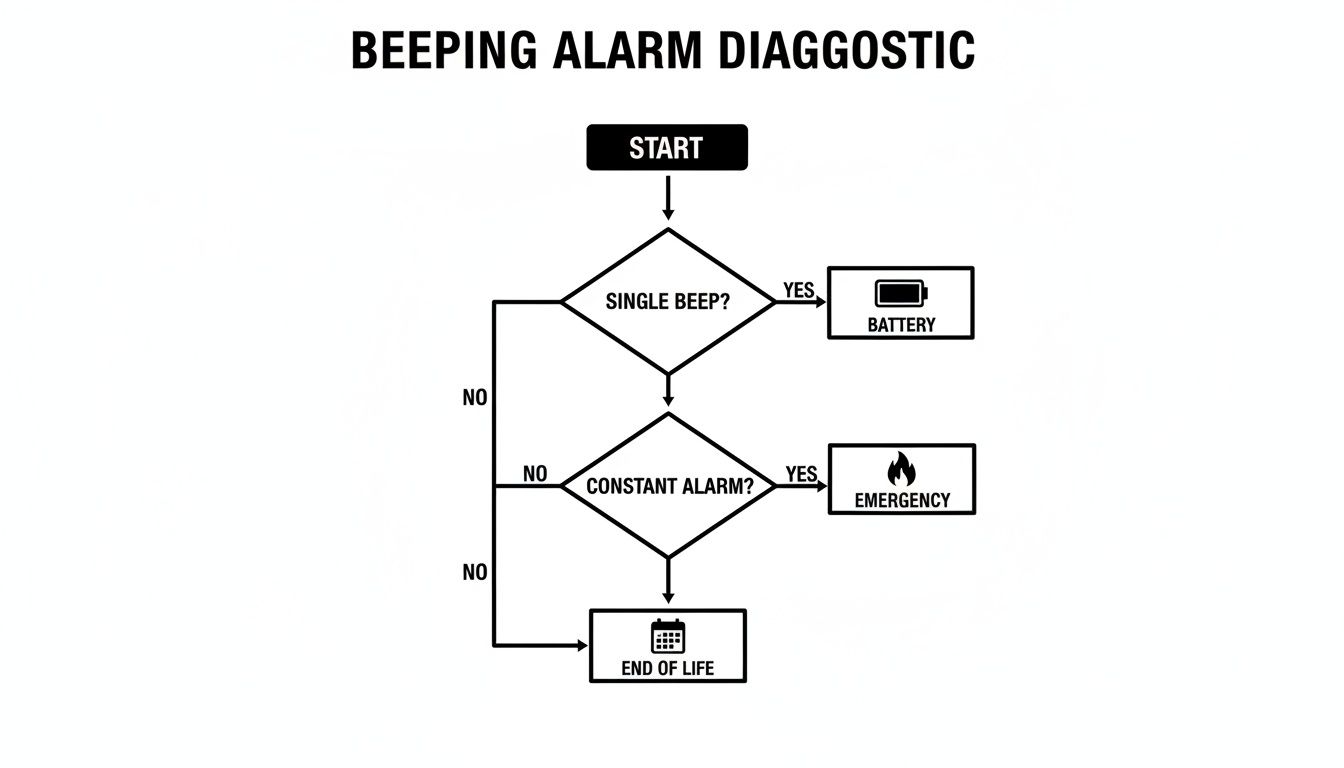
The flowchart walks you through the troubleshooting process, starting with the most common problem (a single beep for a low battery) and moving on to more serious alerts.
To make it even simpler, here’s a quick guide to what your alarm’s signals usually mean.
| Beep Pattern | Likely Cause | Recommended Action |
|---|---|---|
| One chirp every 30-60 seconds | Low Battery | Replace the backup battery immediately. |
| Three loud beeps in a row | Smoke Detected (Emergency) | Evacuate the premises and call 000. |
| Five chirps in a row | End-of-Life | The entire alarm unit is expired and needs to be replaced. |
| Intermittent or random chirps | False Alarm / Contamination | Clean the alarm of dust/debris. Check for humidity or steam sources. |
Remember, this is a general guide, and you should always check the manufacturer’s manual for your specific model’s signals.
Key Takeaway: A beeping alarm is a working alarm that is actively reporting a fault. Disabling it is never the safe option. The sound is a direct prompt for you to investigate and resolve an underlying issue, ensuring it will function correctly in a real emergency.
Sometimes, the beeping can seem to happen for no reason at all, which is particularly confusing when there’s no smoke or fire. If you’re stuck in this situation, check out our guide on why your smoke alarm might be going off without any smoke.
Right, that incessant chirping has finally pushed you over the edge. It’s time to take action and get some peace and quiet. Let’s walk through how to safely and correctly silence that beeping alarm, making sure we fix the actual problem instead of just hitting the snooze button on a potential hazard.
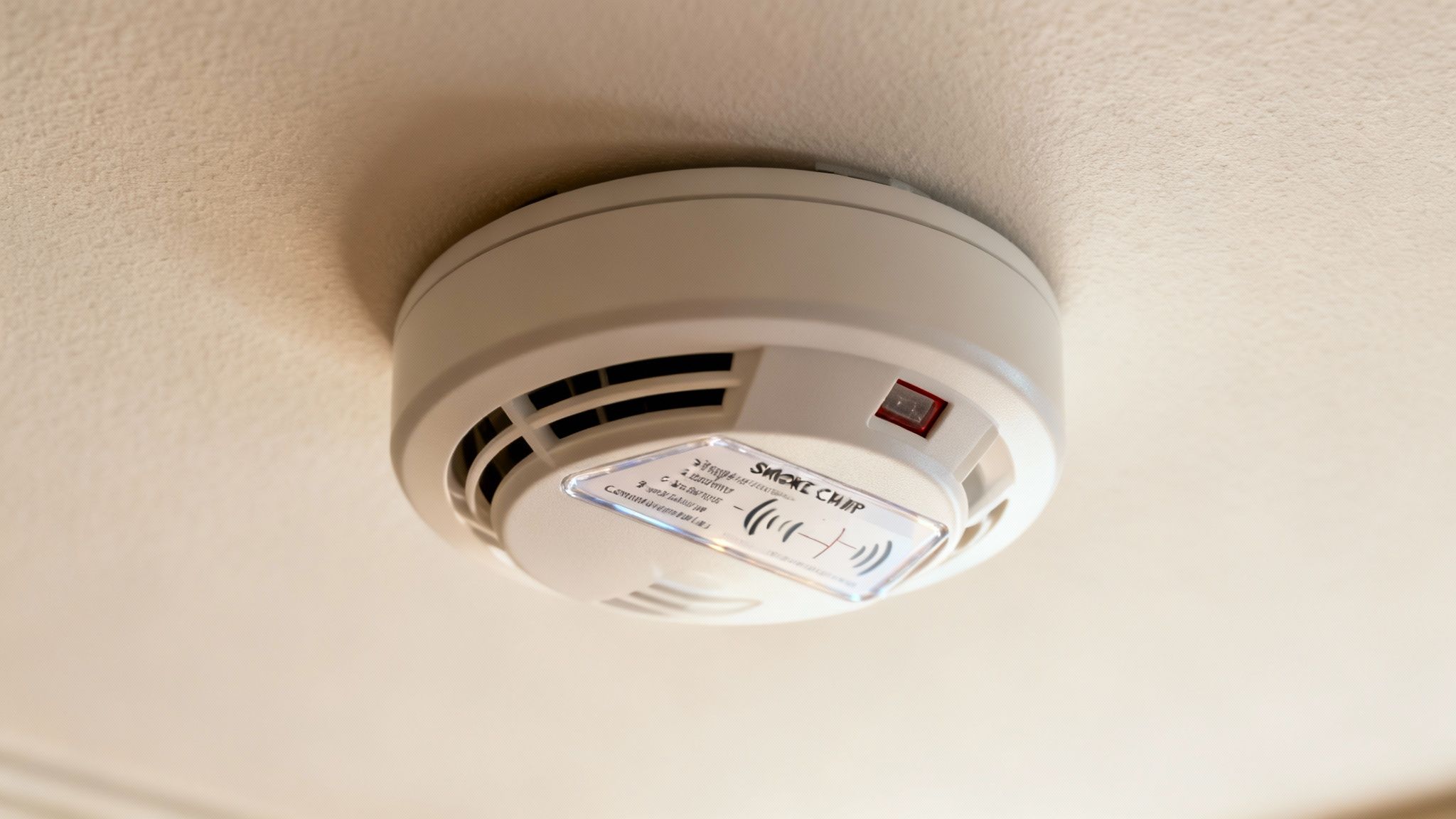
Before you climb up there, let’s get prepared. You’ll need a sturdy step ladder, a fresh 9-volt or AA battery (double-check what your model needs), and a can of compressed air if you’ve got one handy. And a crucial safety step: if your alarm is hardwired into the mains power, it’s always best practice to flick the corresponding circuit breaker off at your switchboard first.
Nine times out of ten, the reason a home fire alarm keeps beeping is a dying battery. It’s the most common culprit by a long shot. Even your hardwired alarms have a backup battery, and you can bet it will let you know when it’s running low—usually at 3 AM.
To get to it, you’ll typically need to twist the alarm anti-clockwise to pop it off its mounting bracket. If it’s a hardwired model, you’ll also see a small power connector plugged into the back; carefully unplug this as well.
Now that it’s in your hands, find the battery compartment. Pop it open, unclip the old battery, and slide the new one in, making sure the positive (+) and negative (-) terminals line up correctly.
Pro Tip: Whatever you do, don’t use a rechargeable battery in a smoke alarm. They just don’t provide the consistent, long-lasting power delivery these devices need. Stick with a high-quality alkaline or, even better, a lithium 9-volt battery. Lithium ones can last for years, which means fewer of those rude awakenings.
So, you’ve swapped the battery, but the chirping continues. What gives? This often happens because of a residual charge stored in the alarm’s internal capacitor. It’s holding onto an old error memory, and we need to clear it out with a full reset.
It’s simple. With the alarm completely disconnected—no mains power plug and no battery—press and hold the ‘Test’ button for about 20-30 seconds. This simple action drains any leftover power and forces the unit’s memory to clear.
Once that’s done, plug the power connector back in (for hardwired units), install the fresh battery, and twist the alarm back onto its bracket. Give the test button one final press. You should hear the full, ear-splitting alarm sound for a moment before it goes silent. Problem solved.
If a new battery and a reset didn’t do the trick, the next thing to suspect is a contaminated sensor. Dust, sneaky cobwebs, and even tiny insects can get inside the sensing chamber and fool the alarm into thinking there’s smoke.
Here’s how to give it a good clean:
This kind of simple maintenance is incredibly effective. It’s a frustrating reality that many nuisance beeps lead to people disabling their alarms, but a bit of upkeep can prevent this. Fire Rescue Victoria actually recommends cleaning your alarms and replacing the batteries every single year to ensure they’re ready when you need them. You can find more helpful advice on why your smoke alarm keeps beeping and how to manage it from home safety experts.
When one hardwired smoke alarm decides to start beeping, it often kicks off a chorus of chirps from every other unit in your home. That’s the reality of interconnected systems—a fantastic safety feature that ensures an alert in one room is heard everywhere. But it can also make finding the original culprit feel like a frustrating game of whack-a-mole.
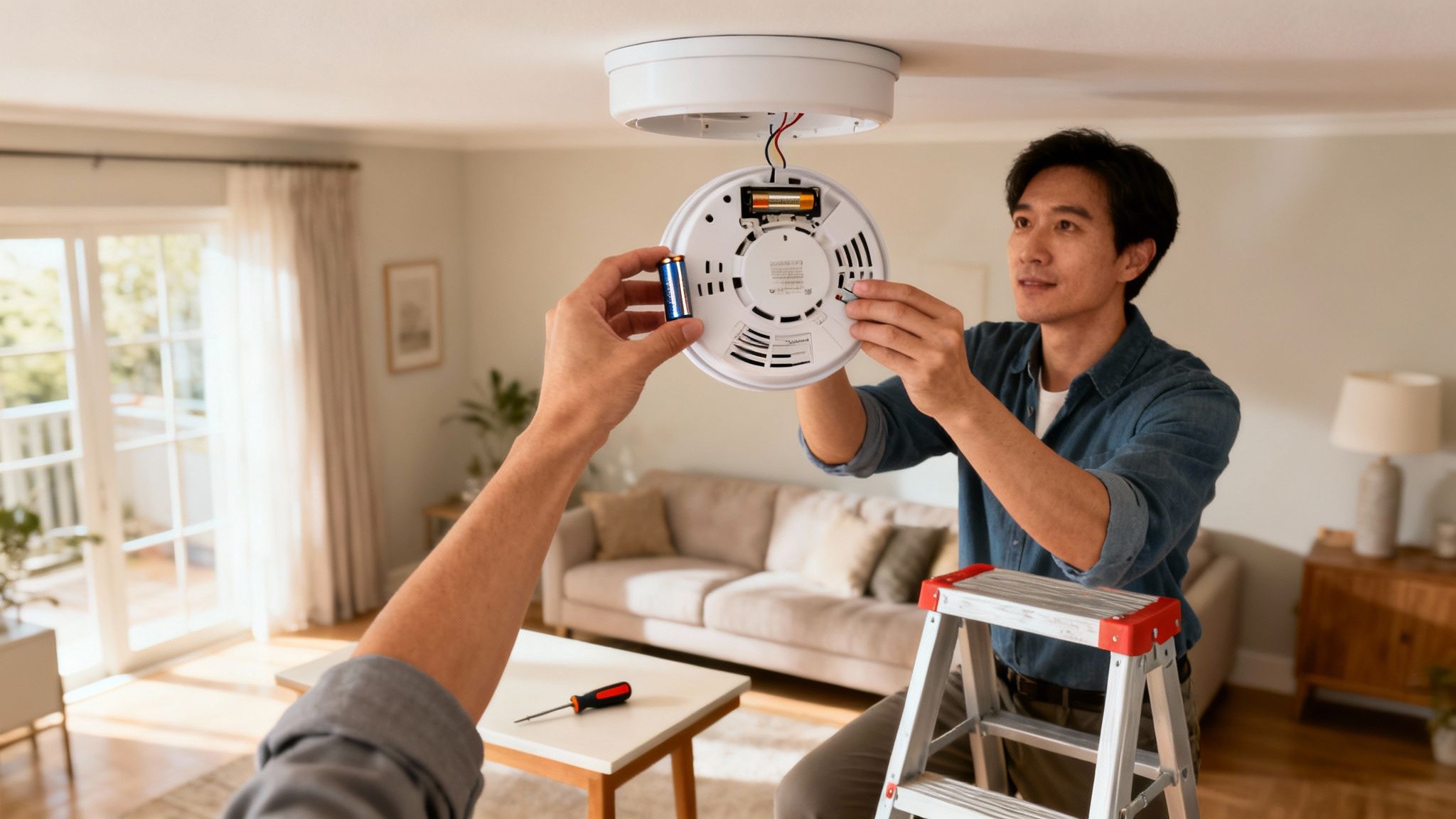
These 240V alarms are wired directly into your home’s electrical circuits, but they all have a backup battery. In our experience, this battery is the most common reason a home fire alarm keeps beeping, even when your main power is perfectly fine. The real challenge is figuring out which specific unit has the failing battery or fault.
Your first job is to identify the instigator. When the beeping starts, walk through your home and look closely at each alarm. The unit causing the trouble will typically have a flashing red light that blinks more frequently or erratically than the others. A steady green light usually just means it’s getting mains power; the red light is your key to diagnostics.
If the lights aren’t giving you a clear signal, you might need to reset the whole system. This usually means switching off the circuit at your switchboard and then carefully disconnecting each alarm one by one until the beeping stops. It can be a tedious process, but it’s a surefire way to find the troublemaker.
Remember, the single chirp from one unit is a fault signal. The full-blown alarm sound from the others is just them doing their job—relaying the message. Don’t assume every alarm is faulty.
Once you’ve found the problem unit, you can take a more targeted approach. If it’s not a simple battery issue, there might be a wiring fault at play.
When you’re dealing with interconnected systems, knowing what you have on your ceiling is crucial. For a deeper dive into their benefits and what’s required for installation, you can learn more about the specifics of wired smoke alarms in our detailed guide.
Sometimes, diagnosing complex electrical issues requires more advanced tools. If you suspect a deeper electrical fault, learning advanced techniques like how to use a multimeter for continuity testing can be helpful for those with the right knowledge. For most homeowners, however, if a fresh battery and a reset don’t fix it, it’s time to call in a professional. Working with 240V wiring is dangerous without a licence.
You’ve tried everything. You’ve replaced the batteries, done a full reset, and even given the unit a good clean, but that maddening chirp just won’t quit. While DIY troubleshooting is great for the common culprits, there comes a point where a persistently beeping home fire alarm is signalling a deeper problem—one that’s best left to a professional.
Your safety, and your home’s electrical integrity, are definitely not worth the risk.
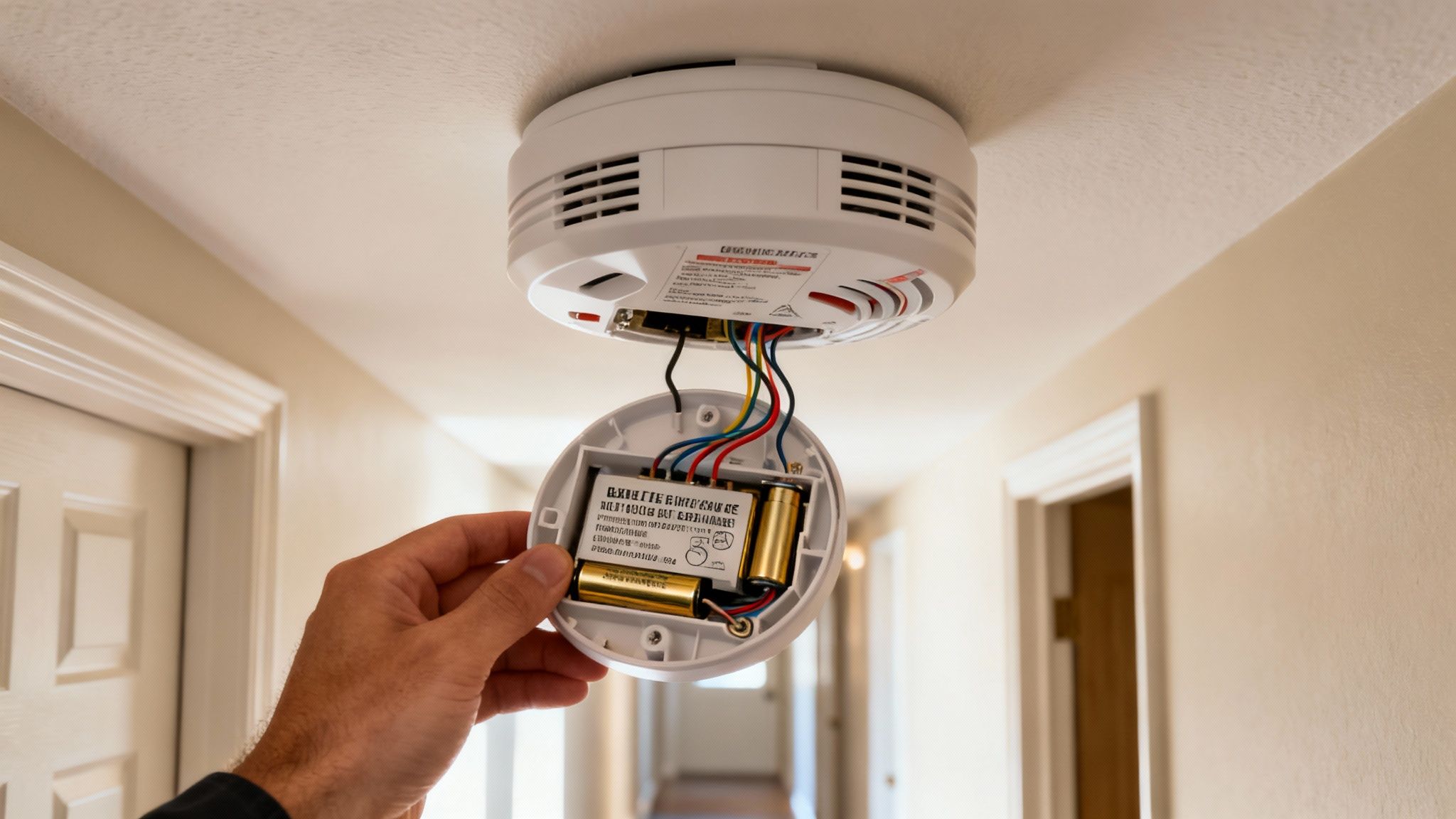
Some red flags are simply too significant to ignore. If you find yourself in any of the situations below, it’s time to put down the step ladder, pick up the phone, and get some expert help.
First off, let’s be clear: working on 240V wiring without a licence is not only illegal in Australia, it’s extremely dangerous. A licensed electrician can diagnose complex issues safely and make sure your entire system is compliant with current standards.
Here are the scenarios where calling a professional is non-negotiable:
Crucial Safety Warning: Never, ever attempt to repair or modify the 240V wiring connected to your hardwired smoke alarms. This is a job exclusively for a licensed electrician who can safely handle the electrical circuits and ensure a secure, compliant installation.
For Brisbane homeowners, a beeping smoke alarm isn’t just an annoyance; it’s tied to a strict legal framework. Under Australian rules, domestic smoke alarms have a service life of about 10 years. The Building Code of Australia also mandates hardwired, interconnected alarms in most modern homes.
Queensland’s specific reforms take it a step further, requiring photoelectric, interconnected alarms in all bedrooms and hallways. This makes professional installation absolutely essential for compliance.
A qualified electrician doesn’t just silence the beep; they provide a permanent solution. They can test the entire circuit, confirm all interconnected units are communicating correctly, and install new alarms that meet the latest safety standards. When you need absolute certainty that your home is safe and compliant, finding a reliable electrician in Brisbane is the most important final step to resolving your alarm issues for good.
Getting that beeping alarm to stop is a relief, but the real goal is to make sure your home’s safety net is always ready. It’s time to move beyond just reacting when a home fire alarm keeps beeping and get into a proactive routine. This simple habit not only prevents those annoying chirps but builds genuine confidence that your system will work when it truly matters.
This is about shifting your mindset from reactive fixing to proactive care. All it takes is a few minutes of attention every couple of months to make a massive difference in your home’s safety.
You don’t need some complex, colour-coded spreadsheet for this. A straightforward schedule is the easiest to stick with, and it’s incredibly effective at preventing nuisance alarms and ensuring your system is reliable. Just think of it as another essential piece of home upkeep.
A great little trick to stay on track is to tie your alarm maintenance to seasonal events—maybe the start of summer or winter, or when you’re changing the clocks for daylight saving.
Here’s a practical routine that we recommend to all our clients:
Adopting this simple schedule transforms your alarms from potential annoyances into reliable protectors. Proactive care is the cornerstone of effective home fire safety, ensuring your alarms are always prepared to function correctly in a genuine emergency.
Maintenance is absolutely crucial, but the technology inside the alarm plays a massive role in modern fire safety. If your alarms are getting close to their 10-year expiry date, it’s the perfect time to think about upgrading, not just replacing like-for-like.
Modern photoelectric interconnected alarms are a huge leap forward in protection. Unlike older ionisation models, which were notorious for going off when you were just making toast, photoelectric sensors are much better at detecting the slow, smouldering fires that produce a lot of smoke before they ever burst into flames. They are also far less likely to be triggered by cooking fumes or steam from the shower.
The “interconnected” part is the real game-changer. It means that when one alarm detects smoke, every single alarm in the house goes off at the same time. In a big or multi-storey home, this early warning can provide those critical extra seconds you need to get everyone out safely. For more detailed advice on these devices, you can explore resources that cover general maintenance and common issues with smoke detector repairs.
Ultimately, it’s the combination of regular, simple maintenance and modern, compliant technology that gives you true peace of mind. This ensures your system is not only silent when it should be but loud and clear when you need it most.
Even after running through the usual checks, sometimes an alarm just won’t quit. That incessant chirping can be a real head-scratcher, so we’ve put together some of the most common questions our electricians hear from homeowners at their wits’ end.
Getting to the bottom of these specific scenarios can help you finally pinpoint the cause and get some peace and quiet back.
This is one of the most frustrating problems we see. You’ve just put in a new alarm, maybe even a new battery, and it’s already chirping. Nine times out of ten, it’s not a faulty unit. The culprit is often a residual static charge left over from the plastic packaging, which can play tricks on the sensor.
The fix is usually a full power drain. Start by disconnecting the alarm from the mains power (if it’s hardwired) and taking out the battery. Now, press and hold the test button for about 20 seconds. This simple action forces any leftover electrical charge out of the system and gives its internal memory a clean slate.
Another possibility, especially if you’ve added it to an interconnected system, is an incompatibility issue. If your new alarm is trying to talk to older models on the same network, it can sometimes lead to confusion and system-wide beeping. If a full reset doesn’t do the trick, checking that all your alarms are compatible models is the next logical step.
Yes, absolutely. In fact, it’s one of the most common reasons a home fire alarm keeps beeping. The dense steam and high humidity from a hot shower release a massive amount of airborne water particles. Older ionisation-type alarms are designed to detect tiny particles, and they often struggle to tell the difference between harmless steam and real smoke.
This is exactly why modern Australian safety standards now strongly recommend photoelectric smoke alarms. Their sensors use a beam of light to detect smoke, making them far less prone to these kinds of nuisance alarms from cooking fumes or bathroom steam. If your alarm is close to a bathroom and this happens regularly:
Every single smoke alarm sold in Australia comes with a strict use-by date. According to Australian Standard AS 3786, all units must be replaced within 10 years of their manufacture date. You’ll find this date printed on a sticker on the back of the alarm itself.
After a decade in service, the internal sensors start to degrade and lose their sensitivity. The alarm might still sound when you press the test button, but its ability to detect a genuine fire becomes dangerously unreliable. An expired alarm is a major safety risk, and many will start to chirp intermittently as a clear end-of-life warning.
If your alarm problems won’t go away, or you need a licensed expert to make sure your home is safe and compliant, the team at DLG Electrical is here to help. Contact us today for a free quote on smoke alarm installation and maintenance.

Master Electrician with over 30 years of experience. Founded DLG Electrical in 2005 after international project work including electrical installations at Stamford Bridge Stadium, London(Home of Chelsea FC).

Local Electricians that can fix all Electric Hot water Systems.
Motion sensor lights are a versatile addition to any home, offering nu
