83 Jean St, Grange QLD 4051
Mon-Fri 07:30 AM - 04:00 PM - Sat - 8:00 - 12 - Sunday Closed
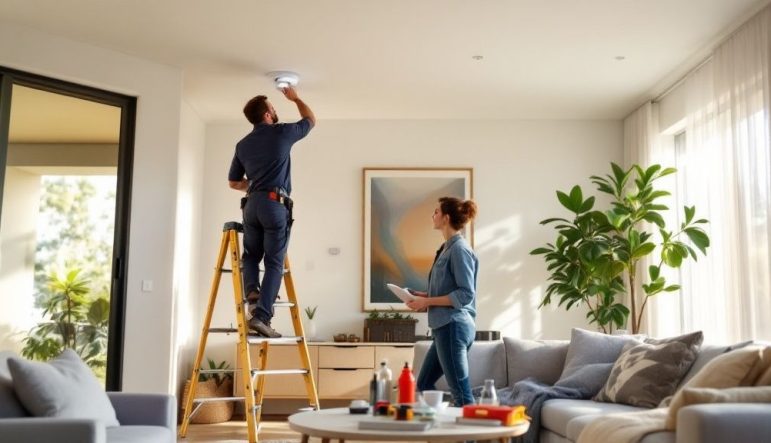
A truly effective smoke alarm solution is about more than just a single device on the ceiling. It’s a complete system that brings together the right technology, smart placement, and consistent upkeep to create a proper safety net for your Brisbane property. It’s about shifting your thinking from a passive gadget to an active, life-saving system.
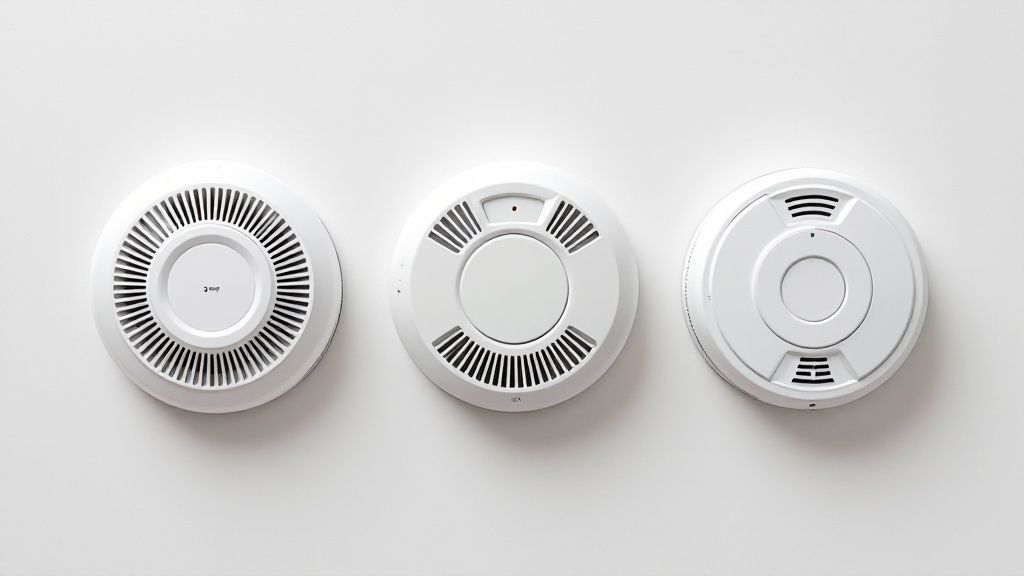
That small, unassuming circle on your ceiling? It’s arguably one of the most critical installations in your entire home. It’s easy to forget it’s even there, but it’s your first and most important line of defence against fire, protecting your family, pets, and property.
Thinking in terms of a ‘smoke alarm solution’ instead of just a ‘smoke detector’ is a crucial change in mindset. A single, old alarm shoved in a hallway is just a box-ticking exercise. A strategically planned network of modern, interconnected alarms, on the other hand, is a genuine life-saving system. It works around the clock, silently standing guard to give you the earliest possible warning when every single second counts.
The goal here is to see your alarms not as individual gadgets but as one cohesive, intelligent network. Think of it like your home’s nervous system—when one sensor detects danger, the entire system instantly responds, alerting everyone at the same time. This is absolutely critical in multi-storey homes or at night when everyone is asleep and at their most vulnerable.
This guide is designed to walk you through what makes a fire safety plan truly effective. We’ll cover:
A fire in a home without a working smoke alarm is a silent, deadly threat. The statistics are clear and consistent: having functional, interconnected alarms can slash the risk of dying in a house fire by more than half.
At the end of the day, a well-planned smoke alarm solution gives you more than just a loud noise; it gives you time. Time to get out, time to call for help, and time to protect what matters most. By understanding the core parts of these systems, Brisbane residents can move beyond basic compliance and build a robust safety net that’s perfectly suited to their home, ensuring total peace of mind.
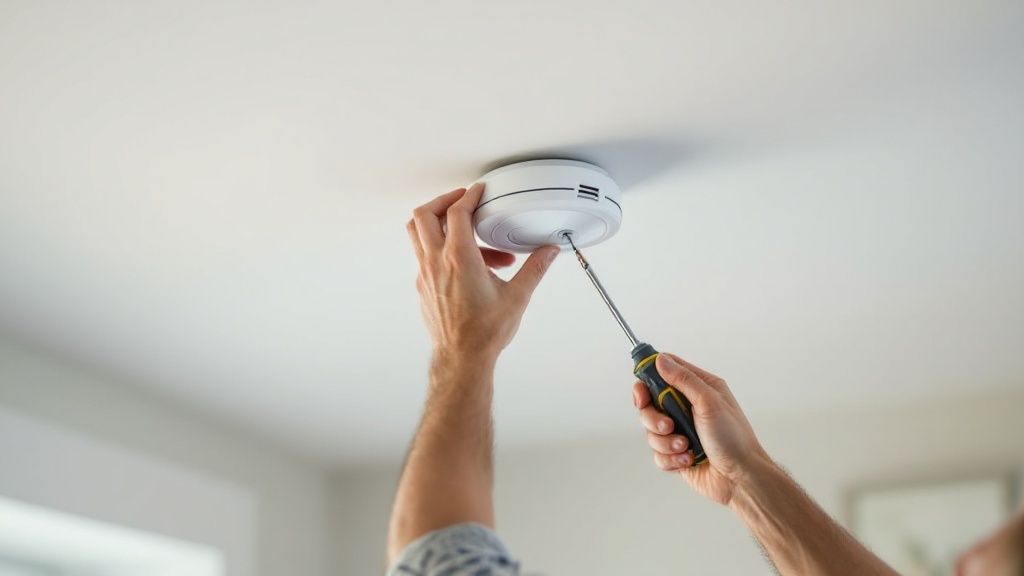
Queensland’s smoke alarm legislation can feel a bit complex at first glance, but it all boils down to one simple, powerful goal: saving lives. These rules weren’t just created to add another layer of red tape; they are a direct response to preventable fire tragedies and are designed to give you and your family the earliest possible warning when it matters most.
Getting your head around the ‘why’ is the best way to appreciate the importance of these laws. The legislation is pushing a major shift away from old, isolated battery alarms towards a fully integrated system of interconnected photoelectric smoke alarms. Think of it as creating a powerful safety net that covers your entire property.
So, what does an interconnected system actually do? Imagine it as a digital nervous system for your home. When one alarm detects smoke, it doesn’t just beep away on its own. It instantly sends a signal to every other alarm in the house, and they all go off at the same time.
This is a massive leap forward for home safety. A fire starting in the garage or a spare bedroom might not be heard by someone sleeping behind a closed door until it’s dangerously late. With an interconnected system, an alarm triggered in the basement will instantly sound in every bedroom, creating a loud, impossible-to-miss alert for everyone, all at once.
The statistics really drive this point home. Queensland sees roughly 1,600 house fires annually, which averages out to about one every five hours. Research has shown that working, interconnected alarms can cut the risk of death in a house fire by more than half.
The legislation spells out some very specific requirements for all Queensland homes. While there have been phased rollouts, the end goal is for every single residence to meet this higher standard of safety.
Here’s what you need to know:
The mandate for interconnected photoelectric alarms is easily the biggest change. It ensures that no matter where a fire starts, the warning is immediate and widespread, giving sleeping occupants those crucial extra seconds to escape.
Understanding your obligations is the first step. For landlords, making sure your rental property is fully compliant isn’t just a good idea—it’s a legal duty of care. For homeowners, it’s about protecting your family and your biggest asset.
If you’re planning a new build or a major renovation, especially if you’re looking into programs like the Homebuilder Grant requirements, you need to factor these laws into your project from day one. Integrating a compliant smoke alarm system during the building phase is always the most efficient and cost-effective way to do it.
At the end of the day, these laws aren’t just about ticking a box or avoiding fines. They represent the best-practice approach to fire safety. By following them, you ensure your property isn’t just legally compliant, but genuinely safe for everyone inside. For a more detailed breakdown, check out our guide on the current smoke alarm legislation in Queensland.
When it comes to smoke alarms, picking one off the shelf just won’t cut it. It’s about understanding the different ways alarms detect danger and choosing the one that gives you the earliest possible warning for the most common—and deadliest—types of house fires. Queensland law is very clear on this, mandating a specific type of technology for a very good reason.
The two main players in the smoke alarm world have always been photoelectric and ionisation alarms. For years, ionisation alarms were common, but safety standards have evolved. Today, Queensland legislation exclusively requires photoelectric technology in our homes, and the reason boils down to the science of how house fires actually start.
Think of a photoelectric alarm as a silent guardian, constantly watching for the first hint of trouble. Inside its chamber is a beam of light. When the thick, dense smoke from a slow, smouldering fire drifts in, the particles scatter that light beam, causing it to hit a sensor. This simple disruption is what triggers the alarm.
This is absolutely critical because most house fires don’t begin with a sudden explosion of flames. They often start quietly, smouldering away unnoticed. Common culprits include:
These fires produce huge volumes of toxic smoke well before any significant flames appear. A photoelectric alarm is purpose-built to detect this specific type of smoke, giving your family a precious head start to get out safely.
An ionisation alarm works more like a tripwire. It uses a tiny amount of radioactive material to create a steady electrical current between two plates. When the fine, invisible particles from a fast-flaming fire enter the chamber, they disrupt this current and set off the alarm.
While they are good at detecting fires that ignite quickly, like a kitchen grease fire, they are notoriously slow to react to the thick, heavy smoke from a smouldering fire. Because smouldering fires are such a common and insidious threat in homes, relying on an ionisation alarm leaves a dangerous gap in your safety net.
The statistics are sobering. In just one recent winter period, Fire and Rescue NSW attended over 1,000 house fires. Tragically, nearly half of those homes either had no smoke alarms or alarms that weren’t working. The most common starting points were kitchens (37%) and loungerooms (11%)—highlighting just how everyday these risks are.
To make the choice clearer, here’s a straightforward comparison of the main alarm technologies available to Brisbane residents. This table breaks down how each type performs, helping you understand why the regulations are what they are.
| Feature | Photoelectric Alarm | Ionisation Alarm | Dual-Sensor Alarm |
|---|---|---|---|
| Best For Detecting | Slow, smouldering fires (e.g., electrical, furniture) | Fast-flaming fires (e.g., grease, paper) | Both fire types |
| Detection Method | Light beam scattered by smoke particles | Electrical current disrupted by smoke particles | Combines both photoelectric and ionisation sensors |
| QLD Compliance | Yes, this is the mandated technology for homes. | No, not compliant for new installations in homes. | Yes, as long as the primary sensor is photoelectric. |
| Nuisance Alarms | Less prone to nuisance alarms from cooking. | Prone to nuisance alarms from cooking steam/smoke. | Can be more prone due to higher sensitivity. |
| Primary Benefit | Early warning for the most common type of fatal house fire. | Quick detection of rapidly spreading flames. | Broader detection range, but can be less reliable. |
While dual-sensor alarms might seem like the best of both worlds, Queensland law still requires the primary detection method to be photoelectric. This underscores just how vital early detection of smouldering fires is considered for home safety.
Once you’ve settled on photoelectric technology, the next big decision is how your alarms get their power. This choice affects reliability, how complex the installation is, and what you’ll need to do for maintenance down the track.
Hardwired alarms are connected directly to your home’s 240V mains power. This is their biggest strength—a constant, reliable power source that won’t die on you. To cover you during a blackout, every hardwired alarm must also have a battery backup, which could be a standard 9V or a sealed, long-life lithium battery.
10-year lithium battery alarms, on the other hand, are completely standalone. They run on a built-in, non-removable battery that’s designed to last the entire 10-year life of the alarm. Their main advantage is flexibility, as you can install them anywhere without running new electrical wiring.
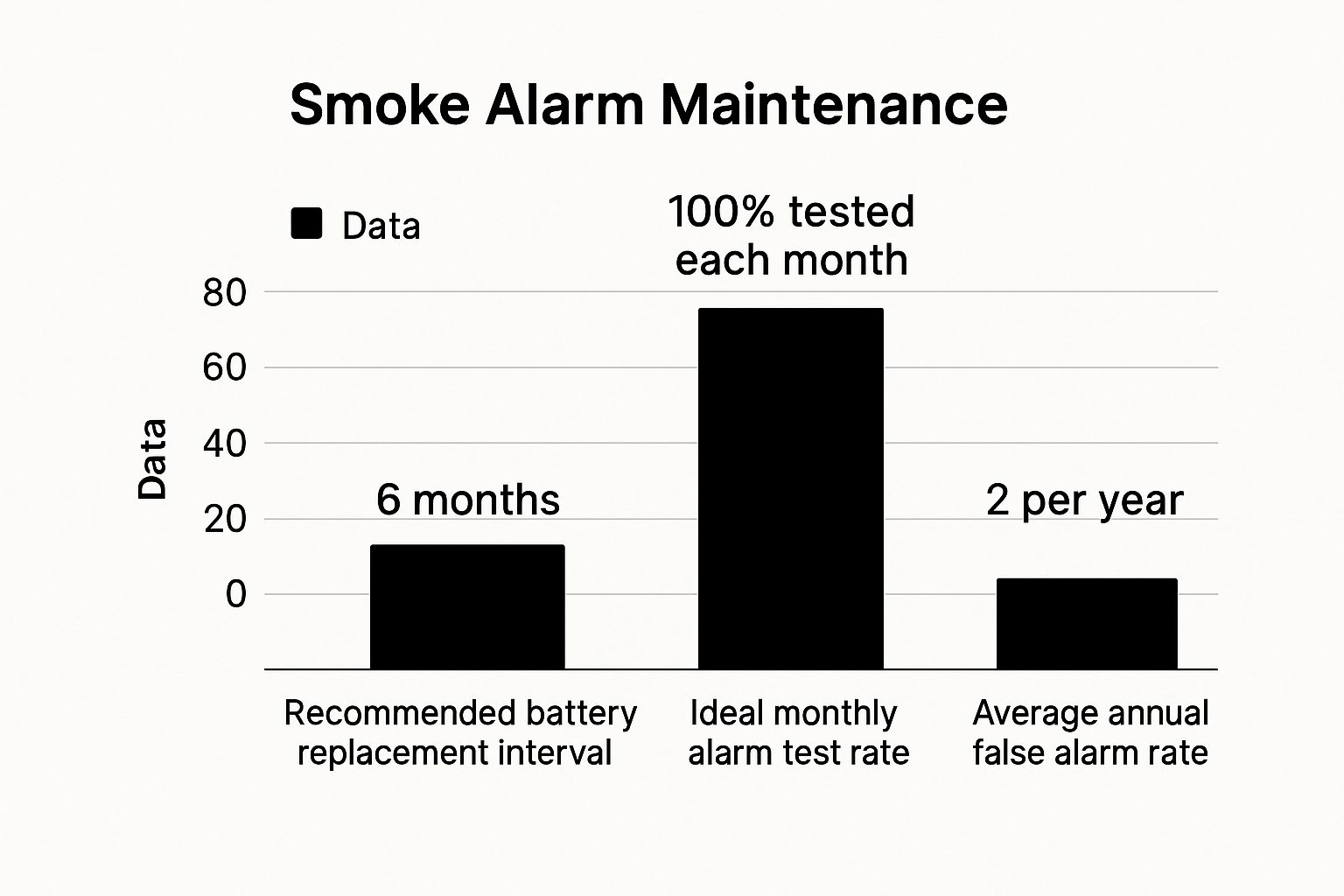
This visual guide highlights the simple but essential upkeep needed to make sure your alarms are always ready to protect you.
Key Takeaway: While 10-year battery alarms are a fully compliant solution and are perfect for older homes where running new cables is a headache, hardwired systems are the gold standard for reliability, especially in new builds or during major renovations.
Ultimately, getting your smoke alarm solution right comes down to using the legally required technology and picking a power source that suits your home. For those looking to take their safety to the next level, it’s worth exploring systems with more advanced features. You can learn more about how alarms can work together by reading our article on the advantages of Brooks Mesh technology, which creates a powerful, interconnected wireless safety network in your home.
Choosing the right photoelectric alarm is a huge step, but even the best alarm in the world is useless if it’s tucked away in the wrong corner. Where you put your smoke alarms is just as critical as the technology inside them. It’s all about making sure smoke can find the sensor fast, without any detours.
Think of it like setting up a security system. You wouldn’t point a camera at a wall; you’d aim it at the entry points. The same logic applies here. You need to map out the likely paths smoke will travel and place your alarms along those routes. This isn’t about ticking boxes; it’s about creating a smart, overlapping web of detection that covers your entire home.
The placement rules set out in Queensland’s legislation aren’t just red tape. They’re a carefully designed blueprint based on years of research into how fires behave and how people react. The whole point is to give you the earliest possible warning when you’re most vulnerable—especially when you’re asleep.
The core requirements are pretty straightforward:
This layered strategy means that whether a fire starts next to your bed or on a different floor, the alarm network is designed to wake everyone up.
A common mistake we see is people thinking an alarm in the hallway outside the bedrooms is enough. While that hallway alarm is absolutely essential, it’s the alarms inside each bedroom that provide immediate protection from fires starting in those rooms from things like dodgy chargers or electric blankets.
Okay, so you know which rooms need an alarm. Now, where exactly do you put it on the ceiling? Hot smoke rises, but the air doesn’t circulate evenly, especially near walls and corners. This creates little pockets of still air, or ‘dead air’ spaces, where smoke can get held up, delaying the alarm.
Putting an alarm in one of these spots can be a fatal mistake. To make sure your alarms go off as fast as possible, just follow these simple rules:
Getting the placement right lays the foundation, but interconnection is what turns your alarms into a life-saving system. Queensland law demands that all your smoke alarms are linked together. When one goes off, they all go off.
Imagine a fire starts downstairs while your family is fast asleep upstairs. A single, isolated alarm might beep away for precious minutes before anyone hears it. With an interconnected system, the second that downstairs alarm detects smoke, the alarm in every bedroom starts screaming. It’s a loud, impossible-to-ignore warning.
There are two ways to achieve this:
Whichever method you use, the result is the same: a synchronised, house-wide alert. This single feature transforms a bunch of separate detectors into a unified team. It’s the key to making sure that no matter where a fire starts, everyone gets the warning they need to get out safely.
Putting a modern, interconnected smoke alarm system in your Brisbane home is a brilliant move, but it’s definitely not a “set and forget” deal. A smoke alarm is only as good as the care you give it. Think of it like servicing your car—it’s not optional, it’s the crucial check-up that guarantees it will perform when you need it most.
A simple maintenance routine is all it takes to keep your alarms ready to go. Neglecting them can lead to failure, and the stats are sobering: fires in homes where alarms didn’t work properly account for a huge number of preventable deaths. Following an easy schedule gives you confidence that your first line of defence is in perfect working order.
The single most important habit you can build is the monthly test. It’s quick, it’s simple, and it confirms the alarm’s internal parts and power supply are good to go. Just press and hold the ‘test’ button on each alarm for a few seconds until you hear that loud, piercing beep.
For interconnected systems, this test does double duty. When you press the button on one alarm, every single other unit in the house should scream to life within seconds. If one or more stay silent, you’ve got a problem with the interconnection that needs looking at right away.
False alarms aren’t just annoying; they can make you complacent. One of the most common culprits for those frustrating beeps is dust or tiny insects getting inside the alarm’s sensing chamber. This can easily trick a photoelectric alarm into thinking it’s spotted smoke particles.
To stop this from happening, give your alarms a clean every six months:
This quick clean dramatically cuts down the chances of false alarms and keeps the sensor clear to detect real smoke.
“A well-maintained smoke alarm is a reliable one. Monthly testing and biannual cleaning are not just recommendations; they are fundamental practices that ensure your safety system will function as intended during an emergency.”
Every smoke alarm has a use-by date. Over the years, the electronic sensors inside the unit degrade and become less sensitive, which makes them unreliable. That’s why all smoke alarms must be replaced every 10 years. This isn’t just a friendly guideline; it’s a critical safety standard baked into Australian law.
You’ll always find the manufacturing date printed on the back of the alarm. If you can’t see a date, or if you know the alarm is over a decade old, it has to be replaced—no excuses. This rule applies to both hardwired and battery-powered alarms. Even if an old alarm seems to pass its monthly test, its ability to actually detect smoke accurately drops off a cliff after that 10-year mark.
For a more detailed guide on testing procedures, our article explains how to test your smoke detector correctly to confirm your system is ready.
While popping up a single, 10-year battery alarm can feel like a simple weekend DIY job, piecing together a fully compliant smoke alarm system is a different beast altogether. Knowing when to put down the tools and call a licensed electrician is the key to ensuring your setup isn’t just working, but is genuinely safe and legal.
In Queensland, the line is drawn in the sand, and it’s a bright one: any work involving 240V mains power is strictly for licensed professionals. That means if you’re installing or replacing a hardwired smoke alarm, you legally must use a licensed electrician. There are no grey areas here—tackling this yourself is not only illegal but incredibly dangerous.
Hiring a pro is about so much more than just getting the wiring right. A seasoned installer brings a wealth of practical knowledge that ensures your entire system is optimised for the real world, not just a textbook diagram.
Here’s what that experience gets you:
The fire and security alarm installation market is a huge part of Australia’s building industry, and for good reason. The professionals working in it are held to incredibly high standards. Valued at around AUD 5.1 billion recently, this sector’s importance in keeping properties safe can’t be overstated. You can get a deeper look into the fire and security installation market in Australia.
For landlords, bringing in a professional goes way beyond just the initial setup. An annual service contract is one of the smartest ways to manage your ongoing legal responsibilities.
A professional service visit ensures every alarm is properly tested, cleaned, and still within its 10-year expiry. For landlords, this provides documented proof that they’re meeting their obligations to tenants, offering complete peace of mind.
At the end of the day, while battery alarms give you some DIY flexibility, any system that touches your home’s main power requires a professional touch. Calling in an expert guarantees your alarms are installed safely, work flawlessly as a team, and meet every single legal standard—turning a box of detectors into a true life-saving network.
When it comes to smoke alarm rules and the practical side of getting your home compliant, a lot of questions can pop up. We get it. Here are some of the most common queries we hear from Brisbane residents, with clear, straightforward answers to help you feel confident about your fire safety.
The price of upgrading to a fully compliant, interconnected system really depends on your property’s size and layout. A small, single-storey home might only need a few alarms, whereas a large, multi-level house will naturally require more to provide proper coverage.
Honestly, the only way to know for sure is to get a customised quote. Every home is different.
We’ve all been there—the alarm shrieking because of a bit of burnt toast. False alarms are incredibly frustrating, but they’re usually caused by something you can fix. The number one culprit? Placing an alarm too close to a kitchen or bathroom, where steam and cooking fumes can easily trick the sensor.
To cut down on false alarms, make sure your units are installed well away from these areas. Regular cleaning is also a game-changer. Just give each alarm a quick vacuum with a soft brush attachment every six months to clear out dust and tiny insects that can trigger a false alert.
If you’ve got an alarm that keeps going off for no reason, and you’ve already cleaned it and checked its location, it could be a sign the unit is faulty or has hit its 10-year expiry date. At that point, it’s time for a replacement.
In Queensland, the law is very clear about who does what. The responsibility for smoke alarms is split between landlords and tenants to make sure safety is a shared effort.
What Landlords Must Do:
What Tenants Must Do:
This clear division of labour helps keep the smoke alarm system in a rental property working exactly as it should.
For professional advice on setting up a compliant and effective fire safety system for your Brisbane home or investment property, trust the experts at DLG Electrical. Contact us for a free quote on our comprehensive smoke alarm solutions. https://dlgelectrical.com.au

Master Electrician with over 30 years of experience. Founded DLG Electrical in 2005 after international project work including electrical installations at Stamford Bridge Stadium, London(Home of Chelsea FC).

Local Electricians that can fix all Electric Hot water Systems.
Motion sensor lights are a versatile addition to any home, offering nu
