83 Jean St, Grange QLD 4051
Mon-Fri 07:30 AM - 04:00 PM - Sat - 8:00 - 12 - Sunday Closed
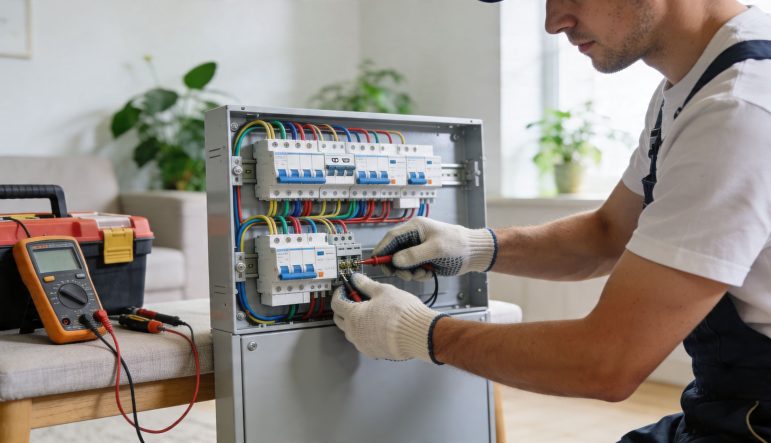
You notice it on a wet Brisbane afternoon. The lights dip when the kettle and air con run together. The old fuse box gives off a faint buzz. Maybe you’re planning a renovation in Grange, adding a charger in Windsor, or sorting out a rental that still has a switchboard nobody’s touched in decades.
That box on the wall isn’t just another bit of hardware. It’s the control point for every light, appliance, power point and protective device in the house. When it’s old, undersized or non-compliant, the whole property carries that risk with it.
Homeowners often put switchboard upgrades in the “later” pile because the problems seem small at first. A nuisance trip. A warm breaker. A board that still “works”. In practice, that’s where trouble starts. Old switchboards don’t fail politely. They fail under load, during storms, in the middle of renovations, or when someone plugs in one more modern appliance than the system was ever designed to handle.
A proper upgrade isn’t about making the board look newer. It’s about making the home safer, bringing it into line with Queensland requirements, and checking whether the electrical system is ready for the way people live now.
The switchboard isn’t often considered until it begins to demand attention.
It might be the hallway light flickering when the microwave starts. It might be a ceramic fuse that’s been there since the house was built. It might be a renovation quote that suddenly includes switchboard work because the existing setup won’t pass inspection. In older Brisbane homes, especially in suburbs with plenty of pre-1990s stock, that’s common.
The switchboard is the home’s electrical heartbeat. Power comes in from the street, the switchboard distributes it around the property, and the protective devices inside are meant to disconnect dangerous faults before they hurt someone or start a fire. If the board is outdated, every circuit downstream is relying on old protection or, in some cases, not enough protection at all.
The first signs aren’t always dramatic. They’re often the little warnings people live around for months.
A switchboard can appear functional and still be unsafe. Age, missing protection, heat damage and poor capacity don’t announce themselves neatly.
That’s why switchboard upgrades need to be looked at as both a safety job and a planning job. The right solution depends on the board, the wiring, the property type, and what you want the home to support over the next several years.
Brisbane isn’t a one-size-fits-all market. We see older Queenslanders, post-war homes, brick houses from the 70s and 80s, and investment properties that have had bits added over time. Some boards are outdated. Others have had piecemeal work done that leaves the final result messy, cramped, or hard to certify.
Queensland compliance also matters in a very practical way. Energex requirements, modern wiring rules, and the condition of the existing installation all affect what can stay and what has to change. That’s why a proper inspection matters before anyone promises a quick fix.
Some warning signs are visible. Others are audible. A few only show up when the house is under load.
If you’ve got one or more of the signs below, it’s worth organising a licensed electrician to inspect the board rather than waiting for the next failure.

Flickering lights
Flicker usually means inconsistent power flow somewhere in the system. That can come from loose terminations, overloaded circuits or a board that’s struggling with current demand.
Old ceramic fuses
Ceramic fuse boards belong to another era. They don’t offer the circuit-specific protection and convenience of modern devices, and they’re a common sign the whole installation needs review.
No safety switches on key circuits
Switchboards installed before the 1990s in Queensland homes often lack Residual Current Devices (RCDs), which are mandated under AS/NZS 3000:2018. Electrical faults cause over 5,000 house fires annually in Australia, and Queensland Fire and Emergency Services data indicates residential electrical incidents account for about 20% of structure fires, often linked to older unprotected systems, as noted in this Queensland switchboard safety overview.
Frequent circuit tripping
A breaker that trips now and then can be doing its job. A breaker that trips regularly needs investigation. That can point to overload, a fault on the circuit, or a board that no longer suits the home’s load profile.
Buzzing or crackling from the board
Electricity should be controlled, not noisy. Buzzing often points to loose connections, arcing or heat buildup. That needs urgent inspection.
Possible asbestos backing
In older Brisbane homes, some boards were mounted on asbestos-containing panels. If that material is present, removal and upgrade work must be handled correctly. This isn’t DIY territory and it isn’t something to disturb casually.
You’re adding major appliances
A new oven, ducted air conditioning, EV charger, pool equipment or solar inverter can push an old board past what it was set up to handle. Sometimes the answer is a full replacement. Sometimes it’s a more targeted upgrade. Either way, the board has to be assessed before the new load goes in.
If the switchboard smells hot, makes noise, or shows signs of damage, don’t keep resetting it and hoping for the best. Turn off what you can safely turn off and get it checked.
| What you see | What it may mean |
|---|---|
| Ceramic fuses | Outdated protection |
| Blank or poor labelling | Previous ad hoc work |
| Rust or moisture marks | Environmental damage |
| Melt marks or discolouration | Heat stress |
| No test buttons on safety devices | Older board or incomplete protection |
A homeowner doesn’t need to diagnose the defect. You only need to recognise when the board is giving you enough warning that it shouldn’t be ignored.
Queensland switchboard rules matter most when an old board is being altered, replaced, or asked to support more load than it was built for. In Brisbane, we see the same problem often. A homeowner starts with a tripping circuit or a renovation quote, then finds the existing board no longer meets current safety expectations for protection, labeling, testing, or service work.
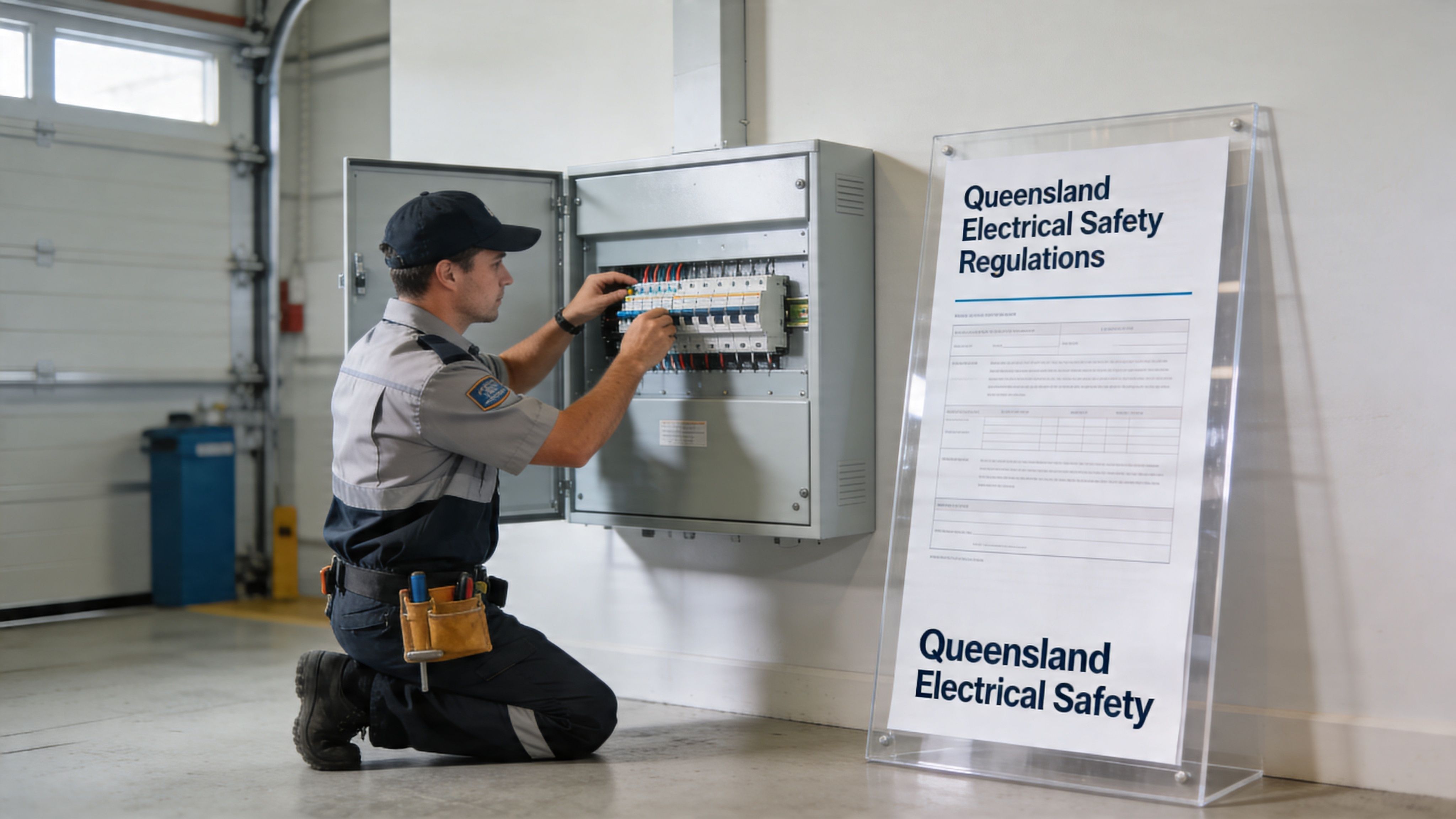
AS/NZS 3000:2018 sets the Wiring Rules electricians follow for electrical installation work in Australia. For a Brisbane homeowner, the practical takeaway is straightforward. Once substantial electrical work is carried out, the affected part of the installation usually needs to comply with current standards, not the standards that applied when the house was built.
That has real consequences at the switchboard. Older fuse boards and mixed-protection setups often fall short once circuits are modified or added. Current work commonly requires modern protective devices, correct circuit segregation, compliant earthing arrangements, and proper testing before the installation can be put back into service.
In Queensland, local distributor requirements matter as well. Energex rules can affect metering, consumer mains arrangements, clearances, and how the supply is isolated and reconnected. A board can look acceptable to a homeowner and still fail at the point where the work needs to be signed off or re-energised.
An RCD disconnects power when it detects leakage current that could indicate electric shock risk. An RCBO does that job and also protects the individual circuit against overload and short circuit.
That difference matters in a house. With RCBO protection, a fault on one circuit is contained to that circuit more neatly. The kitchen power can trip without taking out lighting elsewhere. Outdoor equipment can fault without dropping unrelated parts of the home. Fault-finding is usually cleaner too, which saves time during future service work.
For older Brisbane homes, there is another trade-off to consider. Some switchboards can be partly upgraded. Others should not be patched again. If the enclosure is deteriorated, the layout is cramped, the busbar system is dated, or asbestos backing is suspected, replacement is usually the safer and more sensible option.
Compliance changes how a fault behaves. The right protection disconnects dangerous current quickly, limits heat buildup, and reduces the chance of damage spreading beyond one circuit.
Any switchboard upgrade should end with testing, accurate circuit identification, and formal certification. In Queensland, that paperwork is not an optional extra. It records that the work has been checked and completed by a licensed electrical contractor. Homeowners who want to understand what they should receive after the job can read this guide to an electrical certificate of compliance.
We also check for local issues that generic online advice often misses. Brisbane homes built decades ago may have asbestos behind the board, corroded gear from humidity, or limited capacity for air conditioning, induction cooking, solar, batteries, or EV charging. Compliance is not just about passing an inspection. It is about making sure the board is safe to use, safe to expand, and safe to reconnect under current Queensland requirements.
Most homeowners relax once they understand how the job unfolds. A switchboard upgrade sounds disruptive, but a well-run job follows a clear sequence.
The first job isn’t to replace anything. It’s to inspect what’s there.
We check the age and type of the existing board, the condition of the wiring, the earthing setup, available capacity, circuit layout and any visible signs of heat or damage. We also ask what the house needs to support now and later. That includes air conditioning, renovation plans, a pool, induction cooking, solar, battery storage or EV charging.
A common misconception is that every new appliance means a full board replacement. A professional load audit can sometimes show that the existing service can handle additions through a sub-panel, potentially saving homeowners up to 40% compared to a blanket replacement, according to this Brisbane switchboard upgrade guide discussing load audits.
Once the assessment is done, the quote should tell you what’s being replaced, what’s being retained, what testing is included, and whether there are any likely complications.
Common variables include:
A vague quote usually leads to variation disputes later. Clear scope is part of a safe job.
Before the day of works, the electrician should confirm shutdown expectations, access requirements and whether any coordination with the distributor is needed. Homeowners should know which circuits will be off, how long the outage is likely to last, and whether sensitive equipment needs to be powered down beforehand.
Practical rule: Ask your electrician what assumptions the quote relies on. If the answer is fuzzy, the price probably is too.
On the day, power is isolated, the old switchboard components are removed, the new enclosure and devices are installed, and each circuit is terminated and labelled correctly. This is also where tidy workmanship matters. A good switchboard isn’t just compliant. It’s organised, legible and serviceable for the next electrician who opens it.
If you want a plain-English refresher on the protective device most homeowners know as a safety switch, this guide on what an RCD switch is is useful background.
No switchboard upgrade is finished when the cover goes on. It’s finished when the installation has been tested properly.
That includes confirming protective devices operate correctly, circuits are identified, connections are secure, and the system is safe to energise. At handover, the homeowner should understand the main switch, the circuit layout, and how to test the safety devices.
A good handover also answers practical questions. Which circuit feeds the oven? What happens if one RCBO trips? How often should the test buttons be checked? Those details matter because the board has to remain safe after the electricians leave.
A Brisbane homeowner usually asks the same two questions first. What is this likely to cost, and how long will the power be off?
For a standard residential switchboard upgrade, pricing commonly sits in the low thousands, but the spread can be wide. Industry pricing guides such as hipages’ switchboard cost overview show why. The final figure depends on what is already in the board, what condition the wiring is in, and whether the installation can be brought up to current Queensland requirements without extra rectification work.
Older Brisbane homes are where the range opens up. A tidy board with clear access and sound existing circuits is usually straightforward. A board in a post-war or 70s home can be a different job once the cover comes off, especially if we find deteriorated cabling, mixed eras of electrical work, or a meter panel with asbestos backing.
The main cost drivers are practical, not cosmetic:
Quotes can look similar on the front page and be very different once you read the exclusions. A careful quote should tell you what is included, what assumptions have been made about the existing wiring, and what happens if non-compliant conditions are found on the day.
The actual cost is labour, testing, compliance, and fault finding, not just parts in a new enclosure.
A proper upgrade includes safe isolation, removal of outdated protective devices, installation of compliant circuit protection, reconnection of each circuit, testing, clear labelling, and the paperwork that shows the work has been carried out correctly. In Brisbane, that also means accounting for local distributor rules and the condition of many older homes, which is why two houses on the same street can end up with different upgrade costs.
Cheap pricing often means something has been left out. Common omissions are circuit tracing, defect rectification, or allowance for aged cable tails and meter panel issues. Those shortcuts usually show up later as nuisance tripping, messy board layouts, or a second callout to fix what should have been done properly the first time.
A straightforward board replacement is often completed within the day, with the property without power for several hours while the old gear is removed, the new board is fitted, and testing is finished before re-energisation.
More involved jobs take longer. The usual reasons are not hard to guess. Poor access, unclear circuit identification, wiring defects, and distributor coordination all slow the process because they have to be handled properly.
Asbestos is the big one in older Brisbane homes. Safe Work Australia explains the licensing and control measures required for asbestos removal and disturbance in residential settings in its asbestos management guidance. If asbestos-backed materials are present, the electrical work may need to pause until the area is made safe by the right licensed party. That can turn a same-day electrical job into a staged process.
At DLG Electrical, we set expectations before the day starts. If we believe the board is likely to involve asbestos risk, hidden defects, or Energex coordination, we say so upfront. That gives homeowners a realistic timeframe instead of a low quote and a surprise delay.
A switchboard upgrade is often triggered by a safety concern, but the longer-term value is in what it lets your home handle next. In Brisbane, that usually means adding load in stages. An EV charger this year, air conditioning next summer, then solar, battery storage, or an induction cooktop later on.

Older boards were not set up for the way many Queensland households now use power. More circuits, higher-demand appliances, smarter controls, and home office equipment all add pressure to a board that may already be short on space. A well-planned upgrade gives each load a proper place, keeps the layout clear, and makes later additions far less disruptive.
Some Brisbane homes run perfectly well on single-phase. Others reach the point where three-phase is the practical option, especially if the property has a large air conditioning setup, workshop equipment, high-demand hot water, or a planned EV charger with faster charging capacity.
The right choice depends on the load calculation, the supply available to the property, and Energex requirements. Three-phase can make load distribution easier and reduce the compromises that come with trying to fit several major appliances onto an already stretched single-phase setup. It is not an automatic upgrade. It needs to suit the house and the way the occupants use power.
Future-proofing does not mean overspending on hardware you will never use. It means leaving sensible capacity and space so the next electrician is not forced into awkward workarounds.
That often includes:
We see this a lot in older Brisbane suburbs where renovations happen in stages. Doing the board properly once is usually better than patching it twice.
A modern switchboard also puts homeowners in a better position when the property changes hands, goes through renovation, or is assessed after an electrical issue. Buyers, property managers, and insurers all look more favourably at a neat, labelled, compliant board than one that still shows its age.
| Property goal | Why the switchboard matters |
|---|---|
| Renovation planning | New circuits can be added with less rework |
| Solar and EV readiness | Future connections are easier to accommodate |
| Fault finding | Clear circuit separation speeds up diagnosis |
| Property presentation | A current, labelled board reflects better overall upkeep |
For homeowners comparing contractors, good planning matters as much as the board itself. Our guide on choosing a great electrician in Brisbane covers what to check before approving electrical work, and this broader article on how to hire contractors is also useful if you are coordinating a larger renovation.
DLG Electrical carries out switchboard upgrades for Brisbane homes with the testing, labelling, and compliance documentation these jobs should include.
The quality of the electrician matters as much as the quality of the hardware. A switchboard upgrade done neatly by a licensed contractor is an asset. A rushed board with poor labelling and vague paperwork is a liability hiding behind a closed cover.

If you want a broader homeowner checklist, this guide on how to hire contractors is a sensible starting point. For electrical work in Brisbane, narrow it down further.
Licensing and insurance
Ask who will perform the work and confirm they’re properly licensed and insured for the job.
Experience with older Brisbane homes
A contractor who regularly works in Grange, Windsor and similar suburbs is more likely to spot asbestos risk, limited access issues and legacy wiring problems early.
Clear scope and testing
The quote should state what’s included, how the board will be protected, and what certification you’ll receive at handover.
Local reputation
Reviews don’t replace trade knowledge, but they do tell you how the contractor communicates, arrives, and handles problems.
For a more specific local checklist, this article on how to hire a great electrician in Brisbane is useful.
How long will the power be off?
Usually part of the day, but the exact outage depends on the board, access, and whether extra defects are found once work starts.
Can I keep my old board and just add one new circuit?
Sometimes yes, sometimes no. That depends on the board’s condition, available capacity, compliance requirements and the type of work being added.
Can I do any of this myself?
No. Switchboard work must be done by a licensed electrician. It’s unsafe and unlawful to attempt it yourself.
Do all appliance upgrades mean a new switchboard?
No. Some homes can support additions through better circuit planning or a sub-panel. That’s why load assessment comes first.
Is this worth doing if the board still works?
If the board is outdated, non-compliant, overloaded or missing modern protection, “still works” isn’t the standard that matters.
If your switchboard is old, noisy, overloaded or holding up renovation plans, talk to DLG Electrical for a free, no-obligation quote. We inspect Brisbane homes with a compliance-first approach, explain what needs doing, and give you a clear path to a safer, future-ready electrical system.

Master Electrician with over 30 years of experience. Founded DLG Electrical in 2005 after international project work including electrical installations at Stamford Bridge Stadium, London(Home of Chelsea FC).

Local Electricians that can fix all Electric Hot water Systems.
Motion sensor lights are a versatile addition to any home, offering nu
