83 Jean St, Grange QLD 4051
Mon-Fri 07:30 AM - 04:00 PM - Sat - 8:00 - 12 - Sunday Closed

An RCD switch, short for Residual Current Device, is one of the most important life-saving devices in your home’s electrical system. Think of it as a super-fast bodyguard for your family, designed to protect you from a serious electric shock. It instantly cuts the power the moment it detects a fault—often before you even realise something is wrong.
Let’s use a simple analogy. Imagine the wiring in your house is like a closed loop of pipes carrying water. The same amount of water that flows out should always flow back in. Your home’s electricity works in a similar way: power flows out on the “live” wire and returns on the “neutral” wire. An RCD is like a smart meter on that loop, constantly monitoring the flow.
If everything is working correctly, the flow out and back is perfectly balanced. But if a fault happens—maybe you touch a faulty toaster or a wire becomes exposed—some of that electricity will find a new, dangerous path to the ground. That path could be through you.
The RCD instantly detects this tiny imbalance, realising that electricity is “leaking” out somewhere it shouldn’t be.
In less than the blink of an eye—typically within 30 milliseconds—it trips and kills the power to that circuit. This incredible speed is what stops a potentially fatal electric shock or prevents an electrical fire from starting.
For a clearer understanding of what an RCD does and why it’s a non-negotiable part of modern electrical safety, here’s a quick summary.
| Feature | Primary Benefit |
|---|---|
| Monitors Current Flow | Continuously checks for imbalances between live and neutral wires. |
| Ultra-Fast Trip Speed | Shuts off power in under 30ms, preventing serious electric shock. |
| Detects Earth Faults | Protects against faults that circuit breakers and fuses can’t see. |
| Prevents Electrical Fires | Cuts power before a fault can overheat and ignite nearby materials. |
| Protects People, Not Just Appliances | Specifically designed for personal safety from electrocution. |
This table highlights just how critical the RCD’s role is. It’s not just another switch; it’s a dedicated life-saving device.
This isn’t just a “nice-to-have” feature; it’s a fundamental part of a safe, modern home. The widespread adoption of RCDs has had a massive, measurable impact on safety right across Australia. Sadly, electrical accidents still claim over 15 lives and lead to 300 hospitalisations each year. However, homes fitted with RCDs reduce their risk of electrocution by a staggering 95%.
This incredible effectiveness is exactly why their installation is now a legal requirement in so many situations. You can discover more about the importance of RCDs in Australian homes and see how they’ve drastically improved safety statistics over the years.
Getting your head around what an RCD switch is and the job it does is the first step towards a safer home. It’s a silent, ever-watchful guardian that provides a critical layer of protection that old-school circuit breakers and fuses simply can’t offer. It doesn’t just protect your appliances; it protects your family.
To get your head around how a safety switch works, think of your home’s electrical circuit like a set of perfectly balanced scales. The electricity flowing in to an appliance on the live wire is on one side, and the electricity flowing out on the neutral wire is on the other. As long as what goes in comes out, the scales stay level, and the RCD is happy.
This isn’t a slow, lazy process either. The RCD is constantly monitoring this balance, measuring the current thousands of times per second. In a healthy circuit, like when you’re boiling the kettle, the power goes in, does its job, and the exact same amount returns. Everything is balanced.
Now, let’s introduce a hazard. Say you touch a faulty toaster with a damaged cord. Suddenly, that electricity has found a new, dangerous path to escape—through your body and into the ground.
This creates an instant imbalance. A small, but potentially lethal, amount of current is now leaking away and not returning on the neutral wire. The scales are thrown completely off balance. The RCD is designed to spot this tiny difference, often as small as just 30 milliamps (that’s only 0.03 amps). The second it senses this leakage, it knows something is seriously wrong.
In a fraction of a second—typically less than 30 milliseconds—the RCD trips, cutting all power to that circuit. It’s so fast it stops the flow of electricity long before a fatal shock can occur.
This is the RCD’s entire reason for being: to act faster than the electricity can harm you.
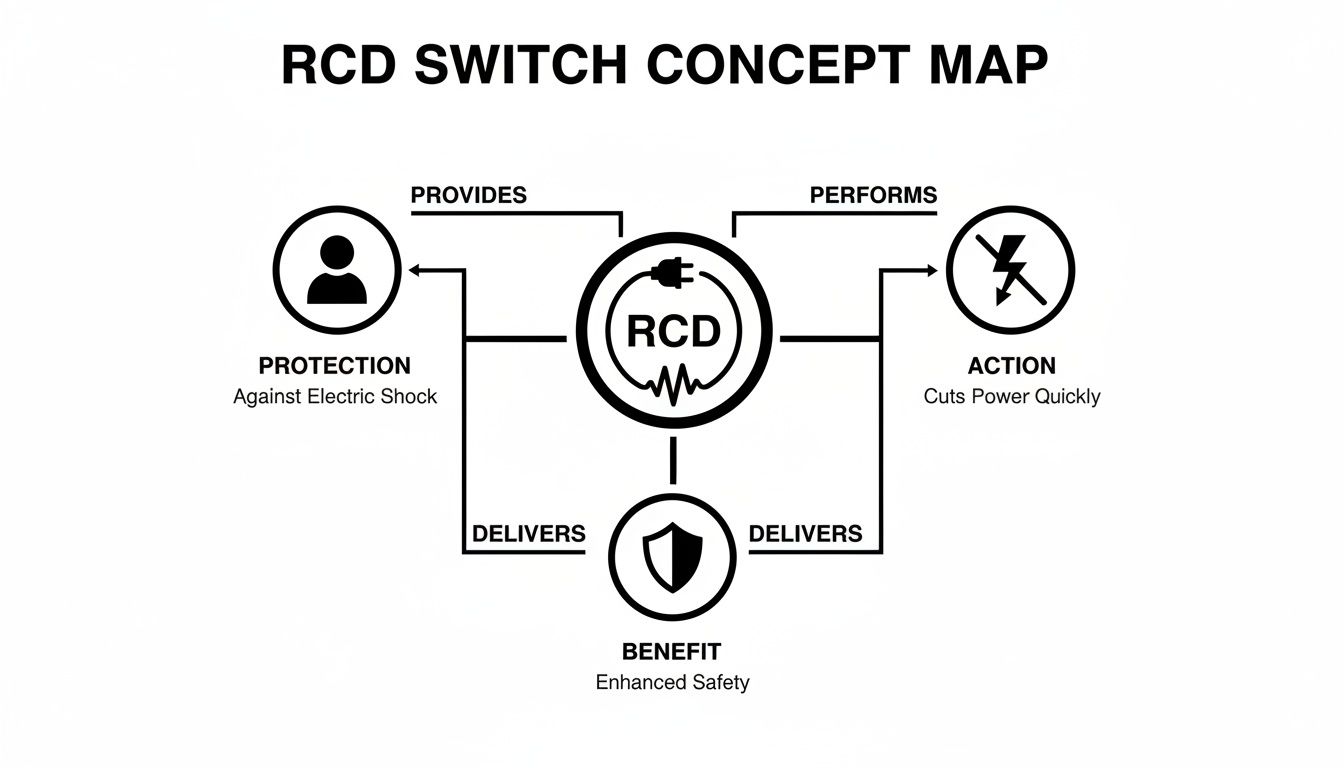
As the diagram shows, an RCD’s job is personal protection. It achieves this by instantly interrupting the power, which ultimately makes your home a much safer place.
It’s really important not to mix up RCDs (safety switches) and circuit breakers. They both live in your switchboard, but they have completely different jobs.
A regular circuit breaker wouldn’t even notice the small amount of current involved in an electric shock, which is precisely why having an RCD is so critical. You can get a more detailed breakdown on the different roles of the RCD and circuit breaker in our guide.
Put simply: circuit breakers protect your property, but RCDs protect your life.
Not all RCDs are created equal, and picking the right one is absolutely critical for getting the protection you and your family need. The decision usually boils down to where you need protection and what kind of appliances you’re running. Getting your head around the main options will help you have a much clearer conversation with your electrician.
The most common types of RCDs are categorised by where they’re installed. Each one serves a distinct purpose, offering either broad protection for your entire home or targeted safety for specific, high-risk tasks.
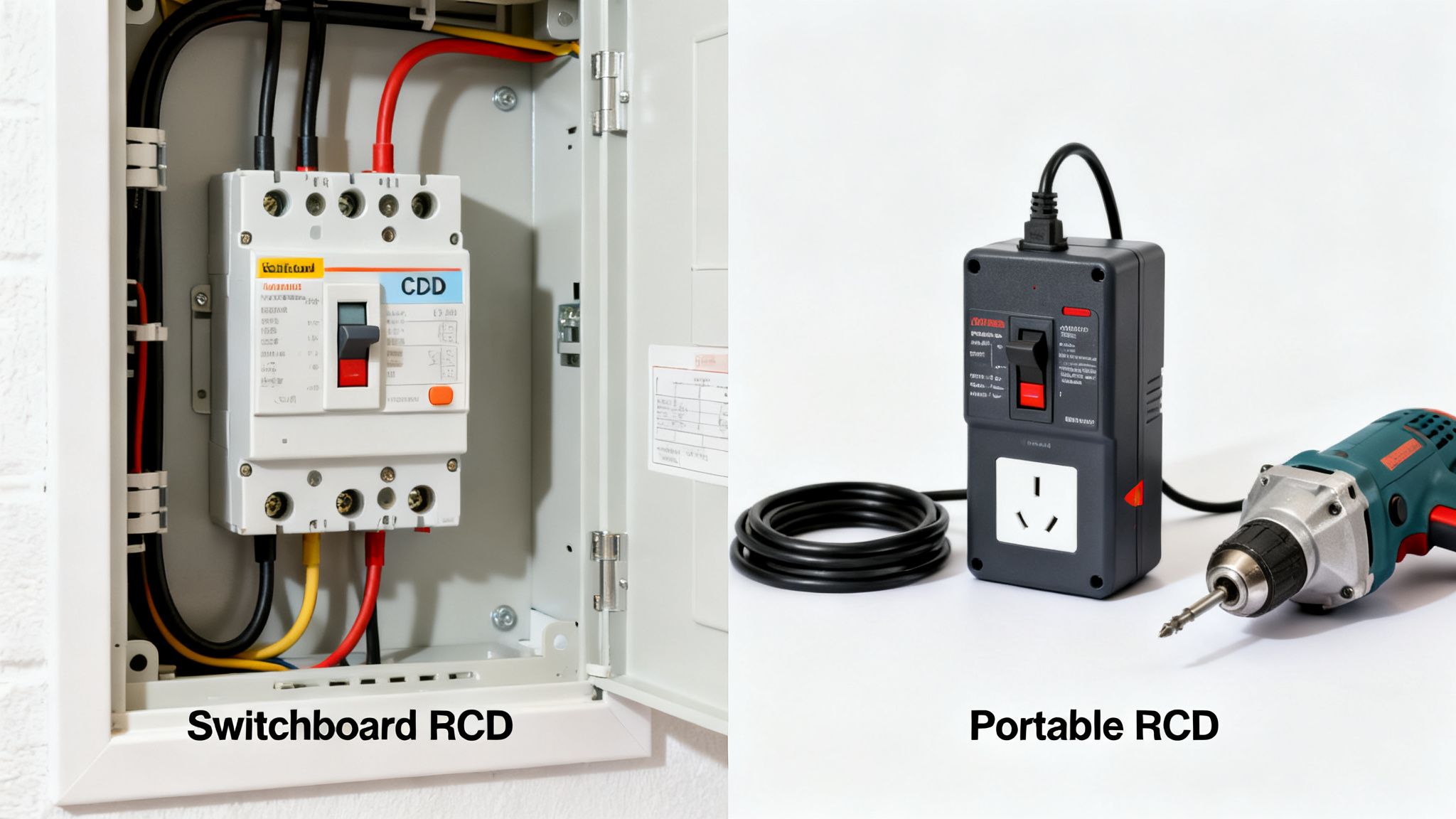
The first big choice you’ll encounter is whether you need a fixed unit hardwired into your switchboard or a portable device you can plug in anywhere.
While portable RCDs are fantastic for specific jobs, remember they only protect the person using that one appliance. A switchboard-mounted RCD is the non-negotiable standard for comprehensive home safety.
Beyond where they live, RCDs are also classified by their sensitivity (how quickly they trip) and their internal tech. These details might sound technical, but they’re incredibly important for making sure your RCDs actually work with modern electronics.
For Australian homes, the standard RCD is designed to trip at a maximum residual current of 30mA within 300 milliseconds. That’s fast enough to prevent a life-threatening shock. This sensitivity is a cornerstone of our national safety standards, which have massively reduced electrocution fatalities since they were introduced. For a deeper dive, you can learn more about RCD requirements and their impact.
You might also hear your electrician talk about different “Types,” most commonly Type AC or Type A. This is where it gets really important.
Type AC RCDs are the old-school style, designed for simple alternating current (AC) electrical loads from things like heaters and basic motors. The problem is, they can be completely blind to the complex, pulsating direct current (DC) faults produced by modern electronics like computers, washing machines, solar inverters, and EV chargers.
Because of this serious blind spot, Type A RCDs are now the standard for all new installations. They are specifically designed to detect both standard AC faults and the pulsating DC faults from modern devices, offering much broader, more reliable protection.
Making sure you have the right type installed is vital for keeping your safety system effective in a home filled with today’s technology. Using an old Type AC on a circuit with a new appliance is a risk you just don’t want to take.
When it comes to electrical safety in Queensland, the rules aren’t just suggestions—they’re the law. For homeowners, landlords, and anyone selling a property, getting your head around these legal requirements is crucial. It’s about more than just ticking a box; it’s about making sure your property is safe and compliant, preventing the kind of tragic accidents that can happen in unprotected homes.
The backbone of all electrical work in Australia is the AS/NZS 3000 Wiring Rules, and Queensland’s local regulations are built on this foundation. If you’re building a new home today, the law is crystal clear: RCDs must be installed on all power and lighting circuits. This rule also applies to older homes undergoing major electrical work, like a big renovation or a much-needed switchboard upgrade.
The legal responsibilities get even tighter if you’re renting out or selling a property. The duty of care placed on property owners is significant, and for good reason.
These laws are part of a national push for higher safety standards. Just look at Western Australia, where RCDs became mandatory after grim statistics revealed that 23 electrocution deaths over 17 years could have been prevented if they’d been installed. Queensland’s laws echo this commitment, especially for rentals and high-risk zones like bathrooms. You can read more about how mandatory RCDs prevent fatalities to truly understand the life-saving impact of this simple device.
A good way to quickly check your obligations is with a simple checklist.
This table provides a simplified guide for homeowners and landlords to quickly assess if their property is likely to meet Queensland’s RCD regulations.
| Property Type | Minimum RCD Requirement (AS/NZS 3000) | Common Action Needed |
|---|---|---|
| New Homes (Built after 2000) | RCDs must be installed on all power and lighting circuits. | Usually compliant, but worth checking during a pre-purchase inspection. |
| Existing Homes (Owner-Occupied) | RCDs are strongly recommended on all circuits. Mandatory if significant electrical work is done (e.g., new circuit, switchboard upgrade). | If you have an old switchboard with ceramic fuses, an upgrade to include RCDs is a critical safety investment. |
| Rental Properties | RCDs must be installed on all socket-outlet (power point) circuits. | Landlords must engage an electrician to install RCDs if they are not already present to meet leasing obligations. |
| Properties Being Sold | The seller must declare in the sales contract whether RCDs are installed for socket outlets. | If no RCDs are present, this must be disclosed. Many sellers choose to install them to improve the property’s safety and appeal. |
While this checklist is a great starting point, remember it’s not a substitute for professional advice from a licensed electrician.
Following these regulations is non-negotiable. The only way to be absolutely certain your installation meets the complex legal and technical standards is to hire a licensed electrician. They have the training to assess your property, install the right RCDs, and give you the compliance certificate to prove it.
Trying to do electrical work yourself or hiring an unlicensed person isn’t just illegal—it’s incredibly dangerous. It can void your home insurance and leave you legally and financially exposed if an accident happens. Investing in a professional installation is an investment in safety, compliance, and your own peace of mind. Your property will be safer for your family, tenants, or the next owner, and you’ll know you’ve done the right thing by the law.
An RCD is a life-saving device, but just like your car’s airbags or a smoke alarm, it needs a regular check-up to make sure it’s ready to jump into action. A simple push of a button can confirm it’s in top working order. This quick bit of maintenance is a shared responsibility between you and your electrician, and your part is the easiest.
What you need to do is called the push-button test. It takes only a few seconds, and doing it regularly is crucial for keeping the sensitive internal parts from getting stiff or seizing up over time.
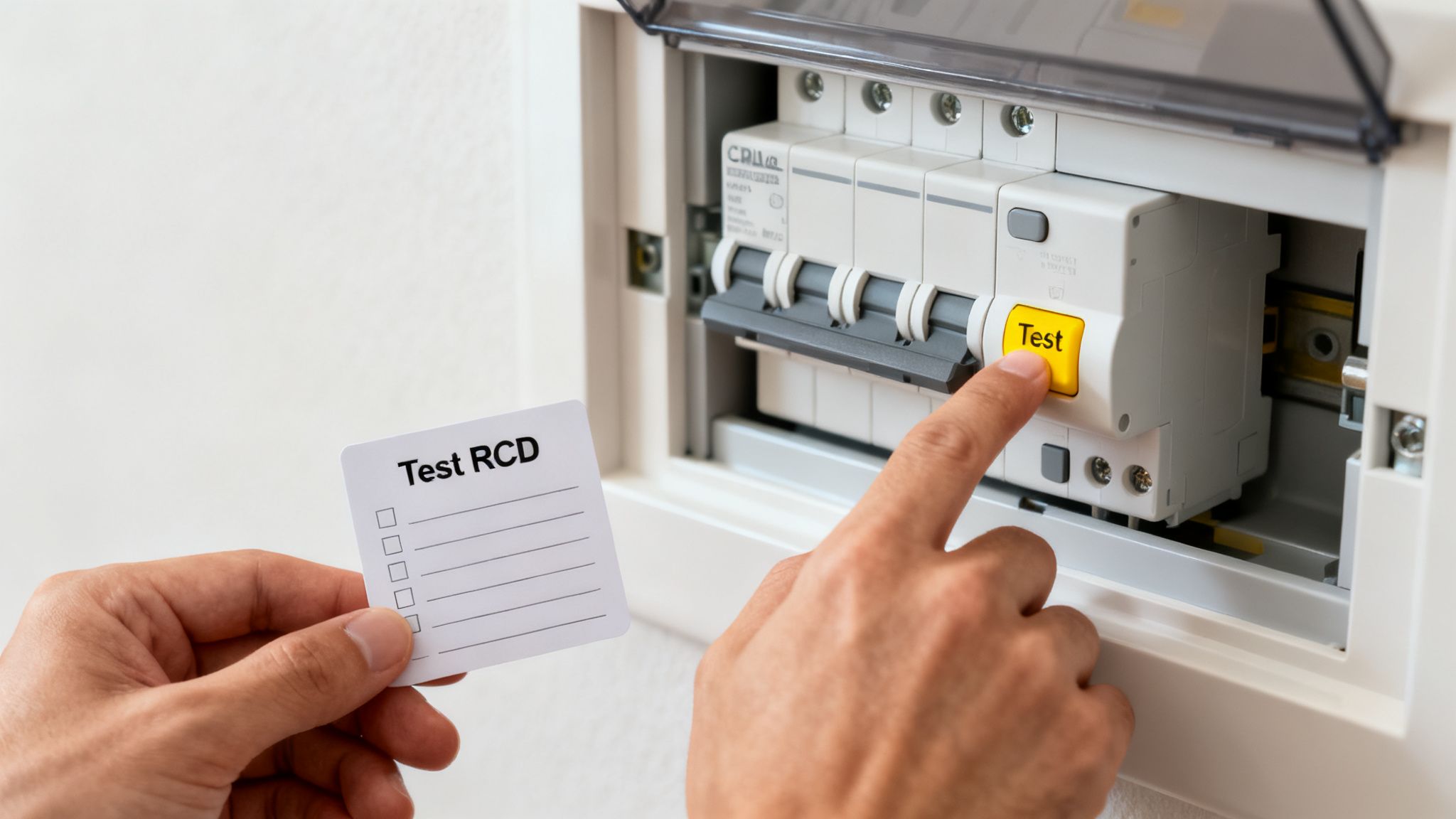
Just follow these quick steps every few months to test your RCD switch:
If you press the test button and nothing happens, the RCD is faulty and offers no protection. This is a serious safety issue, and you need to contact a licensed electrician immediately to get it replaced.
It’s really important to know the difference between your simple push-button test and what a licensed sparkie does. The DIY test is great for confirming the mechanical parts are moving freely, but it can’t measure the RCD’s trip speed or sensitivity.
A professional uses specialised testing equipment to make sure the RCD trips within the required 30 milliseconds when the right amount of fault current is detected. This comprehensive check is the only way to be certain your RCD is fully compliant and genuinely safe. It’s also a mandatory requirement for many properties, particularly rentals and workplaces.
While you’re thinking about safety, if you need targeted protection for tools in the workshop or office equipment, you might be interested in learning about a portable RCD power board for an extra layer of safety.
So, while the regular DIY tests are your job, always call in a professional for annual checks, fault-finding, or replacements.
A safety switch that keeps tripping can be incredibly frustrating. But before you get annoyed, remember what it’s doing—its job. Think of it less as a nuisance and more as a critical warning sign that it has detected a potentially dangerous electrical fault somewhere in your home.
More often than not, the culprit is a single faulty appliance.
The good news is that you can often find the problem yourself without needing to call an electrician. By following a simple process of elimination, you can figure out whether the issue is a specific device or something more serious hiding in your home’s wiring.
If your RCD has tripped, this methodical process will help you pinpoint the source of the problem. It’s completely safe, easy to do, and could save you the cost of a call-out fee.
This simple diagnostic process is a fantastic first step. You can also explore our more detailed guide on why your safety switch keeps tripping to understand other potential causes.
Important: Never ignore a tripping RCD. It’s a vital warning that a fault exists. Continuously resetting it without finding the cause is extremely dangerous and puts you at risk of electric shock or fire.
Sometimes, the issue isn’t an appliance at all.
If you follow the steps above and the RCD still trips even when absolutely everything is unplugged, this points to a more serious problem.
This situation almost always indicates a fault within your home’s fixed wiring—think a damaged cable inside a wall or ceiling, or moisture getting into a connection somewhere. This is definitely not something you can diagnose or fix yourself. It requires immediate professional attention.
A wiring fault is a significant safety hazard. In this case, leave the RCD in the off position and call a licensed electrician straight away to locate and repair the issue safely.
Thinking about your home’s electrical safety is one of the most important things you can do. When it comes to installing an RCD safety switch, it helps to see it not just as a cost, but as a critical investment in protecting your family from the very real risks of electric shock and fire.
So, how much should you budget? The final price for a professional RCD installation can vary, but on average, you can expect to pay between $150 and $400 for a single safety switch. Of course, several factors can shift this price up or down.
No two homes are the same, and your electrical setup is unique. That’s why a one-size-fits-all price doesn’t really exist. Here are the main things a sparky will consider when putting together your quote:
It’s always a good idea to think about your home’s entire electrical system. When you’re looking into the costs of other significant home electrical installations like an EV charger, making sure you have RCD protection isn’t just an add-on; it’s fundamental to the safety of the whole setup.
Ultimately, installing an RCD switch is a job that absolutely must be done by a licensed professional. DIY electrical work is not only illegal and incredibly dangerous, but it can also void your home insurance. A qualified electrician guarantees the correct type of RCD is fitted, that it complies with the AS/NZS 3000 Wiring Rules, and will issue a certificate of compliance upon completion.
This doesn’t just make your home safer—it ensures it’s legally compliant, giving you true peace of mind.
Your family’s safety is far too important to leave to chance. For expert advice and a transparent, free quote on RCD installation or switchboard upgrades in Brisbane, trust the licensed professionals at DLG Electrical. Visit us at https://dlgelectrical.com.au to secure your home today.

Master Electrician with over 30 years of experience. Founded DLG Electrical in 2005 after international project work including electrical installations at Stamford Bridge Stadium, London(Home of Chelsea FC).

Local Electricians that can fix all Electric Hot water Systems.
Motion sensor lights are a versatile addition to any home, offering nu
