83 Jean St, Grange QLD 4051
Mon-Fri 07:30 AM - 04:00 PM - Sat - 8:00 - 12 - Sunday Closed
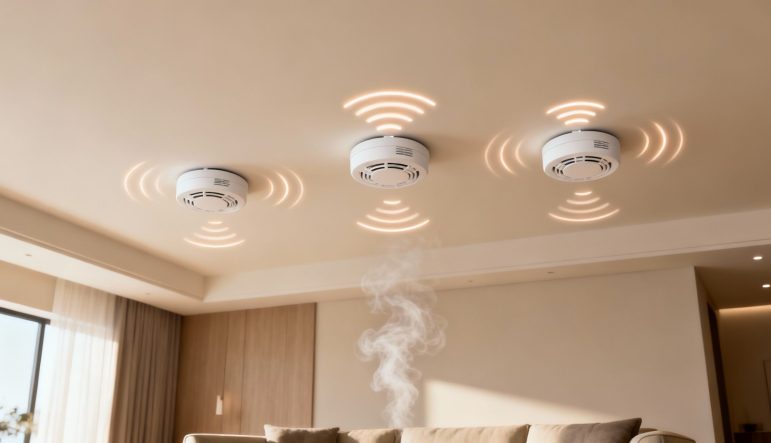
Picture a neighbourhood watch system, but for inside your own home. If one house spots trouble, it instantly alerts all the others. That’s the simple, brilliant idea behind wireless interconnect smoke detectors. It’s a system where if one alarm goes off, they all go off, creating a faster, safer, and house-wide alert without running a single new wire.
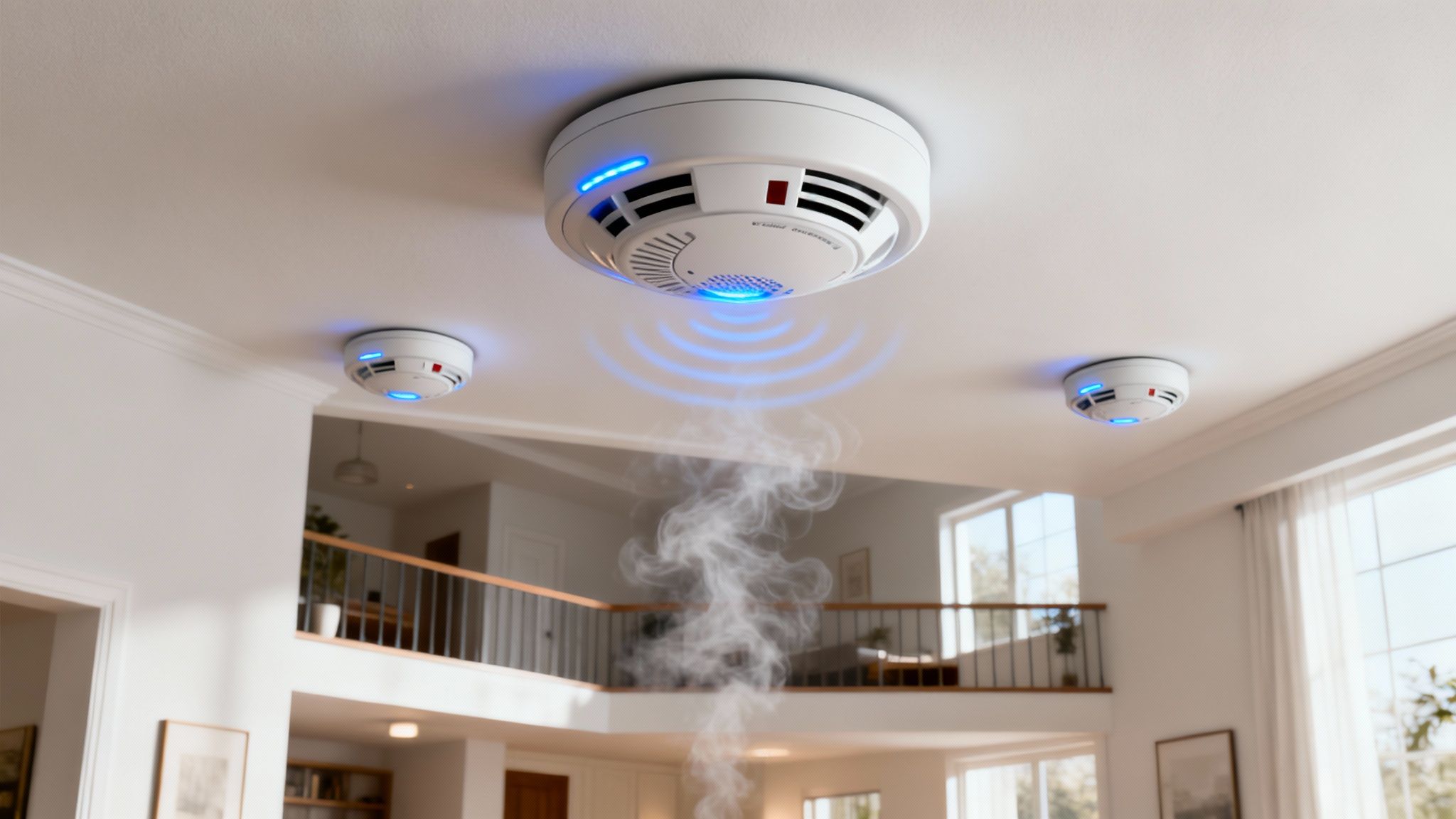
At its heart, the technology is elegantly simple. Instead of being isolated, standalone units, each smoke detector is fitted with a small radio transmitter and receiver. They chat with each other over a dedicated, low-frequency radio channel that’s completely separate from your home’s Wi-Fi network. No internet needed.
When one alarm senses smoke, it doesn’t just start screaming on its own. It instantly broadcasts a signal to every other detector it’s been paired with, telling them all to activate. This creates an immediate, synchronised alert that blasts through the entire property. Think of that first alarm as the scout that raises the flag—the radio signal is the messenger ensuring the entire army responds at once.
This communication builds a reliable, closed-loop safety network. It’s a crucial feature because it means the system stays fully functional even if the power goes out or your internet is down. The alarms are powered by long-life lithium batteries and only need their own internal radio link to work.
The system really comes down to three core parts:
This unified alert is a massive leap forward in home safety. A fire starting in a distant garage or downstairs rumpus room will trigger the alarm in a top-floor bedroom instantly, cutting out the dangerous delay of waiting for smoke to drift through the house.
This technology is a game-changer, especially for multi-storey homes where sound struggles to travel between floors. More advanced systems use specific protocols to create an even more robust connection. You can learn more about the advantages of Brooks Mesh technology, one of the best systems for enhancing this network reliability. By using radio frequency, wireless interconnect smoke detectors turn individual alarms into a powerful, cohesive safety team.
Upgrading from standalone alarms to a synchronised system isn’t just a small step up—it’s a complete shift from basic protection to an active, intelligent safety net for your entire home. The single biggest advantage is the immediate, property-wide alert that isolated units simply can’t deliver.
Picture this: a fire starts from an electrical fault in the garage while your family is fast asleep upstairs. With a standalone alarm, the warning is stuck in the garage, muffled by walls and doors. By the time that faint sound finally reaches you, precious, life-saving minutes have already been lost.
A wireless interconnect smoke detector system completely closes this dangerous gap. The moment the garage unit senses smoke, it instantly sends a radio signal to every other alarm in the house. The siren in the top-floor bedroom goes off at the exact same time as the one at the source.
This instant, all-in alert gives you the most valuable thing you can have in a fire: time. Modern homes are filled with synthetic materials that burn incredibly fast, meaning a small fire can become life-threatening in less than three minutes. A synchronised alert gives your family those crucial extra seconds needed to get out safely.
Beyond this life-saving speed, interconnected alarms make it straightforward to comply with Queensland’s stringent safety legislation. The law is clear: you must have interconnected photoelectric alarms in every bedroom, in hallways that connect bedrooms, and on each level of your home.
Installing a wireless interconnected system is hands down the most efficient way for homeowners and landlords to meet these legal duties. It delivers maximum safety and full compliance without the headache and cost of running new wires.
For anyone living in an existing home, the thought of running new cables through walls and ceilings is often a deal-breaker. It’s a messy, disruptive process that can be incredibly expensive once you factor in plaster repairs and repainting.
This is where the practical brilliance of wireless interconnect smoke detectors really shines.
Because they communicate using radio frequency, there’s no need to cut into your walls. The installation is clean, fast, and significantly more affordable than trying to retrofit a hardwired system. It makes achieving a much higher standard of safety accessible for just about any property.
This practicality has driven a huge shift in home safety standards right across Australia. Over the past decade, regulatory updates have pushed for interconnected alarms. As a practical alternative to costly hardwiring, wireless systems have become the go-to solution for bringing existing homes up to modern safety requirements. You can read more about the growth of the interconnected smoke detector market to see how the industry is moving. At the end of the day, this upgrade is a smart investment in your family’s well-being and your own peace of mind.
Picking the right wireless interconnect smoke detectors isn’t just about grabbing a device off the shelf; it’s about creating a smart, layered safety plan for your home. Getting it right starts with figuring out exactly how many alarms you need to properly cover your property’s unique layout.
Australian Standards are crystal clear on this. You must have an alarm on every level of your home, one inside every bedroom, and another in the hallways connecting those bedrooms to the rest of the house. A typical three-bedroom, single-storey home, for instance, might need five alarms, while a larger, two-storey property will naturally require more to ensure there are absolutely no blind spots.
Where you put your alarms is just as critical as having them in the first place. The whole idea is to position them where they can detect smoke at the earliest possible moment, without driving you crazy with false alarms from burnt toast.
Here are the key placement rules we stick to:
A professional electrician doesn’t just guess where an alarm should go. We assess your home’s airflow and layout to find the most effective spots, giving you the earliest possible warning in a real fire.
The type of alarm technology you choose is another massive decision. In fact, Queensland legislation has made the choice for you, mandating photoelectric alarms. The reason is simple: they are significantly better at detecting the slow, smouldering fires that are most common—and most deadly—in homes.
This handy decision tree helps clarify when a wireless system makes more sense than a hardwired one for your home.
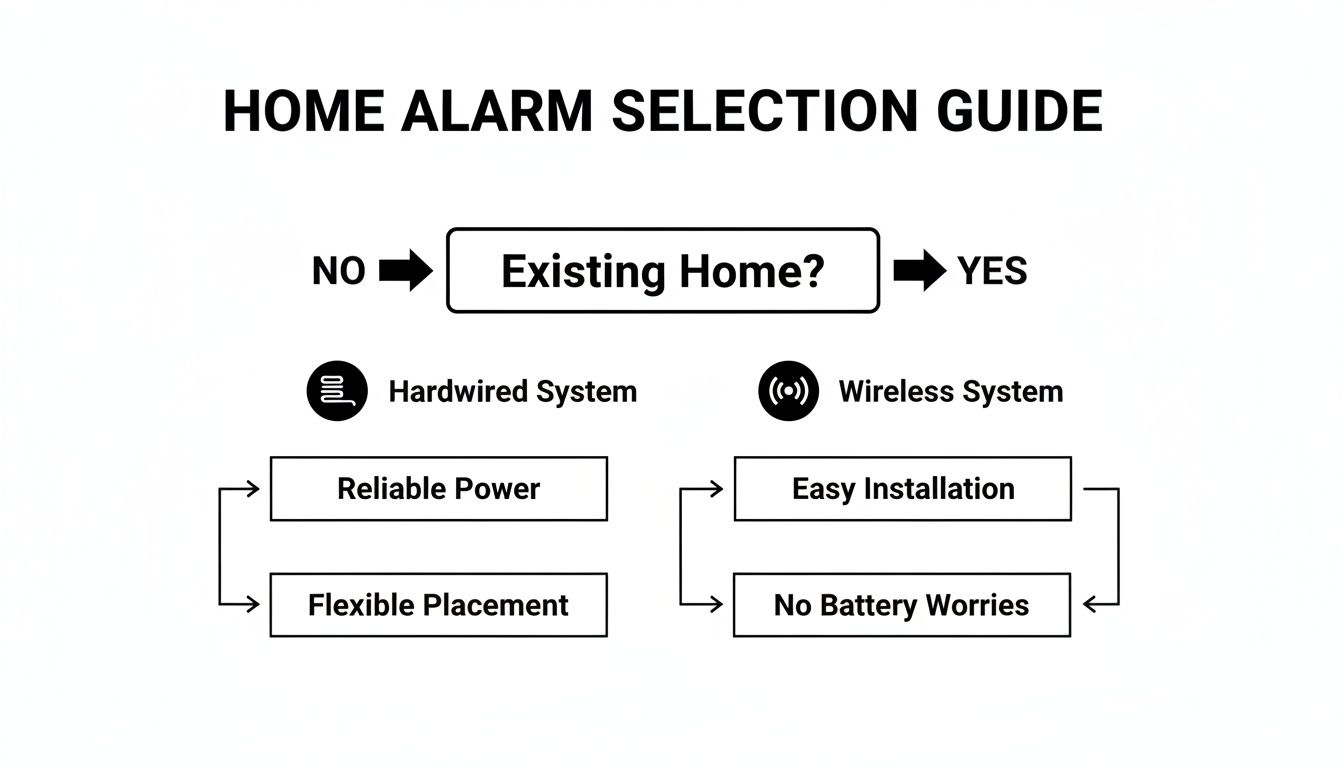
As the flowchart shows, for most existing homes, a wireless system is the most practical choice. It saves you from the cost and mess of having to run new cables through your walls and ceilings.
To help you understand why photoelectric is the mandated technology, here’s a straightforward comparison between the two main types of smoke alarms.
| Feature | Photoelectric Alarms | Ionisation Alarms |
|---|---|---|
| Best For Detecting | Smouldering fires that produce large smoke particles, like those from faulty wiring or furniture. | Fast-flaming fires that produce small smoke particles, like a paper fire. |
| Response Time | Faster response to the most common and deadliest types of house fires. | Slower to respond to smouldering fires, which can produce toxic smoke for hours. |
| Nuisance Alarms | Less likely to be triggered by cooking fumes or steam, making them ideal for general living areas. | Prone to false alarms from everyday activities like burning toast. |
| QLD Legislation | Mandatory for all new installations and upgrades to meet current compliance standards. | No longer compliant for installation in Queensland residential properties. |
At the end of the day, choosing photoelectric technology isn’t just about ticking a legal box—it’s about giving your family the fastest possible warning for the most likely type of house fire. Bringing in a professional ensures you not only get the right devices but also have them placed perfectly for maximum protection.
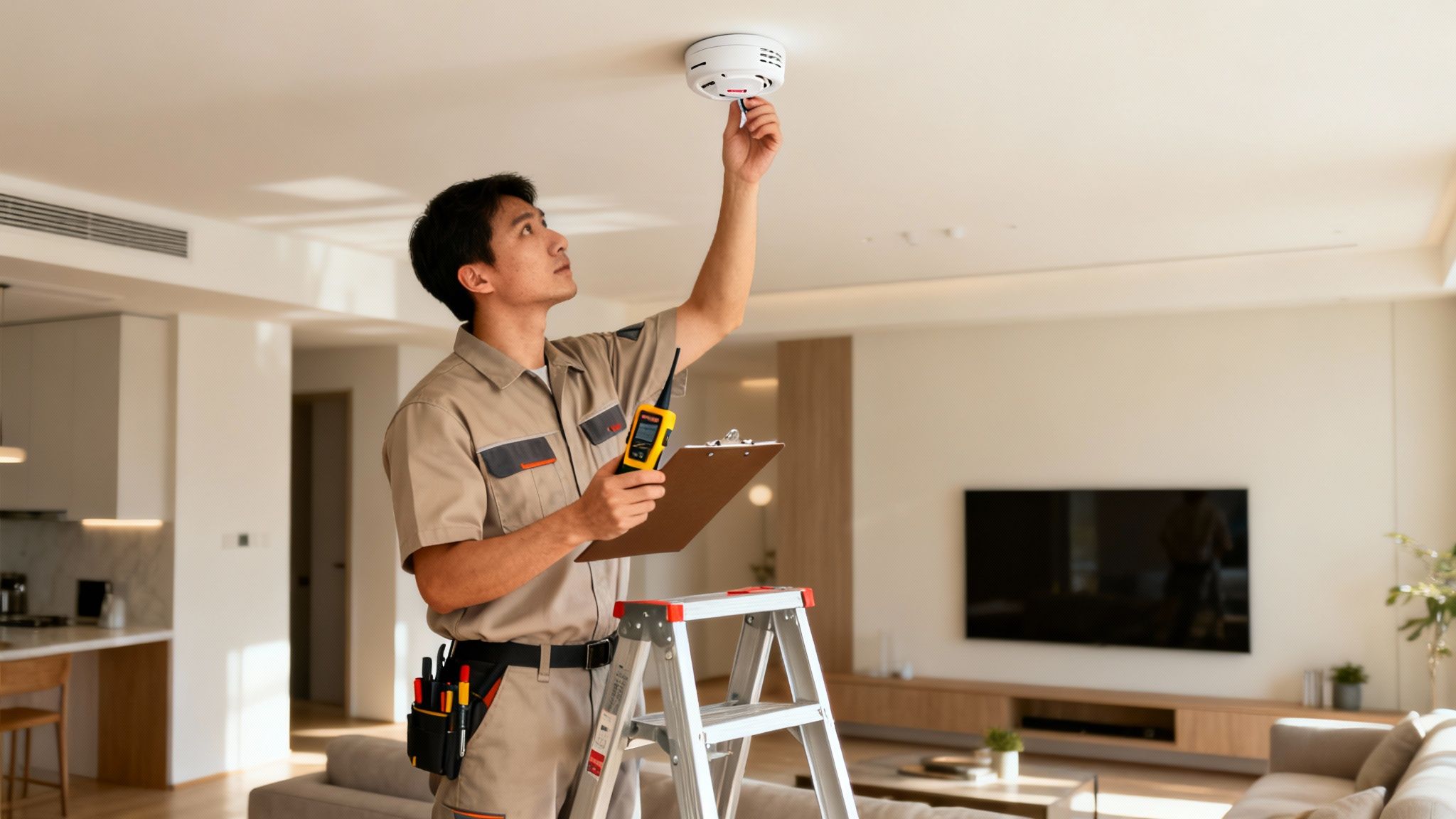
Getting your wireless interconnect smoke detectors to work perfectly starts with a flawless installation. And while the technology might be wireless, Queensland law is very clear: the job must be handled by a licensed electrician. Bringing in a professional like DLG Electrical is the only way to guarantee safety, compliance, and genuine peace of mind.
The process is much more than just sticking alarms on the ceiling. It’s a careful, methodical approach designed to create a rock-solid safety net across your entire home. When our team arrives, we treat your property with the utmost respect, ensuring a clean and efficient service from start to finish.
The first step is always a thorough assessment of your property. Our licensed sparkie will walk through your home to pinpoint the optimal placement for each alarm, making sure we follow Australian Standards to the letter. We look at your home’s layout, ceiling design, and even how air moves through the space to find spots that will give the earliest possible warning without driving you crazy with false alarms.
This strategic placement is absolutely crucial. We make sure every bedroom, hallway, and each level of your home is covered, creating a seamless web of protection with no blind spots. This professional evaluation takes all the guesswork out of the equation, ensuring your system is set up for maximum effectiveness from day one. To get a better idea of what goes into professional work, have a look at our guide on the costs of smoke detector installation.
Once we’ve mapped out the ideal locations, our electrician gets to work. Each alarm is carefully paired to create one unified, synchronised network. This is a critical step—we double-check that every unit is “talking” to the others perfectly before it’s permanently mounted.
A professional installation isn’t finished until the entire system has been put through its paces. We don’t just test one alarm; we trigger the network to confirm that every single unit sounds off at the same time, proving the interconnected system is fully operational and ready to protect you.
Finally, after a successful test, we issue you a certificate of compliance. This official document is your proof that the wireless interconnect smoke detectors have been installed correctly by a licensed professional and that your property meets all Queensland legislative requirements. It’s your complete assurance that the system will work exactly as it should when you need it most.
A modern safety system is only as good as your trust in it. Thankfully, keeping your wireless interconnect smoke detectors in perfect working order is surprisingly simple. Just a few minutes of your time each month can ensure your entire network is ready to act as a reliable lifesaver at a moment’s notice.
Regular checks and a bit of cleaning are the two pillars of good maintenance. This isn’t just about ticking a compliance box; it’s about having unshakable confidence that your family is protected by a system that’s always on guard. To make things easier, you might find it helpful to start creating a flawless preventive maintenance schedule for all your home’s essential systems.
The single most important habit you can build is a quick system test once a month. This simple check confirms that every alarm has power and, crucially, that their wireless link is strong and ready to go.
For a more detailed walkthrough, you can follow our easy guide on how to test a fire alarm properly.
Your smoke detectors are smart enough to tell you what they need. While it’s rare in modern models with sealed batteries, an intermittent chirp every minute or so is the classic sign of a low battery needing attention.
The most critical signal to recognise, however, is the end-of-life warning. All smoke detectors have a mandatory 10-year lifespan. After a decade of service, their internal sensors start to degrade. The unit will begin to chirp consistently to signal that it’s time for a replacement.
Ignoring this alert is a serious risk, as the alarm can no longer be trusted to detect a fire when it matters most. It’s this essential 10-year replacement cycle that is a key driver behind the market growth for battery-operated wireless smoke detectors, which is projected to hit US$2.96 billion by 2030 as homeowners upgrade to newer, more reliable technology.
As your long-term safety partners, we can help with maintenance reminders and professional replacements to keep your system reliable, year after year.
When it comes to installing wireless interconnect smoke detectors, choosing the right electrician is just as critical as picking the right alarms. It’s a decision that comes down to trust, genuine expertise, and local knowledge. For over 19 years, DLG Electrical has been the team Brisbane homeowners, landlords, and property managers turn to when they refuse to cut corners on safety.
We’re not a faceless national franchise; we are a family-owned and operated local business, born and bred in Brisbane. This means we know the unique layouts of Brisbane homes—from Queenslanders to modern builds—and more importantly, we have a deep, practical understanding of Queensland’s specific smoke alarm legislation. Our fully licensed and insured electricians don’t just tick a box; they design and install a complete safety system built for your property.
It’s this commitment to doing things properly that’s reflected in our consistent five-star Google rating. We’re in the business of building lasting relationships by getting the job done right the first time, ensuring your system is 100% compliant and works flawlessly when you need it most.
At DLG Electrical, we see professional installation as a direct investment in your family’s security. We take care of every single detail, from the first site assessment to the final testing and issuing of your certificate of compliance. Our expertise is focused on one thing: making sure your system gives you the earliest possible warning, buying you precious, life-saving time.
Choosing DLG Electrical isn’t just about meeting a legal requirement. It’s about partnering with a trusted local expert who is genuinely dedicated to protecting what matters most to you. We bring together technical skill with a real commitment to our community’s well-being.
Our entire process is built around giving you total confidence and lasting security. We offer a transparent, straightforward service that guarantees both your safety and your compliance, with no grey areas.
Ready to secure your home with a professionally installed, fully compliant smoke alarm system? The expert team at DLG Electrical is here to help. Contact us today for a free, no-obligation quote and experience the peace of mind that comes with superior fire protection.
When it comes to home safety, it’s natural to have questions. We get it. To make sure you feel completely confident, we’ve answered some of the most common queries Brisbane homeowners have about wireless interconnect smoke detectors.
Absolutely. Modern wireless alarms don’t rely on your home Wi-Fi at all. Instead, they use their own secure, dedicated radio frequencies to talk to each other.
They are built to meet the exact same strict Australian Standards for performance as hardwired alarms. For most existing homes, they’re the most practical and effective way to get your property fully compliant without the cost and hassle of major electrical work.
While it might look like a straightforward DIY job, Queensland law is black and white on this. Any installation or replacement of a smoke alarm must be carried out by a licensed electrician.
This isn’t just red tape; it’s a critical safety measure. An electrician ensures the alarms are correctly placed for maximum coverage, properly linked together, and fully tested. They’ll also issue a certificate of compliance, which is vital for both legal reasons and your insurance policy.
This professional certification is your guarantee that the system has been installed correctly and will function as a cohesive network during an emergency, providing the highest level of protection.
This is a great question, but the system is designed to handle it intelligently. If the long-life battery in a single unit starts running low, only that specific alarm will start to “chirp” every so often.
This chirp is an isolated alert to let you know which unit needs attention. Crucially, it doesn’t take the rest of the network down. All other alarms will continue to function perfectly, keeping your home protected while you sort out the replacement.
Beyond fire prevention, it’s also wise to understand what happens after an incident. Many homeowners find it helpful to have resources for understanding smoke damage insurance claims just in case the worst should happen.
The number isn’t just a suggestion—it’s set by Queensland legislation to ensure there are no dangerous blind spots in your home. The rules are very specific:
The team at DLG Electrical can perform an on-site assessment of your home’s layout to map out the exact number and best placement for each alarm. This ensures your family is fully protected and your property is 100% compliant.
Ready to upgrade your home’s safety with a fully compliant, professionally installed wireless interconnected smoke alarm system? The expert team at DLG Electrical is here to provide a seamless installation and lasting peace of mind. Contact us today for a free, no-obligation quote at https://dlgelectrical.com.au.

Master Electrician with over 30 years of experience. Founded DLG Electrical in 2005 after international project work including electrical installations at Stamford Bridge Stadium, London(Home of Chelsea FC).

Local Electricians that can fix all Electric Hot water Systems.
Motion sensor lights are a versatile addition to any home, offering nu
