83 Jean St, Grange QLD 4051
Mon-Fri 07:30 AM - 04:00 PM - Sat - 8:00 - 12 - Sunday Closed
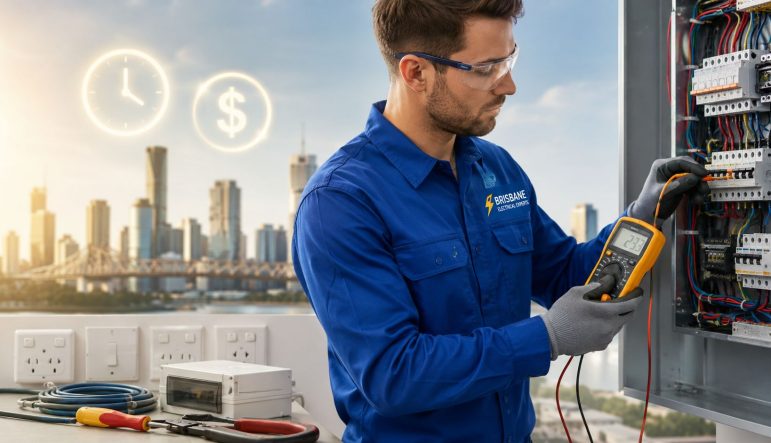
A qualified Brisbane electrician typically charges AU$80 to AU$110 per hour during normal business hours in 2026. If you need urgent help at night or on a weekend, that rate usually jumps to AU$150 to AU$300 per hour.
That's the part typically inquired about first. The part that usually causes confusion comes a few minutes later, when you're comparing quotes, looking at a call-out line, or wondering why a job that seemed simple still carries a real cost.
If you're dealing with flickering lights, planning a renovation, replacing a switchboard, or booking compliance work for a rental, it helps to know what sits behind the hourly figure. The rate on the invoice isn't just “time with a screwdriver”. It also reflects licensing, testing gear, travel, administration, insurance, and the business costs required to send a qualified electrician to your home safely and prepared.
You book an electrician for what sounds like a small job, then the quote lands higher than expected. In Brisbane, that usually comes down to one thing. The bill reflects the full cost of getting a qualified, insured tradesperson to your door with the right gear, not just the minutes spent on the repair.
The hourly rate is only one part of the price. A fair electrical charge can also include travel, time spent testing, quoting and admin, insurance, licensing, vehicle costs, stock carried in the van, compliance obligations, and GST. That is why two electricians can quote differently on the same job and both still be pricing fairly.
This matters most on jobs that look simple from the outside. Replacing a damaged switch plate is usually straightforward. Tracing a tripping circuit in an older home, working in a hot roof space, or attending an urgent fault after hours is a different job with a different cost stack.
Ask for clear answers on these points:
A good quote should be easy to follow. If the wording is vague, ask the electrician to break out labour, materials, call-out fees, and any possible extras before work starts.
If you want to compare the type of work included across different electrical services in Brisbane, that helps put pricing into context before you book.
You book an electrician for a weekday job, expect a simple hourly charge, and then realise the rate only makes sense once you know what sits behind it.
In Brisbane, the standard hourly rate usually refers to work done during normal business hours on routine residential jobs. It is the labour rate for a licensed electrician on site. It is not the full job price, and that is where plenty of confusion starts.
A fair hourly rate has to cover more than the time spent holding tools. It also has to carry the cost of running a compliant electrical business in Brisbane, including licensing, insurance, vehicles, testing equipment, admin time, and GST where applicable. If a rate looks cheap at first glance, check what has been left out.
For a normal weekday booking, the hourly rate generally includes:
Some electricians price with a first-hour minimum, then charge in smaller increments after that. Others look at a well-defined job and give a fixed price instead. Neither approach is automatically better. Fixed pricing gives certainty if the scope is clear. Hourly pricing can be fairer when the job could open up hidden issues once testing starts.
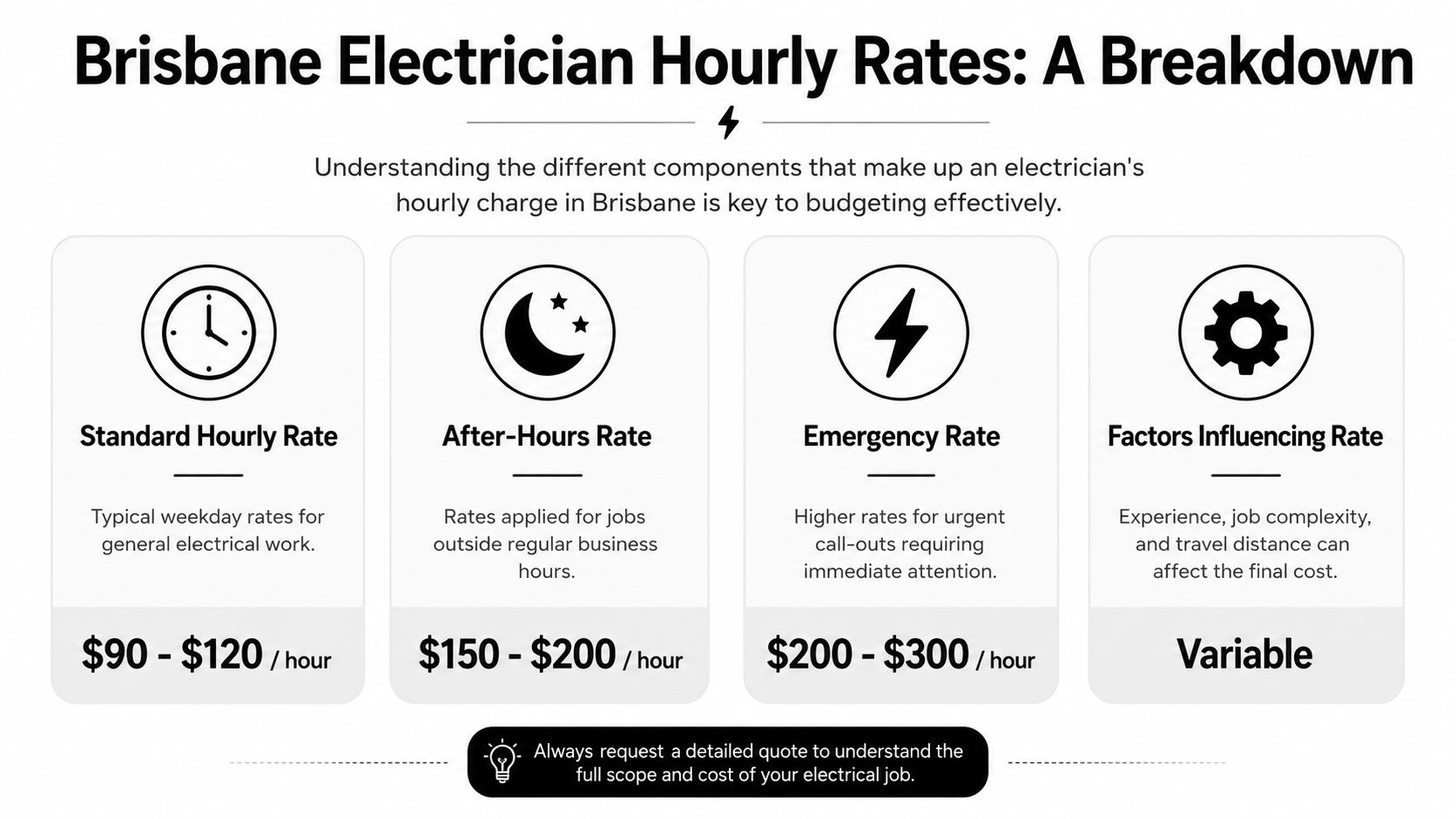
After-hours, weekend, and emergency work usually costs more than a standard weekday booking.
That increase is not arbitrary. Someone has to leave scheduled work, attend without much notice, and carry the cost of overtime, extra staffing pressure, and lost efficiency for the rest of the day or night. Urgent faults also tend to involve more risk at the start because the cause has not been confirmed yet.
If the issue is safe to leave, booking in normal trading hours is usually the cheapest option.
Two electricians can give different hourly rates and still be pricing justifiably. Often, the difference sits in what each business includes in that rate and how much uncertainty the job carries.
A straightforward task in a newer home is easier to price. Fault-finding in an older Queenslander is different. The electrician may need extra testing time, more circuit tracing, and slower, more careful work around older wiring or limited access.
These are common reasons one hourly rate does not compare neatly with another:
The practical takeaway is simple. Ask what the hourly rate includes, what is charged separately, and whether the electrician expects the work to be predictable or diagnostic. That gives you a much clearer read on value than the rate alone.
The hourly rate is only one part of the bill. For many residential jobs, the first charge you'll see is the attendance cost. That's where homeowners often confuse call-out fees with minimum charges.
A call-out fee usually covers the electrician getting to site, parking up, unloading tools, and carrying out the initial look at the problem. Even before a repair starts, time has already been spent.
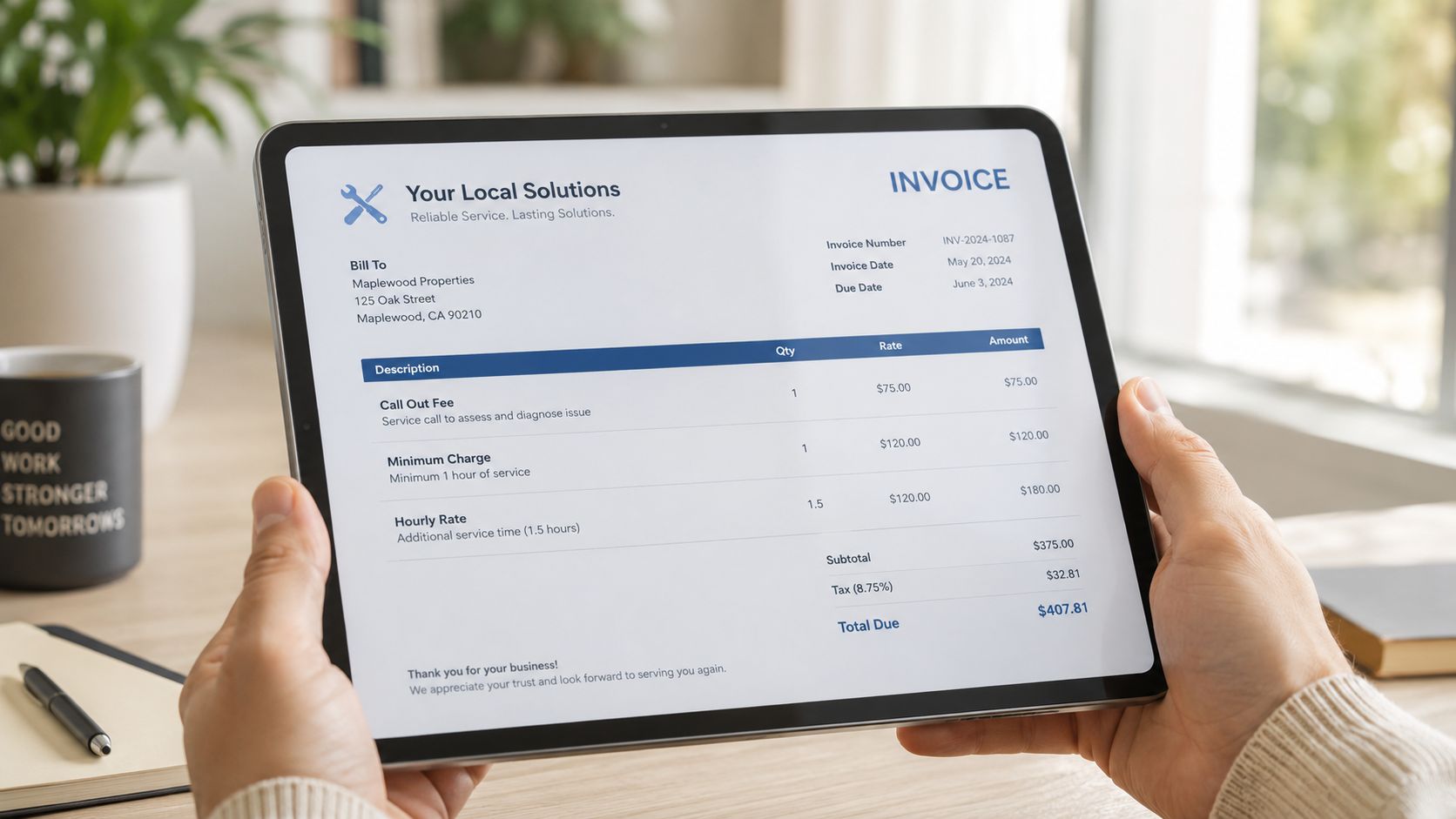
This catches people out with small tasks. A light switch might only take a short time to replace once the electrician is standing in front of it, but the total visit includes more than the few minutes spent on the mechanism itself.
A minimum charge exists because very small jobs still require:
If you see wording like “first hour”, “minimum attendance”, or “service call”, don't assume you're being overcharged. Ask what it includes.
A clear explanation might cover arrival, diagnosis, the first block of labour, and whether small materials are billed separately. What doesn't work is guessing from a one-line invoice after the job is done.
Ask one simple question before booking: “What's your minimum charge, and what does that include?” You'll avoid most billing surprises right there.
For homeowners, this is less about hunting for the cheapest entry fee and more about comparing like for like. A slightly higher minimum that includes proper testing and clear communication can be better value than a lower headline number with extra line items added later.
The biggest mistake people make is comparing an electrician's invoice to a wage figure and assuming the gap is profit. It isn't that simple.
In 2026, the average hourly pay for a qualified electrician in Brisbane is AU$35.89 for employed professionals, based on Brisbane electrician wage data from Payscale. That's useful background, but it's not the same thing as what an independent electrical contractor has to bill a client.
An employee's hourly pay is their wage. A contractor's hourly charge has to support the entire business around the labour.
That includes things like:
That's why the contractor billing rate is always much higher than the employed wage. It has to be, or the business doesn't stay viable.
Even with a fair hourly rate, the final invoice can move depending on the work.
A few common variables:
A cheap rate on a poorly scoped job can end up costing more than a well-explained quote from the start.
There's a business lesson in that too. Plenty of small trade operators wrestle with quoting, overhead recovery, and cash flow while trying to stay competitive. Homeowners don't need to become accountants, but understanding the pressures behind service pricing helps. If you're interested in the broader side of overcoming business challenges in Australia, that perspective explains why transparent operators price carefully instead of guessing low and chasing variations later.
The cleanest way to budget is to treat common household work as a combination of time on site, materials, and access. Exact pricing still depends on the property and the product selected, but a practical estimate can help you judge whether a quote feels sensible.
Because specific job-by-job market figures weren't provided in the verified data, the table below uses qualitative ranges rather than invented dollar amounts. That's the honest approach.
| Common Electrical Job | Estimated Time | Estimated Total Cost (inc. GST & Labour) |
|---|---|---|
| Install a new power point | Often completed within a short standard visit if access is straightforward | Usually falls within a minimum charge or short labour booking, plus materials |
| Replace a smoke alarm | Commonly a quick service task if the location is accessible | Often priced as a small service job, with the alarm unit charged in addition if not supplied |
| Replace downlights | Varies with the number of fittings and ceiling access | Usually scales with labour time and fitting choice. For related planning, see this guide to downlight installation cost |
| Switchboard upgrade | Commonly a larger scheduled job requiring testing and compliance checks | Typically quoted rather than left open-ended, because scope and materials matter |
| Fault-finding for tripping circuits | Timing can vary because diagnosis is part of the job | Often harder to fix-price upfront than an installation, so labour time can be the main cost driver |
| Ceiling fan replacement | Often straightforward if wiring and support are already suitable | Usually a moderate service job with labour plus the fan if supplied by the electrician |
| Hot water electrical repair | Depends on whether the fault is at the isolator, circuit, or unit connection | Usually priced after inspection because diagnosis affects both labour and parts |
| Security lighting installation | Time varies with cable path, mounting point, and switching method | Often quoted as labour plus fittings, especially for outdoor work |
Don't use a table like this to force a contractor into a price before they've seen the site. Use it to ask better questions.
For example:
That gives you a much better conversation than asking, “How much to do this?” with no details.
The cheapest electrical job isn't always the one with the lowest headline rate. It's usually the one that's planned properly.
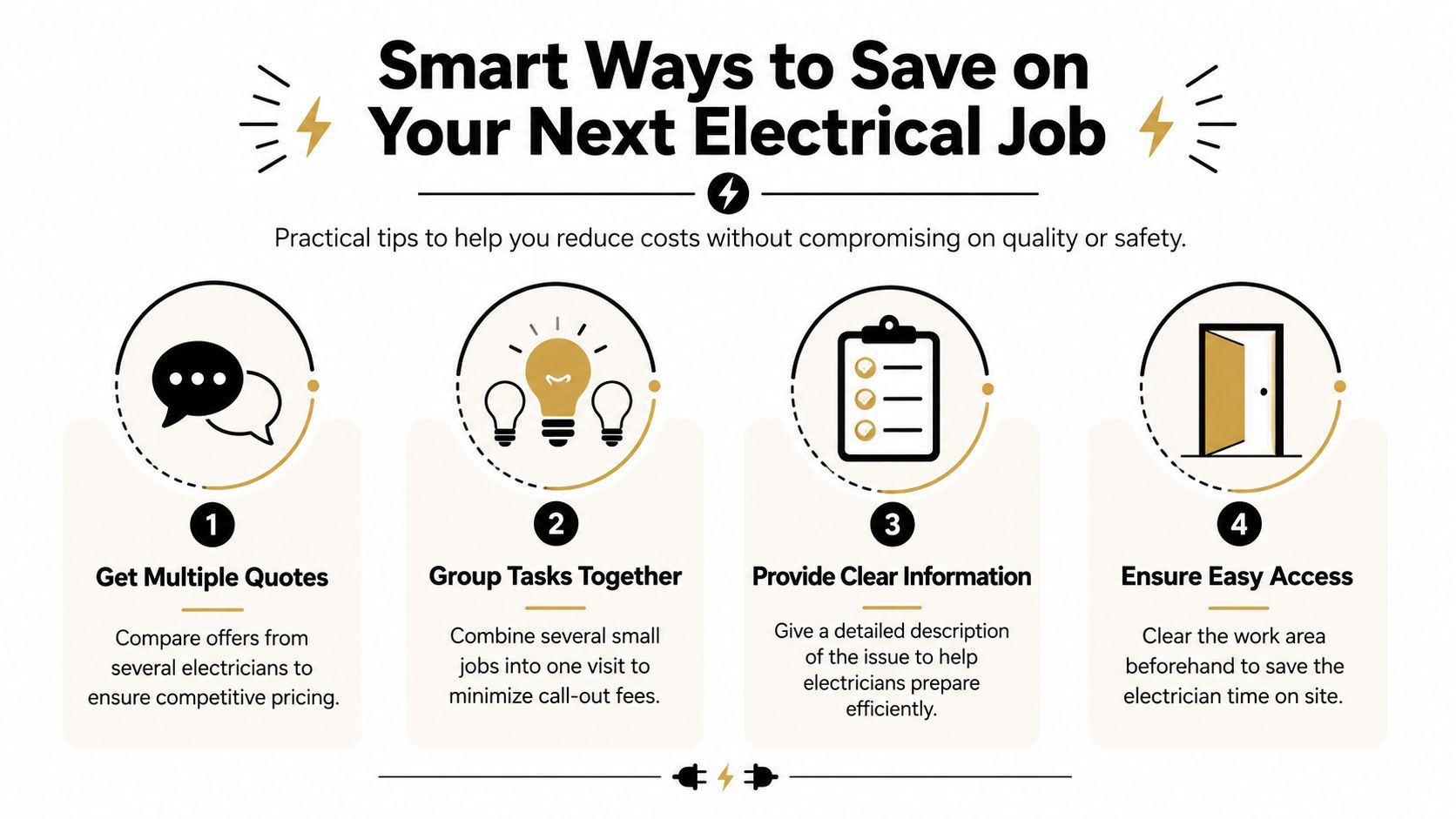
If you want to reduce the final bill without cutting corners on safety, focus on efficiency. Electricians lose time when they need to make repeat visits, wait for access, or arrive with too little information to prepare properly.
For bigger projects, an hourly arrangement isn't always the best fit. The verified Brisbane pricing data notes that a full-day rate is often available for larger jobs and can work out better than pure hourly billing where the scope is broad but still manageable within a scheduled block.
That tends to suit:
Money-saving habit: Write a list before you book. The more complete your job list is, the easier it is for an electrician to plan efficiently and quote sensibly.
There's a similar lesson in service businesses more broadly. Clear communication and good preparation save time at both ends. If you've ever looked at Wise Web's Brisbane web design advice, the same principle shows up there too. The more clearly a client defines the work, the fewer surprises appear in delivery and cost.
A good electrical quote should leave you with fewer questions, not more. You should be able to see what labour arrangement applies, whether there's a call-out or minimum attendance, what materials are included, and what could change the price once the electrician is on site.

That matters whether you own a home, manage a rental, or are lining up work for a renovation. The cheapest-looking quote can become the most expensive if it's vague, excludes key materials, or leaves too much open to “we'll see when we get there”.
Look for these basics in writing:
A service business also needs a clean way to capture job details before quoting. Good enquiry forms help a lot. These examples of winning service job forms show why better information up front usually leads to clearer pricing and fewer back-and-forth messages.
A Brisbane electrician who works in local homes every week will usually spot the practical issues faster. Older switchboards, tight roof spaces, compliance upgrades, smoke alarm placement, and lighting layout problems all have a local flavour. That experience doesn't guarantee the lowest price. It often leads to fewer surprises.
If you're comparing contractors, it also helps to review what to expect from a local electrician in Brisbane before you book. The goal isn't just to get someone on site. It's to get someone who quotes clearly, turns up prepared, and finishes the work safely.
For homeowners who prefer to see a contractor before reaching out, this short video gives a practical sense of the kind of residential work and presentation you should expect from a professional electrical business.
The bottom line is simple. Understanding the electrician hourly rate in Brisbane helps, but effective protection is a clear written quote, a sensible scope, and honest communication before the first tool comes out.
If you want straightforward advice and a free, no-obligation quote, DLG Electrical is a strong local choice for Brisbane homes and small projects. They're family-owned, fully licensed and insured, have more than 19 years of local experience, and are known for clear communication, competitive rates, and getting the job done right the first time.

Master Electrician with over 30 years of experience. Founded DLG Electrical in 2005 after international project work including electrical installations at Stamford Bridge Stadium, London(Home of Chelsea FC).

Local Electricians that can fix all Electric Hot water Systems.
Motion sensor lights are a versatile addition to any home, offering nu
