83 Jean St, Grange QLD 4051
Mon-Fri 07:30 AM - 04:00 PM - Sat - 8:00 - 12 - Sunday Closed

You've picked up your new EV, driven it home through Brisbane traffic and parked it in the garage. The charging cable reaches the nearest power point, but by morning the battery has barely moved, or the circuit breaker has tripped while the air conditioner and refrigerator were running.
That experience is common because an electric vehicle wall charger isn't a faster plug. It's a dedicated electrical installation that has to suit your vehicle, your home's switchboard, your solar system, and Queensland's connection requirements. The right decision starts with the house, not the charger box.
An electric vehicle wall charger is more accurately called Electric Vehicle Supply Equipment, or EVSE. The unit controls and monitors the electricity supplied to the car, confirms that the vehicle is connected safely, and communicates with the vehicle before charging begins. The car's onboard charger then converts the incoming AC electricity into the DC electricity stored in the battery.
You'll hear several names used interchangeably:
The distinction matters because the wall-mounted unit doesn't independently determine charging speed. Your vehicle's onboard AC charger sets the maximum power it can accept, while the EVSE and household circuit must safely provide that power.
A standard household power point supplies a small amount of AC power through an existing general-purpose circuit. An electric vehicle wall charger uses a dedicated circuit from the switchboard, with its own protection and cable sizing. That arrangement gives the vehicle a controlled, more reliable supply and avoids placing a continuous high load on a circuit shared with household appliances.
Public fast chargers work differently. DC fast chargers bypass the vehicle's onboard AC charger and deliver direct current to the battery. They require substantial electrical infrastructure, high-capacity cabling and, in many installations, three-phase supply. That makes them suitable for service stations, commercial premises and fleet depots, not typical Brisbane garages. Residential projects involving DC equipment can exceed $30,000, so an AC wallbox remains the practical home solution.
Practical rule: Treat the wall charger as part of your home's electrical infrastructure, not as an accessory you can select independently of the switchboard.
Businesses need a different assessment because several vehicles, longer operating hours and shared access can change the load profile. For commercial planning, EV charging solutions for business provides useful context on how workplace and destination charging differs from a single-home installation.
Charging power is measured in kilowatts, while current is measured in amps. The two are connected, but neither figure alone tells you how quickly your car will charge. The vehicle's battery size, onboard charger, temperature and charging losses all affect the result.
A standard 10 A power point provides roughly 2.4 kW of AC charging. That can work for a driver who travels lightly and leaves the vehicle parked for long periods, but it's slow for a large battery or a household that needs dependable overnight recovery. A dedicated single-phase wall charger commonly operates at 7 kW, while Queensland guidance identifies home AC chargers in the 7 kW to 22 kW range, depending on the available supply and installation design. (Queensland Government guidance)
A 32 A single-phase charger produces approximately 7.4 kW under a 230 V supply. A 16 A three-phase charger provides about 11 kW, while a 22 kW three-phase unit can deliver materially more power where the vehicle and property support it. The breaker, cable, protective devices and charger settings must all match the intended continuous load.
The table below uses simple energy division, so it's a planning guide rather than a promise of exact plug-to-battery time. Actual charging takes longer because the car manages current, charging efficiency varies and many vehicles reduce power as the battery approaches full.
| Power Level | Supply Type | Approx. kW | 60 kWh Battery, e.g. Tesla Model 3 | 77 kWh Battery, e.g. Kia EV6 | 44 kWh Battery, e.g. BYD Dolphin |
|---|---|---|---|---|---|
| Level 1 | 10 A single-phase power point | 2.4 kW | 25 hours | 32 hours | 18 hours |
| Level 2 | 16 A three-phase | 11 kW | 5.5 hours | 7 hours | 4 hours |
| Level 2 | 32 A single-phase | 7.4 kW | 8 hours | 10.5 hours | 6 hours |
| Level 2 | 22 kW three-phase | 22 kW | 3 hours | 3.5 hours | 2 hours |
Those figures show why a wallbox often improves the daily experience, even when the vehicle doesn't need a full battery every night. A partial top-up during a normal evening or daytime solar window may be all that's required.
Installing a 22 kW wallbox won't make a vehicle charge at 22 kW if its onboard AC charger accepts less. The charger also won't overcome a single-phase supply limitation or an unsuitable switchboard. Before choosing a product, confirm the vehicle's maximum AC input and compare it with the electrical capacity available at the property.
The most important question is whether the house can support the proposed charging load safely. A licensed electrician should complete a site assessment before giving a final recommendation, particularly in older Brisbane homes where the switchboard may have limited space, outdated protection or little spare capacity.
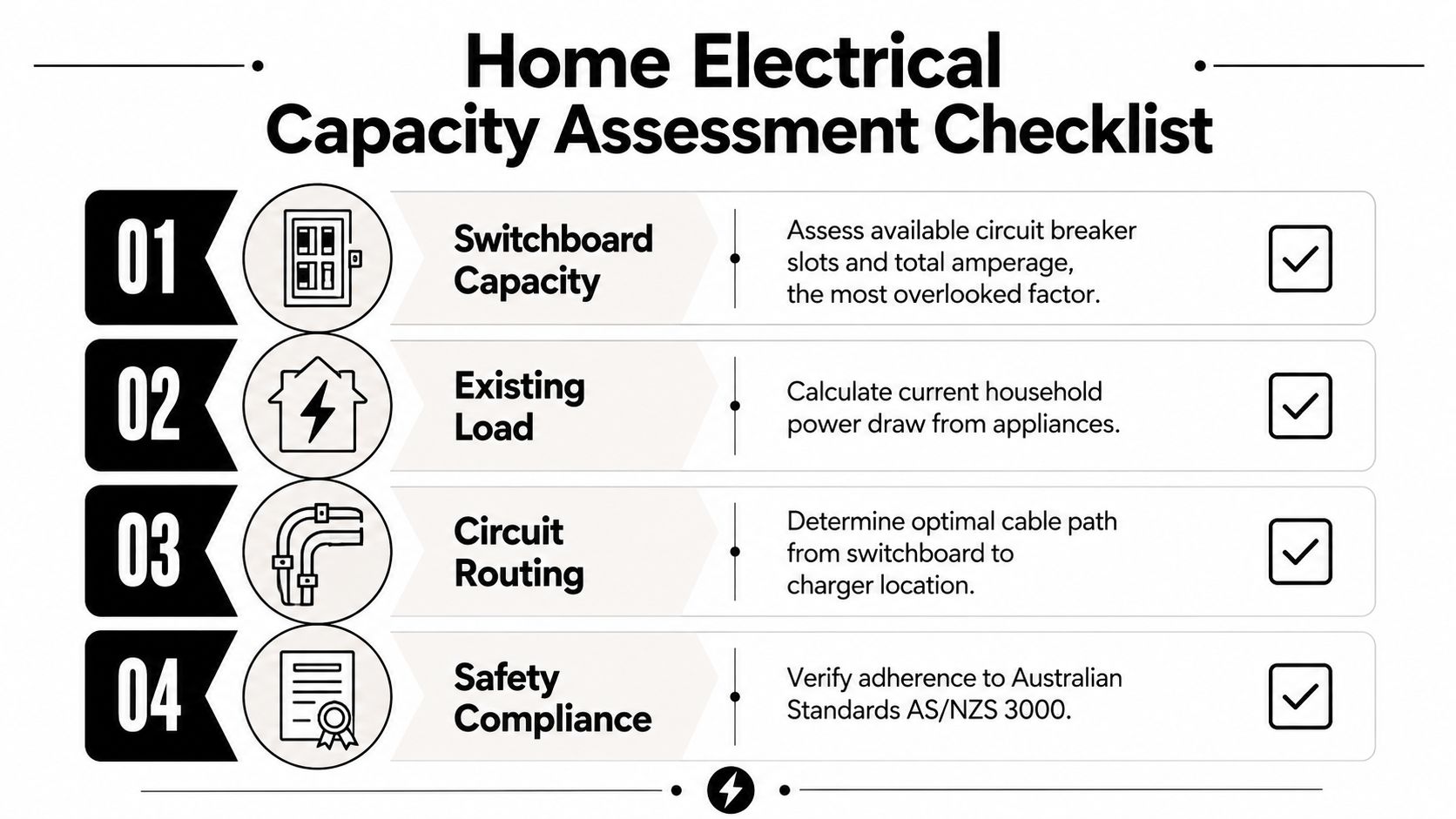
The electrician checks the main switch, service protection, available circuit space and the condition of the enclosure. Ceramic fuses, crowded boards and old cabling can turn a straightforward charger installation into a broader electrical upgrade. The inspection also considers whether there's room for the dedicated breaker and required residual-current protection.
The assessment then considers the existing household load. Air conditioning, electric cooking, pool equipment, hot water systems and other high-demand appliances can operate at the same time as the vehicle charger. A charger that looks suitable on paper may need dynamic load management if the combined demand could approach the property's supply limit.
Queensland has a specific compliance issue that generic overseas charging guides often miss. Under the Queensland Electricity Connection Manual framework, a dedicated home EV wall charger rated above 20 A must use active device management. A typical 32 A single-phase charger therefore can't be hard-wired to run at full output without an approved network-control or load-management arrangement. (Queensland 20 A EV charging information)
In practical terms, the electrician may recommend dynamic load control, an approved managed connection or a charger configured within the permitted current limit. Charging at 20 A or less can generally avoid that particular requirement, but the vehicle will charge substantially more slowly.
The charger rating, switchboard capacity and network rules must be assessed together. Choosing the product first is how homeowners end up paying for avoidable changes later.
The physical installation matters as much as the electrical calculation. The electrician needs to determine the cable route, distance, penetrations, outdoor exposure, mounting surface and protection from mechanical damage. Longer runs may require different cable sizing and more labour.
Earthing and the MEN connection also need verification, along with the suitability of the existing switchboard for modern protective devices. A reputable installer won't finalise the price until these conditions are known.
Hardwired and plug-in chargers solve different problems. A plug-in unit connected to a suitable industrial socket offers portability, which can help tenants or owners who may move the charger between locations. It still needs a correctly installed circuit, socket, protective devices and a mounting arrangement that avoids strain on the plug and cable.
For permanent daily charging, hardwiring is usually the cleaner arrangement. The charger connects directly to a dedicated circuit, reducing reliance on a socket that may loosen, wear or be used for another purpose. Hardwired units also support higher output options, subject to the vehicle, supply and Queensland active-management requirements.
| Feature | Hardwired, Single-Phase | Hardwired, Three-Phase | Plug-In, 15 A or 20 A Socket |
|---|---|---|---|
| Typical use | Daily home charging | Faster home or fleet-style charging | Portable or lower-demand charging |
| Supply requirement | Dedicated single-phase circuit | Dedicated three-phase circuit | Suitable dedicated socket circuit |
| Charging capability | Commonly around 7 kW at higher current | Commonly 11 kW to 22 kW, where supported | Limited by socket and configured current |
| Main advantage | Permanent, tidy installation | Higher available AC power | Portability |
| Main limitation | Single-phase current ceiling | Higher installation complexity | Socket condition and lower output |
| Best fit | Most suitable Brisbane homes | Homes already equipped with three-phase | Situations needing a removable unit |
Queensland Government guidance places home wall-mounted AC charging in the 7 kW to 22 kW category and notes that a 22 kW three-phase charger can deliver roughly triple the power of a 7 kW single-phase unit. The higher output also increases demands on cabling, protection and supply capacity. (Queensland Government EV charging guidance)
Many Brisbane homes can charge effectively on single-phase power. If the car is parked overnight and daily driving is moderate, a compliant 7 kW installation may provide all the recovery needed without pursuing a supply upgrade.
Three-phase becomes more attractive where the property already has it, the vehicle has a suitable onboard charger, or the household needs faster charging for larger batteries and frequent driving. Upgrading solely for the headline charging speed can be poor value if the vehicle cannot accept the extra AC power or the home's driving pattern doesn't require it.
For a clear explanation of the electrical distinction, see this guide to the difference between single-phase and three-phase power.
A charger should fit the way your household produces and buys electricity. Solar generation, tariff timing, vehicle battery level and available switchboard capacity all interact, so the cheapest or most practical schedule isn't automatically overnight.
Australian survey data shows that 66% of home-charging EV owners plug in during the day to use solar, while 34% charge overnight for cheaper tariffs and 16% charge later in the afternoon after returning from work. The same RAC findings report that 80% of home-charging households use solar. (RAC EV owner survey)
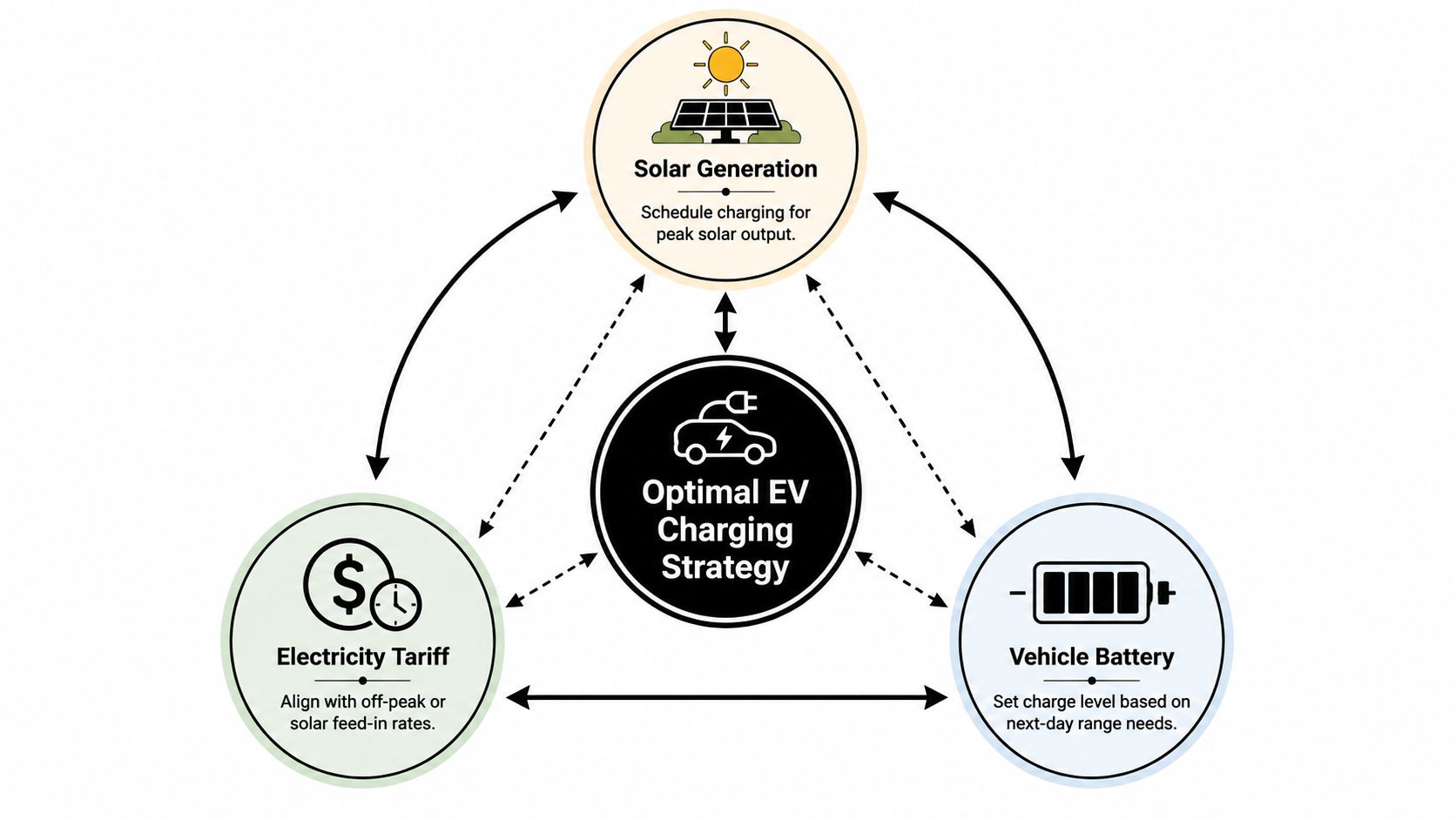
A solar-aware charger, such as a myenergi Zappi or a Wallbox Pulsar Plus configured with suitable energy monitoring, can be set to prioritise surplus solar generation. That approach sends excess production to the vehicle instead of exporting all of it, while still allowing grid charging when the battery needs to be ready.
Solar charging isn't always the right choice. If the vehicle needs a substantial top-up and the next day's driving can't wait, a scheduled grid charge may be more practical. The charger should also be configured so the house retains priority for essential loads.
For households considering storage as well as vehicle charging, this resource on solar panels and batteries helps frame how generation and storage interact. Solar owners should also keep the generation system maintained, and a general solar panel maintenance checklist can help explain the broader upkeep principles, even though it's written for a different climate.
Time-of-use plans can make overnight charging attractive where the tariff offers a cheaper period. Queensland households may also encounter controlled-load arrangements such as Tariff 31 and Tariff 33, but the suitable tariff depends on the property, retailer and approved connection setup. Confirm the actual rate structure before assuming a particular window will reduce the bill.
The practical framework is simple:
A proper installation starts with a site assessment, not with unpacking the charger. The electrician verifies the supply, reviews the switchboard, confirms the cable route and checks whether active device management or other network requirements apply.
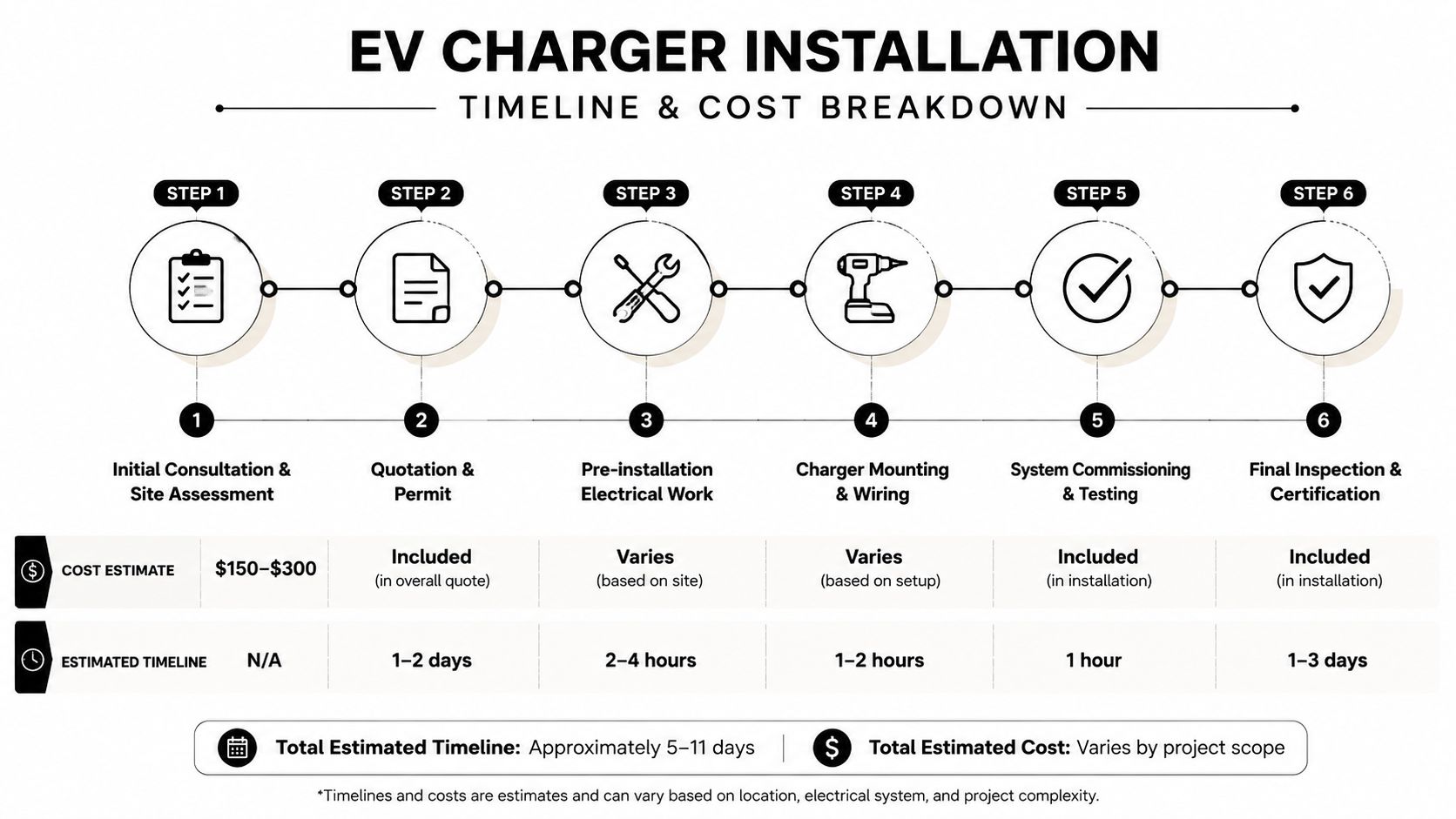
The work normally includes:
Installation must comply with the applicable Australian electrical requirements, including AS/NZS 3000 and the EV charging provisions relevant to the equipment and site. RCD protection is a key part of the design, and the charger's included protection isn't automatically a substitute for correctly designed upstream protection.
The supplied project brief identifies a typical straightforward Brisbane installation, including the charger, at approximately $1,800 to $3,200 where the switchboard and cable route are suitable. A property needing switchboard work, a three-phase conversion or a long and difficult cable run can reach approximately $4,500 to $7,000.
Those figures aren't a substitute for a site-specific quote. The final price depends on the charger selected, distance from the switchboard, wall construction, trenching, switchboard condition, protection requirements and whether network coordination is needed. This Brisbane EV charger installation cost guide covers the variables that commonly move a project outside the straightforward category.
Most standard installations can be completed in a day once the equipment and approvals are ready. Complex electrical upgrades may take two to three days, particularly where additional coordination is required.
A cheap quote that excludes switchboard work, protection or commissioning isn't a cheaper compliant installation. It's an incomplete scope.
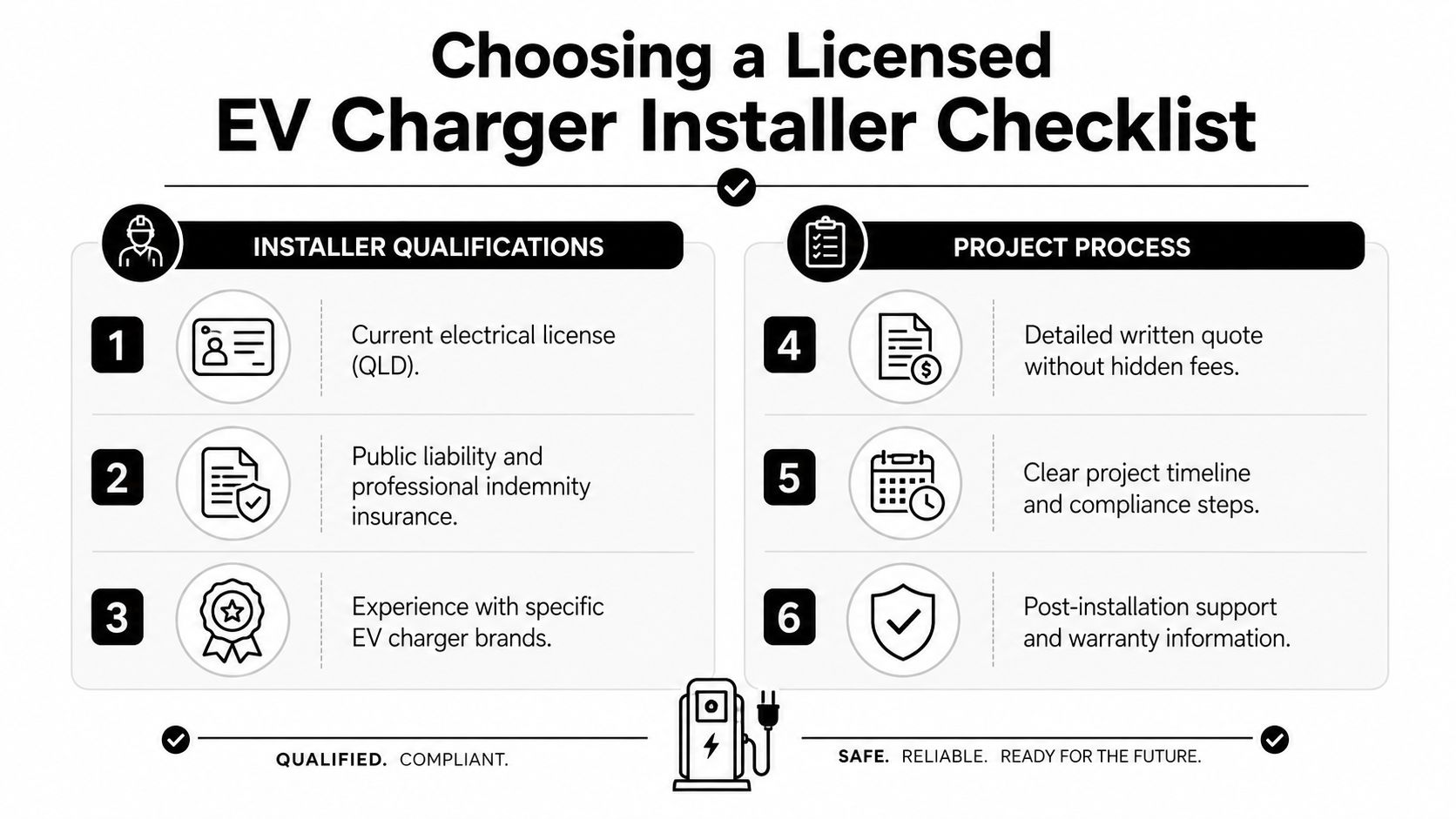
A wallbox carries a serious continuous electrical load, so installation needs to be performed by a properly licensed Queensland electrician. Buying a product online doesn't remove the need for correct circuit design, RCD protection, earthing verification, cable sizing and compliance documentation under the relevant Australian requirements.
A competent installer should inspect the property before confirming the final scope. They'll assess the switchboard, calculate available load, identify the cable route, confirm whether the charger needs active device management and explain what happens if the existing installation needs upgrading.
Red flags include a fixed price supplied without a site visit, advice to connect a 32 A charger to an old board without checking capacity, or an installer who can't explain active device management. A portable plug and socket arrangement also shouldn't be presented as automatically equivalent to a permanent hardwired installation.
DLG Electrical can assess Brisbane homes for single-phase and three-phase EV charging, check whether switchboard or wiring work is required, and install the selected wall charger as part of a compliant electrical scope. The useful outcome isn't just a box on the garage wall. It's a charging setup that works with the vehicle, solar system, household loads and Queensland connection rules.
If you're ready to install an electric vehicle wall charger, visit DLG Electrical to arrange a site-specific assessment in Brisbane. Their licensed electricians can review your switchboard, recommend a suitable charging configuration and provide an installation plan that covers wiring, protection, load management and compliance.

Master Electrician with over 30 years of experience. Founded DLG Electrical in 2005 after international project work including electrical installations at Stamford Bridge Stadium, London(Home of Chelsea FC).

Local Electricians that can fix all Electric Hot water Systems.
Motion sensor lights are a versatile addition to any home, offering nu
