83 Jean St, Grange QLD 4051
Mon-Fri 07:30 AM - 04:00 PM - Sat - 8:00 - 12 - Sunday Closed
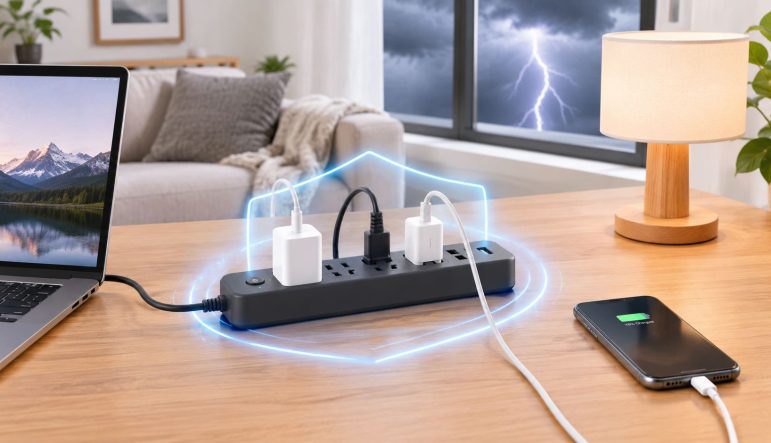
A Brisbane storm usually announces itself the same way. The air gets heavy, the sky goes dark, the lights give a little flicker, and suddenly you're looking at the TV, the modem, the laptop and the gaming console all plugged into one crowded board near the wall.
That's when many people start searching for a surge protector power strip.
It seems simple enough. Buy a board with more outlets, plug everything in, and assume your gear is covered. But many homeowners get caught out here. A standard power board and a surge-protected one can look almost identical, yet they do very different jobs. Even more important, a plug-in strip is only one layer of protection. It doesn't protect your whole house on its own.
You are at home during a summer storm in Brisbane. The lights dip for a moment, the modem drops out, and your TV, laptop and charger are all plugged into the same board in the corner. That is usually the moment a surge protector power strip starts to make sense.
A surge protector power strip is a multi-outlet board made to help shield connected devices from sudden voltage spikes. Those spikes can come from lightning activity nearby, switching on the wider network, or large appliances starting and stopping inside the home. The spike may last only a moment, but modern electronics do not need much time to be upset.
A lot of homeowners first look into this after a small warning sign rather than a total failure. The NBN cuts out during a storm. The TV restarts. A desktop behaves oddly the next morning. If you want a plain-English refresher on what causes power surges, DLG explains the common triggers clearly.
The part that catches people out is simple. A surge protector power strip and a basic power board can look almost the same on the shelf. Same shape, same outlets, same switch. One is mainly giving you extra places to plug things in. The other includes parts intended to reduce the surge that reaches your devices.
In Australian terms, a plug-in surge board is used for protection at the appliance end. It is a local layer of protection for the gear plugged into it, not a substitute for protection at the switchboard.
That layered idea matters in Brisbane homes. A power strip can help protect the TV, modem or computer sitting in one room, but it does not protect every circuit in the house. If your place is exposed to frequent storms, has valuable electronics spread across several rooms, or you want broader protection for the home, the next step is often a switchboard-level SPD installed by a licensed electrician under Australian standards.
A simple way to picture it is a security setup. A surge protector strip is like a lock on one door. Useful, sensible, and worth having where your expensive gear is plugged in. Whole-home surge protection is closer to securing the main entry to the property.
So the first decision is not just, “Do I need more outlets?” It is, “Am I trying to protect one group of devices, or do I want protection designed for the home as a whole?” That question leads to a much better choice than buying a board that only looks the part.
A surge protector power strip reacts to a fast, unwanted rise in voltage before that rise reaches the devices plugged into it. The job is simple in principle. Keep normal power flowing, and step in when the voltage jumps beyond a safe level.
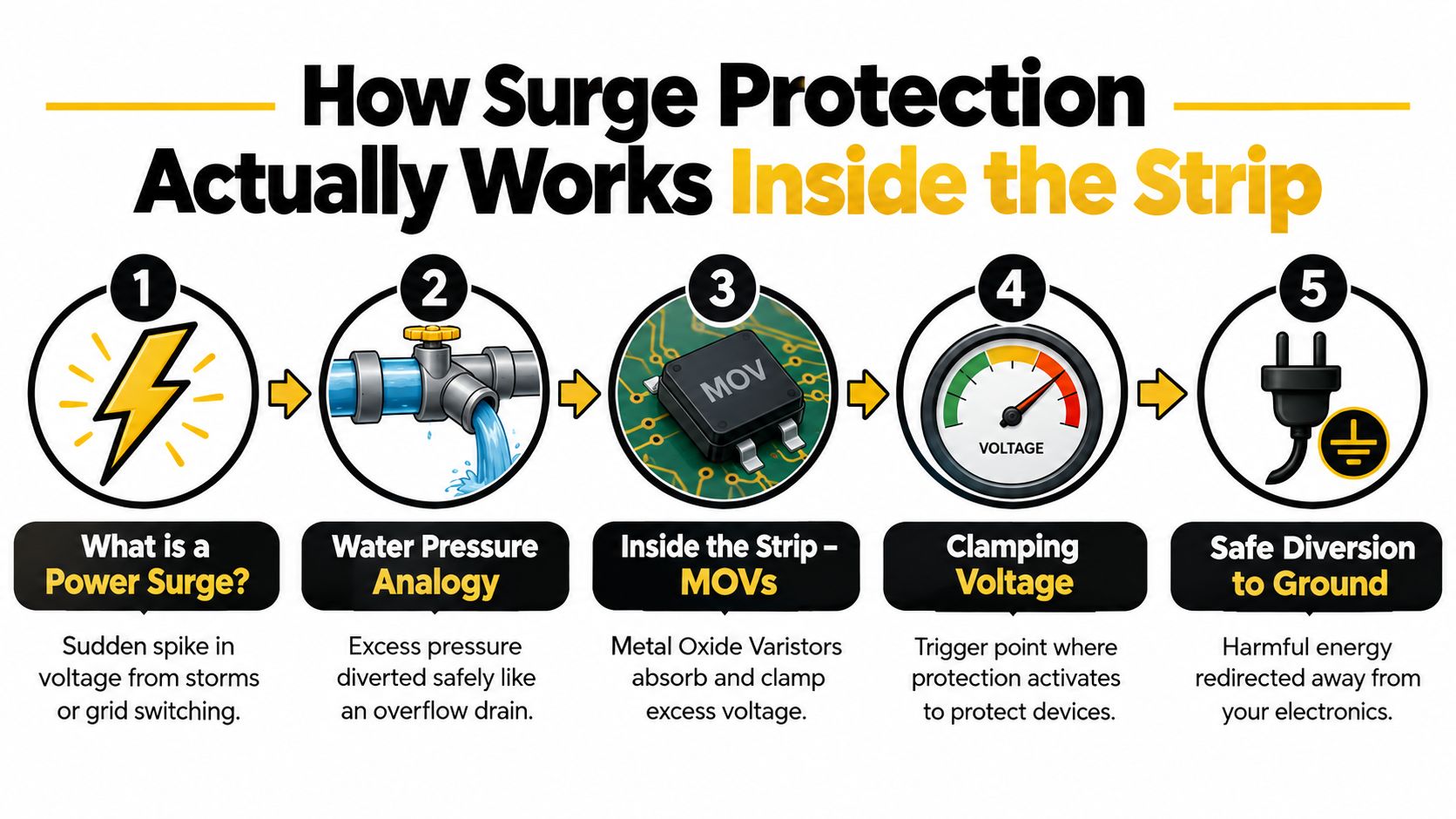
Your home wiring is a bit like pipework that is meant to run at a steady pressure. The everyday flow is fine. The problem is the sudden jump. If that jump reaches delicate electronics, it can stress or damage the tiny components inside them.
A surge protector strip works by giving that spike somewhere else to go. When the voltage rises too high, the strip responds and diverts excess energy away from the equipment and toward earth. The event happens very quickly. In normal use, you do not see it happening.
Inside many surge protector strips is a part called an MOV, short for metal oxide varistor. You do not need the name to choose a good product, but it helps to know its role.
Under normal voltage, the MOV mostly sits in the background. If the voltage jumps above a certain level, it changes behaviour and starts conducting so the spike can be limited. That is what people mean by clamping. The protector sets a ceiling of sorts, then acts once the spike tries to push past it.
Here's a visual if you want to see the concept laid out.
This catches plenty of homeowners off guard. A surge protector does not stay fresh forever.
Each time the strip deals with surge energy, those protective parts take a bit of strain. After enough hits, the board may still supply power while the surge protection has weakened or failed. That is why the protection light matters. It is one of the few clues you get without opening the unit, and you should never open one.
Practical rule: If the strip still turns on but its protection indicator no longer shows healthy protection, treat it as an outlet board, not as a surge protector.
Plug-in strips are used at the appliance end. They are a local layer for the devices plugged into them, not a whole-home solution. In Brisbane, that distinction matters because storm activity can affect more than one room or circuit. If you want protection at the switchboard, or you are unsure whether your home earthing is suitable, that is the point to call a licensed electrician and ask about a switchboard SPD installed to Australian requirements.
For a surge protector strip to do its job, the excess energy needs a proper path. That path relies on correct earthing. If the earthing is poor, the strip may still power your gear, but its ability to divert a surge is reduced.
That is the kitchen-bench version of why one board on the floor is only part of the picture. The strip can help protect the devices connected to it. The quality of the home's earthing and switchboard protection still plays a big part in how well the whole setup works.
A lot of homeowners already own one of these boards and aren't sure which kind it is. The easiest test is not colour, shape or price. It's whether the board is built and labelled to provide surge protection, rather than just extra sockets.
If you only need more outlets for low-risk use, a basic power board may be all you want. If you're plugging in electronics you'd hate to replace or reset, a surge protector power strip is the better fit.
| Feature | Surge Protector Power Strip | Basic Power Board |
|---|---|---|
| Main job | Adds outlets and helps protect connected devices from surges | Adds outlets only |
| Internal protection components | Yes | Not necessarily |
| Best use | TVs, computers, modems, chargers, home office gear | Simple power distribution |
| Product markings | Usually includes surge-related specifications and protection indicators | Often only lists outlet and switch features |
| After a major surge | May need replacement if protection is spent | Offers no surge protection to lose |
| Whole-home protection | No | No |
Not every multi-outlet board is a surge protector. Some are only extension-style outlet boards with a switch.
Walk around your house and check the boards you already use. The spots that matter most are usually the lounge room, study and bedroom charging station. If the board powers devices with circuit boards, data storage or internet hardware, protection matters more.
A good companion read is this explanation of an RCD power board and how it differs from other boards. It helps clear up another common mix-up, because overload, electric shock protection and surge protection are not all the same thing.
A basic board can survive a storm just fine because it never had any surge protection to sacrifice in the first place. A surge protector power strip is different. It may continue to supply power after a rough event, yet the protection element inside may have taken the hit.
That's why relying on appearance alone is risky. If the board has a protection light or status indicator, pay attention to it. If it doesn't, replace older strips sooner rather than assuming they're still doing their job.
A lot of the confusion starts with the box.
You are standing in the shop, two surge protector power strips look similar, and one has bigger numbers printed across the front. Joules. Clamping voltage. kA. They sound like one scorecard, but they describe three different parts of the protection story.
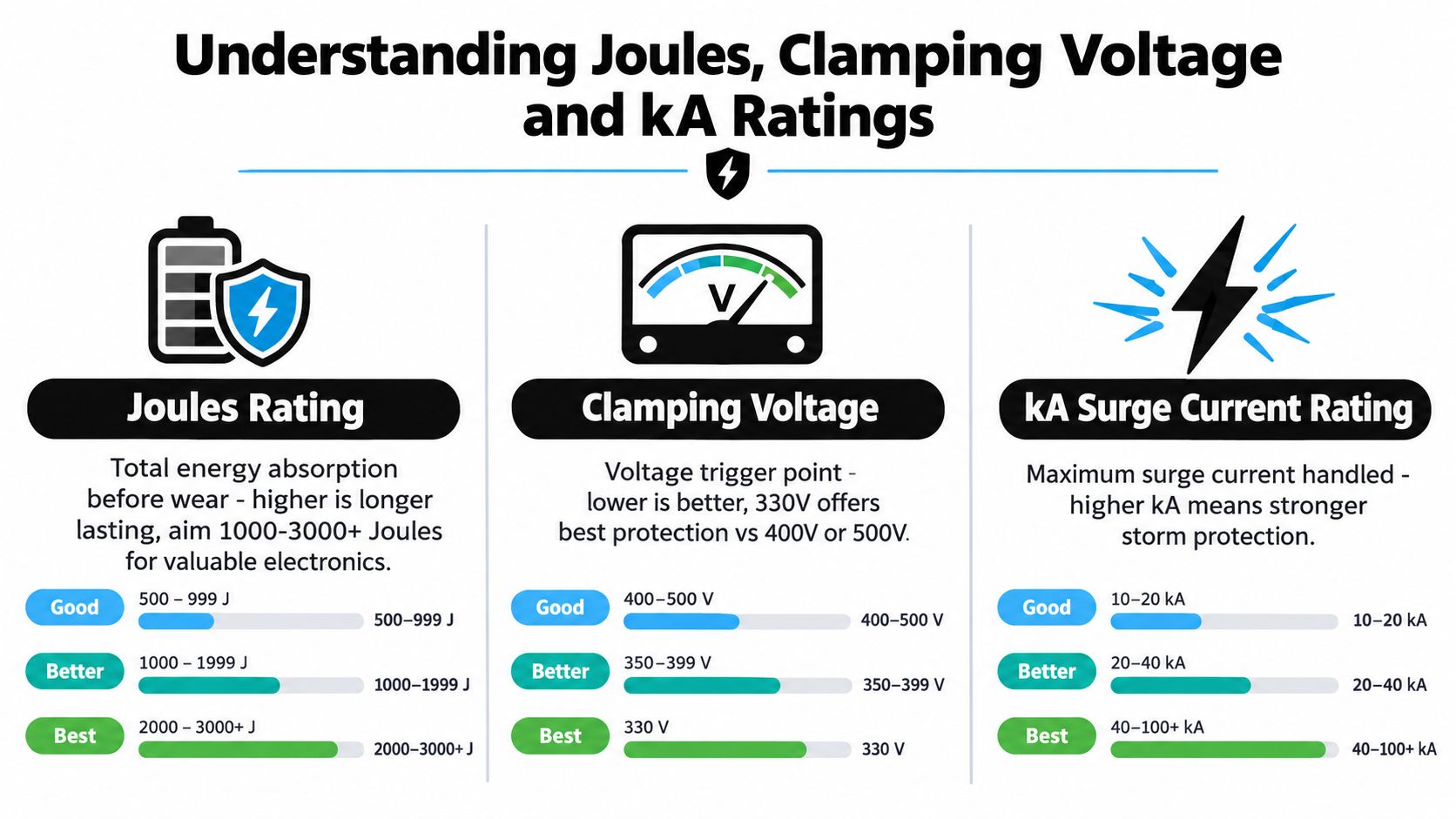
For plug-in surge boards, joules usually describe the protective parts' capacity to absorb surge energy over time. You will often see higher joule figures on larger or better-equipped household models, and lower figures on basic compact boards (Australian retail example and explanation).
A practical way to read it is this. Joules is a bit like the size of a rainwater tank. A bigger tank can handle more water before it is full. A higher joule rating can mean the strip has more reserve before its surge parts wear out from repeated hits.
That does not mean the biggest joule number is automatically the best buy. It only tells one part of the story.
Clamping voltage is the point where the surge protector begins diverting excess voltage away from your connected gear. Lower is generally better, because the protection reacts sooner, but the label is only useful if the product is properly designed and used within its limits.
For a homeowner, the simple takeaway is this. Joules is about how much punishment the strip may take over its life. Clamping voltage is about how early it starts shielding your devices during a surge event.
kA, short for kiloamps, can be misleading on a plug-in product because it sounds like the main measure of quality. In practice, kA becomes far more useful when you look at switchboard-level surge protective devices, where the job is to deal with larger surge currents coming into the home.
That is the layered protection point many Brisbane homeowners miss. A power strip near the TV or computer protects at the last stop. It does not replace a properly selected SPD at the switchboard, especially in homes with more exposure to storms, long supply runs, or overhead feeds. Earlier in this article, we noted that Australian guidance sizes point-of-entry protection to the property's exposure. That is licensed-electrician territory, not something a plug-in strip can do by itself.
Surge protection also depends on the path the surge takes. If that path is long, loose, or poorly arranged, performance drops. Australian industry guidance notes that switchboard SPDs work best with short, straight conductor runs and suitable conductor sizing. In other words, the device rating on paper and the way it is installed have to work together.
Here is the kitchen-bench version:
If you want protection for a work desk or entertainment unit, the strip ratings matter. If you want to protect the home more broadly, especially in Brisbane storm season, speak with a licensed electrician about whether a switchboard SPD is appropriate under Australian standards.
You are standing in the electrical aisle looking at two boards that seem almost the same. One is cheaper. One says "surge protected". The right choice depends less on the label and more on what you want that board to do in your home.
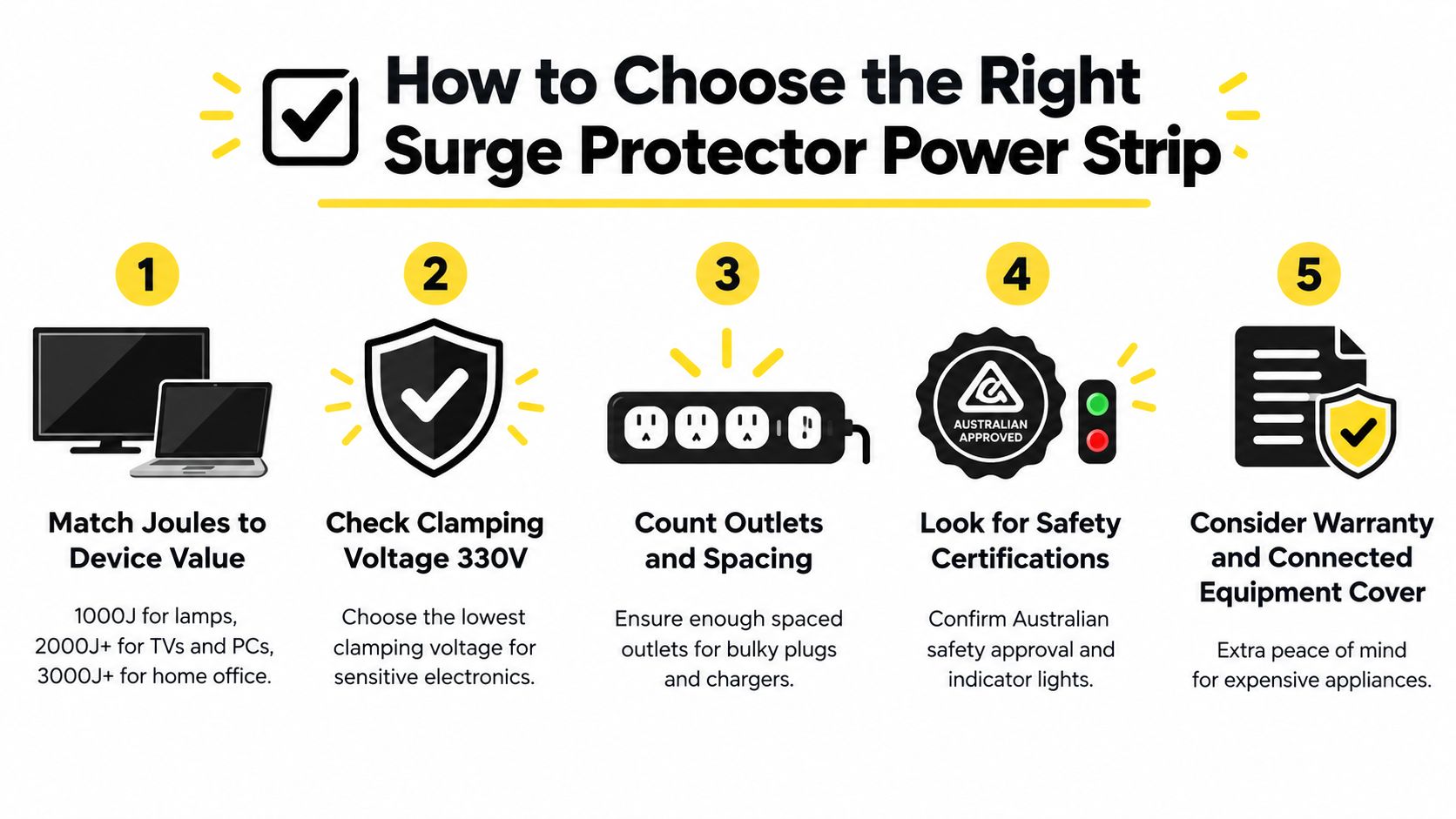
Start with the equipment, not the board.
A phone charger and bedside lamp are low-stakes items. A work desk with two monitors, a laptop dock and NBN modem is different. So is a TV unit with a smart television, soundbar, console and streaming box. The more expensive or interruption-sensitive the setup is, the more careful you should be about the strip you choose.
In a lounge room, outlet spacing often matters more than people expect. Bulky plug packs can block the next socket and push you toward double adaptors or awkward stacking. A better layout saves that headache and keeps the setup safer.
In a home office, the goal is usually continuity. If a small surge or power disturbance drops your modem or reboots your screen setup during work, that is more than annoying. Choose a strip that suits the number of devices you run there, with enough room for larger chargers and a cord length that reaches the wall outlet without being stretched tight.
This part causes confusion, so keep it simple. A surge protector power strip protects devices plugged into that strip. It does not protect the whole house, and it does not do the same job as a surge protective device installed at the switchboard.
A good way to picture it is layers. The strip is the gear beside your couch or under your desk. The switchboard protection, if your home needs it, sits upstream and helps reduce what gets deeper into the installation. As noted earlier, homes with more storm exposure, overhead supply, or longer runs can need that extra layer. That decision belongs with a licensed electrician working to Australian requirements.
Use this checklist in the shop or online:
The wrong question is, "Which strip protects my whole house?" A better question is, "Which strip suits this group of devices, and does my home need another layer at the switchboard?"
That matters in Brisbane. Summer storms can test every weak point in an electrical setup. A plug-in strip is a useful last line for local electronics, but it is only one part of the plan. If you want broader protection for the home, or you know the property has higher exposure, speak with a licensed electrician about whether a switchboard SPD is appropriate under Australian standards.
A surge protector power strip does its job best when the setup around it is simple.
If you plug a good strip into a poor arrangement, protection can drop away for very ordinary reasons. Heat builds up. Plugs loosen. Cables get strained. In Brisbane homes, that often starts with a board tucked behind a TV unit, overloaded in a study nook, or linked to another board because there were not enough outlets nearby.
Plug the surge protector straight into a wall outlet.
Do not stack it into another power board, a double adaptor, or an extension lead unless the manufacturer specifically allows that setup. Each extra connection adds another weak point, a bit like adding more joins into a garden hose and expecting the pressure to stay the same. You may still get power, but the setup is less tidy electrically and less reliable mechanically.
Keep it where you can see it and reach it. A board buried under cushions, behind curtains, or under a rug can trap heat and hide damage until it becomes a bigger problem.
Neat is good. Tight coils are not.
Try to run the lead without sharp bends, stretching, or a big loop of spare cable jammed behind furniture. Fast surges do not behave like normal day-to-day power use, and messy cable paths are not helpful. The homeowner version of the rule is simple. Shorter, straighter, and less tangled is better.
That same idea matters even more at the switchboard level, where installed surge devices need careful wiring practice under Australian requirements. A plug-in strip is only the last part of the path, so it makes sense to avoid creating clutter around it.
You do not need to take anything apart. Just give it a quick look now and then.
Focus on a few plain signs:
A surge strip can keep supplying power even after the protection parts inside have worn out. That catches people out. The board looks normal because the lamps and chargers still turn on, but the safety buffer may already be gone.
A new power strip will not correct a bad wall outlet, missing earthing, a damaged circuit, or problems in the switchboard.
If powerpoint plates feel loose, breakers trip for no clear reason, or you have any doubt about the condition of the wiring, stop there and call a licensed electrician. That is the point where plug-in protection ends and fixed electrical work begins. In Brisbane, especially in storm season, it is worth treating those warning signs seriously rather than assuming the strip will cover everything.
A common Brisbane storm scenario goes like this. The rain starts, lightning rolls through, the TV is on a surge protector power strip, and you assume the whole house is covered. In practice, the strip is only protecting at the last stop, right near the appliance.
A better way to understand it is to picture your home's wiring like a road into the house. If the surge has already travelled through the switchboard and down the circuit, a plug-in strip is trying to deal with the problem late. A switchboard surge protective device works earlier in the path. The strip then supports that protection at the equipment end.
That is why electricians talk about layered protection. One layer at the switchboard helps reduce the surge before it spreads through the home. Another layer at the power strip helps shield the sensitive electronics plugged into it.
This matters more in Brisbane homes with regular storm exposure, overhead supply, expensive electronics, or a home office that needs to stay up and running.
A power strip suits local protection for a few devices, such as a TV, modem, or computer setup. Whole-home protection is a different job. It usually means checking the switchboard and, where appropriate, installing surge protection there under Australian requirements.
If your goal is to protect more than one corner of the house, read DLG's guide to surge protection for home. It explains how plug-in strips and switchboard devices fit into the same plan.
Call a licensed electrician if you want surge protection across the property, not just at one power point. The same applies if your switchboard is older, your area cops frequent storms, or you are protecting hard-wired gear, smart home equipment, security systems, or office equipment.
A homeowner can buy a good surge protector strip. A homeowner should not guess what the switchboard needs.
If you run a home office, there is also a planning lesson here. Protecting hardware is one part of the job. Keeping work, internet access, and connected devices available after an interruption is the bigger picture, which is the idea behind this BC and DR guide for Indiana.
For homes that need switchboard-level surge protection or related upgrades, DLG Electrical provides residential electrical services in Brisbane, including switchboard work that can support a compliant layered protection setup.
If you're not sure whether a surge protector power strip is enough for your home, DLG Electrical can inspect the setup, check the switchboard, and advise whether layered surge protection is the safer option. For Brisbane homeowners who want practical guidance and compliant electrical work, visit DLG Electrical.

Master Electrician with over 30 years of experience. Founded DLG Electrical in 2005 after international project work including electrical installations at Stamford Bridge Stadium, London(Home of Chelsea FC).

Local Electricians that can fix all Electric Hot water Systems.
Motion sensor lights are a versatile addition to any home, offering nu
