83 Jean St, Grange QLD 4051
Mon-Fri 07:30 AM - 04:00 PM - Sat - 8:00 - 12 - Sunday Closed
Ever wondered what a typical power bill looks like here in Queensland’s capital? Let’s break it down. The average electricity bill Brisbane households can expect is around $1,560 a year. That works out to be about $390 per quarter, or $130 a month.
It’s a handy figure to know, giving you a solid benchmark to see how your own power costs stack up.
To give you a clearer picture, here’s a quick summary of those average household electricity costs in Brisbane.
| Time Period | Average Cost |
|---|---|
| Annually | $1,560 |
| Quarterly | $390 |
| Monthly | $130 |
These numbers provide a great starting point, but they don’t tell the whole story.
Think of that “average bill” as just a guide. It’s a bit like quoting an average shoe size—it’s useful, but it certainly doesn’t fit everyone perfectly. The final number on your bill is a unique story, shaped entirely by your household’s specific habits and energy needs.
Recent data shows Brisbane’s average is actually a little below the national figure of $1,668 per year. This is thanks to a mix of factors, like our local climate, the energy providers we choose, and household sizes. But it begs the question: why does your bill look so different to your neighbour’s, even if you live in similar homes?
The answer is always in the details. The key things that really shape your final cost include:
Getting a handle on these variables is the first real step toward taking back control of your power expenses. Once you pinpoint what’s driving your usage, you can start making targeted changes that actually make a difference.
To get a precise picture of what you’re using, it’s worth checking out our guide on how to calculate your electrical energy consumption. This article will walk you through the next steps.
It’s a simple, undeniable rule: the more people living under one roof, the higher the power bill.
Think of your home’s energy use like a shared mobile data plan. One person streaming videos is pretty predictable, but add a few more family members with their own devices, and you’ll burn through your monthly allowance in no time. The exact same logic applies to your electricity bill.
Each person contributes to the daily energy consumption through lighting, charging devices, watching TV, and using hot water. When you multiply these small actions across an entire family, the impact on your quarterly bill becomes crystal clear. A solo dweller’s energy footprint is naturally going to be smaller than that of a bustling family of five.
This isn’t just theory—the numbers back it up. In Queensland, a single-person household pays about $263 per quarter on average.
That figure climbs dramatically for larger families. A household of five or more people is looking at a bill closer to $453 per quarter. It’s a pretty direct link between occupancy and energy costs.
This infographic breaks down how Brisbane’s average monthly electricity bills tend to fluctuate with the seasons.
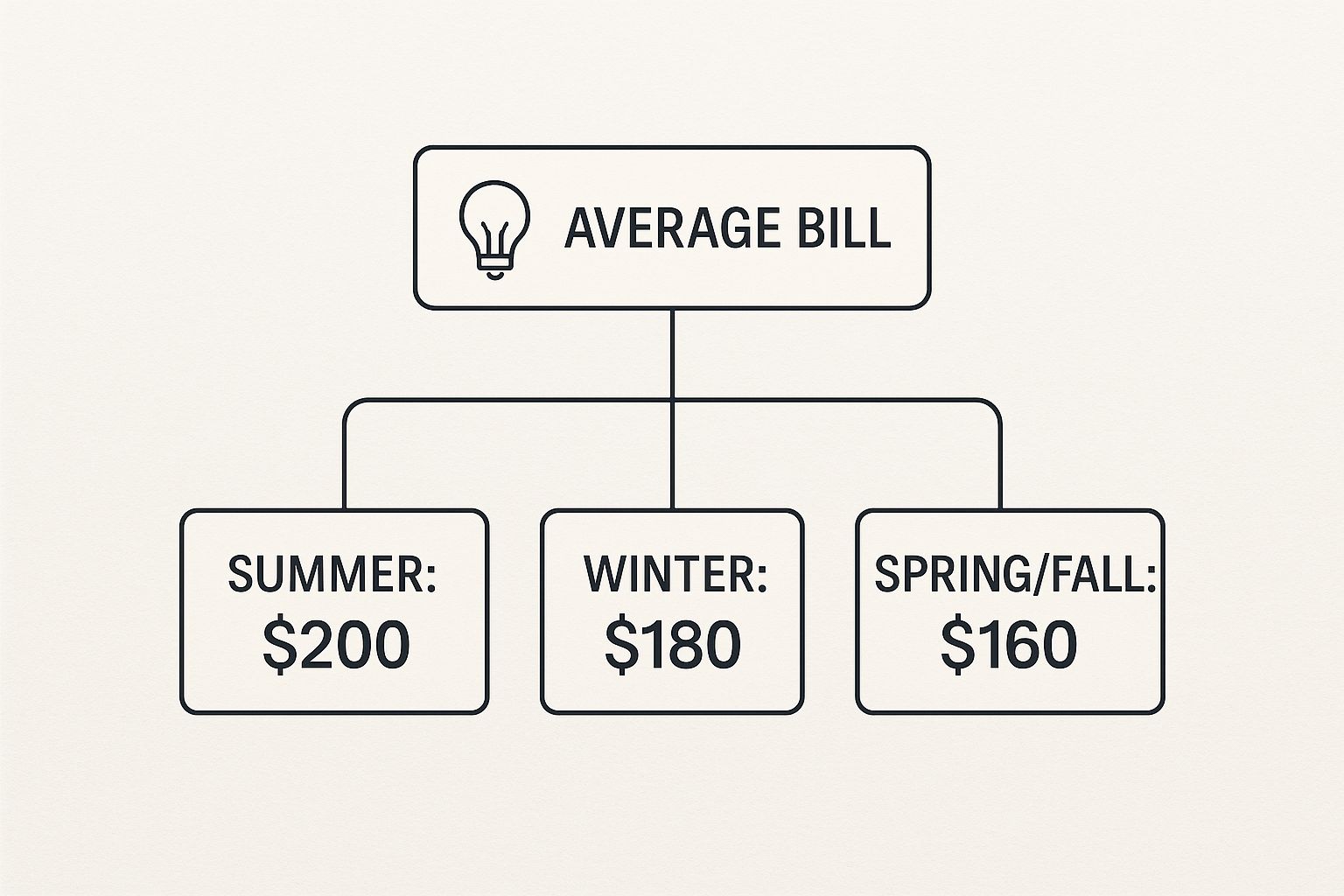
As you can see, bills always seem to peak during our hot, humid summer months, mostly thanks to the air conditioner working overtime. This seasonal spike is often where bigger households feel the financial pinch the most.
The key takeaway here is that your bill isn’t just some random number. It’s a direct reflection of your household’s collective energy habits—from the number of showers taken to the hours the air con is running.
Understanding this connection is the first step toward finding real opportunities for savings. Once you pinpoint where your family’s usage is highest, you can start making targeted changes to bring that average electricity bill in Brisbane back down to a more manageable level.
When you first glance at your electricity bill, that final number can feel a bit like a mystery. It’s easy to assume you’re just paying for the power you’ve used, but the reality is a little more complex.
Think of it like a restaurant receipt. You’re not just paying for the ingredients on your plate; the total also covers the chef’s time, the venue’s rent, and the waitstaff’s service. Your power bill works in a similar way, bundling several different charges into one final figure. While your energy consumption is the main ingredient, a few other key components make up the total cost.
That final figure on your bill is usually a combination of three core elements. Getting your head around these helps to demystify where your money is actually going each quarter.
For anyone living in Brisbane, our humid, subtropical climate adds another hefty layer to the cost. The near-constant reliance on air conditioning during those sweltering summer months is often the single biggest reason for a shockingly high bill. This seasonal spike can push your usage, and your bill, well above the city average.
Sometimes, a high bill has less to do with your habits or the weather and more to do with the electrical system inside your walls. An inefficient home is like trying to fill a leaky bucket—you’re constantly losing energy without even realising it.
A surprisingly high power bill can often be a symptom of deeper electrical issues. Old appliances, poor wiring, or an outdated switchboard can silently drain power, inflating your costs month after month.
These underlying problems don’t just affect the average electricity bill Brisbane families face; they can also be serious safety risks. If your bill seems way too high despite your best efforts to cut back, it might be time for a professional check-up.
Getting to the bottom of these issues can lead to some serious long-term savings. For a deeper look into the common culprits, you can learn more about why your electricity bill is so high in our detailed guide.
Ever get your quarterly power bill and wonder how it stacks up against the rest of the country? It’s a common question. Are we in Brisbane paying more for electricity than someone in Sydney or Melbourne? Putting your costs into a national context is a great way to get a clearer picture of where your money is going.
Understanding these comparisons helps pull back the curtain on the unique factors driving Queensland’s electricity prices, from state regulations to the mix of energy sources we rely on. It shows that while your bill feels personal, it’s also shaped by much larger economic and environmental forces.
So, where does Brisbane actually stand? The good news is, recent analysis shows that Queenslanders are often in a pretty decent position.
The average quarterly electricity bill in Queensland came in at approximately $389.10. That sits comfortably below the national average of about $411.80. If you want to dive deeper, you can explore more demographic insights about Australian energy costs to see the full breakdown.
This difference really highlights just how varied the energy landscape is across Australia. Things like network infrastructure costs, population density, and state-level government policies all play a part in why a household in Victoria might pay a completely different rate than one here in Queensland.
While every individual bill is different, Queensland households on average pay less for their power than the typical Australian household. This advantage is largely thanks to our state’s unique energy generation mix and regulatory environment.
To make this comparison even clearer, let’s look at the numbers side-by-side.
Here’s a quick look at how typical quarterly electricity costs in Queensland compare against other key Australian states.
| State/Territory | Average Quarterly Bill |
|---|---|
| Queensland | $389.10 |
| New South Wales | $416.70 |
| Victoria | $354.20 |
| South Australia | $501.00 |
| Western Australia | $352.80 |
As the table shows, while our bills aren’t the absolute lowest in the country, they are significantly more affordable than in places like South Australia and New South Wales. This data helps put things in perspective—while local factors like cranking up the air conditioning are key drivers of your bill, it’s also part of a much bigger national story.
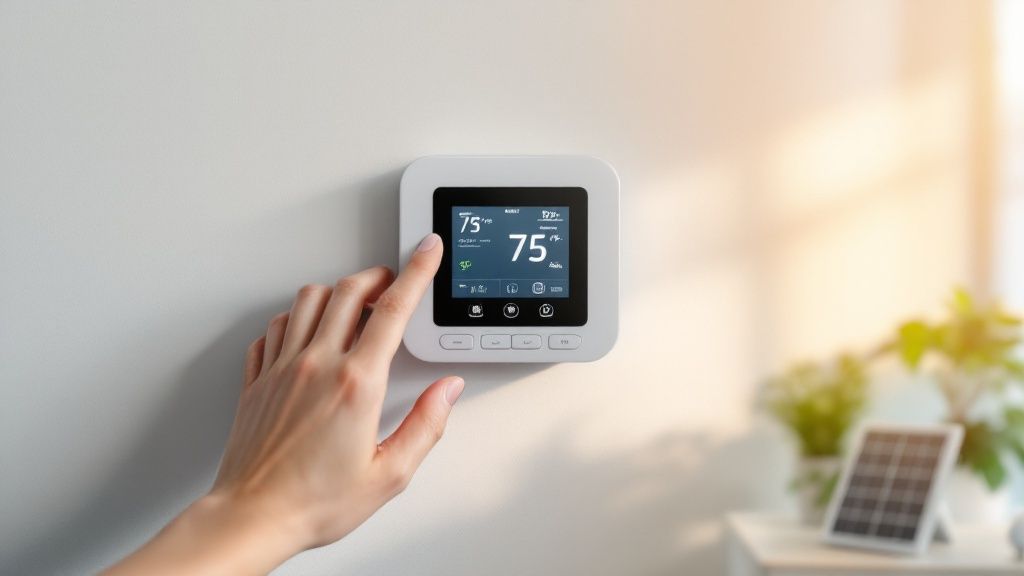
Knowing what drives up your bill is one thing, but actually doing something about it is where you’ll see real savings. The good news is that lowering your power bill doesn’t have to mean big sacrifices. It’s usually about making smarter, more conscious choices day-to-day.
The path to a lower average electricity bill Brisbane families can actually achieve starts with a mix of simple habits, clever upgrades, and a few strategic investments. We can break these down into a couple of key areas, starting with the changes that won’t cost you a cent.
Some of the easiest wins are the ones that are completely free. It all comes down to tweaking your daily routines to cut out wasted energy, which really adds up over the course of a year.
When you’re ready to invest a little bit of money, certain upgrades deliver fantastic long-term value by permanently reducing how much energy your home needs to run.
For instance, installing effective solar window screens can block a significant amount of heat from entering your home in the first place. That means your air conditioner doesn’t have to work nearly as hard. Another no-brainer is switching over to LED lighting, which uses about 75% less energy than old-school incandescent bulbs and lasts a whole lot longer.
Investing in energy efficiency is one of the most reliable ways to secure long-term savings. Upgrades like modernising your switchboard or installing energy-efficient lighting aren’t just expenses—they are investments in a lower power bill for years to come.
To wrap things up, we’ve pulled together some quick answers to the questions we hear most often from Brisbane homeowners trying to get a handle on their power bills.
If you’re consistently seeing bills that are higher than the average, it’s usually a combination of a few key things. Your home might be running older, power-hungry appliances, or perhaps poor insulation is letting all that expensive cool air escape. Sometimes, it’s as simple as having a larger family with more devices running throughout the day.
Don’t underestimate daily habits, either. Cranking the air conditioner, leaving lights on in empty rooms, or having multiple devices on standby all add up surprisingly fast. It’s also a great idea to check if you’re on the best electricity plan for your needs—the default offers from retailers are rarely the cheapest.
Honestly, the savings can be pretty significant. Depending on what plan you’re on now and how much power you use, switching from a standard offer to a more competitive market deal could easily save you hundreds of dollars a year.
The energy market is always shifting, so it pays to jump on a comparison website once a year. A quick check can ensure you’re still getting a great rate and not leaving money on the table.
For a lot of Brisbane locals, installing solar panels is one of the most powerful moves you can make. With our endless sunshine, a well-sized system can slash your electricity bills or even wipe them out entirely, delivering a fantastic return over the long run.
Great question. These terms simply refer to different times of the day when the demand for electricity—and therefore its price—goes up and down.
If your electricity plan has a ‘time-of-use’ tariff, you can make some real savings by running appliances like your dishwasher, washing machine, or pool pump during these off-peak hours.
If you’re ready to get serious about cutting your energy costs with practical, professional solutions—like installing energy-efficient lighting, upgrading your switchboard, or getting your home ready for solar—the team at DLG Electrical is here to help. Get a free quote online and find out how we can make your home safer and more cost-effective.

Master Electrician with over 30 years of experience. Founded DLG Electrical in 2005 after international project work including electrical installations at Stamford Bridge Stadium, London(Home of Chelsea FC).

Local Electricians that can fix all Electric Hot water Systems.
Motion sensor lights are a versatile addition to any home, offering nu
