83 Jean St, Grange QLD 4051
Mon-Fri 07:30 AM - 04:00 PM - Sat - 8:00 - 12 - Sunday Closed

Getting your EV charger installation in Brisbane right starts long before an electrician even shows up. A few simple checks on your end can make the whole process smoother and more cost-effective, preventing any nasty surprises on installation day. Think of it as laying a solid foundation for your home’s new charging setup.
Before you start comparing charger models and calling for quotes, a bit of prep work is essential. This is all about understanding your home’s electrical health, picking a practical spot for the charger, and getting any admin hurdles out of the way. Sorting these details first means the professional installation will be faster and, often, cheaper.
The EV charging market in Australia is absolutely booming. Projections show it growing from USD 250.5 million in 2024 to an estimated USD 1,643.1 million by 2033. This surge is driven by government incentives and new policies pushing for EV-ready buildings, which will likely be standard practice in Brisbane by 2025. It just goes to show how important it is to get your home ready now to join the wave of new residential installations.
The heart of your home’s electrical network is the switchboard. An older switchboard, especially one with those old-school ceramic fuses, probably won’t have the capacity or the necessary safety switches (RCDs) for a modern EV charger.
Have a quick look at your board. If you see ceramic fuses instead of modern circuit breakers, that’s a big red flag that an upgrade is likely on the cards.
A Level 2 EV charger needs its own dedicated circuit, which means your switchboard must have a spare slot. If it’s already full, we’ll need to look at an upgrade or adding a sub-board. Knowing this upfront helps you budget properly and gives your electrician a clear picture from the get-go. For a deeper dive, check out our guide on professional switchboard upgrades in Brisbane.
Figuring out where to put your charger is more than just picking a random spot on the garage wall. The ideal location is a balance of convenience, safety, and practicality.
Keep these factors in mind when choosing a location:
Expert Tip: Don’t forget to future-proof. If you think you might get a second EV down the track, consider a location that could easily accommodate another charger or a dual-port unit without needing major rework.
If you live in an apartment, townhouse, or any property managed by a body corporate, this is a non-negotiable first step. You absolutely cannot proceed with an EV charger installation without their formal approval.
Every body corporate has its own by-laws about modifications to common property, which often includes external walls and the building’s core electrical infrastructure.
Get the conversation started early by submitting a formal request. Your proposal should clearly outline the charger you want to install, where you plan to put it, and the licensed electrician you’ll be using. Providing all this information upfront in a professional way can seriously help streamline the approval process and avoid frustrating delays.
Picking the right EV charger isn’t about finding the “best” one on the market. It’s about finding the perfect fit for your car, your daily drive, and your home’s unique electrical setup. Getting this right from the start has a huge impact on how convenient and affordable your EV ownership experience will be, so it pays to look beyond just the price tag.
For most Brisbane homeowners, the decision almost always lands on a Level 2 charger. Sure, you could technically use a Level 1 charger—the kind that just plugs into a standard wall socket—but its charging speed is painfully slow. At around 10-20 kilometres of range added per hour, it’s only really practical for a rare top-up, not for reliably recharging your car overnight after a day of driving around the city.
At the other end of the scale, you’ve got DC fast chargers. These are the commercial beasts you see at public charging stations, capable of pumping in hundreds of kilometres of range in under an hour. But their massive power needs and eye-watering cost make them completely impractical and unnecessary for a home garage.
That leaves the Level 2 charger as the undisputed sweet spot for home use.
A professionally installed Level 2 charger is the gold standard for charging your EV at home, plain and simple. It runs on a dedicated 240-volt circuit—similar to a big air conditioner or an oven—and will comfortably add between 40 and 60 kilometres of range per hour. That’s more than enough juice to fully charge any EV on the market overnight, so you always wake up with a “full tank.”
This image gives you a snapshot of the crucial groundwork that happens before any tools come out, from checking your property’s capacity to getting the right approvals in place.
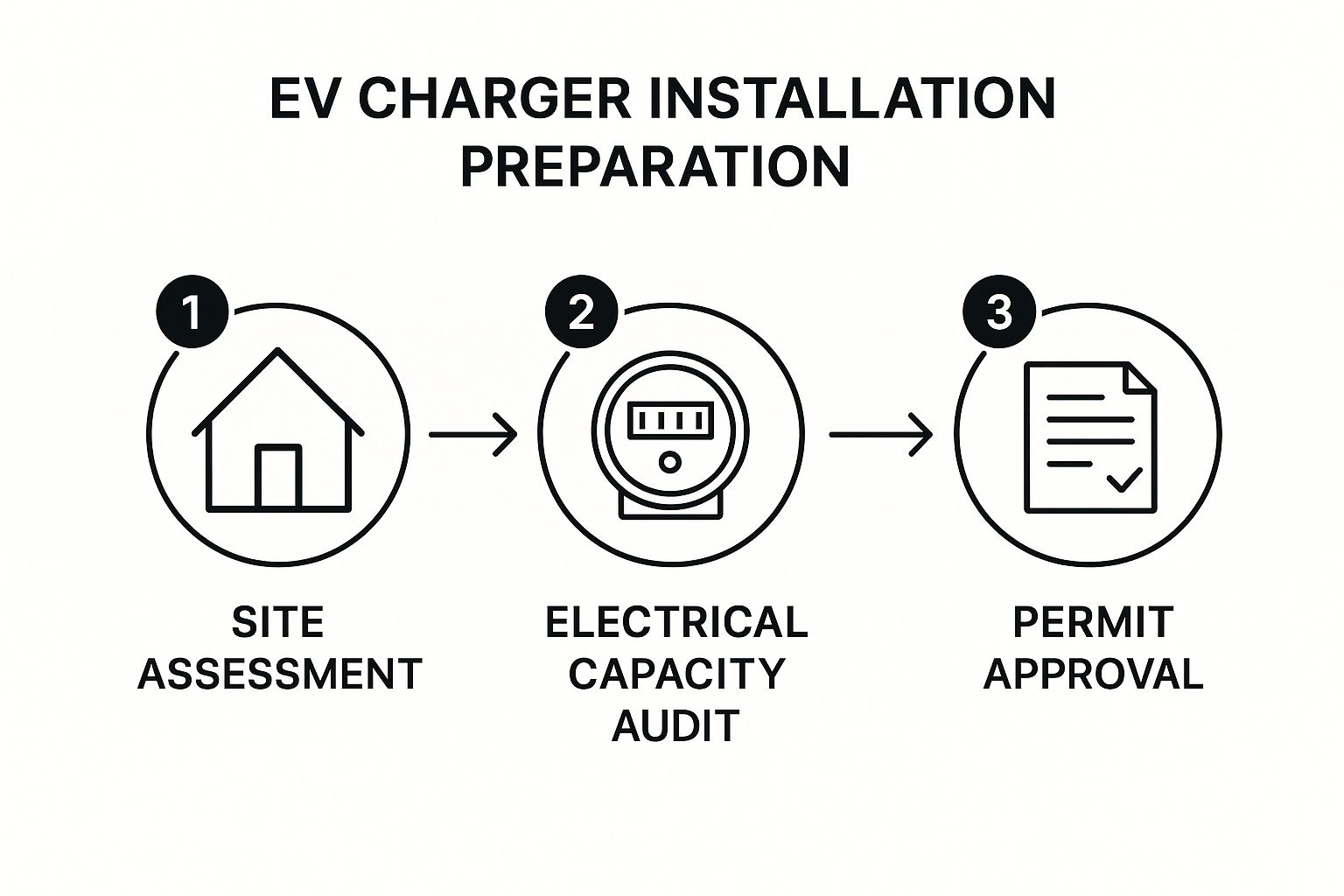
Nailing the initial site assessment, electrical audit, and any permit requirements is key to making sure your chosen charger can be installed safely and without any hitches down the line.
To help you visualise the options, here’s a quick comparison of the charger types available for home installation.
This table breaks down the common charger types to help you decide what’s best for your garage and vehicle.
| Charger Type | Charging Speed (km/hour) | Typical Location | Installation Requirement | Best For |
|---|---|---|---|---|
| Level 1 | 10–20 km/hr | Standard wall outlet | None (plugs directly in) | Emergency top-ups or plug-in hybrids with small batteries |
| Level 2 | 40–60 km/hr | Garage, carport | Dedicated 240V circuit installed by an electrician | Overnight charging for any battery electric vehicle (BEV) |
| DC Fast | 150–350+ km/hr | Public stations | Major 3-phase power upgrade; not for homes | Rapid charging on long-distance road trips |
As you can see, the Level 2 charger offers the perfect balance of speed and affordability for daily home use, making it the go-to choice for Brisbane EV owners.
Once you’ve settled on a Level 2 unit, you’ll need to decide between a charger with a permanently attached (tethered) cable or one with just a socket where you plug in your own (untethered) cable.
For the vast majority of homeowners, a tethered charger is the more practical day-to-day choice. The plug-and-play simplicity easily beats the minor aesthetic benefit of an untethered unit.
Modern EV chargers are far more than just glorified power points. They’re intelligent devices that can talk to your home’s energy system, unlocking features that can seriously cut down your running costs.
One of the most powerful features is scheduled charging. This lets you program the charger to only run during off-peak electricity hours, usually late at night when the tariffs are at their lowest. Instead of paying 30 cents per kWh during peak times, you could be paying just 10-15 cents per kWh on a time-of-use plan. That alone can slash your “fuel” costs in half.
For Brisbane homes with rooftop solar, the real game-changer is solar integration (sometimes called solar diversion). A solar-aware smart charger monitors your solar panel output in real-time. It then automatically adjusts the charging speed to soak up only the excess solar power that you’re not using in the house.
This means you can charge your car with 100% free, clean energy from the sun. It’s one of the most effective ways an EV charger installation can drive down your household bills.
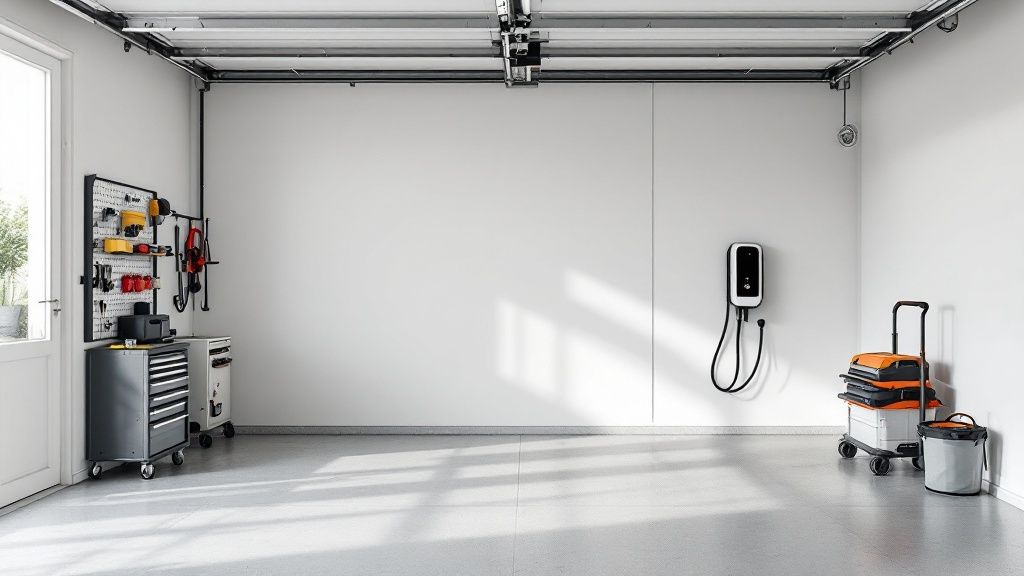
Getting your EV charger installed involves more than just picking a spot and calling the first electrician you find. An EV charger installation in Brisbane is a serious bit of electrical work. It needs to be safe, legal, and compliant with both national standards and local network rules.
Getting this part right isn’t just about ticking boxes; it’s a critical safety net. This kind of work absolutely must be done by a licensed professional who understands the specific demands of EV charging and the local Brisbane requirements. It’s all about protecting your home, your new car, and your peace of mind.
Here in Queensland, all electrical work is governed by the AS/NZS 3000 wiring rules—often called the “electrician’s bible.” While this is the foundation for any installation, EV chargers have extra layers of regulation to make sure they operate safely and don’t put a strain on the local power grid.
Your electrician is responsible for handling all the compliance paperwork. A key part of this involves lodging an Electrical Work Request (EWR) with Energex, Brisbane’s electricity distributor. This form officially notifies the network that a significant new electrical load is being added to your property.
This step is mandatory. It’s what protects the stability of the grid for you and your neighbours. Any installer who suggests skipping this is not only breaking the rules but putting you and your property at risk.
Once the installation is finished, your electrician must provide you with a Certificate of Compliance (COC). This is your official proof that the job was done to standard, is electrically safe, and has been registered correctly. Keep this document somewhere safe—you’ll need it for any warranty claims or insurance purposes down the track.
Here’s a crucial tip: not all licensed electricians are experienced with EV chargers. This is a specialised field that requires specific knowledge of different charger brands, smart charging features, and how to integrate everything with solar if you have it. Finding the right professional is easily the most important step in this whole process.
Start by looking for electricians who specifically advertise EV charger installation in Brisbane. This tells you they’ve already invested in the training and tools needed for this type of work. A general sparky might be able to get it done, but a specialist will understand the nuances that lead to a better, more optimised setup. You can learn more about the importance of adhering to regulations by reviewing the guidelines on compliance with Australian Standards AS/NZS 3000.
When you start contacting potential installers, treat it like an interview. You’re entrusting them with a major piece of tech and the safety of your home’s electrical system, so don’t be afraid to ask detailed questions. A confident, experienced installer will have no problem giving you clear answers.
To make sure you’re hiring a genuine professional, have a list of questions ready to go. How they answer will tell you everything you need to know about their experience and whether they’re the right fit for your project.
Here are a few essential questions to get you started:
Choosing your installer carefully is the final piece of the puzzle. A qualified, experienced professional will ensure your EV charger installation in Brisbane is not only compliant but also perfectly suited to your needs, setting you up for a seamless and cost-effective charging experience for years to come.
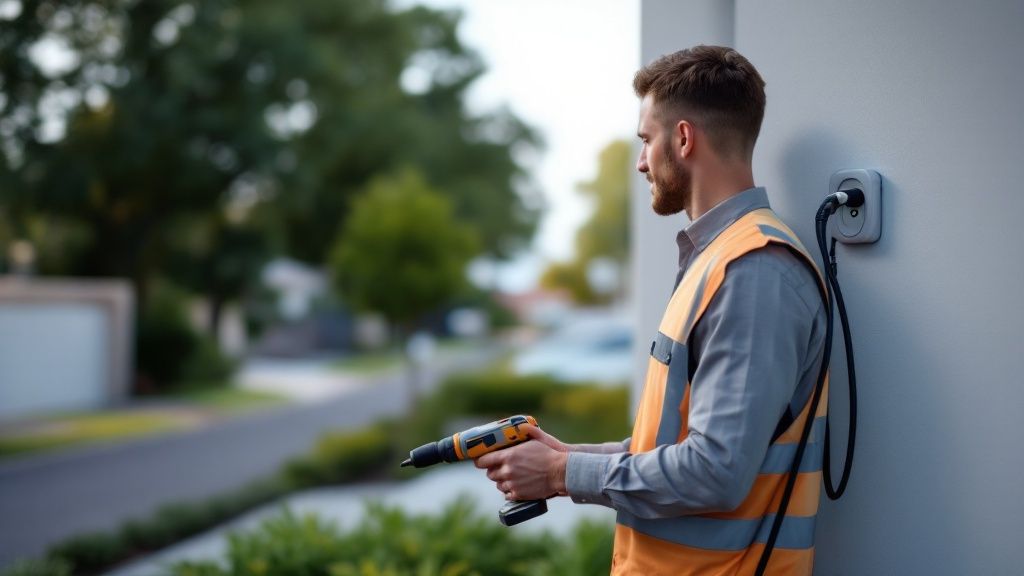
The day your new EV charger gets installed is always an exciting one. But knowing what the process actually involves helps set the right expectations. A professional EV charger installation in Brisbane isn’t just about screwing a box to the wall; it’s a methodical electrical job handled by a licensed expert to ensure it’s efficient, safe, and causes as little disruption as possible.
When your electrician arrives, they won’t just get the tools out and start drilling. The very first step is a final walk-through with you. This is their chance to confirm the exact location for the charger, trace the planned cable path one last time, and answer any final questions you have before the work begins.
With the plan confirmed, the real work starts. The first thing your electrician will do is head to your switchboard and isolate the power to the relevant circuits. This is a non-negotiable safety step that makes the work area electrically safe.
The main tasks of the installation include:
A standard installation in a garage with a nearby switchboard is often done and dusted in just a few hours. However, more complex jobs can take a full day, so it’s always a good idea to keep your schedule flexible.
Not every Brisbane home is a straightforward job. Older homes or unique property layouts can present challenges that require a bit more planning and work. This is where an experienced installer really proves their worth.
For example, if your switchboard is an older model, it might not have enough physical space or the electrical capacity for a new circuit. In this case, a switchboard upgrade might be necessary. While it adds time and cost, it’s a vital update for the safety of your entire home’s electrical system.
The cable run itself can also be a hurdle. A simple run across a garage ceiling is one thing, but getting a cable from a switchboard on one side of the house to a carport on the other might mean navigating tricky wall cavities or neatly running conduit along external brickwork.
If your charger is going into a detached garage or on an outdoor post, the job could even involve digging a shallow trench for armoured underground cable. This is more labour-intensive work, but it will always be clearly discussed and detailed in your initial quote. Understanding the precision required for these tasks can be appreciated by looking at guides for other professional setups, like this detailed installation process for automated systems.
Once all the physical work is done, the job still isn’t finished. The final phase—testing and commissioning—is arguably the most important. Your electrician will restore the power and carry out a series of crucial tests to make sure everything is working perfectly and is 100% safe.
This involves:
The very last step is the personal handover. Your electrician will walk you through using your new charger, explain its smart features and any app connectivity, and show you what to do if the circuit breaker ever trips. They’ll also provide you with the Certificate of Compliance for your records. This official document is your proof that the work was completed by a licensed professional and meets all Australian Standards.
So, your new EV charger is securely on the wall, the electrician’s van is gone, and your car is plugged in for its first home charge. While the physical work is done, this is where the real journey to cost-effective EV ownership begins. By digging into the smart features of your new hardware, you can turn it from a simple power outlet into an intelligent part of your home’s energy ecosystem.
This is where you start seeing a genuine return on your investment. It’s about moving beyond the convenience of charging at home and starting to actively slash your household running costs. For instance, one of the easiest yet most powerful things you can do is program your charger.
Most smart chargers come with a companion app that lets you dictate when your car charges. This is an incredibly powerful tool for saving money, especially if your Brisbane energy provider has you on a time-of-use tariff.
Think about it. Instead of plugging in at 6 PM when you get home—right in the middle of peak electricity rates—you can tell your charger to wait until after midnight to get started. During these off-peak hours, the cost per kilowatt-hour can be less than half the peak rate.
This one simple tweak requires zero effort after the initial setup but can easily cut your car’s “fuel” costs by 50% or more.
By lining up your charging sessions with the cheapest electricity rates, you ensure every kilometre you drive is powered by the most affordable energy available. It’s the absolute low-hanging fruit of EV ownership.
For Brisbane homeowners with solar panels, your EV charger is the perfect partner for your system. Modern smart chargers have a feature often called ‘solar diversion’ or ‘eco-mode,’ which is specifically designed to funnel the free, clean energy from your panels straight into your car.
When this mode is active, the charger intelligently monitors your home’s energy usage and your solar system’s output. It will only send excess solar power—the energy that would otherwise be exported to the grid for a tiny feed-in tariff—directly to your car’s battery.
This integration effectively transforms your EV into a mobile solar battery, storing the sun’s energy for you to use on the road.
Knowledge is power, especially when it comes to energy costs. The app linked to your charger is a goldmine of data on your charging habits. It shows you exactly how much electricity you’ve used and, in many cases, what it actually cost you.
Monitoring this data helps you see the direct impact of your smart charging strategies. You can see how much you saved by shifting to off-peak charging or how many free kilometres you clocked up thanks to your solar panels. For a deeper dive into your home’s overall power use, check out our guide on how to calculate electrical energy consumption.
To take it a step further, you can explore how your charger fits into the bigger picture of seamless smart home integration to really leverage its full potential.
It’s also worth noting the impressive growth in public charging. As of June 2022, Australia had over 2,100 public charging stations, a 56% increase from 2020. Here in Queensland, we had 368 of those stations, showing a solid commitment to supporting EV drivers across the state.
Finally, keeping your charger in top condition is simple. A quick visual check every few months is usually all it takes. Look over the cable for any signs of wear and tear, make sure the plug is clean, and give the unit a wipe-down. These small habits will ensure your charger operates safely and efficiently for years.
Even after you’ve done the research, it’s completely normal to have a few questions rattling around about what an EV charger installation in Brisbane actually involves day-to-day. We get asked the same things by homeowners all over the city, so let’s tackle the most common ones right now.
Getting these final details ironed out will help you move forward knowing exactly what to expect. Most questions boil down to the cost and the rules, which makes sense—you need to know what to budget for and how to make sure everything is above board.
This is usually the first question on everyone’s mind, and the honest answer is: it really depends. For a straightforward job—say, putting a charger in your garage right near a modern switchboard—you’re typically looking at a cost between $800 and $1,500 for the labour and basic materials. This gets you a new dedicated circuit and all the required safety gear.
But things can get more complex. If your switchboard is an older model and needs a full upgrade to cope with the extra load, the price will naturally go up. The same goes for tricky cable runs, like needing to cross a long property or dig a trench for an underground cable. In those cases, the total cost could push past $2,500.
The most important thing is to get a detailed, itemised quote from your electrician before they pick up a single tool. That way, there are no nasty surprises.
Our Promise: We believe in being completely upfront. Our quotes break down every single cost, from the charger itself to the last metre of cable, so you know exactly where your money is going.
Yes, you do—but don’t worry, this isn’t a job for you. Your licensed electrician is legally required to handle all the paperwork. They’ll submit what’s known as an ‘Electrical Work Request’ (EWR) to Energex on your behalf.
This isn’t just red tape. It’s a crucial step that lets Energex know about the new load on their network, ensuring the local grid can handle it safely. It also keeps your installation fully compliant with their rules. This paperwork should always be a standard, included part of any professional installation service.
Absolutely not. In Australia, installing a home EV charger is considered fixed electrical wiring, and it’s illegal for anyone but a licensed electrician to do this kind of work. It’s just not worth the risk.
Trying to DIY an installation is incredibly dangerous and has some serious consequences:
This is one job that must be left to the professionals. No exceptions.
Yes, it does, and it’s a brilliant setup for any Brisbane home with solar already on the roof. Modern smart chargers are built to work hand-in-hand with home solar systems, unlocking a feature often called ‘solar diversion’ or ‘eco-mode’.
When you switch this mode on, the charger cleverly monitors how much power your panels are generating. It then directs only the excess solar power—the energy you aren’t using in the house—straight into your car’s battery.
This means you’re essentially fuelling your car with 100% free, clean energy from the sun. It’s one of the best ways to get the most out of your solar investment and dramatically cut your household running costs.
Ready to take the next step towards convenient, cost-effective home charging? The team at DLG Electrical is here to help. Contact us today for a free, no-obligation quote on your EV charger installation.

Master Electrician with over 30 years of experience. Founded DLG Electrical in 2005 after international project work including electrical installations at Stamford Bridge Stadium, London(Home of Chelsea FC).

Local Electricians that can fix all Electric Hot water Systems.
Motion sensor lights are a versatile addition to any home, offering nu
