83 Jean St, Grange QLD 4051
Mon-Fri 07:30 AM - 04:00 PM - Sat - 8:00 - 12 - Sunday Closed
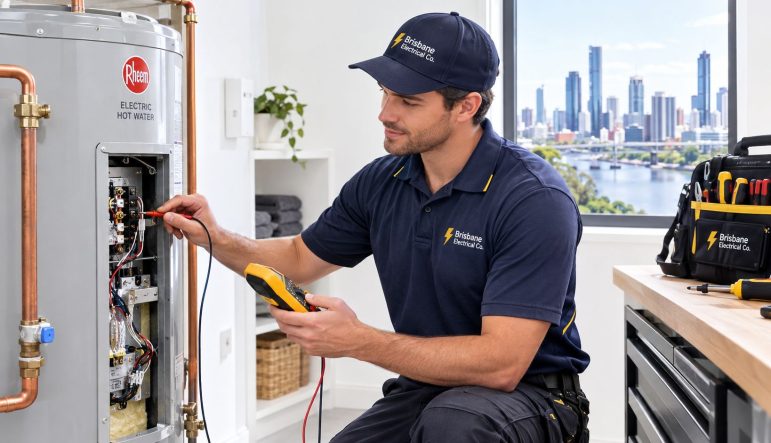
You've probably landed here because the shower went cold at the worst possible time. School run in twenty minutes, work straight after, and someone in the house has already announced that “the hot water's dead”.
That moment feels like a plumbing problem. Sometimes it is. But in Brisbane homes, a hot water fault is often an electrical fault first, or a compliance issue hiding behind what looks like a simple heater problem.
That matters because water heating is one of the bigger energy loads in Australian homes. It accounts for about 24% of residential energy use and 18% of residential electricity use, and household hot water can contribute up to 25% of the average home's greenhouse gas emissions, according to the ARENA domestic hot water and flexibility report. If your system isn't working properly, it's not just inconvenient. It can waste electricity, push bills up, and leave the house outside safe temperature settings.
A search for hot water system repairs near me usually means you need answers quickly. Is it urgent. Is it electrical. Is the unit worth repairing. If it has to be replaced, will the job trigger extra compliance work.
A common Brisbane call goes like this. “We had hot water last night. This morning there's none. The switchboard looks fine, but the water's cold.” Another version is, “The water is hot for two minutes, then lukewarm,” or “Every time we turn the system on, something trips.”
Those details matter more than is commonly realised.
If there's a burning smell, exposed wiring, sparking, or a switch that won't stay on, stop there. Don't keep resetting it and hoping for the best. Electricity and water are a bad combination when something has failed.
If there's water pooling near the unit, treat that seriously too. A leak can damage surrounding areas, and water can reach electrical parts or nearby circuits.
A calm first response usually looks like this:
Practical rule: If the fault involves heat, water, and a tripping electrical circuit, treat it as an electrical diagnosis until proven otherwise.
At the kitchen bench, the questions are usually simple and sensible.
Those are the right questions. If you want a plain-English primer before booking anyone, DLG Electrical's hot water system troubleshooting guide is a useful starting point for understanding the usual failure points.
Hot water systems sit in an awkward middle ground. They involve electricity, stored heated water, plumbing connections, temperature control, and safety devices. So homeowners often get bounced between trades when what they really need is someone to sort the fault path properly.
That's why it helps to understand the system like you'd understand a kettle. Once you see the basic parts and what each one does, the fault starts to make a lot more sense.
Think of an electric storage hot water system as a big insulated kettle connected to your house.
Power feeds a heating element inside the tank. A thermostat tells that element when to heat and when to stop. The tank stores hot water until you use it. When you open a tap, hot water leaves the tank and cold water enters to replace it.
That's the basic loop.
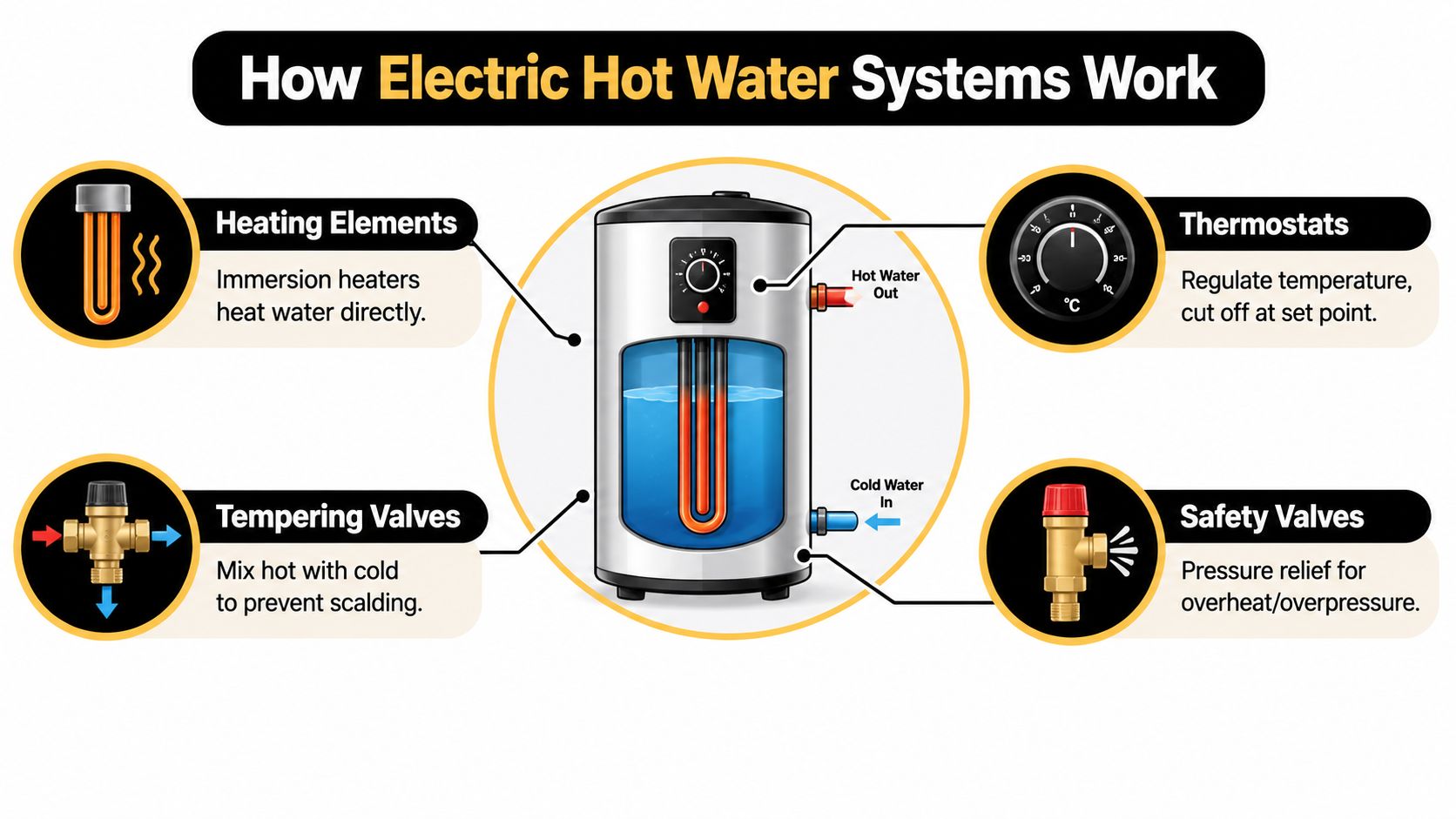
In most Brisbane homes with electric hot water, these are the parts that matter most:
In Queensland, the compliance line is clear. Stored hot water must reach 60°C to suppress Legionella growth, and a temperature control device must limit delivery to personal-hygiene fixtures to a maximum of 50°C for new and replacement systems, as set out in the Queensland hot water system guidance.
That's where people often get confused. They'll say, “Why can't we just turn it down so it's safer?” Because safe storage and safe delivery are not the same thing.
The tank needs to store water hot enough for hygiene control. The taps used for washing and showering need water tempered down for scald prevention. It's a bit like boiling water in a kettle, then adding cold before handing a cup to a child.
Hot enough in the tank. Not too hot at the tap. Both matter.
Queensland homes use a mix of electric, solar-assisted, and gas hot water systems. The Australian Bureau of Statistics records Brisbane and the rest of Queensland separately in its household hot-water-system data, and Queensland survey material includes examples such as solar hot water with electric boosting, instantaneous electric units, and gas systems as major categories in the state mix, as noted in the ABS hot water systems chapter.
That variety is why “just call a plumber” isn't always the best first move. If the issue sits in the element, thermostat, off-peak supply, safety switch, or switchboard, an electrician is often the trade that finds the cause fastest.
Most homeowners don't ring up and say, “I think the thermostat has failed.” They say, “The water's gone cold,” or “The breaker keeps tripping,” or “The shower starts hot and then drops away.”
That's the right way to describe it. Symptoms tell the story.
Here's a quick guide you can use when you're trying to explain the problem on the phone.
| Symptom You Notice | Probable Cause | Likely Trade Needed |
|---|---|---|
| No hot water at all | Failed element, failed thermostat, off-peak supply issue, tripped breaker, faulty isolation switch | Electrician |
| Lukewarm water | Partially failed element, thermostat drift, tempering issue, high demand exceeding recovery | Electrician, sometimes plumber |
| Water too hot | Thermostat fault or temperature control issue | Electrician and compliance check |
| Breaker or safety switch trips | Element fault, damaged wiring, moisture ingress, switchboard protection issue | Electrician urgently |
| Water around the unit | Tank leak, valve leak, fitting issue | Plumber, plus electrician if near live components |
| Strange popping or rumbling noises | Sediment or internal heating stress | Plumber or technician, depends on system type |
| Discoloured hot water | Tank deterioration or internal corrosion | Plumber or replacement assessment |
| Good pressure but poor heat consistency | Thermostat, boosting issue, timer or tariff-related electrical supply issue | Electrician |
If there's no hot water anywhere, that usually points to a supply or heating problem, not a tap problem. On an electric storage unit, the usual suspects are the heating element, thermostat, breaker, isolation switch, or tariff supply arrangement.
Many people get caught here. They assume the whole tank is finished when the fault is one failed electrical part.
The same goes for systems on controlled load or off-peak arrangements. If the supply timing or control gear isn't doing what it should, the tank may be perfectly healthy but never get the chance to heat properly.
Lukewarm water confuses people because it sounds like “the system still sort of works”. Sometimes that's true. A weak element or drifting thermostat can produce some heat without producing enough.
If the water is too hot, that's not a nice bonus. It's a fault and a safety issue. A thermostat that isn't controlling correctly, or a temperature control device that isn't doing its job, needs proper checking.
A hot water system doesn't need to fail completely to become unsafe.
Tripping breakers, a hot smell near the unit, or a safety switch that won't reset should move electrical diagnosis to the top of the list. The Jentech Electrical hot water systems page highlights an important point many homeowners miss. On electric storage systems, “no hot water” may be caused by the switchboard, circuit breaker, safety switch, thermostat, or off-peak tariff issue rather than the tank itself.
That's why replacing the whole unit too early can be an expensive mistake.
Not every hot water fault needs an urgent callout. Some do.
The trick is to separate inconvenient from unsafe. A cold shower is miserable. A live electrical fault near water is a different category altogether.
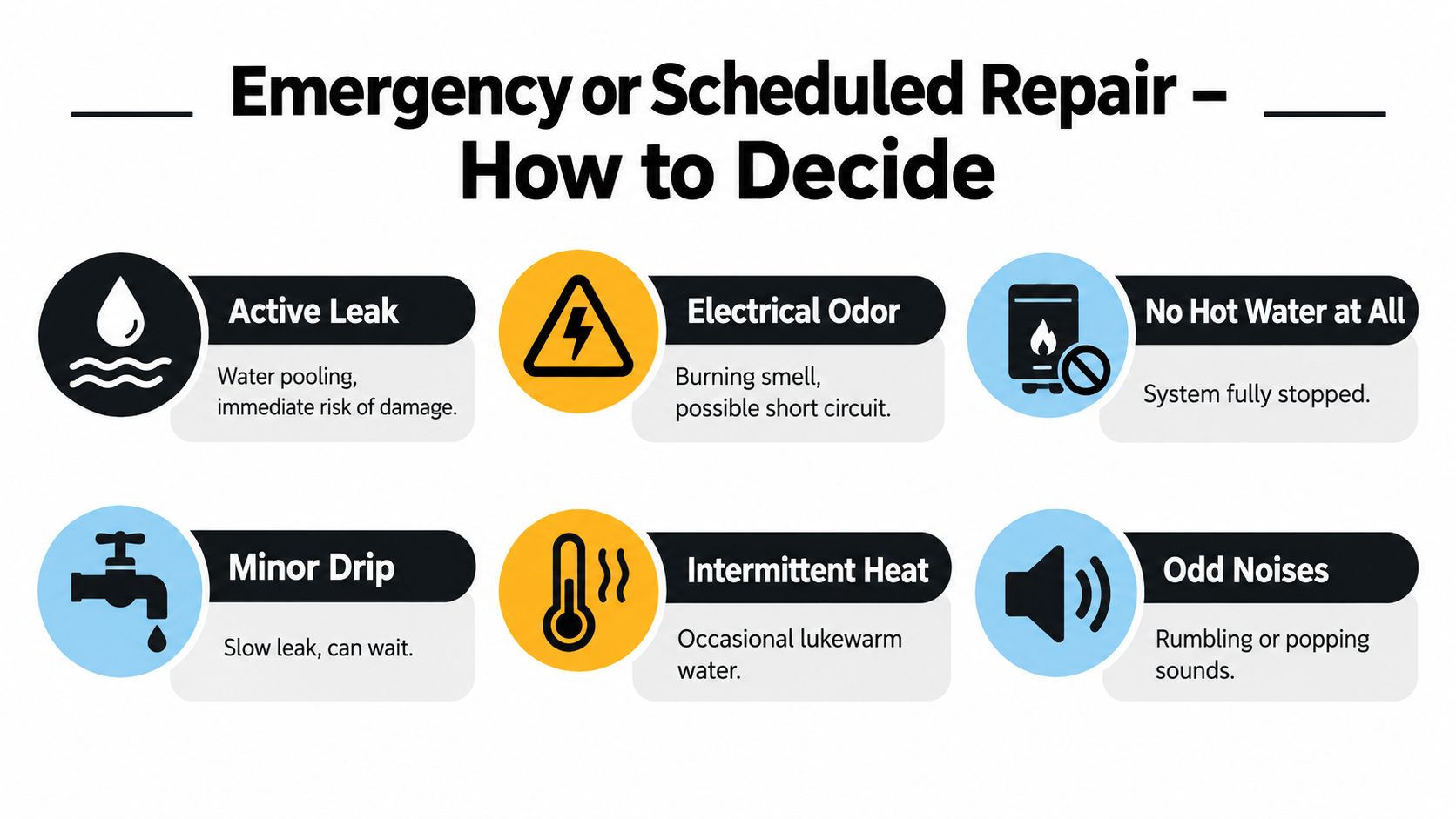
These situations usually justify same-day or urgent attention:
Some faults are serious but not after-hours serious.
Keep it simple.
If you need to choose fast, ask one question: “Is this only uncomfortable, or could it damage the home or hurt someone?” That answer usually tells you whether to call now or book in.
For many Brisbane households, planning matters too. A business-hours electrician may be the right first call if the issue is stable and the likely fault sits in the circuit, controls, or supply rather than the tank shell itself.
A good repair visit shouldn't feel mysterious. You should know what the technician is checking, why they're checking it, and what might expand the job beyond “swap one part and go”.
That's especially true with hot water because one symptom can point to several different causes.
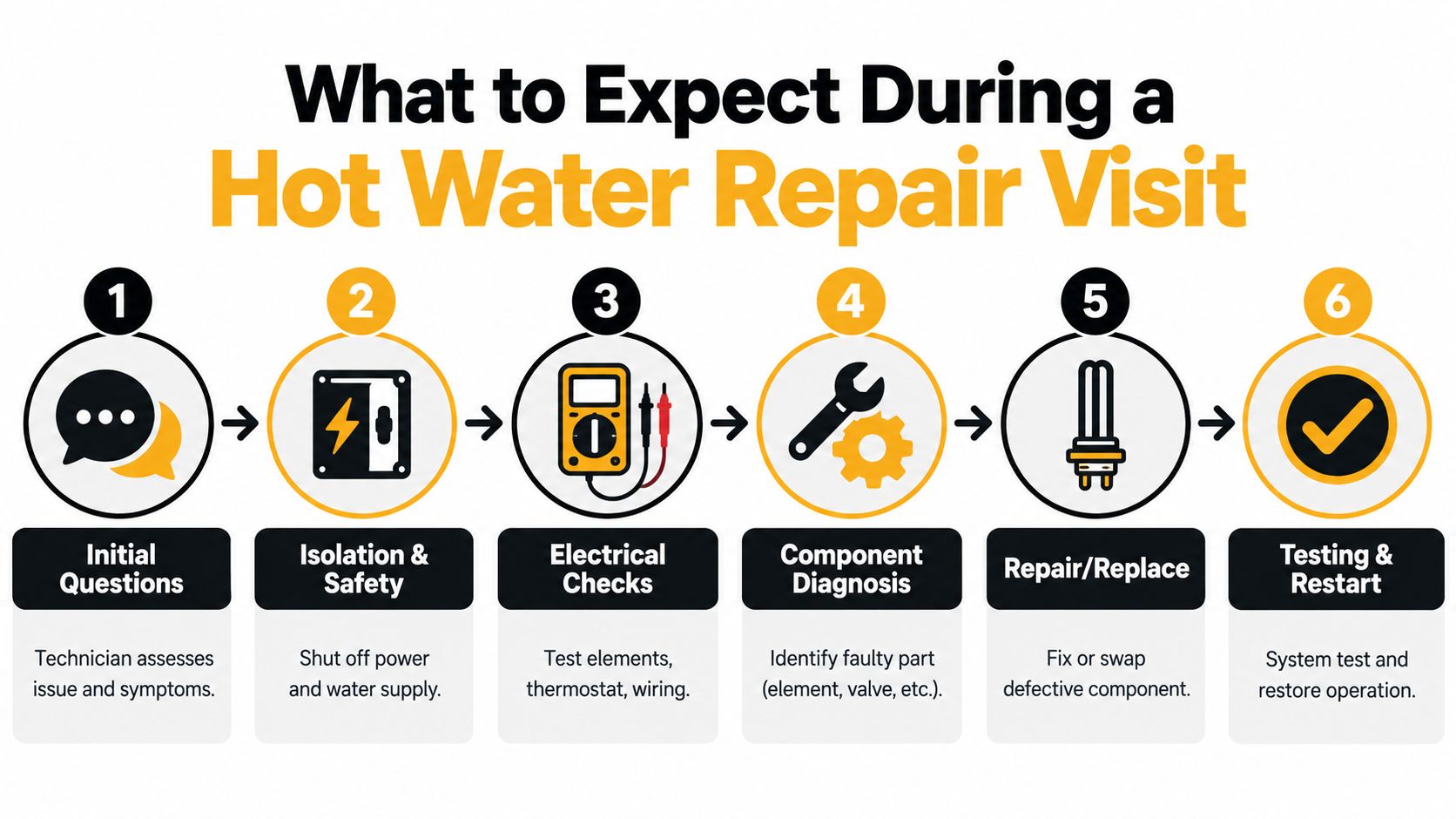
The visit usually starts with questions, not tools.
A technician will want to know when the problem began, whether it's total or intermittent, whether any switches tripped, and whether there have been leaks, noises, or unusual smells. That short conversation helps narrow the path before any covers come off.
Then comes safe isolation. Power is isolated before electrical testing starts. If water-side work is involved, water isolation may be needed as well.
For an electric hot water fault, an electrician may check:
This is why “replace the tank” is often too early as a conclusion. A proper diagnosis works from supply, to control, to heating, then to delivery.
Queensland compliance can widen the scope of the visit. As noted earlier, storage temperature and delivery temperature are not the same issue.
Queensland Health guidance advises technicians to take at least three temperature checks across each loop or building wing, allow about 60 seconds for temperature stabilisation at an outlet, and note maximum and minimum fluctuations when assessing performance, as outlined in the Queensland Health temperature monitoring guidance.
In a house, that principle matters because a system can be hot at the tank but wrong at the tap. A tempering valve may drift. Heat may be dropping off through the run. Distant outlets can behave differently from nearby ones.
Good testing doesn't stop at “the tank is heating”. It asks, “What temperature is actually reaching the fixtures people use?”
You don't need technical jargon. Ask practical questions.
One local option for this kind of fault-finding is DLG Electrical, which handles electric hot water repairs, servicing, and electrical connections for electric, heat-pump, and solar hot-water systems in Brisbane. The important point isn't the brand name. It's that the person attending should be able to explain the electrical fault path clearly before work starts.
Quotes for hot water work can look simple on paper and become less simple on site. That's not always because anyone is being slippery. It's because the visible symptom might be “no hot water”, while the job includes electrical diagnosis, parts, compliance checks, and sometimes work outside the heater itself.
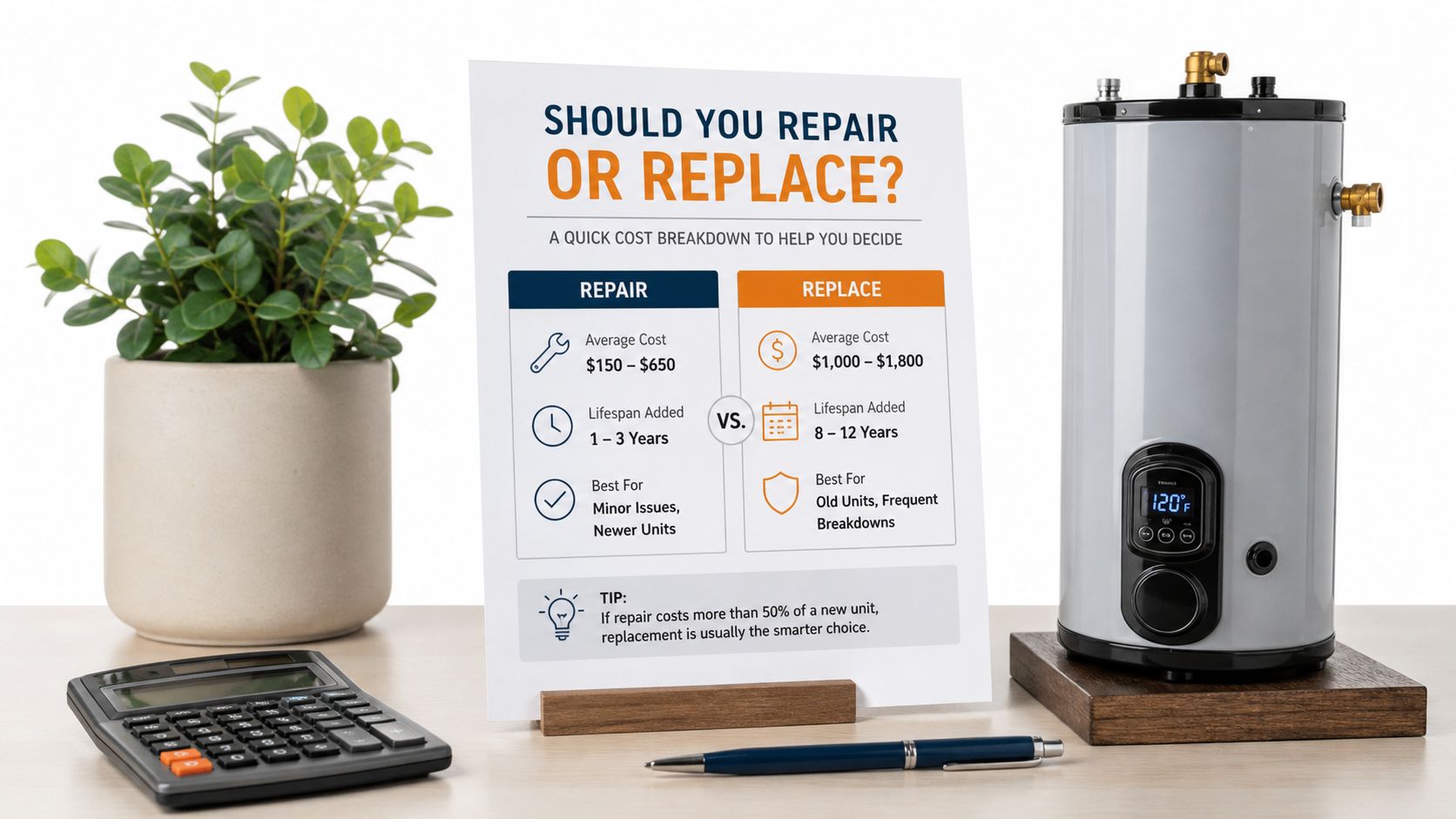
A repair quote commonly reflects a few moving parts:
This last one catches homeowners out. The cheapest quote can look attractive if it assumes “heater fault only”. Then the electrician opens the circuit path and finds a damaged breaker, failed isolator, or another issue that had to be fixed either way.
Repair often makes sense when the vessel is still sound and the fault is clearly isolated to a serviceable component. Replacement starts to make more sense when the unit has multiple problems, the tank itself is suspect, or the work required to make the whole setup compliant and reliable starts snowballing.
A useful way to compare the two is to ask:
If you want a homeowner-friendly breakdown of how quotes are typically framed, DLG Electrical's guide to hot water repair costs gives useful context.
This is one of the most overlooked parts of the decision.
Queensland's Climate Smart Energy Savers rebate for solar and heat pump hot water systems is closed to new applications, while federal STCs may still apply as an upfront discount on eligible systems, according to the Queensland Government statement on the rebate closure.
That means a homeowner comparing repair versus replacement shouldn't rely on old rebate pages or outdated advice. The comparison isn't only “repair bill versus new system price”. It's “repair bill versus replacement after any currently available federal incentive, plus any compliance work the replacement triggers”.
For landlords and renovators, that changes the maths more than many people expect.
When you search hot water system repairs near me, you're not just looking for someone who can arrive. You're looking for someone who can tell the difference between a failed tank, a bad element, a supply problem, and a compliance issue that changes the scope of the job.
That's where local experience matters.
Use a short checklist.
A local electrician usually understands the housing stock, the common switchboard arrangements, and the mixed hot water setups found across Brisbane homes. That matters when a job sits right on the edge between electrical repair and broader replacement planning.
It also helps after the first visit. If you need follow-up work, a compliance adjustment, or a second opinion on replace-versus-repair, you're dealing with a nearby business rather than a call centre chain.
For homeowners comparing providers, DLG Electrical's article on choosing a local electrician in Brisbane is a practical read. If you're also curious how good local trades businesses make themselves easier to find online, this electrician local SEO guide 2026 gives helpful background on why some firms appear prominently in suburb-based searches.
DLG Electrical is a family-owned Brisbane electrical contractor that has operated for over 21 years, according to the publisher information provided for this article. The team services residential and commercial work, including electric hot water repairs, switchboard upgrades, and compliance-related electrical jobs, with service coverage that includes North Brisbane, Grange, and Windsor.
That kind of profile matters because hot water faults rarely stay in one neat trade box. You want someone who can assess the circuit, explain the risk, and flag when the job touches compliance rather than only swapping a part and leaving.
If the person you call can do that calmly, in plain language, you're probably in the right hands.
If your hot water has stopped, is tripping power, or you're trying to work out whether repair or replacement makes more sense, DLG Electrical can help with fault finding and safe electrical diagnosis for Brisbane homes. They handle electric hot water issues with a practical focus on wiring, controls, and compliance, so you can make a clear decision instead of guessing. Visit DLG Electrical to arrange a quote or speak with the team.

Master Electrician with over 30 years of experience. Founded DLG Electrical in 2005 after international project work including electrical installations at Stamford Bridge Stadium, London(Home of Chelsea FC).

Local Electricians that can fix all Electric Hot water Systems.
Motion sensor lights are a versatile addition to any home, offering nu
