83 Jean St, Grange QLD 4051
Mon-Fri 07:30 AM - 04:00 PM - Sat - 8:00 - 12 - Sunday Closed
Let’s get straight to it: **how long do LED bulbs last?Let’s get straight to it: how long do LED bulbs actually last? A modern LED can run for an impressive 25,000 to 50,000 hours, which often translates to more than a decade of use in a typical Australian home. It’s best to think of it less like a use-by date and more like a car’s mileage—its longevity really depends on how much you use it, not just its age.
While the numbers on the box look incredible, they represent potential, not a guarantee. The true lifespan of an LED bulb is a story of efficiency, quality, and its surrounding environment. Unlike old incandescent bulbs that burn out by snapping a fragile filament, LEDs use solid-state technology to produce light. This process is far more durable and generates significantly less heat, which has always been the primary enemy of traditional lighting.
This is a great way to visualise how much longer LEDs last compared to the old tech.
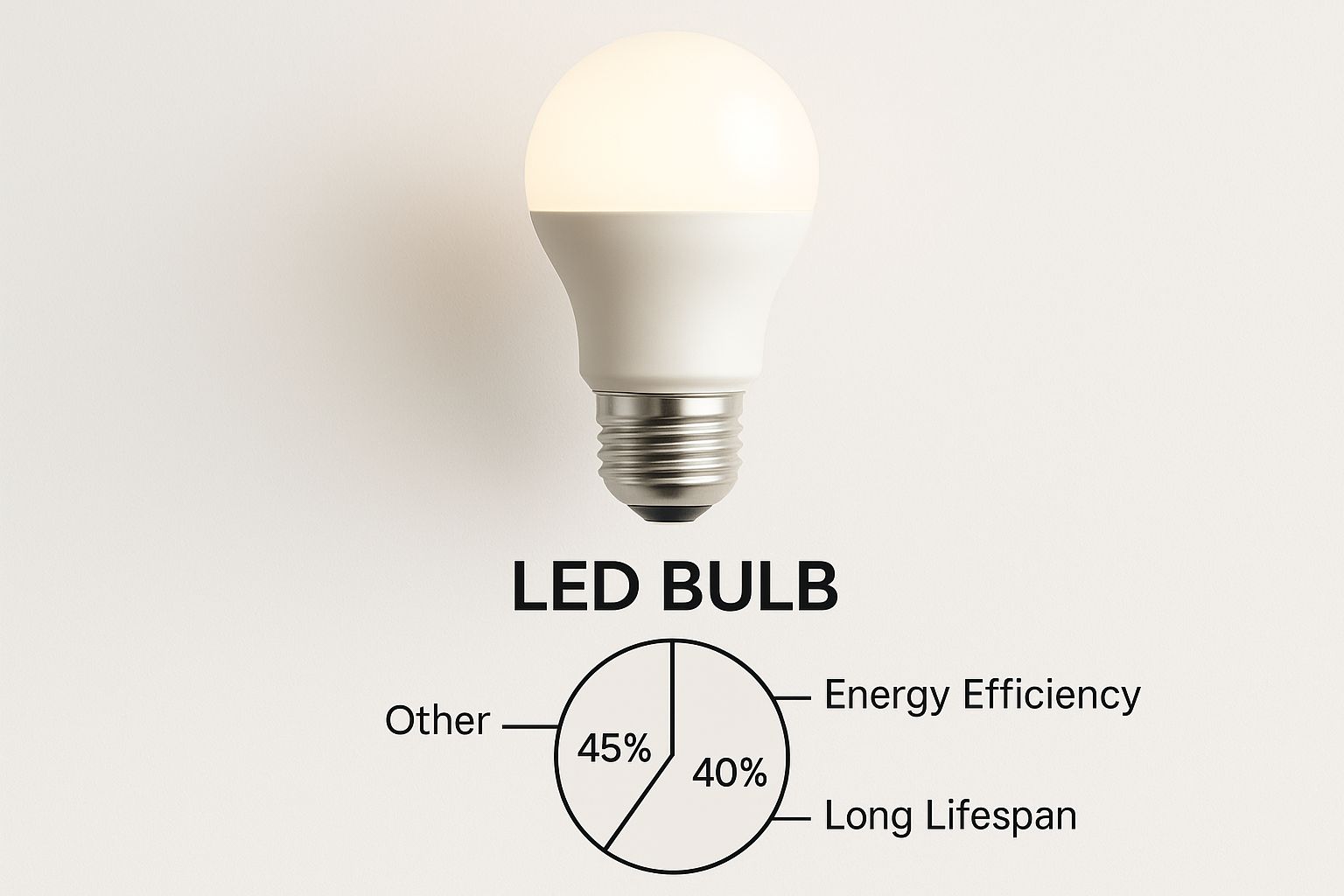
Here in Australia, it’s pretty standard for a quality LED to last between 25,000 to 50,000 hours. If you run your lights for about 8 hours a day, that works out to be anywhere from 10 to 17 years of service.
This performance absolutely dwarfs older technologies. To put it in perspective, incandescent bulbs barely made it to 750–2,000 hours, while halogens offered a slightly better 2,000–4,000 hours. You can get some more insights on LED lifespans over at eleco.com.au.
The difference is stark. Let’s break it down in a simple table.
This table offers a quick comparison of the average rated lifespan for different types of light bulbs, assuming they’re used for 8 hours a day.
| Bulb Type | Average Lifespan (Hours) | Estimated Lifespan (Years) |
|---|---|---|
| LED | 25,000–50,000 | 8.5–17 years |
| CFL | 8,000–12,000 | 2.7–4.1 years |
| Halogen | 2,000–4,000 | 8 months–1.3 years |
| Incandescent | 750–2,000 | 3–8 months |
As you can see, there’s really no contest. LEDs are in a league of their own when it comes to longevity.
The key thing to remember is that LEDs don’t just “burn out” suddenly. Instead, they experience a gradual dimming process called lumen depreciation. This means you get a slow, predictable decline in brightness rather than being plunged into darkness without warning, making them a reliable, long-term investment for any home.
What’s the real secret behind an LED’s incredible lifespan? It all comes down to a fundamentally different and far more clever way of making light.
An old incandescent bulb is a bit like a tiny, fragile toaster element. Electricity is forced through a thin metal filament, which heats up until it glows white-hot. It’s an inefficient, self-destructive process. That filament is always on a countdown to snapping.
LEDs, or Light Emitting Diodes, work on a completely different principle. There’s no filament to burn out. Instead, they use solid-state technology—a semiconductor that emits light when electricity passes through it. Think of it as a tiny computer chip designed to glow. There are no moving parts and nothing to break or wear out.
This modern approach generates remarkably little heat compared to the old globes, and heat is the main enemy of longevity in traditional lighting. By ditching the burning filament, LEDs are built tough from the ground up.
Another key reason LEDs last so long is how they age. An old incandescent or halogen bulb works one minute and is dead the next. That’s the filament finally giving up the ghost and breaking. It’s sudden and always inconvenient.
LEDs, on the other hand, experience something called lumen depreciation. This is a very slow, gradual, and predictable dimming process that happens over tens of thousands of hours. An LED is generally considered “end of life” when its brightness has faded to 70% of its original output.
This slow fade is a huge advantage. You get a reliable, long-term performance indicator instead of a sudden blackout. You’ll notice the light getting slightly dimmer over many years, giving you plenty of warning that it’s time for a replacement.
This inherent durability is precisely why you see LED technology popping up everywhere, from homes to highly specialised professional settings. You only need to look at why lash artists are ditching ring lights for LED lash lamps to see how their reliability makes a real-world difference.
The solid-state design doesn’t just benefit standard bulbs; it extends to all kinds of specialised fixtures. To see how this technology performs in integrated fittings, you can learn more about how long LED downlights last and why they’ve become the standard in modern Aussie homes.

When you see a lifespan like 25,000 hours printed on an LED bulb’s box, it’s easy to think of it as a guarantee. The reality is a little more complicated. That number represents an ideal, best-case scenario, and in the real world, several factors will decide how long your bulbs actually last.
Think of it like the fuel economy sticker on a new car. Your actual kilometres per litre will depend on how you drive, the conditions you drive in, and the quality of the car itself. It’s the same for LEDs—their true longevity comes down to the quality of their parts, the environment they operate in, and how you use them day-to-day.
If there’s one mortal enemy of electronics, it’s heat. LEDs are no exception. While they run much cooler than old-school incandescent bulbs, their sensitive internal electronics can’t stand getting too hot. This is why good ventilation is absolutely critical.
A bulb in an open-air lamp or a well-ventilated downlight fixture has plenty of room to breathe, allowing heat to dissipate naturally. But if you stick that same bulb inside a small, fully enclosed glass fitting, you’re trapping all that heat right where it can do the most damage. This constant overheating can slash an LED’s lifespan in half, or even more.
Key Takeaway: An LED’s operating temperature is the single biggest predictor of its lifespan. If you’re using bulbs in a sealed fitting, always make sure they are specifically rated for enclosed fixtures to prevent premature failure.
You’ve probably noticed the huge price difference between a cheap, no-name bulb and one from a well-known brand. That difference isn’t just marketing—it’s a direct reflection of the quality of the components inside. Two parts, in particular, make all the difference:
At the end of the day, a well-built bulb from a reputable brand is far more likely to hit its advertised lifespan. Cheaper bulbs almost always cut corners on the driver and heat sink, which is why they often lead to disappointment and an early trip back to the hardware store.
The table below breaks down how different environmental and usage factors can either shorten or extend the life of a standard 25,000-hour LED bulb.
| Factor | Poor Condition (Reduces Lifespan) | Ideal Condition (Maximises Lifespan) |
|---|---|---|
| Ventilation | Used in a small, fully enclosed fixture that traps heat. | Installed in an open or well-ventilated fixture. |
| Ambient Temperature | Operating in a hot attic or a commercial kitchen. | Used in a climate-controlled room with stable temperatures. |
| On/Off Cycles | Frequently switched on and off (e.g., motion sensor light). | Left on for long, continuous periods (e.g., office lighting). |
| Voltage Stability | Connected to a circuit with frequent power surges or dips. | Powered by a stable, clean electrical supply. |
| Dimmer Compatibility | Paired with an old, non-LED-compatible dimmer switch. | Used with a modern, LED-rated dimmer or a standard switch. |
As you can see, giving your LED bulbs the right conditions to thrive in is just as important as buying a quality product in the first place.
Walking down the lighting aisle can feel a bit overwhelming, but knowing how to read the packaging turns you into a savvy shopper. It’s the secret to making sure you’re buying a bulb that will actually deliver on its promise of a long life, not just a cheap one that’s doomed to fail early.
When you pick up a box, you need to look beyond the price tag. The real story of a bulb’s quality is told through a few key specifications printed right there on the packaging.
To make the right choice, you really only need to get familiar with three key terms:
Beyond these basics, the most reliable indicator of quality here in Australia is the warranty. A manufacturer that’s confident in its product will always back it up with a solid guarantee.
A longer warranty period almost always points to better internal components and more rigorous testing. For specific fixtures like downlights, understanding the different types of downlights can also help you match the right bulb to the right fitting, maximising its lifespan.
According to Australian consumer guidance, a quality LED bulb should have a guaranteed lifespan of at least 15,000 hours. For these bulbs, you should be looking for a warranty of at least 2 years. If a bulb claims to last longer, it should ideally come with a warranty of 3 years or more.
This simple check is a great way to steer clear of subpar products. You can find more insights on these recommendations from the official Australian consumer guide to buying quality LEDs.
Ultimately, choosing a bulb with a decent warranty is the best way to ensure you’re investing in lighting that is genuinely built to last.
Sure, understanding the technical reasons why LEDs last longer is one thing, but what does that actually mean for your wallet? The real benefit of switching to LED lighting isn’t just a lower electricity bill—it’s the long-term financial saving. Think of it as a smart investment in your home that pays you back for years.
While an LED bulb might cost a little more upfront than a traditional halogen globe, that’s where the comparison ends. A single quality LED can easily outlast 10 to 20 halogen bulbs. Just imagine the time, money, and hassle saved by not having to constantly buy replacements and climb ladders to change dead globes.
This incredible durability translates into a significant return on your investment. The higher initial cost is quickly wiped out by massive savings on replacement bulbs and, of course, reduced energy consumption.
The financial advantage becomes crystal clear when you consider the realistic lifespan of LEDs in Australian homes, which can be anywhere from 10 to 21 years, depending on how you use them. Unlike older globes that dim and fail, LEDs maintain their brightness consistently over their lifetime, meaning a five-year-old bulb shines just as brightly as a new one. For more insights, you can read about the real-world performance of LEDs in Australian homes on energymakeovers.com.au.
Choosing LEDs isn’t just about buying a light globe; it’s about investing in a set-and-forget solution that reduces both your household expenses and your maintenance chores for the next decade or more.
When weighing up the costs, it helps to see a direct comparison. Our detailed guide on LED lights vs halogen breaks down the numbers, showing exactly how the long-term savings make LEDs the clear winner for any budget-conscious homeowner.
Even when you get your head around the tech, a few practical questions always pop up when you’re dealing with LED lighting day-to-day. Let’s run through some of the most common things homeowners ask about how their LED bulbs actually behave and how long they really last.
This is one of the biggest differences between old-school bulbs and modern LEDs. An incandescent bulb dies in a flash when its fragile little filament breaks. LEDs, on the other hand, almost never just burn out suddenly.
Instead, they go through a process called lumen depreciation. It’s a very slow, gradual fade that happens over thousands and thousands of hours. An LED is usually considered “end of life” when its brightness has dimmed to 70% of what it was brand new—a point you honestly might not even notice for years.
While LEDs are incredibly versatile, there are a couple of golden rules to follow to keep them safe and ensure they last. The number one enemy of an LED’s internal electronics is heat.
You should always avoid putting a standard LED bulb into a completely sealed-off light fixture (think certain ceiling dome lights or weatherproof outdoor casings). These fittings are like little ovens that trap heat, which can slash a bulb’s lifespan. If you have a fixture like this, make sure you buy a bulb that’s specifically rated for enclosed fixtures on the packaging.
Also, if you’ve got a dimmer switch on the wall, you absolutely must use a bulb that’s marked as “dimmable.” Sticking a non-dimmable LED on a dimmer circuit is a recipe for flickering, buzzing, and the premature death of the bulb’s internal driver.
This is a classic myth that comes from the days of fluorescent tube lighting, which really did wear out with frequent switching. Luckily, that’s ancient history for modern LEDs.
An LED’s lifespan is all about its total run time and the temperature it operates at, not how many times you flick the switch. Their solid-state components are built to handle constant on-off cycles without any issues.
This makes them the perfect choice for spots where lights get used in short, sharp bursts, such as:
You can flick them on and off all day long without worrying you’re wearing them out. It’s a small detail, but it’s another reason they’re so durable and convenient for a busy home.
For all your residential and commercial electrical needs, from new installations to safety checks, trust the experts at DLG Electrical. Visit us at https://dlgelectrical.com.au to get a free quote today.

Master Electrician with over 30 years of experience. Founded DLG Electrical in 2005 after international project work including electrical installations at Stamford Bridge Stadium, London(Home of Chelsea FC).

Local Electricians that can fix all Electric Hot water Systems.
Motion sensor lights are a versatile addition to any home, offering nu
