83 Jean St, Grange QLD 4051
Mon-Fri 07:30 AM - 04:00 PM - Sat - 8:00 - 12 - Sunday Closed
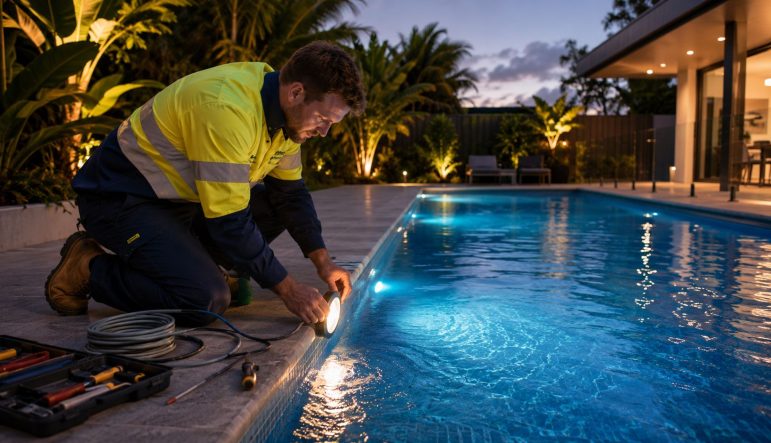
A lot of Brisbane pool owners start in the same place. The pool looks great in daylight, then disappears the moment the sun drops. You can still hear the kids outside, the alfresco is still in use, but the water becomes a dark patch in the yard instead of part of the evening.
Good pool lighting fixes that, but it's not a decorative add-on in the same way as a garden spike light or a wall sconce. Pool lighting installation sits right at the intersection of design, safety, access, and electrical compliance. If the layout is wrong, the pool looks patchy. If the equipment choice is wrong, maintenance becomes a nuisance. If the installation is wrong, the risk is far more serious than a blown fitting.
For Brisbane homeowners, the biggest mistakes usually happen before any cable is pulled. People assume adding lights to an older pool is simple. They assume any waterproof fitting will do. They assume LED means no maintenance. None of those assumptions holds up on a real job site.
A well-lit pool changes how a backyard gets used. Instead of shutting the area down after sunset, the pool stays active. Evening swims feel inviting, the surrounding paving becomes safer to move around, and the water turns into a focal point rather than a blind spot.
Most Brisbane clients aren't asking for a flashy result. They want a pool that feels usable at night, looks clean from the patio, and doesn't create a maintenance headache later. That usually means balancing three things:
A strong result comes from planning the whole scene, not just selecting a fitting from a catalogue. Pool shell colour matters. Coping and tile reflectivity matter. Viewing angles from the house matter. A bright fitting pointed the wrong way can create glare from the kitchen or outdoor dining area and make the pool look worse, not better.
In practice, the best installations are usually the least gimmicky. Clean white light often suits modern Brisbane homes, while colour-changing fittings can work well when the control gear is reliable and the owner will use the different scenes. What doesn't work is cramming in fittings without thinking about cable routes, transformer location, access for service, or how the pool is used week to week.
Practical rule: Treat pool lights as part of the electrical design, not as a last-minute pool accessory.
That mindset saves money, avoids rework, and usually produces a better-looking result.
The first big decision is the light type. For most residential pools, the main comparison is LED versus halogen. Other options exist, but they're less common in standard Brisbane installations and usually chosen for very specific design reasons.
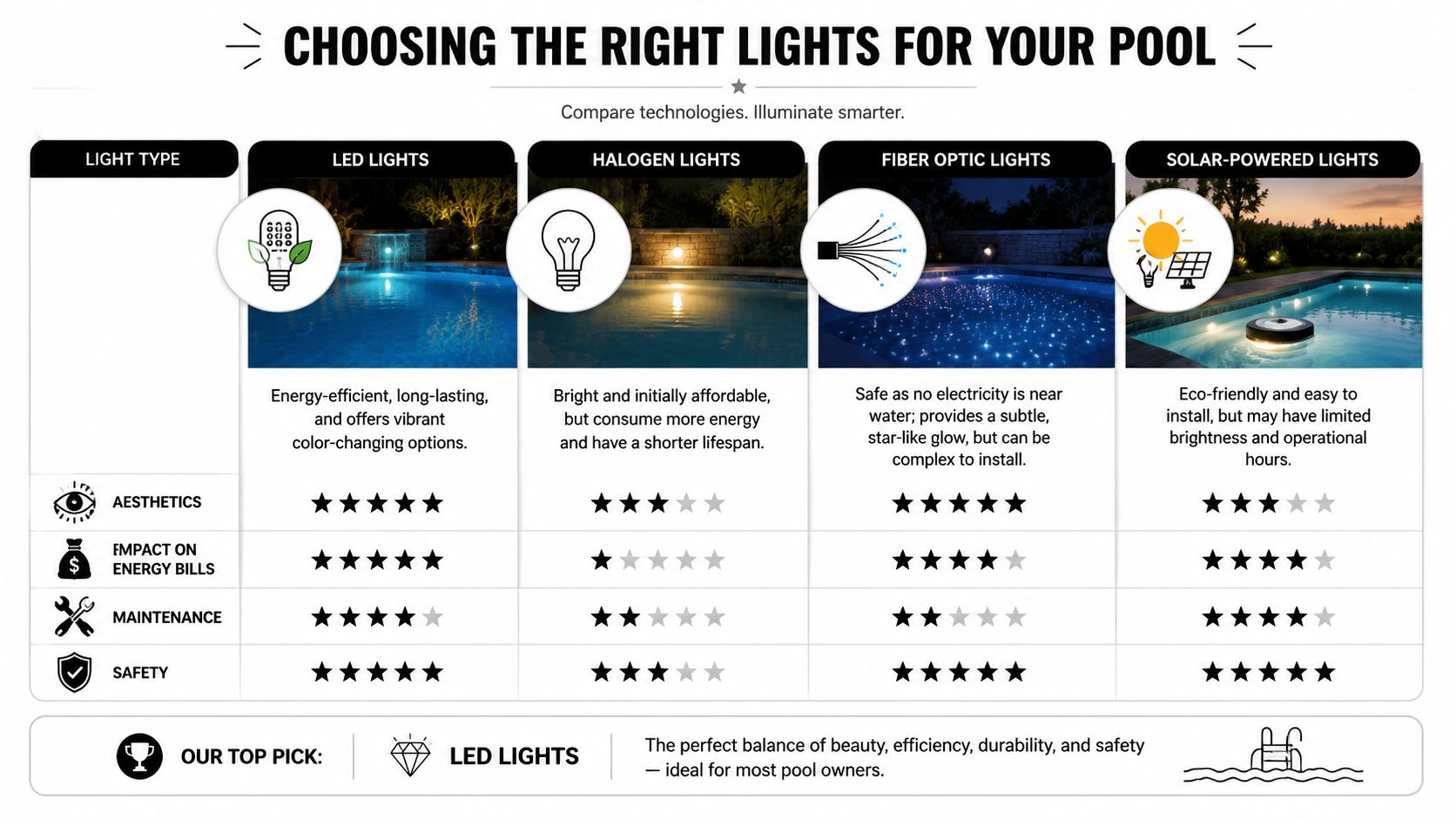
Think of halogen like an older petrol car. It still runs, and some owners are familiar with it, but it asks more from you over time. LED is the modern option. It's become the default choice for most new work because it's more efficient and generally easier to live with long term.
The wider market reflects that shift. The Australian LED lighting market was valued at AUD 2.06 billion in 2025 and is projected to grow at a 9.70% CAGR from 2026 to 2035, reaching about AUD 5.20 billion by 2035, according to Expert Market Research's Australia LED lighting market analysis. That growth is tied to energy efficiency and lower household power use, which is exactly why so many homeowners now choose LED for pool lighting installation.
Here's the practical comparison:
| Light type | Where it helps | Trade-off |
|---|---|---|
| LED | Lower power use, long-term efficiency, colour options, modern controls | Higher upfront equipment cost in some setups |
| Halogen | Familiar technology, bright output, simple replacement in older systems | Higher power use, more frequent lamp changes, less flexible control |
LED suits most Brisbane homes because it handles the two questions owners usually ask first. “Will it cost less to run?” and “Will I be replacing globes all the time?” In most cases, LED is the stronger answer on both counts.
It also gives more freedom with the final look. You can choose a crisp white effect, a warmer ambience, or a colour-changing system if the pool area is used for entertaining. If you're already planning surrounding feature lighting, it's worth looking at the bigger outdoor picture so your pool light colour and beam style don't clash with the rest of the space. This guide to outdoor lighting installation ideas for Brisbane homes is useful for that broader planning.
Halogen usually turns up in older pools, especially when an owner wants a like-for-like replacement rather than a broader upgrade. It can still be serviceable in the right setup, but it's rarely where we'd steer a new installation unless there's a very specific reason.
A cheap fitting isn't cheap if you're opening the same light again and again for service.
The right choice isn't the most expensive fitting. It's the one that matches the pool, the wiring path, and how the backyard gets used.
A pool light is often pictured as a quick fitting swap. Sometimes it is. Often it isn't. The process depends almost entirely on whether the pool was built with lighting provision from the start.
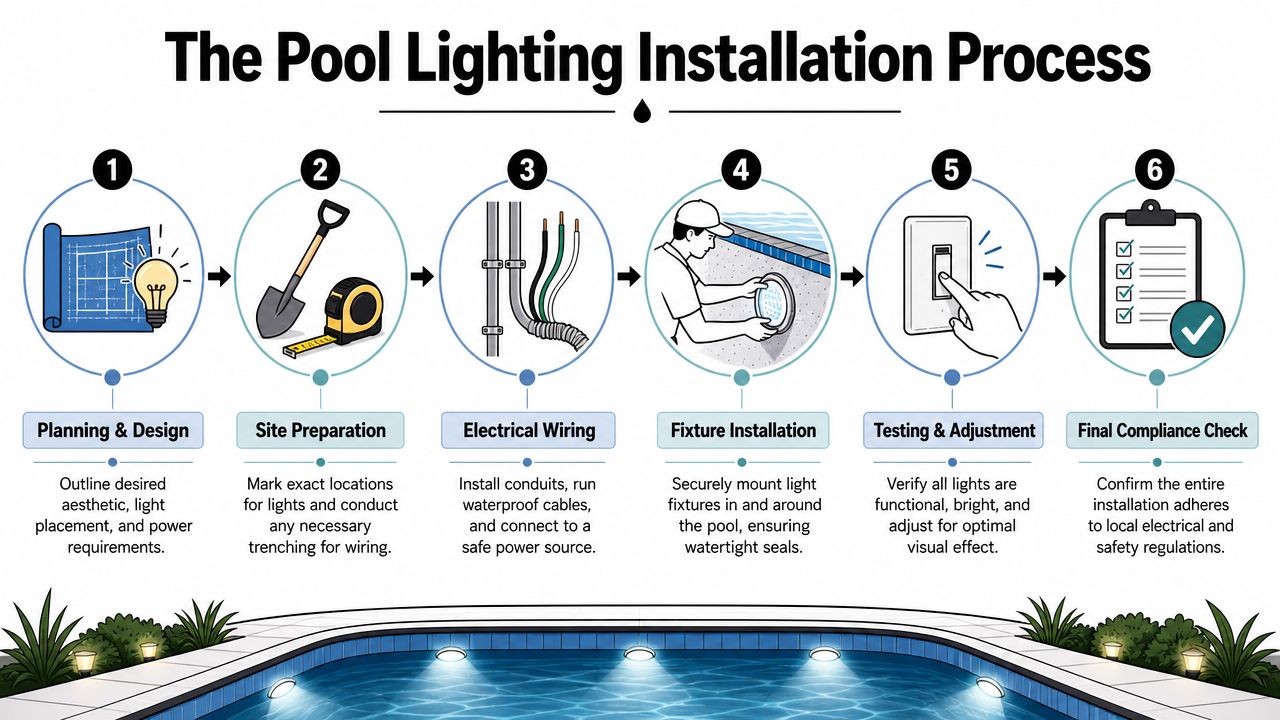
New construction is the cleanest scenario. The shell, conduit planning, cable routes, transformer location, and switching arrangement can all be coordinated before finishes lock everything in.
A typical new-build sequence looks like this:
That's the stage where good planning pays off. If a light location needs to shift after the shell is complete, the job gets harder very quickly.
A quick visual overview helps if you've never seen the workflow laid out clearly:
If the pool already has a niche, conduit, and compliant wiring path, the job is usually more straightforward. Many LED upgrades occur under these circumstances. We inspect the existing setup, confirm the condition of the housing and associated gear, and then determine whether the upgrade is a simple replacement or whether other components need attention as well.
The key point is that “replacement” doesn't automatically mean “simple”. Older installations can hide issues such as degraded seals, unsuitable transformers, or poor previous workmanship.
Generic online advice often proves insufficient. Retrofitting lights into an existing, unlit pool is often a major structural intervention. Baden Pools' article on installing inground pool lights into an existing pool notes that it can require draining the pool and trenching a new conduit through the pool wall.
That's why first-time retrofits tend to surprise homeowners. You're not just “adding a light”. You're creating a safe path for electrical infrastructure into a structure that wasn't built for it.
Common retrofit tasks include:
If you're also improving the wider backyard at the same time, ideas from FenceScape's fence lighting guide can help you think about how boundary lighting, feature lighting, and pool lighting work together instead of feeling like separate projects.
Retrofitting an unlit pool is closer to minor construction than to changing a globe.
That's not a reason to avoid it. It's a reason to budget and plan properly.
This is the part that isn't negotiable. Water is unforgiving, and pool lighting has to be treated accordingly. A neat finish means nothing if the installation isn't compliant.
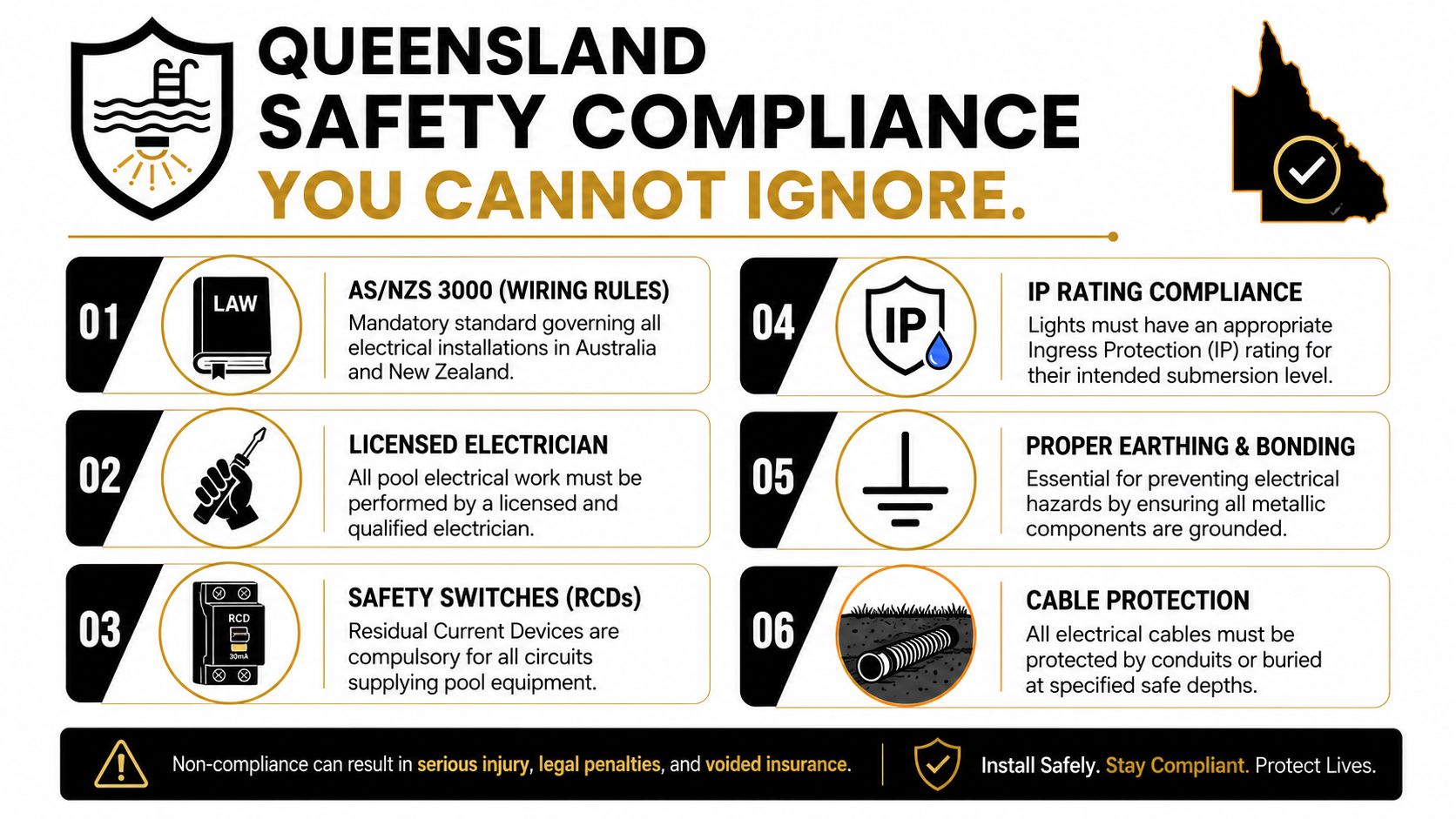
In Australia, underwater pool luminaires must operate at a maximum of 12V AC or 30V DC under AS/NZS 3000:2018, as outlined in this pool lighting compliance overview from Superlight. That rule exists because wet environments increase risk. Lower voltage reduces the potential for dangerous current passing through the body if something fails.
For a homeowner, the takeaway is simple. If anyone proposes an underwater fitting outside that requirement, the answer should be no.
Not every “outdoor” light belongs in a pool. Underwater fittings need the right sealing, construction, and installation conditions for continuous submersion.
Manufacturer guidance also matters here. MAS ATOM installation instructions published by Spa Electrics specify IPX8 for underwater use, require the top of the fixture to sit at a maximum depth of 400mm below the water line, and place lights about 300–400mm from the top of the coping for serviceability and thermal performance. The same guidance places junction boxes in Zone 2, at least 2m from the water's edge.
Those details aren't cosmetic. They affect heat management, maintenance access, and the likelihood of failures at connection points.
A compliant pool lighting installation usually includes several checks happening together, not one magic component.
For homeowners who like understanding the broader safety culture behind regulated work, Managing WHS risks in QLD gives useful background on why these standards are treated seriously across Queensland worksites.
Site check: If an installer talks more about colour modes than compliance, ask harder questions.
The safest pool light is not the fanciest fitting. It's the one installed exactly as the standard and manufacturer require.
Pool lighting quotes vary because the job itself varies. A replacement in an existing compliant niche is one kind of work. A fresh installation into a pool that never had lighting is something else entirely.
The biggest cost factors are usually labour complexity, access, and whether the electrical pathway already exists. Equipment choice matters, but the hidden cost driver is often the amount of physical work needed to get the installation done safely.
A quote generally moves up or down based on these variables:
The wrong place to cut is on compliance items or workmanship. That includes transformers, cable protection, sealing, and proper testing. Those parts don't photograph well, but they decide whether the installation lasts.
The smarter place to control cost is in the design brief. For example, some pools look better with fewer well-positioned lights than with extra fittings added without purpose. A simple, balanced plan can outperform an overcomplicated one.
If you own an older Brisbane pool with no existing lighting provision, budget with caution. Retrofitting can involve draining, wall penetration, conduit work, and reinstatement. That's why broad online price talk is often misleading. Two pool lighting jobs can sound similar and be completely different in scope.
A useful way to think about your budget is to separate it into three buckets:
| Cost area | What it covers | Why it matters |
|---|---|---|
| Electrical labour | Installation, testing, connection, compliance work | Usually the core of the job |
| Materials and fittings | Lights, transformers, cable, conduit, accessories | Varies by system choice |
| Access and building work | Drain-down, trenching, wall work, reinstatement | Often the wildcard in retrofits |
When reviewing a quote, ask what assumptions it relies on. A clear quote should identify whether it's based on existing compliant infrastructure or whether further site work may be needed once access is opened up.
Pool lights don't need constant attention, but they do need the right habits. The biggest maintenance mistake we see is neglect, especially in cooler months when owners stop using the pool as often.
Underwater pool lights should be operated for at least 15 minutes weekly even in winter to help evaporate condensation and prevent globe failure, as noted in AstralPool's LED pool light guidance for Australian conditions. That catches plenty of homeowners off guard because they assume leaving the lights off protects them.
It can do the opposite. Moisture that sits and lingers is what creates trouble.
A pool light can be low-energy and still be vulnerable to condensation.
If you already use automation around the home, it may be worth tying that habit into a broader smart lighting system setup for convenience and control. The easier it is to run the lights regularly, the more likely the habit will stick.
You don't need to pull fittings apart to stay ahead of problems. A few visible changes usually show up first.
Don't ignore those signs and hope they clear on their own. Water-related electrical faults rarely improve with time.
Pool chemistry, mineral deposits, and grime can dull the lens over time. Gentle cleaning helps keep the light output crisp, but abrasive products and aggressive tools can damage the surface or seals.
A sensible routine looks like this:
The recurring theme is simple. Pool lights last longer when they're used regularly, inspected casually, and repaired properly rather than patched.
Pool lighting is one of those jobs where confidence can be dangerous. A homeowner might be handy. A general handyman might be experienced with outdoor lighting. Neither of those things qualifies someone to handle submerged electrical equipment in a regulated wet area.
There have been zero reported deaths in Australia attributed to failures of low-voltage pool lights installed in full compliance with Australian Standards, according to the cited industry reference in the verified data set provided for this article, supported by this referenced discussion link on compliant low-voltage pool light safety. That point matters because it places the emphasis where it belongs. The most important factor is compliant installation.
That means the conversation shouldn't be “Can someone connect this light?” It should be “Can a licensed electrician install this system correctly, test it properly, and verify that it complies?”
A licensed Brisbane electrician understands more than the fitting. They're assessing the power source, the location of associated equipment, the suitability of the cable path, the interaction with other pool equipment, and the service implications later.
That depth matters most when the job gets messy, such as:
Even seemingly basic switching work can go wrong when people don't understand circuit fundamentals. If you're curious how small wiring details matter in ordinary household switching, this explainer on mastering black screw wiring is a useful reminder that simple-looking electrical tasks often aren't simple at all.
Brisbane homes aren't all built the same. Access varies. Pool ages vary. Some properties make cable routing easy, while others force careful planning around concrete, gardens, retaining walls, or finished entertaining areas. A local electrician who regularly works in these conditions is less likely to promise a neat-sounding shortcut that creates trouble later.
If you're comparing trades, start with someone who is clearly licensed, insured, and experienced in residential electrical compliance. This guide on choosing an electrician in Brisbane for residential work is a useful place to benchmark what to look for.
When a job involves water, buried cable, sealed fittings, and compliance obligations, DIY isn't a money-saving strategy. It's a risk transfer strategy, and the risk lands on you.
A professionally installed pool light system should give you confidence every time it switches on. That confidence comes from workmanship, not hope.
If you're planning a pool lighting project in Brisbane and want it done safely, neatly, and in full compliance, talk to DLG Electrical. We're a family-owned Brisbane electrical contractor with over 19 years of experience, and we handle everything from straightforward upgrades to complex retrofit work. Reach out for a free quote and practical advice on the best setup for your pool and outdoor area.

Master Electrician with over 30 years of experience. Founded DLG Electrical in 2005 after international project work including electrical installations at Stamford Bridge Stadium, London(Home of Chelsea FC).

Local Electricians that can fix all Electric Hot water Systems.
Motion sensor lights are a versatile addition to any home, offering nu
