83 Jean St, Grange QLD 4051
Mon-Fri 07:30 AM - 04:00 PM - Sat - 8:00 - 12 - Sunday Closed

You reset the switchboard, hear the safety switch click back in, and start the kettle again. Then the power drops out before the fridge has finished humming. In Brisbane homes, an RCD that keeps tripping usually isn't switching off without cause. It has detected current travelling somewhere it shouldn't, although the source may be a faulty appliance, damp outdoor equipment, wiring, accumulated leakage, or an unsuitable protective device.
You can safely perform a limited isolation check from the outside of the switchboard. You shouldn't remove covers, test live wiring, bypass the device, or keep forcing it on. The useful question isn't "Why is my RCD tripping?" It's, "What pattern does the trip follow, and what can that pattern tell me without creating another hazard?"
An RCD, or Residual Current Device, compares the current leaving through the active conductor with the current returning through neutral. If some current escapes to earth, the two readings no longer match. Australian residential safety arrangements commonly use 30 mA RCD protection for personal protection, with the device intended to disconnect within milliseconds when earth leakage is detected. IPD's Australian RCD guidance explains the domestic protection framework, including the widespread use of RCDs for residential power and lighting circuits.
In Queensland, the device is often labelled Safety Switch. It has a different job from a circuit breaker. A circuit breaker responds to overcurrent, such as an overload or short circuit, and protects cables and equipment from excessive current. An RCD responds to an imbalance between active and neutral, protecting people from electric shock and detecting leakage that a circuit breaker may not notice.
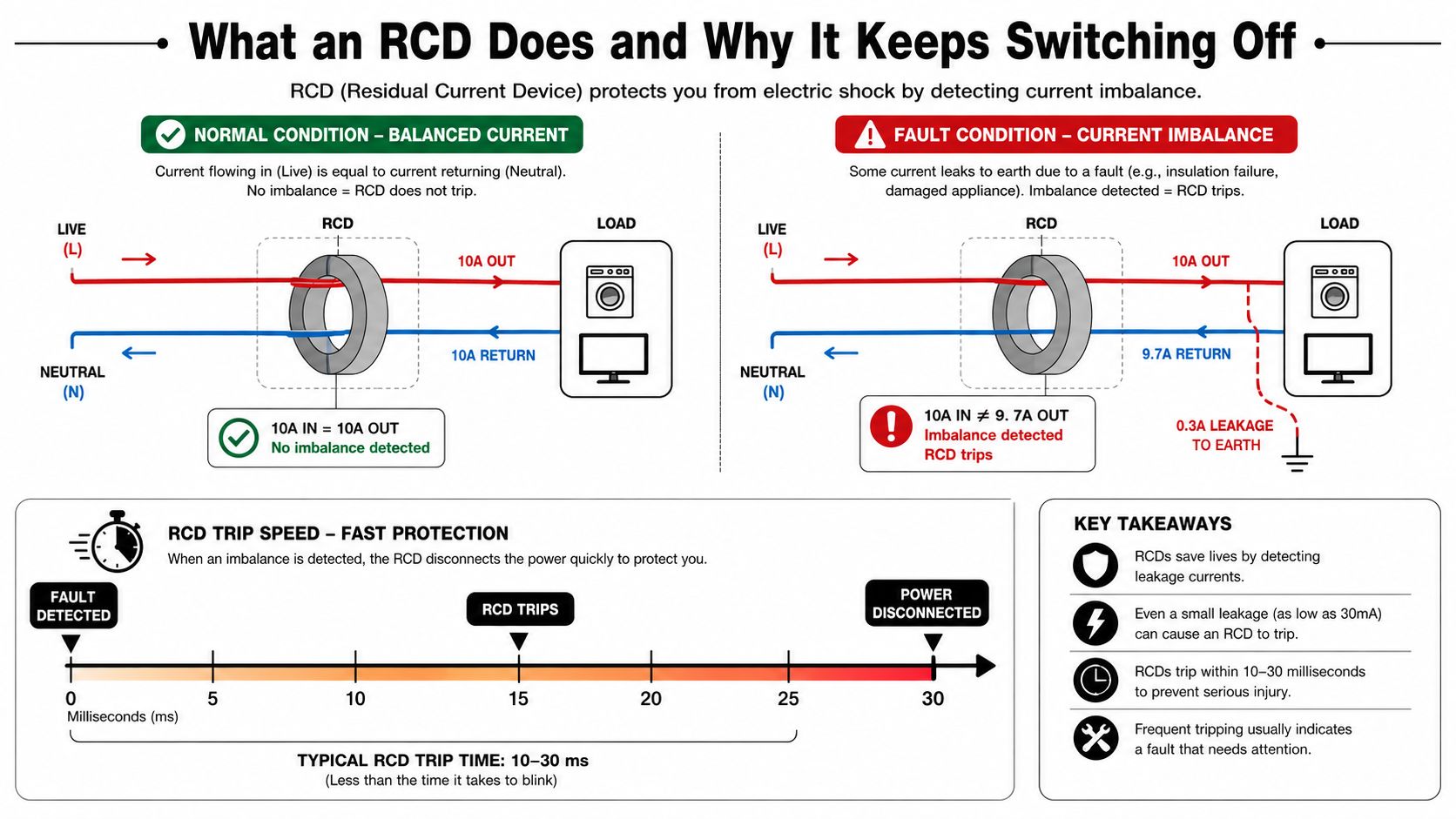
Practical rule: A trip is a warning from the protection system, not proof that the RCD itself has failed.
The cause may be one appliance, damaged insulation, moisture, an overloaded or poorly divided circuit, cumulative leakage from several electronic loads, or a device-type mismatch. Queensland guidance describes nuisance tripping as a safety switch or circuit breaker that regularly trips without an apparent fault, and recommends isolating appliances methodically rather than assuming the switch is defective. DLG Electrical's explanation of RCD switches provides useful background if the labels on your board aren't clear.
Resetting the lever repeatedly doesn't repair the underlying problem. The next step is to observe when the trip occurs, isolate accessible appliances, and stop immediately if the RCD trips with everything disconnected.
The timing of the trip often gives you the first worthwhile clue. A washing machine that causes the trip as its heater starts points to a different problem from a safety switch that drops after heavy rain.
A washing machine, dishwasher, refrigerator, dryer, pool pump, or damaged powerboard can develop leakage to earth. The appliance may appear to work normally until a motor, heating element, pump, filter, or electronic power supply operates. If the trips follow one appliance, unplug that appliance and leave it disconnected until it has been inspected or replaced.
Older Brisbane properties can contain ageing cables, altered circuits, loose connections, or insulation damaged by heat, pests, renovations, or moisture. The fault is hidden inside a wall, ceiling, fitting, or junction point. Random trips with nothing plugged in make fixed wiring or a hard-wired load more likely.
Outdoor power points, pool equipment, garden lighting, external pumps, bathroom fittings, and cable entries can admit water. A cracked cover or failed seal may only leak after rain, washing down, condensation, or prolonged humidity. A trip after wet weather or steam deserves particular attention, and outdoor equipment shouldn't be reconnected just to see whether it fails again.
A circuit can trip when several high-demand or electronic appliances start together. An ordinary overload is primarily the circuit breaker's territory, but multiple connected devices can also create an imbalance or add leakage that pushes the RCD to operate. If the trip follows simultaneous appliance use, record which loads were operating rather than blaming the last appliance switched on.
A safety switch can fail its mechanical or electrical checks, but you can't confirm that by sight. If it trips with accessible appliances unplugged, an electrician needs to test the device and the circuit. Queensland technical guidance stresses that the underlying cause may be faulty equipment or wiring, not the switch mechanism. For broader symptoms involving a circuit breaker rather than residual-current protection, this troubleshooting guide on a breaker keeps tripping can help clarify the difference.
A short video can also help homeowners recognise the protective-device arrangement before they touch anything external:
Start only if the switchboard is dry, accessible, and free from visible damage. Keep your hands away from the inside of the board. You're checking plugs, local appliance switches, and the response of the safety switch, not carrying out electrical work.
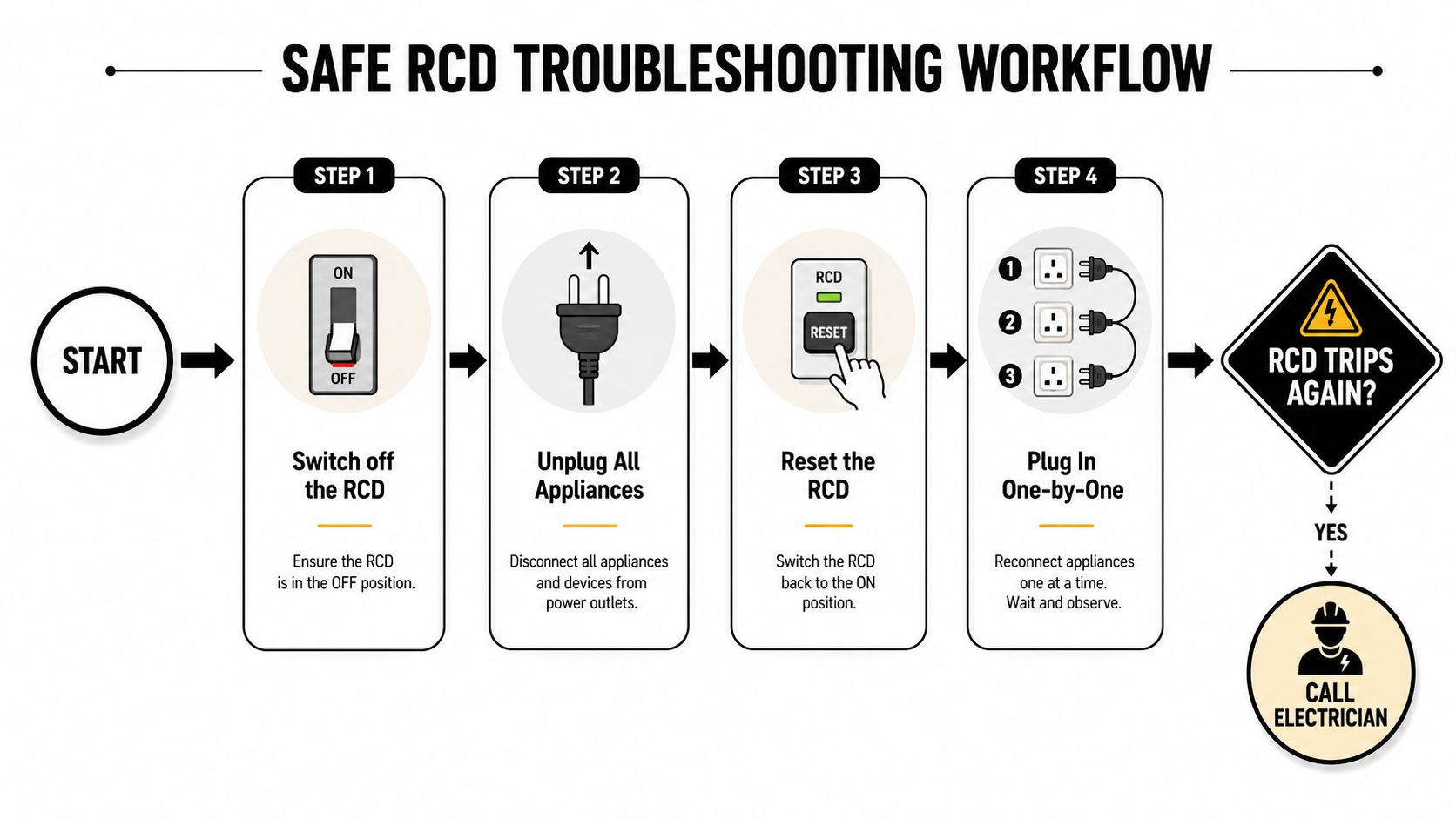
Switch off the affected RCD or safety switch. If several devices have dropped, identify which protective device moved. Don't reset the whole board repeatedly if you can't tell what has operated.
Unplug appliances supplied by the affected circuit. Include portable equipment in rooms that may share that circuit. Turn off accessible hard-wired appliances at their normal local isolator, but don't remove covers or disconnect fixed wiring.
Reset the RCD with loads disconnected. If it stays on, reconnect appliances one at a time. Reset between each reconnection, and note whether the trip occurs when an item is plugged in or when it begins a cycle.
Leave the suspected appliance isolated. Don't keep using it because it worked once after a reset. A developing earth-leakage fault can be intermittent.
If the RCD trips immediately with accessible appliances unplugged, stop. That result points towards fixed wiring, a hard-wired appliance, moisture, cumulative leakage elsewhere on the board, or the RCD itself. A structured electrical fault-finding process is safer than opening the switchboard and guessing.
Never bypass the RCD, wedge the lever on with tape, replace protective devices yourself, or work inside the switchboard. Don't touch a wet board, and don't reset it if there's a burning smell, scorching, buzzing, heat, discolouration, flooding, or water near electrical equipment.
If the safety switch won't hold with the obvious loads disconnected, leave it off and arrange a licensed inspection.
This check separates a plug-in appliance from a problem that requires instruments. It doesn't prove that a circuit is safe merely because the RCD holds for a short period.
The usual “unplug everything” advice can miss a fault pattern that occurs across several appliances. Refrigerators, washing machines, dishwashers, heat-pump dryers, LED drivers, chargers, and other electronic equipment can each contribute a small amount of earth leakage. None may look defective on its own, yet the combined leakage can make one RCD trip when another device starts.
Australian technical material notes that a 30 mA RCD may trip at around 22 mA in practice, rather than waiting for a precise nominal value. IPD's technical explanation of RCD characteristics explains why several small leakages can leave limited operating headroom. This is especially relevant in Brisbane homes with outdoor circuits, pool pumps, hot-water equipment, and moisture-exposed appliances.
The RCD type matters as electronic loads become more common. In Australia, the use of Type AC RCDs was prohibited from 1 May 2023, with regulators identifying Type A, Type B, and Type F devices for compliant installations and replacements. Energy Safe Victoria's battery and RCD guidance explains the regulatory direction and the relevance of modern inverter-based equipment.
Type AC devices respond to alternating-current residual faults. Modern appliances can produce pulsating direct-current components that an unsuitable Type AC device may not handle correctly. The answer isn't automatically “replace the RCD”. A licensed electrician needs to establish whether the issue is a faulty load, cumulative leakage, wiring deterioration, moisture, or an incorrect device type.
| RCD Type | Detects AC Leakage | Detects Pulsing DC Leakage | Typical Use |
|---|---|---|---|
| Type AC | Yes | Not the intended protection for this modern-load problem | Existing installations requiring assessment |
| Type A | Yes | Yes | Common choice for modern household electronic loads |
| Type F | Yes | Designed for relevant mixed-frequency equipment | Selected appliance and inverter applications |
| Type B | Yes | Broader residual-current capability | Specialist equipment and installations |
A shared RCD can monitor several circuits together. If the electrician finds that the installation is sound but combined leakage is excessive, separating circuits onto individual RCBOs may be more effective than swapping one shared device and hoping the trips stop. Each RCBO combines residual-current protection with overcurrent protection for its own circuit, limiting a fault to the affected circuit and making future diagnosis clearer.
That change should follow testing and a switchboard assessment. It may involve choosing Type A or another suitable device, checking the board's compatibility, and correcting any neutral or wiring defects first.
Call a licensed electrician when the RCD trips straight away with nothing accessible connected, when it keeps tripping after you isolate a suspected appliance, or when the trip follows water, storms, outdoor equipment, or a pool circuit. A failed test button is also a serious reason to stop relying on the device. If the safety switch doesn't operate when its test function is pressed, leave the matter to a professional.
Burning smells, warm or discoloured switchgear, buzzing, melted plastic, exposed cable, or water near the board move the situation out of homeowner troubleshooting. Don't remove the switchboard cover to see whether a wire looks loose. You can learn more about situations that need prompt attendance in this guide to an emergency electrician near me.
A proper investigation normally has several layers:
RCD operation testing: A calibrated RCD tester checks whether the device trips within its specified performance. Queensland technical guidance uses 300 milliseconds at rated residual current as the benchmark for a standard 30 mA RCD under the relevant installation requirements. Queensland's technical note on RCD testing also describes testing at 40 to 50 per cent of rated tripping current for 5 seconds without tripping, followed by a rated-current trip-time test.
Insulation and leakage testing: The electrician tests final subcircuits and connected equipment to locate degraded insulation, neutral-earth faults, and moisture-related leakage. This is how they distinguish a genuine appliance fault from a circuit that has accumulated leakage across several loads.
Device and rating audit: The installed RCD type, rating, circuit arrangement, and connected equipment are reviewed together. A Type AC device on a modern appliance-heavy circuit may require replacement with a suitable compliant type, but only after the fault conditions are understood.
The repair might be an appliance replacement, cable repair, weatherproofing, RCD replacement, or switchboard re-segmentation with RCBOs. For Queensland work, ask for written test results, an itemised quote, and the required Certificate of Compliance for notifiable work.
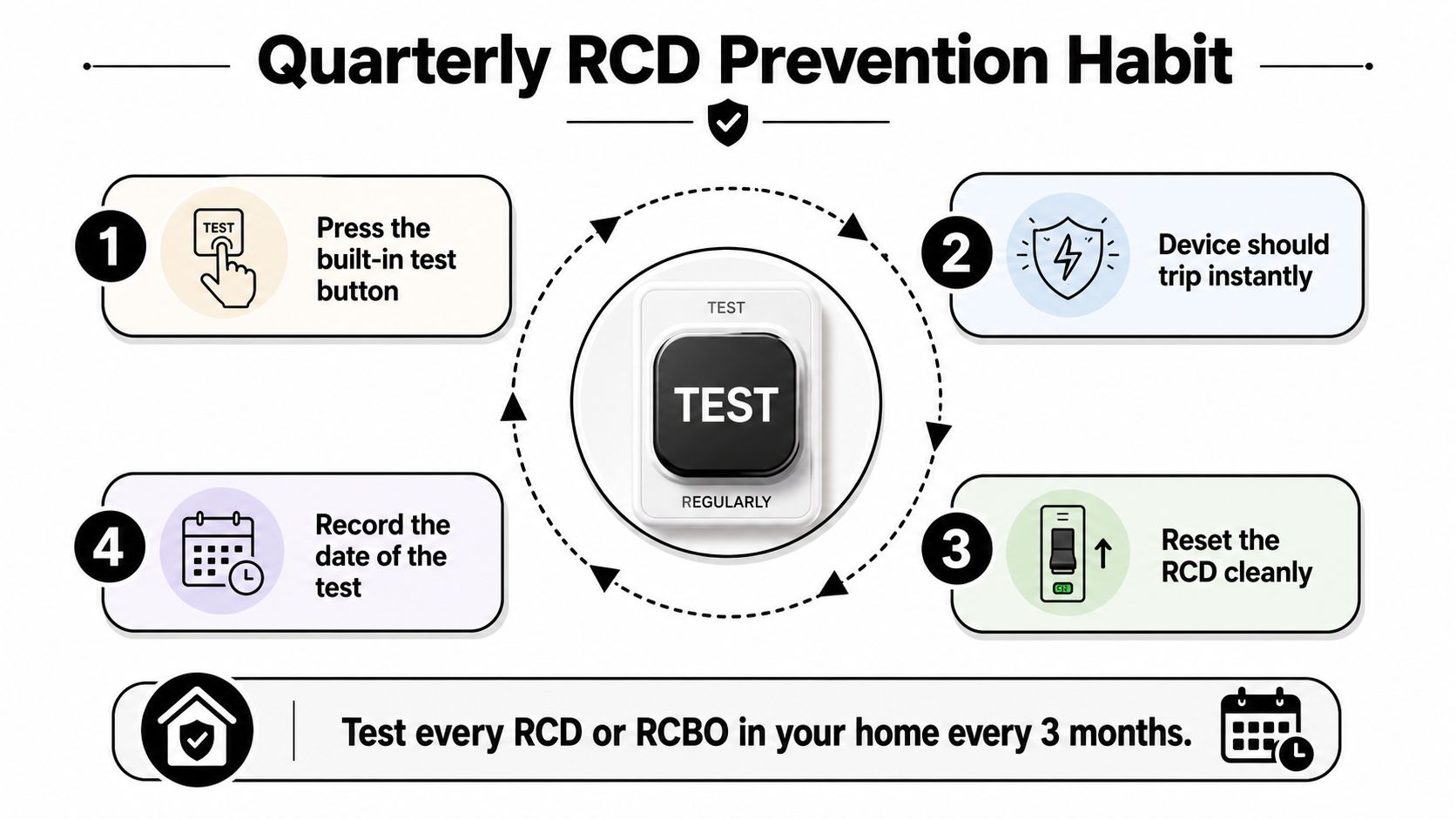
Prevention starts with a simple routine. Press the built-in test button on every RCD or RCBO every three months, as recommended in Australian residential safety guidance. The device should trip promptly and reset cleanly. If it hesitates, buzzes, won't reset, or fails to trip, stop treating it as dependable and arrange an inspection.
Brisbane's weather makes external equipment a regular part of fault diagnosis. Keep outdoor socket covers closed and replace cracked seals. Don't use damaged extension leads outside, and have pool pumps, garden lighting, external outlets, and hot-water equipment checked if trips follow wet conditions. A weatherproof cover can't compensate for damaged cable or water inside a fitting, so persistent weather-related trips need testing.
Daisy-chained powerboards make both loading and fault-finding harder. Spread equipment across suitable circuits where possible, unplug appliances that have already caused a trip, and don't leave a suspect charger, whitegood, pump, or heater connected just because it operates normally most of the time.
Keep the switchboard schedule accurate. Clear circuit labels help you isolate a problem quickly, particularly in a rental property or a home with outdoor circuits that aren't obvious from the room layout. A short log is useful too:
A switchboard with shared RCD protection can make a whole group of circuits go off and can allow leakage from several circuits to combine. After testing, an electrician may recommend individual RCBO protection, especially where the home has many electronic appliances, outdoor equipment, or altered older circuits. This isn't a shortcut around fault-finding. It's a circuit-design solution when the installation needs better separation and discrimination.
If your board contains ageing protective equipment, has unclear labels, or has been affected by renovation, flooding, or storm damage, book a switchboard assessment rather than waiting for another trip. The right repair may be modest, but the decision should come from measured results.
If your RCD keeps tripping, DLG Electrical can fault-find the affected circuit, test RCD operation, assess Type AC and Type A compatibility, and advise whether appliance repair, cable work, or RCBO re-segmentation is appropriate. Visit DLG Electrical to arrange practical Brisbane electrical help and request a quote.

Master Electrician with over 30 years of experience. Founded DLG Electrical in 2005 after international project work including electrical installations at Stamford Bridge Stadium, London(Home of Chelsea FC).

Local Electricians that can fix all Electric Hot water Systems.
Motion sensor lights are a versatile addition to any home, offering nu
